欢迎访问作物学报,今天是
作物学报 ›› 2023, Vol. 49 ›› Issue (11): 2935-2948.doi: 10.3724/SP.J.1006.2023.24276
赵宇晶1( ), 张滨烁1, 苏安玉2, 于振海1, 李佳欢1, 林洋1, 张艳婷1, 武小霞1,*(), 赵莹1,*()
ZHAO Yu-Jing1(), ZHANG Bin-Shuo1, SU An-Yu2, YU Zhen-Hai1, LI Jia-Huan1, LIN Yang1, ZHANG Yan-Ting1, WU Xiao-Xia1,*(), ZHAO Ying1,*()
摘要:
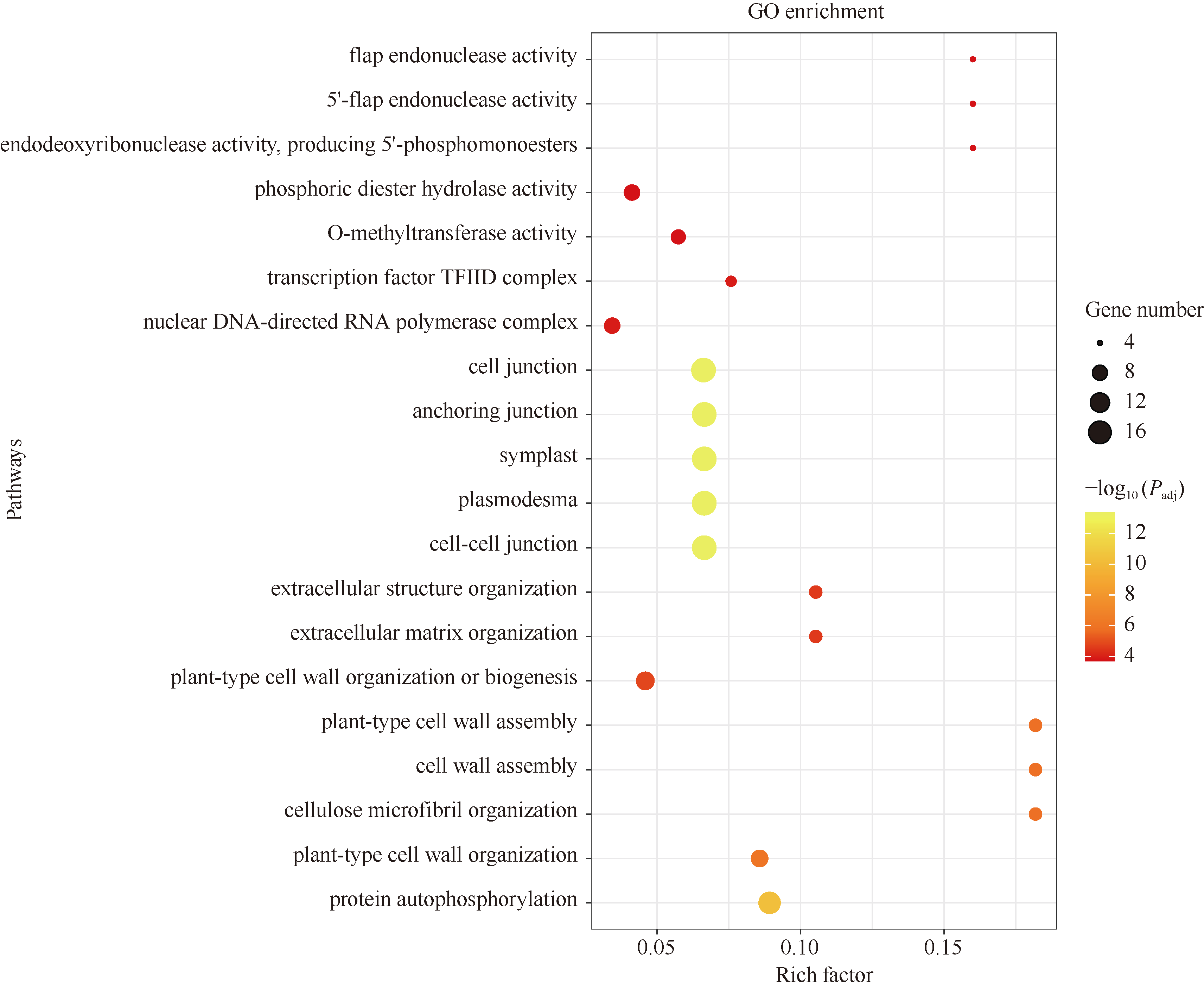
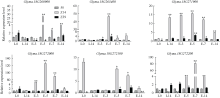
转基因生物育种技术可以定向改良大豆品种, 为大豆定向育种提供一种新思路。为寻找与大豆再生相关的基因, 探索大豆再生规律、提高遗传转化效率, 本研究利用再生能力强材料东农50、再生能力弱材料Keburi及其子代RIL群体的200份材料进行大豆器官发生试验, 比较不同基因型之间再生能力的差异, 筛选出极端材料各20份, 后通过BSA-seq (bulked segregant analysis sequencing)技术对大豆再生候选基因进行初步定位, 共获得88.04 G的clean data, 平均测序深度为20.03×, 定位到2 Mb区间, 利用GO等数据库对区间内基因进行富集分析, 差异表达基因主要富集在纤维素微纤维组织、植物型细胞壁组织或生物发生等20个条目中, 其中被显著富集的植物型细胞壁组织或生物发生条目中共有6个基因, 对6个基因进行组织表达量分析, 在丛生芽伸长期间表达水平较高, 说明其在大豆再生过程中发挥作用, 可能为影响大豆再生的关键基因。本研究为大豆再生机制研究提供了重要的候选基因信息与必要的材料基础。
| [1] |
Cheng T Y, Saka H, Voqui-dinh T H. Plant regeneration from soybean cotyledonary node segments in culture. Plant Sci Lett, 1980, 19: 91-99.
doi: 10.1016/0304-4211(80)90084-X |
| [2] |
Wright M S, Ward D V, Hinchee M A, Carnes M G, Kaufman R J. Regeneration of soybean (Glycine max L. Merr.) from cultured primary leaf tissue. Plant Cell Rep, 1987, 6: 83-89.
doi: 10.1007/BF00276659 pmid: 24248483 |
| [3] |
Barwale U B, Kerns H R, Widholm J M. Plant regeneration from callus cultures of several soybean genotypes via embryogenesis and organogenesis. Planta, 1986, 167: 473-481.
doi: 10.1007/BF00391223 pmid: 24240363 |
| [4] |
Kim J, Lamotte C E, Hack E. Plant regeneration in vitro from primary leaf nodes of soybean (Glycine max) seedlings. J Plant Physiol, 1990, 136: 664-669.
doi: 10.1016/S0176-1617(11)81341-6 |
| [5] | 武小霞, 孙晶, 苏安玉, 李静, 刘明, 张彬彬, 李冬梅, 李文滨. 大豆再生抑制消减杂交文库的构建. 东北农业大学学报, 2014, 45(7): 38-44. |
| Wu X X, Sun J, Su A Y, Li J, Liu M, Zhang B B, Li D M, Li W B. Soybean regeneration inhibits the construction of a subtractive hybrid library. J Northeast Agric Univ, 2014, 45(7): 38-44 (in Chinese with English abstract). | |
| [6] | Kartha K K, Pahl K P, Leung N L, Mroginski L A J B. Plant regeneration from meristems of grain legumes: soybean, cowpea, peanut, chickpea, and bean. Botany, 1981, 59: 1671-1679. |
| [7] |
Paz M M, Martinez J C, Kalvig A B, Fonger T M, Wang K. Improved cotyledonary node method using an alternative explant derived from mature seed for efficient Agrobacterium-mediated soybean transformation. Plant Cell Rep, 2006, 25: 206-213.
doi: 10.1007/s00299-005-0048-7 |
| [8] | 王怡婷, 赵莹, 李思琪, 于耸, 郑志民. 大豆U6启动子(YT9)在CRISPR/Cas9基因组编辑体系中的功能分析. 分子植物育种, 2023, 21: 1189-1195. |
| Wang Y T, Zhao Y, Li S Q, Yu S, Zheng Z M. Functional analysis of the soybean U6 promoter (YT9) in CRISPR/Cas9 genome editing systems. Mol Plant Breed, 2023, 21: 1189-1195 (in Chinese with English abstract). | |
| [9] | Li S, Cong Y, Liu Y, Wang T, Shuai Q, Chen N, Gai J, Li Y. Optimization of agrobacterium-mediated transformation in soybean. Front Plant Sci, 2017, 8: 246. |
| [10] |
Fletcher J C, Brand U, Running M P, Simon R, Meyerowitz E M. Signaling of cell fate decisions by CLAVATA3 in Arabidopsis shoot meristems. Science, 1999, 283: 1911-1914.
doi: 10.1126/science.283.5409.1911 pmid: 10082464 |
| [11] |
Long J A, Moan E I, Medford J I, Barton M K. A member of the KNOTTED class of homeodomain proteins encoded by the STM gene of Arabidopsis. Nature, 1996, 379: 66-69.
doi: 10.1038/379066a0 |
| [12] |
Endrizzi K, Moussian B, Haecker A, Levin J Z, Laux T. The SHOOT MERISTEMLESS gene is required for maintenance of undifferentiated cells in Arabidopsis shoot and floral meristems and acts at a different regulatory level than the meristem genes WUSCHEL and ZWILLE. Plant J, 1996, 10: 967-979.
doi: 10.1046/j.1365-313x.1996.10060967.x pmid: 9011081 |
| [13] |
Zuo J, Niu Q W, Frugis G, Chua N H. The WUSCHEL gene promotes vegetative-to-embryonic transition in Arabidopsis. Plant J, 2002, 30: 349-359.
doi: 10.1046/j.1365-313X.2002.01289.x |
| [14] |
Leibfried A, To J P, Busch W, Stehling S, Kehle A, Demar M, Kieber J J, Lohmann J U. WUSCHEL controls meristem function by direct regulation of cytokinin-inducible response regulators. Nature, 2005, 438: 1172-1175.
doi: 10.1038/nature04270 |
| [15] |
Mayer K F, Schoof H, Haecker A, Lenhard M, Jürgens G, Laux T. Role of WUSCHEL in regulating stem cell fate in the Arabidopsis shoot meristem. Cell, 1998, 95: 805-815.
doi: 10.1016/s0092-8674(00)81703-1 pmid: 9865698 |
| [16] |
Su Y H, Zhou C, Li Y J, Yu Y, Tang L P, Zhang W J, Yao W J, Huang R, Laux T, Zhang X S. Integration of pluripotency pathways regulates stem cell maintenance in the Arabidopsis shoot meristem. Proc Natl Acad Sci USA, 2020, 117: 22561-22571.
doi: 10.1073/pnas.2015248117 |
| [17] |
Matsuo N, Makino M, Banno H. Arabidopsis ENHANCER OF SHOOT REGENERATION (ESR)1 and ESR2 regulate in vitro shoot regeneration and their expressions are differentially regulated. Plant Sci, 2011, 181: 39-46.
doi: 10.1016/j.plantsci.2011.03.007 pmid: 21600396 |
| [18] | Banno H, Ikeda Y, Niu Q W, Chua N H. Overexpression of Arabidopsis ESR1 induces initiation of shoot regeneration. Plant Cell, 2001 13: 2609-2618. |
| [19] | 蔡英卿. 龙眼体胚发生过程中SERK等胚性相关基因的克隆与表达分析. 福建农林大学博士学位论文,福建福州, 2011. |
| Cai Y Q. Cloning and Expression Analysis of Embryonic Genes Such as SERK during Longan Embryogenesis. PhD Dissertation of Fujian Agriculture and Forestry University, Fuzhou, Fujian, China, 2011 (in Chinese with English abstract). | |
| [20] |
Lutz K A, Martin C, Khairzada S, Maliga P. Steroid-inducible BABY BOOM system for development of fertile Arabidopsis thaliana plants after prolonged tissue culture. Plant Cell Rep, 2015, 34: 1849-1856.
doi: 10.1007/s00299-015-1832-7 |
| [21] |
Horstman A, Li M, Heidmann I, Weemen M, Chen B, Muino J M, Angenent G C, Boutilier K. The BABY BOOM transcription factor activates the LEC1-ABI3-FUS3-LEC2 network to induce somatic embryogenesis. Plant Physiol, 2017, 175: 848-857.
doi: 10.1104/pp.17.00232 pmid: 28830937 |
| [22] |
Li S N, Cheng P, Bai Y Q, Shi Y, Yu J Y, Li R C, Zhou R N, Zhang Z G, Wu X X, Chen Q S. Analysis of soybean somatic embryogenesis using chromosome segment substitution lines and transcriptome sequencing. Genes (Basel), 2019, 10: 943.
doi: 10.3390/genes10110943 |
| [23] | 曾维英, 苏燕竹, 赖振光, 杨守臻, 陈怀珠, 谭玉荣, 孙祖东, 盖钧镒. 基于BSA-Seq技术鉴定大豆耐荫性状相关候选基因. 中国油料作物学报, 2021, 43: 1006-1015. |
| Zeng W Y, Su Y Z, Lai Z G, Yang S Z, Chen H Z, Tan Y R, Sun Z D, Gai J Y. Identification of candidate gene controlling shade- tolerant by BSA-Seq in soybean. Chin J Oil Crop Sci, 2021, 43: 1006-1015 (in Chinese with English abstract). | |
| [24] |
张之昊, 王俊, 刘章雄, 邱丽娟. 基于BSA-Seq技术挖掘大豆中黄622的多小叶基因. 作物学报, 2020, 46: 1839-1849.
doi: 10.3724/SP.J.1006.2020.04075 |
| Zhang Z H, Wang J, Liu Z X, Qiu L J. Mapping of an incomplete dominant gene controlling multifoliolate leaf by BSA-seq in soybean (Glycine max L.). Acta Agron Sin, 2020, 46: 1839-1849 (in Chinese with English abstract). | |
| [25] |
严昕, 项超, 刘荣, 李冠, 李孟伟, 李正丽, 宗绪晓, 杨涛. 基于BSA-seq技术对豌豆花色基因的精细定位. 作物学报, 2023, 49: 1006-1015.
doi: 10.3724/SP.J.1006.2023.24055 |
| Yan X, Xiang C, Liu R, Li G, Li M W, Li Z L, Zong X X, Yang T, Fine mapping of flower colour gene in pea (Pisum sativum L.) based on BSA-seq technique. Acta Agron Sin, 2023, 49: 1006-1015 (in Chinese with English abstract). | |
| [26] |
Zhong C, Sun S, Li Y, Duan C, Zhu Z. Next-generation sequencing to identify candidate genes and develop diagnostic markers for a novel Phytophthora resistance gene, RpsHC18, in soybean. Theor Appl Genet, 2018, 131: 525-538.
doi: 10.1007/s00122-017-3016-z pmid: 29138903 |
| [27] |
曾维英, 赖振光, 孙祖东, 杨守臻, 陈怀珠, 唐向民. 基于BSA-Seq和RNA-Seq方法鉴定大豆抗豆卷叶螟候选基因. 作物学报, 2021, 47: 1460-1471.
doi: 10.3724/SP.J.1006.2021.04195 |
| Zeng W Y, Lai Z G, Sun Z D, Yang S Z, Chen H Z, Tang X M. Identification of the candidate genes of soybean resistance to bean pyralid (Lamprosema indicata Fabricius) by BSA-Seq and RNA-Seq. Acta Agron Sin, 2021, 47: 1460-1471 (in Chinese with English abstract). | |
| [28] | 李毅丰. 番茄节间长度主效基因定位及候选基因生物信息学分析. 河北科技师范学院硕士学位论文,河北秦皇岛, 2022. |
| Li Y F. Mapping of Major Genes and Bioinformatics Analysis of Candidate Genes in Tomato Internode Length. MS Thesis of Hebei Normal University of Science & Technology, Qinhuangdao, Hebei, China, 2022 (in Chinese with English abstract). | |
| [29] | 蒋家焕, 朱永生, 陈丽萍, 郑燕梅, 蔡秋华, 谢华安, 王爱荣, 张建福. 利用BSA-Seq方法定位一个水稻早衰相关基因OsBRCA1. 福建农业学报, 2022, 37(2): 131-137. |
| Jiang J H, Zhu Y S, Chen L P, Zheng Y M, Cai Q H, Xie A H, Wang A R, Zhang J F. Mapping of early senescence-related OsBRCA1 in rice by BSA-seq technique. Fujian J Agric Sci, 2022, 37(2): 131-137 (in Chinese with English abstract). | |
| [30] | 王雪彬, 张健, 韦燕燕, 罗继景, 梁云涛, 蔡中全. 基于BSA-seq的水稻耐陈化QTL定位分析. 分子植物育种, 2021. 2021-11-05. https://kns.cnki.net/kcms/detail/46.1068.S.20211104.1822.015.html. |
| Wang X B, Zhang J, Wei Y Y, Luo J J, Liang Y T, Cai Z Q. QTLs Mapping on rice grain aging tolerance based on BSA-seq. Mol Plant Breed, 2021. 2021-11-05. https://kns.cnki.net/kcms/detail/46.1068.S.20211104.1822.015.html (in Chinese with English abstract). | |
| [31] | 周雨晴, 郭宇玲, 伊然, 陈壁融, 杨羽清, 潘玉朋. 基于BSA-Seq的黄瓜重要园艺性状遗传定位研究进展. 分子植物育种, 2022. 2022-07-05. https://kns.cnki.net/kcms/detail/46.1068.S.20220704.0904.002.html. |
| Zhou Y Q, Guo Y L, Yi R, Chen B R, Yang Y Q, Pan Y P. Research progress on genetic mapping of cucumber important horticultural traits based on BSA-Seq. Mol Plant Breed, 2022. 2022-07-05. https://kns.cnki.net/kcms/detail/46.1068.S.20220704.0904.002.html (in Chinese with English abstract). | |
| [32] |
Hill J T, Demarest B L, Bisgrove B W, Gorsi B, Su Y C, Yost H J. MMAPPR: mutation mapping analysis pipeline for pooled RNA-seq. Genome Res, 2013, 23: 687-697.
doi: 10.1101/gr.146936.112 pmid: 23299975 |
| [33] |
Livak K J, Schmittgen T D. Analysis of relative gene expression data using real-time quantitative PCR and the 2(-Delta Delta C(T)) method. Methods, 2001, 25: 402-408.
doi: 10.1006/meth.2001.1262 pmid: 11846609 |
| [34] | Omatsuda T, Ohyama K. Genotypes of high competence for somatic embryogenesis and plant regeneration in soybean Glycine max. Theor Appl Genet, 2004 75: 695-700. |
| [35] | 曹劲宏, 牟少萌, 何雪, 赵波, 杨凯, 李奕松, 李玮瑜, 万平. 不同基因型小豆胚尖再生能力筛选和培养条件优化. 分子植物育种, 2015, 13: 106-118. |
| Cao J H, Mou S M, He X, Zhao B, Yang K, Li Y S, Li W Y, Wan P. Screening on regeneration capacity of embryonic tip from different genotypes of adzuki bean (Vigna angularis) and optimizing on culture condition. Mol Plant Breed, 2015 13: 106-118 (in Chinese with English abstract). | |
| [36] | 武小霞, 李静, 姜成涛, 刘伟婷, 刘淼, 李文滨. 大豆子叶节再生中植物生长调节剂浓度及基因型筛选. 中国油料作物学报, 2011, 33: 123-129. |
| Wu X X, Li J, Jiang C T, Liu W T, Liu M, Li W B. Optimization of regeneration system from soybean cotyledonary node. Chin J Oil Crop Sci, 2011, 33: 123-129 (in Chinese with English abstract). | |
| [37] | 滕卫丽, 郑立娜, 张琦, 赵雪, 韩英鹏, 李文滨. 大豆再生相关性状QTL定位. 东北农业大学学报, 2021, 52(4): 1-10. |
| Teng W L, Zheng L N, Zhang Q, Zhao X, Han Y P, Li W B. QTL mapping of traits correlated with regeneration in soybean. J Northeast Agric Univ, 2021, 52(4): 1-10 (in Chinese with English abstract). | |
| [38] | 李换丽, 王丹, 张树伟, 雷佳, 吴霞, 王新胜, 马燕斌. 山西不同大豆品种再生体系的筛选. 山西农业科学, 2020, 48(2): 161-166. |
| Li H L, Wang D, Zhang S W, Lei J, Wu X, Wang X S, Ma Y B. Selection of soybean regeneration system with different verieties in Shanxi. J Shanxi Agric Sci, 2020, 48(2): 161-166 (in Chinese with English abstract). | |
| [39] |
Roudier F O, Fernandez A G, Fujita M, Himmelspach R, Borner G H H, Schindelman G, Song S, Baskin T I, Dupree P, Wasteneys G O, Benfey P N. COBRA, an Arabidopsis extracellular glycosyl-phosphatidyl inositol-anchored protein, specifically controls highly anisotropic expansion through its involvement in cellulose microfibril orientation. Plant Cell, 2005, 17: 1749-1763.
doi: 10.1105/tpc.105.031732 |
| [40] |
Ko J H, Kim J H, Jayanty S S, Howe G A, Han K H. Loss of function of COBRA, a determinant of oriented cell expansion, invokes cellular defence responses in Arabidopsis thaliana. J Exp Bot, 2006, 57: 2923-2936.
doi: 10.1093/jxb/erl052 |
| [41] |
Sindhu A, Langewisch T, Olek A, Multani D S, McCann M C, Vermerris W, Carpita N C, Johal G. Maize Brittle stalk2 encodes a COBRA-like protein expressed in early organ development but required for tissue flexibility at maturity. Plant Physiol, 2007, 145: 1444-1459.
doi: 10.1104/pp.107.102582 pmid: 17932309 |
| [42] |
Zhang W, Yan H, Chen W, Liu J, Jiang C, Jiang H, Zhu S, Cheng B. Genome-wide identification and characterization of maize expansin genes expressed in endosperm. Mol Genet Genomics, 2014, 289: 1061-1074.
doi: 10.1007/s00438-014-0867-8 pmid: 25213600 |
| [43] |
Marowa P, Ding A, Kong Y. Expansins: roles in plant growth and potential applications in crop improvement. Plant Cell Rep, 2016, 35: 949-965.
doi: 10.1007/s00299-016-1948-4 pmid: 26888755 |
| [44] |
Fleming A J, McQueen-mason S J, Mandel T, Kuhlemeier C J S. Induction of leaf primordia by the cell wall protein expansin. Science, 1997, 276: 1415-1418.
doi: 10.1126/science.276.5317.1415 |
| [45] |
Zavaliev R, Sagi G, Gera A, Epel B L. The constitutive expression of Arabidopsis plasmodesmal-associated class 1 reversibly glycosylated polypeptide impairs plant development and virus spread. J Exp Bot, 2009, 61: 131-142.
doi: 10.1093/jxb/erp301 |
| [46] |
Gallardo K, Le Signor C, Vandekerckhove J, Thompson R D, Burstin J. Proteomics of Medicago truncatula seed development establishes the time frame of diverse metabolic processes related to reserve accumulation. Plant Physiol, 2003, 133: 664-682.
pmid: 12972662 |
| [47] |
Sumiyoshi M, Inamura T, Nakamura A, Aohara T, Ishii T, Satoh S, Iwai H. UDP-arabinopyranose mutase 3 is required for pollen wall morphogenesis in rice (Oryza sativa). Plant Cell Physiol, 2014, 56: 232-241.
doi: 10.1093/pcp/pcu132 |
| [1] | 金昱何, 王雪菲, 徐张一娃, 缪怡宁, 蒋云杰, 伊莹, 缪德麟, 朱静仪, 钟一帆, 陈铭亨, 方芳, 刘鹏. 外源激素对低温胁迫下大豆叶片叶绿素荧光参数及抗氧化酶系统的影响[J]. 作物学报, 2026, 52(6): 1817-1829. |
| [2] | 唐宽强, 李公允, 宋美毅, 赵雪, 常春玲. 大豆株高性状全基因组关联分析及预测模型构建[J]. 作物学报, 2026, 52(6): 1743-1756. |
| [3] | 谷春苗, 王润风, 黄璐, 刘浩, 鲁清, 李海芬, 李少雄, 何双呈, 洪彦彬, 陈小平, 谭斌, 余倩霞. 花生WOX基因家族的全基因组分析及不定芽再生候选基因的鉴定[J]. 作物学报, 2026, 52(5): 1326-1340. |
| [4] | 姚术, 郭凯悦, 翟慧慧, 姚佳慧, 邓文琪, 闫玲, 黄驰, 高阳, 俞嫣然, 赵振邦, 李英慧, 王晓波, 李佳佳. 大豆苗期耐低铁综合评价及优异种质筛选[J]. 作物学报, 2026, 52(5): 1373-1387. |
| [5] | 张超, 郭欢, 李忠玲, 岳淑宁, 赵娜. 基于BSA-seq技术定位玉米籽粒花青素关联基因[J]. 作物学报, 2026, 52(3): 780-789. |
| [6] | 张晴, 杨昱, 郭茜, 岳霈尧, 殷丛丛, 牛景萍, 赵晋忠, 杜维俊, 岳爱琴. 大豆GmARA6a的克隆及响应盐胁迫的功能分析[J]. 作物学报, 2026, 52(2): 480-493. |
| [7] | 朱金娟, 王慧萍, 杨国栋, 王宇诚, 杨晨, 王斌, Agustiani Nurwulan, 涂军明, 毕俊国, 崔克辉, 黄见良, 彭少兵, 袁珅. 水分管理和品种类型对再生稻产量和稻米品质的影响[J]. 作物学报, 2026, 52(1): 295-315. |
| [8] | 贾小霞, 齐恩芳, 文国宏, 马胜, 黄伟, 吕和平, 李建武, 曲亚英, 丁宁. 中早熟马铃薯‘陇薯20号’高效再生体系建立及抗草铵膦种质创制[J]. 作物学报, 2025, 51(9): 2285-2294. |
| [9] | 贺红利, 张雨涵, 杨静, 程云清, 赵杨, 李星诺, 司洪亮, 张兴政, 杨向东. 大豆e1-as基因突变体的创制及生理分析[J]. 作物学报, 2025, 51(8): 2228-2239. |
| [10] | 王克晶, 李向华. 我国珍稀的大豆属多年生烟豆和短绒野大豆物种遗传资源濒危性评估分析[J]. 作物学报, 2025, 51(8): 2009-2019. |
| [11] | 孟然, 李赵嘉, 冯薇, 陈悦, 刘路平, 杨春燕, 鲁雪林, 王秀萍. 大豆不同生育时期耐盐性综合评价及耐盐种质筛选[J]. 作物学报, 2025, 51(8): 1991-2008. |
| [12] | 胡蒙, 沙丹, 张晟瑞, 谷勇哲, 张世碧, 李静, 孙君明, 邱丽娟, 李斌. 大豆分枝数QTL定位及候选基因筛选[J]. 作物学报, 2025, 51(7): 1747-1756. |
| [13] | 邵顺伟, 陈卓, 兰振东, 蔡兴奎, 邹华芬, 李晨曦, 唐景华, 朱熙, 张彧, 董建科, 金辉, 宋波涛. 基于BSA-seq技术的块茎芽眼深度QTL定位分析[J]. 作物学报, 2025, 51(7): 1725-1735. |
| [14] | 王琼, 邹丹霞, 陈兴运, 张威, 张红梅, 刘晓庆, 贾倩茹, 魏利斌, 崔晓艳, 陈新, 王学军, 陈华涛. 大豆开花时间和成熟期性状全基因组关联分析与候选基因预测[J]. 作物学报, 2025, 51(6): 1558-1568. |
| [15] | 殷丛丛, 李睿琦, 岳霈尧, 李晨, 牛景萍, 赵晋忠, 杜维俊, 岳爱琴. 基于闭合哑铃介导等温扩增可视化检测大豆花叶病毒SC15方法的建立及应用[J]. 作物学报, 2025, 51(5): 1248-1260. |
|
||