欢迎访问作物学报,今天是
作物学报 ›› 2026, Vol. 52 ›› Issue (10): 2898-2911.doi: 10.3724/SP.J.1006.2026.63030
杨文妍1,2( ), 渠建洲1, 刘耕瑜1, 卢誉1, 刘健茁1, 张红伟2, 杜万里1,*()
Yang Wen-Yan1,2(), Qu Jian-Zhou1, Liu Geng-Yu1, Lu Yu1, Liu Jian-Zhuo1, Zhang Hong-Wei2, Du Wan-Li1,*()
摘要:
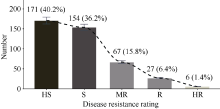
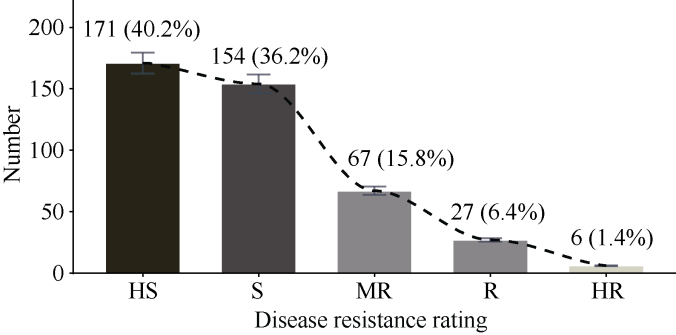
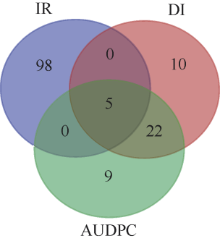
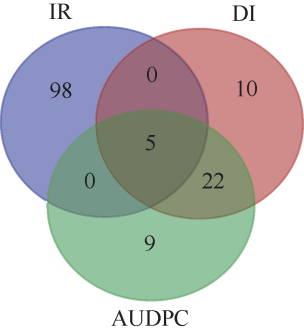
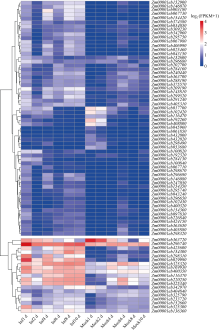
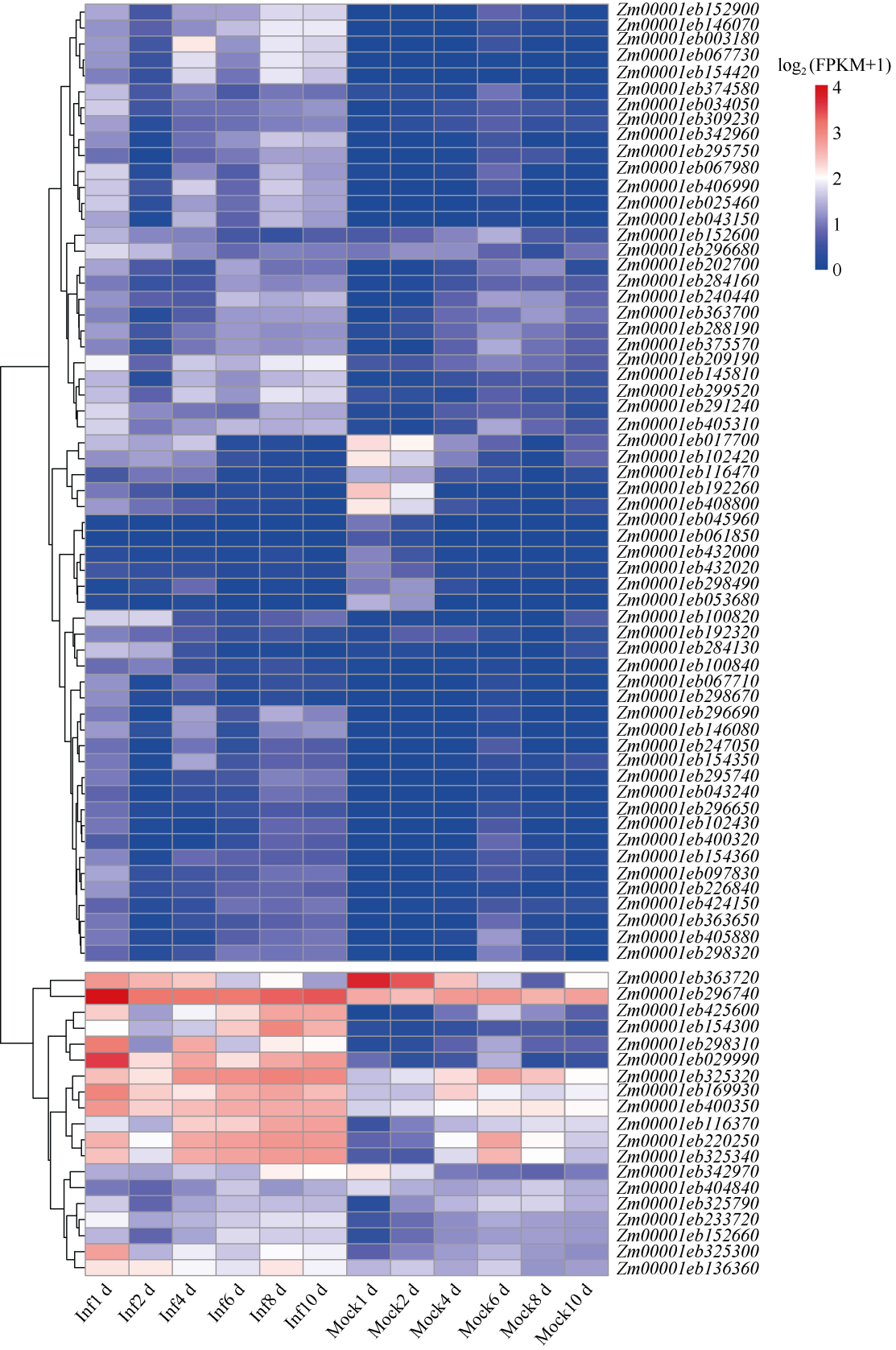
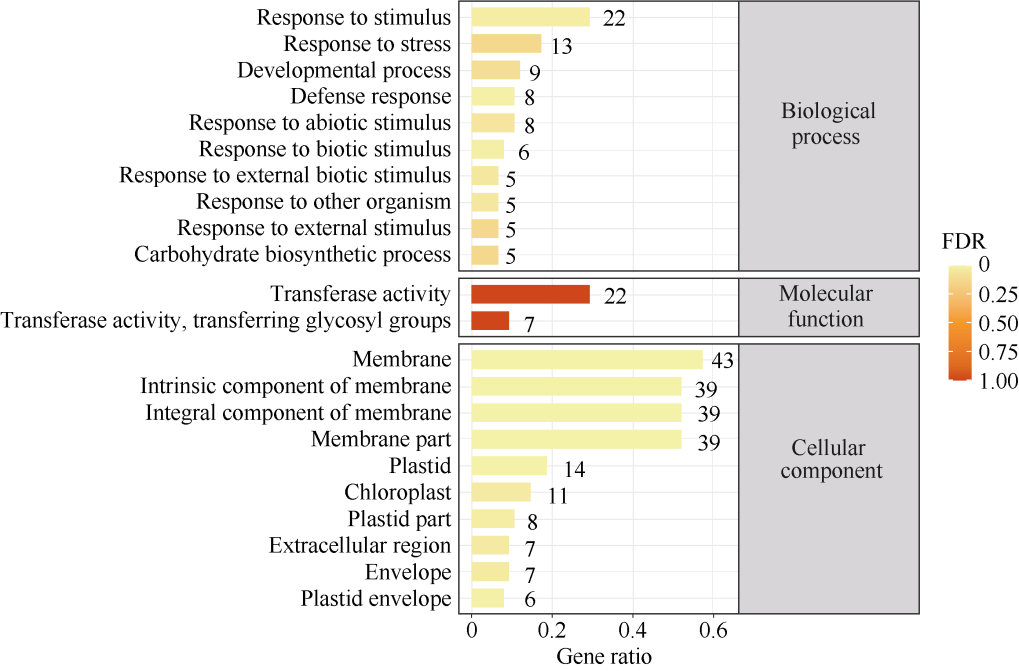
玉米瘤黑粉病是由玉蜀黍黑粉菌(Ustilago maydis)引起的世界性病害, 严重威胁玉米产量与品质, 培育抗病品种是防控该病害最经济有效的策略。为鉴定抗瘤黑粉病优异种质, 挖掘抗病关键基因, 本研究系统评价了425份玉米自交系的抗性水平, 旨在解析抗性遗传基础, 筛选抗病基因。分别于2年2点开展田间人工接种鉴定, 基于病情指数(DI)、发病率(IR)和病程曲线下面积(AUDPC)进行抗性评价。利用970,761个高质量SNP进行全基因组关联分析(GWAS), 结合时空转录组数据, 筛选抗病相关候选基因并进行功能富集分析。425份自交系中鉴定出高抗6份、抗病27份、中抗67份、感病154份、高感171份。DI、IR和AUDPC的广义遗传力均高于75%。GWAS共检测到1665个显著关联SNP位点, 筛选出376个候选基因, 其中, 79个响应病原菌侵染差异表达, 19个显著上调。GO富集分析表明, 筛选到的候选基因主要参与防御反应、细胞壁组织、激素信号传导等过程。本研究明确了玉米瘤黑粉病抗性具有遗传力高、受多基因控制的特点, 鉴定的抗病关联位点及候选基因, 为玉米抗瘤黑粉病分子育种提供重要种质资源和基因靶点。
| [1] |
Martínez-Espinoza A D, Garcı́a-Pedrajas M D, Gold S E. The ustilaginales as plant pests and model systems. Fungal Genet Biol, 2002, 35: 1-20.
pmid: 11860261 |
| [2] |
Zuo W L, Ökmen B, Depotter J R L, et al. Molecular interactions between smut fungi and their host plants. Annu Rev Phytopathol, 2019, 57: 411-430.
doi: 10.1146/annurev-phyto-082718-100139 pmid: 31337276 |
| [3] | 张文洁. 瘤黑粉菌侵染玉米的组织细胞学差异及自交系抗性鉴定. 沈阳农业大学硕士学位论文, 辽宁沈阳, 2020. |
| Zhang W J. Histological and Cytological Differences of Infection by Ustilago Maydis and Identification of inbred Lines. MS Thesis of Shenyang Agricultural University, Shenyang, Liaoning, China, 2020 (in Chinese with English abstract). | |
| [4] |
李翔宇, 刘健茁, 胡丹丹, 等. 玉米种质资源对瘤黑粉病的抗性评价及生理差异分析. 中国农业科学, 2025, 58: 2504-2521.
doi: 10.3864/j.issn.0578-1752.2025.13.002 |
|
Li X Y, Liu J Z, Hu D D, et al. Characterization of maize germplasm resistance to common smut and analysis of physiological differences. Sci Agric Sin, 2025, 58: 2504-2521 (in Chinese with English abstract).
doi: 10.3864/j.issn.0578-1752.2025.13.002 |
|
| [5] | 王铁兵, 王鹏, 蒋建军, 等. 玉米自交系对瘤黑粉病抗性鉴定及遗传多样性分析. 西北农业学报, 2020, 29: 1729-1740. |
| Wang T B, Wang P, Jiang J J, et al. Identification and genetic analysis of maize inbred lines resistant to Ustilago maydis. Acta Agric Boreali-Occidentalis Sin, 2020, 29: 1729-1740 (in Chinese with English abstract). | |
| [6] |
Xu S H, Tang X, Zhang X M, et al. Genome-wide association study identifies novel candidate loci or genes affecting stalk strength in maize. Crop J, 2023, 11: 220-227.
doi: 10.1016/j.cj.2022.04.016 |
| [7] |
Li L Z, Jiang F Y, Bi Y Q, et al. Dissection of common rust resistance in tropical maize multiparent population through GWAS and linkage studies. Plants, 2024, 13: 1410.
doi: 10.3390/plants13101410 |
| [8] |
Baumgarten A M, Suresh J, May G, et al. Mapping QTLs contributing to Ustilago maydis resistance in specific plant tissues of maize. Theor Appl Genet, 2007, 114: 1229-1238.
doi: 10.1007/s00122-007-0513-5 pmid: 17468806 |
| [9] |
Zhang Y T, Zhang H, Zhao H, et al. Multi-omics analysis dissects the genetic architecture of seed coat content in Brassica napus. Genome Biol, 2022, 23: 86.
doi: 10.1186/s13059-022-02647-5 |
| [10] |
Tian F, Bradbury P J, Brown P J, et al. Genome-wide association study of leaf architecture in the maize nested association mapping population. Nat Genet, 2011, 43: 159-162.
doi: 10.1038/ng.746 pmid: 21217756 |
| [11] |
Li H, Peng Z Y, Yang X H, et al. Genome-wide association study dissects the genetic architecture of oil biosynthesis in maize kernels. Nat Genet, 2013, 45: 43-50.
doi: 10.1038/ng.2484 pmid: 23242369 |
| [12] |
Li N, Lin B, Wang H, et al. Natural variation in ZmFBL41 confers banded leaf and sheath blight resistance in maize. Nat Genet, 2019, 51: 1540-1548.
doi: 10.1038/s41588-019-0503-y |
| [13] | Qiu Y T, Adhikari P, Balint-Kurti P, et al. Identification of loci conferring resistance to 4 foliar diseases of maize. G3: Gene Genom Genet, 2024, 14: jkad275. |
| [14] | Doehlemann G, Wahl R, Horst R J, et al. Reprogramming a maize plant: transcriptional and metabolic changes induced by the fungal biotroph Ustilago maydis. Plant J, 2008, 56: 181-195. |
| [15] |
Redkar A, Hoser R, Schilling L, et al. A secreted effector protein of Ustilago maydis guides maize leaf cells to form tumors. Plant Cell, 2015, 27: 1332-1351.
doi: 10.1105/tpc.114.131086 |
| [16] |
Chen J S, Sun M, Xiao G S, et al. Starving the enemy: how plant and microbe compete for sugar on the border. Front Plant Sci, 2023, 14: 1230254.
doi: 10.3389/fpls.2023.1230254 |
| [17] |
Doehlemann G, Requena N, Schaefer P, et al. Reprogramming of plant cells by filamentous plant-colonizing microbes. New Phytol, 2014, 204: 803-814.
pmid: 25539003 |
| [18] |
Pérez-Martín J, Castillo-Lluva S, Sgarlata C, et al. Pathocycles: Ustilago maydis as a model to study the relationships between cell cycle and virulence in pathogenic fungi. Mol Genet Genom, 2006, 276: 211-229.
doi: 10.1007/s00438-006-0152-6 |
| [19] |
Djamei A, Schipper K, Rabe F, et al. Metabolic priming by a secreted fungal effector. Nature, 2011, 478: 395-398.
doi: 10.1038/nature10454 |
| [20] | Nawaz H, Irum A, Nasim W, et al. Hormonal cross-talk mechanisms and plant immunity or defense:an overview. Hormonal Cross-Talk, Plant Defense and Development, Amsterdam: Elsevier, 2023. pp1-12. |
| [21] |
Schurack S, Depotter J R L, Gupta D, et al. Comparative transcriptome profiling identifies maize line specificity of fungal effectors in the maize-Ustilago maydis interaction. Plant J, 2021, 106: 733-752.
doi: 10.1111/tpj.v106.3 |
| [22] | 农业农村部. 中华人民共和国农业行业标准. 玉米抗病虫性鉴定技术规范第12部分: 瘤黑粉病: NY/T 1248.12-2016. |
| Ministry of Agriculture and Rural Affairs. Agricultural Industry Standard of the People’s Republic of China. Technical Specification for Identifying Resistance to Diseases and Insect Pests in Maize-Part 12: Common Smut: NY/T 1248.12-2016 (in Chinese). | |
| [23] | Redkar A, Doehlemann G. EdU based DNA synthesis and cell proliferation assay in maize infected by the smut fungus Ustilago maydis. Bio Protoc, 2016, 6: e1761. |
| [24] | 严理, 李智敏, 陈佳, 等. 不同玉米品种对瘤黑粉病抗性的初步鉴定. 湖南农业大学学报(自然科学版), 2017, 43(1): 42-46. |
| Yan L, Li Z M, Chen J, et al. Primary identification of resistance in different maize varieties to Ustilago maydis. J Hunan Agric Univ (Nat Sci), 2017, 43(1): 42-46 (in Chinese with English abstract). | |
| [25] |
Li X R, Guo T T, Wang J Y, et al. An integrated framework reinstating the environmental dimension for GWAS and genomic selection in crops. Mol Plant, 2021, 14: 874-887.
doi: 10.1016/j.molp.2021.03.010 pmid: 33713844 |
| [26] |
Liu H J, Luo X, Niu L Y, et al. Distant eQTLs and non-coding sequences play critical roles in regulating gene expression and quantitative trait variation in maize. Mol Plant, 2017, 10: 414-426.
doi: S1674-2052(16)30129-0 pmid: 27381443 |
| [27] |
Wang J Y, Zhao W Q, Chang F G, et al. Genetic analysis and identification of the candidate genes of maize resistance to Ustilago maydis by BSA-Seq and RNA-Seq. BMC Plant Biol, 2025, 25: 831.
doi: 10.1186/s12870-025-06842-x |
| [28] |
Wang M, Yan J B, Zhao J R, et al. Genome-wide association study (GWAS) of resistance to head smut in maize. Plant Sci, 2012, 196: 125-131.
doi: 10.1016/j.plantsci.2012.08.004 pmid: 23017907 |
| [29] |
Yu K C, Wang H, Liu X G, et al. Large-scale analysis of combining ability and heterosis for development of hybrid maize breeding strategies using diverse germplasm resources. Front Plant Sci, 2020, 11: 660.
doi: 10.3389/fpls.2020.00660 pmid: 32547580 |
| [30] | Kahmann R, Steinberg G, Basse C, et al. Ustilago maydis, the causative agent of corn smut disease. In: FungalPathology. Dordrecht: Springer Netherlands, 2000. pp 347-371. |
| [31] | Doehlemann G, Wahl R, Vranes M, et al. Establishment of compatibility in the Ustilago maydis/maize pathosystem. J Plant Physiol, 2008, 165: 29-40. |
| [32] |
Steinberg G, Perez-Martin J. Ustilago maydis, a new fungal model system for cell biology. Trends Cell Biol, 2008, 18: 61-67.
doi: 10.1016/j.tcb.2007.11.008 pmid: 18243705 |
| [33] |
Yang P, Praz C, Li B B, et al. Fungal resistance mediated by maize wall-associated kinase ZmWAK-RLK1 correlates with reduced benzoxazinoid content. New Phytol, 2019, 221: 976-987.
doi: 10.1111/nph.15419 pmid: 30178602 |
| [34] |
Yue R Q, Sun Q, Ding J G, et al. Functional analysis revealed the involvement of ZmABCB15 in resistance to rice black-streaked dwarf virus infection. BMC Plant Biol, 2022, 22: 484.
doi: 10.1186/s12870-022-03861-w |
| [35] |
López-Coria M, Guzmán-Chávez F, Carvente-García R, et al. Maize plant expresses SWEET transporters differently when interacting with Trichoderma asperellum and Fusarium verticillioides, two fungi with different lifestyles. Front Plant Sci, 2023, 14: 1253741.
doi: 10.3389/fpls.2023.1253741 |
| [36] |
Ma Y X, Zhou Z J, Cao H Z, et al. Identification and expression analysis of sugar transporter family genes reveal the role of ZmSTP2 and ZmSTP20 in maize disease resistance. J Integr Agric, 2023, 22: 3458-3473.
doi: 10.1016/j.jia.2022.12.014 |
| [1] | 张舒钰, 马璐, 马亮, 朱宏, 章慧敏, 宋旭东, 周广飞, 冒宇翔, 陆虎华, 陈国清, 郝德荣, 张振良. 基于近红外光谱和基因组信息的糯玉米赖氨酸含量精准估计[J]. 作物学报, 2026, 52(9): 2822-2838. |
| [2] | 黄迎, 刘沛琦, 解森, 许洛, 任元, 刘旭洋, 何冠华, 李永祥, 王天宇, 黎裕, 周涛, 廖江林, 李春辉, 张登峰. 玉米氮利用效率全基因组关联分析及候选基因挖掘[J]. 作物学报, 2026, 52(9): 2558-2572. |
| [3] | 崔雯杰, 闫喆林, 任强, 樊志龙, 殷文, 孙亚丽, 范虹, 何蔚, 王凤, 胡发龙, 柴强. 氮肥后移提高麦玉间作系统玉米产量的光合生理机制[J]. 作物学报, 2026, 52(9): 2700-2712. |
| [4] | 张为为, 任姣姣, 魏略, 吴若彤, 陶庭余, 吴传鹏, 阿布力克木·阿布力米提, 徐晓明, 吴鹏昊. 干旱胁迫下玉米雄穗结构性状的GWAS及全基因组选择[J]. 作物学报, 2026, 52(9): 2641-2659. |
| [5] | 张芮嘉, 吕建禹, 高源, 王浩宇, 王宇琦, 姜佳宁, 赵健雄, 王雪贺缘, 贺琳. 玉米ZmDREB53转录因子通过清除活性氧正调控植物的耐盐性[J]. 作物学报, 2026, 52(9): 2660-2670. |
| [6] | 李宗, 叶荣柒, 孙会军, 郭威宏, 罗子恒, 刘硕, 任永峰, 张雯, 宫香伟, 姜英. 间作绿肥对东北春玉米产量及农田土壤质量的影响[J]. 作物学报, 2026, 52(9): 2775-2791. |
| [7] | 王嘉豪, 王小玲, 范震, 郭光旭, 冯文静, 张新博, 罗璇, 任小龙, 陈小莉. 液态地膜与微垄沟种植集成对旱区夏玉米光能利用及产量的提升效应[J]. 作物学报, 2026, 52(9): 2713-2724. |
| [8] | 王恩赐, 宋利, 张等龙, 张龙, 邓巧珍, 郭晓霞, 刘广周, 杨云山, 胡单, 王福录, 陈核心, 张伟, 刘敦一, 刘彬, 李勇, 刘万茂, 明博, 陈新平, 李少昆, 张福锁, 侯鹏. 我国玉米绿色高产纪录田群体与水肥利用特征[J]. 作物学报, 2026, 52(9): 2691-2699. |
| [9] | 张瑞连, 商晓敏, 李婧, 董开林, 谢玉勤, 刘阳, 俞书琴, 曹梦圆, 李文阳. 不同时期高温胁迫对玉米籽粒产量与淀粉理化特性的影响[J]. 作物学报, 2026, 52(8): 2424-2437. |
| [10] | 秦纪辰, 张蔚, 王川, 兰宏亮, 土旦次仁, 王晔, 段留生. 冠菌素引发对玉米种子萌发期耐盐性的影响[J]. 作物学报, 2026, 52(8): 2454-2465. |
| [11] | 刘淳, 许忆葳, 张莹莹, 李瑞, 燕永亮, 邹华文, 王逸茹, 郑军. 耐辐射异常球菌drfE基因提高玉米的耐旱性[J]. 作物学报, 2026, 52(8): 2257-2267. |
| [12] | 黄亚丽, 于爱忠, 姜科强, 蔡宏玮, 王鹏飞, 王玉珑, 尚永盼, 霍建喆, 庞小能. 有机肥不同比例替代化肥对甜玉米田土壤N2O排放及产量的影响[J]. 作物学报, 2026, 52(8): 2396-2409. |
| [13] | 刘奕, 高尚, 闫振华, 梁晨, 吴丽倩, 余海兵, 王克如, 明博, 谢瑞芝, 李少昆. 尿素硝酸铵溶液与分次运筹协同优化密植精准调控夏玉米产量及氮素利用效率[J]. 作物学报, 2026, 52(8): 2496-2508. |
| [14] | 张国超, 王昀杰, 常巧玲, 侯思宇, 樊志龙, 殷文, 胡发龙, 柴强. 绿洲灌区间作绿肥和灌水量对玉米耗水特性及水分生产效率的影响[J]. 作物学报, 2026, 52(7): 2180-2192. |
| [15] | 黄焰新, 闫旭宇, 曹艳, 卫怡涵, 张佳宁, 汪奕彤, 李玲. 外源钙协同褪黑素缓解棉花幼苗镉胁迫的生理效应及转录代谢调控分析[J]. 作物学报, 2026, 52(7): 2159-2179. |
|
||