欢迎访问作物学报,今天是
作物学报 ›› 2026, Vol. 52 ›› Issue (10): 2841-2850.doi: 10.3724/SP.J.1006.2026.63038
• 综述 • 下一篇
吕雅荃( ), 谢传晓(), 刘昌林()
Lyu Ya-Quan(), Xie Chuan-Xiao(), Liu Chang-Lin()
摘要:
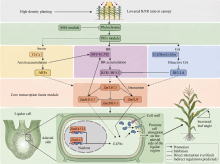
密植栽培是提升我国玉米单产潜力与保障国家粮食安全的核心战略, 而传统平展型玉米品种在高密度种植条件下容易造成冠层郁闭、光合效率下降、倒伏风险增加等问题, 成为制约密植增产的限制因素。叶夹角作为调控冠层构型、优化群体光分布、提升光能利用效率并增强抗倒伏能力的关键农艺性状, 已成为现代紧凑型玉米分子育种的核心靶标。近年来, 随着玉米功能基因组学研究的深入, ZmTAC1、ZmRAVL1、ZmILI1等调控叶夹角的关键基因相继被克隆, 其分子调控机制逐步阐明, 以CRISPR/Cas9为核心的基因编辑技术, 凭借精准高效、多位点同步修饰、无连锁累赘等优势, 为定向改良叶夹角、快速创制紧凑新种质提供了技术支撑。本文系统梳理了玉米叶夹角的遗传基础与分子调控网络, 重点阐述了关键调控基因的功能, 总结了单基因编辑及多位点协同编辑在紧凑种质创制中的应用进展与现存问题, 并对该领域的发展前景进行了展望, 以期为我国玉米紧凑型新品种的分子设计育种提供参考。
| [1] | 国家统计局. 中华人民共和国2025年国民经济和社会发展统计公报. [2026-02-28]. http://www.stats.gov.cn/sj/zxfb/202602/t20260228_1962662.html. |
| National Bureau of Statistics of China. Statistical communiqué on national economic and social development of people’s republic of China (PRC) in 2025. [2026-02-28]. http://www.stats.gov.cn/sj/zxfb/202602/t20260228_1962662.html (in Chinese). | |
| [2] |
Lei R Q, Wang Y, Zhou J M, et al. Tap maize yield productivity in China: a meta-analysis of agronomic measures and planting density optimization. Agronomy, 2025, 15: 861.
doi: 10.3390/agronomy15040861 |
| [3] |
Luo N, Meng Q F, Feng P Y, et al. China can be self-sufficient in maize production by 2030 with optimal crop management. Nat Commun, 2023, 14: 2637.
doi: 10.1038/s41467-023-38355-2 |
| [4] |
Zhang M M, Zhao X R, Han X Q, et al. Optimizing planting density for enhanced maize yield and resource use efficiency in China. A meta-analysis. Agron Sustain Dev, 2025, 45: 29.
doi: 10.1007/s13593-025-01027-0 |
| [5] |
Yan Y Y, Duan F Y, Li X, et al. Photosynthetic capacity and assimilate transport of the lower canopy influence maize yield under high planting density. Plant Physiol, 2024, 195: 2652-2667.
doi: 10.1093/plphys/kiae204 pmid: 38590166 |
| [6] |
Tian J G, Wang C L, Chen F Y, et al. Maize smart-canopy architecture enhances yield at high densities. Nature, 2024, 632: 576-584.
doi: 10.1038/s41586-024-07669-6 |
| [7] |
Strable J, Aragón-Raygoza A. Development and maintenance of the ligular region of maize leaves. Mol Plant, 2024, 17: 1175-1177.
doi: 10.1016/j.molp.2024.07.004 |
| [8] |
Liu G Z, Yang H S, Xie R Z, et al. Genetic gains in maize yield and related traits for high-yielding cultivars released during 1980s to 2010s in China. Field Crops Res, 2021, 270: 108223.
doi: 10.1016/j.fcr.2021.108223 |
| [9] | Jiang Q Y, Wang Y J. Leaf angle regulation toward a maize smart canopy. Plant J, 2025, 121: e17208. |
| [10] |
Gao H R, Gadlage M J, Lafitte H R, et al. Superior field performance of waxy corn engineered using CRISPR-Cas9. Nat Biotechnol, 2020, 38: 579-581.
doi: 10.1038/s41587-020-0444-0 pmid: 32152597 |
| [11] |
Duan H Y, Li J X, Sun Y, et al. Candidate loci for leaf angle in maize revealed by a combination of genome-wide association study and meta-analysis. Front Genet, 2022, 13: 1004211.
doi: 10.3389/fgene.2022.1004211 |
| [12] |
Tang D G, Chen Z J, Ni J X, et al. Identification of QTL for leaf angle at canopy-wide levels in maize. Euphytica, 2021, 217: 75.
doi: 10.1007/s10681-021-02781-4 |
| [13] | Dzievit M J, Li X R, Yu J M. Genetic mapping of dynamic control of leaf angle across multiple canopy levels in maize. Plant Genome, 2024, 17: e20423. |
| [14] |
Peng B, Zhao X L, Wang Y, et al. Genome-wide association studies of leaf angle in maize. Mol Breed, 2021, 41: 50.
doi: 10.1007/s11032-021-01241-0 |
| [15] |
孙娇, 赵美爱, 潘顺祥, 等. 玉米叶夹角的全基因组关联分析. 华北农学报, 2018, 33(1): 60-64.
doi: 10.7668/hbnxb.2018.01.010 |
| Sun J, Zhao M A, Pan S X, et al. Correlation analysis of maize leaf angle with genome-wide association analysis. Acta Agric Boreali Sin, 2018, 33(1): 60-64 (in Chinese with English abstract). | |
| [16] |
秦文萱, 鲍建喜, 王彦博, 等. 玉米叶夹角性状的全基因组关联分析与关键位点优异等位变异挖掘. 作物学报, 2022, 48: 2691-2709.
doi: 10.3724/SP.J.1006.2022.23019 |
|
Qin W X, Bao J X, Wang Y B, et al. Genome-wide association study of leaf angle traits and mining of elite alleles from the major loci in maize. Acta Agron Sin, 2022, 48: 2691-2709 (in Chinese with English abstract).
doi: 10.3724/SP.J.1006.2022.23019 |
|
| [17] |
Wang B B, Lin Z C, Li X, et al. Genome-wide selection and genetic improvement during modern maize breeding. Nat Genet, 2020, 52: 565-571.
doi: 10.1038/s41588-020-0616-3 pmid: 32341525 |
| [18] |
Tian F, Bradbury P J, Brown P J, et al. Genome-wide association study of leaf architecture in the maize nested association mapping population. Nat Genet, 2011, 43: 159-162.
doi: 10.1038/ng.746 pmid: 21217756 |
| [19] |
Qin L, Wu X T, Zhao H. Molecular and functional dissection of LIGULELESS1 (LG1) in plants. Front Plant Sci, 2023, 14: 1190004.
doi: 10.3389/fpls.2023.1190004 |
| [20] |
Walsh J, Waters C A, Freeling M. The maize gene liguleless2 encodes a basic leucine zipper protein involved in the establishment of the leaf blade-sheath boundary. Genes Dev, 1998, 12: 208-218.
doi: 10.1101/gad.12.2.208 |
| [21] | Bauer P, Lubkowitz M, Tyers R, et al. Regulation and a conserved intron sequence of liguleless3/4 knox class-I homeobox genes in grasses. Planta, 2004, 219: 359-368. |
| [22] |
Muehlbauer G J, Fowler J E, Girard L, et al. Ectopic expression of the maize homeobox gene liguleless3 alters cell fates in the leaf. Plant Physiol, 1999, 119: 651-662.
doi: 10.1104/pp.119.2.651 |
| [23] |
Fowler J E, Freeling M. Genetic analysis of mutations that alter cell fates in maize leaves: dominant Liguleless mutations. Dev Genet, 1996, 18: 198-222.
doi: 10.1002/(SICI)1520-6408(1996)18:3<198::AID-DVG2>3.0.CO;2-4 pmid: 8631155 |
| [24] |
Kangben F, Kumar S, Li Z G, et al. Phylogenetic and functional analysis of tiller angle control homeologs in allotetraploid cotton. Front Plant Sci, 2023, 14: 1320638.
doi: 10.3389/fpls.2023.1320638 |
| [25] |
Rasool F, Uzair M, Attia K A, et al. Functional characterization of the IGT gene family in wheat reveals conservation and variation in root architecture under drought condition. Plant Stress, 2023, 10: 100217.
doi: 10.1016/j.stress.2023.100217 |
| [26] | Ku L X, Wei X M, Zhang S F, et al. Cloning and characterization of a putative TAC1 ortholog associated with leaf angle in maize (Zea mays L.). PLoS One, 2011, 6: e20621. |
| [27] |
Chen C H, Li Y J, Zhang H H, et al. Genome-wide analysis of the RAV transcription factor genes in rice reveals their response patterns to hormones and virus infection. Viruses, 2021, 13: 752.
doi: 10.3390/v13050752 |
| [28] |
Luo Y X, Chen S K, Wang P D, et al. Genome-wide analysis of the RAV gene family in wheat and functional identification of TaRAV1 in salt stress. Int J Mol Sci, 2022, 23: 8834.
doi: 10.3390/ijms23168834 |
| [29] |
Tian J G, Wang C L, Xia J L, et al. Teosinte ligule allele narrows plant architecture and enhances high-density maize yields. Science, 2019, 365: 658-664.
doi: 10.1126/science.aax5482 pmid: 31416957 |
| [30] |
Cao Y Y, Dou D D, Zhang D L, et al. ZmDWF1 regulates leaf angle in maize. Plant Sci, 2022, 325: 111459.
doi: 10.1016/j.plantsci.2022.111459 |
| [31] |
Dou D D, Sun J J, Abou-Elwafa S F, et al. ZmILI1 confers salt stress tolerance by regulating genes of phytohormone response in maize. Environ Exp Bot, 2024, 224: 105673.
doi: 10.1016/j.envexpbot.2024.105673 |
| [32] |
Ren Z Z, Wu L C, Ku L X, et al. ZmILI1 regulates leaf angle by directly affecting liguleless1 expression in maize. Plant Biotechnol J, 2020, 18: 881-883.
doi: 10.1111/pbi.v18.4 |
| [33] |
Cao Y Y, Zeng H X, Ku L X, et al. ZmIBH1-1 regulates plant architecture in maize. J Exp Bot, 2020, 71: 2943-2955.
doi: 10.1093/jxb/eraa052 |
| [34] |
Ji X Z, Gao Q H, Chen F Q, et al. Mutant lpa1 analysis of ZmLPA1 gene regulates maize leaf-angle development through the auxin pathway. Int J Mol Sci, 2022, 23: 4886.
doi: 10.3390/ijms23094886 |
| [35] |
Kuang T H, Hu C, Shaw R K, et al. A potential candidate gene associated with the angles of the ear leaf and the second leaf above the ear leaf in maize. BMC Plant Biol, 2023, 23: 540.
doi: 10.1186/s12870-023-04553-9 pmid: 37924003 |
| [36] |
Li J Z, Yang J T, Gao Y B, et al. Parallel auxin transport via PINs and plasmodesmata during the Arabidopsis leaf hyponasty response. Plant Cell Rep, 2023, 43: 4.
doi: 10.1007/s00299-023-03119-1 |
| [37] |
Wang Y B, Xing J P, Wan J C, et al. Auxin efflux carrier ZmPIN1a modulates auxin reallocation involved in nitrate-mediated root formation. BMC Plant Biol, 2023, 23: 74.
doi: 10.1186/s12870-023-04087-0 |
| [38] |
Jiang Z Z, Zhao Y, Gao B, et al. ZmARF16 regulates ZCN12 to promote the accumulation of florigen and accelerate flowering. Int J Mol Sci, 2024, 25: 9607.
doi: 10.3390/ijms25179607 |
| [39] |
Robil J M, McSteen P. Hormonal control of medial-lateral growth and vein formation in the maize leaf. New Phytol, 2023, 238: 125-141.
doi: 10.1111/nph.v238.1 |
| [40] |
Bai M Y, Shang J X, Oh E, et al. Brassinosteroid, gibberellin and phytochrome impinge on a common transcription module in Arabidopsis. Nat Cell Biol, 2012, 14: 810-817.
doi: 10.1038/ncb2546 |
| [41] | Medeiros B O, Silva L A S, Sarmento S N, et al. Antagonistic interactions between cytokinin and gibberellin during initial stem growth and leaf structure of royal Poinciana [Delonix regia (Bojer ex. Hook.) Raf.]. Trees, 2024, 38: 1415-1427. |
| [42] |
Li Q F, Lu J, Zhou Y, et al. Abscisic acid represses rice Lamina joint inclination by antagonizing brassinosteroid biosynthesis and signaling. Int J Mol Sci, 2019, 20: 4908.
doi: 10.3390/ijms20194908 |
| [43] |
Li X, Wu P F, Lu Y, et al. Synergistic interaction of phytohormones in determining leaf angle in crops. Int J Mol Sci, 2020, 21: 5052.
doi: 10.3390/ijms21145052 |
| [44] |
Raghu N, M V M, M S S S. Shade avoidance syndrome: a colour ratio regulated growth. AJSSPN, 2024, 10: 429-436.
doi: 10.9734/ajsspn/2024/v10i1248 |
| [45] |
Leivar P, Quail P H. PIFs: pivotal components in a cellular signaling hub. Trends Plant Sci, 2011, 16: 19-28.
doi: 10.1016/j.tplants.2010.08.003 pmid: 20833098 |
| [46] | 潘教文, 赵术珍, 张烨, 等. 光敏色素互作因子(PIFs)对植物生长发育的调控. 山东农业科学, 2014, 46(6): 150-156. |
| Pan J W, Zhao S Z, Zhang Y, et al. Regulation of phytochrome interacting factors (PIFs) on plant growth and development. Shandong Agric Sci, 2014, 46(6): 150-156 (in Chinese with English abstract). | |
| [47] | Li Q F, Lu J, Yu J W, et al. The brassinosteroid-regulated transcription factors BZR1/BES1 function as a coordinator in multisignal-regulated plant growth. Biochim Biophys Acta BBA Gene Regul Mech, 2018, 1861: 561-571. |
| [48] | Wang H, Tu R R, Ruan Z Y, et al. Photoperiod and gravistimulation-associated Tiller Angle Control 1 modulates dynamic changes in rice plant architecture. Theor Appl Genet, 2023, 136: 160. |
| [49] |
Chen X, Hu X T, Jiang J J, et al. Functions and mechanisms of brassinosteroids in regulating crop agronomic traits. Plant Cell Physiol, 2024, 65: 1568-1580.
doi: 10.1093/pcp/pcae044 |
| [50] |
Wang Q B, Guo Q Y, Shi Q B, et al. Histological and single-nucleus transcriptome analyses reveal the specialized functions of ligular sclerenchyma cells and key regulators of leaf angle in maize. Mol Plant, 2024, 17: 920-934.
doi: 10.1016/j.molp.2024.05.001 |
| [51] |
宣云, 赵竑绯, 郭肖颖, 等. 植物细胞壁重构酶木葡聚糖内转糖苷酶/水解酶(XTH)的研究进展. 中国农学通报, 2016, 32(18): 83-88.
doi: 10.11924/j.issn.1000-6850.casb15120059 |
|
Xuan Y, Zhao H F, Guo X Y, et al. Plant cell wall remodeling enzyme xyloglucan endotransglucosylase/hydrolase (XTH). Chin Agric Sci Bull, 2016, 32(18): 83-88 (in Chinese with English abstract).
doi: 10.11924/j.issn.1000-6850.casb15120059 |
|
| [52] | Zhu X Y, Xin X R, Gu Y. Cellulose and hemicellulose synthesis and their regulation in plant cells. In: Extracellular Sugar-based BiopolymersMatrices. Cham: Springer, 2019. pp 303-353. |
| [53] |
van Sandt V S, Suslov D, Verbelen J P, et al. Xyloglucan endotransglucosylase activity loosens a plant cell wall. Ann Bot, 2007, 100: 1467-1473.
doi: 10.1093/aob/mcm248 |
| [54] | 杨梦冰, 江易林, 祝蕾, 等. CRISPR/Cas植物基因组编辑技术及其在玉米中的应用. 中国生物工程杂志, 2021, 41(12): 4-12. |
| Yang M B, Jiang Y L, Zhu L, et al. CRISPR/cas plant genome editing systems and their applications in maize. China Biotechnol, 2021, 41(12): 4-12 (in Chinese with English abstract). | |
| [55] | Jing S, Xiong W, Liu H, et al. Efficient targeted mutagenesis by endogenous promoter controlled tRNA-gRNA array of CRISPR/Cas9 in potato and application in Solanum etuberosum. Plant Biotechnol J, 2022, 20: 856-867. |
| [56] |
Kausch A P, Wang K, Kaeppler H F, et al. Maize transformation: history, progress, and perspectives. Mol Breed, 2021, 41: 38.
doi: 10.1007/s11032-021-01225-0 |
| [57] |
Komor A C, Kim Y B, Packer M S, et al. Programmable editing of a target base in genomic DNA without double-stranded DNA cleavage. Nature, 2016, 533: 420-424.
doi: 10.1038/nature17946 |
| [58] |
Li Y M, Zhu J J, Wu H, et al. Precise base editing of non-allelic acetolactate synthase genes confers sulfonylurea herbicide resistance in maize. Crop J, 2020, 8: 449-456.
doi: 10.1016/j.cj.2019.10.001 |
| [59] |
Lu Y M, Tian Y F, Shen R D, et al. Targeted, efficient sequence insertion and replacement in rice. Nat Biotechnol, 2020, 38: 1402-1407.
doi: 10.1038/s41587-020-0581-5 |
| [60] |
Wolter F, Klemm J, Puchta H. Efficient in planta gene targeting in Arabidopsis using egg cell-specific expression of the Cas9 nuclease of Staphylococcus aureus. Plant J, 2018, 94: 735-746.
doi: 10.1111/tpj.2018.94.issue-4 |
| [61] |
Svitashev S, Young J K, Schwartz C, et al. Targeted mutagenesis, precise gene editing, and site-specific gene insertion in maize using Cas9 and guide RNA. Plant Physiol, 2015, 169: 931-945.
doi: 10.1104/pp.15.00793 pmid: 26269544 |
| [62] |
石佳鑫, 刘凯, 朱金洁, 等. 基因编辑技术改良玉米株型增加杂交种产量. 生物技术通报, 2023, 39(8): 62-69.
doi: 10.13560/j.cnki.biotech.bull.1985.2023-0533 |
| Shi J X, Liu K, Zhu J J, et al. Gene editing reshaping maize plant type for increasing hybrid yield. Biotechnol Bull, 2023, 39(8): 62-69 (in Chinese with English abstract). | |
| [63] |
Xiang X M, Yang H L, Yuan X, et al. CRISPR/Cas9-mediated editing of GmDWF1 brassinosteroid biosynthetic gene induces dwarfism in soybean. Plant Cell Rep, 2024, 43: 116.
doi: 10.1007/s00299-024-03204-z |
| [64] |
Hake S, Richardson A. Using wild relatives to improve maize. Science, 2019, 365: 640-641.
doi: 10.1126/science.aay5299 pmid: 31416949 |
| [65] |
Wu L H, Hu M, Lyu S W, et al. A 48-bp deletion upstream of LIGULELESS1 alters rice panicle architecture. Crop J, 2024, 12: 354-363.
doi: 10.1016/j.cj.2023.12.008 |
| [66] |
Kellogg E A. Different ways to be redundant. Nat Genet, 2019, 51: 770-771.
doi: 10.1038/s41588-019-0406-y pmid: 31043751 |
| [67] |
Hu Y J, Patra P, Pisanty O, et al. Multi-Knock: a multi-targeted genome-scale CRISPR toolbox to overcome functional redundancy in plants. Nat Plants, 2023, 9: 572-587.
doi: 10.1038/s41477-023-01374-4 |
| [68] |
Liu L, Gallagher J, Arevalo E D, et al. Enhancing grain-yield- related traits by CRISPR-Cas9 promoter editing of maize CLE genes. Nat Plants, 2021, 7: 287-294.
doi: 10.1038/s41477-021-00858-5 |
| [69] |
Mantilla-Perez M B, Fernandez M G S. Differential manipulation of leaf angle throughout the canopy: current status and prospects. J Exp Bot, 2017, 68: 5699-5717.
doi: 10.1093/jxb/erx378 pmid: 29126242 |
| [70] |
Liu Y, Jafari F, Wang H Y. Integration of light and hormone signaling pathways in the regulation of plant shade avoidance syndrome. aBIOTECH, 2021, 2: 131-145.
doi: 10.1007/s42994-021-00038-1 pmid: 36304753 |
| [71] |
Lorenzo C D, Debray K, Herwegh D, et al. BREEDIT: a multiplex genome editing strategy to improve complex quantitative traits in maize. Plant Cell, 2023, 35: 218-238.
doi: 10.1093/plcell/koac243 |
| [72] |
Manghwar H, Lindsey K, Zhang X L, et al. CRISPR/cas system: recent advances and future prospects for genome editing. Trends Plant Sci, 2019, 24: 1102-1125.
doi: S1360-1385(19)30243-2 pmid: 31727474 |
| [73] |
He B, Pan S S, Zhao J F, et al. Maize improvement based on modern breeding strategies: progress and perspective. ACS Agric Sci Technol, 2024, 4: 274-282.
doi: 10.1021/acsagscitech.3c00427 |
| [74] |
Rodríguez-Leal D, Lemmon Z H, Man J, et al. Engineering quantitative trait variation for crop improvement by genome editing. Cell, 2017, 171: 470-480.e8.
doi: S0092-8674(17)30988-1 pmid: 28919077 |
| [1] | 张舒钰, 马璐, 马亮, 朱宏, 章慧敏, 宋旭东, 周广飞, 冒宇翔, 陆虎华, 陈国清, 郝德荣, 张振良. 基于近红外光谱和基因组信息的糯玉米赖氨酸含量精准估计[J]. 作物学报, 2026, 52(9): 2822-2838. |
| [2] | 黄迎, 刘沛琦, 解森, 许洛, 任元, 刘旭洋, 何冠华, 李永祥, 王天宇, 黎裕, 周涛, 廖江林, 李春辉, 张登峰. 玉米氮利用效率全基因组关联分析及候选基因挖掘[J]. 作物学报, 2026, 52(9): 2558-2572. |
| [3] | 肖瑞雪, 李晓鹏. 高粱SAR基因负调控耐盐碱性的功能解析[J]. 作物学报, 2026, 52(9): 2618-2627. |
| [4] | 崔雯杰, 闫喆林, 任强, 樊志龙, 殷文, 孙亚丽, 范虹, 何蔚, 王凤, 胡发龙, 柴强. 氮肥后移提高麦玉间作系统玉米产量的光合生理机制[J]. 作物学报, 2026, 52(9): 2700-2712. |
| [5] | 张为为, 任姣姣, 魏略, 吴若彤, 陶庭余, 吴传鹏, 阿布力克木·阿布力米提, 徐晓明, 吴鹏昊. 干旱胁迫下玉米雄穗结构性状的GWAS及全基因组选择[J]. 作物学报, 2026, 52(9): 2641-2659. |
| [6] | 张芮嘉, 吕建禹, 高源, 王浩宇, 王宇琦, 姜佳宁, 赵健雄, 王雪贺缘, 贺琳. 玉米ZmDREB53转录因子通过清除活性氧正调控植物的耐盐性[J]. 作物学报, 2026, 52(9): 2660-2670. |
| [7] | 李宗, 叶荣柒, 孙会军, 郭威宏, 罗子恒, 刘硕, 任永峰, 张雯, 宫香伟, 姜英. 间作绿肥对东北春玉米产量及农田土壤质量的影响[J]. 作物学报, 2026, 52(9): 2775-2791. |
| [8] | 王嘉豪, 王小玲, 范震, 郭光旭, 冯文静, 张新博, 罗璇, 任小龙, 陈小莉. 液态地膜与微垄沟种植集成对旱区夏玉米光能利用及产量的提升效应[J]. 作物学报, 2026, 52(9): 2713-2724. |
| [9] | 王恩赐, 宋利, 张等龙, 张龙, 邓巧珍, 郭晓霞, 刘广周, 杨云山, 胡单, 王福录, 陈核心, 张伟, 刘敦一, 刘彬, 李勇, 刘万茂, 明博, 陈新平, 李少昆, 张福锁, 侯鹏. 我国玉米绿色高产纪录田群体与水肥利用特征[J]. 作物学报, 2026, 52(9): 2691-2699. |
| [10] | 秦纪辰, 张蔚, 王川, 兰宏亮, 土旦次仁, 王晔, 段留生. 冠菌素引发对玉米种子萌发期耐盐性的影响[J]. 作物学报, 2026, 52(8): 2454-2465. |
| [11] | 刘淳, 许忆葳, 张莹莹, 李瑞, 燕永亮, 邹华文, 王逸茹, 郑军. 耐辐射异常球菌drfE基因提高玉米的耐旱性[J]. 作物学报, 2026, 52(8): 2257-2267. |
| [12] | 黄亚丽, 于爱忠, 姜科强, 蔡宏玮, 王鹏飞, 王玉珑, 尚永盼, 霍建喆, 庞小能. 有机肥不同比例替代化肥对甜玉米田土壤N2O排放及产量的影响[J]. 作物学报, 2026, 52(8): 2396-2409. |
| [13] | 刘奕, 高尚, 闫振华, 梁晨, 吴丽倩, 余海兵, 王克如, 明博, 谢瑞芝, 李少昆. 尿素硝酸铵溶液与分次运筹协同优化密植精准调控夏玉米产量及氮素利用效率[J]. 作物学报, 2026, 52(8): 2496-2508. |
| [14] | 张瑞连, 商晓敏, 李婧, 董开林, 谢玉勤, 刘阳, 俞书琴, 曹梦圆, 李文阳. 不同时期高温胁迫对玉米籽粒产量与淀粉理化特性的影响[J]. 作物学报, 2026, 52(8): 2424-2437. |
| [15] | 刘峰, 董宏伟, 张越, 李冉, 孙若男, 刘佳城, 孙树杰, 张旭东, 韩清芳. 玉豆间作减氮稳产的光合机制: 光合产物转化效率提升[J]. 作物学报, 2026, 52(7): 2095-2108. |
|
||