欢迎访问作物学报,今天是
作物学报 ›› 2024, Vol. 50 ›› Issue (12): 2950-2961.doi: 10.3724/SP.J.1006.2024.44057
金欣欣( ), 苏俏, 宋亚辉, 杨永庆, 李玉荣, 王瑾()
JIN Xin-Xin(), SU Qiao, SONG Ya-Hui, YANG Yong-Qing, LI Yu-Rong, WANG Jin()
摘要:
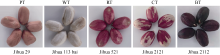
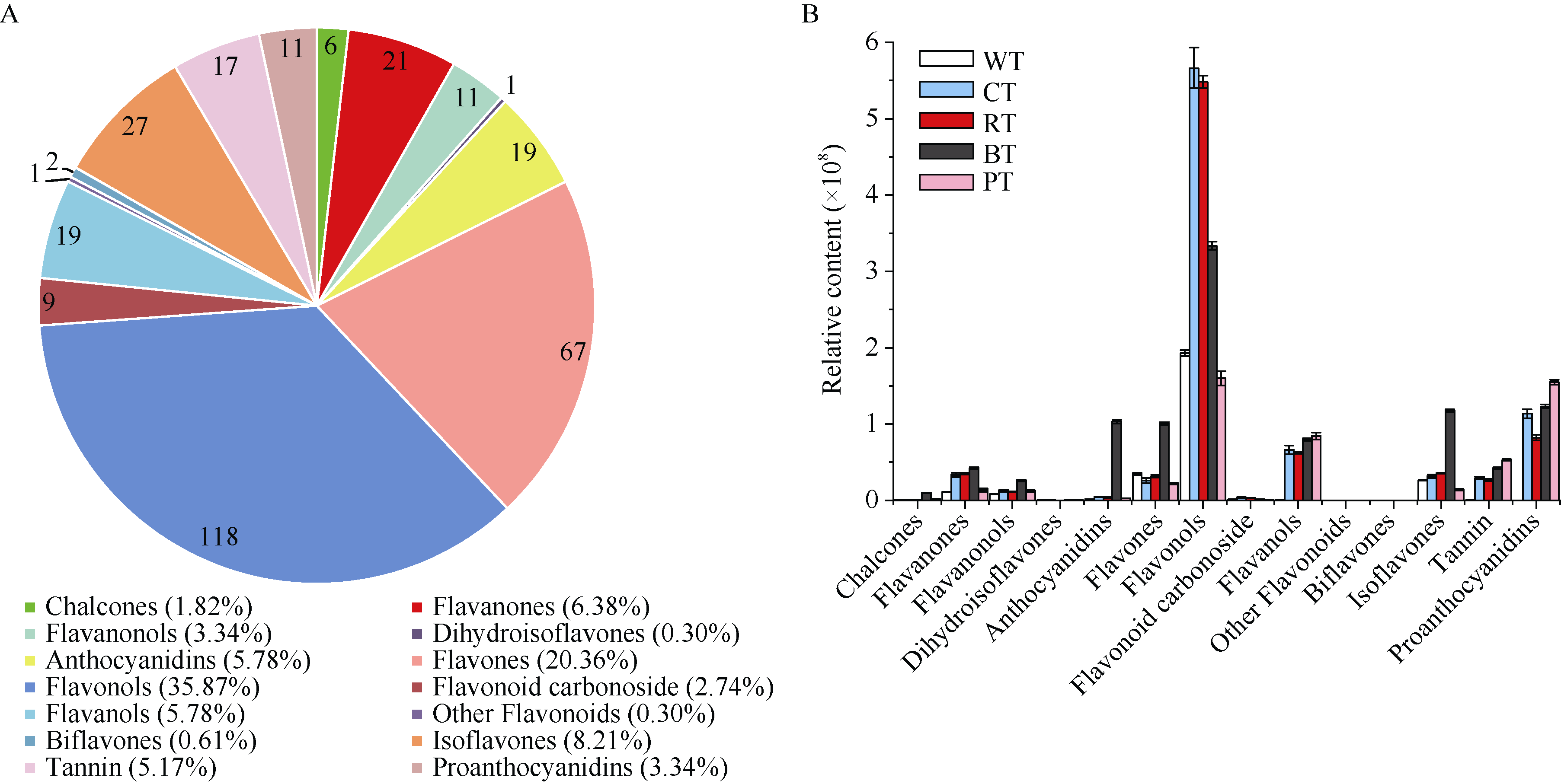
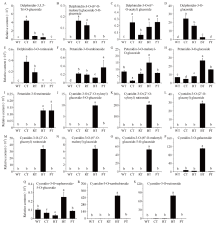
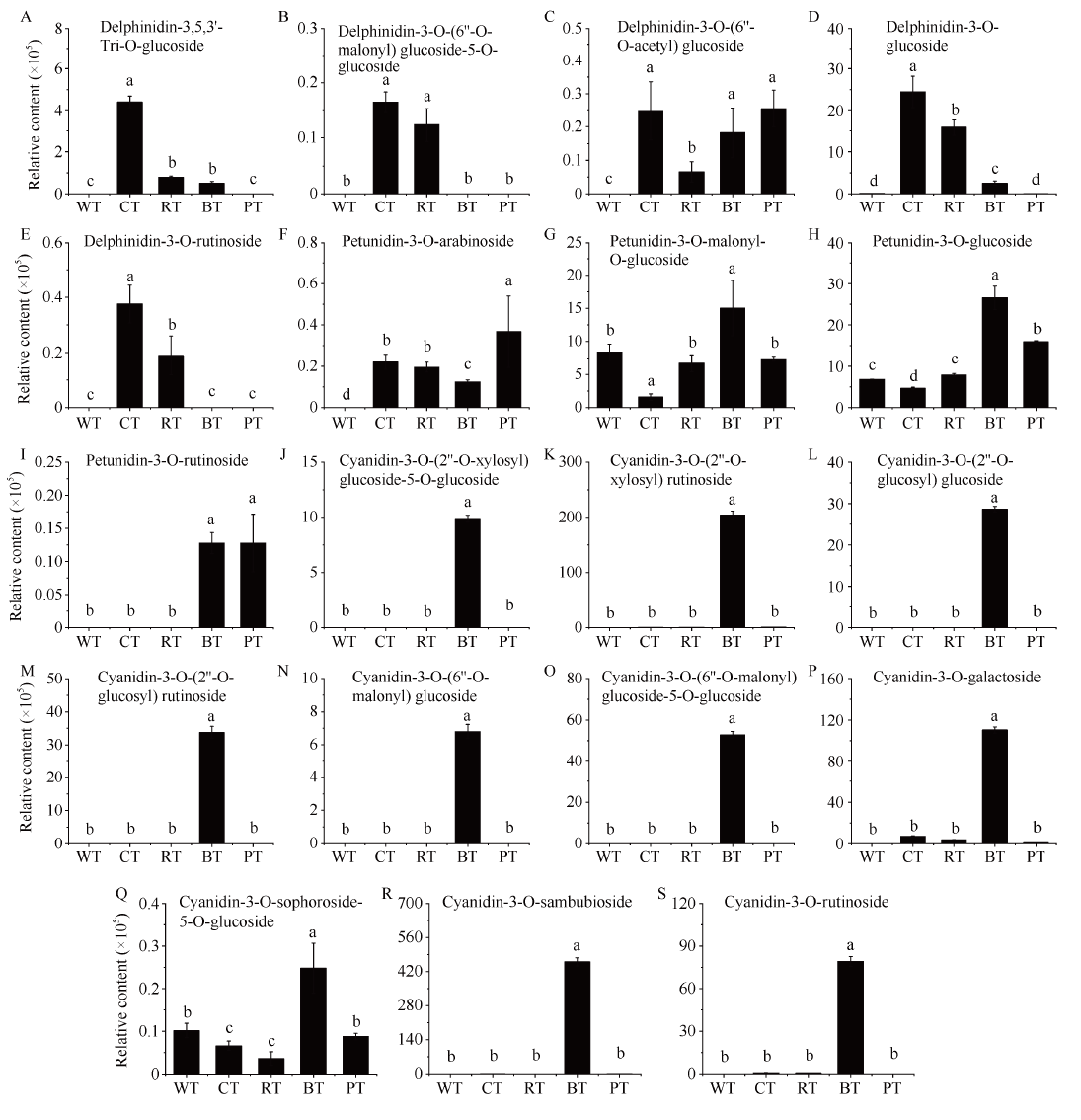
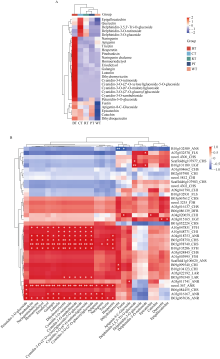
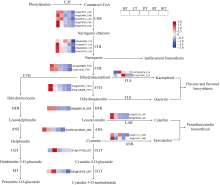
为探究不同颜色花生种皮的类黄酮物质成分及花青素生物合成对种皮颜色形成的调控机制, 本研究利用粉色、红色、白色、黑色以及花斑色(红色和白色)共5种颜色差异明显的花生品种, 对种皮进行类黄酮代谢组和转录组分析, 明确种皮花青素合成相关的关键代谢物和关键基因。结果表明,5种花生种皮共鉴定到329种类黄酮代谢物, 其中黄酮醇类物质相对含量及种类最多。共检测到19种花青素色苷, 主要是矢车菊素色苷、飞燕草素色苷、矮牵牛素色苷, 多以葡萄糖苷、桑布苷、芸香苷、半乳糖苷等糖苷修饰。黑色种皮花青素含量约是其他皮色的22.60~66.72倍。黑色种皮中以矢车菊素-3-O-桑布双糖苷相对含量最高。4种有色种皮分别与白色种皮相比, 差异代谢物主要在花青素生物合成、类黄酮生物合成、黄酮和黄酮醇生物合成、异黄酮生物合成途径中显著富集。有色种皮中, 类黄酮和花青素生物合成途径结构基因的高表达水平, 是促进种皮花青素积累的主要原因。花青素还原酶(ANR)和糖基转移酶(UGT)是参与种皮色素沉着的候选基因, 两者的活性以及对底物花青素的竞争, 最终决定花生种皮的颜色模式。本研究解析了类黄酮物质对花生种皮颜色合成的调控机制, 可为特色花生品种培育以及营养价值利用提供重要参考。
| [1] | Wang X, Liu Y, Ou-Yang L, Yao R N, He D L, Han Z K, Li W T, Ding Y B, Wang Z H, Kang Y P, Yan L Y, Chen Y N, Huai D X, Jiang H F, Lei Y, Liao B S. Metabolomics combined with transcriptomics analyses of mechanism regulating testa pigmentation in peanut. Front Plant Sci, 2022, 13: 1065049. |
| [2] |
李佳伟, 马钰聪, 杨鑫雷, 王梅, 崔顺立, 侯名语, 刘立峰, 胡梦蝶, 蒋晓霞, 穆国俊. 花生种皮色素合成相关通路的转录组- 代谢组学联合分析. 植物遗传资源学报, 2022, 23: 240-254.
doi: 10.13430/j.cnki.jpgr.20210524001 |
| Li J W, Ma Y C, Yang X L, Wang M, Cui S L, Hou M Y, Liu L F, Hu M D, Jiang X X, Mu G J. Transcriptomics-metabolomics combined analysis highlight the mechanism of testa pigment formation in peanut (Arachis hypogaea L.). J Plant Genet Resour, 2022, 23: 240-254 (in Chinese with English abstract). | |
| [3] |
Zhang K, Yuan M, Xia H, He L Q, Ma J, Wang M X, Zhao H L, Hou L, Zhao S Z, Li P C, Tian R Z, Pan J W, Li G H, Thudi M, Ma C L, Wang X J, Zhao C Z. BSA-seq and genetic mapping reveals AhRt2 as a candidate gene responsible for red testa of peanut. Theor Appl Genet, 2022, 135: 1529-1540.
doi: 10.1007/s00122-022-04051-w pmid: 35166897 |
| [4] | Chen L, Yan F F, Chen W B, Zhao L, Zhang J L, Lu Q, Liu R. Procyanidin from peanut skin induces antiproliferative effect in human prostate carcinoma cells DU145. Chem Biol Interact, 2018, 288: 12-23. |
| [5] |
Zhu F. Anthocyanins in cereals: composition and health effects. Food Res Int, 2018, 109: 232-249.
doi: S0963-9969(18)30285-0 pmid: 29803446 |
| [6] |
Tsuda T. Dietary anthocyanin-rich plants: Biochemical basis and recent progress in health benefits studies. Mol Nutr Food Res, 2012, 56: 159-170.
doi: 10.1002/mnfr.201100526 pmid: 22102523 |
| [7] | Attree R, Du B, Xu B J. Distribution of phenolic compounds in seed coat and Cotyledon, and their contribution to antioxidant capacities of red and black seed coat peanuts (Arachis hypogaea L.). Ind Crops Prod, 2015, 67: 448-456. |
| [8] |
Alseekh S, de Souza L P, Benina M, Fernie A R. The style and substance of plant flavonoid decoration; towards defining both structure and function. Phytochemistry, 2020, 174: 112347.
doi: 10.1016/j.phytochem.2020.112347 pmid: 32203741 |
| [9] |
Iwashina T. Flavonoid function and activity to plants and other organisms. Biol Sci Space, 2003, 17: 24-44.
doi: 10.2187/bss.17.24 pmid: 12897458 |
| [10] |
Tanaka Y, Brugliera F, Chandler S. Recent progress of flower colour modification by biotechnology. Int J Mol Sci, 2009, 10: 5350-5369.
doi: 10.3390/ijms10125350 pmid: 20054474 |
| [11] |
Wen W W, Alseekh S, Fernie A R. Conservation and diversification of flavonoid metabolism in the plant kingdom. Curr Opin Plant Biol, 2020, 55: 100-108.
doi: S1369-5266(20)30044-3 pmid: 32422532 |
| [12] | Wang X, Zhang X C, Hou H X, Ma X, Sun S L, Wang H W, Kong L R. Metabolomics and gene expression analysis reveal the accumulation patterns of phenylpropanoids and flavonoids in different colored-grain wheats (Triticum aestivum L.). Food Res Int, 2020, 138: 109711. |
| [13] |
Grotewold E. The genetics and biochemistry of floral pigments. Annu Rev Plant Biol, 2006, 57: 761-780.
pmid: 16669781 |
| [14] | Duan H R, Wang L R, Cui G X, Zhou X H, Duan X R, Yang H S. Identification of the regulatory networks and hub genes controlling alfalfa floral pigmentation variation using RNA-sequencing analysis. BMC Plant Biol, 2020, 20: 110. |
| [15] | 吴紫萱, 薛其勤, 杨会, 刘风珍. 花生种皮颜色研究进展. 山东农业科学, 2022, 54(1): 152-156. |
| Wu Z X, Xue Q Q, Yang H, Liu F Z. Research progress on testa color of peanut. Shandong Agric Sci, 2022, 54(1): 152-156 (in Chinese with English abstract). | |
| [16] | Hu M D, Li J W, Hou M Y, Liu X Q, Cui S L, Yang X L, Liu L F, Jiang X X, Mu G J. Transcriptomic and metabolomic joint analysis reveals distinct flavonoid biosynthesis regulation for variegated testa color development in peanut (Arachis hypogaea L.). Sci Rep, 2021, 11: 10721. |
| [17] | Huang J Y, Xing M H, Li Y, Cheng F, Gu H H, Yue C P, Zhang Y J. Comparative transcriptome analysis of the skin-specific accumulation of anthocyanins in black peanut (Arachis hypogaea L.). J Agric Food Chem, 2019, 67: 1312-1324. |
| [18] | Wan L Y, Li B, Lei Y, Yan L Y, Huai D X, Kang Y P, Jiang H F, Tan J Z, Liao B S. Transcriptomic profiling reveals pigment regulation during peanut testa development. Plant Physiol Biochem, 2018, 125: 116-125. |
| [19] |
Lou Q, Liu Y L, Qi Y Y, Jiao S Z, Tian F F, Jiang L, Wang Y J. Transcriptome sequencing and metabolite analysis reveals the role of delphinidin metabolism in flower colour in grape hyacinth. J Exp Bot, 2014, 65: 3157-3164.
doi: 10.1093/jxb/eru168 pmid: 24790110 |
| [20] |
Wu Q, Wu J, Li S S, Zhang H J, Feng C Y, Yin D D, Wu R Y, Wang L S. Transcriptome sequencing and metabolite analysis for revealing the blue flower formation in waterlily. BMC Genomics, 2016, 17: 897.
pmid: 27829354 |
| [21] | Xia H, Zhu L, Zhao C Z, Li K, Shang C L, Hou L, Wang M X, Shi J, Fan S J, Wang X J. Comparative transcriptome analysis of anthocyanin synthesis in black and pink peanut. Plant Signal Behav, 2020, 15: 1721044. |
| [22] |
Koes R, Verweij W, Quattrocchio F. Flavonoids: a colorful model for the regulation and evolution of biochemical pathways. Trends Plant Sci, 2005, 10: 236-242.
doi: 10.1016/j.tplants.2005.03.002 pmid: 15882656 |
| [23] |
Labbé D, Provencal M, Lamy S, Boivin D, Gingras D, Béliveau R. The flavonols quercetin, kaempferol, and myricetin inhibit hepatocyte growth factor-induced medulloblastoma cell migration. J Nutr, 2009, 139: 646-652.
doi: 10.3945/jn.108.102616 pmid: 19244381 |
| [24] | Kuang Q J, Yu Y Y, Attree R, Xu B J. A comparative study on anthocyanin, saponin, and oil profiles of black and red seed coat peanut (Arachis hypogacea) grown in China. Int J Food Prop, 2017, 20: S131-S140. |
| [25] | Nabavi S M, Šamec D, Tomczyk M, Milella L, Russo D, Habtemariam S, Suntar I, Rastrelli L, Daglia M, Xiao J B, Giampieri F, Battino M, Sobarzo-Sanchez E, Nabavi S F, Yousefi B, Jeandet P, Xu S W, Shirooie S. Flavonoid biosynthetic pathways in plants: Versatile targets for metabolic engineering. Biotechnol Adv, 2020, 38: 107316. |
| [26] | Zhou C B, Mei X, Rothenberg D O, Yang Z B, Zhang W T, Wan S H, Yang H J, Zhang L Y. Metabolome and transcriptome analysis reveals putative genes involved in anthocyanin accumulation and coloration in white and pink tea (Camellia sinensis) flower. Molecules, 2020, 25: 190. |
| [27] | Khlestkina E K, Shoeva O Y, Gordeeva E I. Flavonoid biosynthesis genes in wheat. Russ J Genet Appl Res, 2015, 5: 268-278. |
| [28] | 苏俏, 金欣欣, 李玉荣, 程增书, 宋亚辉, 杨永庆, 王瑾. 影响多彩花生种皮颜色的关键代谢物及ANS基因分析. 华北农学报, 2022, 37(增刊): 19-25. |
|
Su Q, Jin X X, Li Y R, Cheng Z S, Song Y H, Yang Y Q, Wang J. Analysis of key metabolites and ANS genes affecting seed testa color of peanut. Acta Agric Boreali-Sin, 2022, 37(S1): 19-25 (in Chinese with English abstract).
doi: 10.7668/hbnxb.20193143 |
|
| [29] | Zhao Z L, Wu M, Zhan Y L, Zhan K H, Chang X L, Yang H S, Li Z M. Characterization and purification of anthocyanins from black peanut (Arachis hypogaea L.) skin by combined column chromatography. J Chromatogr A, 2017, 1519: 74-82. |
| [1] | 王亚, 赵宜婷, 王宙, 杨俊芳, 张宏斌, 曹越. 转录组-代谢组联合分析蓖麻蜡质合成相关基因[J]. 作物学报, 2026, 52(6): 1774-1787. |
| [2] | 陈雪燕, 何华川, 李政嘉, 董新盼, 李藕琪, 刘小云, 李丹萍, 陈志伟, 刘国霞, 吕胜源, 吴印莹, 赵振东, 曹新有, 万何平. 水培盐碱复合胁迫下‘济麦60’苗期根系有机酸分泌动态变化及其转录调控机制[J]. 作物学报, 2026, 52(6): 1859-1875. |
| [3] | 郑玉珍, 齐飞艳, 孙子淇, 刘华, 秦利, 石磊, 王娟, 汪蒙蒙, 韩锁义, 徐静, 苗利娟, 黄冰艳, 董文召, 郑峥, 张新友. 花生籽仁总超长链脂肪酸和7种脂肪酸组分的QTL定位[J]. 作物学报, 2026, 52(6): 1646-1657. |
| [4] | 邹仪妹, 徐敏, 汪海洋, 姚辉, 王加峰, 刘浩, 任代胜. 两系不育系水稻幼苗根系响应盐胁迫的转录因子调控网络鉴定[J]. 作物学报, 2026, 52(6): 1728-1742. |
| [5] | 陆一楚, 李振影, 买春海, 赵晓蕊, 王利祥. 夜间复合体关键基因AhLUX1正向调控花生结瘤的功能研究[J]. 作物学报, 2026, 52(6): 1658-1668. |
| [6] | 张曦, 王广恩, 李邵琦, 刘祎, 李俊兰, 钱玉源. 基于转录组测序解析陆海杂交姊妹系马克隆值差异的形成机制[J]. 作物学报, 2026, 52(5): 1442-1458. |
| [7] | 韩亚鑫, 何冠华, 张小琼, 张登峰, 李永祥, 刘旭洋, 王天宇, 黎裕, 邹华文, 李春辉. 基于RNA-Seq和BSA-Seq联合分析挖掘玉米侧根密度基因资源[J]. 作物学报, 2026, 52(5): 1341-1352. |
| [8] | 谷春苗, 王润风, 黄璐, 刘浩, 鲁清, 李海芬, 李少雄, 何双呈, 洪彦彬, 陈小平, 谭斌, 余倩霞. 花生WOX基因家族的全基因组分析及不定芽再生候选基因的鉴定[J]. 作物学报, 2026, 52(5): 1326-1340. |
| [9] | 蔡兆琴, 何观咏, 何文, 阮丽霞, 梁振华, 李永珍, 李恒锐, 陈会鲜. 木薯分枝发育过程的动态转录组分析与关键基因发掘[J]. 作物学报, 2026, 52(5): 1430-1441. |
| [10] | 杨亚莉, 徐明睿, 马越飞, 海艺蕊, 刘凯栋, 刘万茂, 孙颖. 玉米根尖及整根响应缺铁的转录组比较研究[J]. 作物学报, 2026, 52(4): 1006-1021. |
| [11] | 马亮, 马璐, 张舒钰, 章慧敏, 王仁明, 宋旭东, 张振良, 冒宇翔, 陆虎华, 陈国清, 郝德荣, 周广飞. 玉米苞叶数目转录组分析及候选基因鉴定[J]. 作物学报, 2026, 52(3): 790-801. |
| [12] | 杨宗桃, 杨婷, 王禹童, 艾静, 李燕烨, 刘家勇, 邓军, 赵勇, 张跃彬. 甘蔗CLC基因家族鉴定与表达分析[J]. 作物学报, 2026, 52(3): 722-734. |
| [13] | 郭颖, 张大效, 陈美霖, 陈冠宇, 刘建民, 杨晓虹, 韩冰. 野生燕麦和栽培燕麦的代谢组学分析[J]. 作物学报, 2026, 52(3): 945-956. |
| [14] | 张宇, 刘芳, 蔡诚诚, 杨小华, 吉阿么石扎, 杨元军, 王西瑶. 溴乙烷与赤霉素协同处理破除马铃薯块茎休眠的机理初探[J]. 作物学报, 2026, 52(3): 825-838. |
| [15] | 于永超, 刘明, 靳容, 赵鹏, 张强强, 王静, 朱晓亚, 唐忠厚. 甘薯高氮徒长的生理机制和转录组分析研究[J]. 作物学报, 2026, 52(3): 813-824. |
|
||