欢迎访问作物学报,今天是
作物学报 ›› 2018, Vol. 44 ›› Issue (9): 1290-1300.doi: 10.3724/SP.J.1006.2018.01290
李红丹1,2,闫蕾1,2,孙蕾1,2,樊晓聪1,3,陈士瞻1,3,张燕1,3,郭林1,游光霞1,李庄1,2,杨宗举1,2,苏亮1,*,杨建平1,3,*
Hong-Dan LI1,2,Lei YAN1,2,Lei SUN1,2,Xiao-Cong FAN1,3,Shi-Zhan CHEN1,3,Yan ZHANG1,3,Lin GUO1,Guang-Xia YOU1,Zhuang LI1,2,Zong-Ju YANG1,2,Liang SU1,*,Jian-Ping YANG1,3,*
摘要:
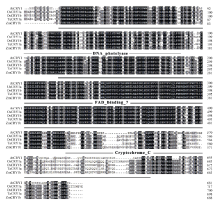
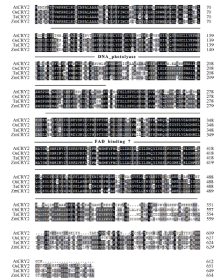
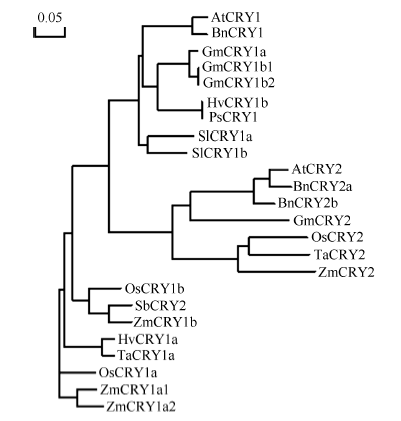
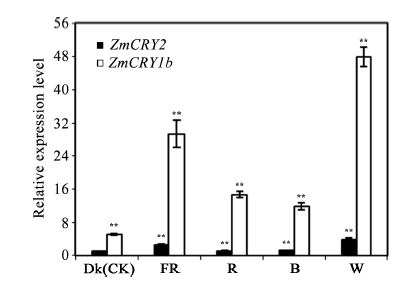
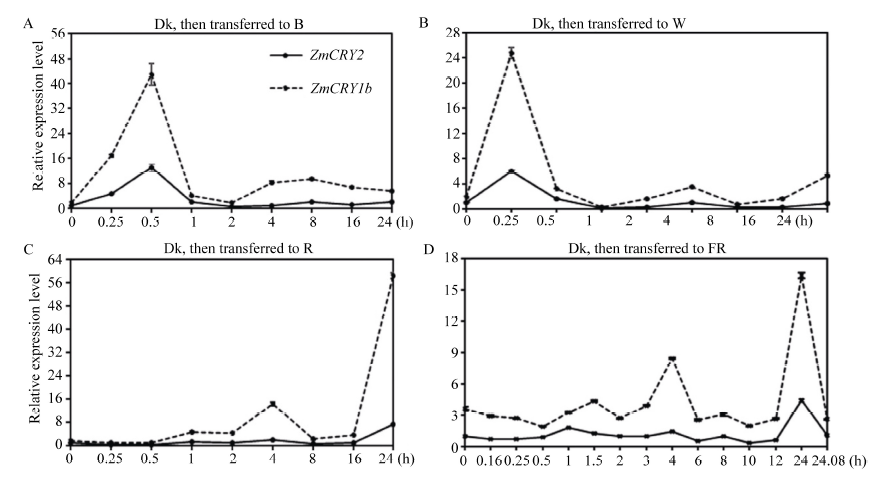
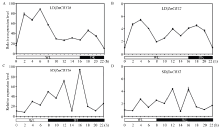
玉米株高、开花期、产量、品质等性状与环境中的光密切相关。隐花色素是一类蓝光和近紫外光的受体, 主要参与植物的光形态建成及动、植物的生物钟调控。通过研究玉米隐花色素基因对不同光处理的表达模式, 可为进一步研究其对玉米光形态建成的作用奠定基础。本研究采用RT-PCR技术克隆了玉米ZmCRY1b和ZmCRY2基因; 利用生物信息学相关网站和软件对其编码蛋白的结构域及氨基酸进行了系统发育分析; 利用qRT-PCR分析了玉米自交系B73中ZmCRY1b和ZmCRY2基因在不同组织、以及响应不同光质及长日照和短日照处理的转录丰度。研究发现, 玉米与拟南芥、水稻和小麦的CRY蛋白有相同的结构域及较高的氨基酸序列的一致性, 表明它们具有相似的功能。ZmCRY1b和ZmCRY2基因主要在玉米的叶片中表达; 二者能迅速响应各种持续光质、黑暗到不同光质转换及长日照和短日照处理, 且ZmCRY1b在各种处理下的转录丰度均高于ZmCRY2, 可能暗示ZmCRY1b在玉米中功能更强。以上研究结果表明, ZmCRY1b和ZmCRY2基因均能有效地响应各种光质和光周期处理, 并在玉米的光形态建成中发挥重要作用。本研究为进一步探明ZmCRY1b和ZmCRY2基因的功能及其在玉米品种改良中的应用提供了研究基础。
| [1] | 詹克慧, 李志勇, 侯佩, 习雨琳, 肖阳, 孟凡华, 杨建平 . 利用修饰光敏色素信号途径进行品种改良的可行性. 中国农业科学, 2012,45:3249-3255 |
| Zhan K H, Li Z Y, Hou P, Xi Y L, Xiao Y, Meng F H, Yang J P . A new strategy for crop improvement through modification of phytochrome signaling pathways. Sci Agric Sin, 2012,45:3249-3255 (in Chinese with English abstract) | |
| [2] | Weller J L, Perrotta G , Schreuder M E, van Tuinen A, Koornneef M, Giuliano G, Kendrick R E . Genetic dissection of blue-light sensing in tomato using mutants deficient in cryptochrome 1 and phytochromes A, B1 and B2. Plant J, 2001,25:427-440 |
| [3] | Giliberto L, Perrotta G, Pallara P, Weller J L, Fraser P D, Bramley P M, Fiore A, Tavazza M, Giuliano G . Manipulation of the blue light photoreceptor cryptochrome 2 in tomato affects vegetative development, flowering time and fruit antioxidant content. Plant Physiol, 2005,137:199-208 |
| [4] |
Platten J D, Foo E, Elliott R C, Hecht V, Reid J B, Weller J L . Cryptochrome 1 contributes to blue-light sensing in pea. Plant Physiol, 2005,139:1472-1482
doi: 10.1104/pp.105.067462 pmid: 16244154 |
| [5] | Sharma P, Chatterjee M, Burman N, Khurana J P . Cryptochrome 1 regulates growth and development in Brassica through alteration in the expression of genes involved in light, phytohormone and stress signalling. Plant Cell Environ, 2014,37:961-977 |
| [6] |
Yang Z H, Liu B B, Su J, Liao J K, Lin C T, Oka Y . Cryptochromes orchestrate transcription regulation of diverse blue light responses in plants. Photochem Photobiol, 2017,93:112-127
doi: 10.1111/php.12663 pmid: 27861972 |
| [7] | Sadanandom A, Ádám É, Orosa B, Viczián A, Klose C, Zhang C, Josse E, Kozma-Bognár L, Nagy F . SUMOylation of phytochrome-B negatively regulates light-induced signaling in Arabidopsis thaliana. Proc Natl Acad Sci USA, 2015,112:11108-11113 |
| [8] | Liu B, Yang Z H, Adam Gomez, Liu B, Lin C T, Oka Y . Signaling mechanisms of plant cryptochromes in Arabidopsis thaliana. J Plant Res, 2016,129:137-148 |
| [9] |
Yuan S, Zhang Z W, Zheng C, Zhao Z Y, Wang Y, Feng L Y, Niu G Q, Wang C Q, Wang J H, Feng H, Xu F, Bao F, Hua Y, Cao Y, Ma L G, Wang H Y, Kong D D, Xiao W, Lin H H, He Y K . Arabidopsis cryptochrome 1 functions in nitrogen regulation of flowering. Proc Natl Acad Sci USA, 2016,113:7661-7666
doi: 10.1073/pnas.1602004113 pmid: 27325772 |
| [10] | Xu F, He S B, Zhang J Y, Mao Z L, Wang W X, Li T, Hua J, Du S S, Xu P B, Li L, Lian H L, Yang H Q . Photoactivated CRY1 and phyB interact directly with AUX/IAA proteins to inhibit auxin signaling in Arabidopsis. Mol Plant, 2017,11:523-541 |
| [11] | Facella P, Daddiego L, Perrotta G . CRY1a influences the diurnal transcription of photoreceptor genes in tomato plants after gibberellin treatment. Plant Signal Behav, 2012,7:1034-1036 |
| [12] | Li Y Y, Mao K, Zhao C, Zhang R F, Zhao X Y, Zhang H L, Shu H R, Zhao Y . Molecular cloning of cryptochrome 1 from apple and its functional characterization in Arabidopsis. Plant Physiol Biochem, 2013,67:169-177 |
| [13] |
Zhang Y C, Gong S F, Sang F, Yang H Q . Functional and signaling mechanism analysis of rice CRYPTOCHROME 1. 2006, Plant J, 46:971-983
doi: 10.1111/j.1365-313X.2006.02753.x pmid: 16805731 |
| [14] |
Hirose F, Shinomura T, Tanabata T, Shimada H, Takano M . Involvement of rice cryptochromes in de-etiolation responses and flowering. Plant Cell Physiol, 2006,47:915-925
doi: 10.1093/pcp/pcj064 pmid: 16760221 |
| [15] |
Platten J D, Foo E, Foucher F, Hecht V, Reid J B, Weller J L . The cryptochrome gene family in pea includes two differentially expressed CRY2 genes. Plant Mol Biol, 2005,59:683-696
doi: 10.1007/s11103-005-0828-z pmid: 16244915 |
| [16] | Imaizumi T, Kanegae T, Wada M . Cryptochrome nucleocytoplasmic distribution and gene expression are regulated by light quality in the fern Adiantum capillus-veneris. Plant Cell, 2000,12:81-96 |
| [17] | Imaizumi T, Kadota A, Hasebe M, Wada M . Cryptochrome light signals control development to suppress auxin sensitivity in the moss physcomitrella patens. Plant Cell, 2002,14:373-386 |
| [18] | Meng Y Y, Li H Y . Blue light-dependent interaction between cryptochrome 2 and CIB1 regulates transcription and leaf senescence in soybean. Plant Cell, 2013,25:4405-4420 |
| [19] | Zhang Q Z, Li H Y, Li R, Hu R B, Fan C M, Chen F L, Wang Z H, Liu X, Fu Y F, Lin C T . Association of the circadian rhythmic expression of GmCRY1a with a latitudinal cline in photoperiodic flowering of soybean. Proc Natl Acad Sci USA, 2008,105:21028-21033 |
| [20] | Chatterjee M, Sharma P, Khurana J P . Cryptochrome 1 from Brassica napus is up-regulated by blue light and controls hypocotyl/stem growth and anthocyanin accumulation . Plant Physiol, 2006,141:61-74 |
| [21] |
Liu H T, Liu B, Zhao C X, Pepper M, Lin C T . The action mechanisms of plant cryptochromes. Trends Plant Sci, 2011,16:684-691
doi: 10.1016/j.tplants.2011.09.002 pmid: 3277817 |
| [22] | Ahmad M, Cashmore A R . HY4 gene of A. thaliana encodes a protein with characteristics of a blue-light photoreceptor . Nature, 1993,366:162-166 |
| [23] |
Guo H W, Yang H Y, Mockler T C, Lin C T . Regulation of flowering time by Arabidopsis photoreceptors. Science, 1998,279:1360-1363
doi: 10.1016/j.pneurobio.2009.12.005. |
| [24] | Wu G, Spalding E P . Separate functions for nuclear and cytoplasmic cryptochrome 1 during photomorphogenesis of Arabidopsis seedlings. Proc Natl Acad Sci USA, 2007,104:18813-18818 |
| [25] |
Yu X H, Klejno J, Zhao X Y, Dror S, Maskit M, Yang H Y, Janet L, Liu X M, Javier L, Lin C T . Arabidopsis cryptochrome 2 completes its posttranslational life cycle in the nucleus. Plant Cell, 2007,19:3146-3156
doi: 10.1105/tpc.107.053017 |
| [26] | Kleine T, Lockhart P, Batschauer A . An Arabidopsis protein closely related to Synechocystis cryptochrome is targeted to organelles. Plant J, 2003,35:93-103 |
| [27] | 闫蕾, 杨宗举, 苏亮, 肖阳, 郭林, 宋梅芳, 孙蕾, 孟凡华, 白建荣, 杨建平 . 2个玉米ZmCRY1a基因的克隆及其响应光质处理的表达模式. 作物学报, 2016,42:1298-1308 |
| Yan L, Yang Z J, Su L, Xiao Y, Guo L, Song M F, Sun L, Meng F H, Bai J R, Yang J P . Molecular cloning of two maize (Zea mays) CRY1a genes and their expression patterns of in response to different light treatments. Acta Agron Sin, 2016,42:1298-1308 (in Chinese with English abstract) | |
| [28] | Rajeevan M S, Ranamukhaarachi D G, Vernon S D, Unger E R . Use of real-time quantitative PCR to validate the results of cDNA array and differential display PCR technologies. Methods, 2001,25:443-451 |
| [29] | Yang Y J, Zuo Z C, Zhao X Y, Li X, John K, Lia Y, Chen P, Liang S P, Yu X H, Liu X M, Lin C T . Blue-light-independent activity of Arabidopsis cryptochromes in the regulation of steady-state levels of protein and mRNA expression. Mol Plant, 2008,1:167-177 |
| [30] |
Wang Q, Liu Q, Wang X, Zuo Z, Oka Y, Lin C . New insights into the mechanisms of phytochrome-cryptochrome coaction. New Phytol, 2018,217:547-551
doi: 10.1111/nph.14886 pmid: 29139123 |
| [31] | de Wit M, Keuskamp D H, Bongers F J, Hornitschek P, Gommers C M M, Reinen E, Martínez-Cerón C, Fankhauser C, Pierik R . Integration of phytochrome and cryptochrome signals determines plant growth during competition for light. Curr Biol, 2016,26:3320-3326 |
| [32] |
Xu P B, Lian H L, Wang W X, Xu F, Yang H Q . Pivotal roles of the phytochrome-interacting factors in cryptochrome signaling. Mol Plant, 2016,9:496-497
doi: 10.1016/j.molp.2016.02.007 pmid: 26921621 |
| [1] | 刘恩波, 陈静, 李红星, 于宁宁, 任佰朝, 赵斌, 刘鹏, 张吉旺. 遮阴改变源-库平衡和调节碳水化合物代谢进而抑制夏玉米幼穗发育[J]. 作物学报, 2026, 52(6): 1891-1901. |
| [2] | 梁进宇, 尹嘉德, 王红丽, 张国平, 侯慧芝, 董博, 马明生. 基于无人机高光谱和机器学习的旱地饲用玉米叶片氮含量估测[J]. 作物学报, 2026, 52(6): 1788-1801. |
| [3] | 孙淑凤, 许振南, 黄嘉鑫, 翁建峰, 李新海. 玉米MAPK家族全基因组鉴定及其对拟轮枝镰孢菌感染的响应[J]. 作物学报, 2026, 52(5): 1291-1308. |
| [4] | 张宁宁, 滕雨菲, 任娜娜, 魏兴卓, 闫书豪, 樊可心, 王永宏, 陈文康, 张兴华, 朱万超, 徐淑兔, 薛吉全. 201份玉米自交系抗旱表型评价及可塑性分析[J]. 作物学报, 2026, 52(5): 1309-1325. |
| [5] | 杨欣雨, 崔文涛, 迪力尼格尔·阿力木, 汪凯翔, 吴鹏昊, 任姣姣. 玉米穗上叶片数全基因组关联分析和全基因组选择[J]. 作物学报, 2026, 52(5): 1573-1590. |
| [6] | 韩亚鑫, 何冠华, 张小琼, 张登峰, 李永祥, 刘旭洋, 王天宇, 黎裕, 邹华文, 李春辉. 基于RNA-Seq和BSA-Seq联合分析挖掘玉米侧根密度基因资源[J]. 作物学报, 2026, 52(5): 1341-1352. |
| [7] | 杨扬, 常诗惠, 田红丽, 易红梅, 王璐, 任洁, 范亚明, 刘亚维, 王凤格, 赵久然. 不同生态区国审玉米品种的遗传多样性分析[J]. 作物学报, 2026, 52(5): 1352-1364. |
| [8] | 张鸿蓉, 王菲儿, 李盼, 仇海龙, 朱静, 赵连豪, 南运有, 何蔚, 樊志龙, 胡发龙, 柴强, 殷文. 减量20%灌水与25%有机肥替代化肥提高青贮玉米产量的光合特性[J]. 作物学报, 2026, 52(5): 1487-1500. |
| [9] | 蔡宏玮, 于爱忠, 姜科强, 王鹏飞, 王玉珑, 霍建喆, 庞小能, 尹波, 尚永盼. 干旱灌区有机肥替代部分化肥促进甜玉米产量提升的关键机制[J]. 作物学报, 2026, 52(4): 1166-1180. |
| [10] | 田红丽, 杨扬, 范亚明, 易红梅, 郭丹丹, 王凤格, 赵久然. 适于玉米品种鉴定的一套三等位变异SNP新型标记组合[J]. 作物学报, 2026, 52(4): 993-1005. |
| [11] | 杨亚莉, 徐明睿, 马越飞, 海艺蕊, 刘凯栋, 刘万茂, 孙颖. 玉米根尖及整根响应缺铁的转录组比较研究[J]. 作物学报, 2026, 52(4): 1006-1021. |
| [12] | 张超, 郭欢, 李忠玲, 岳淑宁, 赵娜. 基于BSA-seq技术定位玉米籽粒花青素关联基因[J]. 作物学报, 2026, 52(3): 780-789. |
| [13] | 郭向阳, 涂亮, 王栋, 刘鹏飞, 王安贵, 易强, 任洪, 李刚, 祝云芳, 吴迅, 蒋喻林, 田丰, 陈泽辉. 热带Suwan种质在我国玉米种质改良中的创新与利用[J]. 作物学报, 2026, 52(3): 655-664. |
| [14] | 孟成, 王哲. 玉米ZmPFK基因家族全基因组鉴定及响应胁迫表达分析[J]. 作物学报, 2026, 52(3): 764-779. |
| [15] | 李新浩, 邢梦柯, 周梓惠, 李思烨, 任昊, 王洪章, 赖华江. 外源褪黑素通过协调光反应与暗反应增强玉米苗期的耐热性[J]. 作物学报, 2026, 52(3): 839-856. |
|
||