欢迎访问作物学报,今天是
作物学报 ›› 2020, Vol. 46 ›› Issue (11): 1690-1702.doi: 10.3724/SP.J.1006.2020.02006
姚姝1( ), 张亚东1, 刘燕清1, 赵春芳1, 周丽慧1, 陈涛1, 赵庆勇1, 朱镇1, Balakrishna Pillay2,*, 王才林1,*()
YAO Shu1(), ZHANG Ya-Dong1, LIU Yan-Qing1, ZHAO Chun-Fang1, ZHOU Li-Hui1, CHEN Tao1, ZHAO Qing-Yong1, ZHU Zhen1, Balakrishna Pillay2,*, WANG Cai-Lin1,*()
摘要:
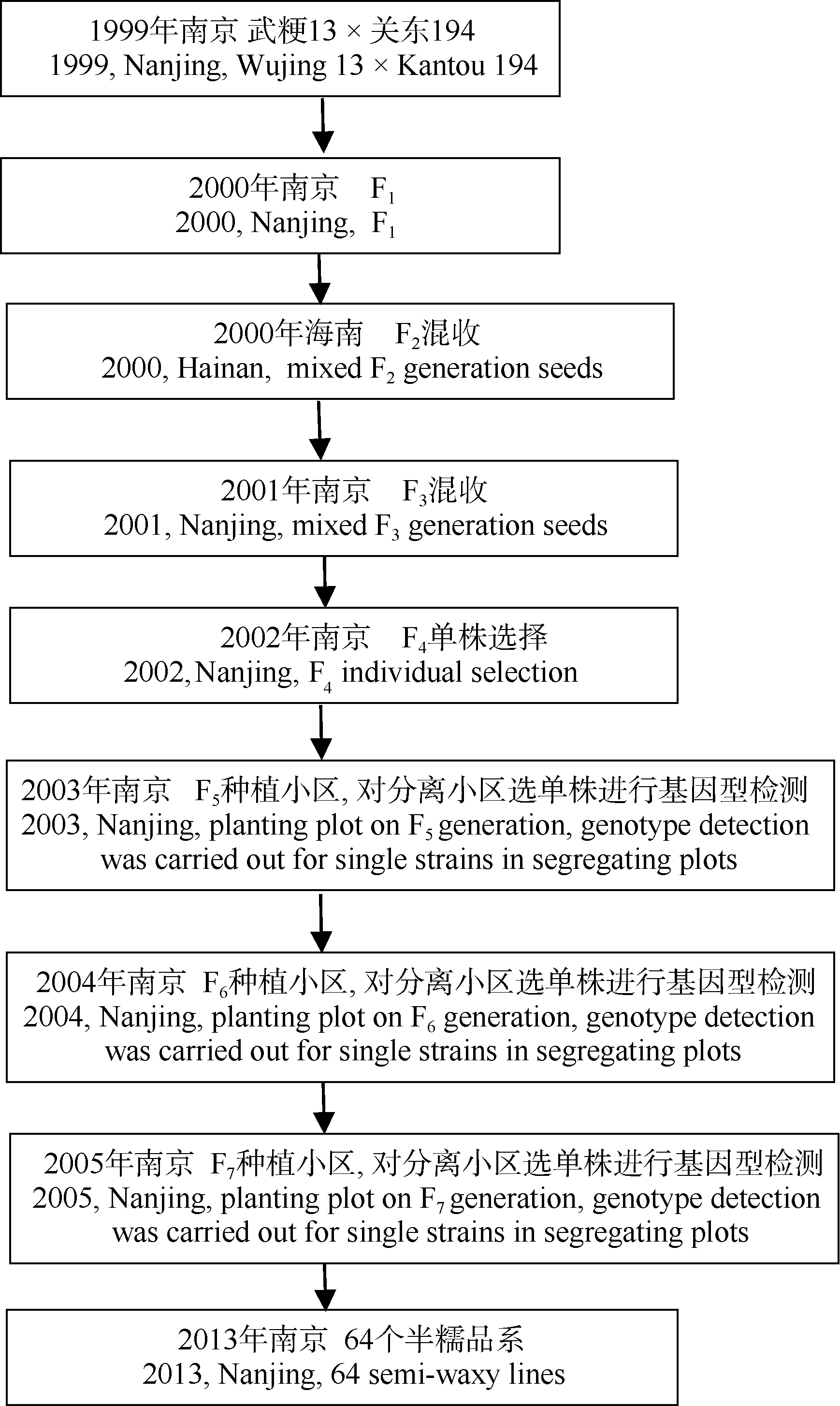
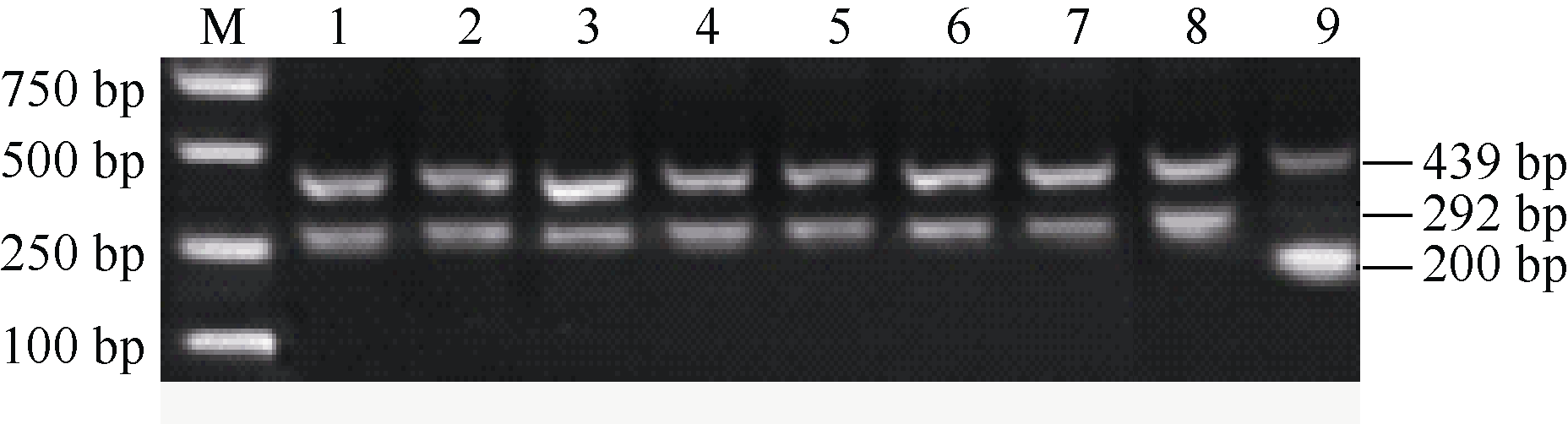
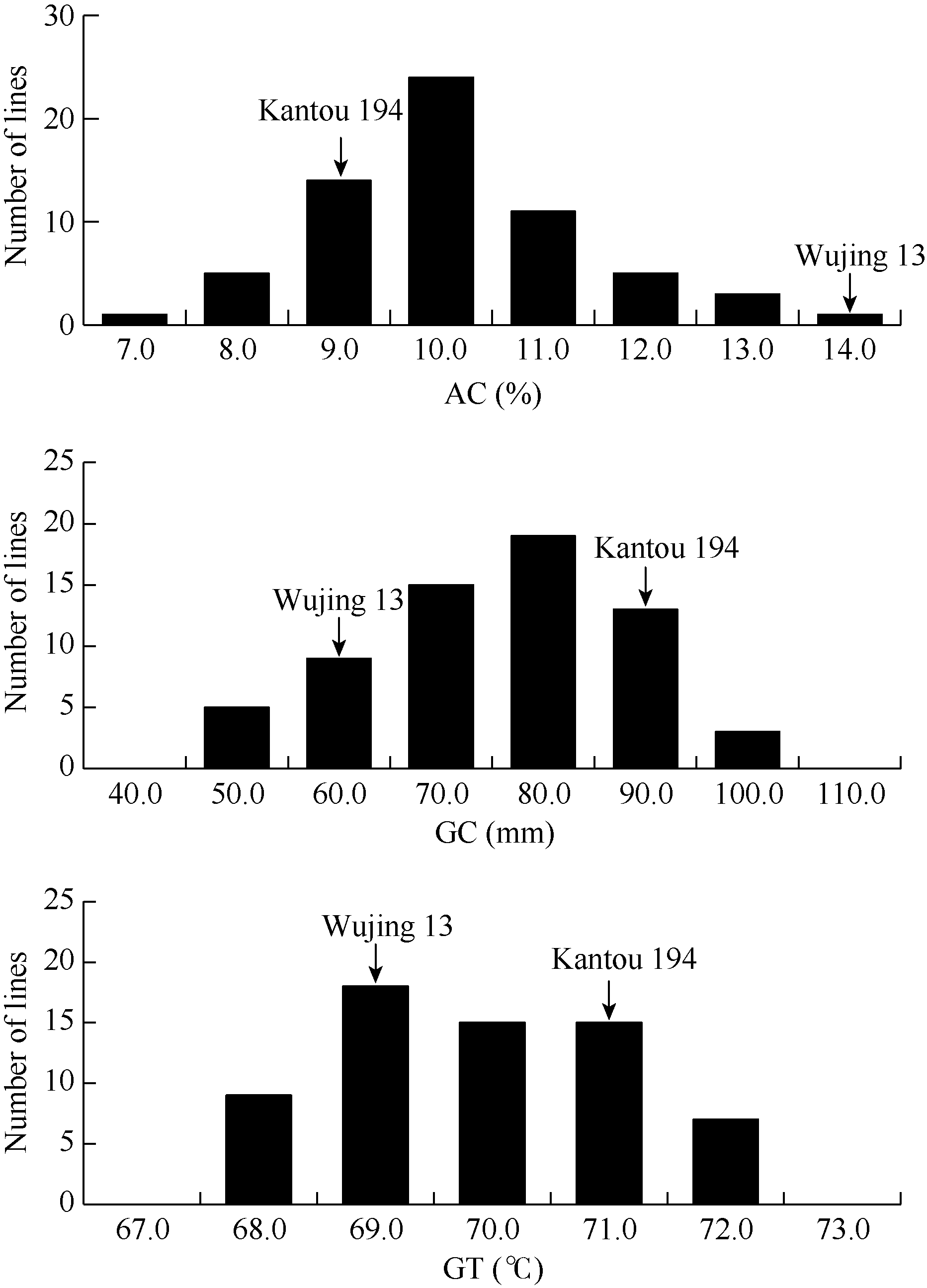
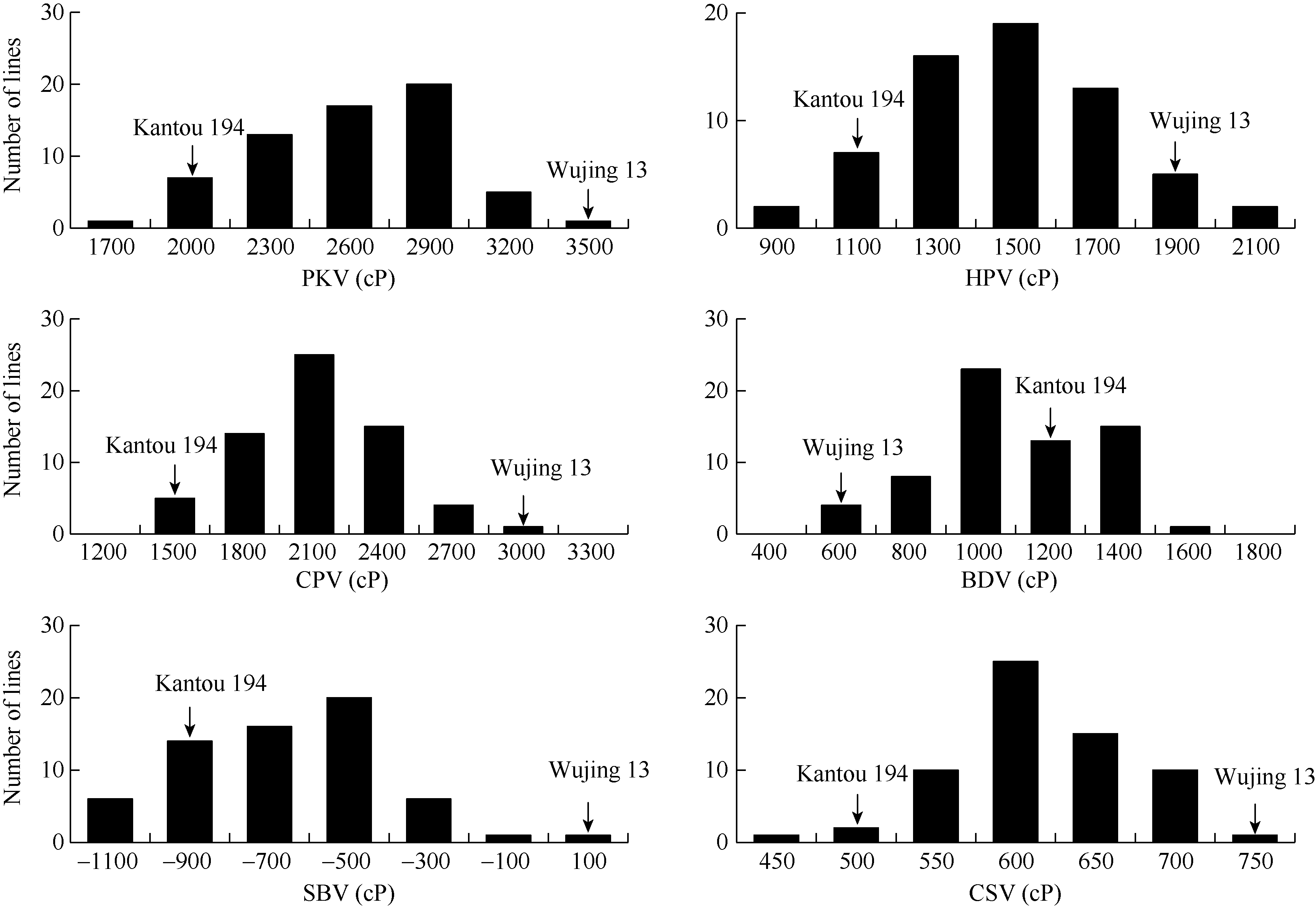
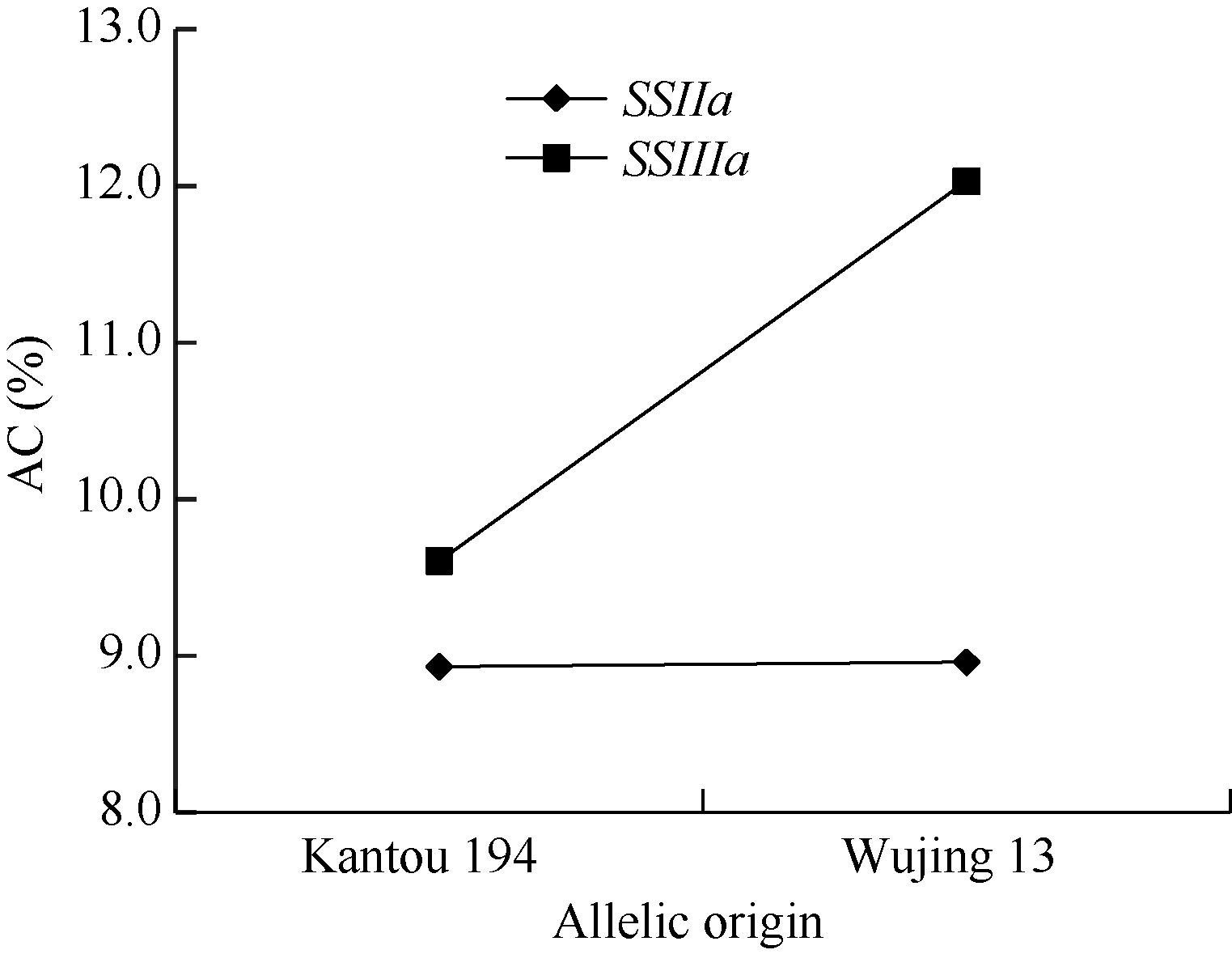
为了明确Wxmp基因背景下不同半糯粳稻品质差异的原因, 以淀粉合成酶基因SSIIa和SSIIIa表现多态性而其他淀粉合成相关基因无多态性的武粳13和关东194 (Milky Princess)杂交后代衍生的64个半糯品系为材料, 分析了Wxmp基因背景下, SSIIa和SSIIIa基因等位变异对直链淀粉含量(amylose content, AC)、胶稠度(gel consistency, GC)、糊化温度(gelatinization temperature, GT)及RVA谱特征值的影响。结果表明, SSIIa和SSIIIa等位变异对AC、GC、GT和RVA谱特征值都有显著影响, 且2个基因间存在互作效应。SSIIa2和SSIIIa2(2表示该基因来源于非半糯亲本武粳13)有使AC增高的趋势, 分别使AC提高1.87%和1.23%, 2年结果基本接近。单个SSIIa和SSIIIa等位变异对GT无显著影响, 而基因型SSIIa1SSIIIa1(1表示该基因来源于半糯亲本关东194)的GT比SSIIa2SSIIIa2高1.34℃, 达显著水平, 表明2个基因的互作对GT有显著影响。GC在不同基因型间均存在极显著差异, SSIIa 2和SSIIIa1可分别使GC增加8.74 mm和9.62 mm。从2个基因的互作效应来看, 基因型SSIIa2SSIIIa1的GC比基因型SSIIa1SSIIIa2和SSIIa2SSIIIa2分别增加10.64 mm和16.95 mm。SSIIa2使最高黏度、热浆黏度、冷胶黏度、崩解值增加, 回复值和消减值下降; 而SSIIIa2的效应则相反。2个基因的互作效应, 最高黏度、热浆黏度和冷胶黏度均以SSIIa2SSIIIa1最大, 崩解值和回复值均以SSIIa2SSIIIa2最大, 消减值SSIIa2SSIIIa1最小。本研究结果为半糯粳稻蒸煮食味品质的改良提供了一定的理论依据。
| [1] | 王才林, 张亚东, 朱镇, 陈涛, 赵庆勇, 赵凌, 周丽慧, 姚姝, 赵凌, 李余生. 水稻优质抗病高产育种的研究与实践. 江苏农业学报, 2012,28:921-927. |
| Wang C L, Zhang Y D, Zhu Z, Chen T, Zhao Q Y, Zhou L H, Yao S, Zhao L, Li Y S. Studies and practice on the development of japonica rice varieties with good quality, disease resistance and high yield. Jiangsu J Agric Sci, 2012, 28:921-927 (in Chinese with English abstract). | |
| [2] | 鄂志国, 程本义, 孙红伟, 汪玉军, 朱练峰, 林海, 王磊, 童汉华, 陈红旗. 近40年我国水稻育成品种分析. 中国水稻科学, 2019,33:523-531. |
| E Z G, Cheng B Y, Sun H W, Wang Y J, Zhu L F, Lin H, Wang L, Tong H H, Chen H Q. Analysis on Chinese improved rice varieties in recent four decade. Chin J Rice Sci, 2019,33:523-531 (in Chinese with English abstract). | |
| [3] | Suto M, Ando I, Numaguchi K. Breeding of low amylose content paddy rice variety Milk Queen with good eating quality. Jpn Breed, 1996,46:221-224. |
| [4] | 黄祖六, 许如根, 陈德辉, 陈勇. 中泰软米资源直链淀粉含量的遗传研究. 扬州大学学报(农业与生命科学版), 2003,24:34-36. |
| Huang Z L, Xu R G, Chen D H, Chen Y. Research on inheritance for amylose content of soft rice from China and Thailand. J Yangzhou Univ (Agric Life Sci Edn), 2003,24:34-36 (in Chinese with English abstract). | |
| [5] | 赵春芳, 岳红亮, 黄双杰, 周丽慧, 赵凌, 张亚东, 陈涛, 朱镇, 赵庆勇, 姚姝, 梁文化, 路凯, 王才林. 南粳系列水稻品种的食味品质与稻米理化特性. 中国农业科学, 2019,52:909-920. |
| Zhao C F, Yue H L, Huang S J, Zhou L H, Zhao L, Zhang Y D, Chen T, Zhu Z, Zhao Q Y, Yao S, Liang W H, Lu K, Wang C L. Study on eating quality and physicochemical properties in Nanjing rice varieties. Sci Agric Sin, 2019,52:909-920 (in Chinese with English abstract). | |
| [6] | 王才林, 陈涛, 张亚东, 朱镇, 赵凌, 林静. 通过分子标记辅助选择培育优良食味水稻新品种. 中国水稻科学, 2009,23:25-30. |
| Wang C L, Chen T, Zhang Y D, Zhu Z, Zhao L, Lin J. Breeding of a new rice variety with good eating quality by marker assisted selection. Chin J Rice Sci, 2009,23:25-30 (in Chinese with English abstract). | |
| [7] | 王才林, 张亚东, 朱镇, 陈涛, 赵庆勇, 赵凌, 周丽慧, 姚姝. 优良食味粳稻新品种南粳5055的选育及利用. 农业科技通讯, 2012, (2):84-87. |
| Wang C L, Zhang Y D, Zhu Z, Chen T, Zhao Q Y, Zhao L, Zhou L H, Yao S. Breeding and application of new good eating quality rice variety Nanjing 5055. Bull Agric Sci Tech, 2012, (2):84-87 (in Chinese with English abstract). | |
| [8] | 王才林, 张亚东, 朱镇, 姚姝, 赵庆勇, 陈涛, 周丽慧, 赵凌. 优良食味粳稻新品种南粳9108的选育与利用. 江苏农业科学, 2013,41:86-88. |
| Wang C L, Zhang Y D, Zhu Z, Yao S, Zhao Q Y, Chen T, Zhou L H, Zhao L. Breeding and application of new good eating quality rice variety Nanjing 9108. Jiangsu Agric Sci, 2013,41:86-88 (in Chinese with English abstract). | |
| [9] | 陈涛, 张亚东, 赵庆勇, 朱镇, 姚姝, 周丽慧, 赵凌, 赵春芳, 王波, 王才林. 优良食味抗病高产晚粳稻新品种南粳3908的选育和栽培技术. 江苏农业科学, 2019,47:72-74. |
| Chen T, Zhang Y D, Zhao Q Y, Zhu Z, Yao S, Zhou L H, Zhao L, Zhao C F, Wang B, Wang C L. Breeding and cultivation technique of a new japonica rice variety Nanjing 3908 with good eating quality, resistant diseases and high yield. Jiangsu Agric Sci, 2019,47:72-74 (in Chinese with English abstract). | |
| [10] | 蔡锋, 吴俊生, 王才林. “南粳2728”特征特性及栽培技术要点. 上海农业科学, 2019, (373):44. |
| Cai F, Wu J S, Wang C L. Characteristics and cultivation techniques of “Nanjing 2728”. Shanghai Agric Sci, 2019, (373):44 (in Chinese). | |
| [11] | 于新, 赵庆勇, 赵春芳, 张亚东, 朱镇, 赵凌, 陈涛, 周丽慧, 姚姝, 王才林. 携带Wx-mq基因的不同类型水稻新品种(系)直链淀粉含量分析. 江苏农业学报, 2012,28:1218-1222. |
| Yu X, Zhao Q Y, Zhao C F, Zhang Y D, Zhu Z, Zhao L, Chen T, Zhou L H, Yao S, Wang C L. Analysis of amylose content in different types of new rice varieties (lines) carrying Wx-mq gene. Jiangsu J Agric Sci, 2012,28:1218-1222 (in Chinese with English abstract). | |
| [12] | 姚姝, 于新, 周丽慧, 陈涛, 赵庆勇, 朱镇, 张亚东, 赵春芳, 赵凌, 王才林. 氮肥用量和播期对优良食味粳稻直链淀粉含量的影响. 中国水稻科学, 2016,30:535-549. |
| Yao S, Yu X, Zhou L H, Chen T, Zhao Q Y, Zhu Z, Zhang Y D, Zhao C F, Zhao L, Wang C L. Effects of nitrogen and sowing date on amylose content in good eating quality rice (Oryza sativa L. japonica). Chin J Rice Sci, 2016,30:535-549 (in Chinese with English abstract). | |
| [13] | Sato H. Genetics and breeding of high eating quality rice: status and perspectives on the researches of low amylose content rice. Jpn Agric Hortic, 2002,77:20-28. |
| [14] | Gao Z Y, Zeng D L, Cui X, Zhou Y H, Yan M X, Huang D N, Li J Y, Qian Q. Map-based cloning of the ALK gene, which controls the gelatinization temperature of rice. Sci China-Life Sci, 2003,46:661-668. |
| [15] |
Umemoto T, Yano M, Satoh H, Shomura A, Nakamura Y. Mapping of a gene responsible for the difference in amylopectin structure between japonica-type and indica-type rice varieties. Theor Appl Genet, 2002,104:1-8.
doi: 10.1007/s001220200000 pmid: 12579422 |
| [16] | Umemoto T, Aoki N. Single-nucleotide polymorphisms in riceStarch synthase IIa that alter starch gelatinisation and starch association of the enzyme. Funct Plant Biol, 2005,32:763-768. |
| [17] |
Bao J S, Corke H, Sun M. Nucleotide diversity in Starch synthase IIa and validation of single nucleotide polymorphisms in relation to starch gelatinization temperature and other physicochemical properties in rice(Oryza sativa L.). Theor Appl Genet, 2006,113:1171-1183.
doi: 10.1007/s00122-006-0355-6 pmid: 16850313 |
| [18] | Waters D, Henry R J, Reinke R F, Fitzgeraid M A. Gelatinization temperature of rice explained by polymorphisms in starch synthase. Plant Biotech, 2006,4:115-122. |
| [19] |
Commuri P D, Keeling P L. Chain-length specificities of maize starch synthase I enzyme: studies of glucan affinity and catalytic properties. Plant J, 2001,25:475-486.
pmid: 11309138 |
| [20] |
Hirose T, Terao T. A comprehensive expression analysis of the starch synthase genes family in rice (Oryza sativa L.). Planta, 2004,220:9-16.
pmid: 15232694 |
| [21] |
Fujita N, Yoshida M, Asakura N, Ohdan T, Miyao A, Hirochika H, Nakamyra Y. Functional and characterization of starch synthase I using mutants in rice. Plant Physiol, 2006,140:1070-1084.
pmid: 16443699 |
| [22] | 杨博文, 向珣朝, 许顺菊, 许亮, 王茜. Wx基因与SSIII-2基因互作对稻米蒸煮食味品质的影响. 西北植物学报, 2017,37:879-884. |
| Yang B W, Xiang X C, Xu S J, Xu L, Wang Q. Effects for interaction of Wx and SSIII-2 on rice eating and cooking qualities. Acta Bot Boreali-Occident Sin, 2017,37:879-884 (in Chinese with English abstract). | |
| [23] |
Li S F, Wei X T, Ren Y L, Qiu J H, Jiao G A, Guo X P, Tang S Q, Wan J M, Hu P S. OsBT1 encodes an ADP-glucose transporter involved in starch synthesis and compound granule formation in rice endosperm. Sci Rep, 2017,7:1-13.
pmid: 28127051 |
| [24] | Nuzhdin S V, Friesen M L, Mcintyre L M. Genotype phenotype mapping in a post-GWAS world. Trends Gene, 2012,28:421-426. |
| [25] |
Kong X, Zhu P, Sui Z, Bao J, Physicochemical properties of starches from diverse rice cultivars varying in apparent amylose content and gelatinization temperature combinations. Food Chem, 2015,172:433-440.
pmid: 25442575 |
| [26] | 刘燕清, 强新涛, 赵春芳, 于新, 姚姝, 周丽慧, 陈涛, 赵庆勇, 朱镇, 张亚东, 王才林. 水稻淀粉合成相关基因分子标记的筛选与利用. 江苏农业学报, 2015,31:471-476. |
| Liu Y Q, Qiang X T, Zhao C F, Yu X, Yao S, Zhou L H, Chen T, Zhao Q Y, Zhu Z, Zhang Y D, Wang C L. Selection and application of molecular markers for starch synthesis-related genes in rice. Jiangsu J Agric Sci, 2015,31:471-476 (in Chinese with English abstract). | |
| [27] |
Rogers S O, Bandit A J. Extraction of DNA from plant tissues. J Integr Plant Biol, 2012,54:979-990.
doi: 10.1111/jipb.12008 pmid: 23137285 |
| [28] | 陈涛, 骆名瑞, 张亚东, 朱镇, 赵庆勇, 赵凌, 周丽慧, 姚姝, 王才林. 利用四引物扩增受阻突变体系PCR技术检测水稻低直链淀粉含量基因Wx-mq. 中国水稻科学, 2013,27:529-534. |
| Chen T, Luo M R, Zhang Y D, Zhu Z, Zhao Q Y, Zhao L, Zhou L H, Yao S, Wang C L. Detection of Wx-mp gene for low amylose content by tetra-amplification refractory mutation system PCR in rice. Chin J Rice Sci, 2013,27:529-534 (in Chinese with English abstract). | |
| [29] | 蔡秀玲, 刘巧泉, 汤述翥, 顾铭洪, 王宗阳. 用于筛选直链淀粉含量为中等的籼稻品种的分子标记. 植物生理与分子生物学报, 2002,28:137-144. |
| Cai X L, Liu Q Q, Tang S Z, Gu M H, Wang Z Y. Development of a molecular marker for screening the rice cultivars with intermediate amylose content in Oryza sativa subsp. indica. J Plant Physiol Mol Biol, 2002,28:137-144. | |
| [30] | 田志喜, 严长杰, 钱前, 严松, 谢会兰, 王芳, 徐洁芬, 刘贵富, 王永红, 刘巧泉, 汤述翥, 李家洋, 顾铭洪. 水稻淀粉合成相关基因分子标记的建立. 科学通报, 2010,55:2591-2601. |
| Tian Z X, Yan C J, Qian Q, Yan S, Xie H L, Wang F, Xu J F, Liu G F, Wang Y H, Liu Q, Tang S Z, Li J Y, Gu M H. Development of gene-tagged molecular markers for starch synthesis-related genes in rice. Chin Sci Bull, 2010,55:2591-2601 (in Chinese with English abstract). | |
| [31] | 万映秀. 水稻淀粉生物合成途径中关键酶基因分子标记的开发及应用. 四川农业大学, 四川成都, 2006. |
| Wan Y X. Development and Application of the Key Enzyme Gene Sequence-tagged Molecular Markers of Starch Biosynthesis in Rice (Oryza sativa L.). MS Thesis of Sichuan Agricultural University, Chengdu, Sichuan,China, 2006 (in Chinese with English abstract). | |
| [32] | 中华人民共和国农业部标准米质测定方法NY147-88. 北京: 中国标准出版社, 1988. pp 4-6. |
| Standard Rice Quality Measurement Method of Ministry of Agriculture of the People’s Republic of China NY147-88. Beijing: Standards Press of China, 1988. pp 4-6(in Chinese). | |
| [33] | 中华人民共和国国家标准. 粮油检验大米胶稠度的测定, GB/T 22294-2008. 北京: 中国标准出版社, 2009. |
| National Standard of the People’s Republic of China. Inspection of the Grain and Oil-determination of Rice Adhesive Strength, GB/T 22294-2008. Beijing: Standards Press of China, 2009 (in Chinese). | |
| [34] | 莫惠栋. 农业试验统计. 上海: 上海科学技术出版社, 1992. pp 151-166. |
| Mo H D. Agricultural Experiment Statistics. Shanghai: Shanghai Scientific and Technical Publishers, 1992. pp 151-166(in Chinese). | |
| [35] | 隋炯明, 李欣, 严松, 严长杰, 张蓉, 汤述翥, 陆驹飞, 陈宗祥, 顾铭洪. 稻米淀粉RVA谱特征与品质性状相关性研究. 中国农业科学, 2005,38:657-663. |
| Sui J M, Li X, Yan S, Yan C J, Zhang R, Tang S Z, Lu J F, Chen Z X, Gu M H. Studies on the rice RVA profile characteristics and its correlation with the quality. Sci Agric Sin, 2005,38:657-663 (in Chinese with English abstract). | |
| [36] |
Nakamura Y. Towards a better understanding of the metabolic system for amylopectin biosynthesis in plants: rice endosperm a model tissue. Plant Cell Physiol, 2002,43:718-725.
pmid: 12154134 |
| [37] |
Gao Z Y, Zeng D L, Cheng F M, Tian Z X, Guo L B, Su Y, Yan M X, Jiang H, Dong G J, Huang Y C, Han B, Li J Y, Qian Q. ALK, the key gene for gelatinization temperature is a modifier gene for gel consistency in rice. J Integr Plant Biol, 2011,53:756-765.
doi: 10.1111/j.1744-7909.2011.01065.x pmid: 21711449 |
| [38] | Bao J S. Towards understanding of the genetic and molecular basis of eating and cooking quality of rice. Cereal Food World, 2012,57:148-156. |
| [39] |
Tian Z X, Qian Q, Liu Q Q, Yan M, Liu X, Yan C J, Liu G, Gao Z, Tang S, Zeng D, Wang Y, Yu J, Gu M H, Li J Y. Allelic diversities in rice starch biosynthesis lead to a diverse array of rice eating and cooking qualities. Proc Natl Acad Sci USA, 2009,106:21760-21765.
pmid: 20018713 |
| [40] | He Y, Han Y P, Jiang L, Xu C W, Lu J F, Xu M L. Functional analysis of starch-synthesis genes in determining rice eating and cooking qualities. Mol Breed, 2006,18:277-290. |
| [41] | 吴洪恺, 梁国华, 顾燕娟, 单丽丽, 王芳, 韩月澎, 顾铭洪. 水稻淀粉合成相关基因对稻米RVA谱特征的影响. 作物学报, 2006,32:159-163. |
| Wu H K, Liang G H, Gu Y J, Shan L L, Wang F, Han Y P, Gu M H. The effect of the starch-synthesizing genes on RVA profile characteristics in rice (Oryza sativa L.) Acta Agron Sin, 2006,32:159-163 (in Chinese with English abstract). | |
| [42] | 舒庆尧, 吴殿星, 夏英武, 高明尉, McClung A. 稻米淀粉RVA谱特征与食用品质的关系. 中国农业科学, 1998,31:25-29. |
| Shu Q Y, Wu D X, Xia Y W, Gao M W, McClung A. Relationship between RVA profile character and eating quality inOryza sativa L. Sci Agric Sin, 1998,31:25-29 (in Chinese with English abstract). | |
| [43] | 陈峰, 张正球, 张士永, 张洪瑞, 杨连群, 严长杰. 稻米淀粉的生物合成与品质改良的研究进展. 山东农业科学, 2008, (3):20-25. |
| Chen F, Zhang Z Q, Zhang S Y, Zhang H R, Yang L Q, Yan C J. Research progress of rice starch biosynthesis and quality improvement. Shandong Agric Sci, 2008, (3):20-25 (in Chinese). | |
| [44] | 姚姝, 张亚东, 刘燕清, 赵春芳, 周丽慧, 陈涛, 赵庆勇, 朱镇, Pillay B, 王才林. Wxmp基因背景下SSIIa和PUL基因对水稻蒸煮食味品质的影响 . 中国水稻科学, 2020,34:217-227. |
| Yao S, Zhang Y D, Liu Y Q, Zhao C F, Zhou L H, Chen T, Zhao Q Y, Zhu Z, Pillay B, Wang C L. Allelic effects on eating and cooking quality of SSIIa and PUL genes under Wxmp background in rice. Chin J Rice Sci , 2020,34:217-227 (in press) (in Chinese with English abstract). | |
| [45] |
Asai H, Abe N, Matsushima R, Crofts N, Oitome F N, Nakamura Y, Fujita N. Deficiencies in both starch synthase IIIa and branching enzyme IIb lead to a significant increase in amylose in SSIIa-inactive japonica rice seeds. J Exp Bot, 2014,65:5497-5507.
doi: 10.1093/jxb/eru310 pmid: 25071222 |
| [46] |
Hannah L, James M. The complexities of starch biosynthesis in cereal endosperms. Curr Opin Biotech, 2008,19:160-165.
doi: 10.1016/j.copbio.2008.02.013 pmid: 18400487 |
| [47] |
Zhou S, Yin L, Xue H. Functional genomics based understanding of rice endosperm development. Curr Opin Plant Biol, 2013,16:236-246.
pmid: 23582455 |
| [1] | 崔致远, 秦晨展, 刘星雨, 张海, 曾康, 黄国强, 徐景升. 甘蔗类四跨膜蛋白ScTSPAN18与6K2互作应答SCMV侵染研究[J]. 作物学报, 2026, 52(6): 1618-1630. |
| [2] | 张宁宁, 滕雨菲, 任娜娜, 魏兴卓, 闫书豪, 樊可心, 王永宏, 陈文康, 张兴华, 朱万超, 徐淑兔, 薛吉全. 201份玉米自交系抗旱表型评价及可塑性分析[J]. 作物学报, 2026, 52(5): 1309-1325. |
| [3] | 李灿, 张喜伟, 朱博涛, 张沛沛. 小麦GSK激酶TaSK41的功能分析及互作蛋白的筛选[J]. 作物学报, 2026, 52(3): 677-687. |
| [4] | 刘晓宁, 张颖, 蔡曼蕾, 马昊, 苗智博, 曹宁, 连荣芳, 徐全乐. LsSAT2与LsAAE3互作调控山黧豆ODAP水平[J]. 作物学报, 2025, 51(8): 2220-2227. |
| [5] | 李福媛, 杨奕, 马继琼, 许明辉, 林良斌, 孙一丁. 水稻OsPUB4基因克隆、激素诱导表达分析与互作蛋白筛选[J]. 作物学报, 2025, 51(6): 1690-1700. |
| [6] | 王青, 王伊秀, 李越男, 吕永辉, 张海波, 刘娜, 程红艳. 高、低Cd积累小麦对Cd胁迫的转录组学响应差异[J]. 作物学报, 2025, 51(5): 1230-1247. |
| [7] | 蒋雨洲, 王甲, 张宏媛, 冯文豪, 王鹏, 李玉义. 化肥配施有机物料对玉米田土壤细菌和真菌群落结构的影响[J]. 作物学报, 2025, 51(5): 1378-1388. |
| [8] | 周恩强, 缪亚梅, 周瑶, 姚梦楠, 赵娜, 王永强, 朱宇翔, 薛冬, 李宗迪, 石宇欣, 李波, 汪凯华, 顾春燕, 王学军, 魏利斌. 基于种子发育转录组的豌豆bZIP基因家族分析及种子发育候选基因的鉴定[J]. 作物学报, 2025, 51(4): 914-931. |
| [9] | 王语新, 陈天羽, 翟红, 张欢, 高少培, 何绍贞, 赵宁, 刘庆昌. 甘薯激酶基因IbHT1的克隆及抗旱性功能鉴定[J]. 作物学报, 2025, 51(2): 301-311. |
| [10] | 张瀚, 余金琎, 谭林璐, 张婧泉, 王小董, 谢庄, 谢可盈, 凌英华, 赵芳明. 基于CSSL-Z267的单/双片段代换系的水稻产量性状QTL遗传效应解析与设计育种应用[J]. 作物学报, 2025, 51(12): 3157-3170. |
| [11] | 王彦婷, 逄蕾, 赵建华, 郑浩飞, 麻文浩. 玉米配置不同豆科作物对间作体系产量稳定性的影响[J]. 作物学报, 2025, 51(12): 3292-3303. |
| [12] | 刘佳荟, 李雨龙, 王雅茹, 贺宏, 张云书, 吴郁, 曾秀丽, 刘廷辉, 陈国跃, 祁鹏飞, 魏育明, 江千涛. 西藏大麦SSIIa基因自然变异对淀粉组成及特性的影响[J]. 作物学报, 2025, 51(12): 3144-3156. |
| [13] | 赵海红, 李梦媛, 刘锦婧, 王园园, 杜磊, 王娟, 董承光, 李成奇. 利用3VmrMLM方法检测陆地棉株高QTN及QTN-环境互作(QEI)[J]. 作物学报, 2025, 51(10): 2619-2631. |
| [14] | 何梅, 张佳蕾, 范士凯, 孟静静, 王建国, 郭峰, 李新国, 万书波, 杨莎. 花生抗旱基因AhCPK8及其互作蛋白GAPDH的克隆及分子鉴定[J]. 作物学报, 2025, 51(10): 2713-2726. |
| [15] | 胡亮亮, 周洪妹, 王晓磊, 王素华, 李彩菊, 魏云山, 王丽侠, 程须珍, 陈红霖. 小豆产量相关性状的基因型与环境互作效应及稳定性分析[J]. 作物学报, 2025, 51(10): 2581-2594. |
|
||