欢迎访问作物学报,今天是
作物学报 ›› 2018, Vol. 44 ›› Issue (6): 852-858.doi: 10.3724/SP.J.1006.2018.00852
艾丽娟1,2,陈强2,杨春燕2,闫龙2,王凤敏2,葛荣朝1,*( ),张孟臣2,*()
Li-Juan AI1,2,Qiang CHEN2,Chun-Yan YANG2,Long YAN2,Feng-Min WANG2,Rong-Chao GE1,*(),Meng-Chen ZHANG2,*()
摘要:
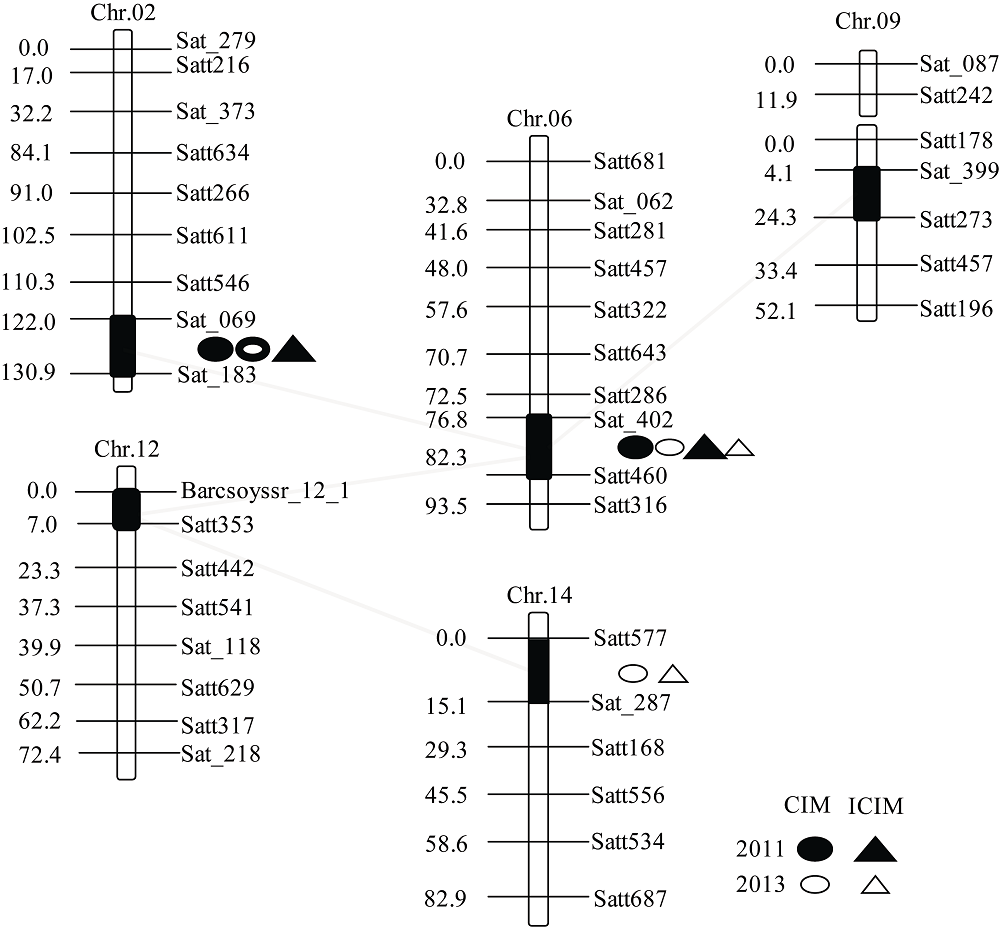
硬实是植物种子的普遍特性, 是影响大豆种子发芽率、生存能力及储存期的重要数量性状, 同时影响着大豆的加工品质。本实验通过对大豆籽粒硬实性状的加性和上位性互作QTL (quantitative trait locus)分析, 明确控制大豆籽粒硬实的重要位点及效应, 旨在为进一步解析硬实性状复杂的遗传机制提供理论依据。以冀豆12和地方品种黑豆(ZDD03651)杂交构建的包含186个家系的F6:8和F6:9重组自交系群体为材料, 采用WinQTL Cartographer V. 2.5的复合区间作图法(composite interval mapping, CIM)定位不同年份的籽粒硬实性状相关的加性QTL, 同时采用IciMapping 4.1软件中的完备区间作图法(inclusive composite interval mapping, ICIM)检测籽粒硬实性状的加性及上位性QTL。共检测到3个籽粒硬实性状相关的加性QTL, 分别位于第2、第6和第14染色体, 遗传贡献率范围为5.54%~12.94%。同时检测到4对上位性互作QTL, 分别位于第2、第6、第9、第12和第14染色体, 可解释的表型变异率为2.53%~3.47%。同时检测到籽粒硬实性状加性及上位性互作QTL, 且上位性互作多发生在主效QTL间或主效QTL与非主效QTL间, 表明上位性互作效应在大豆籽粒硬实性状的遗传基础中具有重要的作用。
| [1] |
孙星邈, 王政, 李曙光, 孟凡凡, 王曙明, 张井勇 . 大豆硬实形成机制与破除技术的研究进展. 大豆科技, 2014, ( 3):23-27
doi: 10.3969/j.issn.1674-3547.2014.03.007 |
|
Sun X M, Wang Z, Li S G, Meng F F, Wang S M, Zhang J Y . Progress on formation mechanism and breaking methods of hard seed in soybean. Soybean Sci Technol, 2014, ( 3):23-27 (in Chinese with English abstract)
doi: 10.3969/j.issn.1674-3547.2014.03.007 |
|
| [2] |
Ladizinsky G . The origin of lentil and its wild genepoo. Euphytica, 1979,28:179-187
doi: 10.1007/BF00029189 |
| [3] | Abbo S, Shtienberg D, Lichtenzveig J, Lev-Yadun S, Gopher A . The chickpea, summer cropping, and a new model for pulse domestication in the ancient near east. Q Rev Biol, 2003, 78:435 |
| [4] |
Weeden N F . Genetic changes accompanying the domestication of pisum sativum: is there a common genetic basis to the ‘domestication syndrome’ for legumes? Ann Bot, 2007,100:1017-1025
doi: 10.1109/55.215086 pmid: 17660515 |
| [5] | Andargie M, Pasquet R S, Gowda B S, Muluvi G M, Timko M P . Molecular mapping of QTLs for domestication-related traits in cowpea [ V. unguiculata( L.) Walp.]. Euphytica, 2014,200:401-412 |
| [6] |
Potts H C, Duangpatra J, Hairston W G, Delouche J C . Some influences of hardseededness on soybean seed quality. Crop Sci, 1978,18:221-224
doi: 10.2135/cropsci1978.0011183X001800020006x |
| [7] | Meyer C J, Steudle E, Peterson C A . Patterns and kinetics of water uptake by soybean seeds. J Exp Bot, 2007,58:717-732 |
| [8] | Mullin W J, Xu W . Study of soybean seed coat components and their relationship to water absorption. J Agric Food Chem, 2001, 49:5331-5335 |
| [9] |
Zhang B, Chen P Y, Chen C Y, Wang D C, Shi A N, Hou A F, Ishibashi T . Quantitative trait loci mapping of seed hardness in soybean. Crop Sci, 2008,48:1341-1349
doi: 10.2135/cropsci2007.10.0544 |
| [10] |
Rolston M P . Water impermeable seed dormancy. Bot Rev, 1978,44:365-396
doi: 10.1007/BF02957854 |
| [11] | Foley M E . Seed dormancy: an update on terminology, physiological genetics, and quantitative trait loci regulating germinability. Weed Sci, 2017,49:305-317 |
| [12] | Saio K, Arai K, Watanabe T . Fine structure of soybean seed coat and its changes on cooking. Cereal Sci Today, 1973,18:197-201 |
| [13] |
Saio K . Soybeans resistant to water absorption. Cereal Foods World, 1976,21:168-173
doi: 10.1007/BF02591040 |
| [14] |
Ting C L . Genetic studies on the wild and cultivated soybeans. J Am Soc Agron, 1946,38:381-393
doi: 10.2134/agronj1946.00021962003800050001x |
| [15] | Kilen T C, Hartwig E E . An inheritance study of impermeable seed in soybean. Field Crops Res, 1978, 1:65-70 |
| [16] | Marjushkin V F, Sichkar V I, Michailov V G, Polivoda V G . Inheritance of hard seedness in soybean. Soybean Genet Newsl, 1988,15:294-297 |
| [17] |
Watanabe S, Tajuddin T, Yamanaka N, Hayashi M, Harada K . Analysis of QTLs for reproductive development and seed quality traits in soybean using recombinant inbred lines. Breed Sci, 2004,54:399-407
doi: 10.1270/jsbbs.54.399 |
| [18] | Keim P, Diers B W, Shoemaker R C . Genetic analysis of soybean hard seededness with molecular markers. Theor Appl Genet, 1990,79:465-469 |
| [19] | Sun L J, Miao Z Y, Cai C M, Zhang D J, Zhao M X, Wu Y Y, Zhang X L, Swarm S A, Zhou L W , Zhang Z J Y, Nelson R L, Ma J X. GmHs1-1, encoding a calcineurin-like protein, controls hard-seededness in soybean. Nat Genet, 2015,47:939 |
| [20] |
Jang S J, Sato M, Sato K, Jitsuyama Y, Fujino K, Mori H, Takahashi R, Benitez E R, Liu B H, Yamada T, Abe J . A single-nucleotide polymorphism in an endo-1,4-β-glucanase gene controls seed coat permeability in soybean. PLoS One, 2015,10:e0128527
doi: 10.1371/journal.pone.0128527 pmid: 4454576 |
| [21] |
雷东阳, 谢放鸣, 徐建龙, 陈立云 . 稻米粒形和垩白度的QTL定位和上位性分析. 中国水稻科学, 2008,22:255-260
doi: 10.3321/j.issn:1001-7216.2008.03.006 |
|
Lei D Y, Xie F M, Xu J L, Chen L Y . QTLs mapping and epistasis analysis for grain shape and chalkiness degree of rice. Chin J Rice Sci, 2008,22:255-260 (in Chinese with English abstract)
doi: 10.3321/j.issn:1001-7216.2008.03.006 |
|
| [22] |
Soyk S, Lemmon Z H, Oved M, Fisher J, Liberatore K L, Park S J, Goren A, Jiang K, Ramos A , Van der Knaap E, Van Eck J, Zamir D, Eshed Y, Lippman Z B. Bypassing negative epistasis on yield in tomato imposed by a domestication gene. Cell, 2017,169:1142-1155
doi: 10.1016/j.cell.2017.04.032 |
| [23] | Liu B, Fujita T, Yan Z H, Sakamoto S, Xu D, Abe J . QTL mapping of domestication-related traits in soybean ( Glycine max). Ann Bot, 2007,100:1027-1038 |
| [24] |
陈强 . 大豆籽粒相关性状QTL定位分析 . 河北科技师范学院硕士学位论文, 河北秦皇岛, 2014
doi: 10.7666/d.Y2762071 |
|
Chen Q . QTL Mapping for Seed Related Traits in Soybean (Glycine max L. Merr.) . MS Thesis of Hebei Normal University of Science & Technology, Qinhuangdao, Hebei, China, 2014 ( in Chinese with English abstract)
doi: 10.7666/d.Y2762071 |
|
| [25] |
雷雅坤, 闫龙, 杨春燕, 宋晓坤, 张孟臣, 黄占景 . 大豆公共遗传图谱C1连锁群SSR标记空白区段的填补. 华北农学报, 2012,27:5-10
doi: 10.3969/j.issn.1000-7091.2012.06.002 |
|
Lei Y K, Yan L, Yang C Y, Song X K, Zhang M C, Huang Z J . Complete the blank section with SSR markers on linkage group C1 of public genetic map in soybean. Acta Agric Boreali-Sin, 2012,27:5-10 (in Chinese with English abstract)
doi: 10.3969/j.issn.1000-7091.2012.06.002 |
|
| [26] |
McCouch S R, Chen X L, Panaud O, Temnykh S, Xu Y B, Cho Y G, Huang N, Ishii T, Blair M . Microsatellite marker development, mapping and application in rice genetics and breeding. Plant Mol Biol, 1997,35:89-99
doi: 10.1023/A:1005711431474 pmid: 9291963 |
| [27] | 牛远, 谢芳腾, 布素红, 谢尚潜, 韩世凤, 耿青春, 刘兵, 章元明 . 大豆粒形性状QTL的精细定位. 作物学报, 2013,39:609-616 |
| Niu Y, Xie F T, Bu S H, Xie S Q, Han S F, Geng Q C, Liu B, Zhang Y M . Fine mapping of quantitative trait loci for seed shape traits in soybean. Acta Agron Sin, 2013,39:609-616 (in Chinese with English abstract) | |
| [28] |
Hagiwara W E, Onishi K, Takamure O I, Sano Y . Transgressive segregation due to linked QTLs for grain characteristics of rice. Euphytica, 2006,150:27-35
doi: 10.1007/s10681-006-9085-8 |
| [29] |
Zhang Z H, Yu S B, Yu T, Huang Z, Zhu Y G . Mapping quantitative trait loci (QTLs) for seedling-vigor using recombinant inbred lines of rice ( Oryza sativa L.). Field Crops Res, 2005,91:161-170
doi: 10.1016/j.fcr.2004.06.004 |
| [30] |
Zhuang J Y, Lin H X, Lu J, Qian H R, Hittalmani S, Huang N, Zheng K L . Analysis of QTL × environment interaction for yield components and plant height in rice. Theor Appl Genet, 1997,95:799-808
doi: 10.1007/s001220050628 |
| [31] |
Lehner B . Molecular mechanisms of epistasis within and between genes. Trends Genet, 2011,27:323-331
doi: 10.1016/j.tig.2011.05.007 |
| [32] |
Cho Y B, Jones S I, Vodkin L O . Mutations in argonaute5 illuminate epistatic interactions of the K1 and I loci leading to saddle seed color patterns in Glycine max. Plant Cell, 2017,29:708
doi: 10.1105/tpc.17.00162 pmid: 28351993 |
| [33] |
Carlborg O, Haley C S . Epistasis: too often neglected in complex trait studies? Nat Rev Genet, 2004,5:618
doi: 10.1038/nrg1407 |
| [1] | 陈玲玲, 李战, 刘亭萱, 谷勇哲, 宋健, 王俊, 邱丽娟. 基于783份大豆种质资源的叶柄夹角全基因组关联分析[J]. 作物学报, 2022, 48(6): 1333-1345. |
| [2] | 胡文静, 李东升, 裔新, 张春梅, 张勇. 小麦穗部性状和株高的QTL定位及育种标记开发和验证[J]. 作物学报, 2022, 48(6): 1346-1356. |
| [3] | 杨欢, 周颖, 陈平, 杜青, 郑本川, 蒲甜, 温晶, 杨文钰, 雍太文. 玉米-豆科作物带状间套作对养分吸收利用及产量优势的影响[J]. 作物学报, 2022, 48(6): 1476-1487. |
| [4] | 王炫栋, 杨孙玉悦, 高润杰, 余俊杰, 郑丹沛, 倪峰, 蒋冬花. 拮抗大豆斑疹病菌放线菌菌株的筛选和促生作用及防效研究[J]. 作物学报, 2022, 48(6): 1546-1557. |
| [5] | 于春淼, 张勇, 王好让, 杨兴勇, 董全中, 薛红, 张明明, 李微微, 王磊, 胡凯凤, 谷勇哲, 邱丽娟. 栽培大豆×半野生大豆高密度遗传图谱构建及株高QTL定位[J]. 作物学报, 2022, 48(5): 1091-1102. |
| [6] | 李阿立, 冯雅楠, 李萍, 张东升, 宗毓铮, 林文, 郝兴宇. 大豆叶片响应CO2浓度升高、干旱及其交互作用的转录组分析[J]. 作物学报, 2022, 48(5): 1103-1118. |
| [7] | 彭西红, 陈平, 杜青, 杨雪丽, 任俊波, 郑本川, 罗凯, 谢琛, 雷鹿, 雍太文, 杨文钰. 减量施氮对带状套作大豆土壤通气环境及结瘤固氮的影响[J]. 作物学报, 2022, 48(5): 1199-1209. |
| [8] | 王好让, 张勇, 于春淼, 董全中, 李微微, 胡凯凤, 张明明, 薛红, 杨梦平, 宋继玲, 王磊, 杨兴勇, 邱丽娟. 大豆突变体ygl2黄绿叶基因的精细定位[J]. 作物学报, 2022, 48(4): 791-800. |
| [9] | 李瑞东, 尹阳阳, 宋雯雯, 武婷婷, 孙石, 韩天富, 徐彩龙, 吴存祥, 胡水秀. 增密对不同分枝类型大豆品种同化物积累和产量的影响[J]. 作物学报, 2022, 48(4): 942-951. |
| [10] | 杜浩, 程玉汉, 李泰, 侯智红, 黎永力, 南海洋, 董利东, 刘宝辉, 程群. 利用Ln位点进行分子设计提高大豆单荚粒数[J]. 作物学报, 2022, 48(3): 565-571. |
| [11] | 周悦, 赵志华, 张宏宁, 孔佑宾. 大豆紫色酸性磷酸酶基因GmPAP14启动子克隆与功能分析[J]. 作物学报, 2022, 48(3): 590-596. |
| [12] | 王娟, 张彦威, 焦铸锦, 刘盼盼, 常玮. 利用PyBSASeq算法挖掘大豆百粒重相关位点与候选基因[J]. 作物学报, 2022, 48(3): 635-643. |
| [13] | 董衍坤, 黄定全, 高震, 陈栩. 大豆PIN-Like (PILS)基因家族的鉴定、表达分析及在根瘤共生固氮过程中的功能[J]. 作物学报, 2022, 48(2): 353-366. |
| [14] | 张艳波, 王袁, 冯甘雨, 段慧蓉, 刘海英. 棉籽油分和3种主要脂肪酸含量QTL分析[J]. 作物学报, 2022, 48(2): 380-395. |
| [15] | 张国伟, 李凯, 李思嘉, 王晓婧, 杨长琴, 刘瑞显. 减库对大豆叶片碳代谢的影响[J]. 作物学报, 2022, 48(2): 529-537. |
|
||