欢迎访问作物学报,今天是
作物学报 ›› 2023, Vol. 49 ›› Issue (1): 177-187.doi: 10.3724/SP.J.1006.2023.24026
白智媛, 陈向阳, 郑阿香, 张力, 邹军, 张大同, 陈阜, 尹小刚( )
)
BAI Zhi-Yuan, CHEN Xiang-Yang, ZHENG A-Xiang, ZHANG Li, ZOU Jun, ZHANG Da-Tong, CHEN Fu, YIN Xiao-Gang()
摘要:
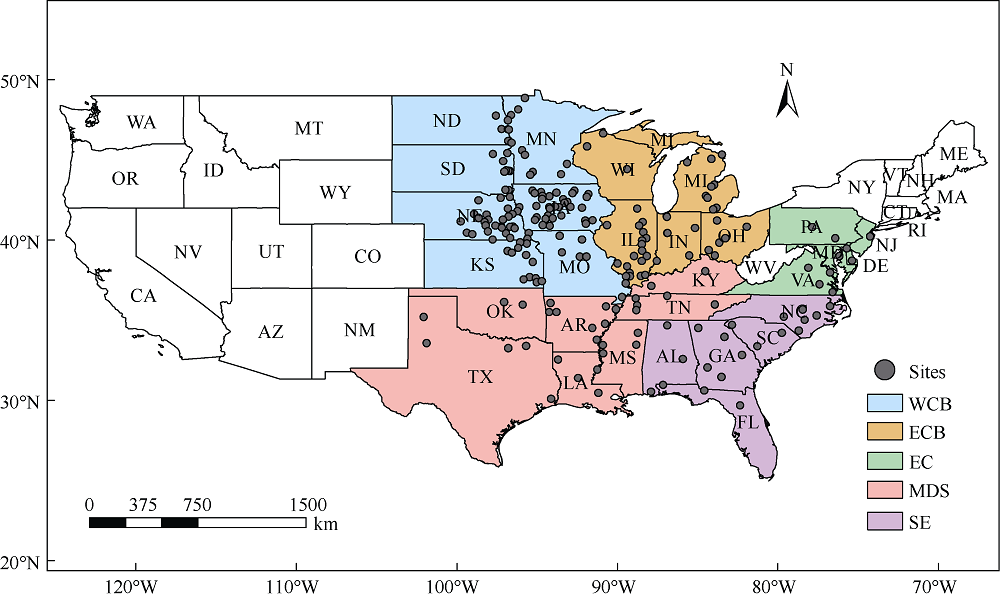
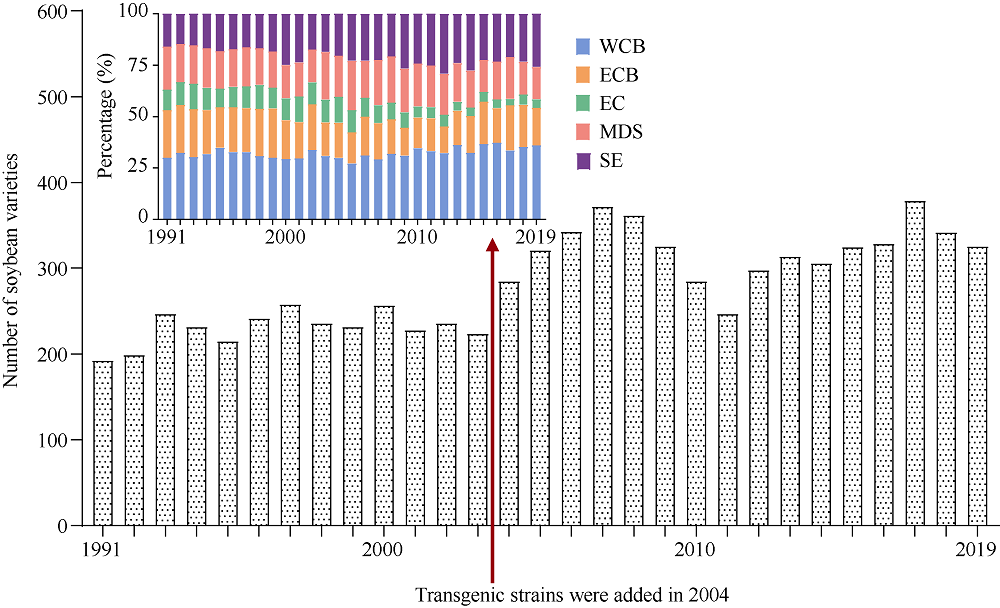
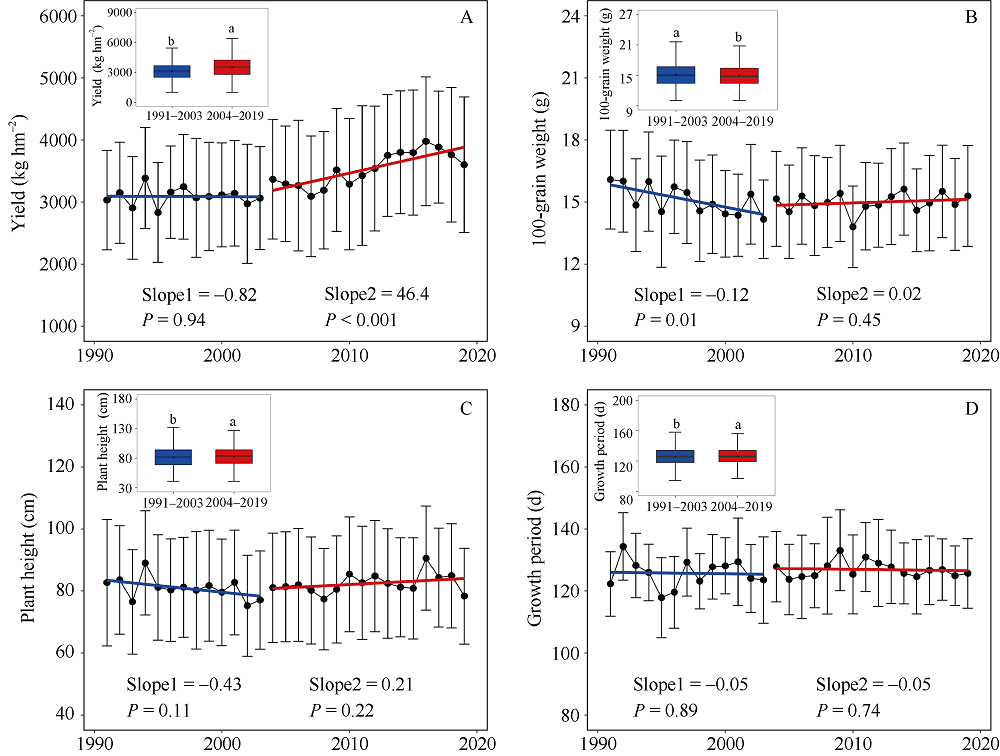
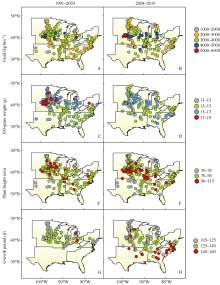
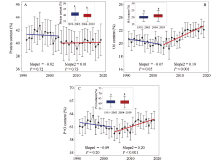
美国是全球重要的大豆生产国, 中美大豆生产水平差距大, 探讨美国大豆品种主要性状的时空演变规律对中国大豆生产具有重要借鉴意义。本研究基于1991—2019年美国213个大豆品种区试站点共计102,244个年点观测数据, 综合运用线性回归模型、空间分析和结构方程模型等方法, 研究了近30年来美国大豆区试品种(系)农艺和品质性状的时空变化特征。结果表明: (1) 1991—2019年美国大豆区试品种(系)数量和大豆单产均呈上升趋势, 1991—2003年大豆单产稳定在3000 kg hm-2左右, 2004年以来大豆单产以年均46.4 kg hm-2的速度显著增加, 近15年大豆平均单产为3525 kg hm-2; 西部和东部玉米带是美国大豆高产区, 2004—2019年美国有22.6%的区试站点大豆单产超过4000 kg hm-2, 且主要分布于西部玉米带和东部玉米带。(2) 近30年美国大豆区试品种(系)的百粒重呈下降趋势, 而株高和生育期无显著变化; 1991—2003年间百粒重年均下降0.12 g, 2004年以来百粒重无明显变化。(3) 近30年美国大豆区试品种(系)的蛋白质含量呈下降趋势, 平均蛋白质含量从1991—2003年间的41.3%下降到2004—2019年间的40.0%, 美国南部地区的蛋白质含量比北部地区高1.4%; 油脂呈先下降后增加趋势, 平均油脂含量从1991—2003年间的20.3%上升到2004—2019年间的21.3%; 2004—2019年美国有59.2%的区试站点大豆油脂含量超过21%。(4) 2004—2019年美国大豆区试品种(系)单产水平和油脂含量协同提高, 大豆自身农艺性状对单产的制约作用降低。本研究揭示了美国近30年来大豆品种(系)农艺和品质性状的时空变化特征, 阐明了不同时期大豆区试品种(系)单产与主要性状之间的关系, 可为中国大豆品种高产优质协同发展提供参考。
| [1] | 盖钧镒. 中国大豆产业、科技、种业和转基因育种的思考(I). 大豆科技, 2011, (3): 1-2. |
| Gai J Y. Thoughts on soybean industry, science and technology, seed industry and transgenic breeding in China (I). Soybean Sci Technol, 2011, (3): 1-2. (in Chinese) | |
| [2] | 杨皓森, 王禹. 中国大豆供需形势中长期展望研究. 农业经济, 2020, (12): 114-117. |
| Yang H S, Wang Y. Study on medium- and long-term prospect of soybean supply and demand in China. Agric Econ, 2020, (12): 114-117. (in Chinese) | |
| [3] | 胡忆雨, 邹军, 吴尧, 王小慧, 杨雨豪, 陈阜, 尹小刚. 全球禾-豆生产系统作物多样性变化特征及其影响. 中国农业大学学报, 2021, 26(8): 9-22. |
| Hu Y Y, Zou J, Wu Y, Wang X H, Yang Y H, Chen F, Yin X G. Changes and impacts of crop diversity in global cereal-legume production systems. J China Agric Univ, 2021, 26(8): 9-22. (in Chinese with English abstract) | |
| [4] | 曹宝明, 赵霞. 基于局部均衡理论的中国大豆及其制品供需变化预测. 中国农村经济, 2011, (9): 23-36. |
| Cao B M, Zhao X. Prediction of supply and demand changes of soybean and its products in China based on local equilibrium theory. Chin Rural Econ, 2011, (9): 23-36. (in Chinese) | |
| [5] | 陈伟, 朱俊峰, 田国强. 中美贸易摩擦对中国大豆的影响及对策分析. 大豆科学, 2019, 38: 118-123. |
| Chen W, Zhu J F, Tian G Q. The impact and countermeasures analysis of Sino-US trade friction on China’s soybean. Soybean Sci, 2019, 38: 118-123. (in Chinese with English abstract) | |
| [6] | USDA. Uniform Soybean Test Sites. https://www.nass.usda.gov/. |
| [7] | 尹小刚, 陈阜. 1961-2017年全球大豆生产时空变化. 世界农业, 2019, 487(11): 65-71. |
| Yin X G, Chen F. Spatial-temporal changes of global soybean production during 1961 and 2017. World Agric, 2019, 487(11): 65-71. (in Chinese with English abstract) | |
| [8] |
Hurburgh C R, Brumm T J, Guinn J M, Hartwig R A. Protein and oil patterns in U.S. and world soybean markets. J Am Oil Chem Soc, 1990, 67: 966-973.
doi: 10.1007/BF02541859 |
| [9] | 胡忆雨, 朱颖璇, 杨雨豪, 邹军, 陈阜, 尹小刚. 1951-2015年中国主要粮食与油料作物种植结构变化分析. 中国农业大学学报, 2019, 24(11): 183-196. |
| Hu Y Y, Zhu Y X, Yang Y H, Zou J, Chen F, Yin X G. Changes of planting structure of major food and oil crops in China from 1951 to 2015. J China Agric Univ, 2019, 24(11): 183-196. (in Chinese with English abstract) | |
| [10] |
Li C, Wang X S, Guo Z K, Huang N, Hou S B, He G, Batchelor W D, Siddique K H M, Wang Z H, Zhang D. Optimizing nitrogen fertilizer inputs and plant populations for greener wheat production with high yields and high efficiency in dryland areas. Field Crops Res, 2022, 276: 108374.
doi: 10.1016/j.fcr.2021.108374 |
| [11] |
敖荣军, 常亮. 基于结构方程模型的中国县域人口老龄化影响机制. 地理学报, 2020, 75: 1572-1584.
doi: 10.11821/dlxb202008002 |
| Ao R J, Chang L. Influencing mechanism of regional ageing in China based on the structural equation model. Acta Geograph Sin, 2020, 75: 1572-1584. (in Chinese with English abstract) | |
| [12] |
Board J E. Yield components related to seed yield in determinate soybean. Crop Sci, 1987, 27: 1296-1297.
doi: 10.2135/cropsci1987.0011183X002700060041x |
| [13] |
Wei M C F, Molin J P. Soybean yield estimation and its components: a linear regression approach. Agriculture, 2020, 10: 348.
doi: 10.3390/agriculture10080348 |
| [14] |
Suhre J J, Weidenbenner N H, Rowntree S C, Wilson E W, Naeve S L, Conley S P, Casteel S N, Diers B W, Esker P D, Specht J E, Davis V M. Soybean yield partitioning changes revealed by genetic gain and seeding rate interactions. Agron J, 2014, 106: 1631-1642.
doi: 10.2134/agronj14.0003 |
| [15] | 尹阳阳, 徐彩龙, 宋雯雯, 胡水秀, 吴存祥. 密植是挖掘大豆产量潜力的重要栽培途径. 土壤与作物, 2019, 8: 361-367. |
| Yin Y Y, Xu C L, Song W W, Hu S X, Wu C X. Increasing planting density is an important approach to achieve the potential of soybean yield. Soils Crops, 2019, 8: 361-367. (in Chinese with English abstract) | |
| [16] | 赵团结, 盖钧镒, 李海旺, 邢邯, 邱家驯. 超高产大豆育种研究的进展与讨论. 中国农业科学, 2006, 39: 29-37. |
| Zhao T J, Gai J Y, Li H W, Xing H, Qiu J X. Advances in breeding for super high-yielding soybean cultivars. Sci Agric Sin, 2006, 39: 29-37. (in Chinese with English abstract) | |
| [17] | 杜维广, 张桂茹, 满为群, 陈怡, 栾晓燕, 郝乃斌, 戈巧英, 谷秀芝. 大豆高光效品种(种质)选育及高光效育种再探讨. 大豆科学, 2001, 20: 110-115. |
| Du W G, Zhang G R, Man W Q, Chen Y, Luan X Y, Hao N B, Ge Q Y, Gu X Z. Development of soybean cultivars (germplasm) with high photosynthetic efficiency (HPE) and rediscussion of breeding for HPE. Soybean Sci, 2001, 20: 110-115. (in Chinese with English abstract) | |
| [18] | 刘章雄, 邱丽娟, 关荣霞, 常汝镇. 美国大豆育种研究进展. 大豆科学, 2004, 23: 123-129. |
| Liu Z X, Qiu L J, Guan R X, Chang R Z. New advances in the study soybean breeding of U.S.A. Soybean Sci, 2004, 23: 123-129. (in Chinese with English abstract) | |
| [19] |
Cooper R L. A delayed flowering barrier to higher soybean yields. Field Crops Res, 2003, 82: 27-35.
doi: 10.1016/S0378-4290(03)00003-0 |
| [20] |
Carciochi W D, Schwalbert R, Andrade F H, Corassa G M, Carter P, Gaspar A P, Schmidt J, Ciampitti I A. Soybean seed yield response to plant density by yield environment in north America. Agron J, 2019, 111: 1923-1932.
doi: 10.2134/agronj2018.10.0635 |
| [21] |
Pedersen P, Lauer J G. Corn and soybean response to rotation sequence, row spacing, and tillage system. Agron J, 2003, 95: 965-971.
doi: 10.2134/agronj2003.9650 |
| [22] | 张伟, 张惠君, 王海英, 谢甫绨, 陈振武. 株行距和种植密度对高油大豆农艺性状及产量的影响. 大豆科学, 2006, 25: 283-287. |
| Zhang W, Zhang H J, Wang H Y, Xie F T, Chen Z W. Effects of spacings and planting densities on agronomic traits and yield in high-oil soybean. Soybean Sci, 2006, 25: 283-287. (in Chinese with English abstract) | |
| [23] | USDA. https://www.usda.gov/topics/trade, 2021. |
| [24] |
Rotundo J L, Westgate M E. Meta-analysis of environmental effects on soybean seed composition. Field Crops Res, 2009, 110: 147-156.
doi: 10.1016/j.fcr.2008.07.012 |
| [25] |
Yaklich R W, Vinyard B, Camp M, Douglass S. Analysis of seed protein and oil from soybean Northern and Southern Region uniform tests. Crop Sci, 2002, 42: 1504-1515.
doi: 10.2135/cropsci2002.1504 |
| [26] |
Wu D, Qu J J, Hao X. Agricultural drought monitoring using MODIS-based drought indices over the America Corn Belt. Int J Remote Sens, 2015, 36: 5403-5425.
doi: 10.1080/01431161.2015.1093190 |
| [27] |
Ren C, Bilyeu K D, Beuselinck P R. Composition, vigor, and proteome of mature soybean seeds developed under high temperature. Crop Sci, 2009, 49: 1010-1022.
doi: 10.2135/cropsci2008.05.0247 |
| [28] | Liu Y, Dai L. Modelling the impacts of climate change and crop management measures on soybean phenology in China. J Clean Prod, 2020, 262. |
| [29] | 肖琴, 李建平, 刘冬梅. 转基因大豆冲击下的中国大豆产业发展对策. 中国科技论坛, 2015, (6): 137-141. |
| Xiao Q, Li J P, Liu D M. Development countermeasures of China’s soybean industry under the impact of genetically modified soybean. Forum Sci Technol China, 2015, (6): 137-141. (in Chinese with English abstract) | |
| [30] | 杨树果, 何秀荣. 中国大豆产业状况和观点思考. 中国农村经济, 2014, (4): 32-41. |
| Yang S G, He X R. Situation and viewpoint of China’s soybean industry. Chin Rural Econ, 2014, (4): 32-41. (in Chinese) | |
| [31] | 宋启建, 盖钧镒, 马育华. 长江中游夏大豆地方品种品质及产量等性状的典型相关与通径分析. 大豆科学, 1996, 15: 11-16. |
| Song Q J, Gai J Y, Ma Y H. Canonical correlation and path analysis of quality and yield of summer soybean landraces in the middle reaches of the Yangtze River. Soybean Sci, 1996, 15: 11-16. (in Chinese with English abstract) | |
| [32] | 何鑫, 马文娅, 付汝洪, 张琪, 闫向前. 2006-2017年国家黄淮海夏大豆品种区域试验参试品种(系)分析. 中国油料作物学报, 2019, 41: 537-549. |
| He X, Ma W Y, Fu R H, Zhang Q, Yan X Q. Analysis of national summer soybean regional trials in Huang-Huai-Hai region during 2006-2017. Chin Oil Crop Sci, 2019, 41: 537-549. (in Chinese with English abstract) | |
| [33] | 刘军, 徐瑞新, 石垒, 王孟, 徐印印, 姜汉峰, 姜硕琛, 邢丹英. 中国国审大豆品种(2003-2016年)主要性状变化趋势分析. 安徽农学通报, 2017, 23(11): 60-66. |
| Liu J, Xu R X, Shi L, Wang M, Xu Y Y, Jiang H F, Jiang S C, Xing D Y. Variation trend of major traits of national authorized soybean cultivars from 2003 to 2016. Anhui Agric Sci Bull, 2017, 23(11): 60-66. (in Chinese with English abstract) | |
| [34] | 刘绪贻. 罗斯福“新政”的农业政策. 史学月刊, 2001, (3): 103-109. |
| Liu X Y. Roosevelt’s agricultural policy in his “New Deal”. J Historic Sci, 2001, (3): 103-109. (in Chinese with English abstract) | |
| [35] | 王玉飞. 美国大豆补贴政策对我国的借鉴和启示. 农业经济问题, 2011, 32(1): 100-105. |
| Wang Y F. Reference and enlightenment of American soybean subsidy policy to China. Issues Agric Econ, 2011, 32(1): 100-105. (in Chinese) | |
| [36] | 苗水清, 程国强. 美国大豆补贴政策及其影响. 中国农村经济, 2006, (5): 72-80. |
| Miao S Q, Cheng G Q. American soybean subsidy policy and its impact. Chin Rural Econ, 2006, (5): 72-80. (in Chinese) | |
| [37] | Glauber J, Smith V. Trends in US agricultural policy since 2000 and implications for the next twenty years. Euro Choices, 2021, 20: 58-63. |
| [38] | 程敏. 从粮食视角分析中美农产品贸易互利互赢——依据美国农业部数据. 黑龙江粮食, 2021, (6): 33-35. |
| Cheng M. Analysis on the mutual benefit and win-win of Sino US agricultural trade from the perspective of grain—according to the data of the U.S. Department of Agriculture. Heilongjiang Grain, 2021, (6): 33-35. (in Chinese with English abstract) | |
| [39] | 徐雪高, 吴比, 张振. 大豆目标价格补贴的政策演进与效果评价. 经济纵横, 2016, (10): 81-87. |
| Xu X G, Wu B, Zhang Z. Policy evolution and effect evaluation of soybean target price subsidy. Econ Rev J, 2016, (10): 81-87. (in Chinese) | |
| [40] | 王新刚, 司伟. 大豆补贴政策改革实现大豆扩种了吗?——基于大豆主产区124个地级市的实证. 中国农村经济, 2021, (12): 44-65. |
| Wang X G, Si W. Does the reform of subsidy policy realize the expansion of soybean production? An empirical analysis based on 124 prefecture-level cites in soybean main producing areas. Chin Rural Econ, 2021, (12): 44-65. (in Chinese with English abstract) | |
| [41] | 知谷客. 农业农村部、财政部发布2018年财政重点强农惠农政策. 农业机械, 2018, (4): 45-48. |
| Zhi G K. Ministry of Agriculture and Rural Affairs, Ministry of Finance issued the policy of strengthening agriculture and benefiting agriculture in 2018. Farm Machin, 2018, (4): 45-48. (in Chinese) |
| [1] | 金昱何, 王雪菲, 徐张一娃, 缪怡宁, 蒋云杰, 伊莹, 缪德麟, 朱静仪, 钟一帆, 陈铭亨, 方芳, 刘鹏. 外源激素对低温胁迫下大豆叶片叶绿素荧光参数及抗氧化酶系统的影响[J]. 作物学报, 2026, 52(6): 1817-1829. |
| [2] | 唐宽强, 李公允, 宋美毅, 赵雪, 常春玲. 大豆株高性状全基因组关联分析及预测模型构建[J]. 作物学报, 2026, 52(6): 1743-1756. |
| [3] | 王宇诚, 张露, 刘阿康, 黄见良, 彭少兵, 袁珅. 基于产量差的作物大面积单产提升策略与展望[J]. 作物学报, 2026, 52(5): 1279-1290. |
| [4] | 姚术, 郭凯悦, 翟慧慧, 姚佳慧, 邓文琪, 闫玲, 黄驰, 高阳, 俞嫣然, 赵振邦, 李英慧, 王晓波, 李佳佳. 大豆苗期耐低铁综合评价及优异种质筛选[J]. 作物学报, 2026, 52(5): 1373-1387. |
| [5] | 张全军, 吴东丽, 刘聪, 朱永超, 杨大生, 孔祥胜. 1981—2024年长江中下游油菜发育期时空格局演变特征[J]. 作物学报, 2026, 52(4): 1140-1152. |
| [6] | 张晴, 杨昱, 郭茜, 岳霈尧, 殷丛丛, 牛景萍, 赵晋忠, 杜维俊, 岳爱琴. 大豆GmARA6a的克隆及响应盐胁迫的功能分析[J]. 作物学报, 2026, 52(2): 480-493. |
| [7] | 王克晶, 李向华. 我国珍稀的大豆属多年生烟豆和短绒野大豆物种遗传资源濒危性评估分析[J]. 作物学报, 2025, 51(8): 2009-2019. |
| [8] | 孟然, 李赵嘉, 冯薇, 陈悦, 刘路平, 杨春燕, 鲁雪林, 王秀萍. 大豆不同生育时期耐盐性综合评价及耐盐种质筛选[J]. 作物学报, 2025, 51(8): 1991-2008. |
| [9] | 贺红利, 张雨涵, 杨静, 程云清, 赵杨, 李星诺, 司洪亮, 张兴政, 杨向东. 大豆e1-as基因突变体的创制及生理分析[J]. 作物学报, 2025, 51(8): 2228-2239. |
| [10] | 胡蒙, 沙丹, 张晟瑞, 谷勇哲, 张世碧, 李静, 孙君明, 邱丽娟, 李斌. 大豆分枝数QTL定位及候选基因筛选[J]. 作物学报, 2025, 51(7): 1747-1756. |
| [11] | 王琼, 邹丹霞, 陈兴运, 张威, 张红梅, 刘晓庆, 贾倩茹, 魏利斌, 崔晓艳, 陈新, 王学军, 陈华涛. 大豆开花时间和成熟期性状全基因组关联分析与候选基因预测[J]. 作物学报, 2025, 51(6): 1558-1568. |
| [12] | 殷丛丛, 李睿琦, 岳霈尧, 李晨, 牛景萍, 赵晋忠, 杜维俊, 岳爱琴. 基于闭合哑铃介导等温扩增可视化检测大豆花叶病毒SC15方法的建立及应用[J]. 作物学报, 2025, 51(5): 1248-1260. |
| [13] | 庄玥茗, 宋毅, 陈航航, 陆志峰, 廖世鹏, 李小坤, 丛日环, 任涛, 鲁剑巍. 氮肥用量对油菜籽粒内生微生物及籽粒品质的影响[J]. 作物学报, 2025, 51(12): 3357-3368. |
| [14] | 许睿, 何妙华, 王昊, 李卫, 任杰, 夏志强. 基于空间转录组技术解析大豆种胚对X射线辐射的响应机制[J]. 作物学报, 2025, 51(12): 3121-3132. |
| [15] | 林洋, 史晓蕾, 陈强, 刘兵强, 杨庆, 于慧娟, 闫龙, 武小霞, 杨春燕. 大豆蛋白质脂肪及脂肪酸组分相关QTL定位[J]. 作物学报, 2025, 51(11): 2899-2910. |
|
||