欢迎访问作物学报,今天是
作物学报 ›› 2026, Vol. 52 ›› Issue (4): 1088-1102.doi: 10.3724/SP.J.1006.2026.54108
蒋嘉卉1,2( ), 江炳志1, 刘冠明2, 王章英1,*(), 唐朝臣1,*()
Jiang Jia-Hui1,2(), Jiang Bing-Zhi1, Liu Guan-Ming2, Wang Zhang-Ying1,*(), Tang Chao-Chen1,*()
摘要:
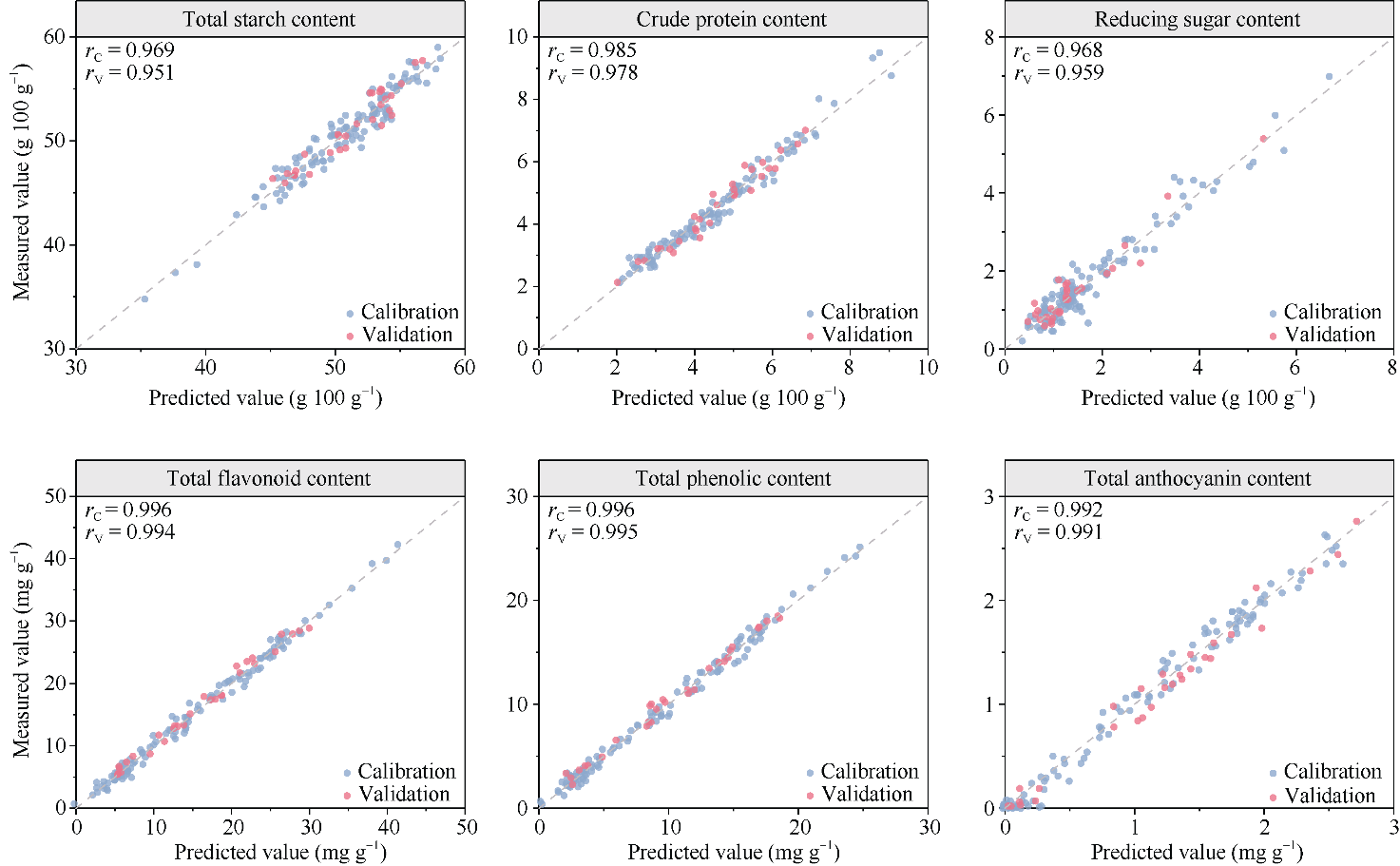
紫肉甘薯在品质评价上缺乏精确高效的方法, 已成为其种质资源精准鉴定与遗传改良的关键瓶颈。为此, 本研究基于近红外光谱(NIRS)技术, 针对紫肉甘薯的主要品质性状(包括总淀粉、粗蛋白、还原糖、总黄酮、总酚和花青素), 开展了高通量预测模型的构建与优化。本研究选取150份代表性样品, 结合双重优化策略与机器学习算法, 成功建立并优化了6个高性能预测模型。结果显示, 校正集决定系数(R2C)为0.936~0.992, 交叉验证决定系数(R2CV)为0.918~0.987, 验证集决定系数(R2V)为0.903~0.987, 预测偏差比(RPD)为6.55~19.80, 范围误差比(RER)为21.9~63.4, 这些结果表明, 所构建的模型具有良好的稳定性与可靠的预测能力。这些预测模型为紫肉甘薯品质的高通量评价提供了高效、可行的技术路径, 能够促进营养成分的定量评估和优质种质的高效筛选, 从而为提升紫肉甘薯品质和推动产业可持续发展提供核心驱动力。
| [1] |
史光辉, 胡志和, 马科铭, 等. 紫薯花青素提取条件优化及淀粉等产物的制备. 食品科学, 2014, 35(22): 39-45.
doi: 10.7506/spkx1002-6630-201422008 |
| Shi G H, Hu Z H, Ma K M, et al. Optimization of extraction conditions of anthocyanins from purple sweet potato and simultaneous preparation of starch and other by-products. Food Sci, 2014, 35(22): 39-45 (in Chinese with English abstract). | |
| [2] | Song W H, Li C Y, Kou M, et al. Different regions and environments have critical roles on yield, main quality and industrialization of an industrial purple-fleshed sweetpotato (Ipomoea batatas (L.) Lam. “Xuzishu 8”. Heliyon, 2024, 10: e25328. |
| [3] |
朱大洲, 武宁, 张勇, 等. 营养导向型作物新品种选育与审定现状、问题与展望. 作物学报, 2023, 49: 1-11.
doi: 10.3724/SP.J.1006.2023.23018 |
|
Zhu D Z, Wu N, Zhang Y, et al. Current situation, issues, and prospects of breeding and approval of new varieties of nutrition-oriented crops. Acta Agron Sin, 2023, 49: 1-11 (in Chinese with English abstract).
doi: 10.3724/SP.J.1006.2023.23018 |
|
| [4] | 谢一芝, 郭小丁, 贾赵东, 等. 紫心甘薯育种现状及展望. 植物遗传资源学报, 2012, 13: 709-713. |
| Xie Y Z, Guo X D, Jia Z D, et al. Progresses and prospects on purple-fleshed sweet potato breeding. J Plant Genet Resour, 2012, 13: 709-713 (in Chinese with English abstract). | |
| [5] |
王欣, 李强, 曹清河, 等. 中国甘薯产业和种业发展现状与未来展望. 中国农业科学, 2021, 54: 483-492.
doi: 10.3864/j.issn.0578-1752.2021.03.003 |
| Wang X, Li Q, Cao Q H, et al. Current status and future prospective of sweet potato production and seed industry in China. Sci Agric Sin, 2021, 54: 483-492 (in Chinese with English abstract). | |
| [6] |
何鸿举, 王婧茹, 刘红, 等. 近红外光谱技术在甘薯品质检测方面的应用研究进展. 食品科学, 2023, 44(21): 341-350.
doi: 10.7506/spkx1002-6630-20221030-307 |
| He H J, Wang J R, Liu H, et al. Recent advances in the application of near-infrared spectroscopy in quality detection of sweet potato. Food Sci, 2023, 44(21): 341-350 (in Chinese with English abstract). | |
| [7] | 魏良明, 严衍禄, 戴景瑞. 近红外反射光谱测定玉米完整籽粒蛋白质和淀粉含量的研究. 中国农业科学, 2004, 37: 630-633. |
| Wei L M, Yan Y L, Dai J R. Determining protein and starch contents of whole maize kernel by near infrared reflectance spectroscopy (NIRS). Sci Agric Sin, 2004, 37: 630-633 (in Chinese with English abstract). | |
| [8] |
Tang C C, Jiang B Z, Ejaz I, et al. High-throughput phenotyping of nutritional quality components in sweet potato roots by near-infrared spectroscopy and chemometrics methods. Food Chem X, 2023, 20: 100916.
doi: 10.1016/j.fochx.2023.100916 |
| [9] |
Liu M, Wang R X, Shi D L, et al. Non-destructive prediction of tea polyphenols during Pu-erh tea fermentation using NIR coupled with chemometrics methods. J Food Compos Anal, 2024, 131: 106247.
doi: 10.1016/j.jfca.2024.106247 |
| [10] |
Porep J U, Kammerer D R, Carle R. On-line application of near infrared (NIR) spectroscopy in food production. Trends Food Sci Technol, 2015, 46: 211-230.
doi: 10.1016/j.tifs.2015.10.002 |
| [11] | 陈瀑, 戴嘉伟, 李敬岩, 等. 近红外光谱分析中的化学计量学方法进展. 化学试剂, 2023, 45(6): 105-112. |
| Chen P, Dai J W, Li J Y, et al. Progress of chemometric methods in near-infrared spectroscopy. Chem Reag, 2023, 45(6): 105-112 (in Chinese with English abstract). | |
| [12] | 毕京翠, 张文伟, 肖应辉, 等. 应用近红外光谱技术分析稻米蛋白质含量. 作物学报, 2006, 32: 709-715. |
| Bi J C, Zhang W W, Xiao Y H, et al. Analysis for protein content in rice by near infrared reflectance spectroscopy (NIRS) technique. Acta Agron Sin, 2006, 32: 709-715 (in Chinese with English abstract). | |
| [13] |
李栓明, 郭银巧, 王克如, 等. 小麦籽粒蛋白质光谱特征变量筛选方法研究. 中国农业科学, 2015, 48: 2317-2326.
doi: 10.3864/j.issn.0578-1752.2015.12.004 |
| Li S M, Guo Y Q, Wang K R, et al. Research on variable selection of wheat kernel protein content with near-infrared spectroscopy. Sci Agric Sin, 2015, 48: 2317-2326 (in Chinese with English abstract). | |
| [14] |
张北举, 陈松树, 李魁印, 等. 基于近红外光谱的高粱籽粒直链淀粉、支链淀粉含量检测模型的构建与应用. 中国农业科学, 2022, 55: 26-35.
doi: 10.3864/j.issn.0578-1752.2022.01.003 |
|
Zhang B J, Chen S S, Li K Y, et al. Construction and application of detection model for amylose and amylopectin content in sorghum grains based on near infrared spectroscopy. Sci Agric Sin, 2022, 55: 26-35 (in Chinese with English abstract).
doi: 10.3864/j.issn.0578-1752.2022.01.003 |
|
| [15] |
王若楠, 张颖星, 于筱菡, 等. 基于近红外快速检测技术的谷子淀粉多样性分析及模型构建. 作物学报, 2025, 51: 1757-1768.
doi: 10.3724/SP.J.1006.2025.44194 |
|
Wang R N, Zhang Y X, Yu X H, et al. Near-infrared spectroscopic evaluation of starch diversity and model construction in foxtail millet. Acta Agron Sin, 2025, 51: 1757-1768 (in Chinese with English abstract).
doi: 10.3724/SP.J.1006.2025.44194 |
|
| [16] |
Lu G Q, Huang H H, Zhang D P. Prediction of sweetpotato starch physiochemical quality and pasting properties using near-infrared reflectance spectroscopy. Food Chem, 2006, 94: 632-639.
doi: 10.1016/j.foodchem.2005.02.006 |
| [17] |
Diaz J T, Veal M W, Chinn M S. Development of NIRS models to predict composition of enzymatically processed sweetpotato. Ind Crops Prod, 2014, 59: 119-124.
doi: 10.1016/j.indcrop.2014.05.012 |
| [18] |
Gouveia C S S, Lebot V, de Carvalho M P. NIRS estimation of drought stress on chemical quality constituents of taro (Colocasia esculenta L.) and sweet potato (Ipomoea batatas L.) flours. Appl Sci, 2020, 10: 8724.
doi: 10.3390/app10238724 |
| [19] |
Magwaza L S, Messo Naidoo S I, Laurie S M, et al. Development of NIRS models for rapid quantification of protein content in sweetpotato [Ipomoea batatas (L.) Lam.]. LWT Food Sci Technol, 2016, 72: 63-70.
doi: 10.1016/j.lwt.2016.04.032 |
| [20] | 唐忠厚, 李洪民, 李强, 等. 基于近红外光谱技术预测甘薯块根淀粉与糖类物质含量. 江苏农业学报, 2013, 29: 1260-1265. |
| Tang Z H, Li H M, Li Q, et al. Prediction of starch and sugar contents in sweet potato root by near-infrared spectroscopy (NIRS). Jiangsu J Agric Sci, 2013, 29: 1260-1265 (in Chinese with English abstract). | |
| [21] |
He H J, Wang Y Y, Zhang M, et al. Rapid determination of reducing sugar content in sweet potatoes using NIR spectra. J Food Compos Anal, 2022, 111: 104641.
doi: 10.1016/j.jfca.2022.104641 |
| [22] |
卜晓朴, 彭彦昆, 王文秀, 等. 生鲜紫薯花青素等多品质参数的可见-近红外快速无损检测. 食品科学, 2018, 39(16): 227-232.
doi: 10.7506/spkx1002-6630-201816033 |
| Bu X P, Peng Y K, Wang W X, et al. Rapid nondestructive detection of multiple quality parameters of fresh purple sweet potato based on visible near infrared spectroscopy. Food Sci, 2018, 39(16): 227-232 (in Chinese with English abstract). | |
| [23] | Tian X Y, Aheto J H, Bai J W, et al. Quantitative analysis and visualization of moisture and anthocyanins content in purple sweet potato by Vis-NIR hyperspectral imaging. J Food Process Preserv, 2021, 45: e15128. |
| [24] |
Lebot V, Ndiaye A, Malapa R. Phenotypic characterization of sweet potato [Ipomoea batatas (L.) Lam.] genotypes in relation to prediction of chemical quality constituents by NIRS equations. Plant Breed, 2011, 130: 457-463.
doi: 10.1111/pbr.2011.130.issue-4 |
| [25] | Tang C C, Mo X Y, Ma Z M, et al. Machine learning-enhanced near-infrared spectroscopy for high-throughput phenotyping of sweet potato sugars across raw and cooked states. J Agric Food Res, 2025, 21: 101934. |
| [26] |
Jeng T L, Lai C C, Liao T C, et al. Effects of drying on caffeoylquinic acid derivative content and antioxidant capacity of sweet potato leaves. J Food Drug Anal, 2015, 23: 701-708.
doi: S1021-9498(14)00078-7 pmid: 28911486 |
| [27] |
Chaukhande P, Luthra S K, Patel R N, et al. Development and validation of near-infrared reflectance spectroscopy prediction modeling for the rapid estimation of biochemical traits in potato. Foods, 2024, 13: 1655.
doi: 10.3390/foods13111655 |
| [28] | 唐忠厚, 李洪民, 马代夫. 甘薯蛋白质含量近红外反射光谱分析模型应用研究. 中国食品学报, 2008, 8(4): 169-173. |
| Tang Z H, Li H M, Ma D F. Studies on the application of analysis model for protein content in sweet potato by near infrared reflectance spectroscopy (NIRS). J Chin Inst Food Sci Technol, 2008, 8(4): 169-173 (in Chinese with English abstract). | |
| [29] | 赵凯, 许鹏举, 谷广烨. 3,5-二硝基水杨酸比色法测定还原糖含量的研究. 食品科学, 2008, 29: 534-536. |
| Zhao K, Xu P J, Gu G Y. Study on determination of reducing sugar content using 3,5-dinitrosalicylic acid method. Food Sci, 2008, 29: 534-536 (in Chinese with English abstract). | |
| [30] |
Xu Y Y, Xiao Y D, Lagnika C, et al. A comparative evaluation of nutritional properties, antioxidant capacity and physical characteristics of cabbage (Brassica oleracea var. capitate var L.) subjected to different drying methods. Food Chem, 2020, 309: 124935.
doi: 10.1016/j.foodchem.2019.06.002 |
| [31] | 陆国权, 赵文静. 甘薯多酚最佳提取工艺及多酚含量的基因型差异研究. 中国粮油学报, 2009, 24(3): 49-52. |
| Lu G Q, Zhao W J. Sweet potato polyphenol: optimal extraction condition and genotypic variation in polyphenol content. J Chin Cereals Oils Assoc, 2009, 24(3): 49-52 (in Chinese with English abstract). | |
| [32] |
Hosseinian F S, Li W D, Beta T. Measurement of anthocyanins and other phytochemicals in purple wheat. Food Chem, 2008, 109: 916-924.
doi: 10.1016/j.foodchem.2007.12.083 pmid: 26050008 |
| [33] |
Li M, Wang J, Du F, et al. High-throughput analysis of chemical components and theoretical ethanol yield of dedicated bioenergy sorghum using dual-optimized partial least squares calibration models. Biotechnol Biofuels, 2017, 10: 206.
doi: 10.1186/s13068-017-0892-z pmid: 28878821 |
| [34] |
Li M, He S Y, Wang J, et al. An NIRS-based assay of chemical composition and biomass digestibility for rapid selection of Jerusalem artichoke clones. Biotechnol Biofuels, 2018, 11: 334.
doi: 10.1186/s13068-018-1335-1 pmid: 30574187 |
| [35] |
Li H D, Xu Q S, Liang Y Z. Random frog: an efficient reversible jump Markov Chain Monte Carlo-like approach for variable selection with applications to gene selection and disease classification. Anal Chim Acta, 2012, 740: 20-26.
doi: 10.1016/j.aca.2012.06.031 |
| [36] |
Li H D, Liang Y Z, Xu Q S, et al. Key wavelengths screening using competitive adaptive reweighted sampling method for multivariate calibration. Anal Chim Acta, 2009, 648: 77-84.
doi: 10.1016/j.aca.2009.06.046 pmid: 19616692 |
| [37] |
Yang Z, Li K, Zhang M M, et al. Rapid determination of chemical composition and classification of bamboo fractions using visible-near infrared spectroscopy coupled with multivariate data analysis. Biotechnol Biofuels, 2016, 9: 35.
doi: 10.1186/s13068-016-0443-z pmid: 26862349 |
| [38] |
Zhong Y C, Zhang Z Q, Chen J, et al. Physicochemical properties, content, composition and partial least squares models of A. trifoliata seeds oil. Food Chem X, 2021, 12: 100131.
doi: 10.1016/j.fochx.2021.100131 |
| [39] | 赵凌霄, 王珧, 姚祝芳, 等. 我国甘薯种质资源研究现状及展望. 植物遗传资源学报, 2025, 26: 1068-1079. |
| Zhao L X, Wang Y, Yao Z F, et al. Research proceeding and prospects of sweet potato germplasm resources in China. J Plant Genet Resour, 2025, 26: 1068-1079 (in Chinese with English abstract). | |
| [40] | 梁晓艳, 吉海彦. 近红外光谱技术在农作物品质分析方面的应用. 中国农学通报, 2006, 22(1): 366-371. |
|
Liang X Y, Ji H Y. Applications of near infrared spectroscopy technology in analyzing the quality of crops. Chin Agric Sci Bull, 2006, 22(1): 366-371 (in Chinese with English abstract).
doi: 10.11924/j.issn.1000-6850.0601366 |
|
| [41] | 王多加, 周向阳, 金同铭, 等. 近红外光谱检测技术在农业和食品分析上的应用. 光谱学与光谱分析, 2004, 24: 447-450. |
| Wang D J, Zhou X Y, Jin T M, et al. Application of near-infrared spectroscopy to agriculture and food analysis. Spectrosc Spectr Anal, 2004, 24: 447-450 (in Chinese with English abstract). | |
| [42] | Laurie S M, Naidoo S I M, Magwaza L, et al. Assessment of the genetic diversity of sweet potato germplasm collections for protein content. S Afr N J Bot, 2020, 132: 132-139. |
| [43] |
Sanchez P D C, Hashim N, Shamsudin R, et al. Applications of imaging and spectroscopy techniques for non-destructive quality evaluation of potatoes and sweet potatoes: a review. Trends Food Sci Technol, 2020, 96: 208-221.
doi: 10.1016/j.tifs.2019.12.027 |
| [44] |
Baccichet I, Chiozzotto R, Spinardi A, et al. Evaluation of a large apricot germplasm collection for fruit skin and flesh acidity and organic acids composition. Sci Hortic, 2022, 294: 110780.
doi: 10.1016/j.scienta.2021.110780 |
| [45] | Pfeiffer W H, McClafferty B. HarvestPlus: breeding crops for better nutrition. Crop Sci, 2007, 47: S-88-S-105. |
| [46] |
Wang L, Wang L, Tan M L, et al. Rapid identification and preliminary evaluation of quality characters of oilseed sunflower by near infrared spectroscopy. Oil Crop Sci, 2022, 7: 142-148.
doi: 10.1016/j.ocsci.2022.08.003 |
| [47] |
Xu F, Yu J M, Tesso T, et al. Qualitative and quantitative analysis of lignocellulosic biomass using infrared techniques: a mini- review. Appl Energy, 2013, 104: 801-809.
doi: 10.1016/j.apenergy.2012.12.019 |
| [48] |
Ejaz I, He S Y, Li W, et al. Sorghum grains grading for food, feed, and fuel using NIR spectroscopy. Front Plant Sci, 2021, 12: 720022.
doi: 10.3389/fpls.2021.720022 |
| [49] |
Li X R, Ma F M, Liang C P, et al. Precise high-throughput online near-infrared spectroscopy assay to determine key cell wall features associated with sugarcane bagasse digestibility. Biotechnol Biofuels, 2021, 14: 123.
doi: 10.1186/s13068-021-01979-x pmid: 34051834 |
| [1] | 李赢, 石晓旭, 刘海翠, 石吕, 薛亚光, 魏亚凤. 裸大麦籽粒β-葡聚糖含量近红外预测模型的建立[J]. 作物学报, 2026, 52(3): 735-745. |
| [2] | 王若楠, 张颖星, 于筱菡, 刘少雄, 王跃, 薛亚鹏, 辛旭霞, 张莉, 刘敏轩. 基于近红外快速检测技术的谷子淀粉多样性分析及模型构建[J]. 作物学报, 2025, 51(7): 1757-1768. |
| [3] | 王天译, 杨绣娟, 赵佳佳, 郝宇琼, 郑兴卫, 武棒棒, 李晓华, 郝水源, 郑军. 山西小麦醇溶蛋白多样性及其对面粉品质效应研究[J]. 作物学报, 2025, 51(7): 1784-1800. |
| [4] | 姜骁, 赵健鑫, 毕竞男, 许静, 殷祥贞, 赵旭红, 潘丽娟, 陈娜, 马俊卿, 韩鹏, 杨珍, 迟晓元. 中国北方主产区主要地理和气候因子对花生农艺性状和品质的影响[J]. 作物学报, 2025, 51(10): 2805-2820. |
| [5] | 聂波涛, 刘德泉, 陈健, 崔正果, 侯云龙, 陈亮, 邱红梅, 王跃强. 北方春大豆品种农艺和品质性状分析与综合评价[J]. 作物学报, 2024, 50(9): 2248-2266. |
| [6] | 彭小爱, 卢茂昂, 张玲, 刘童, 曹磊, 宋有洪, 郑文寅, 何贤芳, 朱玉磊. 基于55K SNP芯片的小麦籽粒主要品质性状的全基因组关联分析[J]. 作物学报, 2024, 50(8): 1948-1960. |
| [7] | 鲁清, 刘浩, 李海芬, 王润风, 黄璐, 梁炫强, 陈小平, 洪彦彬, 刘海燕, 李少雄. 花生含油量全基因组选择及近红外光谱筛选的育种技术探究[J]. 作物学报, 2024, 50(4): 969-980. |
| [8] | 杨静蕾, 吴冰杰, 王安洲, 肖英杰. 基于多维组学数据的玉米农艺和品质性状预测研究[J]. 作物学报, 2024, 50(2): 373-382. |
| [9] | 薛亚鹏, 辛旭霞, 王若楠, 于筱菡, 刘少雄, 王瑞云, 刘敏轩. 国内外谷子资源农艺、品质性状差异分析以及遗传多样性研究[J]. 作物学报, 2024, 50(10): 2468-2482. |
| [10] | 胡美玲, 郅晨阳, 薛晓梦, 吴洁, 王瑾, 晏立英, 王欣, 陈玉宁, 康彦平, 王志慧, 淮东欣, 姜慧芳, 雷永, 廖伯寿. 单粒花生蔗糖含量近红外预测模型的建立[J]. 作物学报, 2023, 49(9): 2498-2504. |
| [11] | 郭宏, 于霁雯, 裴文锋, 关永虎, 李航, 李长喜, 刘金伟, 王伟, 王宝全, 梅拥军. 南疆陆地棉杂种F2的遗传分析及遗传主效聚类[J]. 作物学报, 2023, 49(3): 608-621. |
| [12] | 怀园园, 张晟瑞, 武婷婷, 李静, 孙石, 韩天富, 李斌, 孙君明. 大豆主要营养品质性状相关分子标记的育种应用潜力评价[J]. 作物学报, 2022, 48(8): 1957-1976. |
| [13] | 刘嘉欣, 兰玉, 徐倩玉, 李红叶, 周新宇, 赵璇, 甘毅, 刘宏波, 郑月萍, 詹仪花, 张刚, 郑志富. 耐三唑并嘧啶类除草剂花生种质创制与鉴定[J]. 作物学报, 2022, 48(4): 1027-1034. |
| [14] | 刘少荣, 杨扬, 田红丽, 易红梅, 王璐, 康定明, 范亚明, 任洁, 江彬, 葛建镕, 成广雷, 王凤格. 基于农艺及品质性状与SSR标记的青贮玉米品种遗传多样性分析[J]. 作物学报, 2021, 47(12): 2362-2370. |
| [15] | 赵佳佳,马小飞,郑兴卫,郝建宇,乔玲,葛川,王爱爱,张树伟,张晓军,姬虎太,郑军. 不同水分条件下HMW-GS对小麦品质的影响[J]. 作物学报, 2019, 45(11): 1682-1690. |
|
||