欢迎访问作物学报,今天是
作物学报 ›› 2023, Vol. 49 ›› Issue (6): 1532-1541.doi: 10.3724/SP.J.1006.2023.24121
刘亭萱1,2,**( ), 谷勇哲2,**(), 张之昊3, 王俊1,*(), 孙君明2,*(), 邱丽娟1,2,*()
LIU Ting-Xuan1,2,**(), GU Yong-Zhe2,**(), ZHANG Zhi-Hao3, WANG Jun1,*(), SUN Jun-Ming2,*(), QIU Li-Juan1,2,*()
摘要:
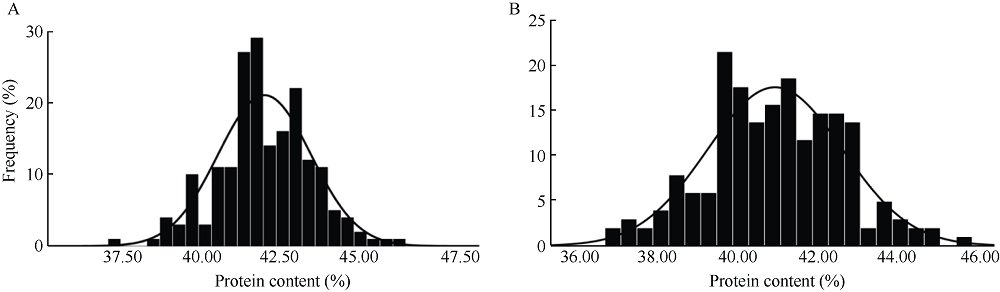
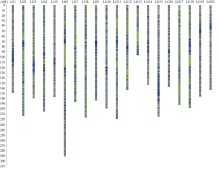
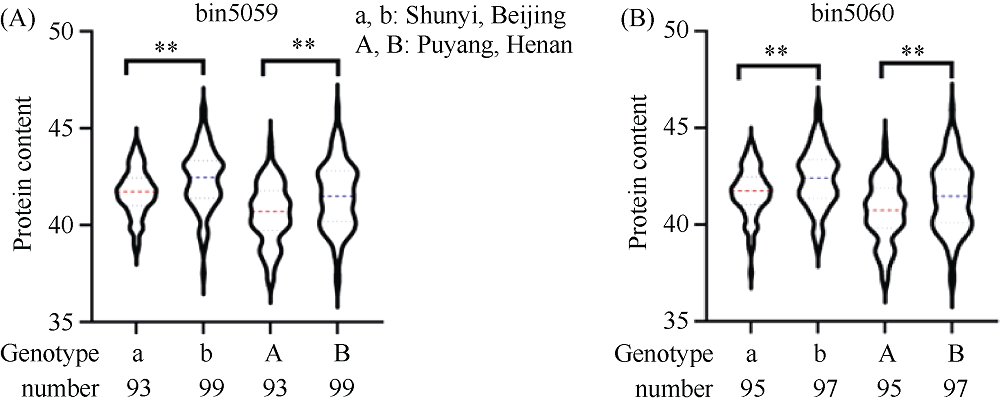
大豆是重要的粮食作物和经济作物, 其籽粒蛋白约为40%, 是优质植物蛋白主要来源之一。挖掘控制大豆高蛋白数量性状位点(Quantitative trait loci, QTL)以及分子标记育种对高蛋白大豆培育具有重要的意义。本研究利用蛋白含量存在明显差异的中黄35 (Zhonghuang 35, ZH35)和中黄13 (Zhonghuang 13, ZH13)杂交构建的包含192个株系的重组自交系群体为供试材料, 通过对两亲本及RIL群体重测序, 构建了包含4879个bin标记的高密度遗传图谱, 总遗传距离为3760.71 cM, 相邻标记间的遗传距离为0.77 cM。RIL群体及亲本分别于北京顺义和河南濮阳种植, 2个环境共检测到15个蛋白含量相关QTL位点, 分布于5号、12号、15号、17号、18号、19号和20号染色体, 贡献率为4.36%~11.39%。其中, 北京顺义和河南濮阳检测到qPro-20-1和qPro-20-3, 2个QTL贡献率分别为7.65%和7.58%, 重叠区域包括33个基因。本研究有助于精细定位和图位克隆大豆蛋白含量相关基因, 并为进一步培育高蛋白大豆品种提供基因资源。
| [1] |
Huang J H, Ma Q B, Cai Z D, Xia Q J, Cheng Y B. Identification and mapping of stable QTLs for seed oil and protein content in soybean [Glycine max (L.) Merr]. J Agric Food Chem, 2020, 68: 6448-6460.
doi: 10.1021/acs.jafc.0c01271 |
| [2] |
Wang J, Chen P, Wang D, Shannon G, Zeng A, Orazaly M, Wu C. Identification and mapping of stable QTL for protein content in soybean seeds. Mol Breed, 2015, 35: 92-102.
doi: 10.1007/s11032-015-0285-6 |
| [3] |
Pathan S M, Vuong T, Clark K, Lee J D, Sleper D A. Genetic mapping and confirmation of quantitative trait loci for seed protein and oil contents and seed weight in soybean. Crop Sci, 2013, 53: 765-774.
doi: 10.2135/cropsci2012.03.0153 |
| [4] |
Wilcox J R. Increasing seed protein in soybean with eight cycles of recurrent selection. Crop Sci, 1998, 38: 1536-1540.
doi: 10.2135/cropsci1998.0011183X003800060021x |
| [5] |
Keim P, Diers B W, Olson T C, Shoemaker R C. RFLP mapping in soybean: association between marker loci and variation in quantitative traits. Genetics, 1990, 126: 735-742.
doi: 10.1093/genetics/126.3.735 pmid: 1979039 |
| [6] |
Du W J, Wang M, Fu S X, Yu D Y. Mapping QTLs for seed yield and drought susceptibility index in soybean (Glycine max L.) across different environments. J Genet Genomics, 2009, 36: 721-731.
doi: 10.1016/S1673-8527(08)60165-4 |
| [7] |
Pipolo C V, Pipolo A E, Haleem A H, Boerma H R, Sinclair T R. Identification of QTLs associated with limited leaf hydraulic conductance in soybean. Euphytica, 2012, 186: 679-686.
doi: 10.1007/s10681-011-0535-6 |
| [8] |
Powell W, Morgante M, Andre C, Hanafey M, Vogel J, Tingey S, Rafalski A. The comparison of RFLP, RAPD, AFLP and SSR (microsatellite) markers for germplasm analysis. Mol Breed, 1996, 2: 225-238.
doi: 10.1007/BF00564200 |
| [9] | Apuya N R, Frazier B L, Keim P, Roth E J, Lark K G. Restriction fragment length polymorphisms as genetic markers in soybean, Glycine max (L.) Merrill. Theorl Appl Genet, 1988, 75: 889-901. |
| [10] |
Keim P S, Diers B W, Olson T C, Shoemaker R C. RFLP mapping in soybean: association between marker loci and variation in quantitative traits. Genetics, 1990, 126: 735-742.
doi: 10.1093/genetics/126.3.735 pmid: 1979039 |
| [11] |
Keim P, Schupp J M, Travis S E, Clayton K, Zhu T, Shi L, Ferreira A, Webb D M. A high-density soybean genetic map based on AFLP markers. Crop Sci, 1997, 37: 537-543.
doi: 10.2135/cropsci1997.0011183X003700020038x |
| [12] |
Akkaya M S, Shoemaker R C, Specht J E, Bhagwat A A, Cregan P B. Integration of simple sequence repeat DNA markers into a soybean linkage map. Crop Sci, 1995, 35: 1439-1445.
doi: 10.2135/cropsci1995.0011183X003500050030x |
| [13] |
Cregan P B, Jarvik T, Bush A L, Kaya N, Vantoai T T, Lohnes D G, Chung J. An integrated genetic linkage map of the soybean genome. Crop Sci, 1999, 39: 1464-1490.
doi: 10.2135/cropsci1999.3951464x |
| [14] |
Liu N X, Li M, Hu X B, Ma Q B, Mu Y H, Tan Z Y, Xia Q J, Zhang G Y, Nian H. Construction of high-density genetic map and QTL mapping of yield-related and two quality traits in soybean RILs population by RAD-sequencing. BMC Genomics, 2017, 18: 466-479.
doi: 10.1186/s12864-017-3854-8 pmid: 28629322 |
| [15] |
Varshney R K, Nayak S N, May G D, Jackson S A. Next- generation sequencing technologies and their implications for crop genetics and breeding. Trends Biotechnol, 2009, 27: 522-530.
doi: 10.1016/j.tibtech.2009.05.006 pmid: 19679362 |
| [16] |
Joosen R V L, Arends D, Willems L A J, Ligterink W, Jansen R C, Hilhorst H W M. Visualizing the genetic landscape of Arabidopsis seed performance. Plant Physiol, 2012, 158: 570-589.
doi: 10.1104/pp.111.186676 |
| [17] |
Yu H H, Xie W B, Wang J, Xing Y Z, Xu C G, Li X H, Xiao J H, Zhang Q F. Gains in QTL detection using an ultra-high density SNP map based on population sequencing relative to traditional RFLP/SSR markers. PLoS One, 2011, 6: e17595.
doi: 10.1371/journal.pone.0017595 |
| [18] |
Song W B, Wang B B, Hauck A L, Dong X M, Li J P, Lai J S. Genetic dissection of maize seedling root system architecture traits using an ultra-high density bin-map and a recombinant inbred line population. J Integr Plant Biol, 2015, 58: 266-279.
doi: 10.1111/jipb.12452 |
| [19] |
Cheng Y B, Ma Q B, Ren H L, Xia Q J, Song E L, Tan Z Y, Li S X, Zhang G Y, Nian H. Fine mapping of a phytophthora- resistance gene RpsWY in soybean (Glycine max L.) by high- throughput genome-wide sequencing. Theor Appl Genet, 2017, 130: 1041-1051.
doi: 10.1007/s00122-017-2869-5 |
| [20] |
Jiang N F, Shi S L, Shi H, Khanzada H, Wassan G M, Zhu C L, Peng X S, Yu Q Y, Chen X R, He X P, Fu J R, Hu L F, Xu J, Ou-Yang L J, Sun X T, Zhou D H, He H H, Bian J M. Mapping QTL for seed germinability under low temperature using a new high-density genetic map of rice. Front Plant Sci, 2017, 8: 1223-1232.
doi: 10.3389/fpls.2017.01223 pmid: 28747923 |
| [21] |
Yu T, Lei Y, Lu H F, Zhang B, Li Y F, Liu C, Ge T L, Liu Y L, Han J N, Li Y H, Qiu L J. QTL analysis for plant height and fine mapping of two environmentally stable QTLs with major effects in soybean. J Integr Agric, 2022, 21: 933-946.
doi: 10.1016/S2095-3119(21)63693-6 |
| [22] |
Pan L Y, He J B, Zhao T J, Xing G N, Wang Y F, Yu D Y, Chen S Y, Gai J Y. Efficient QTL detection of flowering date in a soybean RIL population using the novel restricted two-stage multi-locus GWAS procedure. Theor Appl Genet, 2018, 131: 2581-2599.
doi: 10.1007/s00122-018-3174-7 pmid: 30167759 |
| [23] |
Wang W B, Liu M F, Wang Y F, Li X L, Cheng S X, Shu L P, Yu Z P, Kong J J, Zhao T J, Gai J Y. Characterizing two inter-specific bin maps for the exploration of the QTLs/genes that confer three soybean evolutionary traits. Front Plant Sci, 2016, 7: 1248-1264.
doi: 10.3389/fpls.2016.01248 pmid: 27602037 |
| [24] |
Allen G C, Flores-Vergara M A, Krasnyanski S, Kumar S, Thompson W F. A modified protocol for rapid DNA isolation from plant tissues using cetyltrimethylammonium bromide. Nat Protoc, 2006, 1: 2320-2325.
doi: 10.1038/nprot.2006.384 pmid: 17406474 |
| [25] |
Wang L X, Wang J, Luo G L, Yuan X X, Gong D, Hu L L, Chen H L, Wang S H, Chen X, Cheng X Z. Construction of a high- density adzuki bean genetic map and evaluation of its utility based on a QTL analysis of seed size. J Integr Agric, 2021, 20: 1753-1761.
doi: 10.1016/S2095-3119(20)63343-3 |
| [26] |
Shen Y T, Du H L, Liu Y C, Ni L B, Wang Z, Liang C Z, Tian Z X. Update soybean Zhonghuang 13 genome to a golden reference. Sci China Life Sci, 2019, 62: 1257-1260.
doi: 10.1007/s11427-019-9822-2 pmid: 31444683 |
| [27] |
Liu D Y, Ma C X, Hong W G, Huang L, Liu M, Liu H, Zeng H P, Deng D J, Xin H, Song J, Xu C H, Sun X W, Hou X L, Wang X W, Zheng H K. Construction and analysis of high-density linkage map using high-throughput sequencing data. PLoS One, 2014, 9: e98855.
doi: 10.1371/journal.pone.0098855 |
| [28] | McCouch S R, Cho Y G, Yano M, Paul E, Blinstrub M, Morishima H, Kinoshita T. Report on QTL nomenclature. Rice Genet Newsl, 1997, 14: 11-12. |
| [29] |
董骥驰, 杨靖, 郭涛, 陈立凯, 陈志强, 王慧. 基于高密度Bin图谱的水稻抽穗期QTL定位. 作物学报, 2018, 44: 938-946.
doi: 10.3724/SP.J.1006.2018.00938 |
|
Dong J C, Yang J, Guo T, Chen L K, Chen Z Q, Wang H. QTL mapping for heading date in rice using high-density bin map. Acta Agron Sin, 2018, 44: 938-946 (in Chinese with English abstract).
doi: 10.3724/SP.J.1006.2018.00938 |
|
| [30] |
Hori K, Kobayashi T, Shimizu A, Sato K, Takeda K, Kawasaki S. Efficient construction of high-density linkage map and its application to QTL analysis in barley. Theor Appl Genet, 2003, 107: 806-813.
pmid: 12838391 |
| [31] |
Xu X Y, Zeng L, Tao Y, Vuong T, Wan J R, Boerma R, Noe J, Li Z L, Finnerty S, Pathan S M, Shannon J G, Nguyen H T. Pinpointing genes underlying the quantitative trait loci for root-knot nematode resistance in palaeopolyploid soybean by whole genome resequencing. Proc Natl Acad Sci USA, 2013, 110: 13469-13474.
doi: 10.1073/pnas.1222368110 pmid: 23898176 |
| [32] |
Karikari B, Li S G, Bhat J A, Cao Y, Kong J J, Yang J Y, Gai J Y, Zhao T J. Genome-wide detection of major and epistatic effect QTLs for seed protein and oil content in soybean under multiple environments using high-density bin map. Int J Mol Sci, 2019, 20: 979-1000.
doi: 10.3390/ijms20040979 |
| [33] |
Ma Y J, Ma W Y, Hu D Z, Zhang X N, Yuan W J, He X H, Kan G Z, Yu D Y. QTL mapping for protein and sulfur-containing amino acid contents using a high-density bin-map in soybean (Glycine max L. Merr.). J Agric Food Chem, 2019, 67: 12313-12321.
doi: 10.1021/acs.jafc.9b04497 |
| [34] |
Huang J H, Ma Q B, Cai Z D, Xia Q J, Li S X, Jia J, Chu L, Lian T X, Nian H, Cheng Y B. Identification and mapping of stable QTLs for seed oil and protein content in soybean [Glycine max (L.) Merr.]. J Agric Food Chem, 2020, 68: 6448-6460.
doi: 10.1021/acs.jafc.0c01271 |
| [35] |
Wang J, Mao L, Zeng Z Q, Yu X B, Lian J Q, Feng J, Yang W Y, An J G, Wu H Y, Zhang M G, Liu L Z. Genetic mapping high protein content QTL from soybean ‘Nanxiadou 25’ and candidate gene analysis. BMC Plant Biol, 2021, 21: 388.
doi: 10.1186/s12870-021-03176-2 pmid: 34416870 |
| [36] |
Patil G, Vuong T D, Kale S, Valliyodan B, Deshmukh R, Zhu C S, Wu X L, Bai Y H, Yungbiuth D, Lu F, Kumpatla S, Shannon J G, Varshney R K, Nguyen H T. Dissecting genomic hotspots underlying seed protein, oil, and sucrose content in an interspecific mapping population of soybean using high-density linkage mapping. Plant Biotechnol J, 2018, 16: 1939-1953.
doi: 10.1111/pbi.12929 pmid: 29618164 |
| [37] |
Mansur L M, Orf J H, Chase K, Jarvik T, Cregan P B, Lark K G. Genetic mapping of agronomic traits using recombinant inbred lines of soybean. Crop Sci, 1996, 36: 1327-1336.
doi: 10.2135/cropsci1996.0011183X003600050042x |
| [38] |
Mao T T, Jiang Z F, Han Y P, Teng W L, Zhao X, Li W B. Identification of quantitative trait loci underlying seed protein and oil contents of soybean across multi-genetic backgrounds and environments. Plant Breed, 2013, 132: 630-641.
doi: 10.1111/pbr.12091 |
| [39] | Li X Y, Xue H, Zhang K X, Li W B, Ning H L. Mapping QTLs for protein and oil content in soybean by removing the influence of related traits in a four-way recombinant inbred line population. J Agric Sci, 2020, 158: 659-675. |
| [40] |
Wang W, Sun Y, Yang P, Cai X, Yang L, Ma J, Ou Y, Liu T, Ali I, Liu D. A high density SLAF-seq SNP genetic map and QTL for seed size, oil and protein content in upland cotton. BMC Genomics, 2019, 20: 599-610.
doi: 10.1186/s12864-019-5819-6 pmid: 31331266 |
| [41] |
Zhang J P, Wang X Z, Lu Y M, Bhusal S J, Song Q J, Cregan P B, Yen Y, Brown M, Jiang G L. Genome-wide scan for seed composition provides insights into soybean quality improvement and the impacts of domestication and breeding. Mol Plant, 2018, 11: 460-472.
doi: S1674-2052(17)30386-6 pmid: 29305230 |
| [42] | Kaleri A A, Li L, Zhang Y, Liu W, Jiang C, Zhang Y, Liu C, Kaleri H A, Nizamani M M, Mehmood A, Bahadur S, Li W X, Ning H. Recognition of QTL for seed protein and oil content in two soybean recombinat inbred lines populations. J Anim Plant Sci, 2021, 31: 1669-1685. |
| [43] | 邱红梅, 厉志, 于妍, 高淑芹, 马晓萍, 郑宇宏, 孟凡凡, 侯云龙, 王跃强, 王曙明. 基于元分析的大豆含硫氨基酸相关基因挖掘与信息学分析. 中国油料作物学报, 2015, 37: 141-147. |
| Qiu H M, Li Z, Yu Y, Gao S Q, Ma X P, Zheng Y H, Meng F F, Hou Y L, Wang Y Q, Wang S M. Mining and analysis of genes related to sulfur-containing amino acids in soybean based on meta-QTL. Chin Oil Crop Sci, 2015, 37: 141-147. (in Chinese with English abstract) | |
| [44] |
Li Z W, Meyer S, Essig J S, Liu Y, Schapaugh M A, Muthukrishnan S, Hainline B E, Trick H N. High-level expression of maize γ-zein protein in transgenic soybean (Glycine max). Mol Breed, 2005, 16: 11-20.
doi: 10.1007/s11032-004-7658-6 |
| [1] | 金昱何, 王雪菲, 徐张一娃, 缪怡宁, 蒋云杰, 伊莹, 缪德麟, 朱静仪, 钟一帆, 陈铭亨, 方芳, 刘鹏. 外源激素对低温胁迫下大豆叶片叶绿素荧光参数及抗氧化酶系统的影响[J]. 作物学报, 2026, 52(6): 1817-1829. |
| [2] | 唐宽强, 李公允, 宋美毅, 赵雪, 常春玲. 大豆株高性状全基因组关联分析及预测模型构建[J]. 作物学报, 2026, 52(6): 1743-1756. |
| [3] | 郑玉珍, 齐飞艳, 孙子淇, 刘华, 秦利, 石磊, 王娟, 汪蒙蒙, 韩锁义, 徐静, 苗利娟, 黄冰艳, 董文召, 郑峥, 张新友. 花生籽仁总超长链脂肪酸和7种脂肪酸组分的QTL定位[J]. 作物学报, 2026, 52(6): 1646-1657. |
| [4] | 姚术, 郭凯悦, 翟慧慧, 姚佳慧, 邓文琪, 闫玲, 黄驰, 高阳, 俞嫣然, 赵振邦, 李英慧, 王晓波, 李佳佳. 大豆苗期耐低铁综合评价及优异种质筛选[J]. 作物学报, 2026, 52(5): 1373-1387. |
| [5] | 刘长友, 王珅, 时会影, 沈颖超, 孙蕾, 王彦, 张志肖, 苏秋竹, 田静, 范保杰. 基于饭豆基因资源的小豆远缘杂交群体抗豆象QTL定位[J]. 作物学报, 2026, 52(3): 936-944. |
| [6] | 张晴, 杨昱, 郭茜, 岳霈尧, 殷丛丛, 牛景萍, 赵晋忠, 杜维俊, 岳爱琴. 大豆GmARA6a的克隆及响应盐胁迫的功能分析[J]. 作物学报, 2026, 52(2): 480-493. |
| [7] | 王克晶, 李向华. 我国珍稀的大豆属多年生烟豆和短绒野大豆物种遗传资源濒危性评估分析[J]. 作物学报, 2025, 51(8): 2009-2019. |
| [8] | 孟然, 李赵嘉, 冯薇, 陈悦, 刘路平, 杨春燕, 鲁雪林, 王秀萍. 大豆不同生育时期耐盐性综合评价及耐盐种质筛选[J]. 作物学报, 2025, 51(8): 1991-2008. |
| [9] | 贺红利, 张雨涵, 杨静, 程云清, 赵杨, 李星诺, 司洪亮, 张兴政, 杨向东. 大豆e1-as基因突变体的创制及生理分析[J]. 作物学报, 2025, 51(8): 2228-2239. |
| [10] | 邵顺伟, 陈卓, 兰振东, 蔡兴奎, 邹华芬, 李晨曦, 唐景华, 朱熙, 张彧, 董建科, 金辉, 宋波涛. 基于BSA-seq技术的块茎芽眼深度QTL定位分析[J]. 作物学报, 2025, 51(7): 1725-1735. |
| [11] | 杨海洋, 吴林宣, 李博纹, 石翰峰, 袁禧龙, 刘金朝, 蔡海荣, 陈诗怡, 郭涛, 王慧. 基于QTL定位发现的OsWRI3调控水稻种子的落粒性[J]. 作物学报, 2025, 51(7): 1712-1724. |
| [12] | 胡蒙, 沙丹, 张晟瑞, 谷勇哲, 张世碧, 李静, 孙君明, 邱丽娟, 李斌. 大豆分枝数QTL定位及候选基因筛选[J]. 作物学报, 2025, 51(7): 1747-1756. |
| [13] | 王琼, 邹丹霞, 陈兴运, 张威, 张红梅, 刘晓庆, 贾倩茹, 魏利斌, 崔晓艳, 陈新, 王学军, 陈华涛. 大豆开花时间和成熟期性状全基因组关联分析与候选基因预测[J]. 作物学报, 2025, 51(6): 1558-1568. |
| [14] | 殷丛丛, 李睿琦, 岳霈尧, 李晨, 牛景萍, 赵晋忠, 杜维俊, 岳爱琴. 基于闭合哑铃介导等温扩增可视化检测大豆花叶病毒SC15方法的建立及应用[J]. 作物学报, 2025, 51(5): 1248-1260. |
| [15] | 张金泽, 周庆国, 肖莉晶, 金海润, 欧阳青静, 龙旭, 晏中彬, 田恩堂. 芥菜型油菜不同组织硫苷含量的QTL定位与候选基因分析[J]. 作物学报, 2025, 51(5): 1166-1177. |
|
||