欢迎访问作物学报,今天是
作物学报 ›› 2023, Vol. 49 ›› Issue (9): 2362-2372.doi: 10.3724/SP.J.1006.2023.22062
胡艳娟( ), 薛丹, 耿嫡, 朱末, 王天穹, 王晓雪()
HU Yan-Juan(), XUE Dan, GENG Di, ZHU Mo, WANG Tian-Qiong, WANG Xiao-Xue()
摘要:
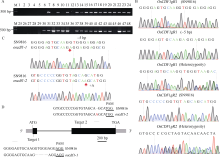
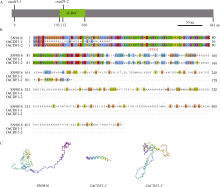
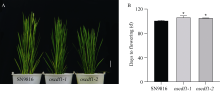
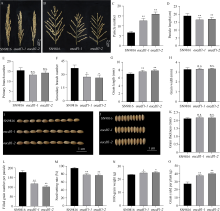
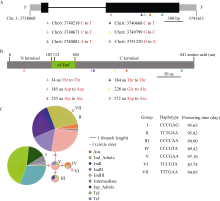
开花期(又叫抽穗期)影响水稻的产量、品质和地区适应性。在拟南芥中, Cycling DOF Factor 1 (CDF1)蛋白质是CONSTANS (CO)的转录抑制因子, 负向调节拟南芥的开花期。但是, 水稻中的同源蛋白OsCDF1的功能尚不完全清楚。为了揭示OsCDF1在水稻中的生物学功能及其对开花期的影响, 本研究利用CRISPR/Cas9基因编辑技术设计定向敲除水稻OsCDF1基因的2个靶位点, 构建OsCDF1基因的敲除载体; 通过农杆菌介导的方法分别转化北方粳稻品种沈农9816, 创制OsCDF1基因的突变体; 分析沈农9816和oscdf1突变体在田间种植下的开花期和产量性状的差异。主要研究结果为: 创制了在第1个外显子的第16 bp处缺失5个碱基和在第2个外显子的338 bp处单碱基A插入的oscdf1纯合突变。序列比对分析表明, 这2种类型的突变均造成移码和蛋白翻译提前终止。在自然长日照条件下, oscdf1突变体的开花期比野生型沈农9816晚4 d以上, 其产量高于野生型。对OsCDF1单倍型和单倍型网络分析发现, OsCDF1在不同品种中进化出高度多样性。本研究成功利用CRISPR/Cas9基因编辑技术敲除了水稻OsCDF1基因, 为进一步研究OsCDF1基因功能提供了理论参考, 也为水稻遗传改良提供了潜在的基因和种质资源。
| [1] |
徐春春, 纪龙, 陈中督, 方福平. 2021年我国水稻产业形势分析及2022年展望. 中国稻米, 2022, 28(2): 16-19.
doi: 10.3969/j.issn.1006-8082.2022.02.003 |
| Xu C C, Ji L, Chen Z D, Fang F P. Situation analysis of China’s rice industry in 2021 and its outlook in 2022. China Rice, 2022, 28(2):16-19. (in Chinese) | |
| [2] | 万建民. 中国水稻分子育种现状与展望. 中国农业科技导报, 2007, (2): 1-9. |
| Wan J M. Current situation and prospect of rice molecular breeding in China. China Agric Sci Technol Rev, 2007, (2): 1-9. (in Chinese with English abstract) | |
| [3] |
张海淼, 李洋, 刘海峰, 孔令广, 丁新华. 水稻重要农艺性状调控基因及其育种利用研究进展. 生物技术通报, 2020, 36(12): 155-169.
doi: 10.13560/j.cnki.biotech.bull.1985.2020-0537 |
| Zhang H M, Li Y, Liu H F, Kong L G, Ding X H. Research progress on regulatory genes of important agronomic traits and breeding utilization in rice. Biotech Bull, 2020, 36(12): 155-169. (in Chinese with English abstract) | |
| [4] | 郭韬, 余泓, 邱杰, 李家洋, 韩斌, 林鸿宣. 中国水稻遗传学研究进展与分子设计育种. 中国科学: 生命科学, 2019, 49: 1185-1212. |
| Guo T, Yu H, Qiu J, Li J Y, Han B, Lin H X. Advances in rice genetics and breeding by molecular design in China. Sci China- Life Sci, 2019, 49: 1185-1212. (in Chinese with English abstract) | |
| [5] |
Izawa T, Oikawa T, Sugiyama N, Tanisaka T, Yano M, Shimamoto K. Phytochrome mediates the external light signal to repress FT orthologs in photoperiodic flowering of rice. Genes Dev, 2002, 16: 2006-2020.
doi: 10.1101/gad.999202 |
| [6] | Mouradov A, Cremer F, Coupland G. Control of flowering time: interacting pathways as a basis for diversity. Plant Cell, 2002, 14: 111-130. |
| [7] |
Yanovsky M J, Kay S A. Molecular basis of seasonal time measurement in Arabidopsis. Nature, 2002, 419: 308-312.
doi: 10.1038/nature00996 |
| [8] |
Ryosuke H, Shuji Y, Shojiro T, Masahiro Y, Ko S. Adaptation of photoperiodic control pathways produces short-day flowering in rice. Nature, 2003, 422: 719-722
doi: 10.1038/nature01549 |
| [9] |
Kardailsky I, Shukla V K, Ahn J H, Dagenais N, Christensen S K, Nguyen J T, Chory J, Harrison M J, Weigel D. Activation tagging of the floral inducer FT. Science, 1999, 286: 1962-1965.
doi: 10.1126/science.286.5446.1962 pmid: 10583961 |
| [10] |
Kobayashi Y, Kaya H, Goto K, Iwabuchi M, Araki T. A pair of related genes with antagonistic roles in mediating flowering signals. Science, 1999, 286: 1960-1962.
doi: 10.1126/science.286.5446.1960 pmid: 10583960 |
| [11] |
Samach A, Onouchi H, Gold S E, Ditta G S, Schwarz-Sommer Z, Yanofsky M F, Coupland G. Distinct roles of CONSTANS target genes in reproductive development of Arabidopsis. Science, 2000, 288: 1613-1616.
doi: 10.1126/science.288.5471.1613 pmid: 10834834 |
| [12] |
Robson F, Costa M M, Hepworth S R, Vizir I, Piñeiro M, Reeves P H, Putterill J, Coupland G. Functional importance of conserved domains in the flowering-time gene CONSTANS demonstrated by analysis of mutant alleles and transgenic plants. Plant J Cell Mol Biol, 2001, 28: 619-631.
doi: 10.1046/j.1365-313x.2001.01163.x |
| [13] |
Yasushi K, Detlef W. Move on up, it’s time for change: mobile signals controlling photoperiod-dependent flowering. Genes Dev, 2007, 21: 2371-2384.
doi: 10.1101/gad.1589007 |
| [14] |
Imaizumi T, Schultz T F, Harmon F G, Ho L A, Kay S A. FKF1 F-Box protein mediates cyclic degradation of a repressor of CONSTANS in Arabidopsis. Science, 2005, 309: 293-297.
doi: 10.1126/science.1110586 pmid: 16002617 |
| [15] |
Sawa M, Nusinow D A, Kay S A, Imaizumi T. FKF1 and GIGANTEA complex formation is required for day-length measurement in Arabidopsis. Science, 2007, 318: 261-265.
doi: 10.1126/science.1146994 |
| [16] |
Fornara F, Panigrahi K C S, Gissot L, Sauerbrunn N, Rühl M, Jarillo J A, Coupland G. Arabidopsis DOF transcription factors act redundantly to reduce CONSTANS expression and are essential for a photoperiodic flowering response. Dev Cell, 2009, 17: 75-86.
doi: 10.1016/j.devcel.2009.06.015 pmid: 19619493 |
| [17] |
Goralogia G S, Liu T K, Zhao L, Panipinto P M, Groover E D, Bains Y S, Imaizumi T. CYCLING DOF FACTOR 1 represses transcription through the TOPLESS co-repressor to control photoperiodic flowering in Arabidopsis. Plant J, 2017, 92: 244-262.
doi: 10.1111/tpj.2017.92.issue-2 |
| [18] |
Imaizumi T, Schultz T F, Harmon F G, Ho L A, Kay S A. FKF1 F-box protein mediates cyclic degradation of a repressor of CONSTANS in Arabidopsis. Science, 2005, 309: 293-297.
doi: 10.1126/science.1110586 pmid: 16002617 |
| [19] |
Yano M, Katayose Y, Ashikari M, Yamanouchi U, Monna L, Fuse T, Baba T, Yamamoto K, Umehara Y, Nagamura Y, Sasaki T. Hd1, a major photoperiod sensitivity quantitative trait locus in rice, is closely related to the Arabidopsis flowering time gene CONSTANS. Plant Cell, 2000, 12: 2473-2484.
doi: 10.1105/tpc.12.12.2473 pmid: 11148291 |
| [20] |
Izawa T, Takahashi Y, Yano M. Comparative biology comes into bloom: genomic and genetic comparison of flowering pathways in rice and Arabidopsis. Curr Opinion Plant Biol, 2003, 6: 113-120.
doi: 10.1016/S1369-5266(03)00014-1 |
| [21] |
Kazuyuki D, Takeshi I, Takuichi F, Utako Y, Takahiko K, Zenpei S, Masahiro Y, Atsushi Y. Ehd1, a B-type response regulator in rice, confers short-day promotion of flowering and controls FT-like gene expression independently of Hd1. Genes Dev, 2004, 18: 926-936.
doi: 10.1101/gad.1189604 |
| [22] |
Li D J, Yang C H, Li X B, Gan Q, Zhao X F, Zhu L H. Functional characterization of rice OsDof12. Planta, 2009, 229: 1159-1169.
doi: 10.1007/s00425-009-0893-7 |
| [23] | Wu Q, Li D Y, Li D J, Liu X, Zhao X F, Li X B, Li S G, Zhu L H. Overexpression of OsDof12 affects plant architecture in rice (Oryza sativa L.). Front Plant Sci, 2015, 6: 833. |
| [24] | 单奇伟, 高彩霞. 植物基因组编辑及衍生技术最新研究进展. 遗传, 2015, 37: 953-973. |
| Dan Q W, Gao C X. Research progress of genome editing and derivative technologies in plants. Hereditas, 2015, 37: 953-973. (in Chinese with English abstract) | |
| [25] |
Xie K B, Minkenberg B, Yang Y N: Boosting CRISPR/Cas9 multiplex editing capability with the endogenous tRNA-processing system. Proc Natl Acad Sci USA, 2015, 112: 3570-3575.
doi: 10.1073/pnas.1420294112 pmid: 25733849 |
| [26] |
Li D, Xu H, Sun X X, Cui Z B, Zhang Y, Bai Y G, Wang X X, Chen W F. Differential transformation efficiency of japonica rice varieties developed in northern China. Crop Breed Appl Biotechnol, 2015, 15: 162-168.
doi: 10.1590/1984-70332015v15n3a28 |
| [27] |
Zhu M, Hu Y J, Tong A Z, Yan B W, Lyu Y P, Wang S Y, Ma W H, Cui Z B, Wang X X. LAZY1 controls tiller angle and shoot gravitropism by regulating the expression of auxin transporters and signaling factors in rice. Plant Cell Physiol, 2021, 61: 2111-2125.
doi: 10.1093/pcp/pcaa131 pmid: 33067639 |
| [28] | 孔冬艳, 陈会广. 近40年来中国农作物与耕地受灾时空特征及影响因素分析. 长江流域资源与环境, 2020, 29: 1236-1246. |
| Kong D Y, Chen H G. Spatial-temporal characteristics and influencing factors of agricultural crop and cultivated land disaster in China in recent 40 years. Res Environ Yangtze Basin, 2020, 29: 1236-1246. (in Chinese) | |
| [29] |
Wang Y P, Cheng X, Shan Q W, Zhang Y, Liu J X, Gao C X, Qiu J L. Simultaneous editing of three homoeoalleles in hexaploid bread wheat confers heritable resistance to powdery mildew. Nat Biotechnol, 2014, 32: 947-951.
doi: 10.1038/nbt.2969 pmid: 25038773 |
| [30] | Wang F J, Wang C L, Liu P Q, Lei C L, Hao W, Gao Y, Liu Y G, Zhao K J. Enhanced rice blast resistance by CRISPR/Cas9- targeted mutagenesis of the ERF transcription factor gene OsERF922. PLoS One, 2016, 11: e0154027. |
| [31] |
Wang Y X, Liu X Q, Zheng X X, Wang W X, Yin X Q, Liu H F, Ma C L, Niu X M, Zhu J K, Wang F. Creation of aromatic maize by CRISPR/Cas. J Integr Plant Biol, 2021, 63: 1664-1670.
doi: 10.1111/jipb.13105 |
| [32] |
侯智红, 吴艳, 程群, 董利东, 芦思佳, 南海洋, 甘卓然, 刘宝辉. 利用CRISPR/Cas9技术创制大豆高油酸突变系. 作物学报, 2019, 45: 839-847.
doi: 10.3724/SP.J.1006.2019.84157 |
| Hou Z H, Wu Y, Cheng Q, Dong L D, Lu S J, Nan H Y, Gan Z R, Liu B H. Creation of high oleic acid soybean mutation plants by CRISPR/Cas9. Acta Agron Sin, 2019, 45: 839-847. (in Chinese with English abstract) | |
| [33] |
张旺, 冼俊霖, 孙超, 王春明, 石丽, 于为常. CRISPR/Cas9编辑花生FAD2基因研究. 作物学报, 2021, 47: 1481-1490.
doi: 10.3724/SP.J.1006.2021.04214 |
| Zhang W, Xian J L, Sun C, Wang C M, Shi L, Yu W C. Preliminary study of genome editing of peanut FAD2 genes by CRISPR/ Cas9. Acta Agron Sin, 2021, 47: 1481-1490. (in Chinese with English abstract) | |
| [34] |
Zhang J H, Zhang H T, Li S Y, Li J Y, Yan L, Xia L Q. Increasing yield potential through manipulating of an ARE1 ortholog related to nitrogen use efficiency in wheat by CRISPR/Cas9. J Integr Plant Biol, 2021, 63: 1649-1663.
doi: 10.1111/jipb.v63.9 |
| [35] |
Fu Y F, Foden J A, Khayter C, Maeder M L, Reyon D, Joung J K, Sander J D. High-frequency off-target mutagenesis induced by CRISPR-Cas nucleases in human cells. Nat Biotechnol, 2013, 31: 822-826.
doi: 10.1038/nbt.2623 pmid: 23792628 |
| [36] |
Riechmann J L, Heard J, Martin G, Reuber L, Jiang C, Keddie J, Adam L, Pineda O, Ratcliffe O J, Samaha R R, Creelman R, Pilgrim M, Broun P, Zhang J Z, Ghandehari D, Sherman B K, Yu G. Arabidopsis transcription factors: genome-wide comparative analysis among Eukaryotes. Science, 2000, 290: 2105-2110.
doi: 10.1126/science.290.5499.2105 pmid: 11118137 |
| [37] |
Shuichi Y. Dof domain proteins: plant-specific transcription factors associated with diverse phenomena unique to plants. Plant Cell Physiol, 2004, 45: 386-391.
doi: 10.1093/pcp/pch055 pmid: 15111712 |
| [38] |
Shigyo M, Tabei N, Yoneyama T, Yanagisawa S. Evolutionary processes during the formation of the plant-specific Dof transcription factor family. Plant Cell Physiol, 2007, 48: 179-185.
pmid: 17132629 |
| [1] | 彭佳泺, 李颖, 李丹丹, 杨军宁, 郭学峰, 张文姣, 俞晓雪, 周亚荣, 王振玉, 王彩香, 马雄风, 宿俊吉. 陆地棉I类LBD家族成员鉴定及GhLBD6调控开花期的功能和单倍型分析[J]. 作物学报, 2026, 52(6): 1682-1697. |
| [2] | 唐宽强, 李公允, 宋美毅, 赵雪, 常春玲. 大豆株高性状全基因组关联分析及预测模型构建[J]. 作物学报, 2026, 52(6): 1743-1756. |
| [3] | 胡赵, 钱润, 谢丰璞, 应素平. 水稻SPX基因家族鉴定及响应磷处理的表达分析[J]. 作物学报, 2026, 52(6): 1902-1912. |
| [4] | 邹仪妹, 徐敏, 汪海洋, 姚辉, 王加峰, 刘浩, 任代胜. 两系不育系水稻幼苗根系响应盐胁迫的转录因子调控网络鉴定[J]. 作物学报, 2026, 52(6): 1728-1742. |
| [5] | 张献丰, 郭利建, 李康春, 孔斌雪, 刘玉芳, 车卓, 杨德龙. 小麦ABHD6基因家族鉴定与粒重功能标记开发[J]. 作物学报, 2026, 52(6): 1711-1727. |
| [6] | 闫安, 蒋昆炜, 王蓉圆, 田林, 张璐, 王韵, 徐建龙. 水稻剑叶小维管束数基因SVN7的鉴定与克隆[J]. 作物学报, 2026, 52(5): 1364-1372. |
| [7] | 王壮壮, 武紫君, 张永新, 张芯源, 袁丽雪, 陈如雪, 刘世举, 段剑钊, 冯伟, 王同朝, 王永华. 豫东南黏壤潮土区水氮优化协同提高冬小麦产量和氮素利用效率[J]. 作物学报, 2026, 52(5): 1501-1521. |
| [8] | 陈伟, 卫万娟, 赵其兵, 常东伟, 余凌波, 翟鹏飞, 冯志明, 陈宗祥, 任仰涛, 杨鹏, 刘海浪, 李珍富, 杨永乐, 金彦刚, 左示敏. 利用CRISPR/Cas9编辑Hd6基因创制优质早熟水稻新种质[J]. 作物学报, 2026, 52(4): 1046-1056. |
| [9] | 石少阶, 刘凯, 陈姿夷, 王卉颖, 李三和, 周雷, 游艾青. 水稻矮化多分蘖基因DMT1的克隆与功能分析[J]. 作物学报, 2026, 52(4): 1022-1034. |
| [10] | 覃奕琰, 付瑶, 苏畅, 李娜, 徐静茹, 程笑然, 张琪, 赵明辉. OsST41调控水稻苗期耐盐性的功能分析[J]. 作物学报, 2026, 52(3): 802-812. |
| [11] | 叶凡, 李帅, 李思宇, 陈云, 窦超银, 刘立军. 不同节水灌溉方式对东北稻区水稻产量和群体质量的影响[J]. 作物学报, 2026, 52(3): 895-907. |
| [12] | 李诗晴, 王茜, 王素华, 张耀文, 王丽侠. 绿豆种质资源苗期耐盐性鉴定及相关基因发掘[J]. 作物学报, 2026, 52(2): 376-388. |
| [13] | 马婷婷, 郭晓江, 李豪, 邓梅, 蒲至恩, 李伟, 张亚洲, 王凤涛, 崔凤娟, 魏育明, 王际睿, 蒋云峰, 陈国跃. 利用小麦农家种孝感麦协同改良蜀麦753产量与抗病耐逆性的育种实践[J]. 作物学报, 2026, 52(1): 56-71. |
| [14] | 王婵, 吴莹莹, 李文奇, 李霞, 王芳权, 周彤, 杨杰. 基于HRM技术开发水稻抗条纹叶枯病基因STV11功能标记[J]. 作物学报, 2025, 51(9): 2547-2556. |
| [15] | 李璐琪, 程宇坤, 白斌, 雷斌, 耿洪伟. 小麦叶片气孔相关性状全基因组关联分析[J]. 作物学报, 2025, 51(9): 2266-2284. |
|
||