欢迎访问作物学报,今天是
作物学报 ›› 2018, Vol. 44 ›› Issue (02): 227-235.doi: 10.3724/SP.J.1006.2018.00227
李继洋, 雷建峰, 代培红, 姚瑞, 曲延英, 陈全家, 李月, 刘晓东*( )
)
Ji-Yang LI, Jian-Feng LEI, Pei-Hong DAI, Rui YAO, Yan-Ying QU, Quan-Jia CHEN, Yue LI, Xiao-Dong LIU*()
摘要:
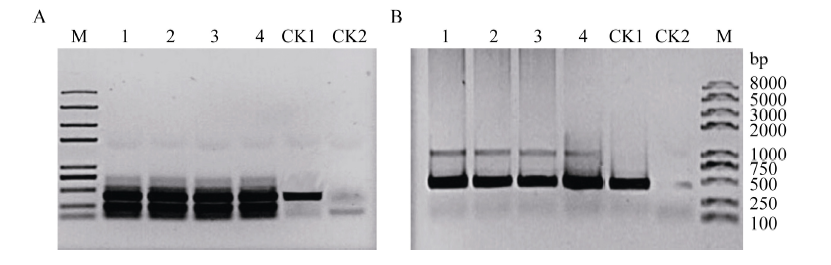
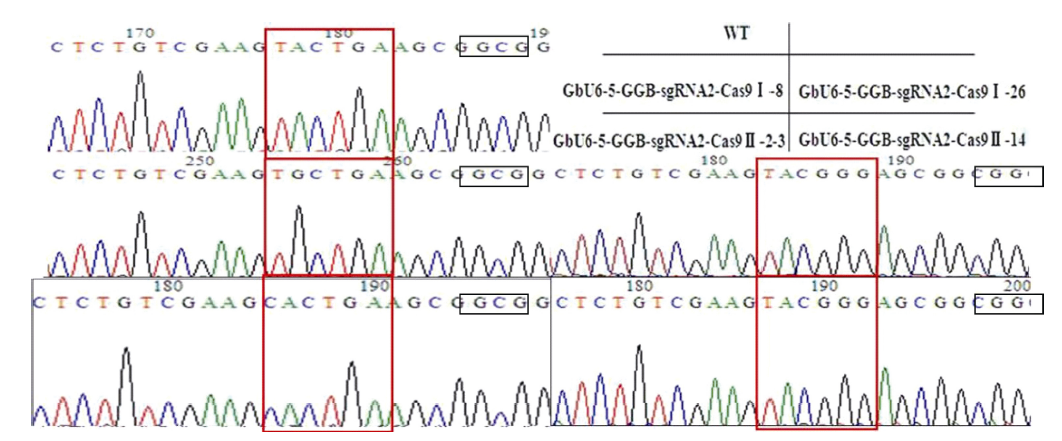
CRISPR/Cas9基因组编辑技术是基因功能研究的一种强有力的工具, 目前已在许多生物体中成功实现内源靶向基因的突变。利用已克隆的海岛棉新海16的2个U6启动子, 分别构建带有新海16内源基因(GbGGB和GbERA1)靶位点DNA片段的CRISPR/Cas9基因编辑载体。以新海16的胚性愈伤组织为供试材料, 制备海岛棉的原生质体。通过PCR方法大量富集构建好的CRISPR/Cas9基因编辑载体的核心片段(包括GbU6::sgRNA和CAMV35S::Cas9两部分), 并利用PEG法转化海岛棉的原生质体。对原生质体基因组DNA进行酶切后PCR, 成功检测到内源靶基因的突变现象。对PCR产物进行克隆测序, 结果显示序列突变的类型主要以碱基替换为主, 少数为碱基缺失。结果表明基于海岛棉U6启动子的CRISPR/Cas9基因编辑系统能在海岛棉中实现靶向基因编辑的功能, 为棉花功能基因组学研究提供了重要的技术基础。
| [1] | 李付广, 袁有禄, 棉花分子育种学. 北京: 中国农业大学出版社, 2013 |
| Li F G, Yuan Y L.Molecular Breeding of Cotton. Beijing: China Agricultural University Press, 2013 (in Chinese) | |
| [2] | 张德超. 棉花叶片干旱胁迫蛋白的表达分析与鉴定. 中国农业科学院硕士学位论文, 北京, 2013 |
| Zhang D C.Analysis and Identification of Drought Stress Proteins in Cotton Leaves. MS Thesis of Chinese Academy of Agricultural Sciences, Beijing, China, 2013 (in Chinese) | |
| [3] | 丁震乾, 陈天子, 刘廷利, 刘小双, 张保龙, 周兴根. 棉花干旱诱导MYB类转录因子GhRAX3的功能分析. 中国农业科学, 2015, 18: 3569-3579 |
| Ding Z Q, Chen T Z, Liu T L, Liu X S, Zhang B L, Zhou G X.Functional analysis of MYB transcription factor GhRAX3 induced by Cotton Drought.Sci Agric Sin, 2015, 18: 3569-3579 (in Chinese with English abstract) | |
| [4] | 许宗弘. 棉花枯黄萎病研究现状及展望. 知识经济, 2010, (16): 132 |
| Xu Z H.Research status and Prospect of cotton wilt disease.Knowledge Economy, 2010, (16): 132 (in Chinese) | |
| [5] | 任爱霞. 棉花枯黄萎病抗性遗传及生化机理研究. 浙江大学硕士学位论文, 浙江杭州, 2002 |
| Ren A X.Genetic and Biochemical Mechanism of Resistance to Verticillium wilt of Cotton. MS Thesis of Zhejiang University, Hangzhou, China, 2002 (in Chinese) | |
| [6] | 戴敬, 徐俊兵, 杨举善, 吕丽兰. 棉花留叶枝栽培的研究现状与应用前景. 中国农业科技导报, 2003, (6): 19-23 |
| Dai J, Xu J B, Yang J H, Lyu L L.Study on the cultivation of cotton retaining with status and application prospect.J Agric Sci Technol, 2003, (6): 19-23 (in Chinese with English abstract) | |
| [7] | 徐立华. 我国棉花高产、高效栽培技术研究现状与发展思路. 中国棉花, 2001, (3): 5-8 |
| Xu L H.Research status and development of high yield and high efficiency cultivation techniques of cotton in China.China Cotton, 2001, (3): 5-8 (in Chinese) | |
| [8] | 孙学振, 施培, 周治国. 我国棉花高产栽培技术理论研究现状与展望. 中国棉花, 1999, (4): 2-7 |
| Sun X Z, Shi P, Zhou Z G.Current situation and prospect of high yield cultivation techniques of cotton in China. China Cotton, 1999, (4): 2-7 (in Chinese) | |
| [9] | Sun Y, Li J, Xia L.Precise genome modification via sequence-specific nucleases-mediated gene targeting for crop improvement.Front Plant Sci, 2016, 7: 1928 |
| [10] | Cao H X, Wang W, Le H T T, Giang T H Vu. The power of CRISPR-Cas9-induced genome editing to speed up plant breeding.Int J Genom, 2016: 5078796 |
| [11] | Gilbert L A, Larson H M, Morsut L, Z R Liu, Brar G A, Torres S E, Ginossar N S, Brandman O, Whitehead E H, Doudna J A, Lim W A, Weissman J S, Qi L S. CRISPR-mediated modular RNA-guided regulation of transcription in Eukaryotes.Cell, 2013, 154: 442-451 |
| [12] | Hsu P D, Lander E S, Zhang F.Development and applications of CRISPR-Cas9 for genome engineering.Cell, 2014, 157: 1262-1278 |
| [13] | Bassett A R, C Tibbit, Ponting C P, Liu J L. Highly efficient targeted mutagenesis of drosophila with the CRISPR/Cas9 system.Cell Rep, 2013, 4: 220-228 |
| [14] | Barrangou R, Marraffini L A.CRISPR-Cas systems: prokaryotes upgrade to adaptive immunity.Mol Cell, 2014, 54: 234-244 |
| [15] | Mao Y F, Zhang Z G, Feng Z Y, Wei P L, Zhang H, Botella J R, Zhu J K.Development of germline specific CRISPR/Cas9 systems to improve the production of heritable gene modifications inArabidopsis. Plant Biotechnol J, 2016, 14: 519-532 |
| [16] | Kim H, Kim S T, Ryu J, Choi M K, Kweon J, Kang B C, Ahn S M, Bae S J, Kim J G, Kim J S, Kim S G.A simple flexible and high-throughput cloning system for plant genome editing via CRISPR/Cas system.J Integr Plant Biol, 2016, 58: 705-712 |
| [17] | Gao S L, Tong Y Y, Wen Z Q.Multiplex gene editing of theYarrowia lipolytica genome using the CRISPR/Cas9 system. Microbiol Biotech, 2016, 43: 1085-1093 |
| [18] | Johnson R A, Gurevich V, Filler S, Samach A, Levy A A.Comparative assessments of CRISPR-Cas nucleases cleavage efficiency in planta.Plant Mol Biol, 2015, 87: 143-156 |
| [19] | Xu R F, Li H, Qin R Y, Wang L, Li L, Wei P C, Yang J B.Gene targeting using theAgrobacterium tumefaciens-mediated CRISPR-Cas system in rice. Rice, 2014, 7: 5 |
| [20] | Kumar V, Jain M.The CRISPR/Cas system for plant genome editing: advances and opportunities.J Exp Bot, 2015, 66: 47-57 |
| [21] | Sharma K, Hrle A, Kramer K, Sachsenberg T, Staals R H J, Randau L, Marchfelder A, van der Oost J, Kohlbacher O, Conti E, Urlaub H. Analysis of protein-RNA interactions in CRISPR proteins and effector complexes by UV-induced cross-linking and mass spectrometry.Methods, 2015, 89: 138-148 |
| [22] | Basak J, Nithin C.Targeting non-coding RNAs in plants with the CRISPR-Cas technology is a challenge yet worth accepting.Front Plant Sci, doi: 10.3389/fpls.2015.01001 |
| [23] | Zlotorynski E.Plant cell biology: CRISP-Cas protection from plant viruses.Nat Rev Mol Cell Biol, 2015, 16: 642 |
| [24] | Liu L, Fan X D.CRISPR-Cas system: a powerful tool for genome engineering.Plant Mol Biol, 2014, 3: 209-218 |
| [25] | Chen X, Lu X, Shu N, Wang S, Wang J, Wang D, Guo L, Ye W W.Targeted mutagenesis in cotton (Gossypium hirsutum L.) using the CRISPR/Cas9 system. Sci Rep, 2017, 7: 44304 |
| [26] | Li C, Unver T, Zhang B.A high efficiency CRISPR/Cas9 system for targeted mutagenesis in cotton (Gossypium hirsutum L.). Sci Rep, 2017, 7: 43902 |
| [27] | Johnson C D, Chary S N, Chernoff E A, Zeng Q, Running M P, Crowell D N.Protein geranylgeranyltransferase I is involved in specific aspects of abscisic acid and auxin signaling inArabidopsis. Plant Physiol, 2005, 139: 722-733 |
| [28] | Andrews M, Huizinga D H, Crowell D N.The CaaX specificities of Arabidopsis proteinprenyltransferases explainera1 and ggb phenotypes. BMC Plant Biol, 2010, 10: 118 |
| [29] | 雷建峰, 徐新霞, 李月, 代培红, 刘超, 刘晓东. CRISPR/Cas9介导靶向敲除拟南芥GGB基因突变体的鉴定. 西北植物学报, 2016, 36: 857-864 |
| Lei J F, Xu X X, Li Y, Dai P H, Liu C, Liu X D.CRISPR/Cas9 mediated targeting to in identification ofGGB mutants of Arabidopsis. J Northwest Plants, 2016, 36: 857-864 | |
| [30] | 雷建峰, 伍娟, 陈晓俊, 於添平, 倪志勇, 李月, 张巨松, 刘晓东. 棉花花粉中高效转录U6启动子的克隆及功能分析. 中国农业科学, 2015, 48: 3794-3802 |
| Lei J F, Wu J, Chen X J, Yu T P, Ni Z Y, Li Y, Zhang J S, Liu X D. cloning and functional analysis of high efficient U6 promoter in cotton pollen.Chin J Agric Sci, 2015, 48: 3794-3802 | |
| [31] | Lu Y M, Chen X, Wu Y X, Wang Y P, He Y Q, Wu Y.Directly transforming PCR amplified DNA fragments into plant cells is a versatile system That facilitates the transient expression assay.PLoS One, 2013, 8: e57171 |
| [1] | 周静远, 孔祥强, 张艳军, 李雪源, 张冬梅, 董合忠. 基于种子萌发出苗过程中弯钩建成和下胚轴生长的棉花出苗壮苗机制与技术[J]. 作物学报, 2022, 48(5): 1051-1058. |
| [2] | 孙思敏, 韩贝, 陈林, 孙伟男, 张献龙, 杨细燕. 棉花苗期根系分型及根系性状的关联分析[J]. 作物学报, 2022, 48(5): 1081-1090. |
| [3] | 闫晓宇, 郭文君, 秦都林, 王双磊, 聂军军, 赵娜, 祁杰, 宋宪亮, 毛丽丽, 孙学振. 滨海盐碱地棉花秸秆还田和深松对棉花干物质积累、养分吸收及产量的影响[J]. 作物学报, 2022, 48(5): 1235-1247. |
| [4] | 郑曙峰, 刘小玲, 王维, 徐道青, 阚画春, 陈敏, 李淑英. 论两熟制棉花绿色化轻简化机械化栽培[J]. 作物学报, 2022, 48(3): 541-552. |
| [5] | 张艳波, 王袁, 冯甘雨, 段慧蓉, 刘海英. 棉籽油分和3种主要脂肪酸含量QTL分析[J]. 作物学报, 2022, 48(2): 380-395. |
| [6] | 张特, 王蜜蜂, 赵强. 滴施缩节胺与氮肥对棉花生长发育及产量的影响[J]. 作物学报, 2022, 48(2): 396-409. |
| [7] | 赵文青, 徐文正, 杨锍琰, 刘玉, 周治国, 王友华. 棉花叶片响应高温的差异与夜间淀粉降解密切相关[J]. 作物学报, 2021, 47(9): 1680-1689. |
| [8] | 岳丹丹, 韩贝, Abid Ullah, 张献龙, 杨细燕. 干旱条件下棉花根际真菌多样性分析[J]. 作物学报, 2021, 47(9): 1806-1815. |
| [9] | 张旺, 冼俊霖, 孙超, 王春明, 石丽, 于为常. CRISPR/Cas9编辑花生FAD2基因研究[J]. 作物学报, 2021, 47(8): 1481-1490. |
| [10] | 曾紫君, 曾钰, 闫磊, 程锦, 姜存仓. 低硼及高硼胁迫对棉花幼苗生长与脯氨酸代谢的影响[J]. 作物学报, 2021, 47(8): 1616-1623. |
| [11] | 马欢欢, 方启迪, 丁元昊, 池华斌, 张献龙, 闵玲. 棉花GhMADS7基因正调控棉花花瓣发育[J]. 作物学报, 2021, 47(5): 814-826. |
| [12] | 许乃银, 赵素琴, 张芳, 付小琼, 杨晓妮, 乔银桃, 孙世贤. 基于GYT双标图对西北内陆棉区国审棉花品种的分类评价[J]. 作物学报, 2021, 47(4): 660-671. |
| [13] | 周冠彤, 雷建峰, 代培红, 刘超, 李月, 刘晓东. 棉花CRISPR/Cas9基因编辑有效sgRNA高效筛选体系的研究[J]. 作物学报, 2021, 47(3): 427-437. |
| [14] | 卢合全, 唐薇, 罗振, 孔祥强, 李振怀, 徐士振, 辛承松. 商品有机肥替代部分化肥对连作棉田土壤养分、棉花生长发育及产量的影响[J]. 作物学报, 2021, 47(12): 2511-2521. |
| [15] | 王晔, 刘钊, 肖爽, 李芳军, 吴霞, 王保民, 田晓莉. 转PSAG12-IPT基因对棉花叶片衰老及产量和纤维品质的影响[J]. 作物学报, 2021, 47(11): 2111-2120. |
|
||