欢迎访问作物学报,今天是
作物学报 ›› 2021, Vol. 47 ›› Issue (9): 1806-1815.doi: 10.3724/SP.J.1006.2021.04162
岳丹丹( ), 韩贝, Abid Ullah, 张献龙, 杨细燕*
YUE Dan-Dan(), HAN Bei, Abid Ullah, ZHANG Xian-Long, YANG Xi-Yan*
摘要:
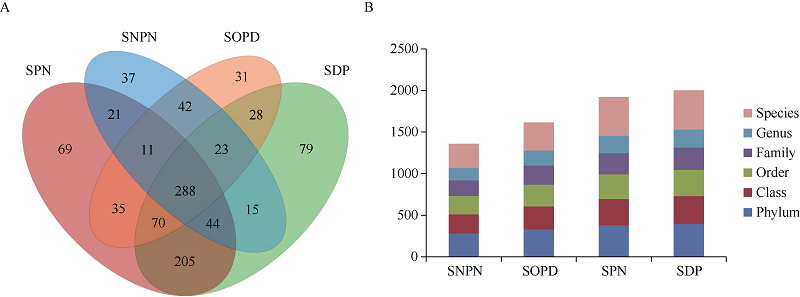
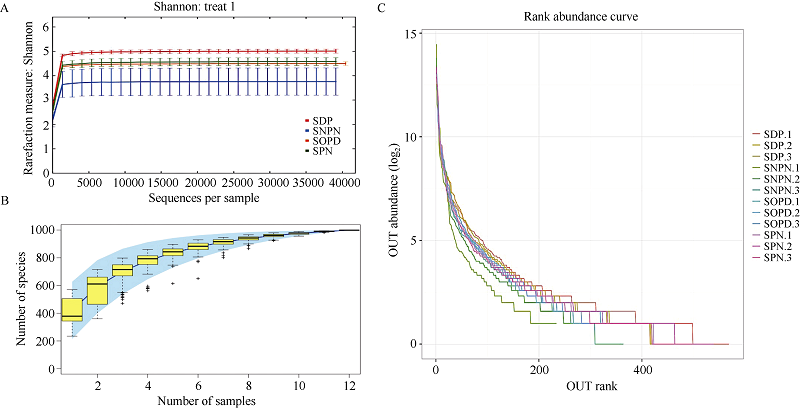
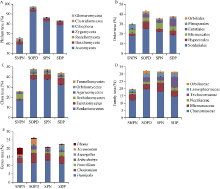
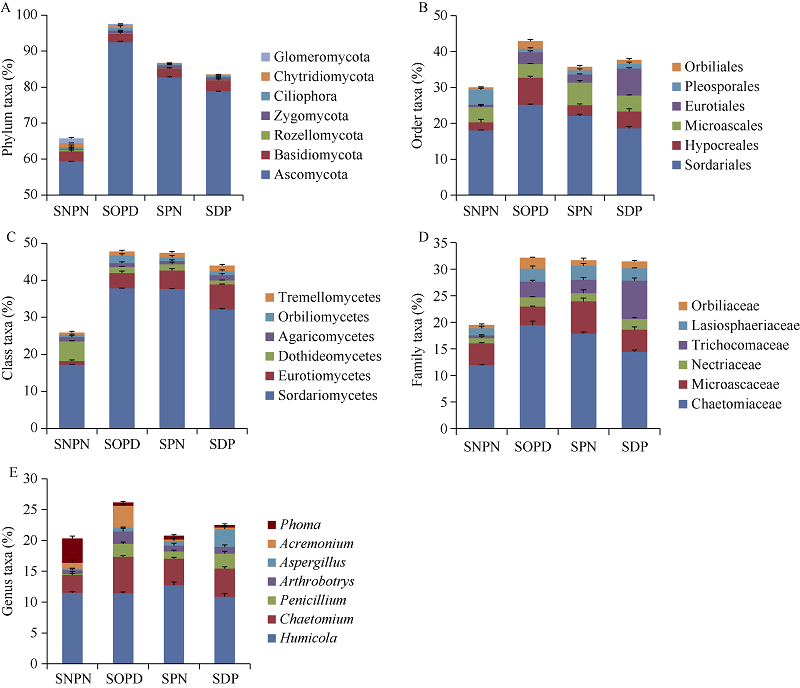
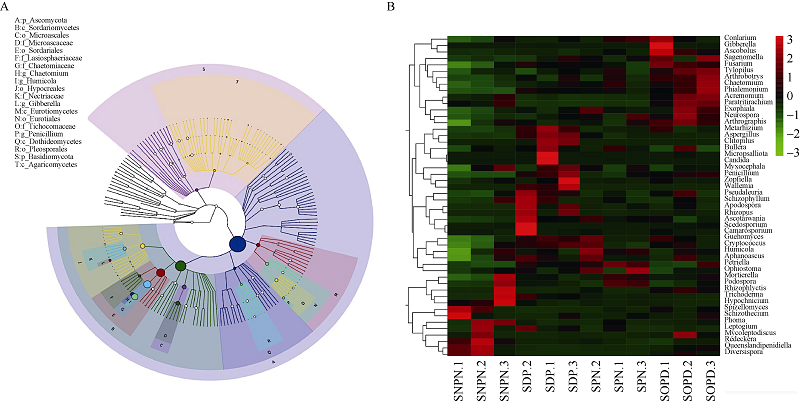
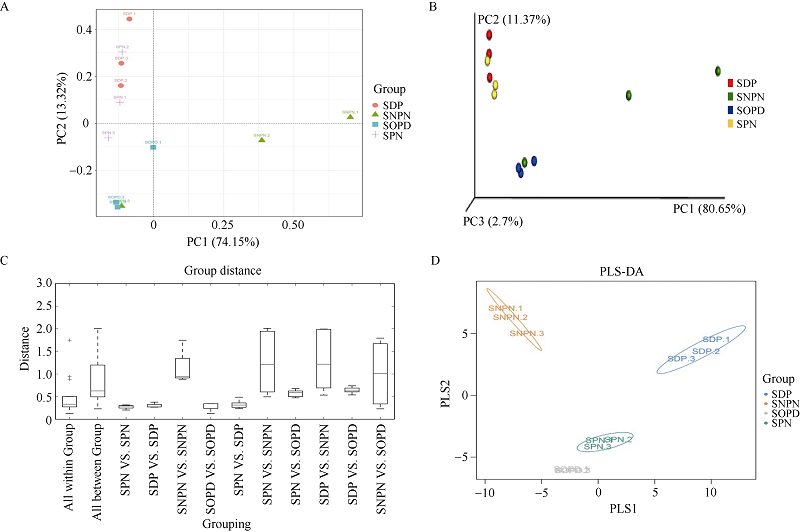
植物根际微生物群落对植物生长和适逆性至关重要, 本研究对干旱条件下棉花根际真菌群落进行分析, 旨在探明干旱胁迫对棉花根际真菌多样性和群落结构的影响, 为利用有益微生物提高棉花水分利用率提供理论依据。以陆地棉Jin 668 (Gossypium hirsutum cv. Jin668)为试验材料, 采用盆栽控水方式, 对处于开花期的棉花根际土壤(SDP)和未种植棉花土壤(SOPD)进行干旱处理, 正常浇水的棉花根际土壤(SPN)和无棉花土壤(SNPN)为对照。从中采集土壤样品, 提取DNA, 采用Illumina Miseq对真菌ITS1区域进行高通量测序, 研究土壤中真菌多样性。结果共鉴定到970个OTUs, SNPN、SOPD、SPN和SDP样品中真菌OTUs数量分别为481、528、743和752个, 其中288个OTUs为所有组共有。对获得OTUs进行门、纲、目、科和属5个分类水平的划分表明, 棉花根际真菌群落结构主要由子囊菌门(82.70%)和担子菌门(10.15%)组成; 干旱处理使粪壳菌纲(Sordariomycetes)、粪壳菌目(Sordariales)和毛壳菌科(Chaetomiaceae)丰度显著降低, 而散囊菌目(Eurotiales)、发菌科(Trichocomaceae)、曲霉属(Aspergillus)和青霉属(Penicillum)的丰度显著增加。多样性分析结果显示, 与未种棉花的土壤相比, 有棉花的土壤中真菌群落的α多样性显著增加; 同时, SPN和SDP之间的真菌群落结构更相似, 而与SNPN和SOPD间差异较大。研究表明, 棉花根际存在丰富的真菌群落, 干旱对土壤中真菌的丰度和多样性有显著影响。本研究从微生物的角度为提高棉花耐旱性的研究提供新见解。
| [1] | Rapparini F, Peñuelas J. Use of Microbes for the Alleviation of Soil Stresses, New York: Springer, 2014. pp 21-42. |
| [2] |
Parida A K, Dagaonkar V S, Phalak M S, Umalkar G V, Aurangabadkar L P. Alterations in photosynthetic pigments, protein and osmotic components in cotton genotypes subjected to short-term drought stress followed by recovery. Plant Biotechnol Rep, 2007, 1:37-48.
doi: 10.1007/s11816-006-0004-1 |
| [3] |
Ullah A, Sun H, Yang X Y, Zhang X L. Drought coping strategies in cotton: increased crop per drop. Plant Biotechnol J, 2017, 15:271-284.
doi: 10.1111/pbi.12688 pmid: 28055133 |
| [4] |
Rovira A D. Plant root exudates. Bot Rev, 1969, 35:35-57.
doi: 10.1007/BF02859887 |
| [5] |
Bai Y, Muller D B, Srinivas G, Garrido-Oter R, Potthoff E, Rott M, Dombrowski N, Munch P C, Spaepen S, Remus-Emsermann M, Huttel B, McHardy A C, Vorholt J A, Schulze-Lefert P. Functional overlap of the Arabidopsis leaf and root microbiota. Nature, 2015, 528:364-369.
doi: 10.1038/nature16192 |
| [6] |
Wei F, Zhao L, Xu X, Feng H, Shi Y, Deakin G, Feng Z, Zhu H. Cultivar-dependent variation of the cotton rhizosphere and endosphere microbiome under field conditions. Front Plant Sci, 2019, 10:1659.
doi: 10.3389/fpls.2019.01659 pmid: 31921274 |
| [7] |
Toju H, Peay K G, Yamamichi M, Narisawa K, Hiruma K, Naito K, Fukuda S, Ushio M, Nakaoka S, Onoda Y, Yoshida K, Schlaeppi K, Bai Y, Sugiura R, Ichihashi Y, Minamisawa K, Kiers E T. Core microbiomes for sustainable agroecosystems. Nat Plants, 2018, 4:247-257.
doi: 10.1038/s41477-018-0139-4 |
| [8] |
Lau J A, Lennon J T. Rapid responses of soil microorganisms improve plant fitness in novel environments. Proc Natl Acad Sci USA, 2012, 109:14058-14062.
doi: 10.1073/pnas.1202319109 |
| [9] |
Niu X, Song L, Xiao Y, Ge W. Drought-tolerant plant growth-promoting rhizobacteria associated with foxtail millet in a semi-arid agroecosystem and their potential in alleviating drought stress. Front Microbiol, 2017, 8:2580.
doi: 10.3389/fmicb.2017.02580 |
| [10] |
de Zelicourt A, Al-Yousif M, Hirt H. Rhizosphere microbes as essential partners for plant stress tolerance. Mol Plant, 2013, 6:242-245.
doi: 10.1093/mp/sst028 pmid: 23475999 |
| [11] |
Yang J, Kloepper J W, Ryu C M. Rhizosphere bacteria help plants tolerate abiotic stress. Trends Plant Sci, 2009, 14:1-4.
doi: 10.1016/j.tplants.2008.10.004 |
| [12] | 赵卫松, 郭庆港, 李社增, 王培培, 鹿秀云, 苏振贺, 张晓云, 马平. 花铃期棉花黄萎病抗病与感病品种对土壤细菌群落结构的影响. 中国农业科学, 2020, 53:942-954. |
| Zhao W S, Guo Q G, Li S Z, Wang P P, Lu X Y, Su Z H, Zhang X Y, Ma P. Effect of wilt-resistant and wilt-susceptible cotton on soil bacterial community structure at flowering and boll stage. Sci Agric Sin, 2020, 53:942-954 (in Chinese with English abstract). | |
| [13] |
Edwards J, Johnson C, Santos-Medellín C, Lurie E, Sundaresan V. Structure, variation, and assembly of the root-associated microbiomes of rice. Proc Natl Acad Sci USA, 2015, 112:911-920.
doi: 10.1073/pnas.1423603112 |
| [14] |
Walters W A, Jin Z, Youngblut N, Wallace J G, Sutter J, Zhang W, González-Peña A, Peiffer J, Koren O, Shi Q, Knight R, Glavina Del Rio T, Tringe S G, Buckler E S, Dangl J L, Ley R E. Large-scale replicated field study of maize rhizosphere identifies heritable microbes. Proc Natl Acad Sci USA, 2018, 115:7368-7373.
doi: 10.1073/pnas.1800918115 |
| [15] |
Zolla G, Badri D V, Bakker M G, Manter D K, Vivanco J M. Soil microbiomes vary in their ability to confer drought tolerance to Arabidopsis. Appl Soil Ecol, 2013, 68:1-9.
doi: 10.1016/j.apsoil.2013.03.007 |
| [16] |
Carvalhais L C, Dennis P G, Badri D V, Kidd B N, Vivanco J M, Schenk P M. Linking jasmonic acid signaling, root exudates, and rhizosphere microbiomes. Mol Plant-Microbe Interact, 2015, 28:1049-1058.
doi: 10.1094/MPMI-01-15-0016-R |
| [17] | 吴会会, 邹英宁, 吴强盛. 干旱胁迫下菌根真菌对枳根系形态、内源激素和土壤结构的影响. 中国南方果树, 2018, 47(3):14-17. |
| Wu H H, Zou Y N, Wu J S. Effects of mycorrhizal fungi on root morphology, endogenous hormones and soil structure of trifoliate orange under drought stress. South China Fruits, 2018, 47(3):14-17 (in Chinese with English abstract). | |
| [18] |
Pieterse C M, Zamioudis C, Berendsen R L, Weller D M, Van Wees S C, Bakker P A. Induced systemic resistance by beneficial microbes. Annu Rev Phytopathol, 2014, 52:347-375.
doi: 10.1146/annurev-phyto-082712-102340 pmid: 24906124 |
| [19] |
Hedden P, Thomas S G. Gibberellin biosynthesis and its regulation. Biochem J, 2012, 444:11-25.
doi: 10.1042/BJ20120245 |
| [20] |
Finkel O M, Castrillo G, Herrera Paredes S, Salas Gonzalez I, Dangl J L. Understanding and exploiting plant beneficial microbes. Curr Opin Plant Biol, 2017, 38:155-163.
doi: S1369-5266(17)30015-8 pmid: 28622659 |
| [21] |
Lundberg D S, Lebeis S L, Paredes S H, Yourstone S, Gehring J, Malfatti S, Tremblay J, Engelbrektson A, Kunin V, Rio T G D. Defining the core Arabidopsis thaliana root microbiome. Nature, 2012, 488:86-90.
doi: 10.1038/nature11237 pmid: 22859206 |
| [22] | 薛英龙, 李春越, 王苁蓉, 王益, 刘津, 常顺, 苗雨, 党廷辉. 丛枝菌根真菌促进植物摄取土壤磷的作用机制. 水土保持学报, 2019, 33(6):10-20. |
| Xue Y L, Li C Y, Wang C R, Wang Y, Liu J, Chang S, Miao Y, Dang T H. Mechanisms of phosphorus uptake from soils by arbuscular mycorrhizal fungi. J Soil Water Conserv, 2019, 33(6):10-20 (in Chinese with English abstract). | |
| [23] | Rapparini F, Peñuelas J. Use of Microbes for the Alleviation of Soil Stresses, New York: Springer, 2014. pp 165-174. |
| [24] |
Uehlein N, Fileschi K, Eckert M, Bienert G P, Bertl A, Kaldenhoff R. Arbuscular mycorrhizal symbiosis and plant aquaporin expression. Phytochemistry, 2007, 68:122-129.
doi: 10.1016/j.phytochem.2006.09.033 |
| [25] |
Miller S H, Browne P, Prigent-Combaret C, Combes-Meynet E, Morrissey J P, O’Gara F. Biochemical and genomic comparison of inorganic phosphate solubilization in Pseudomonas species. Environ Microbiol Rep, 2010; 2:403-411.
doi: 10.1111/j.1758-2229.2009.00105.x |
| [26] |
Qiao Q, Wang F, Zhang J, Chen Y, Zhang C, Liu G, Zhang H, Ma C, Zhang J. The variation in the rhizosphere microbiome of cotton with soil type, genotype and developmental stage. Sci Rep, 2017, 7:3940.
doi: 10.1038/s41598-017-04213-7 |
| [27] |
Xi H, Shen J, Qu Z, Yang D, Liu S, Nie X, Zhu L. Effects of long-term cotton continuous cropping on soil microbiome. Sci Rep, 2019, 9:18297.
doi: 10.1038/s41598-019-54771-1 |
| [28] |
Ullah A, Akbar A, Luo Q, Khan A H, Manghwar H, Shaban M, Yang X. Microbiome diversity in cotton rhizosphere under normal and drought conditions. Microb Ecol, 2019, 77:429-439.
doi: 10.1007/s00248-018-1260-7 pmid: 30196314 |
| [29] |
Caporaso J G, Kuczynski J, Stombaugh J, Bittinger K, Bushman F D, Costello E K, Fierer N, Peña A G, Goodrich J K, Gordon J I, Huttley G A, Kelley S T, Knights D, Koenig J E, Ley R E, Lozupone C A, McDonald D, Muegge B D, Pirrung M, Reeder J, Sevinsky J R, Turnbaugh P J, Walters W A, Widmann J, Yatsunenko T, Zaneveld J, Knight R. QIIME allows analysis of high-throughput community sequencing data. Nat Methods, 2010, 7:335-336.
doi: 10.1038/nmeth.f.303 pmid: 20383131 |
| [30] |
Edgar R C, Haas B J, Clemente J C, Quince C, Knight R. UCHIME improves sensitivity and speed of chimera detection. Bioinformatics, 2011, 27:2194-2200.
doi: 10.1093/bioinformatics/btr381 |
| [31] |
Koljalg U, Nilsson R H, Abarenkov K, Tedersoo L, Taylor A F, Bahram M, Bates S T, Bruns T D, Bengtsson-Palme J, Callaghan T M, Douglas B, Drenkhan T, Eberhardt U, Duenas M, Grebenc T, Griffith G W, Hartmann M, Kirk P M, Kohout P, Larsson E, Lindahl B D, Lucking R, Martin M P, Matheny P B, Nguyen N H, Niskanen T, Oja J, Peay K G, Peintner U, Peterson M, Poldmaa K, Saag L, Saar I, Schussler A, Scott J A, Senes C, Smith M E, Suija A, Taylor D L, Telleria M T, Weiss M, Larsson K H. Towards a unified paradigm for sequence-based identification of fungi. Mol Ecol, 2013, 22:5271-5277.
doi: 10.1111/mec.12481 |
| [32] |
Chao A, Shen T J. Nonparametric prediction in species sampling. J Agric Biol Environ Statist, 2004, 9:253-269.
doi: 10.1198/108571104X3262 |
| [33] |
Eichmann R, Richards L, Schäfer P. Hormones as go-betweens in plant microbiome assembly. Plant J, 2021, 105:518-541.
doi: 10.1111/tpj.v105.2 |
| [34] |
Verbon E H, Liberman L M. Beneficial microbes affect endogenous mechanisms controlling root development. Trends Plant Sci, 2016, 21:218-229.
doi: S1360-1385(16)00028-5 pmid: 26875056 |
| [35] |
Yu C, Hu X M, Deng W, Li Y, Xiong C, Ye C H, Han G M, Li X. Changes in soil microbial community structure and functional diversity in the rhizosphere surrounding mulberry subjected to long-term fertilization. Appl Soil Ecol, 2015, 86:30-40.
doi: 10.1016/j.apsoil.2014.09.013 |
| [36] | 赵存鹏, 郭宝生, 刘素恩, 王兆晓, 昭耿, 王凯辉, 耿军义. 粮棉轮作对土壤中养分及真菌多样性的影响. 华北农学报, 2017, 32(6):139-146. |
| Zhao B C, Guo B S, Liu S E, Wang Z X, Zhao G, Wang K H, Geng J Y. Effect of cotton and grain crops rotation on nutrients contents and diversity of fungi in the soil. Acta Agric Boreali-Sin, 2017, 32(6):139-146 (in Chinese with English abstract). | |
| [37] |
Rousk J, Brookes P C, Bååth E. Fungal and bacterial growth responses to N fertilization and pH in the 150-year ‘Park Grass’ UK grassland experiment. FEMS Microbiol Ecol, 2011, 76:89-99.
doi: 10.1111/fem.2011.76.issue-1 |
| [38] | 刘宇, 韩淑梅, 宋希强, 丁琼, 王鹏, 赵莹. 不同海拔下海南凤仙花可培养根际真菌和细菌群落的季节性变化. 热带生物学报, 2018, 9(1):50-56. |
| Liu Y, Han S M, Song X Q, Ding Q, Wang P, Zhao Y. Seasonal variation of microbial communities in the rhizosphere of Impatiens hainanensis (Balsaminaceae) at different altitudes. J Trop Biol, 2018, 9(1):50-56 (in Chinese with English abstract). | |
| [39] |
Butinar L, Zalar P, Frisvad J C, Gunde-Cimerman N. The genus Eurotium members of indigenous fungal community in hypersaline waters of salterns. FEMS Microbiol Ecol, 2005, 51:155-166.
pmid: 16329864 |
| [40] |
Beever R E, Laracy E P. Osmotic adjustment in the filamentous fungus Aspergillus nidulans. J Bacteriol, 1986, 168:1358-1365.
pmid: 3536874 |
| [41] |
Araújo C A S, Ferreira P C, Pupin B, Dias L P, Avalos J, Edwards J, Hallsworth J E, Rangel D E N. Osmotolerance as a determinant of microbial ecology: a study of phylogenetically diverse fungi. Fungal Biol, 2020, 124:273-288.
doi: 10.1016/j.funbio.2019.09.001 |
| [42] |
Fahad S, Hussain S, Bano A, Saud S, Hassan S, Shan D, Khan F A, Khan F, Chen Y, Wu C, Tabassum M A, Chun M X, Afzal M, Jan A, Jan M T, Huang J. Potential role of phytohormones and plant growth-promoting rhizobacteria in abiotic stresses: consequences for changing environment. Environ Sci Pollut Res Int, 2015, 22:4907-4921.
doi: 10.1007/s11356-014-3754-2 |
| [43] |
Qiao Q, Zhang J, Ma C, Wang F, Chen Y, Zhang C, Zhang H, Zhang J. Characterization and variation of the rhizosphere fungal community structure of cultivated tetraploid cotton. PLoS One, 2019, 14:e0207903.
doi: 10.1371/journal.pone.0207903 |
| [44] | Yan N, Marschner P, Cao W, Zuo C, Qin W. Influence of salinity and water content on soil microorganisms. Int Soil Water Conserv, 2015, 3:316-323. |
| [1] | 赵佳雪, 周龙昊, 郭岂源, 尚伦霄, 王涵, 刘志涛, 陈曦, 张晓佩, 宋宪亮, 毛丽丽. 长期秸秆还田与深松通过改善土壤环境与棉花光合特性提高滨海盐碱地棉花产量[J]. 作物学报, 2026, 52(5): 1548-1560. |
| [2] | 张曦, 王广恩, 李邵琦, 刘祎, 李俊兰, 钱玉源. 基于转录组测序解析陆海杂交姊妹系马克隆值差异的形成机制[J]. 作物学报, 2026, 52(5): 1442-1458. |
| [3] | 周琦翔, 朱艳, 汪楚博, 朱柏林, 李俊博, 宋利兵. 基于DSSAT模型模拟气候变化对新疆棉花物候期及产量的影响[J]. 作物学报, 2026, 52(2): 590-602. |
| [4] | 杨飚, 杜帅康, 张继旺, 石瑛, 张丽莉. 马铃薯III类POD基因家族的全基因组鉴定及其表达谱分析[J]. 作物学报, 2026, 52(2): 405-420. |
| [5] | 王雅致, 杨飚, 季香林, 石瑛, 张丽莉. 二倍体马铃薯抗旱资源鉴定及抗旱基因初步筛选[J]. 作物学报, 2026, 52(1): 72-84. |
| [6] | 孔娜, 刘涛, 刘文婷, 陈刚, 文利超, 邓智超, 郭梅, 李伟, 郭永峰. 烟草NtCEP7基因克隆及其编码小肽在苗期抗旱中的作用分析[J]. 作物学报, 2026, 52(1): 249-261. |
| [7] | 刘海波, 张蕾, 王立琦, 石晓丽, 周文莹, 崔国贤, 佘玮. 苎麻BnGCL1基因响应干旱胁迫的功能研究[J]. 作物学报, 2026, 52(1): 14-27. |
| [8] | 姬炫彤, 卞春松, 金黎平, 李森, 秦军红, 李广存. 不同耐旱型马铃薯根际微生物对干旱的响应[J]. 作物学报, 2026, 52(1): 165-177. |
| [9] | 胡城祯, 高维东, 孔斌雪, 王建飞, 车卓, 杨德龙, 陈涛. 小麦TaAPC11基因家族鉴定及TaAPC11-5B参与干旱胁迫的生物学功能研究[J]. 作物学报, 2026, 52(1): 148-164. |
| [10] | 何鹏旭, 姚立蓉, 陈远玲, 闫妍, 张宏, 汪军成, 李葆春, 杨轲, 司二静, 孟亚雄, 马小乐, 王化俊. 大麦干旱胁迫萌发生理及分子机理的差异性与相关性研究[J]. 作物学报, 2025, 51(9): 2412-2432. |
| [11] | 张建鹏, 王国瑞, 别海, 叶飞宇, 马晨晨, 梁小菡, 鲁晓民, 尚霄丽, 曹丽茹. 转录因子ZmMYB153通过ABA信号调节气孔运动增强玉米苗期抗旱性[J]. 作物学报, 2025, 51(7): 1827-1837. |
| [12] | 郭栋财, 吕涛, 蔡永生, 买吾鲁达·艾合买提, 全家, 曲延英, 郑凯. 棉花纤维品质相关性状QTL元分析及候选基因鉴定[J]. 作物学报, 2025, 51(6): 1445-1466. |
| [13] | 王亚雯, 戚正阳, 尤佳琦, 聂新辉, 曹娟, 杨细燕, 涂礼莉, 张献龙, 王茂军. 棉花60K功能位点基因芯片的制备及应用[J]. 作物学报, 2025, 51(5): 1178-1188. |
| [14] | 陆雯佳, 汪军成, 姚立蓉, 张宏, 司二静, 杨轲, 孟亚雄, 李葆春, 马小乐, 王化俊. 大麦PRX基因家族全基因组鉴定及其干旱胁迫下的表达分析[J]. 作物学报, 2025, 51(5): 1198-1214. |
| [15] | 李乔, 叶杨春, 常旭虹, 王德梅, 王艳杰, 杨玉双, 马瑞琦, 赵广才, 蔡瑞国, 张敏, 刘希伟. 花后高温干旱逆境对冬小麦光合特性和产量的影响[J]. 作物学报, 2025, 51(4): 1077-1090. |
|
||