欢迎访问作物学报,今天是
作物学报 ›› 2020, Vol. 46 ›› Issue (12): 1870-1883.doi: 10.3724/SP.J.1006.2020.01009
杨正钊( ), 王梓豪, 胡兆荣, 辛明明, 姚颖垠, 彭惠茹, 尤明山, 宿振起*(), 郭伟龙*()
YANG Zheng-Zhao(), WANG Zi-Hao, HU Zhao-Rong, XIN Ming-Ming, YAO Ying-Yin, PENG Hui-Ru, YOU Ming-Shan, SU Zhen-Qi*(), GUO Wei-Long*()
摘要:
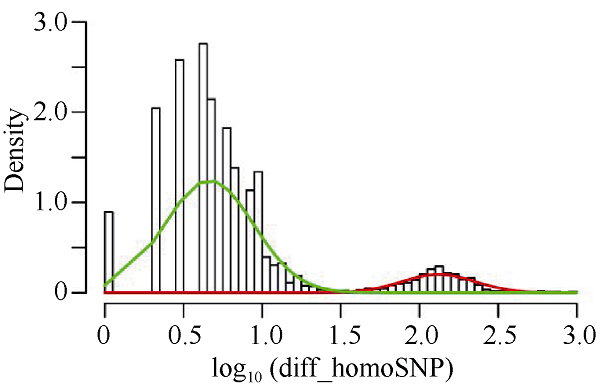
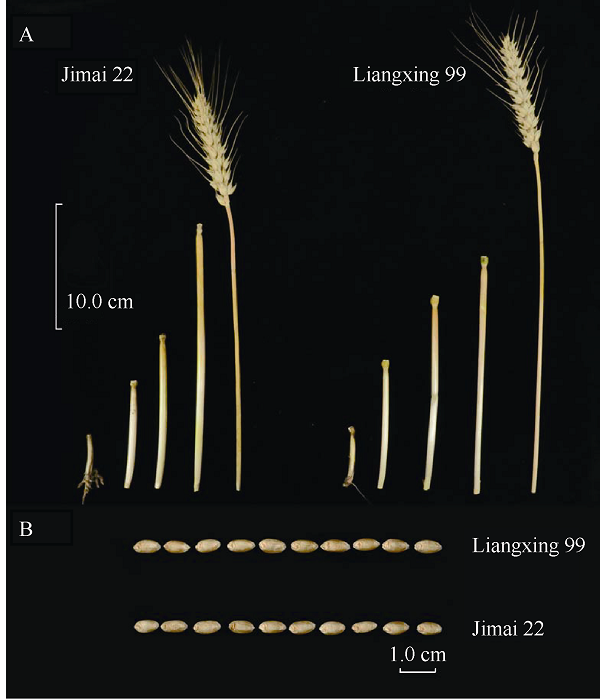
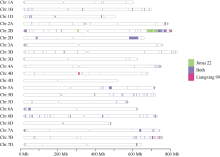
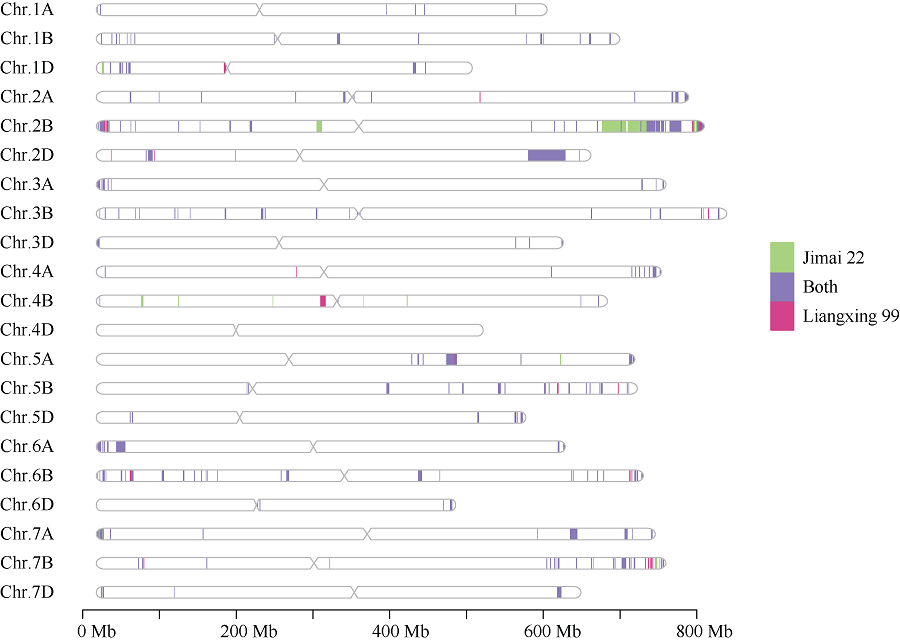
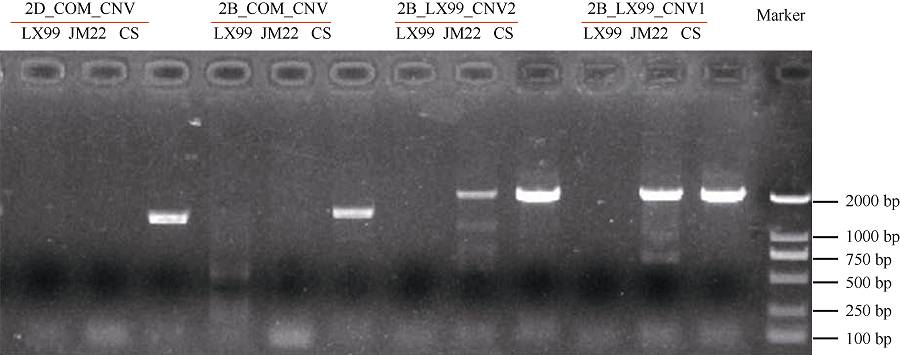
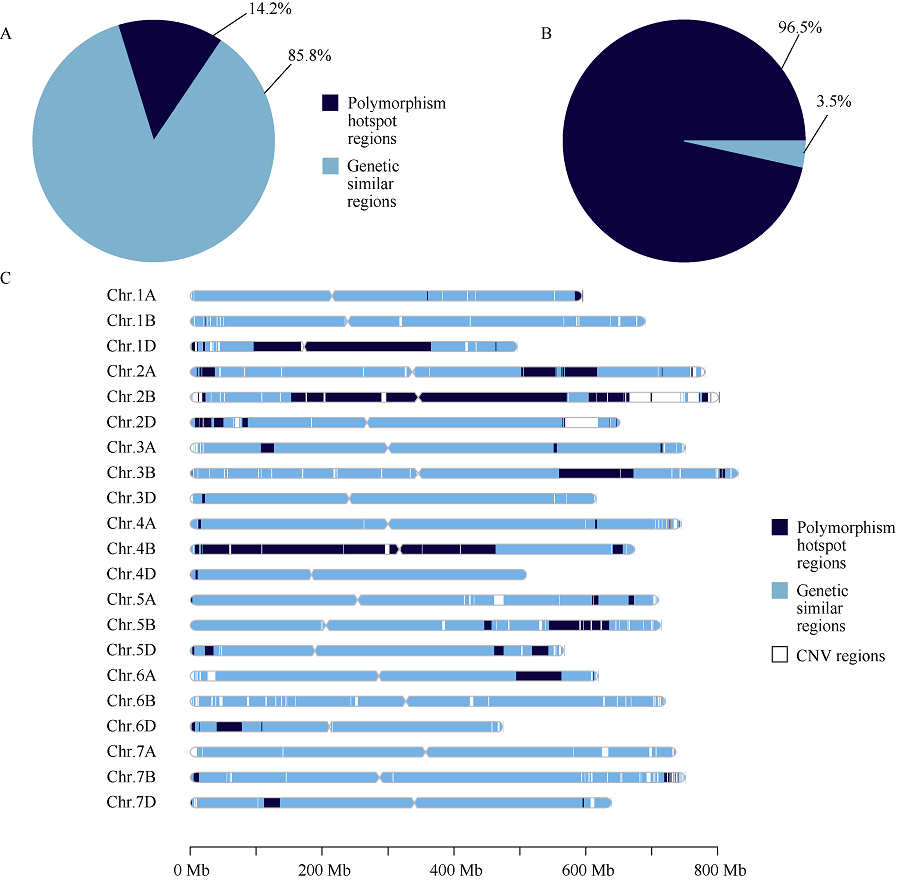
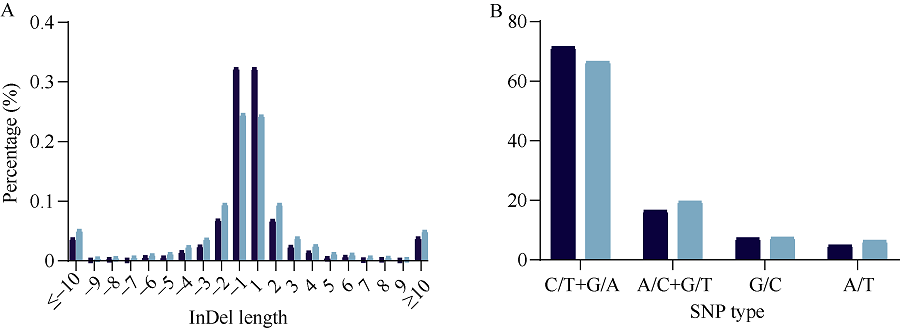
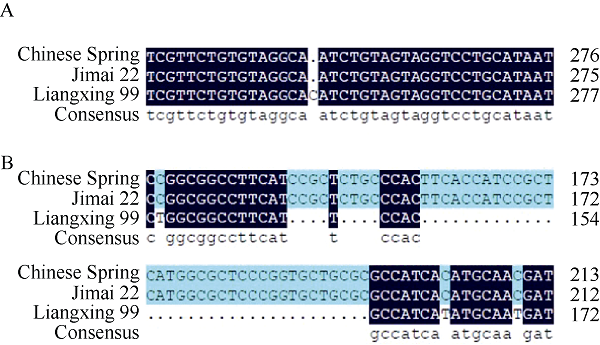
济麦22和良星99是我国黄淮冬麦区和北部冬麦区大面积推广的高产小麦品种, 也是目前小麦杂交育种的重要亲本。虽然济麦22和良星99的来源和系谱不同, 但在重要农艺、产量等性状上存在较高的相似性。为了从全基因组水平研究其遗传组成的异同, 本研究采用Illumina HiSeq2500测序平台对上述两个品种进行了全基因组测序(平均测序深度为5.8×), 并系统地比较了两个品种拷贝数变异(CNV)、单核苷酸多态性(SNP)和插入/缺失(InDel)的序列差异。与中国春参考基因组序列相比, 两个品种除了具有总长466 Mb的共有CNV变异区间外, 济麦22和良星99的特有CNV变异区间的总长分别为91 Mb和45 Mb, 这些特有CNV区间主要集中在2B和4B染色体上; 济麦22和良星99间存在1,547,371个SNP差异位点和137,817个InDel差异位点。以差异SNP分布规律为依据, 在全基因组水平鉴定出济麦22和良星99间存在14.2%的差异多态性热点区间, 这些区间集中分布在1D、2B和4B染色体上。通过对5个控制小麦株高和穗长基因的序列分析, 发现有2个位于多态性热点区间的基因在品种间存在移码突变。本研究为利用重测序数据在基因组水平上比较小麦品种间遗传差异提供了重要参考, 同时揭示了济麦22和良星99在全基因组的遗传相似区间和差异区间, 为今后小麦育种改良中更好利用济麦22与良星99提供了重要遗传信息。
| [1] | 何中虎, 庄巧生, 程顺和, 于振文, 赵振东, 刘旭 . 中国小麦产业发展与科技进步. 农学学报, 2018,8(1):99-106. |
| He Z H, Zhuang Q S, Cheng S H, Yu Z W, Zhao Z D, Liu X . Wheat production and technology improvement in China. J Agric, 2018,8(1):99-106 (in Chinese). | |
| [2] | 张婷, 逯腊虎, 张伟, 杨斌, 袁凯, 史晓芳 . 黄淮麦区300个小麦种质的主要农艺性状比较. 小麦研究, 2018,39(1):13-20. |
| Zhang T, Lu L H, Zhang W, Yang B, Yuan K, Shi X F . Comparison of main agronomic traits of 300 wheat germplasms in Huanghuai Wheat Region. J Wheat Res, 2018,39(1):13-20 (in Chinese). | |
| [3] | 曹廷杰, 王西成, 赵虹 . 国审小麦新品种周麦18号丰产性、稳产性及适应性分析. 中国农业科技导报, 2007,9(1):39-41. |
| Cao T J, Wang X C, Zhao H . Analysis on the yield potential, stability and adaptability of national authorized wheat variety Zhoumai 18. Rev China Agric Sci Technol, 2007,9(1):39-41 (in Chinese with English abstract) | |
| [4] |
盖红梅, 李玉刚, 王瑞英, 李振清, 王圣健, 高峻岭, 张学勇 . 鲁麦14对山东新选育小麦品种的遗传贡献. 作物学报, 2012,38:954-961.
doi: 10.3724/SP.J.1006.2012.00954 |
| Gai H M, Li Y G, Wang R Y, Li Z Q, Wang S J, Gao J L, Zhang X Y . Genetic contribution of Lumai 14 to novel wheat varieties developed in Shandong province. Acta Agron Sin, 2012,38:954-961 (in Chinese with English abstract) | |
| [5] | 傅晓艺, 郭进考, 刘艳滨, 史占良, 单子龙, 韩然, 何明琦 . 利用石4185为骨干亲本培育高产小麦新品种. 种子, 2017,36(12):95-99. |
| Fu X Y, Guo J K, Liu Y B, Shi Z L, Shan Z L, Han R, He M Q . New wheat varieties with high yield of core parent breeding by using Shi 4185. Seed, 2017,36(12):95-99 (in Chinese). | |
| [6] | 凌宏清 . 小麦及其近缘种基因组测序研究进展与发展趋势. 麦类作物学报, 2016,36:397-403. |
| Ling H Q . Progress and perspectives of the genome sequencing in wheat and its relatives. J Triticeae Crops, 2016,36:397-403 (in Chinese with English abstract) | |
| [7] |
Uauy C . Wheat genomics comes of age. Curr Opin Plant Biol, 2017,36:142-148.
doi: 10.1016/j.pbi.2017.01.007 pmid: 28346895 |
| [8] |
殷贵鸿, 李根英, 何中虎, 刘建军, 王辉, 夏先春 . 小麦新品种济麦22抗白粉病基因的分子标记定位. 作物学报, 2009,35:1425-1431.
doi: 10.3724/SP.J.1006.2009.01425 |
| Yin H G, Li G Y, He Z H, Liu J J, Wang H, Xia X C . Molecular mapping of powdery mildew resistance gene in wheat cultivar Jimai 22. Acta Agron Sin, 2009,35:1425-1431 (in Chinese with English abstract) | |
| [9] | 赵广军, 张英肖 . 高产稳产冬小麦品种良星99栽培技术. 小麦研究, 2006,27(3):12-13. |
| Zhao G J, Zhang Y X . Cultivation technique of Liangxing 99, a winter wheat variety with high and stable yield. J Wheat Res, 2006,27(3):12-13 (in Chinese) | |
| [10] |
Qu Y F, Wu P P, Hu J H, Chen Y X, Shi Z L, Qiu D, Li Y H, Zhang H J, Zhou Y, Yang L, Liu H W, Zhu T Q, Liu Z Y, Zhang Y M, Li H J . Molecular detection of the powdery mildew resistance genes in winter wheats DH51302 and Shimai 26. J Integr Agric, 2020,19:931-940.
doi: 10.1016/S2095-3119(19)62644-4 |
| [11] |
Bolger A M, Lohse M, Usadel B . Trimmomatic: a flexible trimmer for Illumina sequence data. Bioinformatics, 2014,30:2114-2120.
doi: 10.1093/bioinformatics/btu170 |
| [12] |
Li H, Durbin R . Fast and accurate short read alignment with Burrows-Wheeler transform. Bioinformatics, 2009,25:1754-1760.
doi: 10.1093/bioinformatics/btp324 pmid: 19451168 |
| [13] |
Appels R, Eversole K, Feuillet C, Keller B, Rogers J, Stein N, Pozniak C J, Stein N, Choulet F, Distelfeld A, Eversole K, Poland J, Rogers J, Ronen G, Sharpe A G, Pozniak C, Ronen G, Stein N, Barad O, Baruch K, Choulet F, Keeble-Gagnere G, Mascher M, Sharpe A G, Ben-Zvi G, Josselin A A, Stein N, Mascher M, Himmelbach A, Choulet F, Keeble-Gagnere G, Mascher M, Rogers J, Balfourier F, Gutierrez-Gonzalez J, Hayden M, Josselin A A, Koh C, Muehlbauer G, Pasam R K, Paux E, Pozniak C J, Rigault P, Sharpe A G, Tibbits J, Tiwari V, Choulet F, Keeble-Gagnere G, Mascher M, Josselin A A, Rogers J, Spannagl M, Choulet F, Lang D, Gundlach H, Haberer G, Keeble-Gagnere G, Mayer KFX, Ormanbekova D, Paux E, Prade V, Simkova H, Wicker T, Choulet F, Spannagl M, Swarbreck D, Rimbert H, Felder M, Guilhot N, Gundlach H, Haberer G, Kaithakottil G, Keilwagen J, Lang D, Leroy P, Lux T, Mayer KFX, Twardziok S, Venturini L, Appels R, Rimbert H, Choulet F, Juhasz A, Keeble-Gagnere G, Choulet F, Spannagl M, Lang D, Abrouk M, Haberer G, Keeble-Gagnere G, Mayer KFX, Wicker T, Choulet F, Wicker T, Gundlach H, Lang D, Spannagl M, Lang D, Spannagl M, Appels R, Fischer I, Uauy C, Borrill P, Ramirez-Gonzalez R H, Appels R, Arnaud D, Chalabi S, Chalhoub B, Choulet F, Cory A, Datla R, Davey M W, Hayden M, Jacobs J, Lang D, Robinson S J, Spannagl M, Steuernagel B, Tibbits J, Tiwari V, van Ex F, Wulff BBH, Pozniak C J, Robinson S J, Sharpe A G, Cory A, Benhamed M, Paux E, Bendahmane A, Concia L, Latrasse D, Rogers J, Jacobs J, Alaux M, Appels R, Bartos J, Bellec A, Berges H, Dolezel J, Feuillet C, Frenkel Z, Gill B, Korol A, Letellier T, Olsen O A, Simkova H, Singh K, Valarik M, van der Vossen E, Vautrin S, Weining S, Korol A, Frenkel Z, Fahima T, Glikson V, Raats D, Rogers J, Tiwari V, Gill B, Paux E, Poland J, Dolezel J, Cihalikova J, Simkova H, Toegelova H, Vrana J, Sourdille P, Darrier B, Appels R, Spannagl M, Lang D, Fischer I, Ormanbekova D, Prade V, Barabaschi D, Cattivelli L, Hernandez P, Galvez S, Budak H, Steuernagel B, Jones J D G, Witek K, Wulff B B H, Yu G, Small I, Melonek J, Zhou R, Juhasz A, Belova T, Appels R, Olsen O A, Kanyuka K, King R, Nilsen K, Walkowiak S, Pozniak C J, Cuthbert R, Datla R, Knox R, Wiebe K, Xiang D, Rohde A, Golds T, Dolezel J, Cizkova J, Tibbits J, Budak H, Akpinar B A, Biyiklioglu S, Muehlbauer G, Poland J, Gao L, Gutierrez-Gonzalez J, N'Daiye A, Dolezel J, Simkova H, Cihalikova J, Kubalakova M, Safar J, Vrana J, Berges H, Bellec A, Vautrin S, Alaux M, Alfama F, Adam-Blondon A F, Flores R, Guerche C, Letellier T, Loaec M, Quesneville H, Pozniak C J, Sharpe A G, Walkowiak S, Budak H, Condie J, Ens J, Koh C, Maclachlan R, Tan Y, Wicker T, Choulet F, Paux E, Alberti A, Aury J M, Balfourier F, Barbe V, Couloux A, Cruaud C, Labadie K, Mangenot S, Wincker P, Gill B, Kaur G, Luo M, Sehgal S, Singh K, Chhuneja P, Gupta O P, Jindal S, Kaur P, Malik P, Sharma P, Yadav B, Singh N K, Khurana J, Chaudhary C, Khurana P, Kumar V, Mahato A, Mathur S, Sevanthi A, Sharma N, Tomar R S, Rogers J, Jacobs J, Alaux M, Bellec A, Berges H, Dolezel J, Feuillet C, Frenkel Z, Gill B, Korol A, van der Vossen E, Vautrin S, Gill B, Kaur G, Luo M, Sehgal S, Bartos J, Holusova K, Plihal O, Clark M D, Heavens D, Kettleborough G, Wright J, Valarik M, Abrouk M, Balcarkova B, Holusova K, Hu Y, Luo M, Salina E, Ravin N, Skryabin K, Beletsky A, Kadnikov V, Mardanov A, Nesterov M, Rakitin A, Sergeeva E, Handa H, Kanamori H, Katagiri S, Kobayashi F, Nasuda S, Tanaka T, Wu J, Appels R, Hayden M, Keeble-Gagnere G, Rigault P, Tibbits J, Olsen O A, Belova T, Cattonaro F, Jiumeng M, Kugler K, Mayer K F X, Pfeifer M, Sandve S, Xun X, Zhan B, Simkova H, Abrouk M, Batley J, Bayer P E, Edwards D, Hayashi S, Toegelova H, Tulpova Z, Visendi P, Weining S, Cui L, Du X, Feng K, Nie X, Tong W, Wang L, Borrill P, Gundlach H, Galvez S, Kaithakottil G, Lang D, Lux T, Mascher M, Ormanbekova D, Prade V, Ramirez-Gonzalez R H, Spannagl M, Stein N, Uauy C, Venturini L, Stein N, Appels R, Eversole K, Rogers J, Borrill P, Cattivelli L, Choulet F, Hernandez P, Kanyuka K, Lang D, Mascher M, Nilsen K, Paux E, Pozniak C J, Ramirez-Gonzalez R H, Simkova H, Small I, Spannagl M, Swarbreck D, Uauy C . Shifting the limits in wheat research and breeding using a fully annotated reference genome. Science, 2018, 361: eaar7191.
doi: 10.1126/science.aav0887 pmid: 30262485 |
| [14] |
Li H, Handsaker B, Wysoker A, Fennell T, Ruan J, Homer N, Marth G, Abecasis G, Durbin R . The sequence alignment/map format and SAMtools. Bioinformatics, 2009,25:2078-2079.
doi: 10.1093/bioinformatics/btp352 pmid: 19505943 |
| [15] | van der Auwera G A, Carneiro M O, Hartl C, Poplin R, Del Angel G, Levy-Moonshine A, Jordan T, Shakir K, Roazen D, Thibault J, Banks E, Garimella K V, Altshuler D, Gabriel S, Depristo M A . From FastQ data to high-confidence variant calls: The genome analysis toolkit best practices pipeline. Curr Protoc Bioinform, 2013,43:10-11. |
| [16] |
Cingolani P, Platts A, Wang L L, Coon M, Nguyen T, Wang L, Land S J, Lu X, Ruden D M . A program for annotating and predicting the effects of single nucleotide polymorphisms, SnpEff. Fly, 2014,6:80-92.
doi: 10.4161/fly.19695 pmid: 22728672 |
| [17] |
Quinlan A R, Hall I M . BEDTools: a flexible suite of utilities for comparing genomic features. Bioinformatics, 2010,26:841-842.
doi: 10.1093/bioinformatics/btq033 pmid: 20110278 |
| [18] |
Peng J, Richards D E, Hartley N M, Murphy G P, Devos K M, Flintham J E, Beales J, Fish L J, Worland A J, Pelica F, Sudhakar D, Christou P, Snape J W, Gale M D, Harberd N P . ‘Green revolution’ genes encode mutant gibberellin response modulators. Nature, 1999,400:256-261.
doi: 10.1038/22307 pmid: 10421366 |
| [19] |
Beales J, Turner A, Griffiths S, Snape J W, Laurie D A . A pseudo-response regulator is misexpressed in the photoperiod insensitive Ppd-D1a mutant of wheat(Triticum aestivum L.). Theor Appl Genet, 2007,115:721-733.
doi: 10.1007/s00122-007-0603-4 |
| [20] | 柴岭岭 . 普通小麦2D染色体株高和穗长QTL的精细定位与图位克隆. 中国农业大学博士学位论文, 北京, 2019. pp 38-39. |
| Chai L L . Fine Mapping and Map-based Cloning of QTL Controlling Plant Height and Spike Length on Chromosome 2D in Common Wheat (Triticum aestivum L.). PhD Dissertation of China Agricultural University, Beijing, China, 2019. pp 38-39 (in Chinese with English abstract). | |
| [21] |
Chai L L, Chen Z Y, Bian R L, Zhai H J, Cheng X J, Peng H R, Yao Y Y, Hu Z R, Xin M M, Guo W L, Sun Q X, Zhao A J, Ni Z F . Dissection of two quantitative trait loci with pleiotropic effects on plant height and spike length linked in coupling phase on the short arm of chromosome 2D of common wheat ( Triticum aestivum L.). Theor Appl Genet, 2018,131:2621-2637.
doi: 10.1007/s00122-018-3177-4 pmid: 30267114 |
| [22] |
Zhao Z H, Sun H G, Song W, Lu M, Huang J, Wu L F, Wang X M, Li H J . Genetic analysis and detection of the gene MlLX99 on chromosome 2BL conferring resistance to powdery mildew in the wheat cultivar Liangxing 99. Theor Appl Genet, 2013,126:3081-3089.
doi: 10.1007/s00122-013-2194-6 pmid: 24061485 |
| [23] |
邹景伟, 邱丹, 孙艳玲, 郑超星, 李静婷, 吴培培, 武小菲, 王晓鸣, 周阳, 李洪杰 . Pm52——小麦品种良星99抗白粉病基因的有效性. 作物学报, 2017,43:332-342.
doi: 10.3724/SP.J.1006.2017.00332 |
|
Zou J W, Qiu D, Sun Y L, Zheng C X, Li J T, Wu P P, Wu X F, Wang X M, Zhou Y, Li H J . Pm52: effectiveness of the gene conferring resistance to powdery mildew in wheat cultivar Liangxing 99. Acta Agron Sin, 2017,43:332-342 (in Chinese with English abstract).
doi: 10.3724/SP.J.1006.2017.00332 |
|
| [24] |
Wu P P, Hu J H, Zou J W, Qiu D, Qu Y F, Li Y H, Li T, Zhang H J, Yang L, Liu H W, Zhou Y, Zhang Z J, Li J T, Liu Z Y, Li H J . Fine mapping of the wheat powdery mildew resistance gene Pm52 using comparative genomics analysis and the Chinese Spring reference genomic sequence. Theor Appl Genet, 2019,132:1451-1461.
doi: 10.1007/s00122-019-03291-7 pmid: 30719526 |
| [25] |
Wang Y, Song F, Zhu J, Zhang S, Yang Y, Chen T, Tang B, Dong L, Ding N, Zhang Q, Bai Z, Dong X, Chen H, Sun M, Zhai S, Sun Y, Yu L, Lan L, Xiao J, Fang X, Lei H, Zhang Z, Zhao W . GSA: genome sequence archive. Genom Proteom Bioinf, 2017,15:14-18.
doi: 10.1016/j.gpb.2017.01.001 |
| [26] |
National genomics data center members and partners. Nucleic Acids Res, 2020,48:D24-D33.
doi: 10.1093/nar/gkz913 pmid: 31702008 |
| [27] |
Wang W X, Wang Z H, Li X T, Ni Z F, Hu Z R, Xin M M, Peng H R, Yao Y Y, Sun Q X, Guo W L . SnpHub: an easy-to-set-up web server framework for exploring large-scale genomic variation data in the post-genomic era with applications in wheat. GigaScience, 2020, 9:giaa060.
doi: 10.1093/gigascience/giaa060 pmid: 32501478 |
| [1] | 毛嘉琦, 黄朋雨, 赵佳佳, 郑兴卫, 武棒棒, 郝宇琼, 屈非, 刘成, 马朋涛, 郑军. 山西小麦品种白粉病抗性评价及抗病基因分子检测[J]. 作物学报, 2026, 52(6): 1669-1681. |
| [2] | 胡川, 赵凯男, 黄修利, 吴金芝, 任开明, 王贺正, 付国占, 黄明, 李友军. 一次灌溉下耕作方式和氮肥用量对旱地小麦产量和品质的影响[J]. 作物学报, 2026, 52(6): 1830-1846. |
| [3] | 陈雪燕, 何华川, 李政嘉, 董新盼, 李藕琪, 刘小云, 李丹萍, 陈志伟, 刘国霞, 吕胜源, 吴印莹, 赵振东, 曹新有, 万何平. 水培盐碱复合胁迫下‘济麦60’苗期根系有机酸分泌动态变化及其转录调控机制[J]. 作物学报, 2026, 52(6): 1859-1875. |
| [4] | 高沛阳, 李瑾璇, 董宇奎, 石玉, 张振, 张永丽. 测墒补灌下小麦分蘖发生和成穗对施氮量的响应[J]. 作物学报, 2026, 52(6): 1847-1858. |
| [5] | 张献丰, 郭利建, 李康春, 孔斌雪, 刘玉芳, 车卓, 杨德龙. 小麦ABHD6基因家族鉴定与粒重功能标记开发[J]. 作物学报, 2026, 52(6): 1711-1727. |
| [6] | 翟胜男, 曹新有, 李豪圣, 李吉虎, 李法计, 刘金栋, 夏先春, 吕莹莹, 马瑞峰, 王颖, 耿洪伟, 刘建军. 小麦Pod-A1、Pod-D1和Pod-2D位点等位变异对籽粒过氧化物酶活性的遗传效应分析[J]. 作物学报, 2026, 52(6): 1593-1603. |
| [7] | 习千辉, 徐梓瑗, 刘梦梦, 王宏艺, 郎凯琳, 井震海, 陈锋, 赵磊. 小麦籽粒铜含量的全基因组关联分析及候选基因预测[J]. 作物学报, 2026, 52(6): 1604-1617. |
| [8] | 王壮壮, 武紫君, 张永新, 张芯源, 袁丽雪, 陈如雪, 刘世举, 段剑钊, 冯伟, 王同朝, 王永华. 豫东南黏壤潮土区水氮优化协同提高冬小麦产量和氮素利用效率[J]. 作物学报, 2026, 52(5): 1501-1521. |
| [9] | 何万龙, 耿洪伟, 张飞飞, 米克热阿依·阿巴白克热, 罗紫洋, 李鹏程, 周钊宇, 程宇坤. 基于深度学习的小麦重要病害图像识别系统的研究[J]. 作物学报, 2026, 52(5): 1401-1417. |
| [10] | 张振, 冯连杰, 石玉, 于振文, 张永丽. 节水补灌下不同穗型小麦产量形成差异研究[J]. 作物学报, 2026, 52(5): 1522-1535. |
| [11] | 侯思宇, 王国璀, 韦金贵, 谢玮欣, 殷文, 樊志龙, 柴强, 胡发龙. 绿肥配施化学氮肥对西北干旱灌区小麦干物质积累及产量形成的影响[J]. 作物学报, 2026, 52(4): 1208-1219. |
| [12] | 尚云秋, 赵竹, 陈欢, 丁永刚, 乔玉强, 李玮, 张向前, 曹承富, 杜世州. 长期定位耕作方式对雨养小麦籽粒灌浆和产量形成的影响[J]. 作物学报, 2026, 52(4): 1236-1250. |
| [13] | 田红丽, 杨扬, 范亚明, 易红梅, 郭丹丹, 王凤格, 赵久然. 适于玉米品种鉴定的一套三等位变异SNP新型标记组合[J]. 作物学报, 2026, 52(4): 993-1005. |
| [14] | 乔宇馨, 李程越, 康晓玉, 张鑫琪, 贾绍辉, 刘倩, 曹亚丽, 史鑫蕊, 郝兴宇, 李萍. 基于APSIM模型的长期免耕秸秆覆盖对旱地小麦增产效应研究[J]. 作物学报, 2026, 52(4): 1181-1192. |
| [15] | 李灿, 张喜伟, 朱博涛, 张沛沛. 小麦GSK激酶TaSK41的功能分析及互作蛋白的筛选[J]. 作物学报, 2026, 52(3): 677-687. |
|
||