欢迎访问作物学报,今天是
作物学报 ›› 2021, Vol. 47 ›› Issue (8): 1531-1539.doi: 10.3724/SP.J.1006.2021.04203
傅华英1( ), 张婷1(), 彭文静2, 段瑶瑶1, 许哲昕1, 林艺华1, 高三基1,*()
FU Hua-Ying1(), ZHANG Ting1(), PENG Wen-Jing2, DUAN Yao-Yao1, XU Zhe-Xin1, LIN Yi-Hua1, GAO San-Ji1,*()
摘要:
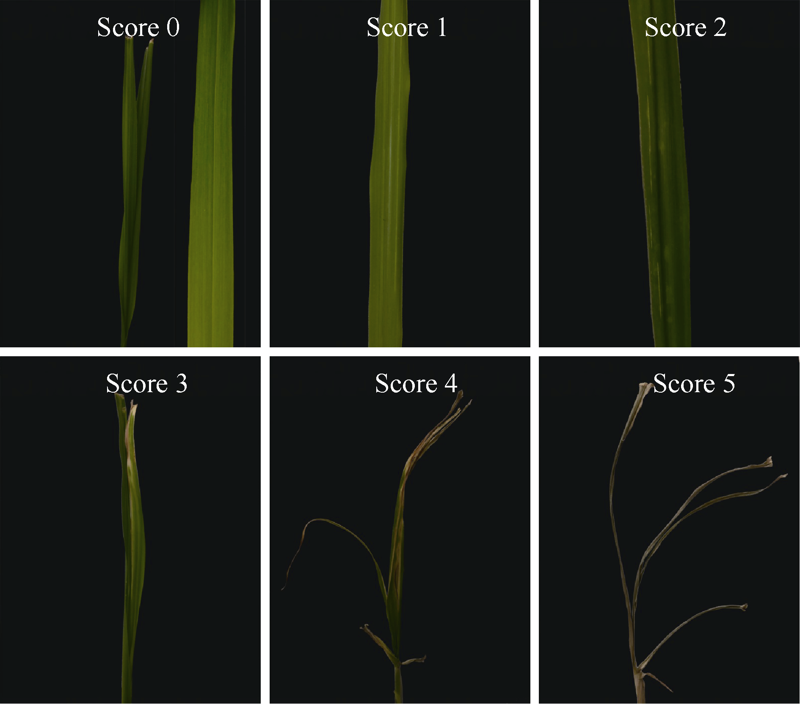
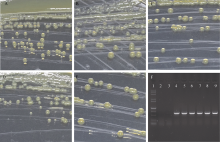
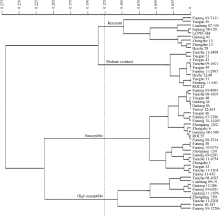
由白条黄单胞杆菌(Xanthomonas albilineans)引起的甘蔗白条病是甘蔗生产中的重要细菌性病害之一,选用抗病品种是甘蔗白条病防控最经济、最有效的措施。为明确国内甘蔗新品种(系)对白条病菌的抗性水平, 本研究选用抗白条病品种LCP 85-384和感白条病品种新台糖20号为对照种, 对我国各育种单位新选育的49个甘蔗新品种(系)进行苗期人工接种抗白条病鉴定。研究结果显示, 从白条病菌Xa-FJ1菌液接种后第7天开始, 随着时间的推移, 甘蔗品种白条病病情指数不断提高, 到接种后21~28 d时, 各品系的病情指数进入平稳增长时期。对接种后的病叶进行病原菌分离和叶片总DNA的提取, 利用甘蔗白条病菌特异性引物XAF1/XAR1进行PCR检测和鉴定, 结果证实白条病菌Xa-FJ1通过人工接种方式成功侵染供试材料。基于病情指数评价甘蔗抗病性水平, 将51份供试材料划分为抗、中抗、感、高感4个不同抗病等级。抗病至中抗水平的品种(系)有19份, 占37.3%, 其中抗病等级只有3份, 分别为粤甘50、福农09-7111和中蔗10号; 感病至高感水平的品种(系)有32份, 占62.7%。上述抗性鉴定结果表明, 本研究参试国内新选育的甘蔗品种(系)苗期对白条病的抗性水平没有达到高抗的品种(系), 建议加强甘蔗白条病抗病基因资源的挖掘和利用。
| [1] |
Ali A, Khan M, Sharif R, Mujtaba M, Gao S J. Sugarcane omics: an update on the current status of research and crop improvement. Plants, 2019,8:344.
doi: 10.3390/plants8090344 |
| [2] | 张跃彬. 我国蔗糖产业安全问题与发展对策. 中国糖料, 2019,41(1):66-68. |
| Zhang Y B. Safety problems and development countermeasures of cane sugar industry in China. Sugar Crops China, 2019,41(1):66-68 (in Chinese with English abstract). | |
| [3] | 刘晓雪, 田冰, 白晨. 我国糖料产业发展特点、问题与趋势. 中国糖料, 2019,41(2):47-51. |
| Liu X X, Tian B, Bai C. Characteristics, problems and development trends of sugar crop industry in China. Sugar Crops China, 2019,41(2):47-51 (in Chinese with English abstract). | |
| [4] |
Javed T, Shabbir R, Ali A, Afzal I, Zaheer U, Gao S J. Transcription factors in plant stress responses: challenges and potential for sugarcane improvement. Plants, 2020,9:491.
doi: 10.3390/plants9040491 |
| [5] |
Barnabas L A, Ramadass R S, Amalraj R S, Palaniyandi M, Rasappa V. Sugarcane proteomics: an update on current status, challenges, and future prospects. Proteomics, 2015,15:1658-1670.
doi: 10.1002/pmic.201400463 pmid: 25641866 |
| [6] | Rott P, Davis M J. Leaf scald. In: Rott P, Bailey R A, Comstock J C, Croft B J, Saumtally A S, eds. A Guide to Sugarcane Diseases. Montpellier, France: CIRAD/ISSCT, La Librairie du Cirad, 2000. pp 38-44. |
| [7] | Royer M, Pieretti I, Cociancich S. Recent progress in understanding three major bacterial diseases of sugarcane: Gumming, leaf scald and ratoon stunting. In: Rott P, eds. Achieving Sustainable Cultivation of Sugarcane Volume 2: Breeding, Pests and Diseases. Cambridge, UK: Burleigh Dodds Science Publishing, 2018. pp 311-336. |
| [8] | 孟建玉, 张慧丽, 林岭虹, 黄宏阳, 高三基. 甘蔗白条病及其致病菌Xanthomonas albilineans研究进展. 植物保护学报, 2019,46:257-265. |
| Meng J Y, Zhang H L, Lin L H, Huang H Y, Gao S J. Research advances in sugarcane leaf scald disease and its causal agent Xanthomonas albilineans. J Plant Prot, 2019,46:257-265 (in Chinese with English abstract). | |
| [9] |
Lin L H, Ntambo M S, Rott P C, Wang Q N, Lin Y H, Fu H Y, Gao S J. Molecular detection and prevalence of Xanthomonas albilineans, the causal agent of sugarcane leaf scald, in China. Crop Prot, 2018,109:17-23.
doi: 10.1016/j.cropro.2018.02.027 |
| [10] |
Ntambo M S, Meng J Y, Rott P C, Royer M, Lin L H, Zhang H L, Gao S J. Identification and characterization of Xanthomonas albilineans causing sugarcane leaf scald in China using multilocus sequence analysis. Plant Pathol, 2019,68:269-277.
doi: 10.1111/ppa.12951 |
| [11] |
Zhang R Y, Wang X Y, Shan H L, Li J, Li W F, Cang X Y, Luo Z M, Yin J, Huang Y K. Identification and phylogenetic analysis of Xanthomonas albilineans (Ashby) Downson based on multiple gene sequences in Yunnan province, China. Sugar Technol, 2019,21:794-801.
doi: 10.1007/s12355-019-00713-0 |
| [12] |
Klett P, Rott P. Inoculum sources for the spread of leaf scald disease of sugarcane caused by Xanthomonas albilineans in Guadeloupe. J Phytopathol, 1994,142:283-291.
doi: 10.1111/j.1439-0434.1994.tb04541.x |
| [13] | Daugrois J H, Boisne-Noc R, Champoiseau P, Rott P. The revisited infection cycle of Xanthomonas albilineans, the causal agent of leaf scald of sugarcane. Funct Plant Sci Biotechnol, 2012,6:91-97. |
| [14] |
Hoy J W, Grisham M P. Sugarcane leaf scald distribution, symptomatology, and effect on yield in Louisiana. Plant Dis, 1994,78:1083.
doi: 10.1094/PD-78-1083 |
| [15] |
Rott P, Soupa D, Brunet Y, Feldmann P, Letourmy P. Leaf scald (Xanthomonas albilineans) incidence and its effect on yield in seven sugarcane cultivars in Guadeloupe. Plant Pathol, 1995,44:1075-1084.
doi: 10.1111/ppa.1995.44.issue-6 |
| [16] |
Rott P, Mohamed I S, Klett P, Soupa D, de Saint-Albin A, Feldmann P, Letourmy P. Resistance to leaf scald disease is associated with limited colonization of sugarcane and wild relatives by Xanthomonas albilineans. Phytopathology, 1997,87:1202-1213.
doi: 10.1094/PHYTO.1997.87.12.1202 pmid: 18945019 |
| [17] |
Lopes S A, Damann K E, Grelen L B. Xanthomonas albilineans diversity and identification based on rep-PCR fingerprints. Current Microbiol, 2001,42:155-159.
doi: 10.1007/s002840010196 |
| [18] |
Garces F F, Gutierrez A, Hoy J W. Detection and quantification of Xanthomonas albilineans by qPCR and potential characterization of sugarcane resistance to leaf scald. Plant Dis, 2014,98:121-126.
doi: 10.1094/PDIS-04-13-0431-RE pmid: 30708616 |
| [19] |
Gutierrez A, Garces F F, Hoy J W. Evaluation of resistance to leaf scald by quantitative PCR of Xanthomonas albilineans in sugarcane. Plant Dis, 2016,100:1331-1338.
doi: 10.1094/PDIS-09-15-1111-RE pmid: 30686195 |
| [20] | 韦金菊, 魏春燕, 宋修鹏, 覃振强, 谭宏伟, 张荣华, 庞天, 王伦旺, 刘璐, 李杨瑞. 广西北海蔗区甘蔗白条病发生情况调查. 南方农业学报, 2018,49:264-270. |
| Wei J J, Wei C Y, Song X P, Qin Z Q, Tan H W, Zhang R H, Pang T, Wang L W, Liu L, Li Y R. Sugarcane leaf scald disease in sugarcane planting areas of Beihai, Guangxi. J Southern Agric, 2018,49:264-270 (in Chinese with English abstract). | |
| [21] | 李文凤, 单红丽, 张荣跃, 仓晓燕, 王晓燕, 尹炯, 罗志明, 黄应昆. 广西蔗区检测发现检疫性病害甘蔗白条病. 中国农学通报, 2018,34(13):144-149. |
| Li W F, Shan H L, Zhang R Y, Cang X Y, Wang X Y, Yin J, Luo Z M, Huang Y K. Sugarcane leaf scald disease found in Guangxi sugarcane region. Chin Agric Sci Bull, 2018,34(13):144-149 (in Chinese with English abstract). | |
| [22] |
Meng J Y, Ntambo M S, Luo L M, Huang M T, Gao S J. Molecular identification of Xanthomonas albilineans infecting elephant grass (Pennisetum purpureum) in China. Crop Prot, 2019,124:104853.
doi: 10.1016/j.cropro.2019.104853 |
| [23] |
Ntambo M S, Meng J Y, Rott P C, Robert J, Henry, Zhang H L, Gao S J. Comparative transcriptome profiling of resistant and susceptible sugarcane cultivars in response to infection by Xanthomonas albilineans. Int J Mol Sci, 2019,20:6138.
doi: 10.3390/ijms20246138 |
| [24] |
Davis M J, Rott P, Baudin P, Dean J L. Evaluation of selective media and immunoassays for detection of Xanthomonas albilineans, the causal agent of sugarcane leaf scald disease. Plant Dis, 1994,78:78-82.
doi: 10.1094/PD-78-0078 |
| [25] |
Wang Z K, Comstock J C, Hatziloukas E, Schaad N W. Comparison of PCR, BIO-PCR, DIA, ELISA and isolation on semiselective medium for detection of Xanthomonas albilineans, the causal agent of leaf scald of sugarcane. Plant Pathol, 1999,48:245-252.
doi: 10.1046/j.1365-3059.1999.00332.x |
| [26] |
Zhang J S, Zhang X T, Tang H B, Zhang Q, Hua X T, Ma X K, Zhu F, Jones T, Zhu X G, Bowers J, Wai C M, Zheng C F, Shil Y, Chen S, Xu X M, Yue J J, Nelsons D R, Huang L X, Li Z, Xu H M, Zhou D, Wang Y J, Hu W C, Lin J S, Deng Y J, Pandey N, Mancini M, Zerpa D, Nguyen J K, Wang L M, Yu L, Xin Y H, Ge L F, Arro J, Han J O, Chakrabarty S, Pushko M, Zhang W P, Ma Y H, Ma P P, Lyu M J, Chen F M, Zheng G Y, Xu J S, Yang Z H, Deng F, Chen X Q, Liao Z Y, Zhang X X, Lin Z C, Lin H, Yan H S, Kuang Z, Zhong W M, Liang P P, Wang G F, Yuan Y, Shi J X, Hou J X, Lin J X, Jin J J, Cao P J, Shen Q C, Jiang Q, Zhou P, Ma Y Y, Zhang X D, Xu R R, Liu J, Zhou Y M, Jia H F, Ma Q, Qi R, Zhang Z L, Fang J P, Fang H K, Song J J, Wang M J, Dong G R, Wang G, Chen Z, Ma T, Liu H, Dhungana S R, Huss S E, Yang X P, Sharma A, Trujillo J H, Hudson M, Riascos J J, Schuler M, Chen L Q, Braun D M, Li L, Yu Q Y, Wang J P, Wang K, Schatz M C, Heckerman D, Van Sluys M A, Souza G M, Moore P H, Sankoff D, VanBuren R, Paterson A H, Nagai C, Ming R. Allele-defined genome of the autopolyploid sugarcane Saccharum spontaneum L. Nat Genet, 2018,50:1565-1573.
doi: 10.1038/s41588-018-0237-2 |
| [27] |
Ahmad A, Wang J D, Pan Y B, Sharif R, Gao S J. Development and use of single sequence repeats (SSRs) markers for sugarcane breeding and genetic studies. Agronomy, 2018,8:260.
doi: 10.3390/agronomy8110260 |
| [28] |
Lakshmanan P, Geijskes R J, Aitken K S, Grof C L P, Bonnett G D, Smith G R. Sugarcane biotechnology: the challenges and opportunities. In Vitro Cell Dev Biol Plant, 2005,41:345-363.
doi: 10.1079/IVP2005643 |
| [29] | Patro T S S K, Rao G V N. Reaction of sugarcane clones to leaf scald disease incited by Xanthomonas albilineans. J Mycol Plant Pathol, 2006,36:241-243. |
| [30] |
Wang H B, Xiao N Y, Wang Y J, Guo J L, Zhang J S. Establishment of a qualitative PCR assay for the detection of Xanthomonas albilineans (Ashby) Dowson in sugarcane. Crop Prot, 2020,130:105053.
doi: 10.1016/j.cropro.2019.105053 |
| [31] |
Duarte D V, Fernandez E, Cunha M G, Pieretti I, Hincapie M, Roumagnac P, Comstock J C, Rott P. Comparison of loop-mediated isothermal amplification, polymerase chain reaction, and selective isolation assays for detection of Xanthomonas albilineans from sugarcane. Trop Plant Pathol, 2018,43:351-359.
doi: 10.1007/s40858-018-0216-2 |
| [1] | 肖健, 陈思宇, 孙妍, 杨尚东, 谭宏伟. 不同施肥水平下甘蔗植株根系内生细菌群落结构特征[J]. 作物学报, 2022, 48(5): 1222-1234. |
| [2] | 周慧文, 丘立杭, 黄杏, 李强, 陈荣发, 范业赓, 罗含敏, 闫海锋, 翁梦苓, 周忠凤, 吴建明. 甘蔗赤霉素氧化酶基因ScGA20ox1的克隆及功能分析[J]. 作物学报, 2022, 48(4): 1017-1026. |
| [3] | 孔垂豹, 庞孜钦, 张才芳, 刘强, 胡朝华, 肖以杰, 袁照年. 不同施肥水平下丛枝菌根真菌对甘蔗生长及养分相关基因共表达网络的影响[J]. 作物学报, 2022, 48(4): 860-872. |
| [4] | 杨宗桃, 刘淑娴, 程光远, 张海, 周营栓, 商贺阳, 黄国强, 徐景升. 甘蔗类泛素蛋白UBL5应答SCMV侵染及其与SCMV-6K2的互作[J]. 作物学报, 2022, 48(2): 332-341. |
| [5] | 张海, 程光远, 杨宗桃, 刘淑娴, 商贺阳, 黄国强, 徐景升. 甘蔗PsbR亚基应答SCMV侵染及其与SCMV-6K2的互作[J]. 作物学报, 2021, 47(8): 1522-1530. |
| [6] | 苏亚春, 李聪娜, 苏炜华, 尤垂淮, 岑光莉, 张畅, 任永娟, 阙友雄. 甘蔗割手密种类甜蛋白家族鉴定及栽培种同源基因功能分析[J]. 作物学报, 2021, 47(7): 1275-1296. |
| [7] | 黄宁, 惠乾龙, 方振名, 李姗姗, 凌辉, 阙友雄, 袁照年. 甘蔗β-胡萝卜素异构酶基因家族的鉴定、定位和表达分析[J]. 作物学报, 2021, 47(5): 882-893. |
| [8] | 王恒波, 陈姝琦, 郭晋隆, 阙友雄. 甘蔗抗黄锈病G1标记的分子检测及候选抗病基因WAK的分析[J]. 作物学报, 2021, 47(4): 577-586. |
| [9] | 张荣跃, 王晓燕, 杨昆, 单红丽, 仓晓燕, 李婕, 王长秘, 尹炯, 罗志明, 李文凤, 黄应昆. 甘蔗新品种及主栽品种对褐锈病抗性与Bru1基因分子检测[J]. 作物学报, 2021, 47(2): 376-382. |
| [10] | 仓晓燕, 夏红明, 李文凤, 王晓燕, 单红丽, 王长秘, 李婕, 张荣跃, 黄应昆. 甘蔗优良品种(系)对黑穗病的抗性评价[J]. 作物学报, 2021, 47(11): 2290-2296. |
| [11] | 张海, 程光远, 杨宗桃, 王彤, 刘淑娴, 商贺阳, 赵贺, 徐景升. 甘蔗ScCRT1基因克隆及其应答SCMV侵染分子机制的研究[J]. 作物学报, 2021, 47(1): 94-103. |
| [12] | 郑清雷,余陈静,姚坤存,黄宁,阙友雄,凌辉,许莉萍. 甘蔗Rieske Fe/S蛋白前体基因ScPetC的克隆及表达分析[J]. 作物学报, 2020, 46(6): 844-857. |
| [13] | 罗俊,林兆里,李诗燕,阙友雄,张才芳,杨仔奇,姚坤存,冯景芳,陈建峰,张华. 不同土壤改良措施对机械压实酸化蔗地土壤理化性质及微生物群落结构的影响[J]. 作物学报, 2020, 46(4): 596-613. |
| [14] | 王恒波,祁舒婷,陈姝琦,郭晋隆,阙友雄. 甘蔗栽培种单倍体基因组SSR位点的发掘与应用[J]. 作物学报, 2020, 46(4): 631-642. |
| [15] | 张海, 刘淑娴, 杨宗桃, 王彤, 程光远, 商贺阳, 徐景升. 甘蔗PsbS亚基应答甘蔗花叶病毒侵染及其与6K2蛋白的互作研究[J]. 作物学报, 2020, 46(11): 1722-1733. |
|
||