欢迎访问作物学报,今天是
作物学报 ›› 2023, Vol. 49 ›› Issue (10): 2633-2642.doi: 10.3724/SP.J.1006.2023.32007
曹慧敏1,2( ), 杨贤莉3(), 王立志3, 李苹苹1, 翟来圆2, 姜树坤3, 郑天清2, 邱先进1(), 徐建龙2,4,5()
CAO Hui-Min1,2(), YANG Xian-Li3(), WANG Li-Zhi3, LI Ping-Ping1, ZHAI Lai-Yuan2, JIANG Shu-Kun3, ZHENG Tian-Qing2, QIU Xian-Jin1(), XU Jian-Long2,4,5()
摘要:
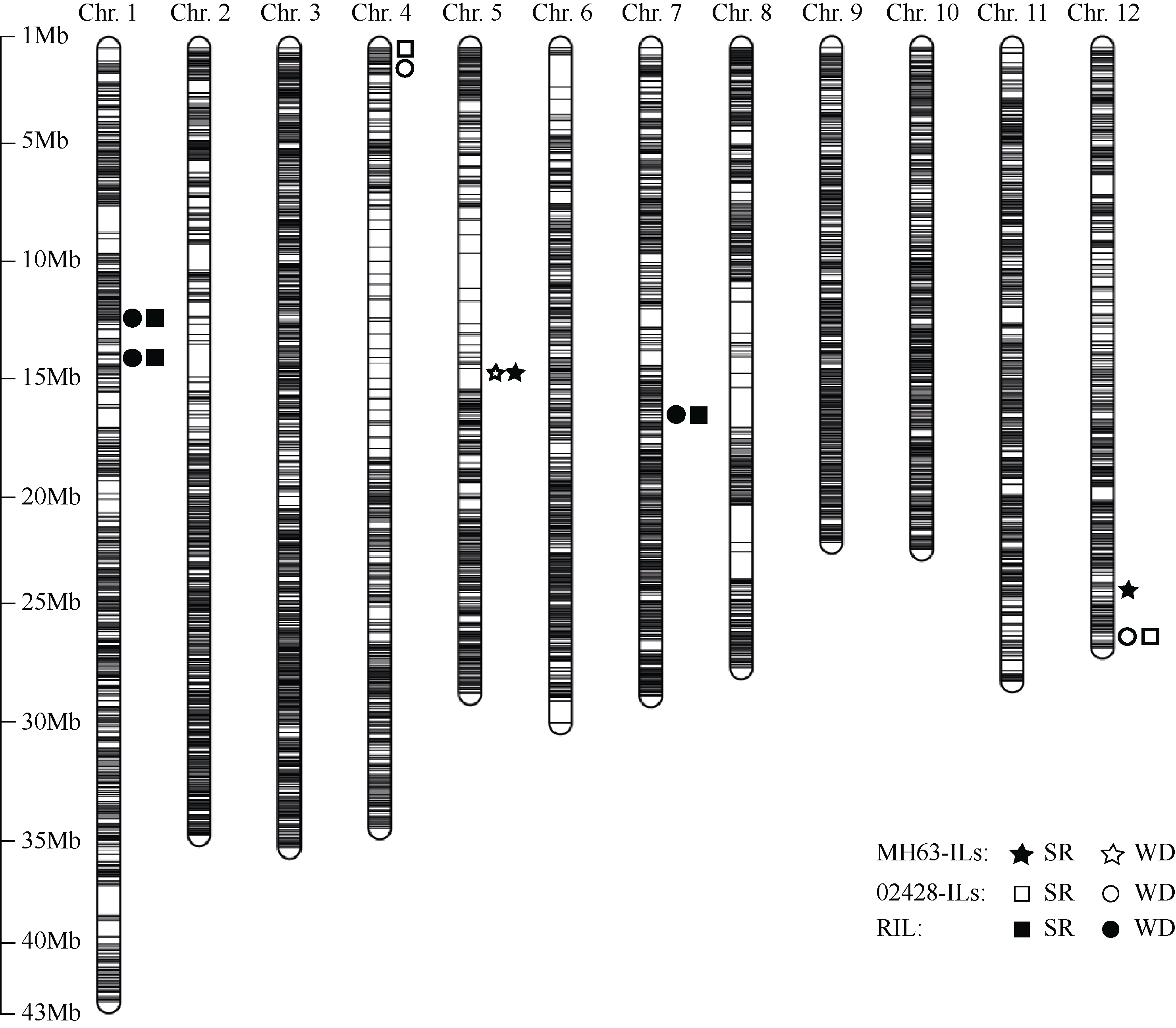
苗期低温冷害常造成水稻生长发育受阻, 影响形态建成最终导致减产。鉴定和挖掘优良的耐冷基因, 选育耐冷水稻品种, 是减少冷害造成水稻产量损失的有效措施。本研究以籼稻明恢63和粳稻02428为亲本构建的双向导入系及重组自交系群体为研究材料, 通过人工气候室进行苗期耐冷性鉴定, 考查枯萎度和冷害恢复生长后的存活率, 结合重测序构建的Bin基因型数据, 进行苗期耐冷性QTL定位, 3个群体在1号、4号、5号、7号和12号染色体上共检测到13个与水稻苗期耐冷性相关的QTL, 解释0.36%~13.63%的表型变异。未定位到不同遗传背景下稳定表达的QTL, 但有5个同时影响枯萎度和存活率的QTL被检出, 分别位于1号、5号、7号和12号染色体, 其中位于1号染色体12,732,139~13,202,097 bp和14,445,778~14,585,009 bp及5号染色体14,658,891~15,684,510 bp的3个QTL的LOD值都高于25, 被认为是可靠的主效QTL。结合基因注释、表达谱数据和3K种质资源的苗期耐冷表型数据分析, 推测位于5号染色体区间内影响枯萎度和存活率的基因很可能是已克隆的耐冷基因OsWKRY45, 而1号染色体2个区间的2个基因是新基因位点, 其候选基因分别是LOC_Os01g25540和LOC_Os01g25560。单倍型分析结果表明, LOC_Os01g25540的Hap2、Hap4和Hap9, LOC_Os01g25560的Hap1、Hap8和Hap10为有利单倍型。研究结果将为水稻品种耐冷分子改良提供宝贵的耐冷资源和有利基因。
| [1] | Li T G, Visperas R M, Vergara B S. Correlation of cold tolerance at different growth stages in rice. Acta Bot Sin, 1981, 23: 203-207. |
| [2] | 李霞, 戴传超, 程睿, 陈婷, 焦德茂. 不同生育期水稻耐冷性的鉴定及耐冷性差异的生理机制. 作物学报, 2006, 32: 76-83. |
| Li X, Dai C C, Cheng R, Chen T, Jiao D M. Identification for cold tolerance at different growth stages in rice (Oryza sativa L.) and physiological mechanism of differential cold tolerance. Acta Agron Sin, 2006, 32: 76-83. (in Chinese with English abstract) | |
| [3] |
Lou Q J, Chen L, Sun Z X, Xing Y Z, Li J, Xu X Y, Mei H W, Luo L J. A major QTL associated with cold tolerance at seedling stage in rice (Oryza sativa L.). Euphytica, 2007, 158: 87-94.
doi: 10.1007/s10681-007-9431-5 |
| [4] |
Zhao J L, Zhang S H, Dong J F, Yang T F, Mao X X, Liu Q, Wang X F, Liu B. A novel functional gene associated with cold tolerance at the seedling stage in rice. Plant Biotechnol J, 2017, 15: 1141-1148.
doi: 10.1111/pbi.12704 pmid: 28173633 |
| [5] |
Kim S, Suh J, Lee C, Lee J, Kim Y, Jena K K. QTL mapping and development of candidate gene-derived DNA markers associated with seedling cold tolerance in rice (Oryza sativa L.). Mol Genet Genomics, 2014, 289: 333-343.
doi: 10.1007/s00438-014-0813-9 |
| [6] |
Ma Y, Dai X Y, Xu Y Y, Luo W, Zheng X M, Zeng D L, Pan Y J, Lin X L, Liu H H, Zhang D J, Xiao J, Guo X Y, Xu S J, Niu Y D, Jin J B, Zhang H, Xu X, Li L G, Wang W, Qian Q, Ge S, Chong K. COLD1 confers chilling tolerance in rice. Cell, 2015, 160: 1209-1221.
doi: 10.1016/j.cell.2015.01.046 pmid: 25728666 |
| [7] |
Tao Z, Kou Y J, Liu H B, Li X H, Xiao J H, Wang S P. OsWRKY45 alleles play different roles in abscisic acid signalling and salt stress tolerance but similar roles in drought and cold tolerance in rice. J Exp Bot, 2011, 62: 4863-4874.
doi: 10.1093/jxb/err144 |
| [8] |
Chen L P, Zhao Y, Xu S J, Zhang Z Y, Xu Y Y, Zhang J Y, Chong K. OsMADS57 together with OsTB1 coordinates transcription of its target OsWRKY94 and D14 to switch its organogenesis to defense for cold adaptation in rice. New Phytol, 2018, 218: 219-231.
doi: 10.1111/nph.14977 |
| [9] |
Ryu H S, Han M, Lee S K, Cho J I, Ryoo N, Heu S, Lee Y H, Bhoo S H, Wang G L, Hahn T R, Jeon J S. A comprehensive expression analysis of the WRKY gene superfamily in rice plants during defense response. Plant Cell Rep, 2006, 25: 836-847.
doi: 10.1007/s00299-006-0138-1 |
| [10] |
Li J, Brader G, Palva E T. The WRKY70 transcription factor: a node of convergence for jasmonate-mediated and salicylate-mediated signals in plant defense. Plant Cell, 2004, 16: 319-331.
doi: 10.1105/tpc.016980 pmid: 14742872 |
| [11] |
Yang C C, Li D Y, Mao D H, Liu X, Ji C J, Li X B, Zhao X F, Cheng Z K, Chen C Y, Zhu L H. Overexpression of microRNA319 impacts leaf morphogenesis and leads to enhanced cold tolerance in rice (Oryza sativa L.). Plant Cell Environ, 2013, 36: 2207-2218.
doi: 10.1111/pce.12130 |
| [12] |
Liu H, Soomro A, Zhu Y J, Qiu X J, Chen K, Zheng T Q, Yang L W, Xing D Y, Xu J L. QTL underlying iron and zinc toxicity tolerances at seedling stage revealed by two sets of reciprocal introgression populations of rice (Oryza sativa L.). Crop J, 2016, 4: 280-289.
doi: 10.1016/j.cj.2016.05.007 |
| [13] |
Xie W B, Feng Q, Yu H H, Huang X H, Zhao Q, Xing Y Z, Yu S B, Han B, Zhang Q. Parent-independent genotyping for constructing an ultrahigh-density linkage map based on population sequencing. Proc Natl Acad Sci USA, 2010, 107: 10578-10583.
doi: 10.1073/pnas.1005931107 pmid: 20498060 |
| [14] | 韩龙植, 张三元. 水稻耐冷性鉴定评价方法. 植物遗传资源学报, 2004, 5: 75-80. |
| Han L Z, Zhang S Y. Methods of characterization and evaluation of cold tolerance in rice. J Plant Genet Resour, 2004, 5: 75-80. | |
| [15] |
Morsy M R, Jouve L, Hausman J, Hoffmann L, Stewart J M. Alteration of oxidative and carbohydrate metabolism under abiotic stress in two rice (Oryza sativa L.) genotypes contrasting in chilling tolerance. J Plant Physiol, 2007, 164: 157-167.<br
doi: 10.1016/j.jplph.2005.12.004 |
| [16] |
Meng L, Li H H, Zhang L Y, Wang J K. QTL IciMapping: integrated software for genetic linkage map construction and quantitative trait locus mapping in biparental populations. Crop J, 2015, 3: 269-283.
doi: 10.1016/j.cj.2015.01.001 |
| [17] |
Zhang F, Wang C C, Li M, Cui Y R, Shi Y Y, Wu Z C, Hu Z Q, Wang W S, Xu J L, Li Z K. The landscape of gene- CDS-haplotype diversity in rice: Properties, population organization, footprints of domestication and breeding, and implications for genetic improvement. Mol Plant, 2021, 14: 787-804.
doi: 10.1016/j.molp.2021.02.003 pmid: 33578043 |
| [18] | Yu Y M, Zhang H, Long Y P, Shu Y, Zhai J X. Plant public RNA-seq database: a comprehensice online database for expression analysis of -45000 plant public RNA-seq libraries. Plant Biotechnol J, 2022, 20: 806-808. |
| [19] |
Li J L, Zeng Y W, Pan Y H, Zhou L, Zhang Z Y, Guo H F, Lou Q J, Shui G H, Huang H G, Tian H, Guo Y M, Yuan P R, Yang H, Pan G J, Wang R Y, Zhang H L, Yang S H, Guo Y, Ge S, Li J J, Li Z C. Stepwise selection of natural variations at CTB2and CTB4a improves cold adaptation during domestication of japonica rice. New Phytol, 2021, 231: 1056-1072.
doi: 10.1111/nph.v231.3 |
| [20] | 王韵, 程立锐, 孙勇, 周政, 朱苓华, 徐正进, 徐建龙, 黎志康. 利用双向导入系解析水稻抽穗期和株高QTL及其与环境互作表达的遗传背景效应. 作物学报, 2009, 35: 1386-1394. |
| Wang Y, Cheng L R, Sun Y, Zhou Z, Zhu L H, Xu Z J, Xu J L, Li Z K. Genetic background effect on QTL expression of heading date and plant height and their interaction with environment in reciprocal introgression lines of rice. Acta Agron Sin, 2009, 35: 1386-1394. (in Chinese with English abstract) | |
| [21] |
Wang Y, Zhang Q, Zheng T Q, Cui Y R, Zhang W Z, Xu J L, Li Z K. Drought-tolerance QTLs commonly detected in two sets of reciprocal introgression lines in rice. Crop Past Sci, 2014, 65: 171.
doi: 10.1071/CP13344 |
| [22] | 张帆, 郝宪彬, 高用明, 华泽田, 马秀芳, 陈温福, 徐正进, 朱苓华, 黎志康. 利用籼稻资源中的“隐蔽有利基因”提高粳稻苗期耐冷性. 作物学报, 2007, 33: 1618-1624. |
| Zhang F, Hao X B, Gao Y M, Hua Z T, Ma X F, Chen W F, Xu Z J, Zhu L H, Li Z K. Improving seedling cold tolerance of japonica rice by using the “Hidden Diversity” in indica rice germplasm in backcross breeding program. Acta Agron Sin, 2007, 33: 1618-1624. (in Chinese with English abstract) |
| [1] | 彭佳泺, 李颖, 李丹丹, 杨军宁, 郭学峰, 张文姣, 俞晓雪, 周亚荣, 王振玉, 王彩香, 马雄风, 宿俊吉. 陆地棉I类LBD家族成员鉴定及GhLBD6调控开花期的功能和单倍型分析[J]. 作物学报, 2026, 52(6): 1682-1697. |
| [2] | 唐宽强, 李公允, 宋美毅, 赵雪, 常春玲. 大豆株高性状全基因组关联分析及预测模型构建[J]. 作物学报, 2026, 52(6): 1743-1756. |
| [3] | 郑玉珍, 齐飞艳, 孙子淇, 刘华, 秦利, 石磊, 王娟, 汪蒙蒙, 韩锁义, 徐静, 苗利娟, 黄冰艳, 董文召, 郑峥, 张新友. 花生籽仁总超长链脂肪酸和7种脂肪酸组分的QTL定位[J]. 作物学报, 2026, 52(6): 1646-1657. |
| [4] | 胡赵, 钱润, 谢丰璞, 应素平. 水稻SPX基因家族鉴定及响应磷处理的表达分析[J]. 作物学报, 2026, 52(6): 1902-1912. |
| [5] | 邹仪妹, 徐敏, 汪海洋, 姚辉, 王加峰, 刘浩, 任代胜. 两系不育系水稻幼苗根系响应盐胁迫的转录因子调控网络鉴定[J]. 作物学报, 2026, 52(6): 1728-1742. |
| [6] | 张献丰, 郭利建, 李康春, 孔斌雪, 刘玉芳, 车卓, 杨德龙. 小麦ABHD6基因家族鉴定与粒重功能标记开发[J]. 作物学报, 2026, 52(6): 1711-1727. |
| [7] | 闫安, 蒋昆炜, 王蓉圆, 田林, 张璐, 王韵, 徐建龙. 水稻剑叶小维管束数基因SVN7的鉴定与克隆[J]. 作物学报, 2026, 52(5): 1364-1372. |
| [8] | 陈伟, 卫万娟, 赵其兵, 常东伟, 余凌波, 翟鹏飞, 冯志明, 陈宗祥, 任仰涛, 杨鹏, 刘海浪, 李珍富, 杨永乐, 金彦刚, 左示敏. 利用CRISPR/Cas9编辑Hd6基因创制优质早熟水稻新种质[J]. 作物学报, 2026, 52(4): 1046-1056. |
| [9] | 石少阶, 刘凯, 陈姿夷, 王卉颖, 李三和, 周雷, 游艾青. 水稻矮化多分蘖基因DMT1的克隆与功能分析[J]. 作物学报, 2026, 52(4): 1022-1034. |
| [10] | 刘长友, 王珅, 时会影, 沈颖超, 孙蕾, 王彦, 张志肖, 苏秋竹, 田静, 范保杰. 基于饭豆基因资源的小豆远缘杂交群体抗豆象QTL定位[J]. 作物学报, 2026, 52(3): 936-944. |
| [11] | 叶凡, 李帅, 李思宇, 陈云, 窦超银, 刘立军. 不同节水灌溉方式对东北稻区水稻产量和群体质量的影响[J]. 作物学报, 2026, 52(3): 895-907. |
| [12] | 覃奕琰, 付瑶, 苏畅, 李娜, 徐静茹, 程笑然, 张琪, 赵明辉. OsST41调控水稻苗期耐盐性的功能分析[J]. 作物学报, 2026, 52(3): 802-812. |
| [13] | 李诗晴, 王茜, 王素华, 张耀文, 王丽侠. 绿豆种质资源苗期耐盐性鉴定及相关基因发掘[J]. 作物学报, 2026, 52(2): 376-388. |
| [14] | 王婵, 吴莹莹, 李文奇, 李霞, 王芳权, 周彤, 杨杰. 基于HRM技术开发水稻抗条纹叶枯病基因STV11功能标记[J]. 作物学报, 2025, 51(9): 2547-2556. |
| [15] | 李璐琪, 程宇坤, 白斌, 雷斌, 耿洪伟. 小麦叶片气孔相关性状全基因组关联分析[J]. 作物学报, 2025, 51(9): 2266-2284. |
|
||