欢迎访问作物学报,今天是
作物学报 ›› 2018, Vol. 44 ›› Issue (8): 1229-1236.doi: 10.3724/SP.J.1006.2018.01229
聂志刚1,2( ),李广3,*(),雒翠萍2,马维伟3,代永强2
Zhi-Gang NIE1,2(),Guang LI3,*(),Cui-Ping LUO2,Wei-Wei MA3,Yong-Qiang DAI2
摘要:
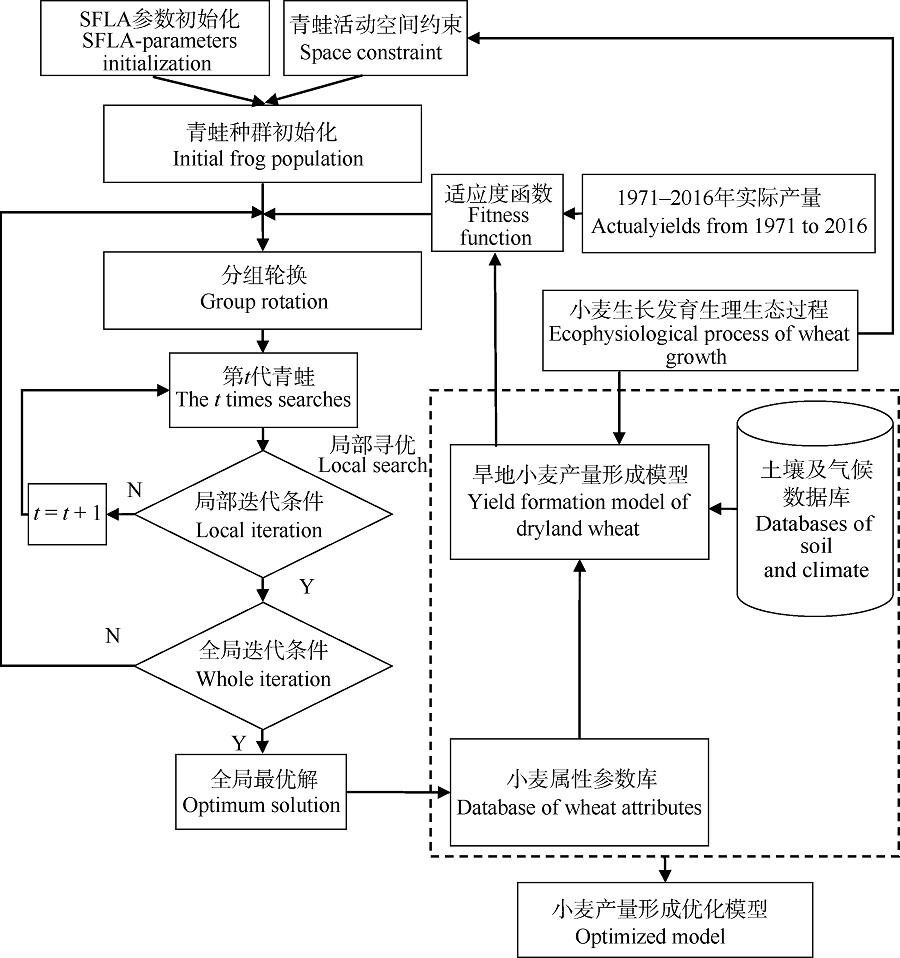
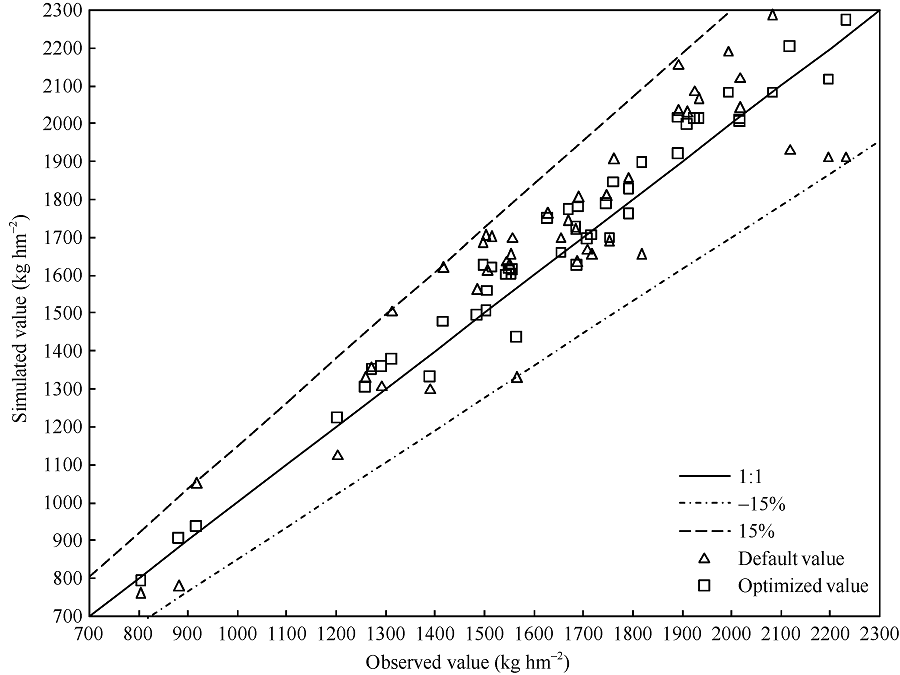
模型参数的快速、准确估算是产量形成模型应用的重要前提。在基于APSIM (agricultural production systems simulator)的旱地小麦产量形成模型参数本土化率定过程中, 存在体量大、耗时长、精度低、效率低的缺点, 本研究利用智能算法优化模型参数, 试图解决上述问题。依据甘肃省定西市安定区李家堡镇麻子川村2002—2005年、凤翔镇安家沟村2015—2016年大田试验数据以及定西市安定区1971—2016年气象和产量资料, 运用混合蛙跳算法分组轮换和全局信息交换的智能策略, 对基于APSIM的旱地小麦产量形成模型参数进行了优化, 并采用相关性分析方法检验。该优化方法利用青蛙智能的群体生物进化学习策略, 可实现对小麦产量形成模型参数的估算, 较APSIM平台参数本土化率定常用的穷举试错法, 参数优化后产量模拟精度显著提高, 均方根误差(RMSE)平均值由79.13 kg hm -2降低到35.36 kg hm -2, 归一化均方根误差(NRMSE)平均值由5.97%降低到2.63%, 模型有效性指数(ME)平均值由0.939提高到0.989。该方法全局优化能力强, 收敛速度快。
| [1] | 邹薇, 刘铁梅, 孔德艳, 汤亮, 曹卫星 . 大麦产量构成模型. 应用生态学报, 2009,20:396-402 |
| Zou W, Liu T M, Kong D Y, Tang L, Cao W X . Simulation model on barley yield formation. Chin J Appl Ecol, 2009,20:396-402 (in Chinese with English abstract) | |
| [2] |
郑秀琴, 冯利平, 刘荣花 . 冬小麦产量形成模拟模型研究. 作物学报, 2006,32:260-266
doi: 10.3321/j.issn:0496-3490.2006.02.018 |
|
Zheng X Q, Feng L P, Liu R H . A simulation model for yield components and final yield in winter wheat. Acta Agron Sin, 2006,32:260-266 (in Chinese with English abstract)
doi: 10.3321/j.issn:0496-3490.2006.02.018 |
|
| [3] | 庄嘉祥, 姜海燕, 刘蕾蕾, 王芳芳, 汤亮, 朱艳, 曹卫星 . 基于个体优势遗传算法的水稻生育期模型参数优化. 中国农业科学, 2013,46:2220-2231 |
| Zhuang J X, Jiang H Y, Liu L L, Wang F F, Tang L, Zhu Y, Cao W X . Parameters optimization of rice development stages model based on individual advantages genetic algorithm. Sci Agric Sin, 2013,46:2220-2231 (in Chinese with English abstract) | |
| [4] |
房全孝 . 根系水质模型中土壤与作物参数优化及其不确定性评价. 农业工程学报, 2012,28(10):118-123
doi: 10.3969/j.issn.1002-6819.2012.10.019 |
|
Fang Q X . Optimizing and uncertainty evaluation of soil and crop parameters in root zone water quality model. Trans CSAE, 2012,28(10):118-123 (in Chinese with English abstract)
doi: 10.3969/j.issn.1002-6819.2012.10.019 |
|
| [5] |
刘志娟, 杨晓光, 王静, 吕硕, 李克南, 荀欣, 王恩利 . APSIM玉米模型在东北地区的适应性. 作物学报, 2012,38:740-746
doi: 10.3724/SP.J.1006.2012.00740 |
|
Liu Z J, Yang X G, Wang J, Lyu S, Li K N, Xun X, Wang E L . Adaptability of APSIM maize model in Northeast China. Acta Agron Sin, 2012,38:740-746 (in Chinese with English abstract)
doi: 10.3724/SP.J.1006.2012.00740 |
|
| [6] |
Mansouri M, Destain M F . An improved particle filtering for time-varying nonlinear prediction of biomass and grain protein content. Comput Electron Agric, 2015,114:145-153
doi: 10.1016/j.compag.2015.04.006 |
| [7] | 刘铁梅, 王燕, 邹薇, 孙东发, 汤亮, 曹卫星 . 大麦叶面积指数模拟模型. 应用生态学报, 2010,21:121-128 |
| Liu T M, Wang Y, Zou W, Sun D F, Tang L, Cao W X . Simulation model of barley leaf area index. Chin J Appl Ecol, 2010,21:121-128 (in Chinese with English abstract) | |
| [8] |
李广, 黄高宝, William B, 陈文 . APSIM模型在黄土丘陵沟壑区不同耕作措施中的适用性. 生态学报, 2009,29:2655-2663
doi: 10.3321/j.issn:1000-0933.2009.05.056 |
|
Li G, Huang G B, William B, Chen W . The applicability of APSIM model in different tillage measures in hilly gully region of the Loess Plateau. Acta Ecol Sin, 2009,29:2655-2663 (in Chinese with English abstract)
doi: 10.3321/j.issn:1000-0933.2009.05.056 |
|
| [9] | 鲍士旦 . 土壤农化分析(第3版). 北京: 中国农业出版社, 2000. pp 263-268 |
| Bao S D. Soil Agricultural Chemistry Analysis, 3rd edn. Beijing: China Agriculture Press, 2000. pp 263-268(in Chinese) | |
| [10] |
李广, 李玥, 黄高宝, 罗珠珠, 王琦, 刘强, 燕振刚, 赵有益 . 基于APSIM模型旱地春小麦产量对温度和CO2浓度升高的响应. 中国生态农业学报, 2012,20:1088-1095
doi: 10.3724/SP.J.1011.2012.01088 |
|
Li G, Li Y, Huang G B, Luo Z Z, Wang Q, Liu Q, Yan Z G, Zhao Y Y . Response of dryland spring wheat yield to elevated CO2 concentration and temperature by APSIM model. Chin J Eco- Agric, 2012,20:1088-1095 (in Chinese with English abstract)
doi: 10.3724/SP.J.1011.2012.01088 |
|
| [11] |
聂志刚, 李广 . 基于APSIM的旱地小麦叶面积指数模拟模型构建. 干旱地区农业研究, 2013,31(4):94-98
doi: 10.3969/j.issn.1000-7601.2013.04.018 |
|
Nie Z G, Li G . Modeling of APSIM-based simulation of leaf area index of wheat in dryland. Agric Res Arid Areas, 2013,31(4):94-98 (in Chinese with English abstract)
doi: 10.3969/j.issn.1000-7601.2013.04.018 |
|
| [12] |
王伟, 黄义德, 黄文江, 李存军, 王娴 . 作物生长模型的适用性评价及冬小麦产量预测. 农业工程学报, 2010,26(3):233-237
doi: 10.3969/j.issn.1002-6819.2010.03.039 |
|
Wang W, Huang Y D, Huang W J, Li C J, Wang X . Applicability evaluation of CERES-Wheat model and yield prediction of winter wheat. Trans CSAE, 2010,26(3):233-237 (in Chinese with English abstract)
doi: 10.3969/j.issn.1002-6819.2010.03.039 |
|
| [13] |
何亮, 赵刚, 靳宁, 庄伟, 于强 . 不同气候区和不同产量水平下APSIM-Wheat模型的参数全局敏感性分析. 农业工程学报, 2015,31(14):148-157
doi: 10.11975/j.issn.1002-6819.2015.14.021 |
|
He L, Zhao G, Jin N, Zhuang W, Yu Q . Global sensitivity analysis of APSIM-Wheat parameters in different climate zones and yield levels. Trans CSAE, 2015,31(14):148-157 (in Chinese with English abstract)
doi: 10.11975/j.issn.1002-6819.2015.14.021 |
|
| [14] |
董朝阳, 刘志娟, 杨晓光 . 北方地区不同等级干旱对春玉米产量影响. 农业工程学报, 2015,31(11):157-164
doi: 10.11975/j.issn.1002-6819.2015.11.023 |
|
Dong C Y, Liu Z J, Yang X G . Effect of different grade drought on grain yield of spring maize in northern China. Trans CSAE, 2015,31(11):157-164 (in Chinese with English abstract)
doi: 10.11975/j.issn.1002-6819.2015.11.023 |
|
| [15] |
Asseng S, Bar-Tal A, Bowden J W, Keating B A, Van Herwaarden A, Palta J A, Huth N I, Probert M E . Simulaton of grain protein content with APSIM-N wheat. Eur J Agron, 2002,16:25-42
doi: 10.1016/S1161-0301(01)00116-2 |
| [16] | 代永强 . 混合蛙跳算法的改进与应用. 甘肃农业大学硕士学位论文, 甘肃兰州, 2011 |
| Dai Y Q . The Improvement and Application of Shuffled Frog Leaping Algorithm. MS Thesis of Gansu Agricultural University, Lanzhou, China, 2011 ( in Chinese with English abstract) | |
| [17] | 康立军, 张仁陟, 吴丽丽 . 基于混合蛙跳算法的灌溉制度寻优应用研究. 节水灌溉, 2012, ( 5):73-75 |
| Kang L J, Zhang R Z, Wu L L . Study on application of SFLA-based irrigation schedule optimization. Water Saving Irrig, 2012, ( 5):73-75 (in Chinese with English abstract) | |
| [18] |
郭小燕, 刘学录, 王联国 . 基于混合蛙跳算法的土地利用格局优化. 农业工程学报, 2015,31(24):281-288
doi: 10.11975/j.issn.1002-6819.2015.24.043 |
|
Guo X Y, Liu X L, Wang L G . Land use pattern optimization based on shuffled frog leaping algorithm. Trans CSAE, 2015,31(24):281-288 (in Chinese with English abstract)
doi: 10.11975/j.issn.1002-6819.2015.24.043 |
|
| [19] |
Zhang X C . Calibration, refinement, and application of the WEPP model for simulating climatic impact on wheat production. Trans ASAE, 2004,47:1075-1085
doi: 10.13031/2013.16580 |
| [20] | Zheng B Y, Chenu K, Doherty A, Chapman S . The APSIM-Wheat Module (7.5 R3008) Documentation. Toowoomba: APSRU, 2014. pp 18-19 |
| [21] | 杨文雄 . 中国西北春小麦. 北京: 中国农业出版社, 2016. pp 155-161 |
| Yang W X. Spring wheat in Northwest China. Beijing: China Agriculture Press, 2016. pp 155-161(in Chinese) | |
| [22] |
蒋纪芸, 苏珮 . 小麦灌浆期间营养器官对籽粒氮积累的影响. 西北农业学报, 1993,2(3):43-47
doi: 10.7606/j.issn.1004-1389.1993.3.010 |
|
Jiang J Y, Su P . The effect of nutrition organs of winter wheat to the accumulation of N substance in seed during the fill period. Acta Agric Boreali-Occident Sin, 1993,2(3):43-47 (in Chinese with English abstract)
doi: 10.7606/j.issn.1004-1389.1993.3.010 |
| [1] | 翟胜男, 曹新有, 李豪圣, 李吉虎, 李法计, 刘金栋, 夏先春, 吕莹莹, 马瑞峰, 王颖, 耿洪伟, 刘建军. 小麦Pod-A1、Pod-D1和Pod-2D位点等位变异对籽粒过氧化物酶活性的遗传效应分析[J]. 作物学报, 2026, 52(6): 1593-1603. |
| [2] | 习千辉, 徐梓瑗, 刘梦梦, 王宏艺, 郎凯琳, 井震海, 陈锋, 赵磊. 小麦籽粒铜含量的全基因组关联分析及候选基因预测[J]. 作物学报, 2026, 52(6): 1604-1617. |
| [3] | 毛嘉琦, 黄朋雨, 赵佳佳, 郑兴卫, 武棒棒, 郝宇琼, 屈非, 刘成, 马朋涛, 郑军. 山西小麦品种白粉病抗性评价及抗病基因分子检测[J]. 作物学报, 2026, 52(6): 1669-1681. |
| [4] | 胡川, 赵凯男, 黄修利, 吴金芝, 任开明, 王贺正, 付国占, 黄明, 李友军. 一次灌溉下耕作方式和氮肥用量对旱地小麦产量和品质的影响[J]. 作物学报, 2026, 52(6): 1830-1846. |
| [5] | 陈雪燕, 何华川, 李政嘉, 董新盼, 李藕琪, 刘小云, 李丹萍, 陈志伟, 刘国霞, 吕胜源, 吴印莹, 赵振东, 曹新有, 万何平. 水培盐碱复合胁迫下‘济麦60’苗期根系有机酸分泌动态变化及其转录调控机制[J]. 作物学报, 2026, 52(6): 1859-1875. |
| [6] | 高沛阳, 李瑾璇, 董宇奎, 石玉, 张振, 张永丽. 测墒补灌下小麦分蘖发生和成穗对施氮量的响应[J]. 作物学报, 2026, 52(6): 1847-1858. |
| [7] | 张献丰, 郭利建, 李康春, 孔斌雪, 刘玉芳, 车卓, 杨德龙. 小麦ABHD6基因家族鉴定与粒重功能标记开发[J]. 作物学报, 2026, 52(6): 1711-1727. |
| [8] | 王壮壮, 武紫君, 张永新, 张芯源, 袁丽雪, 陈如雪, 刘世举, 段剑钊, 冯伟, 王同朝, 王永华. 豫东南黏壤潮土区水氮优化协同提高冬小麦产量和氮素利用效率[J]. 作物学报, 2026, 52(5): 1501-1521. |
| [9] | 何万龙, 耿洪伟, 张飞飞, 米克热阿依·阿巴白克热, 罗紫洋, 李鹏程, 周钊宇, 程宇坤. 基于深度学习的小麦重要病害图像识别系统的研究[J]. 作物学报, 2026, 52(5): 1401-1417. |
| [10] | 张振, 冯连杰, 石玉, 于振文, 张永丽. 节水补灌下不同穗型小麦产量形成差异研究[J]. 作物学报, 2026, 52(5): 1522-1535. |
| [11] | 侯思宇, 王国璀, 韦金贵, 谢玮欣, 殷文, 樊志龙, 柴强, 胡发龙. 绿肥配施化学氮肥对西北干旱灌区小麦干物质积累及产量形成的影响[J]. 作物学报, 2026, 52(4): 1208-1219. |
| [12] | 尚云秋, 赵竹, 陈欢, 丁永刚, 乔玉强, 李玮, 张向前, 曹承富, 杜世州. 长期定位耕作方式对雨养小麦籽粒灌浆和产量形成的影响[J]. 作物学报, 2026, 52(4): 1236-1250. |
| [13] | 乔宇馨, 李程越, 康晓玉, 张鑫琪, 贾绍辉, 刘倩, 曹亚丽, 史鑫蕊, 郝兴宇, 李萍. 基于APSIM模型的长期免耕秸秆覆盖对旱地小麦增产效应研究[J]. 作物学报, 2026, 52(4): 1181-1192. |
| [14] | 李灿, 张喜伟, 朱博涛, 张沛沛. 小麦GSK激酶TaSK41的功能分析及互作蛋白的筛选[J]. 作物学报, 2026, 52(3): 677-687. |
| [15] | 侯洁, 付朵朵, 武海峰, 郝宇琼, 郑兴卫, 武棒棒, 周凯, 李晓华, 郑军, 赵佳佳. 山西省小麦地方品种的染色体多样性及遗传效应分析[J]. 作物学报, 2026, 52(3): 746-763. |
|
||