欢迎访问作物学报,今天是
作物学报 ›› 2019, Vol. 45 ›› Issue (2): 310-315.doi: 10.3724/SP.J.1006.2019.83034
刘月娥,吕天放,赵久然( ),王荣焕(),徐田军,陈传永,张译天,王元东,刘秀芝
Yue-E LIU,Tian-Fang LYU,Jiu-Ran ZHAO(),Rong-Huan WANG(),Tian-Jun XU,Chuan-Yong CHEN,Yi-Tian ZHANG,Yuan-Dong WANG,Xiu-Zhi LIU
摘要:
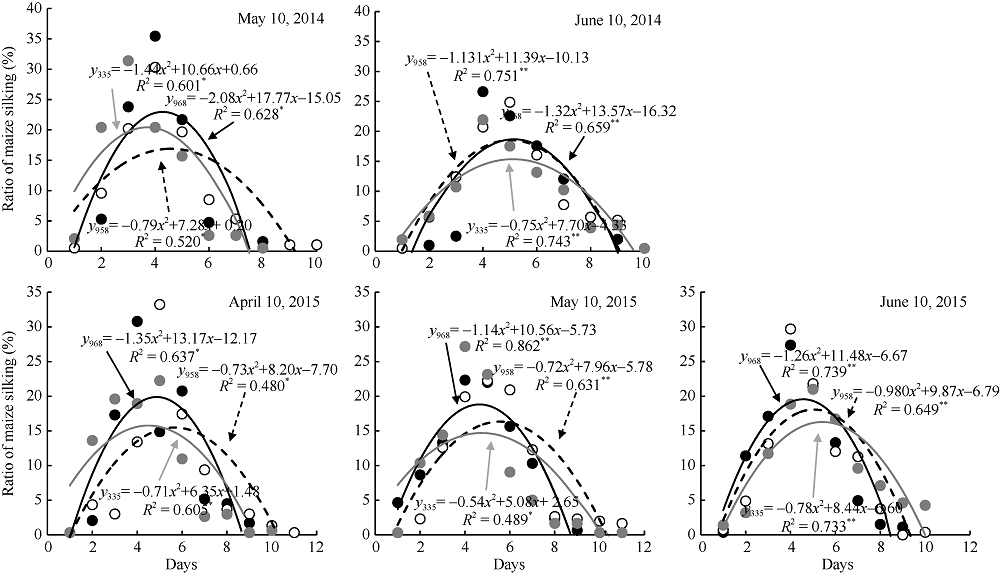
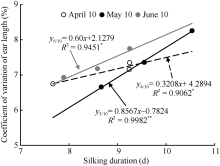
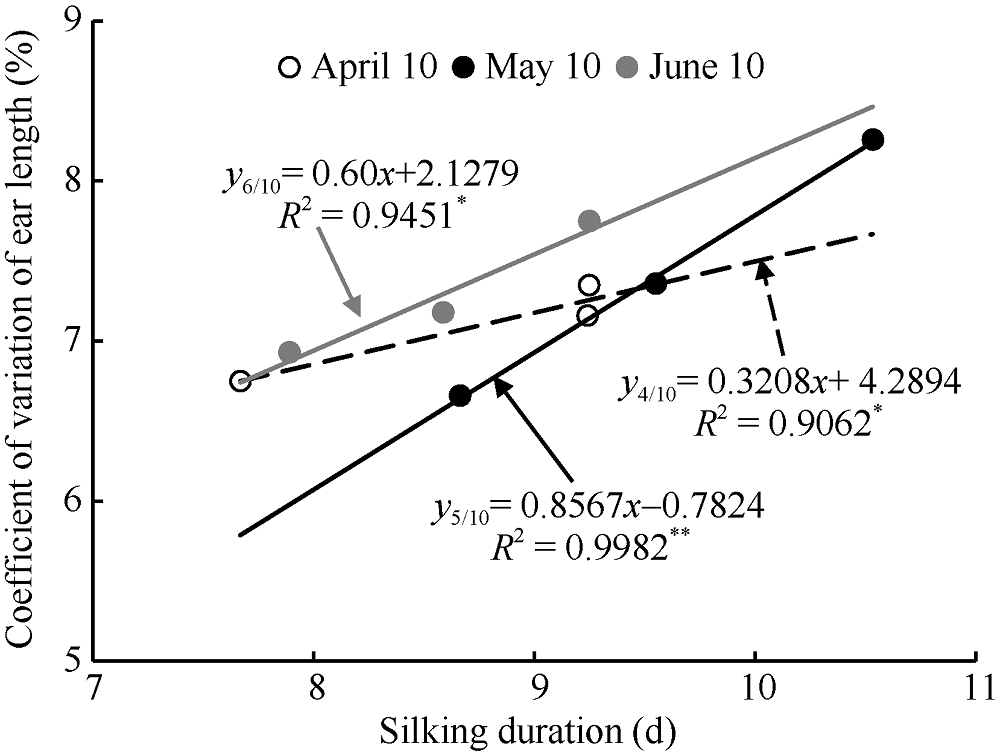
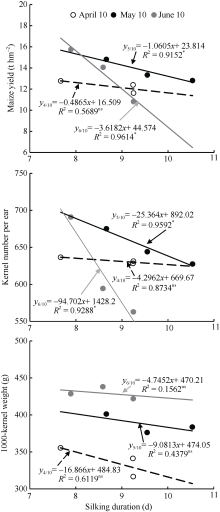
吐丝期是决定玉米产量的关键时期, 研究其相关特性, 对玉米生产意义重大。为准确分析不同玉米品种吐丝特性的差异及其对播期的响应, 于2014年和2015年设置了3个玉米主推品种(郑单958、先玉335和京科968)的3个播期处理(早播: 4月10日, 中播: 5月10日, 晚播: 6月10日), 分析了各个处理间吐丝持续期的差异以及吐丝持续期与雌穗穗长变异及产量构成因素的关系。结果表明: (1)群体吐丝持续期在品种间存在显著差异, 表现为先玉335 (9.12 d) >郑单958 (8.94 d) >京科968 (7.68 d)。随时间推进, 玉米每天吐丝的比例与天数为先升高后降低的二次函数关系, 每天最大吐丝比例为先玉335 (16.51%)<郑单958 (17.07%)<京科968 (19.98%)。京科968较郑单958和先玉335呈现吐丝集中, 每天吐丝比例较高、吐丝持续期短的特点; (2)吐丝持续期在不同播期间差异显著, 郑单958、先玉335和京科968不同播期间的吐丝持续期变幅分别为8.10~9.55 d、7.54~10.53 d和6.65~8.66 d, 郑单958的吐丝持续期在不同播期间最稳定(CV=6.57%), 其次为京科968 (CV=9.40%), 先玉335的吐丝持续期在不同播期间的变化最不稳定(CV=11.68%); (3)吐丝持续期与雌穗穗长的变异系数呈显著正相关, 与产量和穗粒数呈显著负相关, 与千粒重不相关。播期对玉米吐丝持续期具有显著的调控作用。随吐丝持续期增加, 玉米雌穗穗长的变异系数显著增大, 群体果穗的整齐度降低, 穗粒数显著减少, 是玉米产量显著降低的主要原因。
| [1] |
Borrás L, Westgate M E, Astini J P, Echarte L E . Coupling time to silking with plant growth rate in maize. Field Crops Res, 2007,102:73-85.
doi: 10.1016/j.fcr.2007.02.003 |
| [2] |
Gabaldon L C, Webber H, Otegui M E, Slafer G A, Ordonez R A, Gaiser T, Lorite I J, Ruiz R M, Ewert F . Modelling the impact of heat stress on maize yield formation. Field Crops Res, 2016,198:226-237.
doi: 10.1016/j.fcr.2016.08.013 |
| [3] |
Liu G, Hou P, Xie R, Ming B, Wang K, Liu W, Yang Y, Li S . Canopy characteristics of high-yield maize with yield potential of 22.5 Mg ha -1 . Field Crops Res, 2017,213:221-230.
doi: 10.1016/j.fcr.2017.08.011 |
| [4] |
Paponov I A, Sambo P, Erley G S, Presterl T, Geiger H H, Engels C . Kernel set in maize genotypes differing in nitrogen use efficiency in response to resource availability around flowering. Plant Soil, 2005,272:101-110.
doi: 10.1007/s11104-004-4210-8 |
| [5] |
Jia S F, Li C F . Effects of shading at different stages after anthesis on maize grain weight and quality at cytology level. J Integr Agric, 2011,10:58-69.
doi: 10.1016/S1671-2927(11)60307-6 |
| [6] |
张仁和, 郭东伟, 张兴华, 海东, 刘建超, 李凤艳, 郝引川, 薛吉全 . 吐丝期干旱胁迫对玉米生理特性和物质生产的影响. 作物学报, 2012,38:1884-1890.
doi: 10.3724/SP.J.1006.2012.01884 |
|
Zhang R H, Guo D W, Zhang X H, Lu H D, Liu J C, Li F Y, Hao Y C, Xue J Q . Effect of drought stress on physiological characteristics and dry matter production in maize silking stage. Acta Agron Sin, 2012,38:1884-1890 (in Chinese with English abstract).
doi: 10.3724/SP.J.1006.2012.01884 |
|
| [7] |
陈春梅, 高聚林, 苏治军, 于晓芳, 胡树平, 赵晓亮 . 玉米自交系吐丝期叶片光合参数与其耐旱性的关系. 作物学报, 2014,40:1667-1676.
doi: 10.3724/SP.J.1006.2014.01667 |
|
Chen C M, Gao J L, Su Z J, Yu X F, Hu S P, Zhao X L . Relationship between leaf photosynthetic parameters and drought resistance at silking stage in maize inbred lines. Acta Agron Sin, 2014,40:1667-1676 (in Chinese with English abstract).
doi: 10.3724/SP.J.1006.2014.01667 |
|
| [8] |
Ren B, Cui H, Camberato J J, Dong S, Liu P, Zhao B, Zhang J . Effects of shading on the photosynthetic characteristics and mesophyll cell ultrastructure of summer maize. Naturwissenschaften, 2016,103:67.
doi: 10.1007/s00114-016-1392-x pmid: 27437706 |
| [9] |
Beavis W D, Smith O S, Grant D, Fincher R R . Identification of quantitative trait loci using a small sample of top crossed and F4 progeny from maize. Crop Sci, 1994,34:882-896.
doi: 10.2135/cropsci1994.0011183X003400040010x |
| [10] |
Veldboom L R, Lee M . Molecular-marker-facilitated studies of morphological traits in maize. II: Determination of QTLs for grain yield and yield components. Theor Appl Genet, 1994,89:451-458.
doi: 10.1007/BF00225380 pmid: 24177894 |
| [11] |
Berke T G, Rocheford T R . Quantitative trait loci for flowering, plant and ear height, and kernel traits in maize. Crop Sci, 1995,35:1542-1549.
doi: 10.2135/cropsci1995.0011183X003500060004x |
| [12] |
Agrama H A S, Moussa M E . Mapping QTLs in breeding for drought tolerance in maize (Zea mays L.). Euphytica, 1996,91:89-97.
doi: 10.1007/BF00035278 |
| [13] | Kozumplik V, Pejic I, Senior L, Pavlina R, Graham G I, Stuber C W . Use of molecular markers for QTL detection in segregating maize populations derived from exotic germplasm. Maydica, 1996,41:211-217. |
| [14] |
Ribaut J, Hoisington D, Deutsch J A, Jiang C Z, Gonzalez de Leon D . Identification of quantitative trait loci under drought conditions in tropical maize: 1. Flowering parameters and the anthesis-silking interval. Theor Appl Genet, 1996,92:905-914.
doi: 10.1007/BF00221905 pmid: 24166558 |
| [15] |
Veldboom L R, Lee M . Genetic mapping of qunatitative trait loci in maize in stress and nonstress environments: II. Plant height and flowering. Crop Sci, 1996,36:1320-1327.
doi: 10.2135/cropsci1996.0011183X003600050041x |
| [16] |
Rebai A, Blanchard P, Perret D, Vincourt P . Mapping quantitative trait loci controlling silking date in a diallel cross among four lines of maize. Theor Appl Genet, 1997,95:451-459.
doi: 10.1007/s001220050582 |
| [17] |
Khairallah M, Bohn M, Jiang C Z, Deutsch J A, Jewell D C, Mihm J A, Melchinger A E, Gonzalez de Leon D, Hoisington D . Molecular mapping of QTL for southwestern corn borer resistance, plant height and flowering in tropical maize. Plant Breed, 1998,117:309-318.
doi: 10.1111/j.1439-0523.1998.tb01947.x |
| [18] |
Xie H, Ding D, Cui Z, Wu X, Hu Y, Liu Z, Li Y, Tang J . Genetic analysis of the related traits of flowering and silk for hybrid seed production in maize. Genes Genomics, 2010,32:55-61.
doi: 10.1007/s13258-010-0801-3 |
| [19] |
Wang Y, Cui Y, Zhang L, Li J, Liu J, Wang R . Effects of syncrhonization between silk receptivity and pollen grain vigor on kernel sets of corn (Zea mays L.). Front Agric China, 2007,1:271-275.
doi: 10.1007/s11703-007-0046-3 |
| [20] |
李金才, 董海荣, 崔彦宏 . 不同花位间玉米花丝生长发育动态的研究. 河北农业大学学报, 2003,26(2):1-4.
doi: 10.3969/j.issn.1000-1573.2003.02.001 |
|
Li J C, Dong H R, Cui Y H . Study on the dynamics of growth and development of maize silks in different flower positions. J Agric Univ Hebei, 2003,26(2):1-4 (in Chinese with English abstract).
doi: 10.3969/j.issn.1000-1573.2003.02.001 |
| [1] | 刘恩波, 陈静, 李红星, 于宁宁, 任佰朝, 赵斌, 刘鹏, 张吉旺. 遮阴改变源-库平衡和调节碳水化合物代谢进而抑制夏玉米幼穗发育[J]. 作物学报, 2026, 52(6): 1891-1901. |
| [2] | 胡川, 赵凯男, 黄修利, 吴金芝, 任开明, 王贺正, 付国占, 黄明, 李友军. 一次灌溉下耕作方式和氮肥用量对旱地小麦产量和品质的影响[J]. 作物学报, 2026, 52(6): 1830-1846. |
| [3] | 梁进宇, 尹嘉德, 王红丽, 张国平, 侯慧芝, 董博, 马明生. 基于无人机高光谱和机器学习的旱地饲用玉米叶片氮含量估测[J]. 作物学报, 2026, 52(6): 1788-1801. |
| [4] | 马胜乾, 王志平, 陈浩天, 窦淑贤, 张燕, 邓艾兴, 张卫建, 原向阳, 宋振伟. 秸秆还田下耕作方式与氮肥施用量对东北玉米产量及土壤团聚体的影响[J]. 作物学报, 2026, 52(6): 1802-1816. |
| [5] | 孙淑凤, 许振南, 黄嘉鑫, 翁建峰, 李新海. 玉米MAPK家族全基因组鉴定及其对拟轮枝镰孢菌感染的响应[J]. 作物学报, 2026, 52(5): 1291-1308. |
| [6] | 张思思, 赵向辉, 周洋, 姚云凤, 朱荣昱, 董元杰, 胡国庆, 徐通, 刘兆新. 冬闲期翻耕和绿肥还田对连作花生田土壤理化性质和产量的影响[J]. 作物学报, 2026, 52(5): 1472-1486. |
| [7] | 张宁宁, 滕雨菲, 任娜娜, 魏兴卓, 闫书豪, 樊可心, 王永宏, 陈文康, 张兴华, 朱万超, 徐淑兔, 薛吉全. 201份玉米自交系抗旱表型评价及可塑性分析[J]. 作物学报, 2026, 52(5): 1309-1325. |
| [8] | 王宇诚, 张露, 刘阿康, 黄见良, 彭少兵, 袁珅. 基于产量差的作物大面积单产提升策略与展望[J]. 作物学报, 2026, 52(5): 1279-1290. |
| [9] | 赵佳雪, 周龙昊, 郭岂源, 尚伦霄, 王涵, 刘志涛, 陈曦, 张晓佩, 宋宪亮, 毛丽丽. 长期秸秆还田与深松通过改善土壤环境与棉花光合特性提高滨海盐碱地棉花产量[J]. 作物学报, 2026, 52(5): 1548-1560. |
| [10] | 杨扬, 常诗惠, 田红丽, 易红梅, 王璐, 任洁, 范亚明, 刘亚维, 王凤格, 赵久然. 不同生态区国审玉米品种的遗传多样性分析[J]. 作物学报, 2026, 52(5): 1352-1364. |
| [11] | 郭星宇, 胡丹, 林苏期, 王梦凯, 谭文峰, 黄传琴. 生物炭配施化肥提高玉米‖大豆下玉米产量和土壤生态系统多功能性[J]. 作物学报, 2026, 52(5): 1536-1547. |
| [12] | 张鸿蓉, 王菲儿, 李盼, 仇海龙, 朱静, 赵连豪, 南运有, 何蔚, 樊志龙, 胡发龙, 柴强, 殷文. 减量20%灌水与25%有机肥替代化肥提高青贮玉米产量的光合特性[J]. 作物学报, 2026, 52(5): 1487-1500. |
| [13] | 杨欣雨, 崔文涛, 迪力尼格尔·阿力木, 汪凯翔, 吴鹏昊, 任姣姣. 玉米穗上叶片数全基因组关联分析和全基因组选择[J]. 作物学报, 2026, 52(5): 1573-1590. |
| [14] | 韩亚鑫, 何冠华, 张小琼, 张登峰, 李永祥, 刘旭洋, 王天宇, 黎裕, 邹华文, 李春辉. 基于RNA-Seq和BSA-Seq联合分析挖掘玉米侧根密度基因资源[J]. 作物学报, 2026, 52(5): 1341-1352. |
| [15] | 张振, 冯连杰, 石玉, 于振文, 张永丽. 节水补灌下不同穗型小麦产量形成差异研究[J]. 作物学报, 2026, 52(5): 1522-1535. |
|
||