欢迎访问作物学报,今天是
作物学报 ›› 2020, Vol. 46 ›› Issue (7): 1016-1024.doi: 10.3724/SP.J.1006.2020.93054
任蒙蒙1,**,张红伟1,**,王建华2,王国英1,郑军1,*( )
)
REN Meng-Meng1,**,ZHANG Hong-Wei1,**,WANG Jian-Hua2,WANG Guo-Ying1,ZHENG Jun1,*()
摘要:
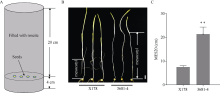
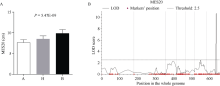
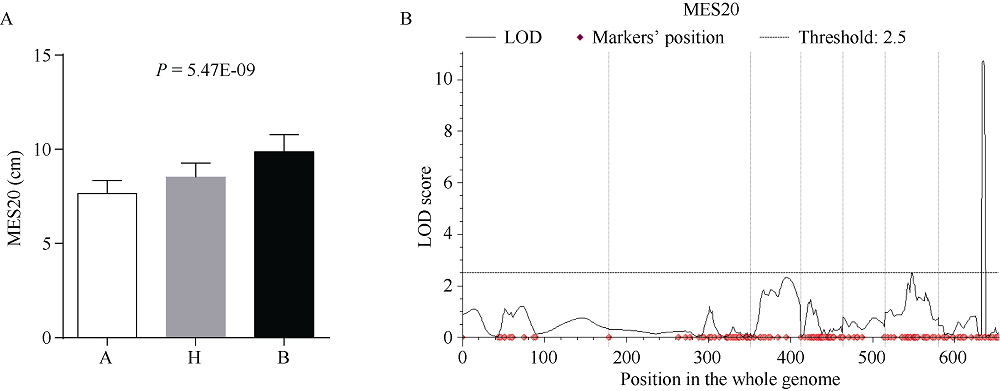
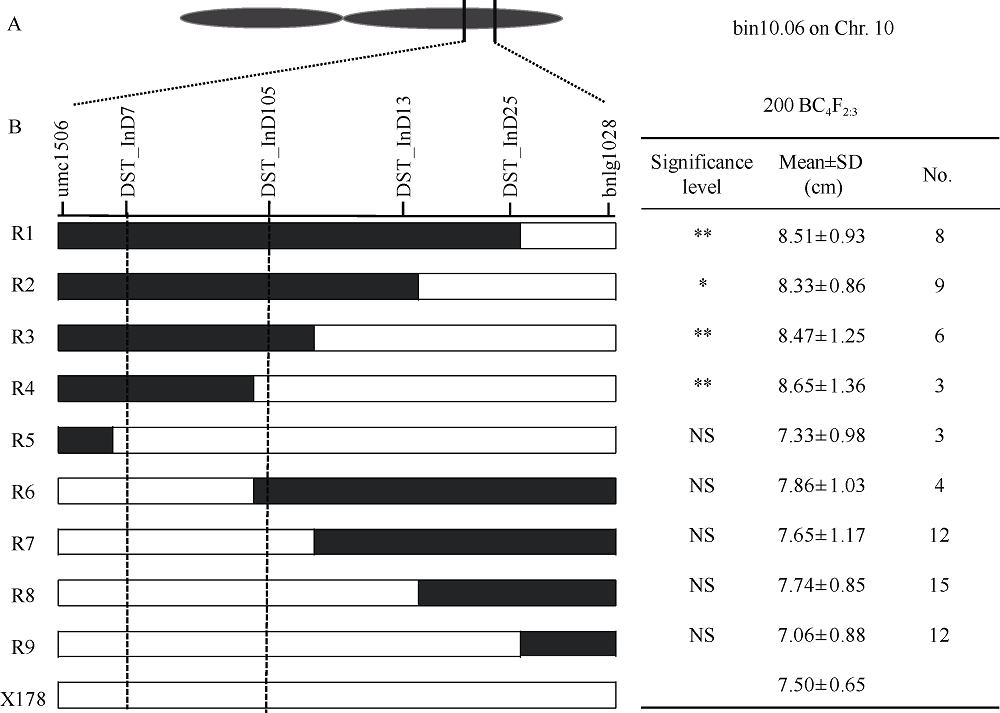
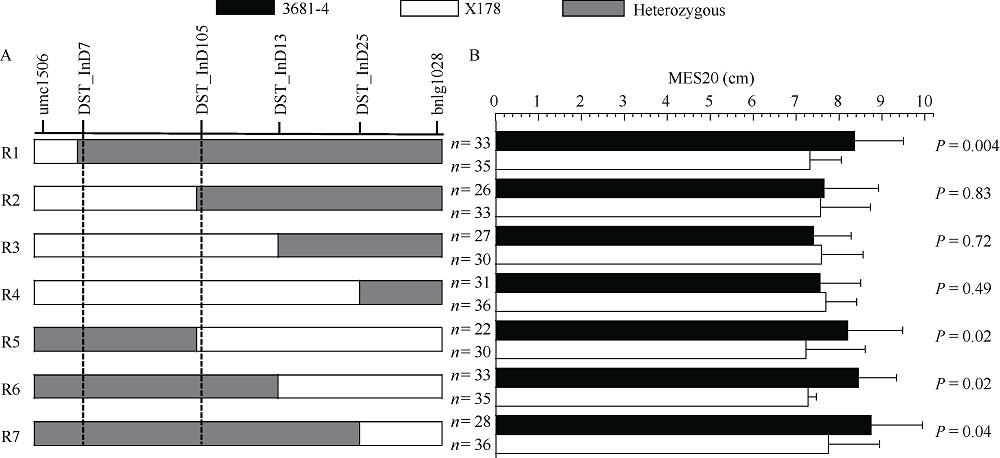
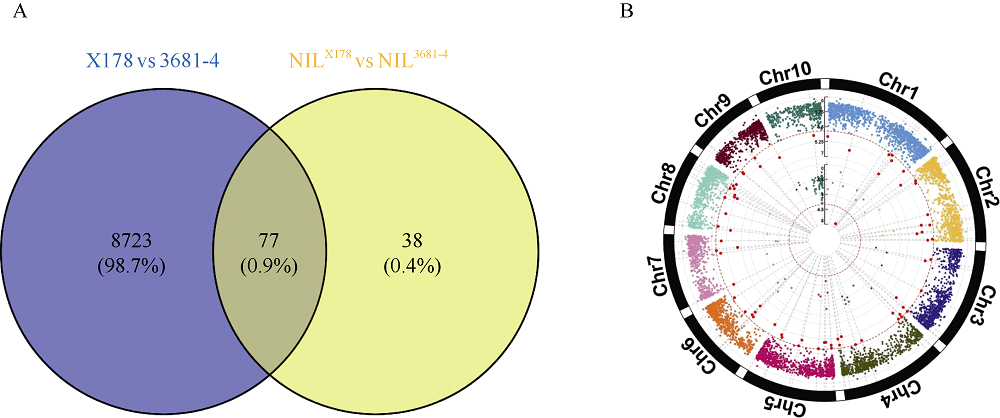
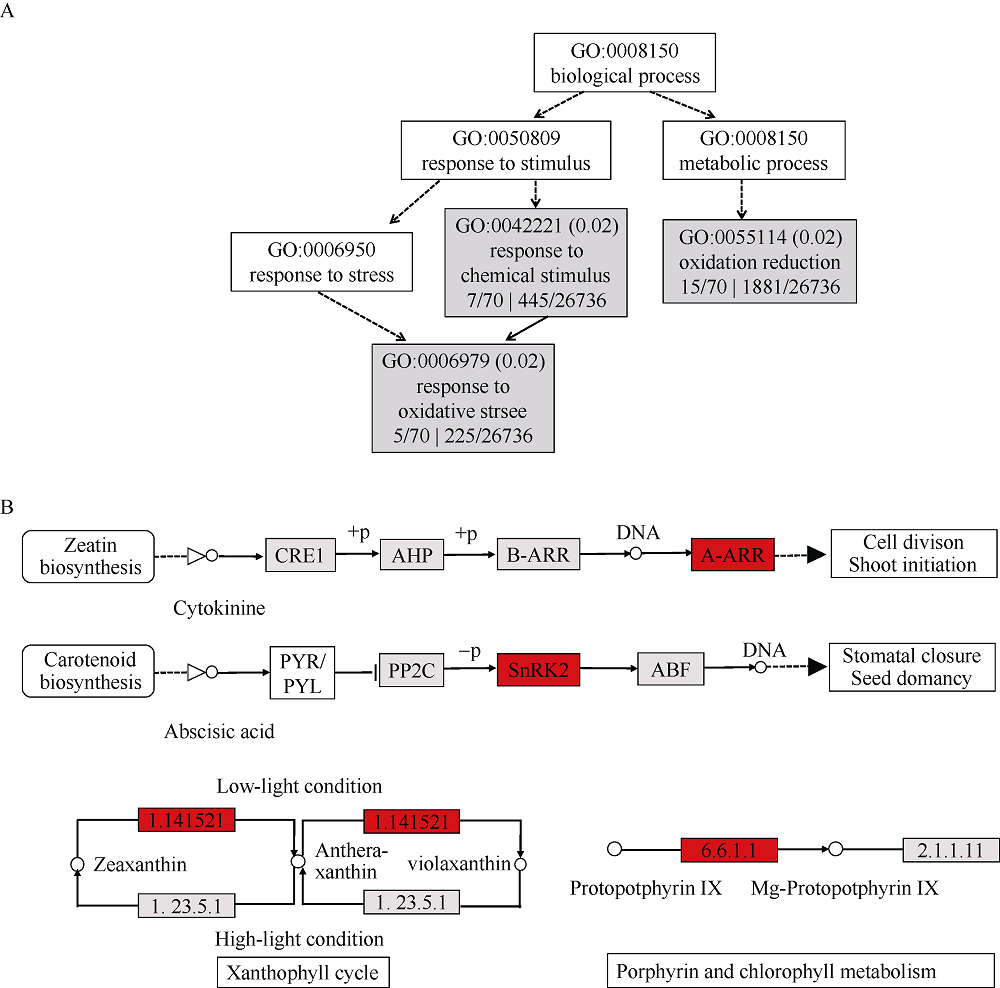
干旱是影响玉米(Zea mays L.)产量最主要的环境因素之一, 具有耐深播特性的玉米种质材料能够吸收土壤深层水分, 具有较强的耐旱性, 因此研究玉米耐深播性状的遗传机制具有重要的理论和应用价值。本实验室前期已利用耐深播玉米自交系3681-4与普通自交系X178构建的F2:3群体, 在玉米10号染色体上定位到了一个耐深播主效QTL qMES20-10。本研究在此基础上, 以X178为轮回亲本, 结合前景选择和背景选择, 构建了BC3F3:4家系, 对qMES20-10进行了确证; 并进一步利用分子标记辅助选择构建了高代回交群体, 将其精细定位于133.3~136.0 Mb的区间之内。同时, 利用从BC3F3:4家系中筛选出的两个近等基因系, 进行差异表达基因分析, 发现差异表达基因主要参与了化学性应激反应、氧化还原反应和对氧化胁迫的应激反应。本研究结果为进一步克隆耐深播主效QTL qMES20-10奠定了基础。
| [1] |
Lobell D B, Roberts M J, Schlenker W, Braun N, Little B B, Rejesus R M, Hammer G L. Greater sensitivity to drought accompanies maize yield increase in the U.S. Midwest. Science, 2014,344:516-519.
doi: 10.1126/science.1251423 pmid: 24786079 |
| [2] | Molatudi R L, Mariga I K. The effect of maize seed size and depth of planting on seedling emergence and seedling vigour. J Appl Sci Res, 2009,5:2234-2237. |
| [3] |
Rebetzke G J, Bruce S E, Kirkegaard J A. Longer coleoptile improve emergence through crop residues to increase seedling number and biomass in wheat (Triticum aestivum L.). Plant Soil, 2005,272:87-100.
doi: 10.1007/s11104-004-4040-8 |
| [4] |
Zhou L, Wang J K, Yi Q, Wang Y Z, Zhu Y G, Zhang Z H. Quantitative trait loci for seedling vigor in rice under field conditions. Field Crops Res, 2007,100:294-301.
doi: 10.1016/j.fcr.2006.08.003 |
| [5] |
Spielmeyer W, Hyles J, Joaquim P, Azanza F, Bonnett D, Ellis M E, Moore C, Richards R A. A QTL on chromosome 6A in bread wheat (Triticum aestivum L.) is associated with longer coleoptile, greater seedling vigor and final plant height. Theor Appl Genet, 2007,115:59-66.
doi: 10.1007/s00122-007-0540-2 |
| [6] |
Zhang Z H, Yu S B, Yu T, Huang Z, Zhu Y G. Mapping quantitative trait loci (QTLs) for seedling-vicror using recombinant inbred lines of rice (Oryza sativa L.). Field Crops Res, 2005,91:161-170.
doi: 10.1016/j.fcr.2004.06.004 |
| [7] |
Alibu S, Saito Y, Shiwachi H, Irie K. Genotypic variation in coleoptile or mesocotyl lengths of upland rice (Oryza sativa L.) and seedling emergence in deep sowing. Afr J Agric Res, 2012,7:6239-6248.
doi: 10.5897/AJAR |
| [8] |
van Ast A, van Delft G J, Graves J D, Fitter A H. Striga seed avoidance by deep planting and no-tillage in sorghum and maize. Int J Pest Manage, 2000,46:251-256.
doi: 10.1080/09670870050206019 |
| [9] |
Troyer A F. The location of genes governing long first internode of corn. Genetics, 1997,145:1149-1154.
pmid: 9093865 |
| [10] |
Dungan G H. Response of corn to extremely deep planting. Agron J, 1950,42:256-257.
doi: 10.2134/agronj1950.00021962004200050010x |
| [11] |
Flint L H. Light and the elongation of the mesocotyl in corn. Plant Physiol, 1944,19:537-543.
doi: 10.1104/pp.19.3.537 pmid: 16653935 |
| [12] |
Rebetzke G J, Richards R A, Fettell N A, Long M, Condon A G, Forrester R I, Botwright T L. Genotypic increases in coleoptile length improves stand establishment, vigor and grain yield of deep-sown wheat. Field Crops Res, 2007,100:10-23.
doi: 10.1016/j.fcr.2006.05.001 |
| [13] |
Lu Q, Zhang M C, Niu X J, Wang C H, Xu Q, Feng Y, Wang S, Yuan X P, Yu H Y, Wang Y P, Wei X H. Uncovering novel loci for mesocotyl elongation and shoot length in indica rice through genome-wide association mapping. Planta, 2016,243:645-657.
doi: 10.1007/s00425-015-2434-x pmid: 26612069 |
| [14] |
Wu J L, Feng F J, Lian X M, Teng X Y, Wei H B, Yu H H, Xie W B, Yan M, Fan P Q, Li Y, Ma X S, Liu H Y, Yu S B, Wang G W, Zhou F S, Luo L J, Mei H W. Genome-wide association study (GWAS) of mesocotyl elongation based on re-sequencing approach in rice. BMC Plant Biol, 2016,15:218.
doi: 10.1186/s12870-015-0608-0 pmid: 26362270 |
| [15] |
Zhao Y, Zhao W P, Jiang C H, Wang X L, Xiong H Y, Elana G T, Yin Z G, Chen Y F, Wang X, Xie J Y, Pan Y H, Rashid M R, Zhang H L Li J X, Li Z C. Genetic architecture and candidate genes for deep-sowing tolerance in rice revealed by non-syn GWAS. Front Plant Sci, 2018,9:332.
doi: 10.3389/fpls.2018.00332 pmid: 29616055 |
| [16] | 赵光武, 马攀, 王建华, 王国英. 不同玉米自交系耐深播能力鉴定及对深播胁迫的生理响应. 玉米科学, 2009,17(5):9-13. |
| Zhao G W, Ma P, Wang J H, Wang G Y. Identification of deep-seeding tolerance in different maize inbred lines and their physiological response to deep-seeding condition. J Maize Sci, 2009,17(5):9-13 (in Chinese with English abstract). | |
| [17] |
Liu H J, Zhang L, Wang J C, Li C S, Zeng X, Xie S P, Zhang Y Z, Liu S S, Hu S L, Wang J H, Lee M, Lübberstedt T, Zhao G W. Quantitative trait locus analysis for deep-sowing germination ability in the maize IBM Syn10 DH population. Front Plant Sci, 2017,8:813.
doi: 10.3389/fpls.2017.00813 pmid: 28588594 |
| [18] |
Henry A, Swamy B P, Dixit S, Torres R D, Batoto T C, Manalili M, Anantha M S, Mandal N P, Kumar A. Physiological mechanisms contributing to the QTL-combination effects on improved performance of IR64 rice NILs under drought. J Exp Bot, 2015,66:1787-1799.
doi: 10.1093/jxb/eru506 pmid: 25680791 |
| [19] | 饶志明, 董海涛, 庄杰云, 柴荣耀, 樊叶杨, 李德葆, 郑康乐. 水稻抗稻瘟病近等基因系的cDNA微阵列分析. 遗传学报, 2002,29:887-893. |
| Rao Z M, Dong H T, Zhuang Z J, Chai R Y, Fan Y Y, Li D B, Zheng K L. Analysis of gene expression profiles during host-Magnaporthe grisea interactions in a pair of near isogenetic lines of rice. Acta Genet Sin, 2002,29:887-893 (in Chinese with English abstract). | |
| [20] |
Zhao G, Fu J, Wang G, Ma P, Wu L, Wang J H. Gibberellin- induced mesocotyl elongation in deep-sowing tolerant maize inbred line 3681-4. Plant Breed, 2010,129:87-91.
doi: 10.1111/pbr.2010.129.issue-1 |
| [21] |
Zhang H W, Ma P, Zhao Z N, Zhao G W, Tian B H, Wang J H, Wang G Y. Mapping QTL controlling maize deep-seeding tolerance-related traits and confirmation of a major QTL for mesocotyl length. Theor Appl Genet, 2012,124:223-232.
doi: 10.1007/s00122-011-1700-y |
| [22] |
Prigge V, Xu X W, Li L, Babu R, Chen S J, Atlin G N, Melchinger A E. New insights into the genetics of in vivo induction of maternal haploids, the backbone of doubled haploid technology in maize. Genetics, 2012,190:781-793.
doi: 10.1534/genetics.111.133066 |
| [23] |
Chen D H, Ronald P C. A rapid DNA min preparation method suitable for AFLP and other PCR applications. Plant Mol Biol Rep, 1999,17:53-57.
doi: 10.1023/A:1007585532036 |
| [24] |
Settles A M, Bagadion A M, Bai F, Zhang J, Barron B, Leach K, Mudunkothge J S, Hoffner C, Bihmidine S, Finefield E, Hibbard J, Dieter E, Malidelis I A, Gustin J L, Karoblyte V, Tseung C W, Braun D M. Efficient molecular marker design using the MaizeGDB Mo17 SNPs and Indels track. G3: Genes Genom Genet, 2014,4:1143-1145.
doi: 10.1534/g3.114.010454 pmid: 24747759 |
| [25] |
Li H H, Ribaut J M, Li Z L, Wang J K. Inclusive composite interval mapping (ICIM) for digenic epistasis of quantitative traits in biparental populations. Theor Appl Genet, 2008,116:243-260.
doi: 10.1007/s00122-007-0663-5 |
| [26] | Revele W. Procedures for Personality and Psychological Research. Evanston, IL, USA: Northwestern University, 2015. |
| [27] | Rio D C, Ares M, Hannon G J, Nilsen T W. Purification of RNA using TRIzol (TRI reagent). Cold Spring Harb Protoc, 2010,6:0-0. |
| [28] |
Yang Q, Zhang D F, Xu M L. A sequential quantitative trait locus fine-mapping strategy using recombinant-derived progeny. J Integr Plant Biol, 2012,54:228-237.
doi: 10.1111/j.1744-7909.2012.01108.x |
| [29] |
Von Korff M, Wang H, Léon J, Pillen K. AB-QTL analysis in spring barley: II. Detection of favourable exotic alleles for agronomic traits introgressed from wild barley (H. vulgare ssp. spontaneum). Theor Appl Genet, 2006,112:1221-1231.
doi: 10.1007/s00122-006-0223-4 |
| [30] |
Ghosh S, Chan C K. Analysis of RNA-Seq data using TopHat and Cufflinks. Methods Mol Biol, 2016,1374:339-361.
doi: 10.1007/978-1-4939-3167-5_18 pmid: 26519415 |
| [31] |
Trapnell C, Williams B A, Pertea G, Mortazavi A, Kwan G, van Baren M J, Salzberg S L, Wold B J, Pachter L. Transcript assembly and quantification by RNA-Seq reveals unannotated transcripts and isoform switching during cell differentiation. Nat Biotechnol, 2010,28:511-515.
doi: 10.1038/nbt.1621 pmid: 20436464 |
| [32] |
Anders S, Huber W. Differential expression analysis for sequence count data. Genome Biol, 2010,11:R106.
doi: 10.1186/gb-2010-11-10-r106 pmid: 20979621 |
| [33] |
Tian T, Liu Y, Yan H Y, You Q, Yi X, Du Z, Xu W Y, Su Z. agriGO v2.0: a GO analysis toolkit for the agricultural community. Nucleic Acids Res, 2017,45:W122-W129.
doi: 10.1093/nar/gkx382 pmid: 28472432 |
| [34] |
Habib A, Powell J J, Stiller J, Liu M, Shabala S, Zhou M X, Gardiner D M, Liu C J. A multiple near isogenic line (multi-NIL) RNA-Seq approach to identify candidate genes underpinning QTL. Theor Appl Genet, 2018,131:613-624.
doi: 10.1007/s00122-017-3023-0 pmid: 29170790 |
| [35] |
Glagoleva A Y, Shmakov N A, Shoeva O Y, Vasiliev G V, Shatskaya N V, Börner A, Afonnikov D A, Khlestkina E K. Metabolic pathways and genes identified by RNA-Seq analysis of barley near-isogenic lines differing by allelic state of the Black lemma and pericarp (Blp) gene. BMC Plant Biol, 2017,17:182.
doi: 10.1186/s12870-017-1124-1 pmid: 29143606 |
| [36] |
Smets R, Le J, Prinsen E, Verbelen J P, Van Onckelen H A. Cytokinin-induced hypocotyl elongation in light-grownArabidopsis plants with inhibited ethylene action or indole-3-acetic acid transport. Planta, 2005,221:39-47.
doi: 10.1007/s00425-004-1421-4 pmid: 15843964 |
| [37] |
Hayashi Y, Takahashi K, Inoue S, Kinoshita T. Abscisic acid suppresses hypocotyl elongation by dephosphorylating plasma membrane H+-ATPase in Arabidopsis thaliana. Plant Cell Physiol, 2014,55:845-853.
doi: 10.1093/pcp/pcu028 pmid: 24492258 |
| [38] |
Luo Q, Lian H L, He S B, Li L, Jia K P, Yang H Q. COP1 and PhyB physically interact with PIF1 to regulate its stability and photomorphogenic development in Arabidopsis. Plant Cell, 2014,26:2441-2456.
doi: 10.1105/tpc.113.121657 pmid: 24951480 |
| [1] | 肖颖妮, 于永涛, 谢利华, 祁喜涛, 李春艳, 文天祥, 李高科, 胡建广. 基于SNP标记揭示中国鲜食玉米品种的遗传多样性[J]. 作物学报, 2022, 48(6): 1301-1311. |
| [2] | 崔连花, 詹为民, 杨陆浩, 王少瓷, 马文奇, 姜良良, 张艳培, 杨建平, 杨青华. 2个玉米ZmCOP1基因的克隆及其转录丰度对不同光质处理的响应[J]. 作物学报, 2022, 48(6): 1312-1324. |
| [3] | 胡文静, 李东升, 裔新, 张春梅, 张勇. 小麦穗部性状和株高的QTL定位及育种标记开发和验证[J]. 作物学报, 2022, 48(6): 1346-1356. |
| [4] | 王丹, 周宝元, 马玮, 葛均筑, 丁在松, 李从锋, 赵明. 长江中游双季玉米种植模式周年气候资源分配与利用特征[J]. 作物学报, 2022, 48(6): 1437-1450. |
| [5] | 杨欢, 周颖, 陈平, 杜青, 郑本川, 蒲甜, 温晶, 杨文钰, 雍太文. 玉米-豆科作物带状间套作对养分吸收利用及产量优势的影响[J]. 作物学报, 2022, 48(6): 1476-1487. |
| [6] | 陈静, 任佰朝, 赵斌, 刘鹏, 张吉旺. 叶面喷施甜菜碱对不同播期夏玉米产量形成及抗氧化能力的调控[J]. 作物学报, 2022, 48(6): 1502-1515. |
| [7] | 徐田军, 张勇, 赵久然, 王荣焕, 吕天放, 刘月娥, 蔡万涛, 刘宏伟, 陈传永, 王元东. 宜机收籽粒玉米品种冠层结构、光合及灌浆脱水特性[J]. 作物学报, 2022, 48(6): 1526-1536. |
| [8] | 单露英, 李俊, 李亮, 张丽, 王颢潜, 高佳琪, 吴刚, 武玉花, 张秀杰. 转基因玉米NK603基体标准物质研制[J]. 作物学报, 2022, 48(5): 1059-1070. |
| [9] | 于春淼, 张勇, 王好让, 杨兴勇, 董全中, 薛红, 张明明, 李微微, 王磊, 胡凯凤, 谷勇哲, 邱丽娟. 栽培大豆×半野生大豆高密度遗传图谱构建及株高QTL定位[J]. 作物学报, 2022, 48(5): 1091-1102. |
| [10] | 李阿立, 冯雅楠, 李萍, 张东升, 宗毓铮, 林文, 郝兴宇. 大豆叶片响应CO2浓度升高、干旱及其交互作用的转录组分析[J]. 作物学报, 2022, 48(5): 1103-1118. |
| [11] | 王好让, 张勇, 于春淼, 董全中, 李微微, 胡凯凤, 张明明, 薛红, 杨梦平, 宋继玲, 王磊, 杨兴勇, 邱丽娟. 大豆突变体ygl2黄绿叶基因的精细定位[J]. 作物学报, 2022, 48(4): 791-800. |
| [12] | 许静, 高景阳, 李程成, 宋云霞, 董朝沛, 王昭, 李云梦, 栾一凡, 陈甲法, 周子键, 吴建宇. 过表达ZmCIPKHT基因增强植物耐热性[J]. 作物学报, 2022, 48(4): 851-859. |
| [13] | 刘磊, 詹为民, 丁武思, 刘通, 崔连花, 姜良良, 张艳培, 杨建平. 玉米矮化突变体gad39的遗传分析与分子鉴定[J]. 作物学报, 2022, 48(4): 886-895. |
| [14] | 闫宇婷, 宋秋来, 闫超, 刘爽, 张宇辉, 田静芬, 邓钰璇, 马春梅. 连作秸秆还田下玉米氮素积累与氮肥替代效应研究[J]. 作物学报, 2022, 48(4): 962-974. |
| [15] | 徐宁坤, 李冰, 陈晓艳, 魏亚康, 刘子龙, 薛永康, 陈洪宇, 王桂凤. 一个新的玉米Bt2基因突变体的遗传分析和分子鉴定[J]. 作物学报, 2022, 48(3): 572-579. |
|
||