欢迎访问作物学报,今天是
作物学报 ›› 2023, Vol. 49 ›› Issue (12): 3277-3288.doi: 10.3724/SP.J.1006.2023.34031
张红梅1( ), 熊雅文2, 许文静3, 张威1, 王琼1, 刘晓庆1, 刘慧3, 崔晓艳1, 陈新1, 陈华涛1,2,*()
ZHANG Hong-Mei1(), XIONG Ya-Wen2, XU Wen-Jing3, ZHANG Wei1, WANG Qiong1, LIU Xiao-Qing1, LIU Hui3, CUI Xiao-Yan1, CHEN Xin1, CHEN Hua-Tao1,2,*()
摘要:
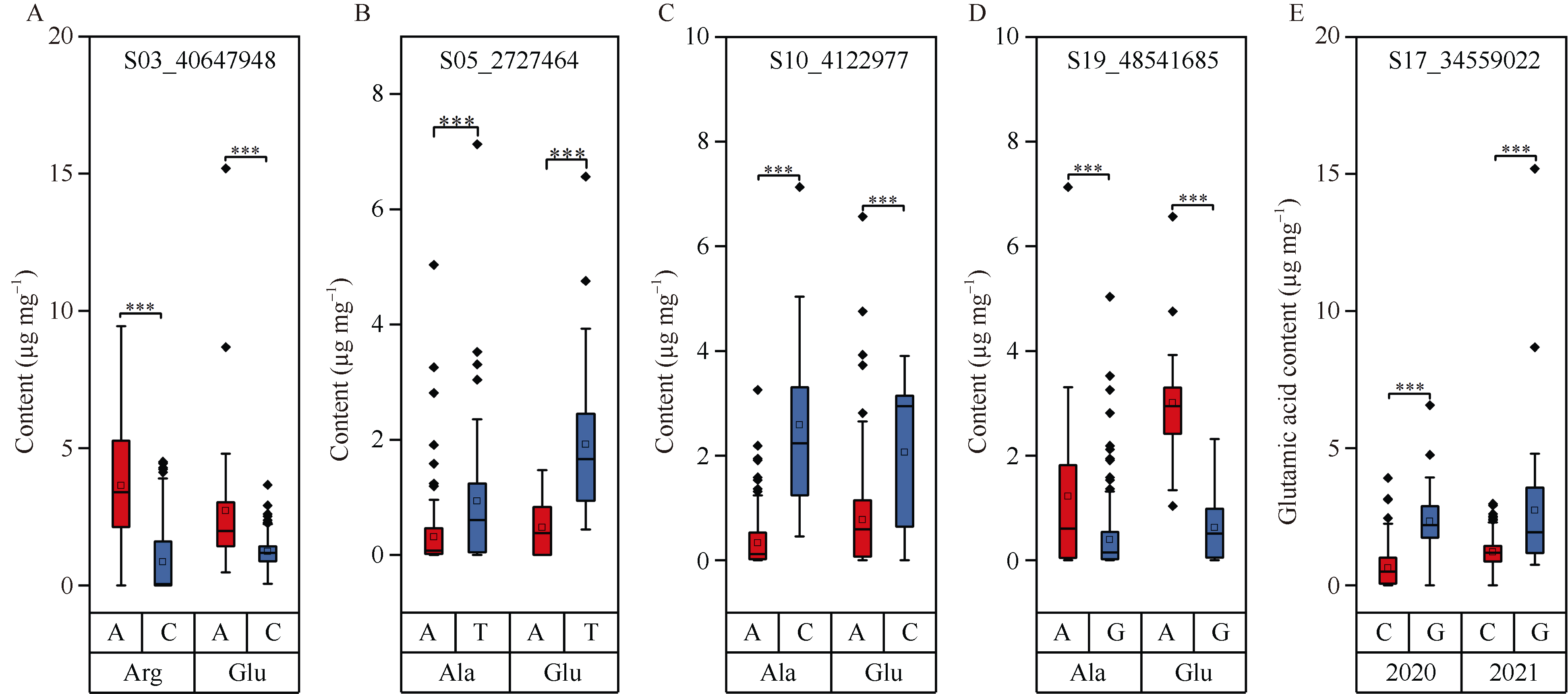
为解析大豆R6期籽粒氨基酸含量的遗传机制, 本研究利用264份大豆种质资源材料在2020年和2021年测定了与菜用大豆食味品质相关的精氨酸、丙氨酸、谷氨酸和天冬氨酸含量, 并进行全基因组关联分析(GWAS)。结果表明, 2年共检测到89个与大豆R6期籽粒4种氨基酸含量显著关联的SNP位点, 其中有5个标记能同时被2年或2个性状重复检测到, 分别为S03_40647948 (Chr.3)、S05_2727464 (Chr.5)、S10_4122977 (Chr.10)、S17_34559022 (Chr.17)和S19_48541685 (Chr.19), 单个位点可以解释11.25%~28.19%的表型变异解, 其中Chr.17上的标记S17_34559022在2020年和2021年被共同检测到与谷氨酸含量显著关联, 属稳定遗传的位点。共挖掘出9个候选基因, 其中ZIP蛋白(zinc finger family protein)、转录因子bHLH (bHLH DNA-binding superfamily protein)、生长素反应蛋白家族(auxin-responsive protein family)和天冬氨酸蛋白酶家族蛋白(aspartyl protease family protein), 可能是影响菜用大豆氨基酸代谢的重要基因。本研究挖掘到的5个氨基酸含量主效SNP位点和9个候选基因, 有助于解析大豆R6期籽粒氨基酸含量的遗传基础及其调控机制, 为菜用大豆食味品质遗传改良奠定了基础。
| [1] | Akazawa T, Yanagisawa Y, Sasahara T. Concentrations of water-soluble nitrogen and amino acids as criteria for discriminating vegetable-type and grain-type soybean cultivars. Breed Sci, 1997, 47: 39-44. |
| [2] |
Ferh W R, Caviness C E, Burmood D T, Pennington J S. Stages of development descriptions for soybean (Glycine max (L.) Merrill). Crop Sci, 1971, 11: 929-931.
doi: 10.2135/cropsci1971.0011183X001100060051x |
| [3] | Fehr W R, Caviness C E. Stages of Soybean Development. Ames: Iowa State University of Science and Technology, Iowa State University, 1977. pp 1-12. |
| [4] |
Dong D K, Fu X J, Yuan F J, Chen P Y, Zhu S L, Li B Q, Yang Q H, Yu X M, Zhu D H. Genetic diversity and population structure of vegetable soybean (Glycine max (L.) Merr.) in China as revealed by SSR markers. Genet Resour Crop Evol, 2014, 61: 173-183.
doi: 10.1007/s10722-013-0024-y |
| [5] | Mohamed A, Rao M S. Vegetable soybeans as a functional food. In: Liu K, eds. Soybeans as Functional Foods and Ingredients, New York: AOAC Press, 2004. pp 209-238. |
| [6] |
Monteiro S T, Minekawa Y, Kosugi Y, Akazawa T, Oda K. Prediction of sweetness and amino acid content in soybean crops from hyperspectral imagery. ISPRS J Photogram, 2007, 62: 2-12.
doi: 10.1016/j.isprsjprs.2006.12.002 |
| [7] | Hounsome N, Hounsome B, Tomos D, Edwards-Jones G. Plant metabolites and nutritional quality of vegetables. J Food Sci, 2008, 73: R48-R65. |
| [8] | Ong P K, Liu S Q. Handbook of Vegetables and Vegetable Processing:Flavor and Sensory Characteristics of Vegetables. Hoboken: John Wiley & Sons Ltd, 2018. pp 135-156. |
| [9] | 王丹英, 汪自强, 方勇, 徐律平. 菜用大豆食味品质及其与内含物关系研究. 金华职业技术学院学报, 2002, 2(3): 15-17. |
| Wang D Y, Wang Z Q, Fang Y, Xu L P. Studies on the relationship between vegetable soybean eating quality and its components. J Jinhua Polytechnic, 2002, 2(3): 15-17. (in Chinese with English abstract) | |
| [10] | Shanmugasundaram S, Cheng S T, Huang M T, Yan M R. Quality requirement and improvement of vegetable soybean. In: Shanmugasundaram S, ed. Vegetable Soybean: Research Needs for Production and Quality Improvement. Taiwan: Asian Vegetable Research and Development Center, 1991. pp 92-102. |
| [11] | Chen Z, Zhong W, Zhou Y, Ji P, Wan Y, Shi S, Yang Z, Gong Y, Mu F, Chen S. Integrative analysis of metabolome and transcriptome reveals the improvements of seed quality in vegetable soybean (Glycine max (L.) Merr.). Phytochem Lett, 2022, 200: 113216-113228. |
| [12] |
Guo L, Huang L, Cheng X, Gao Y, Zhang X, Yuan X, Xue C, Chen X. Volatile flavor profile and sensory properties of vegetable soybean. Molecules, 2022, 29, 27: 939.
doi: 10.3390/molecules27010029 |
| [13] |
Zhao X, Dong H, Chang H, Zhao J, Teng W, Qiu L, Li W, Han Y. Genome wide association mapping and candidate gene analysis for hundred seed weight in soybean [Glycine max (L.) Merrill]. BMC Genomics, 2019, 20: 648.
doi: 10.1186/s12864-019-6009-2 pmid: 31412769 |
| [14] |
Sayama T, Tanabata T, Saruta M, Yamada T, Anai T, Kaga A, Ishimoto M. Confirmation of the pleiotropic control of leaflet shape and number of seeds per pod by the Ln gene in induced soybean mutants. Breed Sci, 2017, 67: 363-369.
doi: 10.1270/jsbbs.16201 |
| [15] |
Assefa T, Otyama P I, Brown A V, Kalberer S R, Kulkarni R S, Cannon S B. Genome-wide associations and epistatic interactions for internode number, plant height, seed weight and seed yield in soybean. BMC Genomics, 2019, 20: 527.
doi: 10.1186/s12864-019-5907-7 pmid: 31242867 |
| [16] |
Liu W, Kim M Y, Kang Y J, Van K, Lee Y H, Srinives P, Yuan D L, Lee S H. QTL identification of flowering time at three different latitudes reveals homeologous genomic regions that control flowering in soybean. Theor Appl Genet, 2011, 123: 545-553.
doi: 10.1007/s00122-011-1606-8 pmid: 21660531 |
| [17] |
Wang J J, Hu B, Jing Y, Hu X, Guo Y, Chen J, Liu Y, Hao J, Li W, Ning H. Detecting QTL and candidate genes for plant height in soybean via linkage analysis and GWAS. Front Plant Sci, 2022, 12: 803820.
doi: 10.3389/fpls.2021.803820 |
| [18] |
Kumar V, Goyal V, Mandlik R, Kumawat S, Sudhakaran S, Padalkar G, Rana N, Deshmukh R, Roy J, Sharma T R, Sonah H. Pinpointing genomic regions and candidate genes associated with seed oil and protein content in soybean through an integrative transcriptomic and QTL Meta-analysis. Cells, 2022, 12: 97.
doi: 10.3390/cells12010097 |
| [19] |
Zhang H M, Zhang G W, Zhang W, Wang Q, Xu W J, Liu X Q, Cui X Y, Chen X, Chen H T. Identification of loci governing soybean seed protein content via genome-wide association study and selective signature analyses. Front Plant Sci, 2022, 13: 1045953.
doi: 10.3389/fpls.2022.1045953 |
| [20] |
Panthee D R, Pantalone V R, Saxton A M, West D R, Sams C E. Genomic regions associated with amino acid composition in soybean. Mol Breed, 2006, 17: 79-89.
doi: 10.1007/s11032-005-2519-5 |
| [21] | Vaughn J N, Nelson R L, Song Q, Cregan P B, Li Z. The genetic architecture of seed composition in soybean is refined by genome-wide association scans across multiple populations. G3: Genes Genom Genet, 2014, 4: 2283-2294. |
| [22] |
Warrington C, Abdel-Haleem H, Hyten D, Cregan P, Orf J, Killam A, Bajjalieh N, Li Z, Boerma H. QTL for seed protein and amino acids in the Benning × Danbaekkong soybean population. Theor Appl Genet, 2015, 128: 839-850.
doi: 10.1007/s00122-015-2474-4 pmid: 25673144 |
| [23] | 汪桂凤, 钟宣伯, 查霆, 周启政, 何梦迪, 唐桂香. 菜用大豆种质资源评价与筛选. 大豆科学, 2019, 38: 169-180. |
| Wang G F, Zhong X B, Zha T, Zhou Q Z, He M D, Tang G X. Evaluation and screening of fresh soybean germplasm. Soybean Sci, 2019, 38: 169-180. (in Chinese with English abstract) | |
| [24] |
Abe T, Ujiie T, Sasahara T. Varietal differences in free amino acid and sugar concentrations in immature seeds of soybean under raw and boiling treatments. J Jpn Soc Food Sci, 2004, 51: 172-176.
doi: 10.3136/nskkk.51.172 |
| [25] |
Tseng Y H, Lee Y L, Li R C, Mau J L. Non-volatile flavour components of ganoderma tsugae. Food Chem, 2005, 90: 409-415.
doi: 10.1016/j.foodchem.2004.03.054 |
| [26] |
Ye Z, Shang Z X, Li M Q, Zhang X T, Ren H B, Hu X S, Yi J J. Effect of ripening and variety on the physiochemical quality and flavor of fermented Chinese chili pepper (Paojiao). Food Chem, 2022, 368: 130797.
doi: 10.1016/j.foodchem.2021.130797 |
| [27] |
Guo J, Rahman A, Mulvaney M J, Hossain M M, Basso K, Fethiere R, Babar M A. Evaluation of edamame genotypes suitable for growing in Florida. Agron J, 2020, 112: 693-707.
doi: 10.1002/agj2.v112.2 |
| [28] |
Flores D, Giovanni M, Kirk L, Liles G. Capturing and explaining sensory differences among organically grown vegetable soybean varieties grown in Northern California. J Food Sci, 2019, 84: 613-622.
doi: 10.1111/1750-3841.14443 pmid: 30741493 |
| [29] |
Zhang J, Wang X, Lu Y, Bhusal S J, Song Q, Cregan P B, Yen Y, Brown M, Jiang G L. Genome-wide scan for seed composition provides insights into soybean quality improvement and the impacts of domestication and breeding. Mol Plant, 2018, 11: 460-472.
doi: S1674-2052(17)30386-6 pmid: 29305230 |
| [30] |
Zhang S, Hao D, Zhang S, Zhang D, Wang H, Du H, Kan G, Yu D. Genome-wide association mapping for protein, oil and water-soluble protein contents in soybean. Mol Genet Genomics, 2021, 296: 91-102.
doi: 10.1007/s00438-020-01704-7 |
| [31] |
Zhang W, Xu W, Zhang H, Liu X, Cui X, Li S, Song L, Zhu Y, Chen X, Chen H. Comparative selective signature analysis and high-resolution GWAS reveal a new candidate gene controlling seed weight in soybean. Theor Appl Genet, 2021, 134: 1329-1341.
doi: 10.1007/s00122-021-03774-6 pmid: 33507340 |
| [32] |
Xiao X, Hou Y, Liu Y, Liu Y, Zhao H, Dong L, Du J, Wang Y, Bai G, Luo G. Classification and analysis of corn steep liquor by UPLC/Q-TOF MS and HPLC. Talanta, 2013, 107: 344-348.
doi: 10.1016/j.talanta.2013.01.044 pmid: 23598232 |
| [33] |
Mao T, Jiang Z, Han Y, Teng W, Zhao X, Li W, Morris B. Identification of quantitative trait loci underlying seed protein and oil contents of soybean across multi-genetic backgrounds and environments. Plant Breed, 2013, 132: 630-641.
doi: 10.1111/pbr.2013.132.issue-6 |
| [34] |
Chapman A, Pantalone V R, Ustun A, Allen F L, Landau-Ellis D, Trigiano R N, Gresshoff P M. Quantitative trait loci for agronomic and seed quality traits in an F2 and F4:6 soybean population. Euphytica, 2003, 129: 387-393.
doi: 10.1023/A:1022282726117 |
| [35] |
Xu W, Wang Q, Zhang W, Zhang H, Liu X, Song Q, Zhu Y, Cui X, Chen X, Chen H. Using transcriptomic and metabolomic data to investigate the molecular mechanisms that determine protein and oil contents during seed development in soybean. Front Plant Sci, 2022, 13: 1012394.
doi: 10.3389/fpls.2022.1012394 |
| [36] |
Orf J H, Chase K, Adler F R, Mansur L M, Lark K G. Genetics of soybean agronomic traits. Crop Sci, 1999, 39: 1642-1651.
doi: 10.2135/cropsci1999.3961642x |
| [37] |
Yoshikawa T, Okumoto Y, Ogata D, Sayama T, Teraishi M, Terai M, Toda T, Yamada K, Yagasaki K, Yamada N, Tsukiyama T, Yamada T, Tanisaka T. Transgressive segregation of isoflavone contents under the control of four QTLs in a cross between distantly related soybean varieties. Breed Sci, 2010, 60: 243-254.
doi: 10.1270/jsbbs.60.243 |
| [38] |
Hyten D L, Pantalone V R, Sams C E, Saxton A M, Landau-Ellis D, Stefaniak T R, Schmidt. Seed quality QTL in a prominent soybean population. Theor Appl Genet, 2004, 109: 552-561.
doi: 10.1007/s00122-004-1661-5 pmid: 15221142 |
| [39] |
Kuroda Y, Kaga A, Tomooka N, Yano H, Takada Y, Kato S, Vaughan D. QTL affecting fitness of hybrids between wild and cultivated soybeans in experimental fields. Ecol Evol, 2013, 3: 2150-2168.
doi: 10.1002/ece3.606 pmid: 23919159 |
| [40] |
Du W, Wang M, Fu S, Yu D. Mapping QTLs for seed yield and drought susceptibility index in soybean (Glycine max L.) across different environments. J Genet Genomics, 2009, 36: 721-731.
doi: 10.1016/S1673-8527(08)60165-4 |
| [41] |
Wang X, Jiang G L, Green M, Scott R A, Hyten D L, Cregan P B. Quantitative trait locus analysis of saturated fatty acids in a population of recombinant inbred lines of soybean. Mol Breed, 2012, 30: 1163-1179.
doi: 10.1007/s11032-012-9704-0 |
| [42] |
Ju Y, Liu C, Lu W, Zhang Q, Sodmergen. Arabidopsis mitochondrial protein slow embryo development1 is essential for embryo development. Biochem Biophys Res Commun, 2016, 474: 371-376.
doi: 10.1016/j.bbrc.2016.04.114 |
| [43] |
Rao V, Virupapuram V. Arabidopsis F-box protein At1g08710 interacts with transcriptional protein ADA2b and imparts drought stress tolerance by negatively regulating seedling growth. Biochem Biophys Res Commun, 2021, 536: 45-51.
doi: 10.1016/j.bbrc.2020.12.054 |
| [44] |
Lantcheva A, Zhiponova M, Revalska M, Heyman J, Dincheva I, Badjakov I, De Geyter N, Boycheva I, Goormachtig S, De Veylder L. A common F-box gene regulates the leucine homeostasis of Medicago truncatula and Arabidopsis thaliana. Protoplasma, 2022, 259: 277-290.
doi: 10.1007/s00709-021-01662-w |
| [45] |
Xu Y P, Zhao Y, Song X Y, Ye Y F, Wang R G, Wang Z L, Ren X L, Cai X Z. Ubiquitin extension protein uep1 modulates cell death and resistance to various pathogens in tobacco. Phytopathology, 2019, 109: 1257-1269.
doi: 10.1094/PHYTO-06-18-0212-R |
| [46] |
Nawaz G, Han Y, Usman B, Liu F, Qin B, Li R. Knockout of OsPRP1, a gene encoding proline-rich protein, confers enhanced cold sensitivity in rice (Oryza sativa L.) at the seedling stage. 3 Biotech, 2019, 9: 254.
doi: 10.1007/s13205-019-1787-4 pmid: 31192079 |
| [47] |
Wang R, Chong K, Wang T. Divergence in spatial expression patterns and in response to stimuli of tandem-repeat paralogues encoding a novel class of proline-rich proteins in Oryza sativa. J Exp Bot, 2006, 57: 2887-2897.
doi: 10.1093/jxb/erl057 |
| [48] |
Kant S, Bi Y M, Zhu T, Rothstein S J. SAUR39, a small auxin-up RNA gene, acts as a negative regulator of auxin synthesis and transport in rice. Plant Physiol, 2009, 151: 691-701.
doi: 10.1104/pp.109.143875 pmid: 19700562 |
| [49] |
Chae K, Isaacs C G, Reeves P H, Maloney G S, Muday G K, Nagpal P, Reed J W. Arabidopsis SMALL AUXIN UP RNA63 promotes hypocotyl and stamen filament elongation. Plant J, 2012, 71: 684-697.
doi: 10.1111/tpj.2012.71.issue-4 |
| [50] |
Hou K, Wu W, Gan S S. SAUR36, a small auxin-up RNA gene, is involved in the promotion of leaf senescence in Arabidopsis. Plant Physiol, 2013, 161: 1002-1009.
doi: 10.1104/pp.112.212787 |
| [51] |
He S L, Hsieh H L, Jauh G Y. Small auxin up RNA62/75 are required for the translation of transcripts essential for pollen tube growth. Plant Physiol, 2018, 178: 626-640.
doi: 10.1104/pp.18.00257 |
| [52] |
Gao H, Li R, Guo Y. Arabidopsis aspartic proteases A36 and A39 play roles in plant reproduction. Plant Signal Behav, 2017, 12: e1304343.
doi: 10.1080/15592324.2017.1304343 |
| [53] |
Hao Y, Zong X, Ren P, Qian Y, Fu A. Basic Helix-Loop-Helix (bHLH) transcription factors regulate a wide range of functions in Arabidopsis. Int J Mol Sci, 2021, 22: 7152.
doi: 10.3390/ijms22137152 |
| [54] |
Frova C, Krajewski P, Fonzo N D, Villa M, Sari-Gorla M. Genetic analysis of drought tolerance in maize by molecular markers: I. Yield components. Theor Appl Genet, 1999, 99: 280-288.
doi: 10.1007/s001220051233 |
| [55] |
张华, 田蕊, 褚佳豪, 邢馨竹, 陈士亮, 李喜焕, 张彩英. 大豆需磷关键时期磷高效利用遗传位点挖掘. 植物遗传资源学报, 2020, 21: 991-1001.
doi: 10.13430/j.cnki.jpgr.20191228001 |
| Zhang H, Tian R, Chu J H, Xing X Z, Chen S L, li X H, Zhang C Y. Mining of genetic loci controlling phosphorus efficiency at crucial phosphorus requirement stages in soybean. J Plant Genet Resour, 2020, 21: 991-1001. (in Chinese with English abstract) |
| [1] | 习千辉, 徐梓瑗, 刘梦梦, 王宏艺, 郎凯琳, 井震海, 陈锋, 赵磊. 小麦籽粒铜含量的全基因组关联分析及候选基因预测[J]. 作物学报, 2026, 52(6): 1604-1617. |
| [2] | 毛嘉琦, 黄朋雨, 赵佳佳, 郑兴卫, 武棒棒, 郝宇琼, 屈非, 刘成, 马朋涛, 郑军. 山西小麦品种白粉病抗性评价及抗病基因分子检测[J]. 作物学报, 2026, 52(6): 1669-1681. |
| [3] | 金昱何, 王雪菲, 徐张一娃, 缪怡宁, 蒋云杰, 伊莹, 缪德麟, 朱静仪, 钟一帆, 陈铭亨, 方芳, 刘鹏. 外源激素对低温胁迫下大豆叶片叶绿素荧光参数及抗氧化酶系统的影响[J]. 作物学报, 2026, 52(6): 1817-1829. |
| [4] | 唐宽强, 李公允, 宋美毅, 赵雪, 常春玲. 大豆株高性状全基因组关联分析及预测模型构建[J]. 作物学报, 2026, 52(6): 1743-1756. |
| [5] | 姚术, 郭凯悦, 翟慧慧, 姚佳慧, 邓文琪, 闫玲, 黄驰, 高阳, 俞嫣然, 赵振邦, 李英慧, 王晓波, 李佳佳. 大豆苗期耐低铁综合评价及优异种质筛选[J]. 作物学报, 2026, 52(5): 1373-1387. |
| [6] | 杨欣雨, 崔文涛, 迪力尼格尔·阿力木, 汪凯翔, 吴鹏昊, 任姣姣. 玉米穗上叶片数全基因组关联分析和全基因组选择[J]. 作物学报, 2026, 52(5): 1573-1590. |
| [7] | 张振, 冯连杰, 石玉, 于振文, 张永丽. 节水补灌下不同穗型小麦产量形成差异研究[J]. 作物学报, 2026, 52(5): 1522-1535. |
| [8] | 闫安, 蒋昆炜, 王蓉圆, 田林, 张璐, 王韵, 徐建龙. 水稻剑叶小维管束数基因SVN7的鉴定与克隆[J]. 作物学报, 2026, 52(5): 1364-1372. |
| [9] | 马亮, 马璐, 张舒钰, 章慧敏, 王仁明, 宋旭东, 张振良, 冒宇翔, 陆虎华, 陈国清, 郝德荣, 周广飞. 玉米苞叶数目转录组分析及候选基因鉴定[J]. 作物学报, 2026, 52(3): 790-801. |
| [10] | 张晴, 杨昱, 郭茜, 岳霈尧, 殷丛丛, 牛景萍, 赵晋忠, 杜维俊, 岳爱琴. 大豆GmARA6a的克隆及响应盐胁迫的功能分析[J]. 作物学报, 2026, 52(2): 480-493. |
| [11] | 鲁雅妮, 丁超杰, 张煜, 杜习军, 齐学礼, 胡琳, 许为钢. 河南省200份小麦品种苗期茎基腐病抗性鉴定与全基因组关联分析[J]. 作物学报, 2026, 52(2): 363-375. |
| [12] | 李诗晴, 王茜, 王素华, 张耀文, 王丽侠. 绿豆种质资源苗期耐盐性鉴定及相关基因发掘[J]. 作物学报, 2026, 52(2): 376-388. |
| [13] | 王雅致, 杨飚, 季香林, 石瑛, 张丽莉. 二倍体马铃薯抗旱资源鉴定及抗旱基因初步筛选[J]. 作物学报, 2026, 52(1): 72-84. |
| [14] | 董丽华, 董成艳, 李正楠, 余静, 叶靓, 刘芳, 谭静. 玉米禾谷镰孢穗腐病抗性候选基因的筛选与鉴定[J]. 作物学报, 2026, 52(1): 131-147. |
| [15] | 李云香, 郭千纤, 侯万伟, 张小娟. 引进ICARDA小麦苗期根系抗旱性状的全基因组关联分析[J]. 作物学报, 2025, 51(9): 2387-2398. |
|
||