欢迎访问作物学报,今天是
作物学报 ›› 2024, Vol. 50 ›› Issue (7): 1719-1727.doi: 10.3724/SP.J.1006.2024.34186
秦娜1( ), 叶珍言2, 朱灿灿1, 付森杰1, 代书桃1, 宋迎辉1, 景雅1, 王春义1, 李君霞1,*()
QIN Na1(), YE Zhen-Yan2, ZHU Can-Can1, FU Sen-Jie1, DAI Shu-Tao1, SONG Ying-Hui1, JING Ya1, WANG Chun-Yi1, LI Jun-Xia1,*()
摘要:
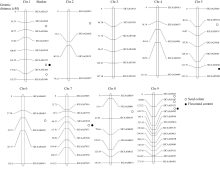
谷子(Setaria italica L.)是我国北方地区重要的粮食作物, 籽粒营养丰富, 且富含多种类黄酮物质, 对生长发育和品质形成发挥着重要作用。目前谷子籽粒类黄酮合成及粒色形成相关调控机制研究较少。分析谷子类黄酮含量及粒色性状相关的QTL, 为类黄酮合成关键基因的精细定位、克隆及功能研究奠定基础, 同时, 也为揭示谷子类黄酮合成及代谢机制和培育富含类黄酮谷子品种提供技术支撑。本研究以红粒色高类黄酮品种金苗红酒谷和黄粒色低类黄酮品种豫谷28为亲本构建的包含150个家系的重组自交系(RIL)群体为试验材料, 在谷子成熟期对籽粒粒色和类黄酮含量相关性状进行分析。同时, 采用复合区间作图法(composite interval mapping, CIM)对粒色和类黄酮含量进行QTL定位与分析, 并对QTL置信区间内的候选基因进行预测。相关性分析表明, 类黄酮含量与粒色呈显著正相关。共定位到4个与类黄酮含量相关和11个与粒色相关的QTL, 分别位于1号、2号、5号、6号、7号、8号和9号染色体上, 单个QTL的表型贡献率为2.01%~29.25%, 6个为主效QTL, 其中, qSC1-2和qFLA1-1、qSC7-1和qFLA7-1、qSC9-3和qFLA9-1为2个性状下共同定位到的QTL。通过基因预测与功能注释, 筛选出QTL置信区间内5个与类黄酮物质合成及代谢相关的候选基因, 表明类黄酮物质的合成、代谢及利用相关基因极有可能控制了这些基因的表达。15个QTL分别聚集于7条染色体上, 基于基因功能注释, 共筛选了5个与谷子类黄酮合成及代谢相关的候选基因, 表明不同QTL位点参与到了共同遗传机制, 并可通过分子标记辅助选择进行类黄酮合成及代谢等有利基因的聚合育种。
| [1] |
Yang X Y, Wan Z W, Perry L, Lu H Y, Wang Q, Zhao C H, Li J, Xie F, Yu J C, Cui T X, Wang T, Ge Q S. Early millet use in northern China. Proc Natl Acad Sci USA, 2012, 109: 3726-3730.
doi: 10.1073/pnas.1115430109 pmid: 22355109 |
| [2] |
Lu H, Zhang J, Liu K B, Wu N Q, Li Y M, Zhou K S, Ye M L, Zhang T Y, Zhang H J, Yang X Y, Shen L C, Xu D K, Li Q. Earliest domestication of common millet (Panicum miliaceum) in east Asia extended to 10,000 years ago. Proc Natl Acad Sci USA, 2009, 106: 7367-7372.
doi: 10.1073/pnas.0900158106 pmid: 19383791 |
| [3] | Diao X M. Foxtail millet production in China and its future development tendency. In: Chai Y, Wan F S, eds. The Industrial Development of China Special Crops. Beijing: China Agricultural Science and Technology Press, 2007. pp 32-43. |
| [4] | 李建锐. 谷子SiASR4基因参与植物响应干旱和盐胁迫的功能研究. 中国农业大学博士学位论文, 北京, 2018. |
| Li J R. Function Analysis of the Foxtail Millet (Setaria italica) Gene, SiASR4, in Response to Drought and Salt Stresses of Plants. PhD Dissertation of China Agricultural University, Beijing, China, 2018 (in Chinese with English abstract). | |
| [5] | 张文英. 谷子种质资源抗旱性评价. 中国农业科学院硕士学位论文, 北京, 2014. |
| Zhang W Y. Evaluation of the Drought Tolerance of Germplasm Resources in Foxtail Millet, Setaria italica L. MS Thesis of Chinese Academy of Agricultural Sciences, Beijing, China, 2014 (in Chinese with English abstract). | |
| [6] |
Vauzour D, Vafeiadou K, Rodriguez-Mateos A, Rendeiro C, Jeremy-Spencer P E. The neuroprotective potential of flavonoids: a multiplicity of effects. Genes Nutr, 2008, 3: 115-126.
doi: 10.1007/s12263-008-0091-4 pmid: 18937002 |
| [7] | Pandey K B, Rizvi S I. Plant polyphenols as dietary antioxidants in human health and disease. Oxidat Med Cell Longev, 2009, 2: 270-278. |
| [8] | 张丽玲, 郄倩茹, 罗韶凡, 牛文康, 朱喆标, 高雨柔, 李旭凯, 韩渊怀. 谷子12种黄酮类代谢物合成通路分析. 山西农业大学学报(自然科学版), 2020, 40(4): 10-18. |
| Zhang L L, Qie Q R, Luo S F, Niu W K, Zhu Z B, Gao Y R, Li X K, Han Y H. Analysis of synthesis pathway of twelve flavonoid metabolites in foxtail millet. J Shanxi Agric Univ (Nat Sci Edn), 2020, 40(4): 10-18 (in Chinese with English abstract). | |
| [9] | Zhang Y K, Gao J H, Qie Q R, Yang Y L, Hou S Y, Wang X C, Li X K, Han Y H. Comparative analysis of flavonoid metabolites in foxtail millet (Setaria italica) with different eating quality. Life (Basel), 2021, 11: 578. |
| [10] |
韩尚玲, 霍轶琼, 李辉, 韩华蕊, 侯思宇, 孙朝霞, 韩渊怀, 李红英. 基于WGCNA发掘谷子穗部类黄酮合成途径调控关键基因. 作物学报, 2022, 48: 1645-1657.
doi: 10.3724/SP.J.1006.2022.14107 |
| Han S L, Huo Y Q, Li H, Han H R, Hou S Y, Sun Z X, Han Y H, Li H Y. Identification of regulatory genes related to flavonoids synthesis by weighted gene correlation network analysis in the panicle of foxtail millet. Acta Agron Sin, 2022, 48: 1645-1657 (in Chinese with English abstract). | |
| [11] | 张瑞杰. 基于转录组水平对谷子叶片花青素积累机制的初探. 山西农业大学硕士学位论文, 山西太谷, 2019. |
| Zhang R J. Preliminary Study on the Mechanism of Anthocyanin Accumulation in Foxtail Millet Leaves Based on the Transcriptome. MS Thesis of Shanxi Agricultural University, Taigu, Shanxi, China, 2019 (in Chinese with English abstract). | |
| [12] | Wang F, Ji G S, Xu Z B, Feng B, Zhou Q, Fan X L, Wang T. Metabolomics and transcriptomics provide insights into anthocyanin biosynthesis in the developing grains of purple wheat (Triticum aestivum L.). J Agric Food Chem, 2021, 69: 11171-11184. |
| [13] |
Li J R, Todd T C, Trick H N. Rapid in planta evaluation of root expressed transgenes in chimeric soybean plants. Plant Cell Rep, 2010, 29: 113-123.
doi: 10.1007/s00299-009-0803-2 pmid: 20012965 |
| [14] | 陈衡, 潘相文, 王飞飞, 刘长锴, 王雪, 李彦生, 张秋英. 大豆异黄酮生物合成与调控的分子机制研究进展. 土壤与作物, 2021, 10(2): 126-142. |
| Chen H, Pan X W, Wang F F, Liu C K, Wang X, Li Y S, Zhang Q Y. Molecular mechanisms of isoflavone biosynthesis and regulation in soybean: a review. Soil Crops, 2021, 10(2): 126-142 (in Chinese with English abstract). | |
| [15] | 李海权, 耿玲玲, 智慧, 王永芳, 李振侠, 相金英, 刁现民, 刘国庆. 基于谷子剩余杂合体的谷子颖壳颜色基因精细定位. 见: 中国作物学会2015年学术年会论文摘要集. 北京: 中国作物学会, 2015. p 35. |
| Li H Q, Geng L L, Zhi H, Wang Y F, Li Z X, Xiang J Y, Diao X M, Liu G Q. Fine mapping of glume shell colour genes based on residual heterozygote in foxtail millet. In: Proceedings of 2015 Annual Conference of the Crop Science Society of China. Beijing: Crop Science Society of China, 2015. p 35 (in Chinese). | |
| [16] | 高俊华, 王润奇, 毛丽萍, 刁现民. 安矮3号谷子矮秆基因的染色体定位. 作物学报, 2003, 29: 152-154. |
| Gao J H, Wang R Q, Mao L P, Diao X M. Chromosome locating of dwarf gene in foxtail millet An’ai 3. Acta Agron Sin, 2003, 29: 152-154 (in Chinese with English abstract). | |
| [17] | 张义茹. 基于代谢组学对小米蒸煮风味、脂质及谷子籽粒灌浆期代谢物累积特征的研究. 山西农业大学博士学位论文, 山西太谷, 2019. |
| Zhang Y R. Study on the Cooking Aroma, Lipid Change Patterns and Metabolite Accumulation during Grain Filling based on Metabolomics in Foxtail Millet. PhD Dissertation of Shanxi Agricultural University, Taigu, Shanxi, China, 2019 (in Chinese with English abstract). | |
| [18] |
邵丽华, 王莉, 白文文, 刘雅娟. 山西谷子资源叶酸含量分析及评价. 中国农业科学, 2014, 47: 1265-1272.
doi: 10.3864/j.issn.0578-1752.2014.07.003 |
|
Shao L H, Wang L, Bai W W, Liu Y J. Evaluation and analysis of folic acid content in millet from different ecological regions in Shanxi province. Sci Agric Sin, 2014, 47: 1265-1272 (in Chinese with English abstract).
doi: 10.3864/j.issn.0578-1752.2014.07.003 |
|
| [19] |
Zhang S, Tang C J, Zhao Q, Li J, Yang L F, Qie L F, Fan X K, Li L, Zhang N, Zhao M C, Liu X T, Chai Y, Zhang X, Wang H L, Li Y T, Li W, Zhi H, Jia G Q, Diao X M. Development of highly polymorphic simple sequence repeat markers using genome-wide microsatellite variant analysis in Foxtail millet [Setaria italica (L.) P. Beauv.]. BMC Genomics, 2014, 15: 78.
doi: 10.1186/1471-2164-15-78 pmid: 24472631 |
| [20] |
Bennetzen J L, Schmutz J, Wang H, Percifield R, Hawkins J, Pontaroli A C, Estep M, Feng L, Vaughn J N, Grimwood J, Jenkins J, Barry K, Lindquist E, Hellsten U, Deshpande S, Wang X W, Wu X M, Mitros T, Triplett J, Yang X H, Ye C Y, Mauro- Herrera M, Wang L, Li P H, Sharma M, Sharma R, Ronald P C, Panaust O, Kellogg E A, Brutnell T P, Doust A N, Tuskan G A, Rokhsar D, Devos K M. Reference genome sequence of the model plant setaria. Nat Biotechnol, 2012, 30: 555-564.
doi: 10.1038/nbt.2196 pmid: 22580951 |
| [21] | Bai H, Cao Y H, Quan J Z, Dong L, Li Z Y, Zhu Y B, Zhu L H, Dong Z P, Li D Y. Identifying the genome-wide sequence variations and developing new molecular markers for genetics research by re-sequencing a landrace cultivar of foxtail millet. PLoS One, 2013, 8: e73514. |
| [22] | Yin C B, Li H H, Li S S, Xu L D, Zhao Z G, Wang J K. Genetic dissection on rice grain shape by the two-dimensional image analysis in one japonica × indica population consisting of recombinant inbred lines. Theor Appl Genet, 2015, 128: 1969-1986. |
| [23] |
孙子淇, 李慧慧, 张鲁燕, 王健康. QTL作图中零假设检验统计量分布特征及LOD临界值估计方法. 作物学报, 2013, 39: 1-11.
doi: 10.3724/SP.J.1006.2013.00001 |
| Sun Z Q, Li H H, Zhang L Y, Wang J K. Properties of the test statistic under null hypothesis and the calculation of LOD threshold in quantitative trait loci (QTL) mapping. Acta Agron Sin, 2013, 39: 1-11 (in Chinese with English abstract). | |
| [24] | Li S S, Wang J K, Zhang L Y. Inclusive composite interval mapping of QTL by environment interactions in biparental populations. PLoS One, 2015, 10: e0132414. |
| [25] | 李慕男, 兰凤英. 小米的营养成分及保健功能研究进展. 河北北方学院学报, 2017, 33(7): 56-60. |
| Li M N, Lan F Y. Nutritional health function and product development of millet. J Hebei North Univ, 2017, 33(7): 56-60 (in Chinese with English abstract). | |
| [26] |
王海岗, 贾冠清, 智慧, 温琪汾, 董俊丽, 陈凌, 王君杰, 曹晓宁, 刘思辰, 王纶, 乔治军, 刁现民. 谷子核心种质表型遗传多样性分析及综合评. 作物学报, 2016, 42: 19-30.
doi: 10.3724/SP.J.1006.2016.00019 |
| Wang H G, Jia G Q, Zhi H, Wen Q F, Dong J L, Chen L, Wang J J, Cao X N, Liu S C, Wang L, Qiao Z J, Diao X M. Phenotypic diversity evaluations of foxtail millet core collections. Acta Agron Sin, 2016, 42: 19-30 (in Chinese with English abstract). | |
| [27] | 薛其勤, 别茹, 常宇涵, 邢明, 杨会, 张昆, 刘风珍, 万勇善. 花生种皮颜色及花青素含量的遗传分析. 花生学报, 2020, 49(1): 19-24. |
| Xue Q Q, Bie R, Chang Y H, Xing M, Yang H, Zhang K, Liu F Z, Wan Y S. Genetic analysis of peanut testa color and anthocyanin content. J Peanut Sci, 2020, 49(1): 19-24 (in Chinese with English abstract). | |
| [28] | 宋健. 大豆种皮色相关基因的图位克隆及功能解析. 中国农业科学院博士学位论文, 北京, 2019. |
| Song J. Map-Based Cloning and Functional Analysis of Genes Controlling Seed Coat Color in Soybean (Glycine max (L.) Merr.). PhD Dissertation of Chinese Academy of Agricultural Sciences, Beijing, China, 2019 (in Chinese with English abstract). | |
| [29] |
白春明, 王春语, 王平, 朱振兴, 陆晓春. 高粱子粒单宁含量和颜色QTL分析. 植物遗传资源学报, 2017, 18: 860-866.
doi: 10.13430/j.cnki.jpgr.2017.05.007 |
|
Bai C M, Wang C Y, Wang P, Zhu Z X, Lu X C. QTLs analysis of tannin content and color of grain in sorghum. J Plant Genet Resour, 2017, 18: 860-866 (in Chinese with English abstract).
doi: 10.13430/j.cnki.jpgr.2017.05.007 |
|
| [30] | 王艳花. 大黄油菜粒色性状候选基因的定位克隆及功能分析. 青海大学博士学位论文, 青海西宁, 2017. |
| Wang Y H. Positional Cloning and Functional Study of Seed Coat Color Gene in Dahuang (a landrace of Brassica rapa L.). PhD Dissertation of Qinghai University, Xining, Qinghai, China, 2017 (in Chinese with English abstract). | |
| [31] | Meyer P, Heidmann I, Forkmann G, Saedler H. A new petunia a flower colour generated by transformation of a mutant with a maize gene. Nature, 1987, 330: 677-678. |
| [32] | Vanderkrol A R, Lenting P E, Veenstra J, Vandermeer I M, Koes R E, Gerats A G M, Mol J N M, Stuitije A R. An anti-sense chalcone synthases gene in transgenic plants inhibits flower pigmentation. Nature, 1988, 333: 866-869. |
| [33] |
李秋琳, 李燕, 陈伟, 姚金波, 朱守鸿, 袁黎, 张永山. 基于广泛靶向代谢组学的不同颜色棉花花瓣中类黄酮成分差异分析. 棉花学报, 2021, 33: 482-492.
doi: 10.11963/cs20210036 |
|
Li Q L, Li Y, Chen W, Yao J B, Zhu S H, Yuan L, Zhang Y S. Metabolomics reveals the variation of flavonoids content in petals of cotton with different colors. Cotton Sci, 2021, 33: 482-492 (in Chinese with English abstract).
doi: 10.11963/cs20210036 |
|
| [34] | Nakabayashi R, Yonekura-Sakakibara K, Urano K, Suzuki M, Yamada Y, Nishizawa T, Matsuda F, Kojima M, Sakakibara H, Shinozaki K, Michael A J, Tohge T, Yamazaki M, Saito K. Enhancement of oxidative and drought tolerance in Arabidopsis by overaccumulation of antioxidant flavonoids. Plant J, 2014, 77: 367-379. |
| [35] |
Gouot J C, Smith J P, Holzapfel B P, Walker A R, Barril C. Grape berry flavonoids: a review of their biochemical responses to high and extreme high temperatures. J Exp Bot, 2019, 70: 397-423.
doi: 10.1093/jxb/ery392 pmid: 30388247 |
| [36] | 潘俊倩, 佟曦然, 郭宝林. 光对植物黄酮类化合物的影响研究进展. 中国中药杂志, 2016, 41: 3897-3903. |
| Pan J Q, Tong X R, Guo B L. Progress of effects of light on plant flavonoids. China J Chin Mater Med, 2016, 41: 3897-3903 (in Chinese with English abstract). | |
| [37] |
葛诗蓓, 张学宁, 韩文炎, 李青云, 李鑫. 植物类黄酮的生物合成及其抗逆作用机制研究进展. 园艺学报, 2023, 50: 209-224.
doi: 10.16420/j.issn.0513-353x.2021-1186 |
|
Ge S B, Zhang X N, Han W Y, Li Q Y, Li X. Research progress on plant flavonoids biosynthesis and their anti-stress mechanism. Acta Hortic Sin, 2023, 50: 209-224 (in Chinese with English abstract).
doi: 10.16420/j.issn.0513-353x.2021-1186 |
|
| [38] | Chen Y Y, Lu H Q, Jiang K X, Wang Y R, Wang Y P, Jiang J J. The favonoid biosynthesis and regulation in Brassica napus: a review. Int J Mol Sci, 2022, 24: 357. |
| [1] | 习千辉, 徐梓瑗, 刘梦梦, 王宏艺, 郎凯琳, 井震海, 陈锋, 赵磊. 小麦籽粒铜含量的全基因组关联分析及候选基因预测[J]. 作物学报, 2026, 52(6): 1604-1617. |
| [2] | 马小倩, 秦娜, 代书桃, 秦家范, 李小艳, 王淑婷, 刘忠玲, 李君霞. 175份谷子种质在2种环境下的表型变异分析[J]. 作物学报, 2026, 52(6): 1757-1773. |
| [3] | 郑玉珍, 齐飞艳, 孙子淇, 刘华, 秦利, 石磊, 王娟, 汪蒙蒙, 韩锁义, 徐静, 苗利娟, 黄冰艳, 董文召, 郑峥, 张新友. 花生籽仁总超长链脂肪酸和7种脂肪酸组分的QTL定位[J]. 作物学报, 2026, 52(6): 1646-1657. |
| [4] | 杨欣雨, 崔文涛, 迪力尼格尔·阿力木, 汪凯翔, 吴鹏昊, 任姣姣. 玉米穗上叶片数全基因组关联分析和全基因组选择[J]. 作物学报, 2026, 52(5): 1573-1590. |
| [5] | 马亮, 马璐, 张舒钰, 章慧敏, 王仁明, 宋旭东, 张振良, 冒宇翔, 陆虎华, 陈国清, 郝德荣, 周广飞. 玉米苞叶数目转录组分析及候选基因鉴定[J]. 作物学报, 2026, 52(3): 790-801. |
| [6] | 刘长友, 王珅, 时会影, 沈颖超, 孙蕾, 王彦, 张志肖, 苏秋竹, 田静, 范保杰. 基于饭豆基因资源的小豆远缘杂交群体抗豆象QTL定位[J]. 作物学报, 2026, 52(3): 936-944. |
| [7] | 鲁雅妮, 丁超杰, 张煜, 杜习军, 齐学礼, 胡琳, 许为钢. 河南省200份小麦品种苗期茎基腐病抗性鉴定与全基因组关联分析[J]. 作物学报, 2026, 52(2): 363-375. |
| [8] | 王雅致, 杨飚, 季香林, 石瑛, 张丽莉. 二倍体马铃薯抗旱资源鉴定及抗旱基因初步筛选[J]. 作物学报, 2026, 52(1): 72-84. |
| [9] | 董丽华, 董成艳, 李正楠, 余静, 叶靓, 刘芳, 谭静. 玉米禾谷镰孢穗腐病抗性候选基因的筛选与鉴定[J]. 作物学报, 2026, 52(1): 131-147. |
| [10] | 李璐琪, 程宇坤, 白斌, 雷斌, 耿洪伟. 小麦叶片气孔相关性状全基因组关联分析[J]. 作物学报, 2025, 51(9): 2266-2284. |
| [11] | 蔡金珊, 李超男, 王景一, 李宁, 柳玉平, 景蕊莲, 李龙, 孙黛珍. 小麦幼苗根系性状全基因组关联分析及TaSRL-3B优异等位基因发掘[J]. 作物学报, 2025, 51(8): 2020-2032. |
| [12] | 杨海洋, 吴林宣, 李博纹, 石翰峰, 袁禧龙, 刘金朝, 蔡海荣, 陈诗怡, 郭涛, 王慧. 基于QTL定位发现的OsWRI3调控水稻种子的落粒性[J]. 作物学报, 2025, 51(7): 1712-1724. |
| [13] | 王若楠, 张颖星, 于筱菡, 刘少雄, 王跃, 薛亚鹏, 辛旭霞, 张莉, 刘敏轩. 基于近红外快速检测技术的谷子淀粉多样性分析及模型构建[J]. 作物学报, 2025, 51(7): 1757-1768. |
| [14] | 赵超男, 王金凤, 张玉, 张丽, 李瑞琦, 王鹏飞, 李鸽子, 张宏军, 虞波, 康国章. 全基因组关联分析定位与挖掘小麦氮高效基因[J]. 作物学报, 2025, 51(7): 1801-1813. |
| [15] | 沈傲, 刘敏, 倪迪安, 刘炜. 谷子m6A甲基转移酶基因SiMTA1的启动子序列特征和基因表达模式分析[J]. 作物学报, 2025, 51(7): 1969-1978. |
|
||