Welcome to Acta Agronomica Sinica,

Acta Agronomica Sinica ›› 2026, Vol. 52 ›› Issue (1): 99-117.doi: 10.3724/SP.J.1006.2026.55049

• CROP GENETICS & BREEDING·GERMPLASM RESOURCES·MOLECULAR GENETICS • Previous Articles     Next Articles

Region-specific yield optimization strategies for rapeseed (Brassica napus L.) in the middle Yangtze Basin across the 30°N latitude

Yang Rui1(), Chen Jing-Dong1, Huang Ying1, Zhang Xue-Kun1,2, Zhou Deng-Wen3, Liu Qing-Yun4, Xu Jing-Song1, Xie Ling-Li1,*(), Xu Ben-Bo1,*()   

  1. 1College of Agronomy, Yangtze University / Key Laboratory of Green and Efficient Crop Production in the Middle Reaches of Yangtze River, Ministry of Agriculture and Rural Affairs / Engineering Research Center of Wetland Ecology and Agricultural Use, Ministry of Education, Jingzhou 434025, Hubei, China
    2Yuelu Mountain Laboratory / Institute of Crops, Hunan Academy of Agricultural Sciences, Changsha 410128, Hunan, China
    3Agricultural Technology Extension Center of Jingzhou, Jingzhou 434020, Hubei, China
    4Agricultural Technology Extension Center of Xishui County, Huanggang 438021, Hubei, China
  • Received:2025-07-22 Accepted:2025-10-30 Online:2026-01-12 Published:2025-11-07
  • Contact: *E-mail: linglixie@yangtzeu.edu.cn; E-mail: benboxu@yangtzeu.edu.cn
  • Supported by:
    Major Projects of Agricultural Biology Breeding of China(2023ZD04042);Ministry of Agriculture and Rural Affairs Improving Rapeseed Yield Potential Ability in the Middle Reaches of the Yangtze River(152304045)

Abstract:

To elucidate the effects of major climatic factors and key agronomic traits on yield formation of winter rapeseed in the middle Yangtze Basin, this study takes the 30°N latitude as a geographical boundary to systematically compare the ecological adaptability and yield-determining factors of winter rapeseed between northern and southern regions. The objective is to provide a theoretical foundation and practical guidance for optimizing regional line selection and precision cultivation. Four representative growing seasons, characterized by distinct climatic conditions—namely warm and dry, cold and humid, and years with strong climate variability—were selected (2006-2007, 2009-2010, 2016-2017, and 2019-2020). Field experiments were conducted across six national winter rapeseed regional trial stations located north and south of the 30°N line. Comprehensive agronomic data were collected for all tested lines, and corresponding monthly climate data were compiled. The impacts of climatic factors on yield, as well as variations in agronomic traits and their synergistic contributions to yield, were analyzed using multiple statistical methods. Results showed that the northern region (north of 30°N) experienced lower winter temperatures, a greater diurnal temperature range, relatively reduced precipitation, and less sunshine during early growth stages, but more sunshine during later stages. In contrast, the southern region (south of 30°N) was relatively warmer, with higher rainfall and reduced sunlight during late growth stages. On average, the northern region achieved significantly higher yields than the southern region by 779.1 kg hm-2 (P < 0.01). It also exhibited higher yield per plant and more siliques per plant, although it faced higher disease pressure. Stepwise regression analysis indicated that yield in the northern region was mainly influenced by April precipitation, while in the southern region it was primarily affected by December sunshine duration and March precipitation. Path analysis further revealed that yield in the north was directly determined by yield per plant and seed number per silique. In the south, yield was more dependent on the combined effects of yield per plant and thousand-seed weight, and the negative impact of excessive branching and seed size needed to be managed. Broadly adapted lines such as 0112, 9ZYYP27, and Keleyou 4 performed well across both ecological zones, while lines such as Hua 68P25, Yuhua 7, and Yueyou 577 showed strong region-specific adaptability. Significant ecological divergence exists across the 30°N boundary in terms of climatic resources, yield components, and dominant agronomic traits. Regional patterns of light, temperature, and water availability significantly influence yield formation mechanisms. It is recommended that the northern region focus on optimizing early-season light utilization and enhancing resistance to late-season waterlogging, prioritizing lines with Sclerotinia stem rot resistance, and high yield per plant with strong seed number and weight. For the southern region, emphasis should be placed on optimizing mid-to-late season light use and developing lines with high photosynthetic efficiency, waterlogging resistance, high yield per plant, more seeds, and elevated oil content. A regional deployment strategy combining “broad adaptability and specific adaptation” is proposed to synergistically advance precision breeding and efficient cultivation, thereby promoting high and stable yields and green, sustainable development of winter rapeseed in the middle Yangtze Basin.

Key words: rapeseed, the middle Yangtze Basin, climatic factors, agronomic traits, yield optimization strategies, 30°N

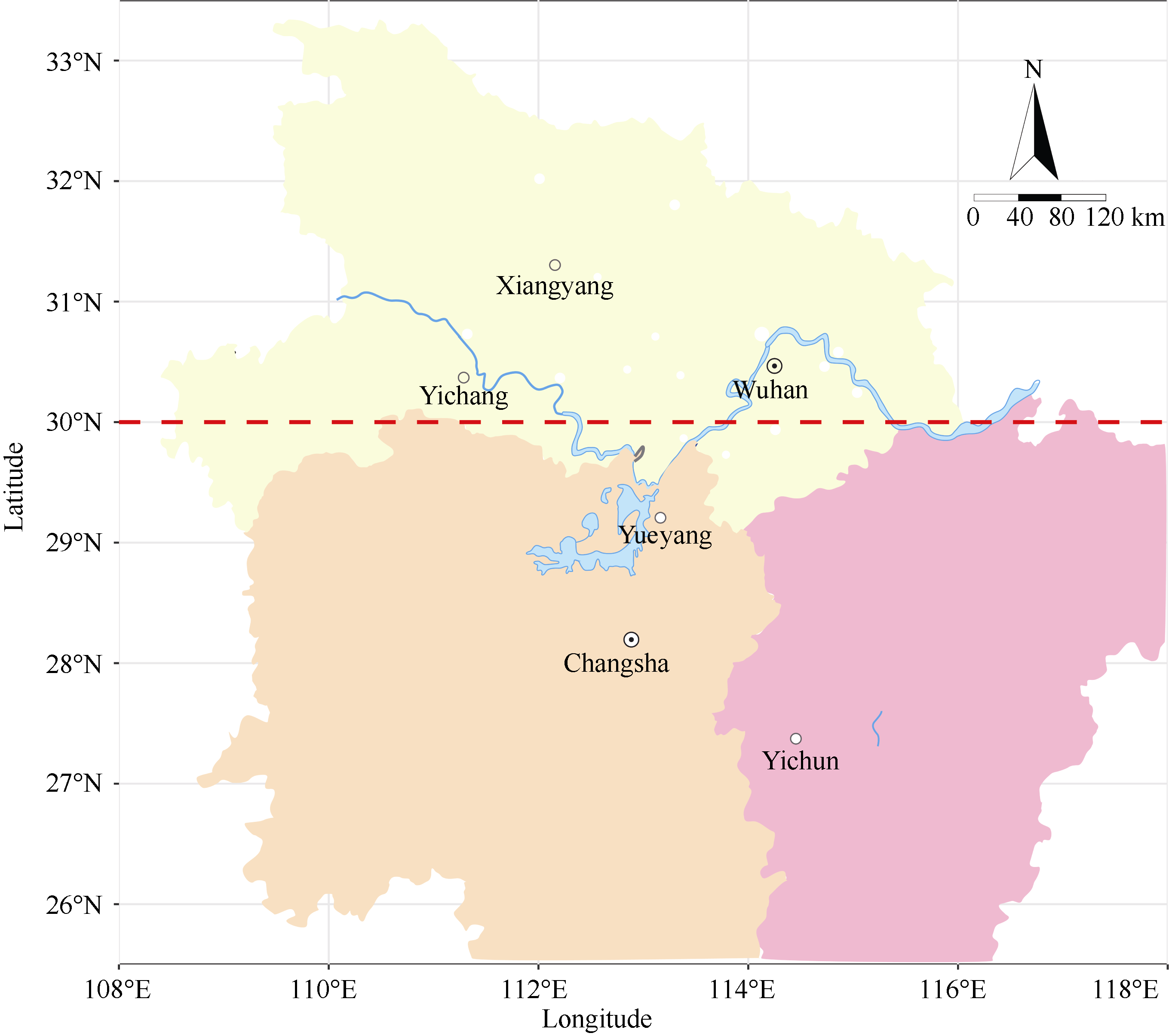
Fig. 1

Distribution of experimental sites This map is based on the standard map with the Review Number GS (2022) 4309, downloaded from the Standard Map Service of the Ministry of Natural Resources of China. The base map boundaries have not been modified."

Table S1

2004-2023 annual meteorological averages during the growth period of rapeseed in the middle Yangtze Basin"

年份
Year
平均气温
Mean temperature (℃)
降水量
Precipitation (mm)
K指数
K index
2004 11.89 659.42 7.46
2005 12.23 683.40 8.21
2006 12.88 584.13 8.65
2007 11.87 496.06 4.51
2008 12.40 668.43 7.00
2009 11.77 767.78 6.10
2010 11.65 418.63 3.09
2011 11.86 724.57 8.36
2012 11.69 696.32 7.89
2013 12.39 616.04 4.49
2014 12.12 665.73 5.61
2015 12.04 812.41 7.85
2016 12.38 738.68 9.04
2017 11.82 599.74 5.32
2018 11.62 685.53 8.69
2019 12.82 630.76 9.74
2020 12.03 550.43 6.51
2021 12.29 696.99 6.50
2022 13.03 599.13 5.80
2023 12.42 759.34 8.67
平均值Average 12.20 652.70 7.00

Table S2

Detailed information of tested lines"

年份Year 品系编号
Line code
品系名称
Line name
类型
Type
芥酸
Erucic acid (%)
硫甙
Glucosinolate content (µmol g-1)
含油量
Oil content (%)
2006 36 K219 杂交系Hybrid line 0.1 17.38 41.49
2006 28 H0202 杂交系Hybrid line 0.2 19.10 42.58
2006 149 杂695 Za 695 杂交系Hybrid line 0.1 19.07 45.08
2006 164 中油98D Zhongyou 98D 杂交系Hybrid line 0 23.07 44.65
2006 152 浙油5002 Zheyou 5002 自交系Inbred line 0 23.46 45.57
2006 34 H9958 杂交系Hybrid line 0.2 19.36 41.39
2006 140 油研1707 Youyan 1707 杂交系Hybrid line 0.5 17.14 45.29
2006 11 56602 自交系Inbred line 0.1 19.94 47.17
2006 14 06杂996 06 za 996 杂交系Hybrid line 0 16.22 43.39
2006 136 扬6614 Yang 6614 自交系Inbred line 0.9 29.56 43.52
2006 165 中油杂2号 Zhongyouza 2 杂交系Hybrid line 0 19.06 42.84
2006 1 112 杂交系Hybrid line 0 23.66 45.86
2006 47 滁核杂1号 Chuheza 1 杂交系Hybrid line 0.2 19.94 43.07
2006 44 V033-118 杂交系Hybrid line 0.1 24.68 44.31
2006 166 中种油1号 Zhongzhongyou 1 杂交系Hybrid line 0 18.43 45.31
2006 33 H9953 杂交系Hybrid line
2006 70 富油2号 Fuyou 2 杂交系Hybrid line 0.3 23.05 41.86
2006 24 EYZ06-14 杂交系Hybrid line 0.3 29.80 41.69
2006 9 6788 杂交系Hybrid line 0 17.52 43.12
2006 114 三北98 Sanbei 98 杂交系Hybrid line 0.4 17.94 46.76
2006 150 杂839 Za 839 杂交系Hybrid line 0.1 17.30 45.08
2006 8 5730 杂交系Hybrid line 0 17.08 43.74
2006 6 2105 杂交系Hybrid line 0.2 22.92 43.43
2006 81 沪油杂4号 Huyouza 4 杂交系Hybrid line 0 28.86 43.27
2006 65 德油22-1 Deyou 22-1 杂交系Hybrid line 0 18.92 44.01
2006 43 T1839 杂交系Hybrid line 0.1 19.18 43.47
2006 153 浙油6001 Zheyou 6001 自交系Inbred line 0 23.52 45.48
2006 21 B351 杂交系Hybrid line 0 26.32 45.07
2006 37 K565 杂交系Hybrid line 0 21.38 45.59
2009 22 C926 杂交系Hybrid line 0 21.66 41.15
2009 167 卓信058 Zhuoxin 058 杂交系Hybrid line 0.1 20.57 43.72
2009 39 K805 杂交系Hybrid line 0 18.19 41.28
2009 46 V6-22 杂交系Hybrid line 0.1 19.68 40.02
2009 120 圣光95 Shengguang 95 杂交系Hybrid line 0.5 29.81 40.28
2009 80 沪油21 Huyou 21 自交系Inbred line 0.1 20.07 39.94
2009 12 03杂-14 03 za-14 杂交系Hybrid line 0.1 29.64 44.74
2009 71 赣油杂6号 Ganyouza 6 杂交系Hybrid line 0.1 17.56 44.63
2009 151 杂油2008 Zayou 2008 杂交系Hybrid line 0 24.67 41.46
2009 138 阳光2009 Yangguang 2009 自交系Inbred line 0.1 19.92 42.92
2009 29 H0602 杂交系Hybrid line 0.9 25.48 44.66
2009 57 大地16 Dadi 16 杂交系Hybrid line 0.2 21.81 43.56
2009 78 禾盛油868 Heshengyou 868 杂交系Hybrid line 0.3 24.71 41.98
2009 155 中农油9号 Zhongnongyou 9 杂交系Hybrid line 0.6 20.88 42.88
2009 67 丰油9号 Fengyou 9 杂交系Hybrid line 1.2 35.55 39.51
2009 50 川农油3号 Chuannongyou 3 杂交系Hybrid line 0.2 18.09 41.64
2009 64 德68-12 De 68-12 杂交系Hybrid line 0.4 26.18 41.10
2009 41 SY05-1 杂交系Hybrid line 0 29.12 40.83
2009 35 JY939 杂交系Hybrid line 0 20.14 38.27
2009 15 09-崇26 09-chong 26 杂交系Hybrid line 0.1 24.52 41.47
2009 146 杂499 Za 499 杂交系Hybrid line 0 21.91 43.14
2009 23 C935 杂交系Hybrid line 0.3 27.16 46.04
2009 30 H1717 杂交系Hybrid line 0 19.40 43.30
2009 62 大地69 Dadi 69 杂交系Hybrid line 0 20.73 41.72
2009 17 36P47 杂交系Hybrid line 0.1 18.87 46.00
2009 38 K586 杂交系Hybrid line 0 22.05 42.48
2009 10 8686 杂交系Hybrid line 0 22.11 41.29
2009 5 928 杂交系Hybrid line 0 24.87 40.56
2009 13 06-L-2Q 杂交系Hybrid line 0.6 28.06 40.94
2009 27 G142 自交系Inbred line 0 25.47 45.22
2009 4 590 杂交系Hybrid line 0.5 22.63 43.13
2009 2 507 杂交系Hybrid line 0 29.78 43.89
2009 66 德油杂10号 Deyouza 10 杂交系Hybrid line 0 21.50 41.26
2009 85 华航901 Huahang 901 自交系Inbred line 0 24.19 43.26
2009 154 中农油6号 Zhongnongyou 6 杂交系Hybrid line 0.1 19.01 44.52
2009 18 86P14 杂交系Hybrid line 0 17.30 46.60
2009 3 589 自交系Inbred line 0 17.53 44.08
2009 45 V037-77 杂交系Hybrid line 0 25.82 41.76
2009 147 杂529 Za 529 杂交系Hybrid line 0 21.74 43.66
2009 40 QL8618 杂交系Hybrid line 0.7 27.90 46.12
2009 16 36P14 杂交系Hybrid line 0 18.24 47.80
2009 148 杂613 Za 613 杂交系Hybrid line 0 18.48 44.28
2009 49 楚油杂79 Chuyouza 79 杂交系Hybrid line 0.2 25.13 45.04
2009 119 圣光86 Shengguang 86 杂交系Hybrid line 0.6 20.47 41.90
2009 79 核优488 Heyou 488 杂交系Hybrid line 0 17.59 42.62
2009 54 川杂NH352 Chuanza NH352 杂交系Hybrid line 0 19.24 43.28
2009 32 H4396 杂交系Hybrid line 0.2 20.96 44.61
2009 42 T1588 杂交系Hybrid line 0.1 25.18 43.27
2009 7 5102 杂交系Hybrid line 0 35.99 42.63
2009 77 禾盛油555 Heshengyou 555 杂交系Hybrid line 0.3 28.87 42.14
2016 156 中双3370 Zhongshuang 3370 自交系Inbred line 0 20.48 41.51
2016 59 大地193 Dadi 193 杂交系Hybrid line 0 21.52 45.87
2016 137 阳光165 Yangguang 165 杂交系Hybrid line 0.1 20.87 42.25
2016 74 汉油10号 Hanyou 10 杂交系Hybrid line 0 21.65 42.36
2016 123 希望122 Xiwang 122 杂交系Hybrid line 0.1 20.13 43.25
2016 134 秀油杂1号 Xiuyouza 1 杂交系Hybrid line 0 21.83 44.02
2016 69 沣油643 Fengyou 643 杂交系Hybrid line 0 19.99 44.97
2016 51 川油56 Chuanyou 56 杂交系Hybrid line 0.3 34.23 45.59
2016 144 渝油36 Yuyou 36 杂交系Hybrid line 0.1 20.90 44.64
2016 55 创油16号 Chuangyou 16 杂交系Hybrid line 0.4 20.40 44.46
2016 90 华油杂12号 Huayouza 12 杂交系Hybrid line 0.1 27.84 42.26
2016 124 希望152 Xiwang 152 杂交系Hybrid line 0.1 21.47 44.26
2016 162 中油619 Zhongyou 619 杂交系Hybrid line 0 22.79 46.67
2016 139 阳光736 Yangguang 736 自交系Inbred line 0.2 23.68 44.87
2016 93 华油杂703 Huayouza 703 杂交系Hybrid line 0 19.62 42.39
2016 88 华协82 Huaxie 82 杂交系Hybrid line 0.1 21.01 44.07
2016 68 沣油306 Fengyou 306 杂交系Hybrid line 0 29.61 45.29
2016 122 西油6号 Xiyou 6 杂交系Hybrid line 0 24.77 48.47
2016 113 蓉油30 Rongyou 30 杂交系Hybrid line 0.1 23.21 44.70
2016 75 豪油29 Haoyou 29 杂交系Hybrid line 0.6 74.95 41.65
2016 98 景油599 Jingyou 599 杂交系Hybrid line 0 25.61 48.14
2016 127 湘杂油352 Xiangzayou 352 杂交系Hybrid line 0 24.03 47.65
2016 141 渝华3号 Yuhua 3 杂交系Hybrid line 0.5 23.07 44.25
2016 117 圣光128 Shengguang 128 杂交系Hybrid line 0 20.59 44.03
2016 129 湘杂油512 Xiangzayou 512 杂交系Hybrid line 0 21.62 47.85
2016 92 华油杂653 Huayouza 653 杂交系Hybrid line 0.3 22.68 44.99
2016 96 金油杂158 Jinyouza 158 杂交系Hybrid line 0.2 21.14 44.81
2016 159 中油159 Zhongyou 159 自交系Inbred line 0.8 26.98 46.43
2016 158 中油153 Zhongyou 153 杂交系Hybrid line 0 21.72 43.08
2016 125 希望202 Xiwang 202 杂交系Hybrid line 0 23.16 43.55
2016 133 兴油杂19 Xingyouza 19 杂交系Hybrid line 0 24.63 44.16
2016 111 秦优1619 Qinyou 1619 杂交系Hybrid line 0 24.68 47.13
2016 105 南油846 Nanyou 846 杂交系Hybrid line 0 21.52 46.01
2016 126 希望402 Xiwang 402 杂交系Hybrid line 0.4 23.77 45.87
2016 60 大地199 Dadi 199 杂交系Hybrid line 0.1 23.71 47.35
2016 161 中油613 Zhongyou 613 杂交系Hybrid line 0.3 22.33 46.29
2016 115 陕油1309 Shaanyou 1309 杂交系Hybrid line 0 27.12 47.20
2016 91 华油杂28 Huayouza 28 杂交系Hybrid line 0 24.53 45.58
2016 128 湘杂油373 Xiangzayou 373 杂交系Hybrid line 0 21.86 48.28
2016 135 亚华油207 Yahuayou 207 杂交系Hybrid line 0 20.73 43.57
2016 63 德5油319 De 5 you 319 杂交系Hybrid line 0.2 29.55 49.55
2016 110 秦荣5号 Qinrong 5 杂交系Hybrid line 0 29.47 45.30
2016 97 景油517 Jingyou 517 杂交系Hybrid line 0 24.74 49.64
2016 58 大地192 Dadi 192 杂交系Hybrid line 0 25.08 44.66
2019 109 黔杂18J32 Qianza 18J32 杂交系Hybrid line 0.6 26.80 43.22
2019 157 中双C35 Zhongshuang C35 自交系Inbred line 0 34.68 48.26
2019 61 大地591 Dadi 591 杂交系Hybrid line 0.2 23.07 49.18
2019 163 中油861 Zhongyou 861 杂交系Hybrid line 0 24.42 48.54
2019 101 利油518 Liyou 518 自交系Inbred line 0 23.59 46.58
2019 56 大地117 Dadi 117 杂交系Hybrid line 0.1 22.31 48.26
2019 73 国盛油7号 Guoshengyou 7 自交系Inbred line 0.1 24.35 48.14
2019 100 科乐油4号 Keleyou 4 杂交系Hybrid line 0.3 21.39 43.70
2019 99 景油830 Jingyou 830 杂交系Hybrid line 0.2 23.16 48.43
2019 132 兴油666 Xingyou 666 自交系Inbred line 0 22.62 47.22
2019 20 9ZYYP27 杂交系Hybrid line 0.1 21.83 47.60
2019 83 华2015TP6 Hua 2015TP6 杂交系Hybrid line 0 22.55 45.89
2019 48 楚禾油937 Chuheyou 937 杂交系Hybrid line 2.6 23.10 45.96
2019 108 宁杂173 Ningza 173 杂交系Hybrid line 0 22.14 44.90
2019 95 华杂875 Huaza 875 杂交系Hybrid line 0 21.09 42.77
2019 52 川油91 Chuanyou 91 杂交系Hybrid line 0 44.47 46.89
2019 143 渝黄9号 Yuhuang 9 杂交系Hybrid line 0.7 27.02 46.86
2019 112 秦优1919 Qinyou 1919 杂交系Hybrid line 0 29.12 46.24
2019 104 南油759 Nanyou 759 杂交系Hybrid line 0 21.56 45.38
2019 121 天禾油23 Tianheyou 23 杂交系Hybrid line 0 21.58 44.55
2019 25 FY19-31 杂交系Hybrid line 0.1 28.14 45.48
2019 19 9ZYYP12 杂交系Hybrid line 0 24.08 49.80
2019 160 中油510 Zhongyou 510 杂交系Hybrid line 0 22.18 45.57
2019 89 华油2133 Huayou 2133 杂交系Hybrid line 0.1 21.86 43.76
2019 87 华秦油971 Huaqinyou 971 杂交系Hybrid line 0 23.85 47.80
2019 106 内油6054 Neiyou 6054 杂交系Hybrid line 0 20.55 43.71
2019 142 渝华7号 Yuhua 7 杂交系Hybrid line 0.1 21.62 43.50
2019 76 豪油杂98 Haoyouza 98 杂交系Hybrid line 0 24.64 43.18
2019 107 宁杂161 Ningza 161 杂交系Hybrid line 0.1 22.35 46.32
2019 102 米油599 Miyou 599 杂交系Hybrid line 0.3 20.80 42.42
2019 31 H1951 杂交系Hybrid line 1.0 22.84 47.74
2019 84 华68P25 Hua 68P25 杂交系Hybrid line 0 24.00 49.72
2019 26 FY19-68 杂交系Hybrid line 0.4 21.23 42.66
2019 130 湘杂油972 Xiangyouza 972 杂交系Hybrid line 0 22.45 46.98
2019 131 信油杂817 Xinyouza 817 杂交系Hybrid line 0.1 28.69 43.10
2019 118 圣光185 Shengguang 185 杂交系Hybrid line 0 22.88 45.72
2019 116 陕油39 Shaanyou 39 杂交系Hybrid line 0 28.94 44.83
2019 86 华抗009R Huakang 009R 杂交系Hybrid line 0 21.39 44.45
2019 103 绵油60 Mianyou 60 杂交系Hybrid line 0.4 26.39 45.61
2019 145 越优577 Yueyou 577 杂交系Hybrid line 0.4 22.82 47.78
2019 94 华油杂718 Huayouza 718 杂交系Hybrid line 1.0 22.78 45.94
2019 72 赣油杂703 Ganyouza 703 杂交系Hybrid line 0.1 24.01 45.41
2019 82 花育1号 Huayu 1 杂交系Hybrid line 0.1 21.31 42.22
2019 53 川油杂2002 Chuanyouza 2002 杂交系Hybrid line 0.1 44.24 43.99

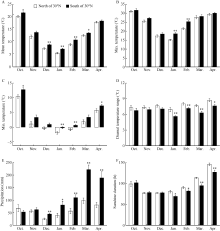
Fig. 2

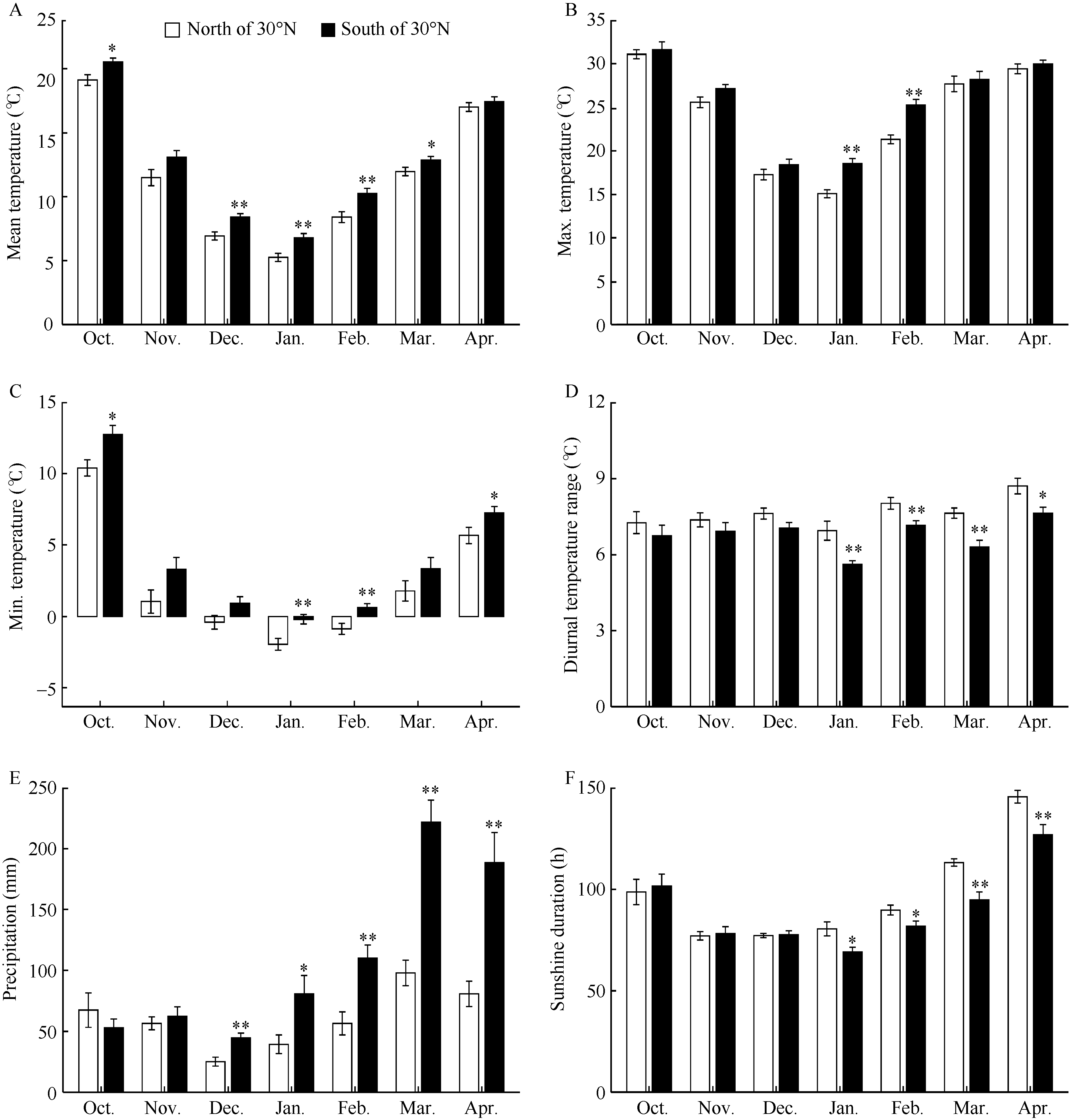
Comparison of major meteorological factors among rapeseed-growing regions in the middle Yangtze Basin A: comparison of mean temperature between regions north and south of 30°N; B: comparison of maximum temperature between regions north and south of 30°N; C: comparison of minimum temperature between regions north and south of 30°N; D: comparison of daily diurnal temperature range between regions north and south of 30°N; E: comparison of precipitation between regions north and south of 30°N; F: comparison of sunshine duration between regions north and south of 30°N. Significance levels are indicated by ** (P < 0.01), * (P < 0.05), and no symbol (P ≥ 0.05)."

Table 1

Comparison of major agronomic traits of rapeseed in different regions of the middle Yangtze Basin"

性状
Trait
30°N以北
North of 30°N
30°N以南
South of 30°N
30°N以北地区较30°N以南地区增减
Increase or decrease of north of 30°N relative to south of 30°N (± %)
菌核病病情指数Index of Sclerotinia sclerotiorm 7.8** 3.7 113.2
株高Plant height (cm) 190.0** 176.6 7.6
分枝数Branching number 7.2** 6.6 8.8
单株角果数Silique number per plant 275.1** 255.1 7.8
每角粒数Seed number per silique 20.0 20.3 -1.3
千粒重Thousand seeds weight (g) 3.9 3.9 -0.8
单株产量Yield per plant (g) 18.9** 13.6 38.4
全生育期Whole growth period (d) 222.8** 214.7 3.8
硫甙Glucosinolate content (µmol g-1) 23.5 23.6 -0.3
含油量Oil content (%) 44.3 44.4 -0.3
产量Yield (kg hm-2) 3136.7** 2357.6 33.0

Table 2

Monthly correlation between meteorological factors and yield traits in different regions"

月份
Month
平均气温Mean temperature (℃) 最高气温Max. temperature (℃) 最低气温Min. temperature (℃)
30°N以北
North of 30°N
30°N以南
South of 30°N
30°N以北
North of 30°N
30°N以南
South of 30°N
30°N以北
North of 30°N
30°N以南
South of 30°N
10月Oct. 0.057 0.204** 0.155** 0.407** 0.174** 0.092*
11月Nov. 0.293** 0.302** 0.117* 0.125** 0.477** 0.304**
12月Dec. 0.081 -0.054 0.004 -0.007 0.294** 0.392**
1月Jan. -0.173** -0.500** 0.355** -0.355** 0.201** -0.084*
2月Feb. 0.311** 0.326** -0.317** -0.171** 0.361** 0.274**
3月Mar. 0.271** 0.484** 0.317** 0.443** 0.175** -0.013
4月Apr. 0.069 0.022 0.332** 0.189** 0.060 -0.046
月份
Month
气温日较差
Diurnal temperature range (℃)
降水量
Precipitation (mm)
日照时数
Sunshine duration (h)
30°N以北
North of 30°N
30°N以南
South of 30°N
30°N以北
North of 30°N
30°N以南
South of 30°N
30°N以北
North of 30°N
30°N以南
South of 30°N
10月Oct. 0.135** 0.239** -0.248** -0.212** 0.166** 0.214**
11月Nov. 0.134** 0.191** -0.353** -0.423** 0.008 0.209**
12月Dec. -0.090 -0.022 -0.457** -0.291** -0.025 -0.087*
1月Jan. 0.032 -0.269** -0.042 0.263** -0.029 -0.003
2月Feb. 0.089 -0.270** -0.079 0.408** -0.121* -0.152**
3月Mar. 0.184** 0.207** -0.310** -0.367** -0.104* 0.222**
4月Apr. 0.397** 0.024 -0.461** -0.390** 0.306** 0.237**

Fig. 3

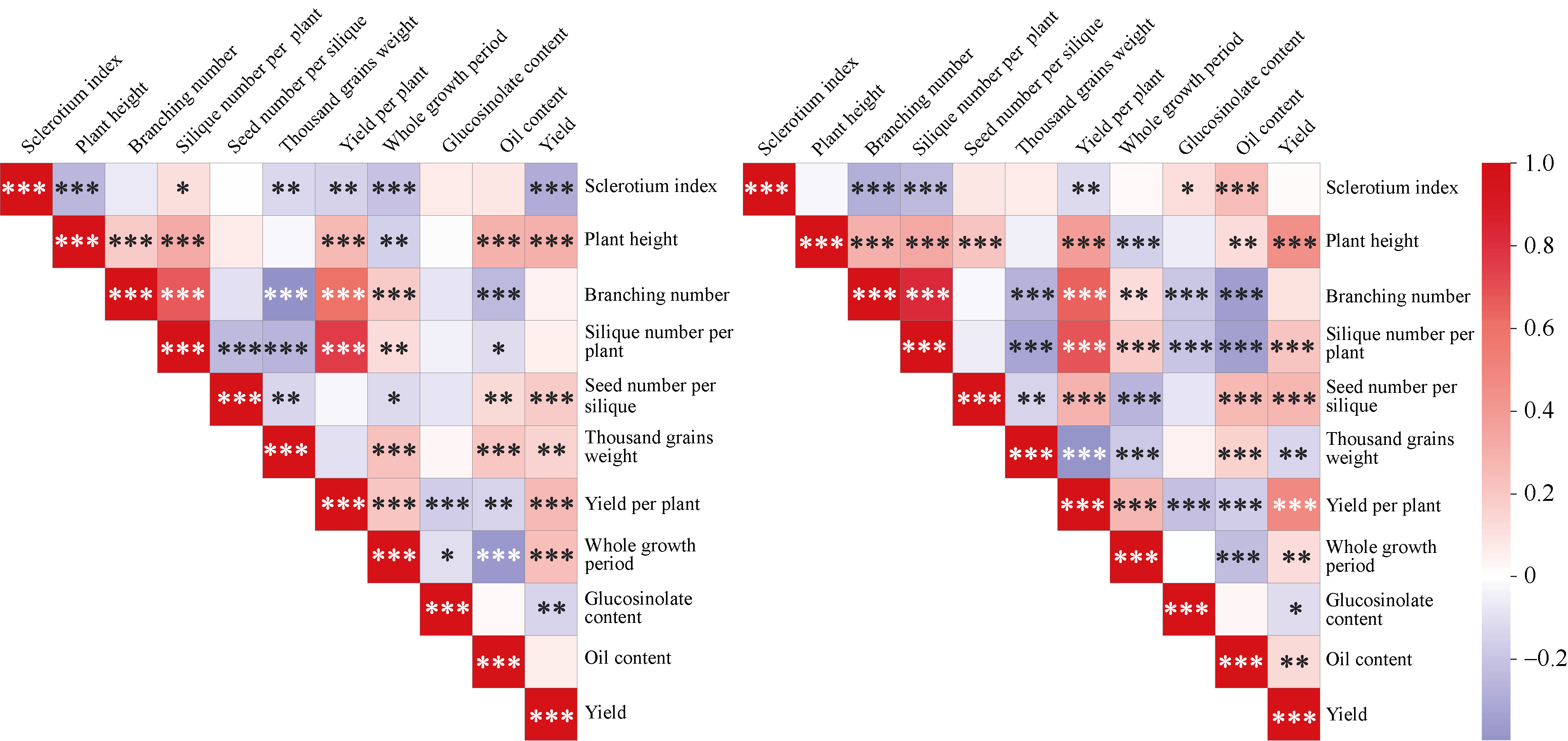
Correlation analysis of major agronomic traits on both sides of 30°N in the middle Yangtze Basin A: correlation analysis of major agronomic traits north of 30°N; B: correlation analysis of major agronomic traits south of 30°N. *** indicates P < 0.001, ** indicates P < 0.01, * indicates P < 0.05, and no symbol indicates P ≥ 0.05."

Table 3

Path analysis of agronomic traits and yield in different regions"

地区
Region
交互作用
因子
Interaction factor
相关系数
Correlation
coefficient
直接通径
系数
Direct path coefficient
间接通径系数Indirect path-coefficient
X1 X2 X3 X4 X5 X6 X7 X8 X9 X10
30°N以北 X1 -0.29 -4.33 -1.87 2.55 -0.12 0.14 -3.21 -5.18 -5.23 -0.38 1.15
North of 30°N X2 0.30 7.51 1.08 -6.63 -0.38 1.67 -0.50 8.71 -3.95 0.05 4.21
X3 0.04 -36.43 0.30 1.37 -0.79 -2.53 -10.17 20.83 4.52 0.44 -3.53
X4 0.06 -1.17 -0.45 2.42 -24.50 -6.17 -6.45 25.87 3.21 0.23 -1.59
X5 0.19 26.37 -0.02 0.48 3.50 0.28 -3.23 -0.88 -3.11 0.41 1.87
X6 0.15 24.67 0.56 -0.15 15.02 0.31 -3.45 -3.15 5.58 -0.14 2.94
X7 0.26 33.95 0.66 1.93 -22.35 -0.89 -0.68 -2.29 5.21 0.87 -2.10
X8 0.24 25.13 0.90 -1.18 -6.55 -0.15 -3.27 5.47 7.04 0.53 -5.62
X9 -0.15 -5.20 -0.32 -0.07 3.08 0.05 -2.07 0.67 -5.65 -2.57 0.27
X10 0.06 14.49 -0.34 2.18 8.88 0.13 3.41 5.01 -4.92 -9.74 -0.10
30°N以南 X1 0.01 -2.07 -0.16 24.90 -0.09 0.73 1.35 -4.17 0.11 -0.22 2.67
South of 30°N X2 0.45 6.70 0.05 -26.18 0.12 1.86 -0.92 13.35 -0.86 0.10 1.36
X3 0.10 -87.42 0.59 2.00 0.31 -0.16 -5.12 22.40 0.64 0.36 -3.86
X4 0.22 0.37 0.51 2.22 -72.65 -0.48 -6.19 23.81 0.98 0.39 -3.74
X5 0.27 8.84 -0.17 1.41 1.58 -0.02 -2.71 9.94 -1.42 0.16 2.80
X6 -0.14 19.24 -0.14 -0.32 23.25 -0.12 -1.24 -13.70 -0.98 -0.08 1.74
X7 0.48 34.57 0.25 2.59 -56.64 0.26 2.54 -7.62 1.46 0.42 -1.77
X8 0.12 5.36 -0.04 -1.07 -10.46 0.07 -2.34 -3.53 9.41 0 -2.50
X9 -0.11 -1.97 -0.23 -0.35 16.05 -0.07 -0.72 0.78 -7.40 -0.01 0.37
X10 0.13 10.82 -0.51 0.84 31.15 -0.13 2.29 3.09 -5.66 -1.24 -0.07

Fig. 4

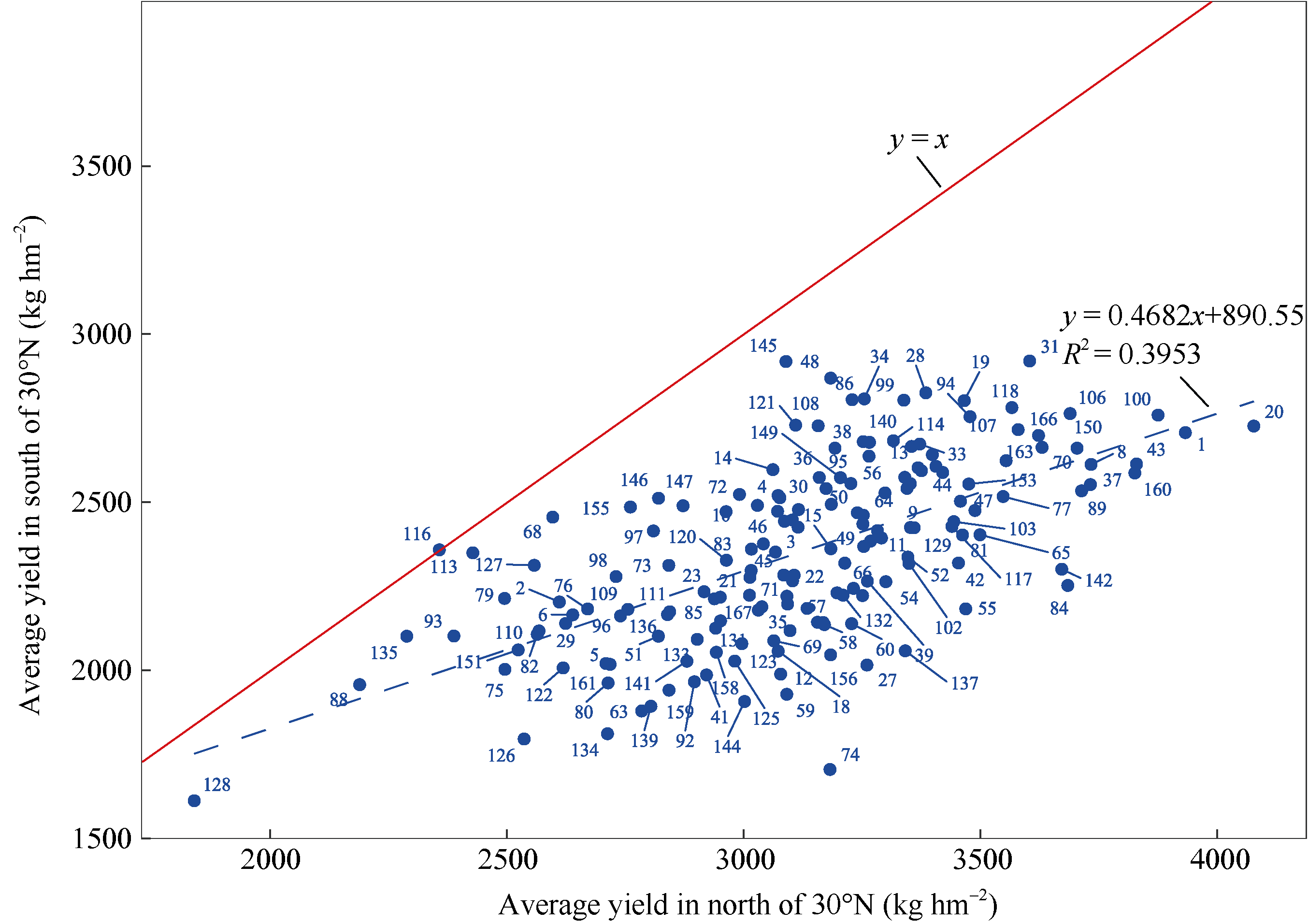
Yield performance of rapeseed varieties across subregions south and north of 30°N in the middle Yangtze Basin Numbers in the figure represent line codes, as detailed in Table S2."

[1] 王汉中. 以新需求为导向的油菜产业发展战略. 中国油料作物学报, 2018, 40: 613-617.
doi: 10.7505/j.issn.1007-9084.2018.05.001
Wang H Z. New-demand oriented oilseed rape industry developing strategy. Chin J Oil Crop Sci, 2018, 40: 613-617 (in Chinese with English abstract).
[2] 何永强, 张金盔, 徐劲松, 等. 14-羟基芸苔素甾醇生长调节剂对油菜生长和产量的影响. 中国农业科学, 2024, 57: 1444-1454.
doi: 10.3864/j.issn.0578-1752.2024.08.003
He Y Q, Zhang J K, Xu J S, et al. Effect of 14-hydroxylated brassinosteroids growth regulator on growth and yield of rapeseed. Sci Agric Sin, 2024, 57: 1444-1454 (in Chinese with English abstract).
doi: 10.3864/j.issn.0578-1752.2024.08.003
[3] 宁宁, 莫娇, 胡冰, 等. 长江流域不同生态区油菜籽关键品质比较研究. 作物学报, 2023, 49: 3315-3327.
doi: 10.3724/SP.J.1006.2023.34017
Ning N, Mo J, Hu B, et al. Comparative study on the processing quality of winter rape in different ecological zones of the Yangtze River valley. Acta Agron Sin, 2023, 49: 3315-3327 (in Chinese with English abstract).
doi: 10.3724/SP.J.1006.2023.34017
[4] Yang X Q, Liu Y, Bezama A, et al. Two birds with one stone: a combined environmental and economic performance assessment of rapeseed-based biodiesel production. GCB Bioenergy, 2022, 14: 215-241.
doi: 10.1111/gcbb.v14.2
[5] 李谷成, 牛秋纯, 冷博峰, 等. 新时代十年: 我国油菜产业发展与路径选择. 中国油料作物学报, 2024, 46: 228-235.
doi: 10.19802/j.issn.1007-9084.2023248
Li G C, Niu Q C, Leng B F, et al. The decade of rapeseed industry in the new era: development and its path choice. Chin J Oil Crop Sci, 2024, 46: 228-235 (in Chinese with English abstract).
[6] Huang J D, Cao X Y, Kuai J, et al. Evaluation of production capacity for rice-rapeseed cropping system in China. Field Crops Res, 2023, 293: 108842.
doi: 10.1016/j.fcr.2023.108842
[7] Zandberg J D, Fernandez C T, Danilevicz M F, et al. The global assessment of oilseed Brassica crop species yield, yield stability and the underlying genetics. Plants, 2022, 11: 2740.
doi: 10.3390/plants11202740
[8] Kirkegaard J A, Lilley J M, Berry P M, et al. Crop Physiology case Histories for Major Crops. Massachusetts: Academic Press, 2021. pp 518-549.
[9] 郑娟, 黄凰, 廖宜涛, 等. 长江中游地区油菜生产全程机械化技术进展与建议. 中国油料作物学报, 2024, 46: 245-259.
doi: 10.19802/j.issn.1007-9084.2022299
Zheng J, Huang H, Liao Y T, et al. Progress and suggestions on full mechanization of rapeseed production in the middle reaches of the Yangtze River. Chin J Oil Crop Sci, 2024, 46: 245-259 (in Chinese with English abstract).
doi: 10.19802/j.issn.1007-9084.2022299
[10] 左萃宸, 曾涛, 何永强, 等. 长江中游南部油菜产区低产原因及育种对策. 中国油料作物学报, 2024, 46: 969-976.
doi: 10.19802/j.issn.1007-9084.2023072
Zuo C C, Zeng T, He Y Q, et al. Causes of low yield and breeding countermeasures in rapeseed producing areas in the middle reaches of the Yangtze River. Chin J Oil Crop Sci, 2024, 46: 969-976 (in Chinese with English abstract).
[11] 普多旺, 拉瓜登顿, 盛敏, 等. 中国北纬30°地面太阳光谱观测. 光谱学与光谱分析, 2023, 43: 1881-1887.
Pu D W, Lagua D D, Sheng M, et al. Surface solar spectral observation along 30°N in China. Spectrosc Spect Anal, 2023, 43: 1881-1887 (in Chinese with English abstract).
[12] 陈晓阳. 北纬30°—优质茶叶产区带. 国土资源导刊, 2005, 2(3): 56-57.
Chen X Y. 30° north latitude-high quality tea producing area. Land Resour Her, 2005, 2(3): 56-57 (in Chinese with English abstract).
[13] Zhu C W, Zhou X J, Zhao P, et al. Onset of East Asian subtropical summer monsoon and rainy season in China. Sci China Earth Sci, 2011, 54: 1845-1853.
doi: 10.1007/s11430-011-4284-0
[14] Zhou B T, Wang H J. Relationship between the boreal spring Hadley circulation and the summer precipitation in the Yangtze River valley. J Geophys Res Atmos, 2006, 111: 2005JD007006.
[15] Day J A, Fung I, Liu W H. Changing character of rainfall in Eastern China, 1951-2007. Proc Natl Acad Sci USA, 2018, 115: 2016-2021.
doi: 10.1073/pnas.1715386115 pmid: 29440414
[16] LinHo L H, Huang X L, Lau N C. Winter-to-spring transition in east Asia: a planetary-scale perspective of the South China spring rain onset. J Clim, 2008, 21: 3081-3096.
doi: 10.1175/2007JCLI1611.1
[17] Gao H, Yang S, Kumar A, et al. Variations of the East Asian Mei-yu and simulation and prediction by the NCEP climate forecast system. J Clim, 2011, 24: 94-108.
doi: 10.1175/2010JCLI3540.1
[18] Gu W, Wang L, Hu Z Z, et al. Interannual variations of the first rainy season precipitation over South China. J Clim, 2018, 31: 623-640.
doi: 10.1175/JCLI-D-17-0284.1
[19] Yao X P, Ma J L, Zhang D L, et al. A 33-yr Meiyu-season climatology of shear lines over the Yangtze-Huai River Basin in Eastern China. J Appl Meteor Climatol, 2020, 59: 1125-1137.
doi: 10.1175/JAMC-D-19-0229.1
[20] Hu Y J, Zhu X Y, Ha Y, et al. Another source of error in simulating or predicting Meiyu: a case study. Theor Appl Climatol, 2024, 155: 9833-9846.
doi: 10.1007/s00704-024-05218-9
[21] Wu W, Shah F, Ma B L. Understanding of crop lodging and agronomic strategies to improve the resilience of rapeseed production to climate change. Crop Environ, 2022, 1: 133-144.
doi: 10.1016/j.crope.2022.05.005
[22] Raza A. Eco-physiological and biochemical responses of rapeseed (Brassica napus L.) to abiotic stresses: consequences and mitigation strategies. J Plant Growth Regul, 2021, 40: 1368-1388.
doi: 10.1007/s00344-020-10231-z
[23] 谢伶俐, 韦丁一, 章子爽, 等. 甘蓝型油菜发育进程中赤霉素动态变化及其与产量的关系. 中国农业科学, 2022, 55: 4793-4807.
doi: 10.3864/j.issn.0578-1752.2022.24.002
Xie L L, Wei D Y, Zhang Z S, et al. Dynamic changes of gibberellin content during the development and its relationship with yield of Brassica napus L. Sci Agric Sin, 2022, 55: 4793-4807 (in Chinese with English abstract).
[24] 高少凡, 韦丁一, 何庆彪, 等. 甘蓝型油菜苗期赤霉素含量及其代谢关键基因转录特性. 中国油料作物学报, 2024, 46: 1240-1250.
doi: 10.19802/j.issn.1007-9084.2023094
Gao S F, Wei D Y, He Q B, et al. Gibberellin metabolism level and key gene transcription characteristics at seedling stage of Brassica napus L. Chin J Oil Crop Sci, 2024, 46: 1240-1250 (in Chinese with English abstract).
[25] Jaime R, Alcántara J M, Manzaneda A J, et al. Climate change decreases suitable areas for rapeseed cultivation in Europe but provides new opportunities for white mustard as an alternative oilseed for biofuel production. PLoS One, 2018, 13: e0207124.
[26] 丛日环, 张智, 鲁剑巍. 长江流域不同种植区气候因子对冬油菜产量的影响. 中国油料作物学报, 2019, 41: 894-903.
doi: 10.19802/j.issn.1007-9084.2019046
Cong R H, Zhang Z, Lu J W. Climate impacts on yield of winter oilseed rape in different growth regions of the Yangtze River Basin. Chin J Oil Crop Sci, 2019, 41: 894-903 (in Chinese with English abstract).
doi: 10.19802/j.issn.1007-9084.2019046
[27] 张学昆, 张春雷, 廖星, 等. 2008年长江流域油菜低温冻害调查分析. 中国油料作物学报, 2008, 30: 122-126.
Zhang X K, Zhang C L, Liao X, et al. Investigation on 2008'low temperature and freeze injure on winter rape along Yangtze River. Chin J Oil Crop Sci, 2008, 30: 122-126 (in Chinese with English abstract).
[28] Kutcher H R, Warland J S, Brandt S A. Temperature and precipitation effects on canola yields in Saskatchewan, Canada. Agric For Meteor, 2010, 150: 161-165.
doi: 10.1016/j.agrformet.2009.09.011
[29] 何泽威, 丁晓雨, 徐劲松, 等. 播种期降水偏多对油菜重要农艺性状和产量的影响. 中国油料作物学报, 2024, 46: 92-101.
doi: 10.19802/j.issn.1007-9084.2022248
He Z W, Ding X Y, Xu J S, et al. Effect of autumn continuously rainy weather which cause waterlogging in rapeseed (Brassica napus L.) traits and yield. Chin J Oil Crop Sci, 2024, 46: 92-101 (in Chinese with English abstract).
[30] 陈于婷, 丁晓雨, 许本波, 等. 气候变暖对冬油菜产量、品质及重要农艺性状的影响. 作物学报, 2025, 51: 516-525.
doi: 10.3724/SP.J.1006.2025.44074
Chen Y T, Ding X Y, Xu B B, et al. Effects of climate warming on yield, quality-related and agronomic traits of winter rapeseed (Brassica napus L.). Acta Agron Sin, 2025, 51: 516-525 (in Chinese with English abstract).
[31] Gopal A, Veerasamy R, Dhashnamurthi V, et al. Enhancing drought tolerance in okra through melatonin application: a comprehensive study of physiological, biochemical and metabolic responses. Not Bot Horti Agrobo, 2024, 52: 14055.
doi: 10.15835/nbha52414055
[32] Guntukula R. Assessing the impact of climate change on Indian agriculture: evidence from major crop yields. J Public Aff, 2020, 20: e2040.
doi: 10.1002/pa.v20.1
[33] 刘海卿, 孙万仓, 刘自刚, 等. 北方不同生态区白菜型冬油菜农艺性状变化分析. 中国生态农业学报, 2015, 23: 694-704.
Liu H Q, Sun W C, Liu Z G, et al. Analysis of agronomic traits of winter rapeseed (Brassica campestris L.) in different ecological areas of North China. Chin J Eco-Agric, 2015, 23: 694-704 (in Chinese with English abstract).
[34] Huang J, Zhou L M, Zhang F M, et al. Responses of yield fluctuation of winter oilseed rape to climate anomalies in South China at provincial scale. Int J Plant Prod, 2020, 14: 521-530.
doi: 10.1007/s42106-020-00102-8
[35] Dron N, Simpfendorfer S, Sutton T, et al. Cause of death: Phytophthora or flood? effects of waterlogging on Phytophthora medicaginis and resistance of chickpea (Cicer arietinum). Agronomy, 2022, 12: 89.
doi: 10.3390/agronomy12010089
[36] Liang J P, Li H, Li N, et al. Analysis and prediction of the impact of socio-economic and meteorological factors on rapeseed yield based on machine learning. Agronomy, 2023, 13: 1867.
doi: 10.3390/agronomy13071867
[37] Butkeviciene L M, Kriauciuniene Z, Pupaliene R, et al. Influence of sowing time on yield and yield components of spring rapeseed in Lithuania. Agronomy, 2021, 11: 2170.
doi: 10.3390/agronomy11112170
[38] Wang X L, Li L, Wang C Y, et al. Micro-ridge-furrow planting increases rapeseed yield and resource utilization efficiency through optimizing field microenvironment and light-nitrogen matching. Crop J, 2025, 13: 587-596.
doi: 10.1016/j.cj.2024.12.021
[39] 蒙祖庆, 宋丰萍, 霍嘉慧, 等. 高原气候下西藏不同熟期甘蓝型春油菜光温资源利用效率比较分析. 中国油料作物学报, 2023, 45: 63-71.
doi: 10.19802/j.issn.1007-9084.2022037
Meng Z Q, Song F P, Huo J H, et al. Comparative analysis on light-temperature resource use efficiency of spring rapeseed (Brassica napus) differing in maturity in China Tibet under plateau climate. Chin J Oil Crop Sci, 2023, 45: 63-71 (in Chinese with English abstract).
[40] Saroj R, Soumya S L, Singh S, et al. Unraveling the relationship between seed yield and yield-related traits in a diversity panel of Brassica juncea using multi-traits mixed model. Front Plant Sci, 2021, 12: 651936.
doi: 10.3389/fpls.2021.651936
[41] Chang T, Wu J J, Wu X P, et al. Comprehensive evaluation of high-oleic rapeseed (Brassica napus) based on quality, resistance, and yield traits: a new method for rapid identification of high- oleic acid rapeseed germplasm. PLoS One, 2022, 17: e0272798.
[42] Radic V, Balalic I, Krstic M, et al. Correlation and path analysis of yield and yield components in winter rapeseed. Genetika, 2021, 53: 157-166.
doi: 10.2298/GENSR2101157R
[43] Pal L, Sandhu S K, Bhatia D, et al. Genome-wide association study for candidate genes controlling seed yield and its components in rapeseed (Brassica napus subsp. napus). Physiol Mol Biol Plants, 2021, 27: 1933-1951.
doi: 10.1007/s12298-021-01060-9
[44] Sadat Hashemi P, Mohammadi A, Alizadeh B, et al. Simultaneous selection of oil yield and other agronomic characteristics in winter rapeseed hybrids. Jcb, 2023, 15: 60-68.
doi: 10.61186/jcb.15.45.60
[45] Gholizadeh A, Oghan H A, Alizadeh B, et al. Phenotyping new rapeseed lines based on multiple traits: application of GT and GYT biplot analyses. Food Sci Nutr, 2023, 11: 853-862.
doi: 10.1002/fsn3.3119 pmid: 36789070
[46] Li Q, Luo T, Cheng T, et al. Evaluation and screening of rapeseed varieties (Brassica napus L.) suitable for mechanized harvesting with high yield and quality. Agronomy, 2023, 13: 795.
doi: 10.3390/agronomy13030795
[47] Liu S Y, Raman H, Xiang Y, et al. De novo design of future rapeseed crops: challenges and opportunities. Crop J, 2022, 10: 587-596.
doi: 10.1016/j.cj.2022.05.003
[48] Alizadeh B, Rezaizad A, Hamedani M Y, et al. Genotype × Environment interactions and simultaneous selection for high seed yield and stability in winter rapeseed (Brassica napus) multi-environment trials. Agric Res, 2022, 11: 185-196.
doi: 10.1007/s40003-021-00565-9
[49] HabibTabar Shiadeh S S, Feizabadi Y, Kosari-Moghaddam A. To what extent cultivar selection can affect the environmental impact of rapeseed production. Environ Sustain Indic, 2025, 26: 100619.
[1] Zhu Jia-Bao, Wang Xian-Ling, Fan You-Zhong, Wang Zong-Kai, Kuai Jie, Wang Bo, Wang Jing, Xu Zheng-Hua, Zhao Jie, Zhou Guang-Sheng. Effects of straw incorporation combined with nitrogen management on stem quality and lodging resistance of rapeseed following rice [J]. Acta Agronomica Sinica, 2026, 52(1): 233-248.
[2] Chi Xiao-Yuan, Liu Qing, Zhang Jun, Zhao Xu-Hong, Li Mei, Yu Tian-Yi, Pan Li-Juan, Xu Jing, Jiang Xiao, Yin Xiang-Zhen, Ma Jun-Qing, Chen Na. Field evaluation of salt-alkaline tolerance and trait correlation analysis in different peanut varieties (lines) [J]. Acta Agronomica Sinica, 2026, 52(1): 85-98.
[3] FAN You-Zhong, WANG Xian-Ling, WANG Zong-Kai, WANG Chun-Yun, WANG Tian-Yao, XIE Jie, KUAI Jie, WANG Bo, WANG Jing, XU Zheng-Hua, ZHAO Jie, ZHOU Guang-Sheng. Effects of straw incorporation combined with nitrogen management on photosynthetic efficiency and yield of rapeseed following rice [J]. Acta Agronomica Sinica, 2025, 51(8): 2139-2151.
[4] LI Shi-Peng, CHEN Cai-Wu, ZHANG Jing, LYU Tian, FU Ting-Dong, YI Bin. Identification of fertility levels and quantification of the temperature-fertility relationship in rapeseed pol TCMS lines using an improved U-Net++ model [J]. Acta Agronomica Sinica, 2025, 51(6): 1423-1434.
[5] CUI Xin, GU He-He, SONG Yi, ZHANG Zhe, LIU Shi-Shi, LU Zhi-Feng, REN Tao, LU Jian-Wei. Effects of potassium fertilizer application rates on rapeseed yield and potassium absorption and yield reduction caused by frost damage [J]. Acta Agronomica Sinica, 2025, 51(6): 1629-1642.
[6] WANG Jia-Jie, WANG Zheng-Nan, BATOOL Maria, WANG Wang-Nian, WEN Jing, REN Chang-Zhong, HE Feng, WU You-You, XU Zheng-Hua, WANG Jing, KUAI Jie, WANG Bo, ZHOU Guang-Sheng, FU Ting-Dong. Comparison of physiological characteristics of salt and alkali tolerance between rapeseed and wheat [J]. Acta Agronomica Sinica, 2025, 51(5): 1215-1229.
[7] SHE Hui-Jie, SUN Ming-Zhu, LI Shi-Gang, WANG Dong-Xian, CHENG Tai, JIANG Bo, CHEN Ai-Wu, WANG Jing, ZHAO Jie, WANG Bo, KUAI Jie, XU Zheng-Hua, ZHOU Guang-Sheng. Effect of coating with fulvic acid and alginate oligosaccharide on emergence and yield of late-sown rapeseed [J]. Acta Agronomica Sinica, 2025, 51(4): 1022-1036.
[8] SU Qing-Fang, SUN Xiao-Zhao, LIN Yang, FU Yan-Ping, CHENG Jia-Sen, XIE Jia-Tao, JIANG Dao-Hong, CHEN Tao. Serratia nematodiphila TG10 enhanced salt-alkali tolerance in rapeseed [J]. Acta Agronomica Sinica, 2025, 51(2): 358-369.
[9] QIN Meng-Qian, HUANG Wei, CHEN Min, NING Ning, HE De-Zhi, HU Bing, XIA Qi-Xin, JIANG Bo, CHENG Tai, CHANG Hai-Bin, WANG Jing, ZHAO Jie, WANG Bo, KUAI Jie, XU Zheng-Hua, ZHOU Guang-Sheng. Effect of nitrogen fertilizer management on yield and resistance of late-seeded rapeseed [J]. Acta Agronomica Sinica, 2025, 51(2): 432-446.
[10] WANG Chong-Ming, LU Zhi-Feng, YAN Jin-Yao, SONG Yi, WANG Kun-Kun, FANG Ya-Ting, LI Xiao-Kun, REN Tao, CONG Ri-Huan, LU Jian-Wei. Effect of phosphorus fertilizer rates on crop yield, phosphorus uptake and its stability in rapeseed-rice rotation system [J]. Acta Agronomica Sinica, 2025, 51(2): 447-458.
[11] QIN Jin-Hua, HONG Wei-Yuan, FENG Xiang-Qian, LI Zi-Qiu, ZHOU Zi-Yu, WANG Ai-Dong, LI Rui-Jie, WANG Dan-Ying, ZHANG Yun-Bo, CHEN Song. Analysis of agronomic and physiological indicators of rice yield and grain quality under nitrogen fertilization management [J]. Acta Agronomica Sinica, 2025, 51(2): 485-502.
[12] CHEN Yu-Ting, DING Xiao-Yu, XU Ben-Bo, ZHANG Xue-Kun, XU Jin-Song, YIN Yan. Effects of climate warming on yield, quality-related and agronomic traits of winter rapeseed (Brassica napus L.) [J]. Acta Agronomica Sinica, 2025, 51(2): 516-525.
[13] LI Yan, LI Yu-Chen, YU Ai-Ping, CHEN Ai-Ping. Comprehensive evaluation of forage yield and nutritional quality in eight Bromus inermis germplasm resources [J]. Acta Agronomica Sinica, 2025, 51(12): 3377-3386.
[14] ZHUANG Yue-Ming, SONG Yi, CHEN Hang-Hang, LU Zhi-Feng, LIAO Shi-Peng, LI Xiao-Kun, CONG Ri-Huan, REN Tao, LU Jian-Wei. Effects of application of nitrogen on endophytic microbiota and seed quality in rapeseed (Brassica napus L.) seeds [J]. Acta Agronomica Sinica, 2025, 51(12): 3357-3368.
[15] QIN Meng-Qian, NING Ning, CHENG Tai, LI Kang-Li, ZHANG Xin-Bei, ZHAO Xin-Yue, ZHANG Zhe, ZHAO Jie, KUAI Jie, WANG Jing, WANG Bo, XU Zheng-Hua, ZHOU Guang-Sheng. Effects of phosphorus application on yield formation and phosphorus use efficiency in late-sown rapeseed [J]. Acta Agronomica Sinica, 2025, 51(12): 3304-3316.
Viewed
Full text


Abstract

Cited

  Shared   
  Discussed   
No Suggested Reading articles found!