欢迎访问作物学报,今天是
作物学报 ›› 2018, Vol. 44 ›› Issue (02): 288-296.doi: 10.3724/SP.J.1006.2018.00288
王瑞霞1, 闫长生2, 张秀英2, 孙果忠2, 钱兆国1, 亓晓蕾1, 牟秋焕1, 肖世和2,*( )
)
Rui-Xia WANG1, Chang-Sheng YAN2, Xiu-Ying ZHANG2, Guo-Zhong SUN2, Zhao-Guo QIAN1, Xiao-Lei QI1, Qiu-Huan MOU1, Shi-He XIAO2,*()
摘要:
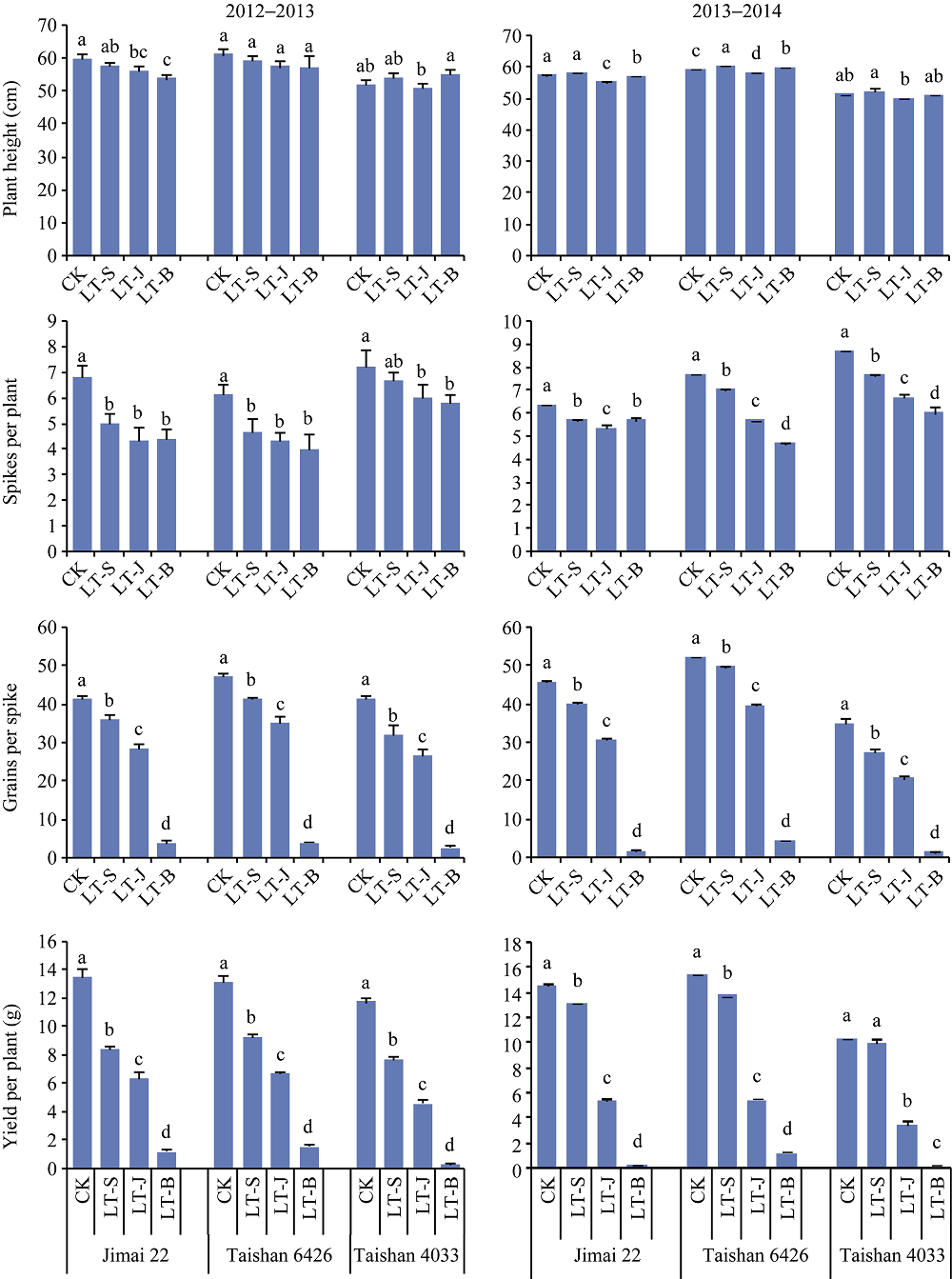
黄淮麦区频发春季低温冻害, 造成小麦减产。为探讨小麦品种对春季低温胁迫响应的生理特点, 确定品种抗寒性鉴定的生理指标, 以泰山6426、泰山4033和济麦22为试验材料, 研究了起身期、拔节期和孕穗期低温处理下不同品种的产量性状、光合生理指标及叶片细胞结构差异。3个品种受低温胁迫后, 观测农艺性状的变化趋势相似, 且年度间有一定的一致性。不同低温处理对株高的影响相对较小, 尤其是起身期低温处理; 不同生育期低温处理, 小麦单株穗数均显著低于对照, 但下降幅度在年度间不完全一致; 单株穗粒数和单株产量随低温处理的推迟呈现显著降低趋势, 尤以孕穗期低温处理的降低幅度最大, 单株穗粒数比对照低90.5%~93.3% (2012—2013)和91.9%~96.6% (2013—2014), 单株产量比对照低87.9%~97.3% (2012—2013)和91.5%~97.8% (2013—2014); 拔节期是低温伤害的第二敏感期, 而起身期低温对小麦产量的影响相对最小。减产的主要原因是穗粒数降低。无论是拔节期还是孕穗期低温处理, 3个品种的叶绿素含量均呈现下降趋势, 下降的幅度因品种而异; 低温胁迫下光合速率、蒸腾速率和叶片气孔导度均显著下降, 胞间CO2浓度均有较大幅度的升高, 3个品种中泰山6426受影响最小。低温胁迫对叶绿素荧光参数也有明显影响, 除泰山6426外, 其余2个品种的Fv/Fm均显著下降。各品种受低温伤害后表皮叶肉细胞破坏严重, 排列趋于松散, 保卫细胞和副卫细胞变形, 气孔变大。本研究结果显示, 光合速率、蒸腾速率、叶片气孔导度、胞间CO2浓度及Fv/Fm可作为评价品种春季抗寒性的生理指标。
| [1] | Fang S B, Yang J J, Zhou G S.Change trend distributive characteristics of agrometeorological disasters in China in recent 30 years.J Nat Dis, 2011, 20: 69-73 |
| [2] | Wang J F, Zhu Y Y, Liu H P.Main agrometeorological disasters and their impact in recent 28 years in Henan.Meteorol Environ Sci, 2007, 30: 9-11 |
| [3] | Cao H M, Shi Z M, Zhou X B, Lei P Z, Dong S G.A review on response of plant to low temperature and its cold resistance.Chin J Agrometeorol, 2010, 31: 310-314 |
| [4] | Gana J A, Sutton F, Kenefick D G. cDNA structure and expression patterns of a low-temperature-specific wheat genetacr7. Plant Mol Biol, 1997, 34: 643-650 |
| [5] | Minami A, Nagao M, Ikegami K, Koshiba T, Arakawa K, Fujikawa S, Takezawa D.Cold acclimation in bryophytes: low- temperature- induced freezing tolerance inPhyscomitrella patens is associated with increases in expression levels of stress-related genes but not with increase in level of endogenous abscisic acid. Planta, 2005, 220: 414-423 |
| [6] | 刘艳阳, 李俊周, 陈磊, 崔党群. 低温胁迫对小麦叶片细胞膜脂质过氧化产物及相关酶活性的影响. 麦类作物学报, 2006, 26(4): 70-73 |
| Liu Y Y, Li J Z, Chen L, Cui D Q.Effect of low temperature stress on peroxidation product of membrane lipids and activity of related enzymes in wheat seeding leaves.J Triticeae Crops, 2006, 26(4): 70-73 (in Chinese with English abstract) | |
| [7] | 姜丽娜, 张黛静, 宋飞, 刘佩, 樊婷婷, 余海波, 李春喜. 不同品种小麦叶片对拔节期低温的生理响应及抗寒性评价. 生态学报, 2014, 34: 4251-4261 |
| Jiang L N, Zhang D J, Song F, Liu P, Fan T T, Yu H B, Li C X.Evaluation of cold resistance of different wheat varieties based on physiological responses of leaves to low temperature at the jointing stage.Acta Ecol Sin, 2014, 34: 4251-4261 (in Chinese with English abstract) | |
| [8] | 张志伟, 王法宏, 李升东, 冯波, 司纪升, 张宾. 不同类型小麦品种孕穗期低温生理反应及其抗寒性分析.麦类作物学报, 2012, 32: 900-906 |
| Zhang Z W, Wang F H, Li S D, Feng B, Si J S, Zhang B.Analysis on physiological reaction to low temperature at booting stage and their cold resistance of different types of wheat varieties.J Triticeae Crops, 2012, 32: 900-906 (in Chinese with English abstract) | |
| [9] | 张军, 鲁敏, 孙树贵, 杜万里, 刘洋, 武军, 陈新宏. 拔节期低温胁迫对小麦生理生化特性和产量的影响. 西北农业学报, 2014, 23(02): 73-79 |
| Zhang J, Lu M, Sun S G, Du W L, Liu Y, Wu J, Chen X H.Changes of physiological and biochemical parameters and grain yield at joining stage of wheat under low temperature stress.Acta Agric Boreali-Occident Sin, 2014, 23(02): 73-79 (in Chinese with English abstract) | |
| [10] | 孙金月, 赵玉田, 梁博文, 刘方, 尤勇. HRGP在小麦抗寒锻炼过程中的变化及其与抗寒性的关系. 植物遗传资源学报, 2004, 5: 6-11 |
| Sun J Y, Zhao Y T, Liang B W, Liu F, You Y.Changes of hydroxyproline-rich glyco-protein wheat under cold stress and its relationship to cold resistance. Plant Genet Resour, 2004, 5: 6-11 (in Chinese with English abstract) | |
| [11] | Equiza M A.Morphological, anatomical and physiological responses related to differential shoot vs. root growth inhibition at low temperature in spring and winter wheat.Ann Bot, 2001, 87: 67-76 |
| [12] | 刘艳阳, 李俊周, 陈磊, 崔党群. 低温胁迫对小麦叶片细胞膜脂质过氧化产物及相关酶活性的影响. 麦类作物学报, 2006, 26(4): 70-73 |
| Liu Y Y, Li J Z, Chen L, Cui D Q.Effect of low temperature stress on peroxidation product of membrane lipids and activity of related enzymes in wheat seed-ling leaves. J Triticeae Crops, 2006, 26(4): 70-73 (in Chinese with English abstract) | |
| [13] | Bohn M, Luthje S.Plasma membrane lipid alterations induced by cold acclimation and abscisic acid treatment of winter wheat seedlings differing in frost resistance.J Plant Physiol, 2007, 164: 146-156 |
| [14] | 刘炜, 孙德兰, 王红, 简令成, 张可夫. 2°C低温下抗寒冬小麦与冷敏感春小麦幼苗细胞质膜Ca2+-ATPase活性比较. 作物学报, 2002, 28: 227-229 |
| Liu W, Sun D L, Wang H, Jian L C, Zhao K F.Comparison of Ca2+-ATPase activity in seedling plasmolemma of cold resistant winter wheat vs. cold-sensitive spring wheat under 2°C low temperature.Acta Agron Sin, 2002, 28: 227-229 (in Chinese with English abstract) | |
| [15] | 蒋高明. 植物生理生态学. 北京: 高等教育出版社, 2004. pp 46-53 |
| Jiang G M. Plant Ecophysiology.Beijing: Higher Education Press, 2004. pp 46-53 (in Chinese) | |
| [16] | Genty B, Briantais J M, Baker N R.The relationship between the quantum yield of photosynthetic electron transport and quenching of chlorophyll fluorescence.Biochim Biophys Acta, 1989, 99: 87-92 |
| [17] | Schreiber U, Bilger W, Neubauer C.Chlorophyll fluorescence as a non-destructive indicator for rapid assessment of in vivo photo- synthesis.Ecol Studies, 1994, 100: 49-70 |
| [18] | Krause G H, Weis E.Chlorophyll fluorescence and photosynthesis: the basis. Annu Rev Plant Physiol Plant Mol Biol, 1991, 42: 313-349 |
| [19] | Van Kooten O, Snel J F.The use of chlorophyll fluorescence nomenclature in plant stress physiology.Photosynth Res, 1990, 25: 147-150 |
| [20] | 王晓楠, 付连双, 李卓夫, 杨方, 孙艳丽, 刘灿, 王金伟, 陈禹兴. 低温驯化及封冻阶段不同冬小麦品种叶绿素荧光参数的比较. 麦类作物学报, 2009, 29: 83-88 |
| Wang X N, Fu L S, Li Z F, Yang F, Sun Y L, Liu C, Wang J W, Chen Y X.Comparison of chlorophyll fluorescence parameters between two winter wheat cultivars during cold acclimation and frozen period.J Triticeae Crops, 2009, 29: 83-88 (in Chinese with English abstract) | |
| [21] | 高艳, 唐建卫, 殷贵鸿, 韩玉林, 黄峰, 王丽娜. 倒春寒发生时期和次数对冬小麦产量性状的影响. 麦类作物学报, 2015, 35: 687-692 |
| Gao Y, Tang J W, Yin G H, Han Y L, Huang F, Wang L N.Effect of different periods and frequency of late spring coldness on winter wheat yield related traits.J Triticeae Crops, 2015, 35: 687-692 (in Chinese with English abstract) | |
| [22] | 王树刚, 王振林, 王平, 王海伟, 黄玮, 武玉国, 尹燕枰. 基于生理指标与籽粒产量关系的小麦品种抗冻性分析. 应用生态学报, 2011, 22: 1477-1484 |
| Wang S G, Wang Z L, Wang P, Wang H W, Huang W, Wu Y G, Yin Y P.Freeze resistance analysis of different wheat cultivars based on relationships between physiological indices and grain yield. Chin J Appl Ecol, 2011, 22: 1477-1484 (in Chinese with English abstract) | |
| [23] | Fracheboud Y, Haldimann P, Leipner J, Stamp P.Chlorophyll fluorescence as a selection tool for cold tolerance of photosynthesis in maize.J Exp Bot, 1999, 50: 1533-1540 |
| [24] | Xu C C, Zhang J H.Effect of drought on chlorophyll fluorescence and xanthophylls cycle components in winter wheat leaves with different ages. Acta Phytophysiol Sin, 1999, 25: 29-37 |
| [25] | Kratsh H A, Wise R R.The ultrastructure of chilling stress.Plant Cell Environ, 2000, 23: 337-350 |
| [26] | 陈思思, 李春燕, 杨景, 徐雯, 朱新开, 郭文善, 封超年. 拔节期低温冻害对扬麦16光合特性及产量形成的影响. 扬州大学学报(农业与生命科学版), 2014, 35(3): 59-64 |
| Chen S S, Li C Y, Yang J, Xu W, Zhu X K, Guo W S, Feng C N.Effect of low temperature at jointing stage on photosynthetic characteristics and yield in wheat cultivar Yangmai 16. J Yangzhou Univ (Agric Life Sci Edn), 2014, 35(3): 59-64 (in Chinese with English abstract) | |
| [27] | 简令成. 植物抗寒机理研究的新进展. 植物学通报, 1992, 9(3): 17-22 |
| Jian L C.Advance of the studies on the mechanism of plant cold hardiness.Chin Bull Bot, 1992, 9(3): 17-22 (in Chinese with English abstract) |
| [1] | 胡文静, 李东升, 裔新, 张春梅, 张勇. 小麦穗部性状和株高的QTL定位及育种标记开发和验证[J]. 作物学报, 2022, 48(6): 1346-1356. |
| [2] | 王丹, 周宝元, 马玮, 葛均筑, 丁在松, 李从锋, 赵明. 长江中游双季玉米种植模式周年气候资源分配与利用特征[J]. 作物学报, 2022, 48(6): 1437-1450. |
| [3] | 王旺年, 葛均筑, 杨海昌, 阴法庭, 黄太利, 蒯婕, 王晶, 汪波, 周广生, 傅廷栋. 大田作物在不同盐碱地的饲料价值评价[J]. 作物学报, 2022, 48(6): 1451-1462. |
| [4] | 颜佳倩, 顾逸彪, 薛张逸, 周天阳, 葛芊芊, 张耗, 刘立军, 王志琴, 顾骏飞, 杨建昌, 周振玲, 徐大勇. 耐盐性不同水稻品种对盐胁迫的响应差异及其机制[J]. 作物学报, 2022, 48(6): 1463-1475. |
| [5] | 杨欢, 周颖, 陈平, 杜青, 郑本川, 蒲甜, 温晶, 杨文钰, 雍太文. 玉米-豆科作物带状间套作对养分吸收利用及产量优势的影响[J]. 作物学报, 2022, 48(6): 1476-1487. |
| [6] | 陈静, 任佰朝, 赵斌, 刘鹏, 张吉旺. 叶面喷施甜菜碱对不同播期夏玉米产量形成及抗氧化能力的调控[J]. 作物学报, 2022, 48(6): 1502-1515. |
| [7] | 李祎君, 吕厚荃. 气候变化背景下农业气象灾害对东北地区春玉米产量影响[J]. 作物学报, 2022, 48(6): 1537-1545. |
| [8] | 郭星宇, 刘朋召, 王瑞, 王小利, 李军. 旱地冬小麦产量、氮肥利用率及土壤氮素平衡对降水年型与施氮量的响应[J]. 作物学报, 2022, 48(5): 1262-1272. |
| [9] | 石艳艳, 马志花, 吴春花, 周永瑾, 李荣. 垄作沟覆地膜对旱地马铃薯光合特性及产量形成的影响[J]. 作物学报, 2022, 48(5): 1288-1297. |
| [10] | 闫晓宇, 郭文君, 秦都林, 王双磊, 聂军军, 赵娜, 祁杰, 宋宪亮, 毛丽丽, 孙学振. 滨海盐碱地棉花秸秆还田和深松对棉花干物质积累、养分吸收及产量的影响[J]. 作物学报, 2022, 48(5): 1235-1247. |
| [11] | 柯健, 陈婷婷, 吴周, 朱铁忠, 孙杰, 何海兵, 尤翠翠, 朱德泉, 武立权. 沿江双季稻北缘区晚稻适宜品种类型及高产群体特征[J]. 作物学报, 2022, 48(4): 1005-1016. |
| [12] | 冯亚, 朱熙, 罗红玉, 李世贵, 张宁, 司怀军. 马铃薯StMAPK4响应低温胁迫的功能解析[J]. 作物学报, 2022, 48(4): 896-907. |
| [13] | 李瑞东, 尹阳阳, 宋雯雯, 武婷婷, 孙石, 韩天富, 徐彩龙, 吴存祥, 胡水秀. 增密对不同分枝类型大豆品种同化物积累和产量的影响[J]. 作物学报, 2022, 48(4): 942-951. |
| [14] | 王吕, 崔月贞, 吴玉红, 郝兴顺, 张春辉, 王俊义, 刘怡欣, 李小刚, 秦宇航. 绿肥稻秆协同还田下氮肥减量的增产和培肥短期效应[J]. 作物学报, 2022, 48(4): 952-961. |
| [15] | 杜浩, 程玉汉, 李泰, 侯智红, 黎永力, 南海洋, 董利东, 刘宝辉, 程群. 利用Ln位点进行分子设计提高大豆单荚粒数[J]. 作物学报, 2022, 48(3): 565-571. |
|
||