欢迎访问作物学报,今天是
作物学报 ›› 2019, Vol. 45 ›› Issue (7): 1059-1069.doi: 10.3724/SP.J.1006.2019.84162
赵文超1,2,杜明伟1,黎芳1,田晓莉1,*( ),李召虎1
ZHAO Wen-Chao1,2,DU Ming-Wei1,LI Fang1,TIAN Xiao-Li1,*(),LI Zhao-Hu1
摘要:
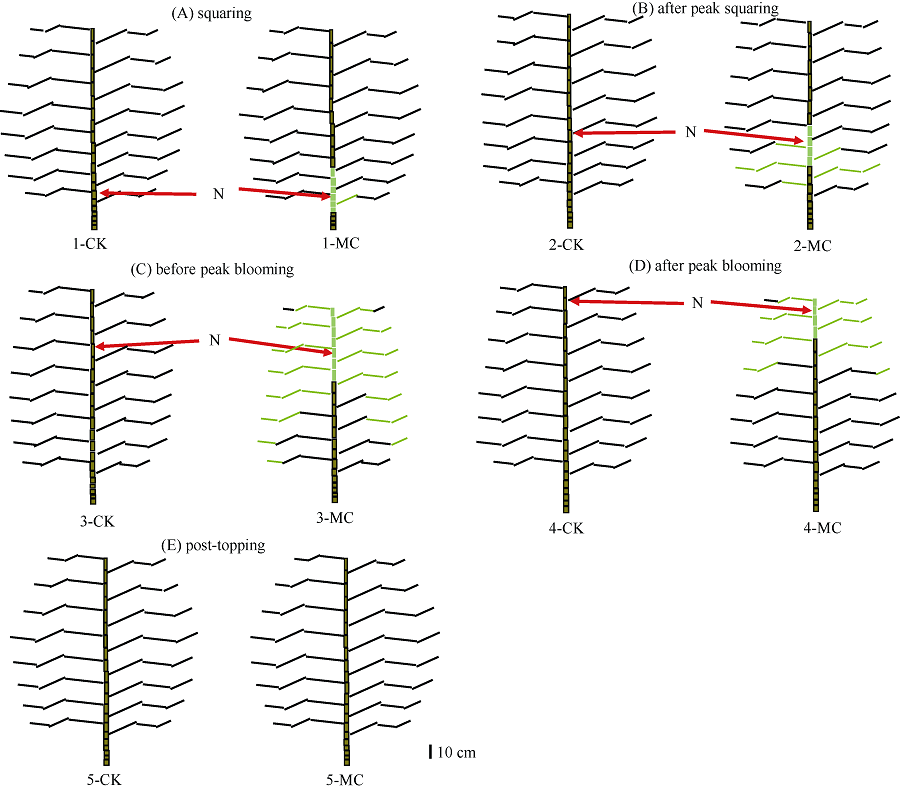
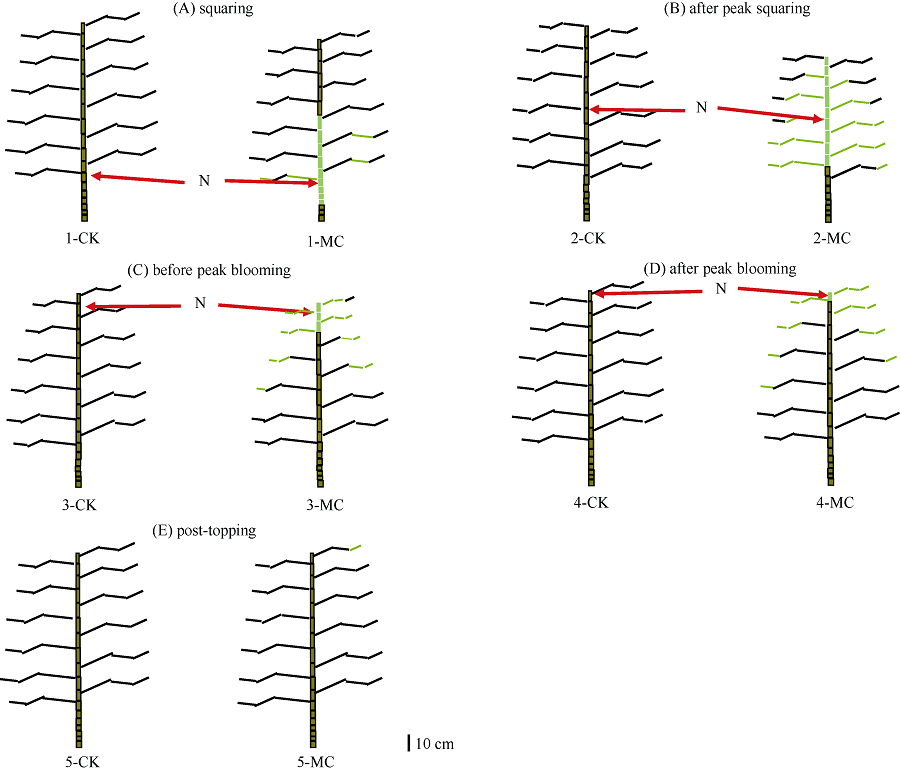
缩节安(1,1-dimethyl piperidinium chloride, DPC)是棉花生产中广泛应用的植物生长延缓剂, 其调控棉花茎枝生长的定位定量效应尚缺乏系统的量化研究。本研究2013—2014年在田间条件下分别于棉花现蕾期、盛蕾期后、盛花期前、盛花期后和打顶后单次应用不同剂量的DPC, 测量了DPC作用有效期内的棉花株高和主茎生长速率, 探究了所有主茎节间及所有果节对DPC的响应。结果表明, DPC处理对棉花主茎节间的影响范围为N节(应用DPC时的主茎节)以下1~4个和N节以上0~6个(打顶条件下), 对果枝的影响范围为N节以下1~11个和N节以上0~5个, 其中N节以下果枝受影响的果节多于N节以上果枝。将盛蕾期后和盛花期前2次应用DPC的效应叠加, 其影响范围几乎可以覆盖全部主茎节间(果枝始节以上)和全部果节。DPC应用剂量与其作用强度并不总存在较好的线性关系。DPC的定位定量效应除了与应用时间和剂量有关, 还受到温度、降水等环境条件和棉株生物量、源库关系的影响。
| [1] | 李丕明, 奚惠达, 何钟佩, 韩碧文 . 农作物化控栽培工程技术的发展与中国农业现代化前景. 北京农业大学学报, 1991,17(增刊):1-5. |
| Li P M, Xi H D, He Z P, Han B W . The engineering development of chemically-manipulated crop culture in relation to the prospect of agricultural modernization in china. Acta Agric Univ Pekinensis, 1991,17(suppl.):1-5 (in Chinese with English abstract). | |
| [2] |
Rademacher W . Growth retardants: effects on gibberellin biosynthesis and other metabolic pathways. Annu Rev Plant Physiol Plant Mol Biol, 2000,51:501-531.
doi: 10.1146/annurev.arplant.51.1.501 |
| [3] |
York A C . Cotton cultivar response to mepiquat chloride. Agron J, 1983,75:663-667.
doi: 10.2134/agronj1983.00021962007500040020x |
| [4] |
York A C . Response of cotton to mepiquat chloride with varying N rates and plant populations. Agron J, 1983,75:667-672.
doi: 10.2134/agronj1983.00021962007500040021x |
| [5] | 何钟佩, 奚惠达, 杨秉芳, 李丕明, 韩碧文 . DPC效应的定向、定量诱导及其在棉花丰产栽培中的应用. 北京农业大学学报, 1984,10(1):19-28. |
| He Z P, Xi H D, Yang B F, Li P M, Han B W . The key to get good yield of cotton by inducing the response to DPC towards a planned direction and in planned strength. Acta Agric Univ Pekinensis, 1984,10(1):19-28 (in Chinese with English abstract). | |
| [6] | 何钟佩, 李丕明, 奚惠达, 李召虎, 白玉良 . DPC化控技术在棉花上的应用和发展~从防止徒长到系统的定向诱导. 北京农业大学学报, 1991,17(增刊):58-63. |
| He Z P, Li P M, Xi H D, Li Z H, Bai Y L . The using and development of DPC chemical controlling technique in cotton culture. Acta Agric Univ Pekinensis, 1991,17(suppl.):58-63 (in Chinese with English abstract). | |
| [7] |
Zhao D, Oosterhuis D M . Pix plus and mepiquat chloride effects on physiology, growth, and yield of field-grown cotton. J Plant Growth Regul, 2000,19:415-422.
doi: 10.1007/s003440000018 |
| [8] | Pettigrew W T, Johnson J T . Effects of different seeding rates and plant growth regulators on early planted cotton. J Cotton Sci, 2005,9:189-198. |
| [9] |
Kerby T A . Cotton response to mepiquat chloride. Agron J, 1985,77:515-518.
doi: 10.2134/agronj1985.00021962007700040003x |
| [10] |
Reddy V R, Baker D N, Hodges H F . Temperature and mepiquat chloride effects on cotton canopy architecture. Agron J, 1990,82:190-195.
doi: 10.2134/agronj1990.00021962008200020004x |
| [11] | Gwathmey C O, Craig Jr C C . Managing earliness in cotton with mepiquat type growth regulators. Crop Manag, 2003,12:1-8. |
| [12] |
Siebert J D, Stewart A M . Influence of plant density on cotton response to mepiquat chloride application. Agron J, 2006,98:1634-1639.
doi: 10.2134/agronj2006.0083 |
| [13] | 何钟佩, 陈洪战, 李丕明, 李召虎 . DPC调控棉花氮素追肥时期的复合效应研究. 北京农业大学学报, 1991,17(增刊):31-37. |
| He Z P, Chen H Z, Li P M, Li Z H . Studies on the complex response of applying nitrogen at different stage under DPC control. Acta Agric Univ Pekinensis, 1991,17(suppl.):31-37 (in Chinese with English abstract). | |
| [14] | 李丕明, 何钟佩, 李召虎 . 棉花应用缩节安(DPC)化控技术研究概况与进展. 作物杂志, 1991, ( 2):1-3. |
| Li P M, He Z P, Li Z H . Outline and progression about the study of DPC chemical control on cotton. Crops, 1991, ( 2):1-3 (in Chinese). | |
| [15] |
Ren X M, Zhang L Z, Du M W, Evers J B, van der Werf W, Tian X L, Li Z H . Managing mepiquat chloride and plant density for optimal yield and quality of cotton. Field Crops Res, 2013,149:1-10.
doi: 10.1016/j.fcr.2013.04.014 |
| [16] |
Yang F Q, Du M W, Tian X L, Eneji A E, Duan L S, Li Z H . Plant growth regulation enhanced potassium uptake and use efficiency in cotton. Field Crops Res, 2014,163:109-118.
doi: 10.1016/j.fcr.2014.03.016 |
| [17] | Wilson Jr D G, York A C, Edmisten K L . Narrow-row cotton response to mepiquat chloride. J Cotton Sci, 2007,11:177-185. |
| [18] |
Biles S P, Cothren J T . Flowering and yield response of cotton to application of mepiquat chloride and PGR-IV. Crop Sci, 2001,41:1834-1837.
doi: 10.2135/cropsci2001.1834 |
| [19] |
McConnell J S, Baker W H, Frizzell B S, Varvil J J . Response of cotton to nitrogen fertilization and early multiple applications of mepiquat chloride. J Plant Nutr, 1992,15:457-468.
doi: 10.1080/01904169209364333 |
| [20] |
Reddy V R, Trent A, Acock B . Mepiquat chloride and irrigation versus cotton growth and development. Agron J, 1992,84:930-933.
doi: 10.2134/agronj1992.00021962008400060004x |
| [21] | Nichols S P, Snipes C E, Jones M A . Evaluation of row spacing and mepiquat chloride in cotton. J Cotton Sci, 2003,7:148-155. |
| [22] | Alkuddsi Y, Patil S S, Manjula S M, Patil B C, Nadaf H L, Nandihali B S . Association analysis of seed cotton yield components and physiological parameters in derived F1 inter specific crosses of cotton. Bioscience Methods, 2013,4(5):23-33. |
| [23] | Baloch M J, Khan N U, Rajput M A, Jatoi W A, Gul S, Rind I H, Veesar N F . Yield related morphological measures of short duration cotton genotypes. J Anim Plant Sci, 2014,24:1198-1211. |
| [24] | 任晓明 . 黄淮海棉区适宜机械采收棉田的种植密度和化学调控技术研究. 中国农业大学博士学位论文,北京, 2013. |
| Ren X M . Managing Plant Density and Chemical Chontrol for Mechanical Harvesting in the Yellow River Valley. PhD Dissertation of China Agricultural University, Beijing, China, 2013 (in Chinese with English abstract) . | |
| [25] | 中国农业科学院棉花研究所. 中国棉花栽培学. 上海: 上海科学技术出版社, 2013. pp 125-185. |
| Cotton Research Institute Chinese Academy of Agricultural Sciences. Cultivation of Cotton in China. Shanghai: Shanghai Scientific and Technical Publishers, 2013. pp 125-185(in Chinese). | |
| [26] | Kerby T A, Bourland F M, Hake K D. Physiological rationales in plant monitoring and mapping. In: Stewart J M, Oosterhuis D M, Heitholt J J, Mauney J R, eds. Physiology of Cotton. New York: Springer, 2010. pp 304-317. |
| [27] |
Reddy A R, Reddy K R, Hodges H F . Mepiquat chloride (PIX)- induced changes in photosynthesis and growth of cotton. Plant Growth Regul, 1996,20:179-183.
doi: 10.1007/BF00043305 |
| [28] |
Rosolem C A, Oosterhuis D M, Souza F S D . Cotton response to mepiquat chloride and temperature. Sci Agric, 2013,70:82-87.
doi: 10.1590/S0103-90162013000200004 |
| [29] |
Yeates S J, Constable G A, McCumstie T . Developing management options for mepiquat chloride in tropical winter season cotton. Field Crops Res, 2002,74:217-230.
doi: 10.1016/S0378-4290(02)00005-9 |
| [30] | Hodges H F, Reddy V R, Reddy K R . Mepiquat chloride and temperature effects on photosynthesis and respiration of fruiting cotton. Crop Sci, 1991,31:1301-1308. |
| [31] | Guthrie D, Landivar J, Munier D, Stichler C, Weir B. Pix application strategies. Memphis, TN: National Cotton Council of America, 1995[ 2018-12-26]. |
| [32] | Landivar J A, Zypman S, Lawlor D J, Vasek J, Crenshaw C. The use of an estimated plant Pix concentration for the determination of timing and rate of application. In: Herber D J, Richter D A, eds. 1992 Beltwide Cotton Conference. Memphis, TN: National Cotton Council of America, 1992. pp 1047-1049. |
| [33] | Livingston S D, Stichler C R, Landivar J A. Using mepiquat chloride on the Texas Coast to reduce cotton plant height. Texas: The Texas A&M University Sytem, 1996[ 2018-12-26]. |
| [34] | 赵文超 . 黄河流域棉区棉花缩节安(DPC)定位定量及与其他因素的互作效应的研究. 中国农业大学博士学位论文, 北京, 2017. |
| Zhao W C . Study on Location Detection and Quantitative Effect of Mepiquat Chloride and Its Interaction with Other Factors on Cotton in the Yellow River Valley of China. PhD Dissertation of China Agricultural University, Beijing, China, 2017 (in Chinese with English abstract). |
| [1] | 赵佳雪, 周龙昊, 郭岂源, 尚伦霄, 王涵, 刘志涛, 陈曦, 张晓佩, 宋宪亮, 毛丽丽. 长期秸秆还田与深松通过改善土壤环境与棉花光合特性提高滨海盐碱地棉花产量[J]. 作物学报, 2026, 52(5): 1548-1560. |
| [2] | 张曦, 王广恩, 李邵琦, 刘祎, 李俊兰, 钱玉源. 基于转录组测序解析陆海杂交姊妹系马克隆值差异的形成机制[J]. 作物学报, 2026, 52(5): 1442-1458. |
| [3] | 周琦翔, 朱艳, 汪楚博, 朱柏林, 李俊博, 宋利兵. 基于DSSAT模型模拟气候变化对新疆棉花物候期及产量的影响[J]. 作物学报, 2026, 52(2): 590-602. |
| [4] | 郭栋财, 吕涛, 蔡永生, 买吾鲁达·艾合买提, 全家, 曲延英, 郑凯. 棉花纤维品质相关性状QTL元分析及候选基因鉴定[J]. 作物学报, 2025, 51(6): 1445-1466. |
| [5] | 王亚雯, 戚正阳, 尤佳琦, 聂新辉, 曹娟, 杨细燕, 涂礼莉, 张献龙, 王茂军. 棉花60K功能位点基因芯片的制备及应用[J]. 作物学报, 2025, 51(5): 1178-1188. |
| [6] | 赵斐斐, 李少雄, 刘浩, 李海芬, 王润风, 黄璐, 余倩霞, 洪彦彬, 陈小平, 鲁清, 曹玉曼. 花生主茎节间和侧枝节间长度的关联作图及候选基因分析[J]. 作物学报, 2025, 51(2): 548-556. |
| [7] | 丁俊沣, 许映飞, 张祥, 陈媛, 陈德华. 生长调节剂吲哚丁酸对移栽棉苗成活及生长发育的影响[J]. 作物学报, 2025, 51(12): 3331-3341. |
| [8] | 哈丽哈什·依巴提, 张炎, 李青军, 徐新朋, 何萍. 基于产量反应和农学效率的棉花智能化推荐施肥方法研究[J]. 作物学报, 2025, 51(11): 3052-3064. |
| [9] | 李亚玮, 徐盈盈, 左春阳, 刘若男, 梁亚军, 孔杰, 张献龙, 闵玲. 棉花减数分裂进程鉴定体系构建及其对高温胁迫的响应分析[J]. 作物学报, 2025, 51(10): 2570-2580. |
| [10] | 陈佳伟, 林艳, 张明星, 周诗晶, 饶力群, 周池, 李鑫. 贝莱斯芽孢杆菌YCH92对棉花根际土壤微生物群落及棉花产量的影响[J]. 作物学报, 2025, 51(10): 2821-2835. |
| [11] | 谢章书, 谢学方, 屠小菊, 刘爱玉, 董合忠, 周仲华. 植物激素对棉花蕾铃脱落的调控研究进展[J]. 作物学报, 2025, 51(1): 1-29. |
| [12] | 辛明华, 秘雅迪, 王国平, 李小飞, 李亚兵, 董合林, 韩迎春, 冯璐. 行距配置和种植密度对棉花干物质生产及产量的影响[J]. 作物学报, 2025, 51(1): 221-232. |
| [13] | 李超, 付小琼. 基于GYT双标图综合评价黄河流域中熟杂交棉花区域试验品种[J]. 作物学报, 2025, 51(1): 30-43. |
| [14] | 艾莎, 李莎, 方治伟, 李论, 李甜甜, 高利芬, 陈利红, 肖华锋, 万人静, 闫多子, 武星廷, 彭海, 韩瑞玺, 周俊飞. 棉花MNP标记位点开发及其在DNA指纹图谱构建中的应用[J]. 作物学报, 2024, 50(9): 2267-2278. |
| [15] | 李航, 刘丽, 黄乾, 刘文豪, 司爱君, 孔宪辉, 王旭文, 赵福相, 梅拥军, 余渝. 棉花种质资源萌发期耐盐性鉴定及筛选[J]. 作物学报, 2024, 50(5): 1147-1157. |
|
||