欢迎访问作物学报,今天是
作物学报 ›› 2021, Vol. 47 ›› Issue (5): 807-813.doi: 10.3724/SP.J.1006.2021.03039
葛敏( ), 王元琮, 宁丽华, 胡梦梅, 石习, 赵涵*()
GE Min(), WANG Yuan-Cong, NING Li-Hua, HU Meng-Mei, SHI Xi, ZHAO Han*()
摘要:
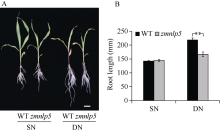
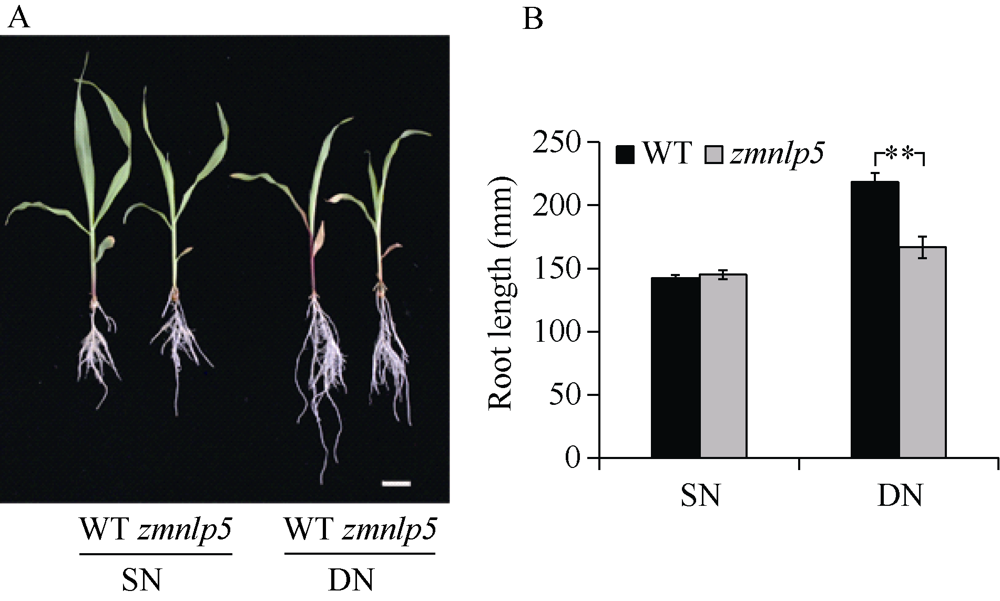
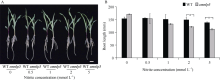
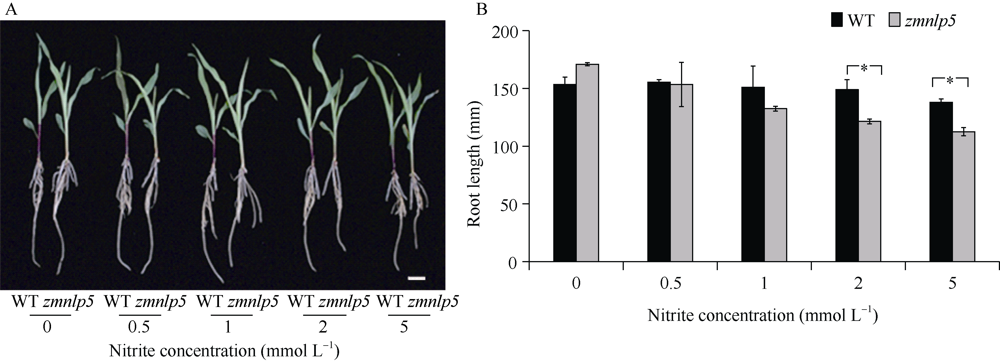
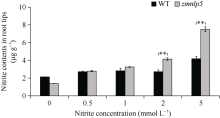
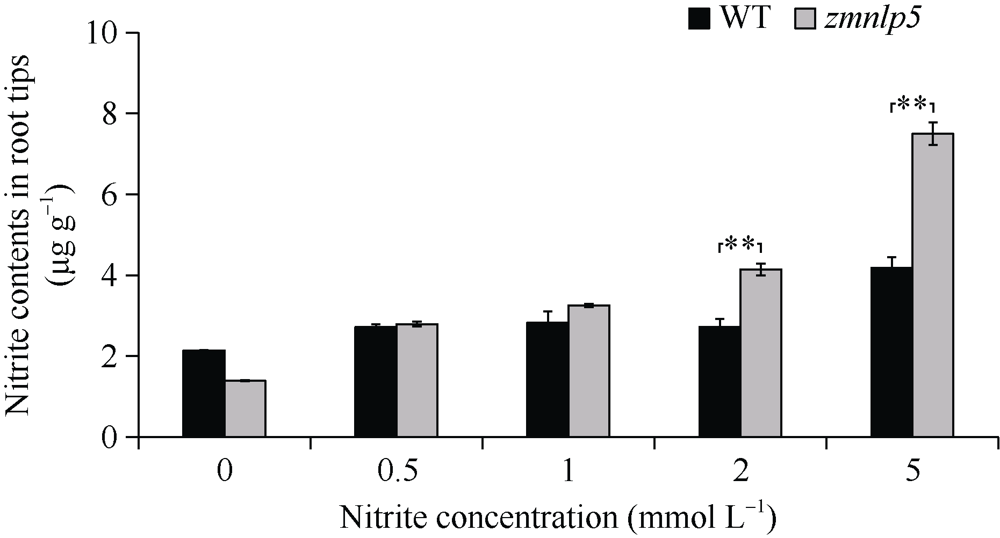
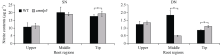
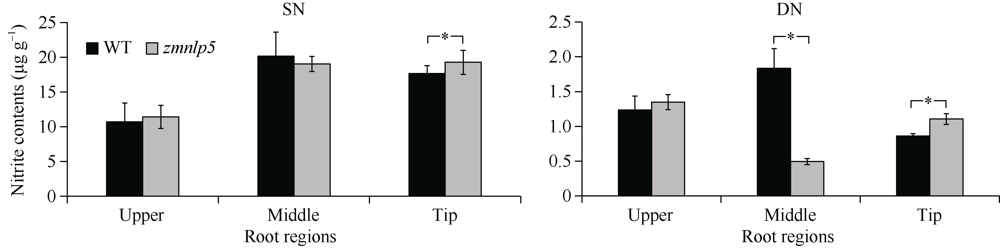
研究作物氮高效机制并挖掘利用其中重要的调控基因, 对我国农业绿色发展具有重要意义。前期我们发现氮响应转录因子ZmNLP5调控亚硝酸还原酶基因的表达, 对玉米氮素吸收利用具有促进作用, 但其调控机制尚未明确。基于此, 本研究以ZmNLP5基因突变体(zmnlp5)和野生型(WT)植株为研究材料, 深入解析ZmNLP5影响玉米氮素吸收利用的生理机制。足氮(sufficient nitrogen, SN)和低氮(deficient nitrogen, DN)条件下研究材料表型分析发现, DN条件下相对于WT植株, zmnlp5植株根长显著降低。根部不同区域ZmNLP5表达量分析发现, ZmNLP5主要在根尖区域表达。不同亚硝酸盐浓度处理下, 研究材料的根长和根尖区域亚硝酸盐含量分析发现, 当亚硝酸盐的浓度高于2 mmol L-1时, zmnlp5突变体根长相对于WT显著降低, zmnlp5植株根尖区域亚硝酸盐积累量显著高于WT。SN和DN条件下研究材料根部亚硝酸盐含量检测发现, DN条件zmnlp5植株根尖区域所积累的亚硝酸盐也显著高于WT。综上所述, 转录因子ZmNLP5在玉米植株响应低氮环境根部伸长生长中发挥重要功能, 该结果为玉米氮高效育种提供了一定的理论基础。
| [1] | Gutierrez R A. Systems biology for enhanced plant nitrogen nutrition. Science, 2012,336:1673-1675. |
| [2] | Guana P Z, Ripolla J J, Wang R H, Vuong L, Bailey-Steinitz L J, Ye D, Crawford N M. Interacting TCP and NLP transcription factors control plant responses to nitrate availability. Proc Natl Acad Sci USA, 2017,114:2419-2424. |
| [3] | Bi Y M, Meyer A, Downs G S, Shi X, El-Kereamy A, Lukens L, Rothstein S J. High throughput RNA sequencing of a hybrid maize and its parents shows different mechanisms responsive to nitrogen limitation. BMC Genom, 2014,15:77. |
| [4] | Humbert S, Subedi S, Cohn J, Zeng B, Bi Y M, Chen X, Zhu T, McNicholas P D, Rothstein S J. Genome-wide expression profiling of maize in response to individual and combined water and nitrogen stresses. BMC Genom, 2013,14:3. |
| [5] | Xu G, Fan X, Miller A J. Plant nitrogen assimilation and use efficiency. Annu Rev Plant Biol, 2012,63:153-182. |
| [6] | Crawford N M. Nitrate: nutrient and signal for plant growth. Plant Cell, 1995,7:859-868. |
| [7] | Crawford N M, Forde B G. Molecular and developmental biology of inorganic nitrogen nutrition. Arabid Book, 2002,1:e0011. |
| [8] | Moose S, Below F E. Biotechnology approaches to improving maize nitrogen use efficiency. In: Kriz A, Larkins B, eds. Molecular Genetic Approaches to Maize Improvement. Biotechnology in Agriculture and Forestry, Springer, Berlin, Heidelberg, 2009. pp 65-77. |
| [9] | Ueda Y, Konishi M, Yanagisawa S. Molecular basis of the nitrogen response in plants. Soil Sci Plant Nutr, 2017,63:329-341. |
| [10] | Yu P, Eggert K, von Wirén N, Li C J, Hochholdinger F. Cell type-specific gene expression analyses by RNA sequencing reveal local high nitrate-triggered lateral root initiation in shoot-borne roots of maize by modulating auxin-related cell cycle regulation. Plant Physiol, 2015,169:690. |
| [11] | Trevisan S, Manoli A, Ravazzolo L, Botton A, Pivato M, Masi A, Quaggiotti S. Nitrate sensing by the maize root apex transition zone: a merged transcriptomic and proteomic survey. J Exp Bot, 2015,66:3699-3715. |
| [12] | Gutierrez R A, Stokes T L, Thum K, Xu X, Obertello M, Katari M S, Tanurdzic M, Dean A, Nero D C, McClung C R, Coruzzi G M. Systems approach identifies an organic nitrogen- responsive gene network that is regulated by the master clock control gene CCA1. Proc Natl Acad Sci USA, 2008,105:4939-4944. |
| [13] | Rubin G, Tohge T, Matsuda F, Saito K, Scheible W R. Members of the LBD family of transcription factors repress anthocyanin synthesis and affect additional nitrogen responses in Arabidopsis. Plant Cell, 2009,21:3567-3584. |
| [14] | Marchive C, Roudier F, Castaings L, Brehaut V, Blondet E, Colot V, Meyer C, Krapp A. Nuclear retention of the transcription factor NLP7 orchestrates the early response to nitrate in plants. Nat Commun, 2013,4:1713. |
| [15] | Ge M, Liu Y H, Jiang L, Wang Y C, Lyu Y D, Zhou L, Liang S Q, Bao H B, Zhao H. Genome-wide analysis of maize NLP transcription factor family revealed the roles in nitrogen response. Plant Growth Regul, 2018,84:95-105. |
| [16] | Konishi M, Yanagisawa S. Identification of a nitrate-responsive cis-element in the Arabidopsis NIR1 promoter defines the presence of multiple cis-regulatory elements for nitrogen response. Plant J, 2010,63:269-282. |
| [17] | Ge M, Wang Y C, Liu Y H, Jiang L, He B, Ning L H, Du H Y, Lyu Y D, Zhou L, Lin F, Zhang T F, Liang S Q, Lu H Y, Zhao H. The NIN-like protein 5 (ZmNLP5) transcription factor is involved in modulating the nitrogen response in maize. Plant J, 2020,102:353-368. |
| [18] | Hachiya T, Ueda N, Kitagawa M, Hanke G, Suzuki A, Hase T, Sakakibara H. Arabidopsis root type ferredoxin: NADP(H) oxidoreductase 2 is involved in detoxification of nitrite in roots. Plant Cell Physiol, 2016,57:2440-2450. |
| [19] | Schlüter U, Mascher M, Colmsee C, Scholz U, Bräutigam A, Fahnenstich H, Sonnewald U. Maize source leaf adaptation to nitrogen deficiency affects not only nitrogen and carbon metabolism but also control of phosphate homeostasis. Plant Physiol, 2012,160:1384-1406. |
| [20] | Lin F, Jiang L, Liu Y, Lv Y, Dai H, Zhao H. Genome-wide identification of housekeeping genes in maize. Plant Mol Biol, 2014,86:543-554. |
| [21] | Zanin L, Zamboni A, Monte R, Tomasi N, Varanini Z, Cesco S, Pinton R. Transcriptomic analysis highlights reciprocal interactions of urea and nitrate for nitrogen acquisition by maize roots. Plant Cell Physiol, 2015,56, 532-548. |
| [22] | Morot-Gaudry-Talarmain Y, Rockel P, Moureaux T, Quilleré I, Leydecker M, Kaiser W, Morot-Gaudry J F. Nitrite accumulation and nitric oxide emission in relation to cellular signaling in nitrite reductase antisense tobacco. Planta, 2002,215:708-715. |
| [23] | Kiba T, Krapp A. Plant nitrogen acquisition under low availability: regulation of uptake and root architecture. Plant Cell Physiol, 2016,57:707-714. |
| [1] | 陈国欢, 张锐, 李艳迪, 赵佳琪, 任湧涛, 张天赐, 郭华春, 李俊, 杨芳. 外源硒叶面喷施对浅紫色马铃薯块茎花青素合成的影响[J]. 作物学报, 2026, 52(6): 1876-1890. |
| [2] | 刘恩波, 陈静, 李红星, 于宁宁, 任佰朝, 赵斌, 刘鹏, 张吉旺. 遮阴改变源-库平衡和调节碳水化合物代谢进而抑制夏玉米幼穗发育[J]. 作物学报, 2026, 52(6): 1891-1901. |
| [3] | 梁进宇, 尹嘉德, 王红丽, 张国平, 侯慧芝, 董博, 马明生. 基于无人机高光谱和机器学习的旱地饲用玉米叶片氮含量估测[J]. 作物学报, 2026, 52(6): 1788-1801. |
| [4] | 王文辕, 燕雪嘉, 刘玉霖, 孙晓彤, 李亚楠, 唐鑫华, 石瑛. 耐弱光马铃薯品种筛选及转录因子编码基因StPIF3的克隆与功能分析[J]. 作物学报, 2026, 52(6): 1631-1645. |
| [5] | 邹仪妹, 徐敏, 汪海洋, 姚辉, 王加峰, 刘浩, 任代胜. 两系不育系水稻幼苗根系响应盐胁迫的转录因子调控网络鉴定[J]. 作物学报, 2026, 52(6): 1728-1742. |
| [6] | 孙淑凤, 许振南, 黄嘉鑫, 翁建峰, 李新海. 玉米MAPK家族全基因组鉴定及其对拟轮枝镰孢菌感染的响应[J]. 作物学报, 2026, 52(5): 1291-1308. |
| [7] | 张宁宁, 滕雨菲, 任娜娜, 魏兴卓, 闫书豪, 樊可心, 王永宏, 陈文康, 张兴华, 朱万超, 徐淑兔, 薛吉全. 201份玉米自交系抗旱表型评价及可塑性分析[J]. 作物学报, 2026, 52(5): 1309-1325. |
| [8] | 蔡兆琴, 何观咏, 何文, 阮丽霞, 梁振华, 李永珍, 李恒锐, 陈会鲜. 木薯分枝发育过程的动态转录组分析与关键基因发掘[J]. 作物学报, 2026, 52(5): 1430-1441. |
| [9] | 杨扬, 常诗惠, 田红丽, 易红梅, 王璐, 任洁, 范亚明, 刘亚维, 王凤格, 赵久然. 不同生态区国审玉米品种的遗传多样性分析[J]. 作物学报, 2026, 52(5): 1352-1364. |
| [10] | 杨欣雨, 崔文涛, 迪力尼格尔·阿力木, 汪凯翔, 吴鹏昊, 任姣姣. 玉米穗上叶片数全基因组关联分析和全基因组选择[J]. 作物学报, 2026, 52(5): 1573-1590. |
| [11] | 韩亚鑫, 何冠华, 张小琼, 张登峰, 李永祥, 刘旭洋, 王天宇, 黎裕, 邹华文, 李春辉. 基于RNA-Seq和BSA-Seq联合分析挖掘玉米侧根密度基因资源[J]. 作物学报, 2026, 52(5): 1341-1352. |
| [12] | 谷春苗, 王润风, 黄璐, 刘浩, 鲁清, 李海芬, 李少雄, 何双呈, 洪彦彬, 陈小平, 谭斌, 余倩霞. 花生WOX基因家族的全基因组分析及不定芽再生候选基因的鉴定[J]. 作物学报, 2026, 52(5): 1326-1340. |
| [13] | 张鸿蓉, 王菲儿, 李盼, 仇海龙, 朱静, 赵连豪, 南运有, 何蔚, 樊志龙, 胡发龙, 柴强, 殷文. 减量20%灌水与25%有机肥替代化肥提高青贮玉米产量的光合特性[J]. 作物学报, 2026, 52(5): 1487-1500. |
| [14] | 王懿涵, 李富昌, 刘意, 朱国鹏. 甘薯IbOPR2基因启动子克隆及调控因子的筛选[J]. 作物学报, 2026, 52(4): 1268-1276. |
| [15] | 杨影, 郝豫皖, 张学宁, 方佳璐, 马月华, 杨伟龙, 孙文清, 王新超, 王玉春, 黄建燕. 乙烯响应因子CsERF9调控茶树炭疽病抗性的分子机制研究[J]. 作物学报, 2026, 52(4): 1103-1115. |
|
||