欢迎访问作物学报,今天是
作物学报 ›› 2022, Vol. 48 ›› Issue (5): 1119-1128.doi: 10.3724/SP.J.1006.2022.12022
杨德卫1,2( ), 王勋1(), 郑星星1, 项信权1, 崔海涛1, 李生平1,*(), 唐定中1,*()
YANG De-Wei1,2(), WANG Xun1(), ZHENG Xing-Xing1, XIANG Xin-Quan1, CUI Hai-Tao1, LI Sheng-Ping1,*(), TANG Ding-Zhong1,*()
摘要:
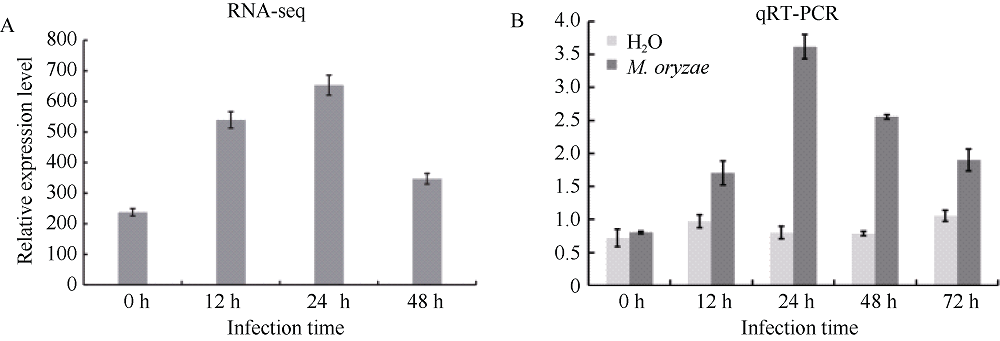
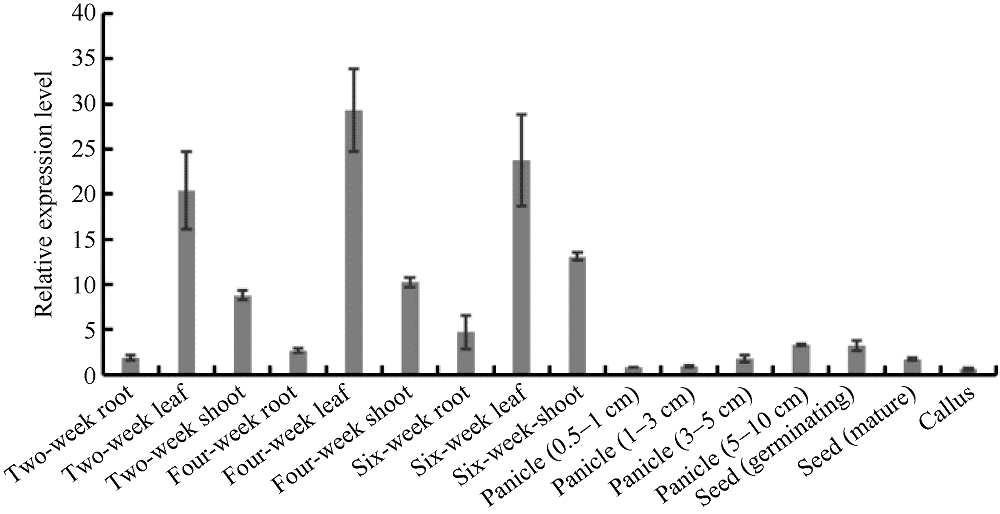
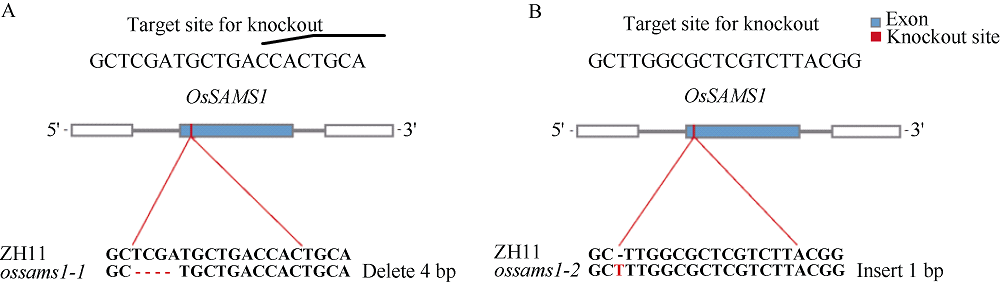
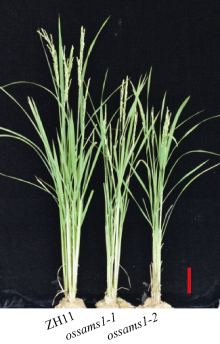
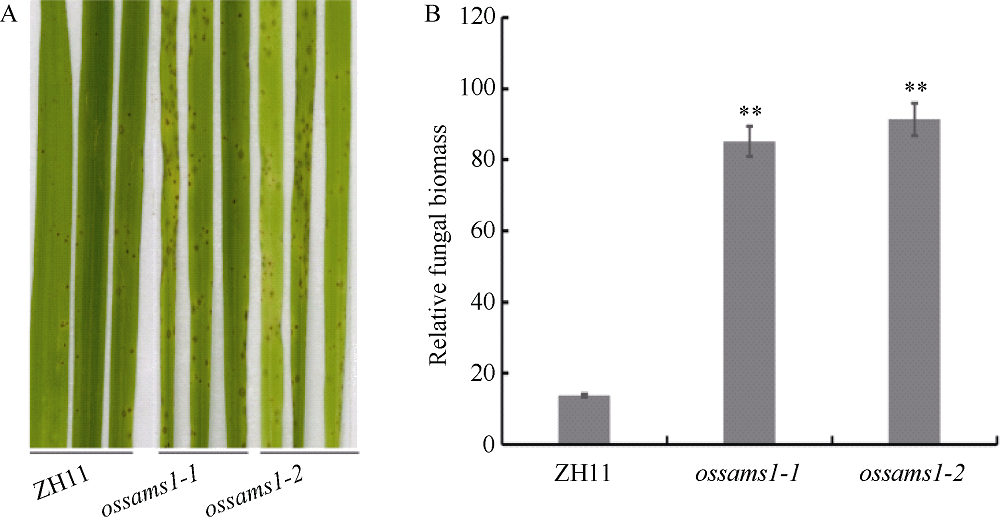
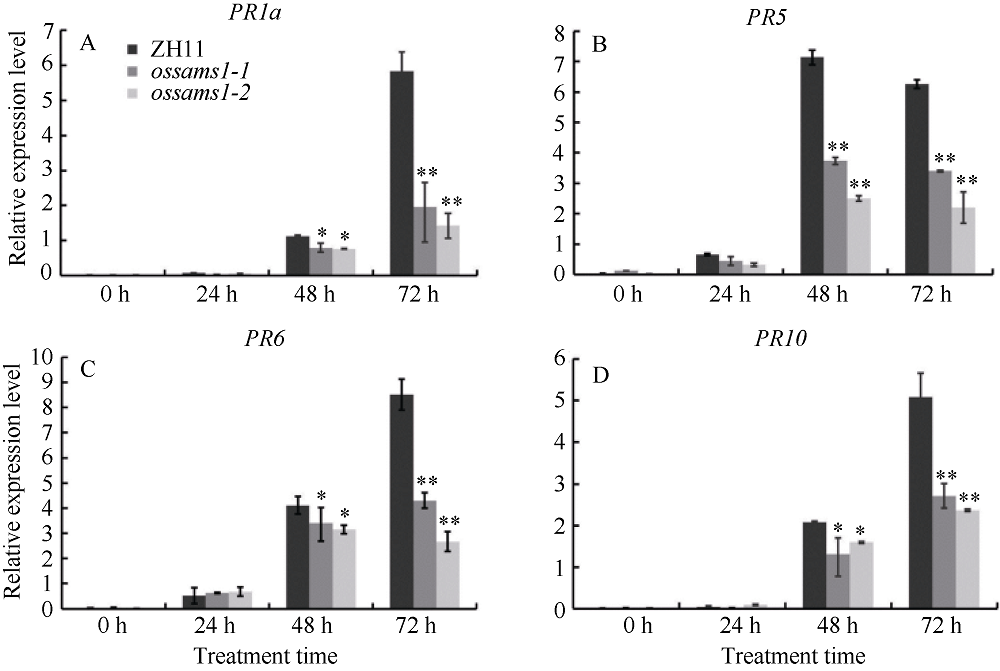
稻瘟病是水稻最重要的病害之一, 对农业生产造成巨大的经济损失。研究表明, 水稻中S-腺苷-L-甲硫氨酸合成酶OsSAMS1参与了水稻衰老相关的进程, 我们实验室前期利用转录组测序分析发现, OsSAMS1基因的表达水平受稻瘟病菌诱导后明显提高。然而, OsSAMS1是否参与水稻的免疫反应, 尚未明确。基于此, 本研究选取野生型ZH11为背景材料, 通过构建OsSAMS1基因敲除突变体来探究该基因在水稻抗病中的功能。结果表明, OsSAMS1主要在水稻叶片中表达; 且其表达明显受稻瘟病菌侵染所诱导。亚细胞定位结果显示, OsSAMS1在细胞膜、细胞质和细胞核内均有表达。通过接种稻瘟病菌发现, 与对照相比, 2个等位敲除突变体ossams1-1和ossams1-2均表现为更加感病, 且体内病程相关基因的表达也明显更低, 同时突变体中乙烯合成相关基因的表达也受到明显抑制。综上所述, OsSAMS1参与了水稻的免疫反应, 且正调控水稻稻瘟病的抗性。本研究为深入揭示OsSAMS1在稻瘟病免疫反应的分子机理奠定了基础, 并为稻瘟病抗病育种研究提供了基因资源。
| [1] | Zhang N, Luo J, Rossman A Y, Aoki T, Chuma I, Crous P W, Dean R, de Vries R P, Donofrio N, Hyde K D, Lebrun M H, Talbot N J, Tharreau D, Tosa Y, Valent B, Wang Z H, Xu J R. Generic names in Magnaporthales. IMA Fung, 2016, 7:155-159. |
| [2] |
Li W T, Chern M S, Yin J J, Wang J, Chen X W. Recent advances in broad-spectrum resistance to the rice blast disease. Curr Opin Plant Biol, 2019, 50:114-120.
doi: 10.1016/j.pbi.2019.03.015 |
| [3] |
Deng Y W, Zhai K R, Xie Z, Yang D Y, Zhu X D, Liu J Z, Wang X, Qin P, Yang Y Z, Zhang G M, Li Q, Zhang J F, Wu S Q, Milazzo J, Mao B Z, Wang E T, Xie H A, Tharreau D, He Z H. Epigenetic regulation of antagonistic receptors confers rice blast resistance with yield balance. Science, 2017, 355:962-965.
doi: 10.1126/science.aai8898 |
| [4] |
Yang D W, Li S P, Lu L, Fang J B, Wang W, Cui H T, Tang D Z. Identification and application of the Pigm-1 gene in rice disease-resistance breeding. Plant Biol, 2020, 22:1022-1029.
doi: 10.1111/plb.v22.6 |
| [5] |
Zhou B, Qu S H, Liu G F, Dolan M, Sakai H, Lu G D, Bellizzi M, Wang G L. The eight amino-acid differences within three leucine-rich repeats between Pi2 and Piz-t resistance proteins determine the resistance specificity to Magnaporthe grisea. Mol Plant Microbe Interact, 2006, 19:1216-1228.
doi: 10.1094/MPMI-19-1216 |
| [6] |
Zhu X Y, Chen S, Yang J Y, Zhou S C, Zeng L X, Han J L, Su J, Wang, Pan Q H. The identification of Pi50(t), a new member of the rice blast resistance Pi2/Pi9 multigene family. Theor Appl Genet, 2012, 124:1295-1304.
doi: 10.1007/s00122-012-1787-9 |
| [7] |
Jiang N, Li Z Q, Wu J, Wang Y, Wu L Q, Wang S H, Wang D, Wen T, Liang Y, Sun P Y, Liu J L, Dai L Y, Wang Z L, Wang C, Luo M Z, Liu X L, Wang G L. Molecular mapping of the Pi2/9 allelic gene Pi2-2 conferring broad-spectrum resistance to Magnaporthe oryzae in the rice cultivar Jefferson. Rice, 2012, 5:29.
doi: 10.1186/1939-8433-5-29 pmid: 27234247 |
| [8] |
Su J, Wang W J, Han J L, Chen S, Wang C Y, Zeng L X, Feng A Q, Yang J Y, Zhou B, Zhu X Y. Functional divergence of duplicated genes results in a novel blast resistance gene Pi50 at the Pi2/9 locus. Theor Appl Genet, 2015, 128:2213-2225.
doi: 10.1007/s00122-015-2579-9 |
| [9] |
Deng Y W, Zhai K R, Xie Z, Yang D Y, Zhu X D, Liu J Z, Wang X, Qin P, Yang Y Z, Zhang G M, Li Q, Zhang J F, Wu S Q, Milazzo J, Mao B Z, Wang E T, Xie H A, Tharreau D, He Z H. Epigenetic regulation of antagonistic receptors confers rice blast resistance with yield balance. Science, 2017, 355:962-965.
doi: 10.1126/science.aai8898 |
| [10] | Dodds P N, Rathjen J P. Plant immunity: towards an integrated view of plant-pathogen interactions. Nat Rev Genet, 2010, 11:539-548. |
| [11] |
Wang W, Feng B M, Zhou J M, Tang D Z. Plant immune signaling: advancing on two frontiers. J Integr Plant Biol, 2020, 62:2-24.
doi: 10.1111/jipb.v62.1 |
| [12] | 杨德卫, 李生平, 崔海涛, 邹声浩, 王伟. 寄主植物与病原菌免疫反应的分子遗传基础. 遗传, 2020, 42:278-286. |
| Yang D W, Li S P, Cui H T, Zou S H, Wang W. Molecular genetic mechanisms of interaction between host plants and pathogens. Hereditas(Beijing), 2020, 42:278-286 (in Chinese with English abstract). | |
| [13] |
Jones J D G, Dangl J L. The plant immune system. Nature, 2006, 444:323-329.
doi: 10.1038/nature05286 |
| [14] | Yuan M, Jiang Z, Bi G, Nomura K, Liu M, Wang Y, Cai B, Zhou J M, He S Y, Xin X F. Pattern-recognition receptors are required for NLR-mediated plant immunity. Nature, 2021, 592:105-109. |
| [15] | Ngou B P M, Ahn H K, Ding P T, Jones J D G. Mutual potentiation of plant immunity by cell-surface and intracellular receptors. Nature, 2021, 592:110-115. |
| [16] |
Li W T, Chern M S, Yin J J, Wang J, Chen X W. Recent advances in broad-spectrum resistance to the rice blast disease. Curr Opin Plant Biol, 2019, 50:114-120
doi: 10.1016/j.pbi.2019.03.015 |
| [17] | Hayafune M, Berisio R, Marchetti R, Silipo A, Kayama M, Desaki Y, Arima S, Squeglia F, Ruggiero A, Tokuyasu K, Molinaro A, Kaku H, Shibuya N. Chitin-induced activation of immune signaling by the rice receptor CEBiP relies on a unique sandwich-type dimerization. Proc Natl Acad Sci USA, 2014, 111:404-413. |
| [18] |
Yamaguchi K, Yamada K, Ishikawa K, Yoshimura S, Hayashi N, Uchihashi K, Ishihama N, Kishi-Kaboshi M, Takahashi A, Tsuge S, Ochiai H, Tada Y, Shimamoto K, Yoshioka H, Kawasaki T. A receptor-like cytoplasmic kinase targeted by a plant pathogen effector is directly phosphorylated by the chitin receptor and mediates rice immunity. Cell Host Microb, 2013, 13:347-357.
doi: 10.1016/j.chom.2013.02.007 |
| [19] |
Yamada K, Yamaguchi K, Yoshimura S, Terauchi A, Kawasaki T. Conservation of chitin-induced MAPK signaling pathways in rice and Arabidopsis. Plant Cell Physiol, 2017, 58:993-1002.
doi: 10.1093/pcp/pcx042 pmid: 28371870 |
| [20] |
Wang C, Wang G, Zhang C, Zhu P K, Dai H L, Yu N, He Z H, Xu L, Wang E T. OsCERK1-mediated chitin perception and immune signaling requires receptor-like cytoplasmic kinase 185 to activate an MAPK cascade in rice. Mol Plant, 2017, 10:619-633.
doi: 10.1016/j.molp.2017.01.006 |
| [21] |
Pennisi E. Armed and dangerous. Science, 2010, 327:804-805.
doi: 10.1126/science.327.5967.804 |
| [22] |
Mine A, Seyerth C, Kracher B, Berens M L, Becker D, Tsuda K. The defense phytohormone signaling network enables rapid, high-amplitude transcriptional reprogramming during eector- triggered immunity. Plant Cell, 2018, 30:1199-1219.
doi: 10.1105/tpc.17.00970 |
| [23] |
Meng J J, Wang L S, Wang J Y, Zhao X W, Cheng J K, Yu W X, Jin D, Li Q, Gong Z Z. Methionine adenosyltransferase4 mediates DNA and histone methylation. Plant Physiol, 2018, 177:652-670.
doi: 10.1104/pp.18.00183 |
| [24] |
Yan, X J, Ma L, Pang H Y, Wang P, Lei L, Cheng Y X, Cheng J K, Guo Y, Li Q Z. Methionine synthase1 is involved in chromatin silencing by maintaining dna and histone methylation. Plant Physiol, 2019, 181:249-261.
doi: 10.1104/pp.19.00528 |
| [25] |
Chen Y, Xu Y Y, Luo W, Li W X, Chen N, Zhang D J, Chong K. The F-box protein OsFBK12 targets OsSAMS1 for degradation and affects pleiotropic phenotypes, including leaf senescence, in rice. Plant Physiol, 2013, 163:1673-1685.
doi: 10.1104/pp.113.224527 |
| [26] |
Bustin S A, Benes V, Garson J A, Hellemans J, Huggett J, Kubista M, Mueller R, Nolan T, Pfaffl M W, Shipley G L, Vandesompe J, Wittwer C T. The MIQE guidelines: minimum information for publication of quantitative real-time PCR experiments. Clin Chem, 2009, 55:611-622.
doi: 10.1373/clinchem.2008.112797 |
| [27] |
Park C H, Chen S B, Shirsekar G, Zhou B, Khang C H, Songkumarn P, Afzal A J, Ning Y S, Wang R S, Bellizzi M, Valent B, Wang G L. The Magnaporthe oryzae effector AvrPiz-t targets the RING E3 ubiquitin ligase APIP6 to suppress pathogen-associated molecular pattern-triggered immunity in rice. Plant Cell, 2012, 24:4748-4762.
doi: 10.1105/tpc.112.105429 |
| [28] |
Yang D W, Cheng C P, Zheng X H, Ye X F, Ye N, Huang F H. Identification and fine mapping of a major QTL, qHD19, that plays pleiotropic roles in regulating the heading date in rice. Mol Breed, 2020, 40:30.
doi: 10.1007/s11032-020-1109-x |
| [29] |
Schwessinger B, Ronald P C. Plant innate immunity: perception of conserved microbial signatures. Annu Rev Plant Biol, 2012, 63:451-482.
doi: 10.1146/annurev-arplant-042811-105518 pmid: 22404464 |
| [30] |
Yang C, Li W, Cao J D, Meng F W, Yu Y Q, Huang J K, Jiang L, Liu M X, Zhang Z G, Chen X W, Miyamoto K, Yamane H, Zhang J S, Chen S Y, Liu J. Activation of ethylene signaling pathways enhances disease resistance by regulating ROS and phytoalexin production in rice. Plant J, 2017, 89:338-353.
doi: 10.1111/tpj.13388 |
| [31] |
Mao D, Feng Y, Jian L, Poel B V, Tan D, Li J L, Liu Y Q, Li X S, Dong M Q, Chen L B, Li D P, Luan S. FERONIA receptor kinase interacts with S-adenosylmethionine synthetase and suppresses S-adenosylmethionine production and ethylene biosynthesis in Arabidopsis. Plant Cell Environ, 2016, 38:2566-2574.
doi: 10.1111/pce.12570 |
| [32] |
Ji D C, Cui X M, Qin G Z, Chen T, Tian S P. SlFERL interacts with S-adenosylmethionine synthetase to regulate fruit ripening. Plant Physiol, 2020, 184:2168-2181.
doi: 10.1104/pp.20.01203 |
| [33] |
Li W X, Han Y Y, Tao F, Chong K. Knockdown of SAMS genes encoding S-adenosyl-L-methionine synthetases causes methylation alterations of DNAs and histones and leads to late flowering in rice. J Plant Physiol, 2011, 168:1837-1843.
doi: 10.1016/j.jplph.2011.05.020 |
| [34] |
Iwai T, Miyasaka A, Seo S, Ohashi Y. Contribution of ethylene biosynthesis for resistance to blast fungus infection in young rice plants. Plant Physiol, 2006, 142:1202-1215.
doi: 10.1104/pp.106.085258 |
| [35] |
Tintor N, Ross A, Kanehara K, Yamada K, Fan L, Kemmerling B, Nürnberger T, Tsuda K, Saijo Y. Layered pattern receptor signaling via ethylene and endogenous elicitor peptides during Arabidopsis immunity to bacterial infection. Proc Natl Acad Sci USA, 2013, 110:6211-6216.
doi: 10.1073/pnas.1216780110 |
| [36] |
Helliwell E E, Wang Q, Yang Y N. Transgenic rice with inducible ethylene production exhibits broad-spectrum disease resistance to the fungal pathogens Magnaporthe oryzae and Rhizoctonia solani. Plant Biotechnol J, 2013, 11:33-42.
doi: 10.1111/pbi.12004 pmid: 23031077 |
| [37] |
Singh M P, Lee F N, Counce P A, Gibbons J H. Mediation of partial resistance to rice blast through anaerobic induction of ethylene. Phytopathology, 2004, 94:819-825.
doi: 10.1094/PHYTO.2004.94.8.819 |
| [38] | Seo Y S, Chern M, Bartley L E, Han M, Jung K H, Lee I, Walia H, Richter T, Xu X, Cao P, Bai W, Ramanan R, Amonpant F, Arul L, Canlas P E, Ruan R, Park C J, Chen X, Hwang S, Jeon J S, Ronald P C. Towards establishment of a rice stress response interactome. PLoS Genet, 2011, 7:e1002020. |
| [39] |
Gong B, Li X VandenLangenberg K M, Wen D, Sun S S, Wei M, Li Y, Yang F J, Shi Q H, Wang X F. Overexpression of S-adenosyl-L-methionine synthetase increased tomato tolerance to alkali stress through polyamine metabolism. Plant Biotechnol J, 2014, 12:694-708.
doi: 10.1111/pbi.2014.12.issue-6 |
| [40] |
Mao D D, Yu F, Li J, Van de Poel B, Tan D, Li J L, Liu Y Q, Li X S, Dong M Q, Chen L B, Li D P, Luan S. FERONIA receptor kinase interacts with S-denosylmethionine synthetase and suppresses S-denosylmethionine production and ethylene biosynthesis in Arabidopsis. Plant Cell Environ, 2015, 38:2566-2574.
doi: 10.1111/pce.12570 |
| [41] |
Chen Y, Zou T, McCormick S. S-adenosylmethionine synthetase 3 is important for pollen tube growth. Plant Physiol, 2016, 172:244-253.
doi: 10.1104/pp.16.00774 |
| [42] |
Shen B, Li C, Tarczynski M C. High free-methionine and decreased lignin content result from a mutation in the Arabidopsis S-adenosyl-L-methionine synthetase 3 gene. Plant J, 2002, 29:371-380.
pmid: 11844113 |
| [43] |
Li W X, Han Y Y, Tao F, Chong K. Knockdown of SAMS genes encoding S-adenosyl-l-methionine synthetases causes methylation alterations of DNAs and histones and leads to late flowering in rice. J Plant Physiol, 2011, 168:1837-1843.
doi: 10.1016/j.jplph.2011.05.020 |
| [1] | 胡赵, 钱润, 谢丰璞, 应素平. 水稻SPX基因家族鉴定及响应磷处理的表达分析[J]. 作物学报, 2026, 52(6): 1902-1912. |
| [2] | 邹仪妹, 徐敏, 汪海洋, 姚辉, 王加峰, 刘浩, 任代胜. 两系不育系水稻幼苗根系响应盐胁迫的转录因子调控网络鉴定[J]. 作物学报, 2026, 52(6): 1728-1742. |
| [3] | 闫安, 蒋昆炜, 王蓉圆, 田林, 张璐, 王韵, 徐建龙. 水稻剑叶小维管束数基因SVN7的鉴定与克隆[J]. 作物学报, 2026, 52(5): 1364-1372. |
| [4] | 杨影, 郝豫皖, 张学宁, 方佳璐, 马月华, 杨伟龙, 孙文清, 王新超, 王玉春, 黄建燕. 乙烯响应因子CsERF9调控茶树炭疽病抗性的分子机制研究[J]. 作物学报, 2026, 52(4): 1103-1115. |
| [5] | 陈伟, 卫万娟, 赵其兵, 常东伟, 余凌波, 翟鹏飞, 冯志明, 陈宗祥, 任仰涛, 杨鹏, 刘海浪, 李珍富, 杨永乐, 金彦刚, 左示敏. 利用CRISPR/Cas9编辑Hd6基因创制优质早熟水稻新种质[J]. 作物学报, 2026, 52(4): 1046-1056. |
| [6] | 石少阶, 刘凯, 陈姿夷, 王卉颖, 李三和, 周雷, 游艾青. 水稻矮化多分蘖基因DMT1的克隆与功能分析[J]. 作物学报, 2026, 52(4): 1022-1034. |
| [7] | 覃奕琰, 付瑶, 苏畅, 李娜, 徐静茹, 程笑然, 张琪, 赵明辉. OsST41调控水稻苗期耐盐性的功能分析[J]. 作物学报, 2026, 52(3): 802-812. |
| [8] | 叶凡, 李帅, 李思宇, 陈云, 窦超银, 刘立军. 不同节水灌溉方式对东北稻区水稻产量和群体质量的影响[J]. 作物学报, 2026, 52(3): 895-907. |
| [9] | 胡城祯, 高维东, 孔斌雪, 王建飞, 车卓, 杨德龙, 陈涛. 小麦TaAPC11基因家族鉴定及TaAPC11-5B参与干旱胁迫的生物学功能研究[J]. 作物学报, 2026, 52(1): 148-164. |
| [10] | 王婵, 吴莹莹, 李文奇, 李霞, 王芳权, 周彤, 杨杰. 基于HRM技术开发水稻抗条纹叶枯病基因STV11功能标记[J]. 作物学报, 2025, 51(9): 2547-2556. |
| [11] | 陈惠莹, 何嘉欣, 朱斌, 黄士轩, 周星佑, 伍君权, 杨美艳. 水稻黄单胞菌噬菌体vB_XaS_HDB2的全基因组分析和生物学特性研究[J]. 作物学报, 2025, 51(8): 2087-2099. |
| [12] | 杨海洋, 吴林宣, 李博纹, 石翰峰, 袁禧龙, 刘金朝, 蔡海荣, 陈诗怡, 郭涛, 王慧. 基于QTL定位发现的OsWRI3调控水稻种子的落粒性[J]. 作物学报, 2025, 51(7): 1712-1724. |
| [13] | 凤舞剑, 冼晓青, 张新钵, 曹丹, 强承魁. 基于转录组和AlphaFold对稻瘟菌经典效应蛋白和水稻受体的快速鉴定[J]. 作物学报, 2025, 51(6): 1480-1488. |
| [14] | 雷松翰, 范骏扬, 车艳奕, 代永东, 郑雨萌, 田维江, 桑贤春, 王晓雯. 水稻内卷叶突变体acl3的鉴定及调控基因的功能分析[J]. 作物学报, 2025, 51(6): 1467-1479. |
| [15] | 李福媛, 杨奕, 马继琼, 许明辉, 林良斌, 孙一丁. 水稻OsPUB4基因克隆、激素诱导表达分析与互作蛋白筛选[J]. 作物学报, 2025, 51(6): 1690-1700. |
|
||