欢迎访问作物学报,今天是
作物学报 ›› 2023, Vol. 49 ›› Issue (2): 377-391.doi: 10.3724/SP.J.1006.2023.23021
所属专题: 玉米:遗传育种·种质资源·分子遗传学
殷芳冰1( ), 李雅楠1, 鲍建喜1, 马雅杰1, 秦文萱1, 王锐璞1, 龙艳1,2, 李金萍2, 董振营1,2,*(), 万向元1,2,*()
YIN Fang-Bing1(), LI Ya-Nan1, BAO Jian-Xi1, MA Ya-Jie1, QIN Wen-Xuan1, WANG Rui-Pu1, LONG Yan1,2, LI Jin-Ping2, DONG Zhen-Ying1,2,*(), WAN Xiang-Yuan1,2,*()
摘要:
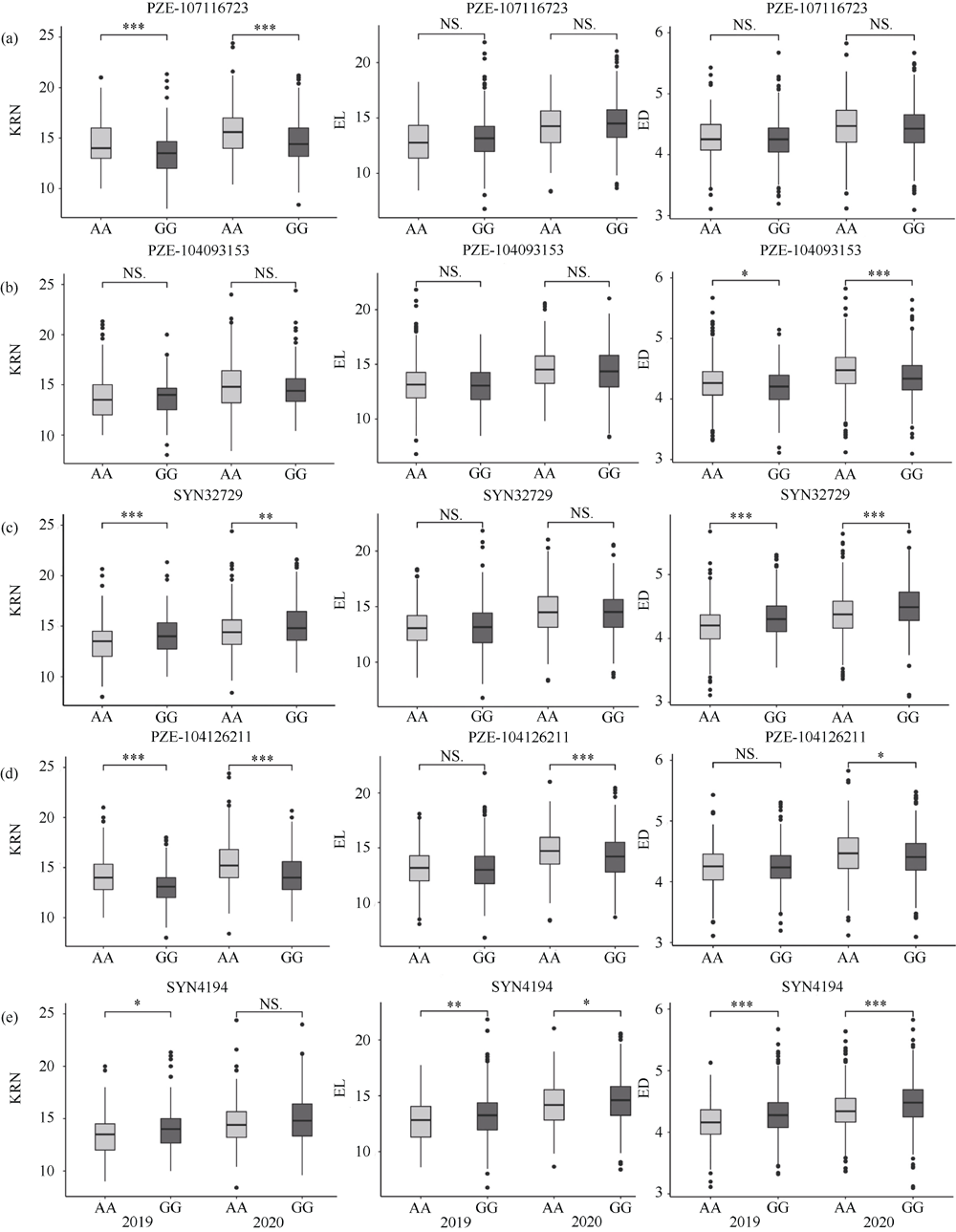
玉米雌穗产量相关性状直接影响玉米最终产量, 解析其遗传机制可为玉米高产提供有益指导。本研究以733份玉米自交系作为关联群体, 在2个环境下随机区组种植, 调查穗行数(KRN)、穗长(EL)和穗粗(ED) 3个产量相关性状, 利用MaizeSNP3072芯片对其进行基因分型, 采用FarmCPU模型进行全基因组关联分析, 分别鉴定出16、13和24个与3个性状显著关联的单核苷酸多态性位点(SNP), 对表型变异的解释率分别为0.01%~7.08%、0.01%~5.34%和0.07%~4.34%。其中, 分别有6、2和5个与3个性状存在显著关联的高可信度(high confidence, HC) SNP, 而且有2个HC-SNP同时与KRN和ED显著相关, 1个KRN HC-SNP和3个ED HC-SNP为本研究首次报道。在所鉴定HC-SNP上下游200 kb范围内筛选出33个重要候选基因, 其中9号染色体SNP标记PZE-109003046所在基因PIN1a为控制生长素极性运输从而调控雌穗性状的已知基因。另一些候选基因编码不同转录因子, 以及参与生长素、赤霉素和乙烯等激素介导的信号转导、DNA甲基化和蛋白磷酸化等翻译后修饰过程的蛋白, 可能从不同方面调控雌穗相关性状。本研究所挖掘的11个HC-SNP与33个候选基因可以为进一步克隆雌穗性状功能基因、揭示相关分子调控机制以及利用分子标记辅助选择育种提供有益指导。
| [1] | 宁慧云, 连晋, 赵玉坤, 连吉明, 高根来. 不同玉米品种雌穗性状及产量的灰关联评价研究. 农学学报, 2013, 3(6): 13-16. |
| Ning H Y, Lian J, Zhao Y K, Lian J M, Gao G L. Grey relational evaluation study in ear traits and yield of different maize varieties. J Agric, 2013, 3(6): 13-16. (in Chinese with English abstract) | |
| [2] | 王帮太, 吴建宇, 丁俊强, 席章营. 玉米产量及产量相关性状QTL的图谱整合. 作物学报, 2009, 35: 1836-1843. |
|
Wang B T, Wu J Y, Ding J Q, Xi Z Y. Map integration of QTLs for grain yield and its related traits in maize. Acta Agron Sin, 2009, 35: 1836-1843. (in Chinese with English abstract)
doi: 10.3724/SP.J.1006.2009.01836 |
|
| [3] | 吴律, 代力强, 董青松, 施婷婷, 王丕武. 玉米行粒数的全基因组关联分析. 作物学报, 2017, 43: 1559-1564. |
|
Wu L, Dai L Q, Dong Q S, Shi T T, Wang P W. Genome-wide association analysis of kernel number per row in maize. Acta Agron Sin, 2017, 43: 1559-1564 (in Chinese with English abstract).
doi: 10.3724/SP.J.1006.2017.01569 |
|
| [4] |
张焕欣, 翁建峰, 张晓聪, 刘昌林, 雍洪军, 郝转芳, 李新海. 玉米穗行数全基因组关联分析. 作物学报, 2014, 40: 1-6.
doi: 10.3724/SP.J.1006.2014.00001 |
|
Zhang H X, Weng J F, Zhang X C, Liu C L, Yong H J, Hao Z F, Li X H. Genome-wide association analysis of kernel row number in maize. Acta Agron Sin, 2014, 40: 1-6. (in Chinese with English abstract)
doi: 10.3724/SP.J.1006.2014.00001 |
|
| [5] |
Li F, Jia H T, Liu L, Zhang C X, Liu Z J, Zhang Z X. Quantitative trait loci mapping for kernel row number using chromosome segment substitution lines in maize. Genet Mol Res, 2014, 13: 1707-1716.
doi: 10.4238/2014.January.17.1 pmid: 24535896 |
| [6] |
Choi J K, Sa K J, Park D H, Lim S E, Ryu S H, Park J Y, Park K J, Rhee H I, Lee M, Lee J K. Construction of genetic linkage map and identification of QTLs related to agronomic traits in DH population of maize (Zea mays L.) using SSR markers. Genes Genomics, 2019, 41: 667-678.
doi: 10.1007/s13258-019-00813-x |
| [7] |
Zhou B, Zhou Z J, Ding J Q, Zhang X C, Mu C, Wu Y B, Gao J Y, Song Y X, Wang S W, Ma J L, Li X T, Wang R X, Xia Z L, Chen J F, Wu J Y. Combining three mapping strategies to reveal quantitative trait loci and candidate genes for maize ear length. Plant Genome, 2018, 11: 170107.
doi: 10.3835/plantgenome2017.11.0107 |
| [8] |
Zhang X X, Guan Z R, Li Z L, Liu P, Ma L L, Zhang Y C, Pan L, He S J, Zhang Y L, Li P, Ge F, Zou C Y, He Y C, Gao S B, Pan G T, Shen Y O. A combination of linkage mapping and GWAS brings new elements on the genetic basis of yield-related traits in maize across multiple environments. Theor Appl Genet, 2020, 133: 2881-2895.
doi: 10.1007/s00122-020-03639-4 pmid: 32594266 |
| [9] |
Xu Y, Xu C, Xu S. Prediction and association mapping of agronomic traits in maize using multiple omic data. Heredity, 2017, 119: 174-184.
doi: 10.1038/hdy.2017.27 pmid: 28590463 |
| [10] |
Li T, Qu J Z, Tian X K, Lao Y H, Wei N N, Wang Y H, Hao Y C, Zhang X H, Xue J Q, Xu S T. Identification of ear morphology genes in maize (Zea mays L.) using selective sweeps and association mapping. Front Genet, 2020, 11: 747.
doi: 10.3389/fgene.2020.00747 |
| [11] |
Tian H L, Wang F G, Zhao J R, Yi H M, Wang L, Wang R, Yang Y, Song W. Development of maizeSNP3072, a high-throughput compatible SNP array, for DNA fingerprinting identification of Chinese maize varieties. Mol Breed, 2015, 35: 136.
doi: 10.1007/s11032-015-0335-0 |
| [12] |
Zhu X M, Shao X Y, Pei Y H, Guo X M, Li J, Song X Y, Zhao M A. Genetic diversity and genome-wide association study of major ear quantitative traits using high-density SNPs in maize. Front Plant Sci, 2018, 9: 966.
doi: 10.3389/fpls.2018.00966 |
| [13] |
Zhang C S, Zhou Z Q, Yong H J, Zhang X C, Hao Z F, Zhang F J, Li M S, Zhang D G, Li X H, Wang Z H, Weng J F. Analysis of the genetic architecture of maize ear and grain morphological traits by combined linkage and association mapping. Theor Appl Genet, 2017, 130: 1011-1029.
doi: 10.1007/s00122-017-2867-7 pmid: 28215025 |
| [14] |
Xue Y D, Warburton M L, Sawkins M, Zhang X H, Setter T, Xu Y B, Grudloyma P, Gethi J, Ribaut J M, Li W C, Zhang X B, Zheng Y L, Yan J B. Genome-wide association analysis for nine agronomic traits in maize under well-watered and water-stressed conditions. Theor Appl Genet, 2013, 126: 2587-2596.
doi: 10.1007/s00122-013-2158-x pmid: 23884600 |
| [15] |
Pandis N. Linear regression. Am J Orthod Dentofacial Orthop, 2016, 149: 431-434.
doi: 10.1016/j.ajodo.2015.11.019 |
| [16] |
Carraro N, Forestan C, Canova S, Traas J, Varotto S. ZmPIN1a and ZmPIN1b encode two novel putative candidates for polar auxin transport and plant architecture determination of maize. Plant Physiol, 2006, 142: 254-264.
pmid: 16844839 |
| [17] |
Forestan C, Meda S, Varotto S. ZmPIN1-mediated auxin transport is related to cellular differentiation during maize embryogenesis and endosperm development. Plant Physiol, 2010, 152: 1373-1390.
doi: 10.1104/pp.109.150193 pmid: 20044449 |
| [18] |
马娟, 曹言勇, 李会勇. 玉米穗轴粗全基因组关联分析. 作物学报, 2021, 47: 1228-1238.
doi: 10.3724/SP.J.1006.2021.03048 |
|
Ma J, Cao Y Y, Li H Y. Genome-wide association study of ear cob diameter in maize. Acta Agron Sin, 2021, 47: 1228-1238. (in Chinese with English abstract)
doi: 10.3724/SP.J.1006.2021.03048 |
|
| [19] | 殷芳冰, 王成, 龙艳, 董振营, 万向元. 玉米雌穗性状遗传分析与形成机制. 中国生物工程杂志, 2021, 41(12): 30-46. |
| Yin F B, Wang C, Long Y, Dong Z Y, Wan X Y. Progress on dissecting genetic architecture and formation mechanism of maize ear traits. China Biotechnol, 2021, 41(12): 30-46. (in Chinese with English abstract) | |
| [20] |
Lu M, Xie C X, Li X H, Hao Z F, Li M S, Weng J F, Zhang D G, Bai L, Zhang S H. Mapping of quantitative trait loci for kernel row number in maize across seven environments. Mol Breed, 2011, 28: 143-152.
doi: 10.1007/s11032-010-9468-3 |
| [21] |
Karen S P, Lopes S C J, Pereira S A, Augusto F G A. QTL mapping for yield components in a tropical maize population using microsatellite markers. Hereditas, 2008, 145: 194-203.
doi: 10.1111/j.0018-0661.2008.02065.x |
| [22] |
Tian B H, Wang J H, Wang G Y. Confirmation of a major QTL on chromosome 10 for maize kernel row number in different environments. Plant Breed, 2014, 133: 184-188.
doi: 10.1111/pbr.12132 |
| [23] |
Liu L, Du Y F, Huo D A, Wang M, Shen X M, Yue B, Qiu F Z, Zheng Y L, Yan J B, Zhang Z X. Genetic architecture of maize kernel row number and whole genome prediction. Theor Appl Genet, 2015, 128: 2243-2254.
doi: 10.1007/s00122-015-2581-2 pmid: 26188589 |
| [24] |
Ma X Q, Tang J H, Teng W T, Yan J B, Meng Y J, Li J S. Epistatic interaction is an important genetic basis of grain yield and its components in maize. Mol Breed, 2007, 20: 41-51.
doi: 10.1007/s11032-006-9071-9 |
| [25] |
Yang C, Liu J, Rong T Z. Detection of quantitative trait loci for ear row number in F2 populations of maize. Genet Mol Res, 2015, 14: 14229-14238.
doi: 10.4238/2015.November.13.6 pmid: 26600480 |
| [26] |
Yan J B, Tang H, Huang Y Q, Zheng Y L, Li J S. Quantitative trait loci mapping and epistatic analysis for grain yield and yield components using molecular markers with an elite maize hybrid. Euphytica, 2006, 149: 121-131.
doi: 10.1007/s10681-005-9060-9 |
| [27] |
Brown P J, Upadyayula N, Mahone G S, Tian F, Bradbury P J, Myles S, Holland J B, Flint-Garcia S, McMullen M D, Buckler E S, Rocheford T R. Distinct genetic architectures for male and female inflorescence traits of maize. PLoS Genet, 2011, 7: e1002383.
doi: 10.1371/journal.pgen.1002383 |
| [28] |
Huo D A, Ning Q, Shen X M, Liu L, Zhang Z X. QTL mapping of kernel number-related traits and validation of one major QTL for ear length in maize. PLoS One, 2016, 11: e0155506.
doi: 10.1371/journal.pone.0155506 |
| [29] |
Yang N, Lu Y L, Yang X H, Huang J, Zhou Y, Ali F, Wen W W, Liu J, Li J S, Yan J B. Genome wide association studies using a new nonparametric model reveal the genetic architecture of 17 agronomic traits in an enlarged maize association panel. PLoS Genet, 2014, 10: e1004573.
doi: 10.1371/journal.pgen.1004573 |
| [30] |
Gallavotti A, Barazesh S, Malcomber S, Hall D, Jackson D, Schmidt R J, McSteen P. Sparse inflorescence1 encodes a monocot-specific YUCCA-like gene required for vegetative and reproductive development in maize. Proc Natl Acad Sci USA, 2008, 105: 15196-15201.
doi: 10.1073/pnas.0805596105 |
| [31] |
Phillips K A, Skirpan A L, Liu X, Christensen A, Slewinski T L, Hudson C, Barazesh S, Cohen J D, Malcomber S, McSteen P. Vanishing tassel2 encodes a grass-specific tryptophan aminotransferase required for vegetative and reproductive development in maize. Plant Cell, 2011, 23: 550-566.
doi: 10.1105/tpc.110.075267 |
| [32] |
Barazesh S, McSteen P. Barren inflorescence1 functions in organogenesis during vegetative and inflorescence development in maize. Genetics, 2008, 179: 389-401.
doi: 10.1534/genetics.107.084079 pmid: 18493061 |
| [33] |
McSteen P, Hake S. Barren inflorescence2 regulates axillary meristem development in the maize inflorescence. Development, 2001, 128: 2881-2891.
doi: 10.1242/dev.128.15.2881 pmid: 11532912 |
| [34] |
McSteen P, Malcomber S, Skirpan A, Lunde C, Wu X T, Kellogg E, Hake S. Barren inflorescence2 encodes a co-ortholog of the PINOID serine/threonine kinase and is required for organogenesis during inflorescence and vegetative development in maize. Plant Physiol, 2007, 144: 1000-1011.
doi: 10.1104/pp.107.098558 pmid: 17449648 |
| [35] |
Kato H, Nishihama R, Weijers D, Kohchi T. Evolution of nuclear auxin signaling: lessons from genetic studies with basal land plants. J Exp Bot, 2018, 69: 291-301.
doi: 10.1093/jxb/erx267 pmid: 28992186 |
| [36] |
Gallavotti A, Zhao Q, Kyozuka J, Meeley R B, Ritter M K, Doebley J F, Pè M E, Schmidt R J. The role of barren stalk1 in the architecture of maize. Nature, 2004, 432: 630-635.
doi: 10.1038/nature03148 |
| [37] |
Sigmon B, Vollbrecht E. Evidence of selection at the ramosa1 locus during maize domestication. Mol Ecol, 2010, 19: 1296-1311.
doi: 10.1111/j.1365-294X.2010.04562.x |
| [38] | 肖朝文, 傅永福. AT-hook蛋白的研究进展. 中国农业科技导报, 2009, 11(5): 12-16. |
| Xiao C W, Fu Y F. Research progress in AT-hook proteins. J Agric Sci Technol, 2009, 11(5): 12-16. (in Chinese with English abstract) | |
| [39] |
Gallavotti A, Malcomber S, Gaines C, Stanfield S, Whipple C, Kellogg E, Schmidt R J. BARREN STALK FASTIGIATE1 is an AT-hook protein required for the formation of maize ears. Plant Cell, 2011, 23: 1756-1771.
doi: 10.1105/tpc.111.084590 |
| [40] |
Jia H T, Li M F, Li W Y, Liu L, Jian Y N, Yang Z X, Shen X M, Ning Q, Du Y F, Zhao R, Jackson D, Yang X H, Zhang Z X. A serine/threonine protein kinase encoding gene KERNEL NUMBER PER ROW6 regulates maize grain yield. Nat Commun, 2020, 11: 988.
doi: 10.1038/s41467-020-14746-7 |
| [1] | 习千辉, 徐梓瑗, 刘梦梦, 王宏艺, 郎凯琳, 井震海, 陈锋, 赵磊. 小麦籽粒铜含量的全基因组关联分析及候选基因预测[J]. 作物学报, 2026, 52(6): 1604-1617. |
| [2] | 毛嘉琦, 黄朋雨, 赵佳佳, 郑兴卫, 武棒棒, 郝宇琼, 屈非, 刘成, 马朋涛, 郑军. 山西小麦品种白粉病抗性评价及抗病基因分子检测[J]. 作物学报, 2026, 52(6): 1669-1681. |
| [3] | 刘恩波, 陈静, 李红星, 于宁宁, 任佰朝, 赵斌, 刘鹏, 张吉旺. 遮阴改变源-库平衡和调节碳水化合物代谢进而抑制夏玉米幼穗发育[J]. 作物学报, 2026, 52(6): 1891-1901. |
| [4] | 梁进宇, 尹嘉德, 王红丽, 张国平, 侯慧芝, 董博, 马明生. 基于无人机高光谱和机器学习的旱地饲用玉米叶片氮含量估测[J]. 作物学报, 2026, 52(6): 1788-1801. |
| [5] | 唐宽强, 李公允, 宋美毅, 赵雪, 常春玲. 大豆株高性状全基因组关联分析及预测模型构建[J]. 作物学报, 2026, 52(6): 1743-1756. |
| [6] | 杨欣雨, 崔文涛, 迪力尼格尔·阿力木, 汪凯翔, 吴鹏昊, 任姣姣. 玉米穗上叶片数全基因组关联分析和全基因组选择[J]. 作物学报, 2026, 52(5): 1573-1590. |
| [7] | 韩亚鑫, 何冠华, 张小琼, 张登峰, 李永祥, 刘旭洋, 王天宇, 黎裕, 邹华文, 李春辉. 基于RNA-Seq和BSA-Seq联合分析挖掘玉米侧根密度基因资源[J]. 作物学报, 2026, 52(5): 1341-1352. |
| [8] | 闫安, 蒋昆炜, 王蓉圆, 田林, 张璐, 王韵, 徐建龙. 水稻剑叶小维管束数基因SVN7的鉴定与克隆[J]. 作物学报, 2026, 52(5): 1364-1372. |
| [9] | 孙淑凤, 许振南, 黄嘉鑫, 翁建峰, 李新海. 玉米MAPK家族全基因组鉴定及其对拟轮枝镰孢菌感染的响应[J]. 作物学报, 2026, 52(5): 1291-1308. |
| [10] | 张宁宁, 滕雨菲, 任娜娜, 魏兴卓, 闫书豪, 樊可心, 王永宏, 陈文康, 张兴华, 朱万超, 徐淑兔, 薛吉全. 201份玉米自交系抗旱表型评价及可塑性分析[J]. 作物学报, 2026, 52(5): 1309-1325. |
| [11] | 张鸿蓉, 王菲儿, 李盼, 仇海龙, 朱静, 赵连豪, 南运有, 何蔚, 樊志龙, 胡发龙, 柴强, 殷文. 减量20%灌水与25%有机肥替代化肥提高青贮玉米产量的光合特性[J]. 作物学报, 2026, 52(5): 1487-1500. |
| [12] | 杨扬, 常诗惠, 田红丽, 易红梅, 王璐, 任洁, 范亚明, 刘亚维, 王凤格, 赵久然. 不同生态区国审玉米品种的遗传多样性分析[J]. 作物学报, 2026, 52(5): 1352-1364. |
| [13] | 蔡宏玮, 于爱忠, 姜科强, 王鹏飞, 王玉珑, 霍建喆, 庞小能, 尹波, 尚永盼. 干旱灌区有机肥替代部分化肥促进甜玉米产量提升的关键机制[J]. 作物学报, 2026, 52(4): 1166-1180. |
| [14] | 田红丽, 杨扬, 范亚明, 易红梅, 郭丹丹, 王凤格, 赵久然. 适于玉米品种鉴定的一套三等位变异SNP新型标记组合[J]. 作物学报, 2026, 52(4): 993-1005. |
| [15] | 杨亚莉, 徐明睿, 马越飞, 海艺蕊, 刘凯栋, 刘万茂, 孙颖. 玉米根尖及整根响应缺铁的转录组比较研究[J]. 作物学报, 2026, 52(4): 1006-1021. |
|
||