欢迎访问作物学报,今天是
作物学报 ›› 2025, Vol. 51 ›› Issue (9): 2514-2526.doi: 10.3724/SP.J.1006.2025.53004
所属专题: 玉米:耕作栽培·生理生化
杨姝( ), 白伟*(), 蔡倩*(), 杜桂娟
YANG Shu(), BAI Wei*(), CAI Qian*(), DU Gui-Juan
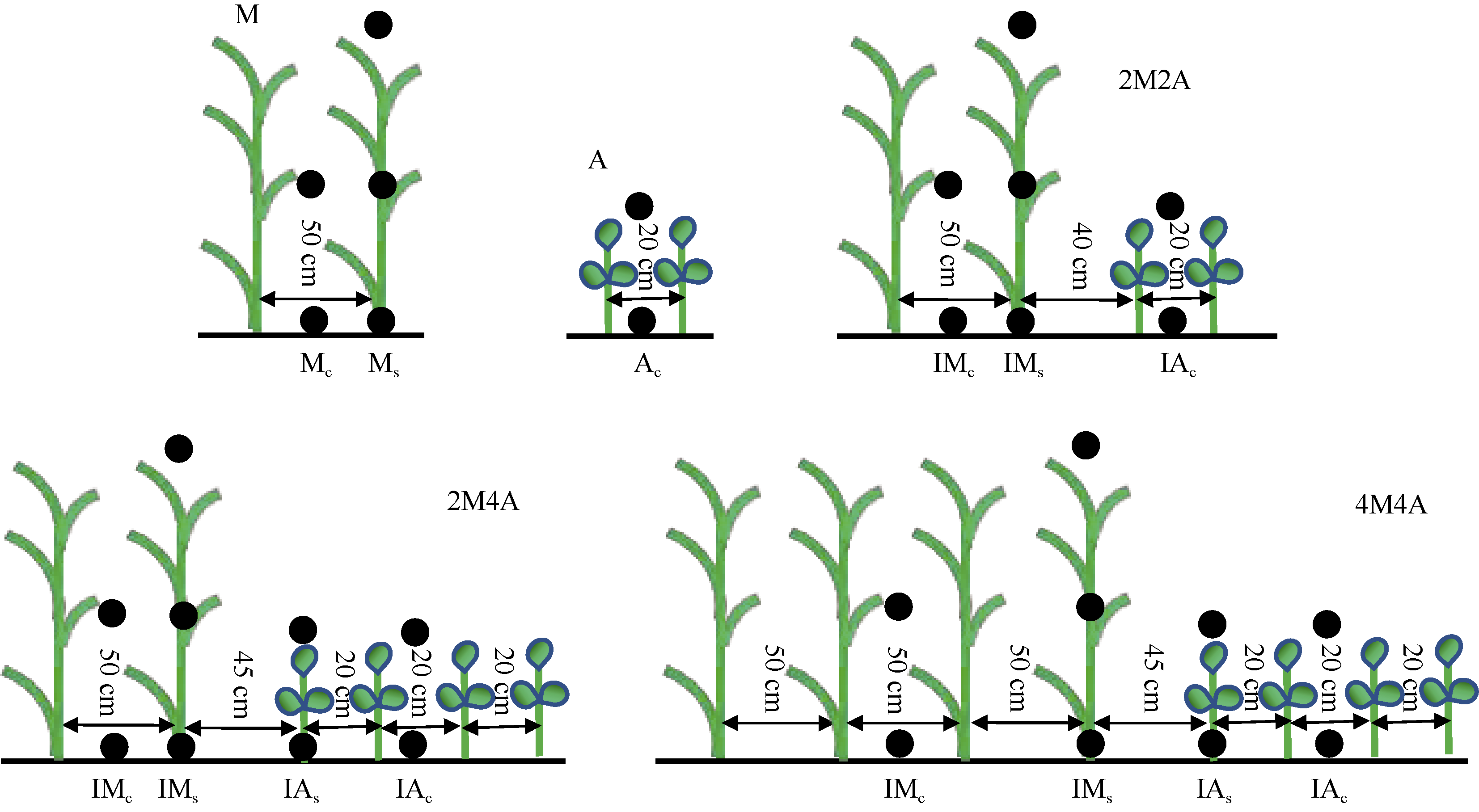
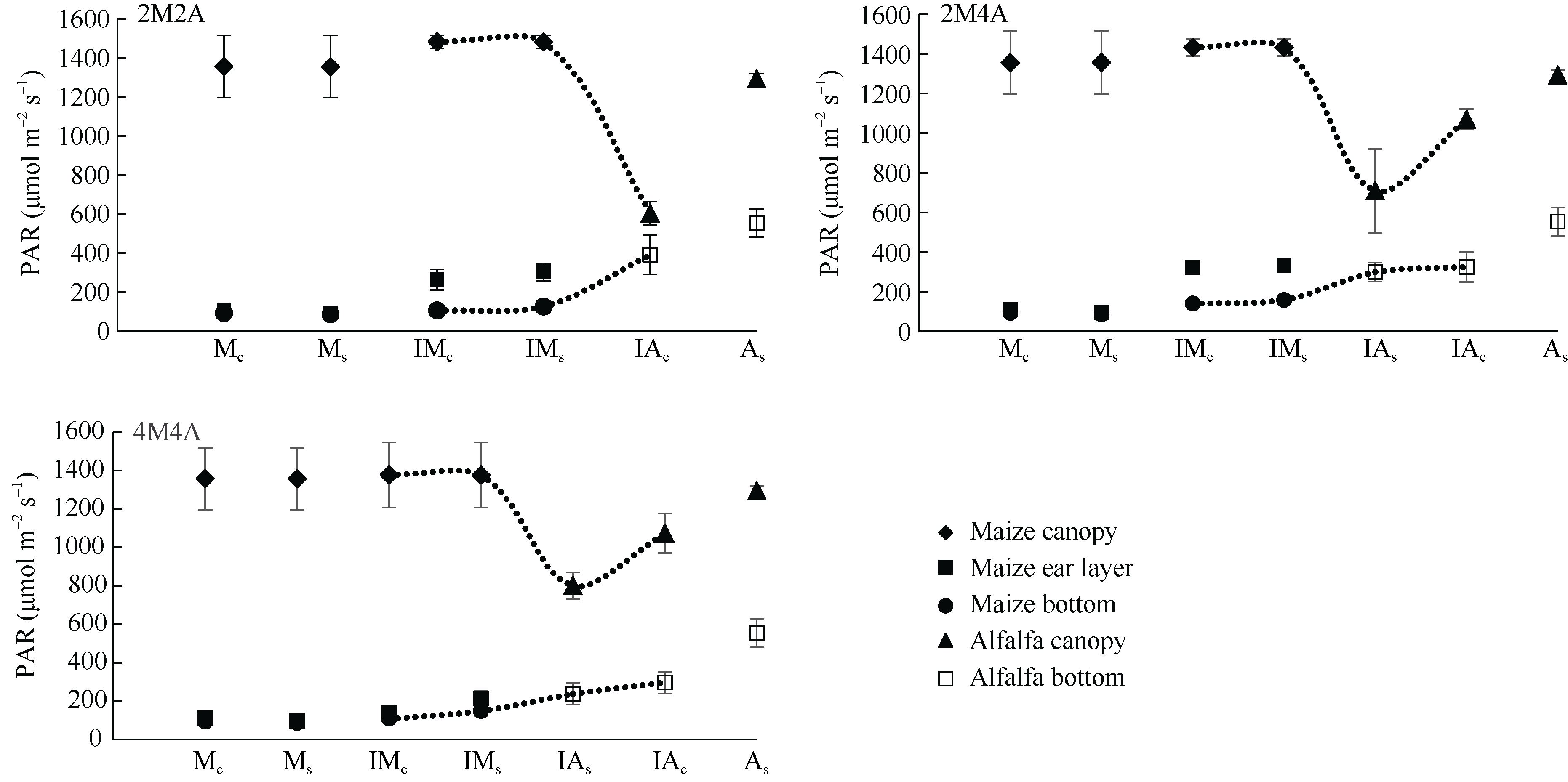
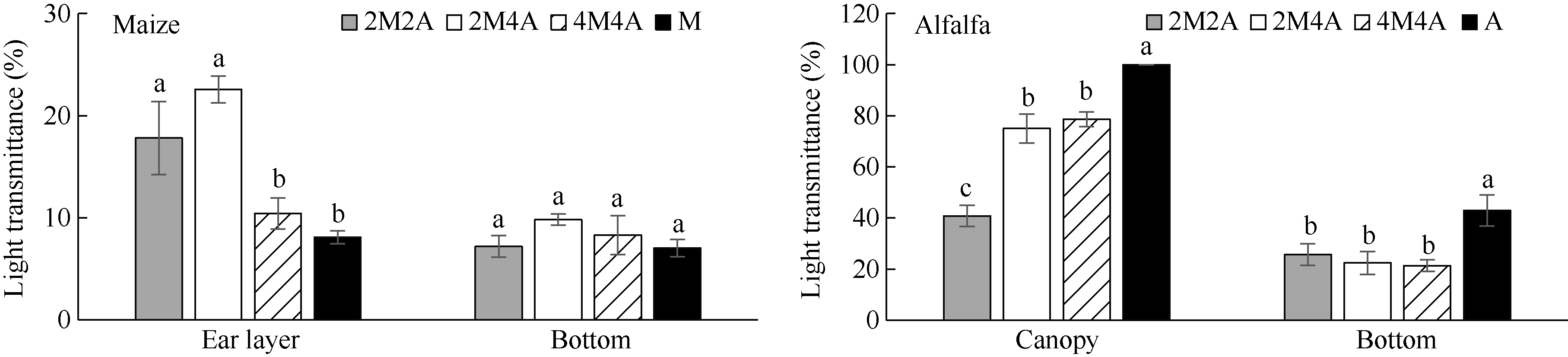
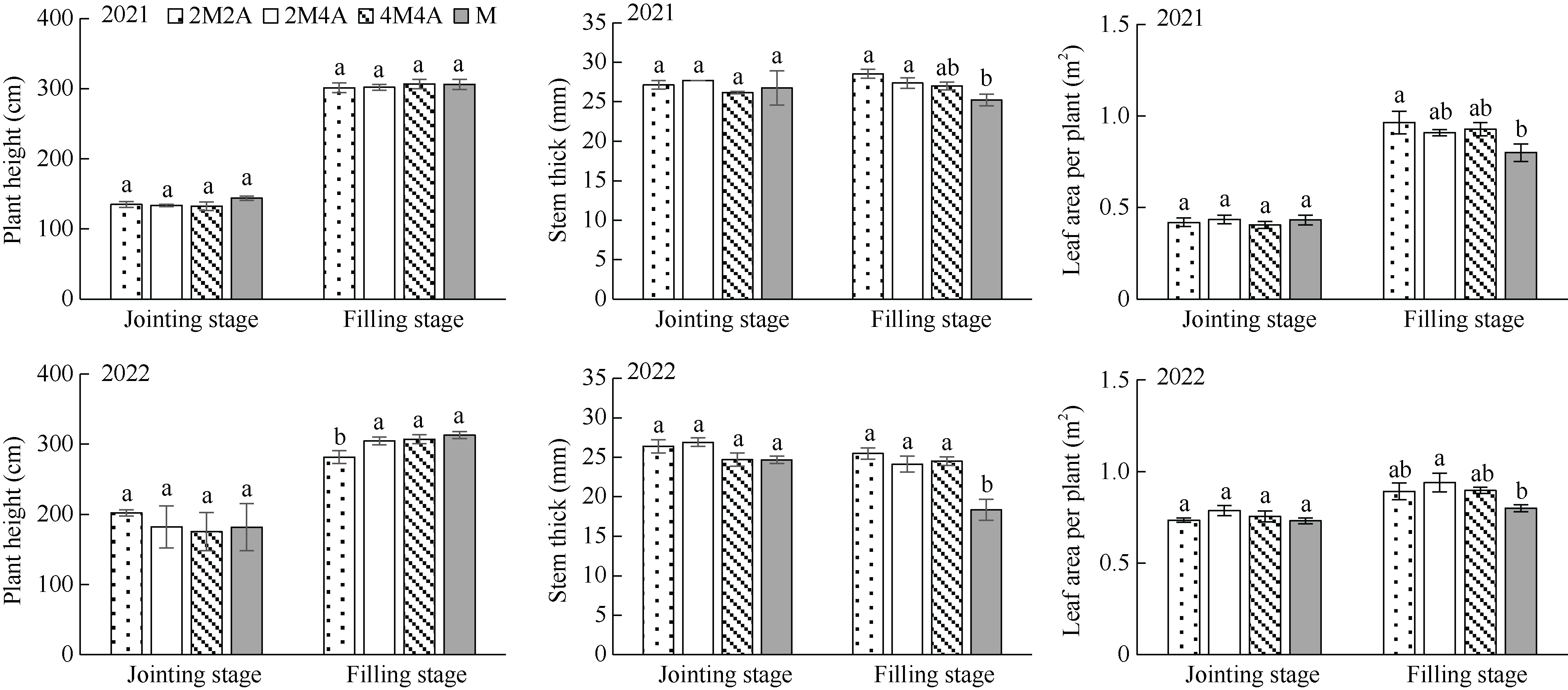
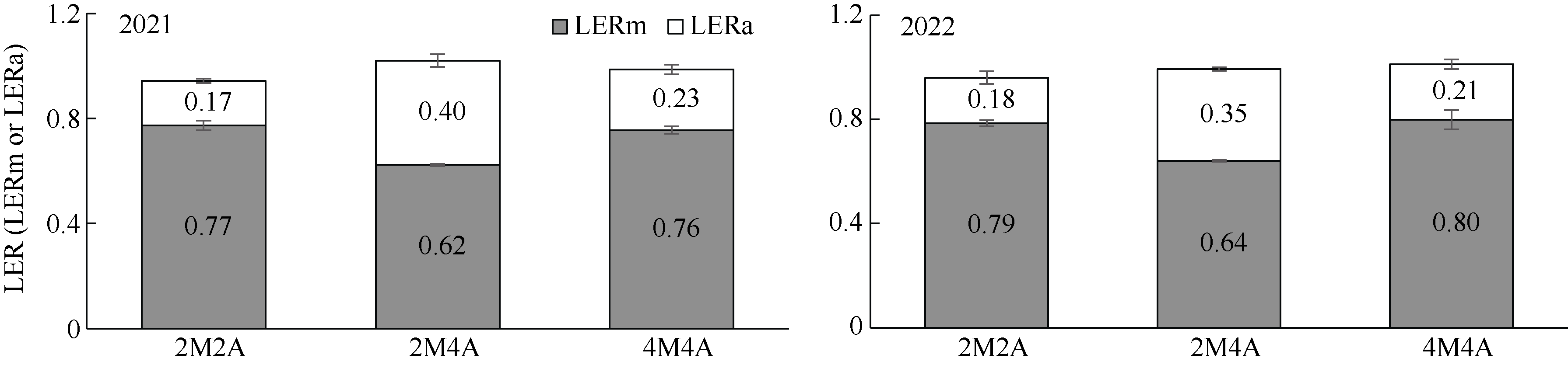
摘要: 为明确玉米‖紫花苜蓿间作群体光资源利用机制, 筛选适宜东北旱作农业区适宜的最优行比配置方式, 本研究于2021—2022年在典型旱作农业区辽宁阜新设置了2行玉米间作2行紫花苜蓿(2M2A)、2行玉米间作4行紫花苜蓿(2M4A)、4行玉米间作4行紫花苜蓿(4M4A)、玉米单作(M)和紫花苜蓿单作(A)5个试验处理的田间定位试验。研究了间作模式对玉米‖紫花苜蓿间作群体光分布及植物性状和产量的影响。结果表明: 玉米‖紫花苜蓿间作系统中紫花苜蓿冠层PAR明显小于玉米冠层; 玉米群体光环境因间作模式而得到改善, 间作玉米穗位层透光率较单作玉米提高28.8%~178.4%, 底层的透光率亦大于单作, 但与单作差异不显著; 紫花苜蓿群体光环境因间作模式变差, 间作紫花苜蓿冠层透光率较单作紫花苜蓿降低21.4%~59.2%, 底层透光率降低40.3%~50.3%; 与单作玉米相比, 间作玉米灌浆期的茎粗和单株叶面积增大, 果穗长度显著增加, 果穗直径略有增加, 秃尖长度略有减小; 间作玉米通过显著提高穗数和穗粒数显著提高了产量, 增产幅度为13.29%~28.22%; 间作紫花苜蓿干草产量较单作降低20.91%~ 49.20%。总之, 间作模式改变了玉米‖紫花苜蓿间作群体的光分布, 适宜的行比配置可以平衡玉米‖紫花苜蓿对光的竞争, 改善植物性状, 提高产量。3种间作模式相比较, 2M4A土地当量比(1.01)最高, 有一定的间作优势, 其纯效益比单作玉米和单作苜蓿分别提高0.8%和10.5%; 4M4A土地当量比为1.00, 没有间作优势, 其纯效益比单作玉米和单作苜蓿分别提高1.9%和11.8%。综合考虑间作优势和纯效益2个指标, 2M4A是东北旱作农业区适宜的间作模式。
| [1] | 周海燕, 柴强, 黄高宝, 白锦龙. 绿洲灌区典型间作模式的产量和光能利用效率. 甘肃农业大学学报, 2012, 47(6): 68-73. |
| Zhou H Y, Chai Q, Huang G B, Bai J L. The yield and light use efficiency of different intercropping systems in the Hexi oasis irrigation area. J Gansu Agric Univ, 2012, 47(6): 68-73 (in Chinese with English abstract). | |
| [2] | Shen L, Wang X Y, Liu T T, Wei W W, Zhang S, Keyhani A B, Li L H, Zhang W. Border row effects on the distribution of root and soil resources in maize-soybean strip intercropping systems. Soil Tillage Res, 2023, 233: 105812. |
| [3] | 孙翔龙, 冯良山, 杨宁, 张诗行, 夏桂敏. 辽西半干旱区玉米花生间作对不同降水年型下产量与水分利用效率的影响. 沈阳农业大学学报, 2024, 55: 530-537. |
| Sun X L, Feng L S, Yang N, Zhang S H, Xia G M. Effects of maize and peanut intercropping on yield and water use efficiency under different precipitation years in semi-arid region of western Liaoning. J Shenyang Agric Univ, 2024, 55: 530-537 (in Chinese with English abstract). | |
| [4] | Tao D X, Delgado-Baquerizo M, Zhou G Y, Revillini D, He Q, Swanson C S, Gao Y Z. Maize-alfalfa intercropping alleviates the dependence of multiple ecosystem services on nonrenewable fertilization. Agric Ecosyst Environ, 2024, 373: 109141. |
| [5] | 杨惠. 苜蓿玉米间作高效生产技术助力优质饲草供应. (2024-09-02) [2025-03-24]. http://www.agri.cn/zx/nyyw/202409/t20240902_8666979.htm. |
| Yang H. The efficient production technology of alfalfa corn intercropping helps the supply of high-quality forage grass. (2024-09-02) [2025-03-24]. http://www.agri.cn/zx/nyyw/202409/t20240902_8666979.htm (in Chinese). | |
| [6] |
陈彦龙, 齐帅, 许瑞轩, 张蓓, 王恕平, 董嘉莉, 曹文侠. 河西走廊玉米-苜蓿间作体系行数与密度对玉米生产性能的影响. 草地学报, 2025, 33: 2013-2022.
doi: 10.11733/j.issn.1007-0435.2025.06.032 |
| Chen Y L, Qi S, Xu R X, Zhang B, Wang S P, Dong J L, Cao W X. Effects of planting row number and density on maize performance in Hexi corridor corn-alfalfa intercropping system. Acta Agrest Sin, 2025, 33: 2013-2022 (in Chinese with English abstract). | |
| [7] | 张桂国, 董树亭, 杨在宾. 苜蓿+玉米间作系统产量表现及其种间竞争力的评定. 草业学报, 2011, 20(1): 22-30. |
| Zhang G G, Dong S T, Yang Z B. Production performance of alfalfa+maize intercropping systems and evaluation of interspecies competition. Acta Pratac Sin, 2011, 20(1): 22-30 (in Chinese with English abstract). | |
| [8] | 邵泽强, 刘书奇, 勾千冬, 依德萍, 陆文龙. 施氮和种植模式对玉米/紫花苜蓿间作体系中作物产量、吸氮量和根系形态的影响. 东北农业科学, 2023, 48(4): 6-11. |
| Shao Z Q, Liu S Q, Gou Q D, Yi D P, Lu W L. Effects of nitrogen application and planting patterns on crop yield, nitrogen uptake and root morphology in a maize/alfalfa intercropping system. J Northeast Agric Sci, 2023, 48(4): 6-11 (in Chinese with English abstract). | |
| [9] | 李玉玺, 王帅, 王立波, 刘凌云, 周昶延, 何东锐, 李芳慧, 梁政帅. 玉米单作及间作紫花苜蓿对产量性状及白浆土供肥特性的影响. 玉米科学, 2018, 26(4): 126-131. |
| Li Y X, Wang S, Wang L B, Liu L Y, Zhou C Y, He D R, Li F H, Liang Z S. Effects of maize monoculture and intercropped with Medicago sativa L. on yield of maize and nutrients of albic soil. J Maize Sci, 2018, 26(4): 126-131 (in Chinese with English abstract). | |
| [10] | 李双伟, 朱俊奇, Jochem B.EVERS, Wopke VAN DER WERF, 郭焱, 李保国, 马韫韬. 基于植物功能-结构模型的玉米-大豆条带间作光截获行间差异研究. 智慧农业(中英文), 2022, 4(1): 97-109. |
|
Li S W, Zhu J Q, Evers J B, Van der Werf W, Guo Y, Li B G, Ma Y T. Estimating the differences of light capture between rows based on functional-structural plant model in simultaneous maize-soybean strip intercropping. Smart Agric, 2022, 4(1): 97-109 (in Chinese with English abstract).
doi: 10.12133/j.smartag.SA202202002 |
|
| [11] | 王志梁, 任媛媛, 张岁岐. 黄土高原不同玉米-大豆间作模式对玉米生长发育的影响. 水土保持通报, 2014, 34(6): 321-326. |
| Wang Z L, Ren Y Y, Zhang S Q. Effect of maize-soybean intercropping modes on maize growth on Loess Plateau. Bull Soil Water Conserv, 2014, 34(6): 321-326 (in Chinese with English abstract). | |
| [12] |
武晶, 陈梦, 汪直华, 杨继芝, 李燕丽, 吴雨珊, 杨文钰. 带状间作不同带间距对玉米光能利用的影响. 中国农业科学, 2023, 56: 4648-4659.
doi: 10.3864/j.issn.0578-1752.2023.23.007 |
|
Wu J, Chen M, Wang Z H, Yang J Z, Li Y L, Wu Y S, Yang W Y. Effect of different strip distances on light energy utilization in strip intercropping maize. Sci Agric Sin, 2023, 56: 4648-4659 (in Chinese with English abstract).
doi: 10.3864/j.issn.0578-1752.2023.23.007 |
|
| [13] | Yang H, Zhang W P, Xu H S, Yu R P, Su Y, Surigaoge S, Wang P X, Yang X, Lambers H, Li L. Trade-offs and synergies of plant traits co-drive efficient nitrogen use in intercropping systems. Field Crops Res, 2023, 302: 109093. |
| [14] | 蔡倩, 孙占祥, 王文斌, 白伟, 杜桂娟, 张悦, 张哲, 冯晨, 向午燕, 赵凤艳. 辽西半干旱区玉米大豆间作对作物产量及水分利用的影响. 中国农业气象, 2022, 43: 551-562. |
| Cai Q, Sun Z X, Wang W B, Bai W, Du G J, Zhang Y, Zhang Z, Feng C, Xiang W Y, Zhao F Y. Yield and water use of maize/ soybean intercropping systems in semi-arid western Liaoning. Chin J Agrometeorol, 2022, 43: 551-562 (in Chinese with English abstract). | |
| [15] | 张忠华, 尹士芳, 谢宾. 大豆玉米间作对作物生长特性及产量效益的影响. 中国农技推广, 2024, 40(3): 44-47. |
| Zhang Z H, Yin S F, Xie B. Effect of maize/soybean intercropping on crop growth characteristics and yield benefits. China Agric Technol Ext, 2024, 40(3): 44-47 (in Chinese). | |
| [16] |
焦念元, 李亚辉, 杨潇, 尹飞, 马超, 齐付国, 刘领, 熊瑛. 玉米/花生间作行比和施磷对玉米光合特性的影响. 应用生态学报, 2016, 27: 2959-2967.
doi: 10.13287/j.1001-9332.201609.019 |
|
Jiao N Y, Li Y H, Yang X, Yin F, Ma C, Qi F G, Liu L, Xiong Y. Effects of maize/peanut intercropping row ratio and phosphate fertilizer on photosynthetic characteristics of maize. Chin J Appl Ecol, 2016, 27: 2959-2967 (in Chinese with English abstract).
doi: 10.13287/j.1001-9332.201609.019 |
|
| [17] | 郑皓远, 陈喜凤, 郭丹阳, 陈蕊, 玛丽亚穆·吾斯曼, 刘颖, 谷岩. 条带间作对玉米大豆光能利用特征、产量及经济收入的影响. 东北农业科学, 2023, 48(6): 1-5. |
| Zheng H Y, Chen X F, Guo D Y, Chen R, Mariamu·Usman, Liu Y, Gu Y. Effects of light energy utilization characteristics, yield and economic output of maize-soybean strip intercropping. J Northeast Agric Sci, 2023, 48(6): 1-5 (in Chinese with English abstract). | |
| [18] |
高超, 陈平, 杜青, 付智丹, 罗凯, 林萍, 李易玲, 刘姗姗, 雍太文, 杨文钰. 播期、 密度对带状间作大豆茎叶生长及产量形成的影响. 作物学报, 2023, 49: 3090-3099.
doi: 10.3724/SP.J.1006.2023.34029 |
|
Gao C, Chen P, Du Q, Fu Z D, Luo K, Lin P, Li Y L, Liu S S, Yong T W, Yang W Y. Effects of sowing date and density on stem, leaf growth, and yield formation in strip intercropping soybean. Acta Agron Sin, 2023, 49: 3090-3099 (in Chinese with English abstract).
doi: 10.3724/SP.J.1006.2023.34029 |
|
| [19] | 乔寅英, 柴强. 带型及施氮水平对玉米间作豌豆群体光分布的影响. 甘肃农业大学学报, 2017, 52(6): 33-38. |
| Qiao Y Y, Chai Q. Effect of band pattern and nitrogen application levels on light distribution in maize-pea intercropping systems. J Gansu Agric Univ, 2017, 52(6): 33-38 (in Chinese with English abstract). | |
| [20] | 宁自力, 王贝贝, 谭先明, 滕一鸣, 杨文钰, 杨峰. 玉米行向配置对带状套作大豆光合特性、叶片结构及产量的影响. 中国生态农业学报(中英文), 2023, 31: 1038-1052. |
| Ning Z L, Wang B B, Tan X M, Teng Y M, Yang W Y, Yang F. Effect of maize row orientation configurations on the photosynthetic characteristics, leaf structure and yield of soybean in relay strip intercropping systems. Chin J Eco-Agric, 2023, 31: 1038-1052 (in Chinese with English abstract). | |
| [21] |
刘涵, 丁迪, 汪江涛, 郑宾, 王笑笑, 朱晨旭, 刘娟, 刘领, 付国占, 焦念元. 玉米穗型与种植密度对玉米花生间作种间竞争的协调效应. 中国农业科学, 2024, 57: 3758-3769.
doi: 10.3864/j.issn.0578-1752.2024.19.004 |
|
Liu H, Ding D, Wang J T, Zheng B, Wang X X, Zhu C X, Liu J, Liu L, Fu G Z, Jiao N Y. Coordinated effects of maize ear type and planting density on interspecific competition in maize-peanut intercropping system. Sci Agric Sin, 2024, 57: 3758-3769 (in Chinese with English abstract).
doi: 10.3864/j.issn.0578-1752.2024.19.004 |
|
| [22] |
吴玉环, 王自奎, 刘亚男, 马千虎. 带幅设计对玉米/苜蓿间作群体光环境特征及光能利用效率的影响. 草业学报, 2022, 31(3): 144-155.
doi: 10.11686/cyxb2020595 |
| Wu Y H, Wang Z K, Liu Y N, Ma Q H. Effects of row configuration on characteristics of the light environment and light use efficiency in maize/alfalfa intercropping. Acta Pratac Sin, 2022, 31(3): 144-155 (in Chinese with English abstract). | |
| [23] | Wang R N, Sun Z X, Zhang L Z, Yang N, Feng L S, Bai W, Zhang D S, Wang Q, Evers J B, Liu Y, et al. Border-row proportion determines strength of interspecific interactions and crop yields in maize/peanut strip intercropping. Field Crops Res, 2020, 253: 107819. |
| [24] | Wang Z S, Dong B, Stomph T J, Evers J B, van der Putten P E L, Ma H H, Missale R, van der Werf W. Temporal complementarity drives species combinability in strip intercropping in the Netherlands. Field Crops Res, 2023, 291: 108757. |
| [25] | 刘朝巍, 张恩和, 谢瑞芝, 刘武仁, 李少昆. 玉米宽窄行交替休闲保护性耕作的根系和光分布特征研究. 中国生态农业学报, 2012, 20: 203-209. |
| Liu C W, Zhang E H, Xie R Z, Liu W R, Li S K. Effect of conservation tillage of wide/narrow row planting on maize root and transmittance distribution. Chin J Eco-Agric, 2012, 20: 203-209 (in Chinese with English abstract). | |
| [26] | 刚永和, 张海博, 牛勇, 杜江, 陈永珑, 萨仁花. 青海东部农业干旱区不同播种方式对紫花苜蓿农艺性状和生产性能的影响. 草业科学, 2021, 38: 327-334. |
| Gang Y H, Zhang H B, Niu Y, Du J, Chen Y L, Sa R H. Effects of different sowing methods on the agronomic and productive properties of alfalfa in the agricultural arid area of Eastern Qinghai. Pratac Sci, 2021, 38: 327-334 (in Chinese with English abstract). | |
| [27] |
王昀杰, 樊志龙, 张刁亮, 毛守发, 胡发龙, 殷文, 柴强. 不同灌水量下玉米的产量可持续性对间作绿肥的响应. 作物学报, 2024, 50: 2562-2574.
doi: 10.3724/SP.J.1006.2024.33068 |
| Wang Y J, Fan Z L, Zhang D L, Mao S F, Hu F L, Yin W, Chai Q. Response of the yield sustainability of maize with different irrigated quota to intercropped green manure. Acta Agron Sin, 2024, 50: 2562-2574 (in Chinese with English abstract). | |
| [28] |
刘铁宁, 徐彩龙, 谷利敏, 董树亭. 高密度种植条件下去叶对不同株型夏玉米群体及单叶光合性能的调控. 作物学报, 2014, 40: 143-153.
doi: 10.3724/SP.J.1006.2014.00143 |
| Liu T N, Xu C L, Gu L M, Dong S T. Effects of leaf removal on canopy apparent photosynthesis and individual leaf photosynthetic characteristics in summer maize under high plant density. Acta Agron Sin, 2014, 40: 143-153 (in Chinese with English abstract). | |
| [29] |
任媛媛, 张莉, 郁耀闯, 张彦军, 张岁岐. 大豆种植密度对玉米/大豆间作系统产量形成的竞争效应分析. 作物学报, 2021, 47: 1978-1987.
doi: 10.3724/SP.J.1006.2021.04226 |
| Ren Y Y, Zhang L, Yu Y C, Zhang Y J, Zhang S Q. Competitive effect of soybean density on yield formation in maize/soybean intercropping systems. Acta Agron Sin, 2021, 47: 1978-1987 (in Chinese with English abstract). | |
| [30] | Zhang Y, Sun Z X, Su Z C, Du G J, Bai W, Wang Q, Wang R N, Nie J Y, Sun T R, Feng C, et al. Root plasticity and interspecific complementarity improve yields and water use efficiency of maize/soybean intercropping in a water-limited condition. Field Crops Res, 2022, 282: 108523. |
| [31] |
蔺芳, 刘晓静, 童长春, 吴勇. 间作对不同类型饲料作物光能利用特征及生产能力的影响. 应用生态学报, 2019, 30: 3452-3462.
doi: 10.13287/j.1001-9332.201910.006 |
| Lin F, Liu X J, Tong C C, Wu Y. Effects of intercropping on light energy utilization characteristics and productivity of different feed crops. Chin J Appl Ecol, 2019, 30: 3452-3462 (in Chinese with English abstract). | |
| [32] | 龙雪芬, 孙雨萌, 张浩, 赵曦然, 杨春. 我国苜蓿进口依赖性分析及中西苜蓿贸易展望. 中国饲料, 2025, (5): 138-148. |
| Long X F, Sun Y M, Zhang H, Zhao X R, Yang C. Analysis of China’s alfalfa import dependence and prospects for Sino Western alfalfa trade. China Feed, 2025, (5): 138-148 (in Chinese with English abstract). |
| [1] | 刘恩波, 陈静, 李红星, 于宁宁, 任佰朝, 赵斌, 刘鹏, 张吉旺. 遮阴改变源-库平衡和调节碳水化合物代谢进而抑制夏玉米幼穗发育[J]. 作物学报, 2026, 52(6): 1891-1901. |
| [2] | 胡川, 赵凯男, 黄修利, 吴金芝, 任开明, 王贺正, 付国占, 黄明, 李友军. 一次灌溉下耕作方式和氮肥用量对旱地小麦产量和品质的影响[J]. 作物学报, 2026, 52(6): 1830-1846. |
| [3] | 梁进宇, 尹嘉德, 王红丽, 张国平, 侯慧芝, 董博, 马明生. 基于无人机高光谱和机器学习的旱地饲用玉米叶片氮含量估测[J]. 作物学报, 2026, 52(6): 1788-1801. |
| [4] | 马胜乾, 王志平, 陈浩天, 窦淑贤, 张燕, 邓艾兴, 张卫建, 原向阳, 宋振伟. 秸秆还田下耕作方式与氮肥施用量对东北玉米产量及土壤团聚体的影响[J]. 作物学报, 2026, 52(6): 1802-1816. |
| [5] | 孙淑凤, 许振南, 黄嘉鑫, 翁建峰, 李新海. 玉米MAPK家族全基因组鉴定及其对拟轮枝镰孢菌感染的响应[J]. 作物学报, 2026, 52(5): 1291-1308. |
| [6] | 张思思, 赵向辉, 周洋, 姚云凤, 朱荣昱, 董元杰, 胡国庆, 徐通, 刘兆新. 冬闲期翻耕和绿肥还田对连作花生田土壤理化性质和产量的影响[J]. 作物学报, 2026, 52(5): 1472-1486. |
| [7] | 张宁宁, 滕雨菲, 任娜娜, 魏兴卓, 闫书豪, 樊可心, 王永宏, 陈文康, 张兴华, 朱万超, 徐淑兔, 薛吉全. 201份玉米自交系抗旱表型评价及可塑性分析[J]. 作物学报, 2026, 52(5): 1309-1325. |
| [8] | 杨欣雨, 崔文涛, 迪力尼格尔·阿力木, 汪凯翔, 吴鹏昊, 任姣姣. 玉米穗上叶片数全基因组关联分析和全基因组选择[J]. 作物学报, 2026, 52(5): 1573-1590. |
| [9] | 韩亚鑫, 何冠华, 张小琼, 张登峰, 李永祥, 刘旭洋, 王天宇, 黎裕, 邹华文, 李春辉. 基于RNA-Seq和BSA-Seq联合分析挖掘玉米侧根密度基因资源[J]. 作物学报, 2026, 52(5): 1341-1352. |
| [10] | 张振, 冯连杰, 石玉, 于振文, 张永丽. 节水补灌下不同穗型小麦产量形成差异研究[J]. 作物学报, 2026, 52(5): 1522-1535. |
| [11] | 闫安, 蒋昆炜, 王蓉圆, 田林, 张璐, 王韵, 徐建龙. 水稻剑叶小维管束数基因SVN7的鉴定与克隆[J]. 作物学报, 2026, 52(5): 1364-1372. |
| [12] | 刘昕萌, 任昊, 张继波, 张吉旺, 赵斌, 任佰朝, 刘鹏, 王洪章. 茉莉酸甲酯(MeJA)缓解高温影响玉米雌穗分化的生理机制[J]. 作物学报, 2026, 52(5): 1561-1572. |
| [13] | 王壮壮, 武紫君, 张永新, 张芯源, 袁丽雪, 陈如雪, 刘世举, 段剑钊, 冯伟, 王同朝, 王永华. 豫东南黏壤潮土区水氮优化协同提高冬小麦产量和氮素利用效率[J]. 作物学报, 2026, 52(5): 1501-1521. |
| [14] | 王宇诚, 张露, 刘阿康, 黄见良, 彭少兵, 袁珅. 基于产量差的作物大面积单产提升策略与展望[J]. 作物学报, 2026, 52(5): 1279-1290. |
| [15] | 赵佳雪, 周龙昊, 郭岂源, 尚伦霄, 王涵, 刘志涛, 陈曦, 张晓佩, 宋宪亮, 毛丽丽. 长期秸秆还田与深松通过改善土壤环境与棉花光合特性提高滨海盐碱地棉花产量[J]. 作物学报, 2026, 52(5): 1548-1560. |
|
||