欢迎访问作物学报,今天是
作物学报 ›› 2026, Vol. 52 ›› Issue (1): 178-190.doi: 10.3724/SP.J.1006.2026.53050
所属专题: 玉米:耕作栽培·生理生化
陈宣伊1,2,3( ), 张健伟1,2, 张向前1,2,*(), 葛国龙3, 路战远1,2,3,*(), 郭星星4, 马子惠4, 李欣艺4, 陈立宇1,2
Chen Xuan-Yi1,2,3(), Zhang Jian-Wei1,2, Zhang Xiang-Qian1,2,*(), Ge Guo-Long3, Lu Zhan-Yuan1,2,3,*(), Guo Xing-Xing4, Ma Zi-Hui4, Li Xin-Yi4, Chen Li-Yu1,2
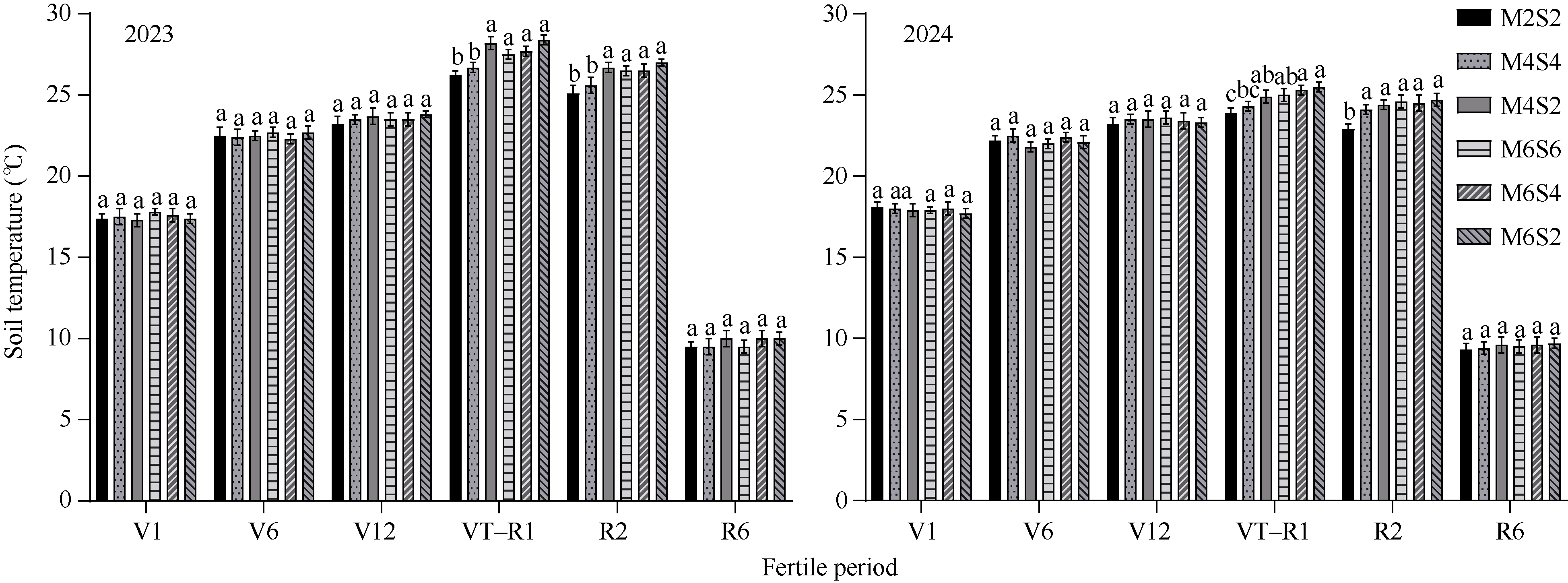
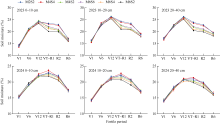
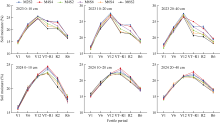
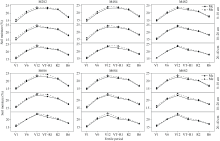
摘要: 为明确内蒙古东北黑土区适宜的大豆‖玉米条带间作模式, 于2023年和2024年在大兴安岭东麓阿荣旗以玉米和大豆为供试材料, 系统研究了玉米大豆不同间作模式2行玉米‖2行大豆(M2S2)、4行玉米‖4行大豆(M4S4)、4行玉米‖2行大豆(M4S2)、6行玉米‖6行大豆(M6S6)、6行玉米‖4行大豆(M6S4)和6行玉米‖2行大豆(M6S2)的玉米带土壤水热时空动态变化规律及产量差异。结果表明, (1) M4S4和M2S2土壤含水量在关键生育时期普遍高于其余处理, 土壤表层温度显著低于其他处理; M2S2在抽雄—吐丝期和灌浆期的土壤含水量分别比其他处理增加1.59%~16.85%和1.89%~14.82%, 与M4S4差异不显著; 同时2个处理在全生育时期下表现出较为均匀的水分分布; (2) 玉米单株产量、水分利用效率均以M2S2最高、M4S4次高; M4S4土地当量比最高, 在2年间分别为1.61和1.60, 复合种植系统的产投比也以M4S4最高, 达6.61, 比其他处理提高7.39%~32.28%。综上所述, M4S4带状间作布局是较适宜内蒙古东北黑土区推广的大豆‖玉米带状间作种植模式。
| [1] | 国家统计局. 2024年国家统计年鉴. 北京: 中国统计出版社, 2024. |
| National Bureau of Statistics of China. China Statistical Yearbook 2024. Beijing: China Statistics Press, 2024 (in Chinese). | |
| [2] | 李国景, 罗其友. 我国耕地资源保护与利用体系、挑战与对策. 山西农业大学学报(社会科学版), 2023, 22(6): 9-15. |
| Li G J, Luo Q Y. The system, challenges and countermeasures of the protection and utilization of China’s cultivated land resources. J Shanxi Agric Univ (Soc Sci Edn), 2023, 22(6): 9-15 (in Chinese with English abstract). | |
| [3] | 陈源源, 孙艺. 未来30年我国粮食增产潜力与保障能力研究. 四川农业大学学报, 2022, 40: 312-318. |
| Chen Y Y, Sun Y. Study on the production increasing potential and guarantee capability of grain in China in the next 30 years. J Sichuan Agric Univ, 2022, 40: 312-318 (in Chinese with English abstract). | |
| [4] | 奎国秀, 祁春节, 方国柱. 中国主要粮食产品进口贸易的资源效应和环境效应研究. 世界农业, 2021(5): 16-25. |
| Kui G X, Qi C J, Fang G Z. Study on the resource effect and environmental effect of China’s import trade of major grain. World Agric, 2021(5): 16-25 (in Chinese with English abstract). | |
| [5] | 冉漫雪, 孙东宝, 丁军军. 种植模式对作物产量及间作系统种间关系的影响. 干旱地区农业研究, 2024, 42(6): 61-68. |
| Ran M X, Sun D B, Ding J J. Effects of cropping patterns on crop yields and interspecific relationships in intercropping systems. Agric Res Arid Areas, 2024, 42(6): 61-68 (in Chinese with English abstract). | |
| [6] |
Brooker R W, Bennett A E, Cong W F, et al. Improving intercropping: a synthesis of research in agronomy, plant physiology and ecology. New Phytol, 2015, 206: 107-117.
pmid: 25866856 |
| [7] | 武维华. 植物生理学. 北京: 科学出版社, 2003. pp 68-69. |
| Wu W H. Phytophysiology. Beijing: Science Press, 2003. pp 68-69 (in Chinese). | |
| [8] | 张唯一, 张志亮, 郑彩霞, 等. 玉米-大豆间作系统土壤水分分布特征研究进展. 灌溉排水学报, 2018, 37(增刊2): 131-133. |
| Zhang W Y, Zhang Z L, Zheng C X, et al. Advance of soil moisture distribution characteristics in maize-soybean intercropping system. J Irrig Drain, 2018, 37(S2): 131-133 (in Chinese with English abstract). | |
| [9] | 李俊祥, 宛志沪. 淮北平原杨-麦间作系统的小气候效应与土壤水分变化研究. 应用生态学报, 2002, 13: 390-394. |
| Li J X, Wan Z H. Microclimatic effect and soil moisture change of poplar-wheat intercropping systems in Huaibei Plain. Chin J Appl Ecol, 2002, 13: 390-394 (in Chinese with English abstract). | |
| [10] | 李倩倩, 王星运, 李孟浩, 等. 小麦玉米间作和氮肥对作物耗水特性及水分利用的影响. 西北农业学报, 2021, 30: 819-828. |
| Li Q Q, Wang X Y, Li M H, et al. Effects of wheat/maize strip intercropping and nitrogen fertilizer on crops water consumption and water use. Acta Agric Boreali-Occident Sin, 2021, 30: 819-828 (in Chinese with English abstract). | |
| [11] | 鲜高结. 西北半干旱地区水分调控措施对玉米大豆带状间作水分利用效率的影响. 四川农业大学硕士学位论文, 四川雅安, 2024. |
| Xian G J. Effect of Water Control Measures on Water Use Efficiency of Maize-soybean Strip Intercropping in Semi-arid Area of Northwest China. MS Thesis of Sichuan Agricultural University, Ya’an, Sichuan, China, 2024 (in Chinese with English abstract). | |
| [12] | 马亮. 干旱区滴灌枣-棉间作系统蒸发蒸腾量及地下竞争关系研究. 新疆农业大学博士学位论文, 新疆乌鲁木齐, 2018. |
| Ma L. Study on the Relationship between Evapotranspiration and Underground Competition of Jujube-cotton Intercropping System under Drip Irrigation in Arid Area. PhD Dissertation of Xinjiang Agricultural University, Urumqi, Xinjiang, China, 2018 (in Chinese with English abstract). | |
| [13] |
Du S N, Bai G S, Yu J. Soil properties and apricot growth under intercropping and mulching with erect milk vetch in the loess hilly-gully region. Plant Soil, 2015, 390: 431-442.
doi: 10.1007/s11104-014-2363-7 |
| [14] | 刘席文, 马淑梅, 余常兵, 等. 长江流域田间配置对玉米-大豆带状复合种植群体产量和气候资源利用效率的影响. 四川农业大学学报, 2024, 42: 724-734. |
| Liu X W, Ma S M, Yu C B, et al. Effects of field configuration on yield and climate resource utilization efficiency of maize-soybean strip intercropping in the Yangtze River Basin. J Sichuan Agric Univ, 2024, 42: 724-734 (in Chinese with English abstract). | |
| [15] | 袁晓婷, 汤松, 罗凯, 等. 大豆玉米带状复合种植产量与效益分析: 基于全国16个示范省(市、区)的调查数据. 四川农业大学学报, 2023, 41: 834-841. |
| Yuan X T, Tang S, Luo K, et al. Yield and benefit analysis of soybean and maize strip compound planting: based on survey data of 16 demonstration provinces (municipalities, autonomous regions). J Sichuan Agric Univ, 2023, 41: 834-841 (in Chinese with English abstract). | |
| [16] |
Tao Z Q, Li C F, Li J J, et al. Tillage and straw mulching impacts on grain yield and water use efficiency of spring maize in Northern Huang-Huai-Hai valley. Crop J, 2015, 3: 445-450.
doi: 10.1016/j.cj.2015.08.001 |
| [17] |
Martin-Guay M O, Paquette A, Dupras J, et al. The new Green Revolution: sustainable intensification of agriculture by intercropping. Sci Total Environ, 2018, 615: 767-772.
doi: 10.1016/j.scitotenv.2017.10.024 |
| [18] |
张振, 石玉, 张永丽, 等. 土壤水分含量对小麦耗水特性和旗叶/根系衰老特性的影响. 作物学报, 2023, 49: 1895-1905.
doi: 10.3724/SP.J.1006.2023.21052 |
|
Zhang Z, Shi Y, Zhang Y L, et al. Effects of different soil water content on water consumption by wheat and analysis of senescence characteristics of root and flag leaf. Acta Agron Sin, 2023, 49: 1895-1905 (in Chinese with English abstract).
doi: 10.3724/SP.J.1006.2023.21052 |
|
| [19] | 陈江鲁, 杨京京, 丁变红, 等. 滴灌量对新疆高产玉米产量和蒸腾量的影响. 江苏农业科学, 2017, 45(18): 67-71. |
| Chen J L, Yang J J, Ding B H, et al. Effect of drip irrigation on yield and transpiration of high-yield maize in Xinjiang. Jiangsu Agric Sci, 2017, 45(18): 67-71 (in Chinese with English abstract). | |
| [20] | 柴强, 殷文. 间作系统的水分竞争互补机理. 生态学杂志, 2017, 36(1): 233-239. |
| Chai Q, Yin W. Research advances in water competition and complementary interaction of intercropping agroecosystems. Chin J Ecol, 2017, 36(1): 233-239 (in Chinese with English abstract). | |
| [21] | 刘景辉, 曾昭海, 焦立新, 等. 不同青贮玉米品种与紫花苜蓿的间作效应. 作物学报, 2006, 32: 125-130. |
| Liu J H, Zeng Z H, Jiao L X, et al. Intercropping of different silage maize cultivars and alfalfa. Acta Agron Sin, 2006, 32: 125-130 (in Chinese with English abstract). | |
| [22] |
Zhang F S, Li L. Using competitive and facilitative interactions in intercropping systems enhances crop productivity and nutrient-use efficiency. Plant Soil, 2003, 248: 305-312.
doi: 10.1023/A:1022352229863 |
| [23] |
Fang J, Ma J, Wen T, et al. Cry for help from rhizosphere microbiomes and self-rescue strategies cooperatively alleviate drought stress in spring wheat. Soil Biol Biochem, 2025, 206: 109813.
doi: 10.1016/j.soilbio.2025.109813 |
| [24] | 闫小红. 间作模式下不同带宽对土壤含水量的影响. 杨凌职业技术学院学报, 2024, 23(1): 18-21. |
| Yan X H. Effects of different bandwidths on soil moisture content under intercropping patterns. J Yangling Vocat Tech Coll, 2024, 23(1): 18-21 (in Chinese with English abstract). | |
| [25] | 高阳. 玉米/大豆条带间作群体PAR和水分的传输与利用. 中国农业科学院博士学位论文, 北京, 2009. |
| Gao Y. Transport and Use of PAR and Water in Maize/Soybean Strip Intercropping System. PhD Dissertation of Chinese Academy of Agricultural Sciences, Beijing, China, 2009 (in Chinese with English abstract). | |
| [26] |
Bekele B, Ademe D, Gemi Y, et al. Evaluation of intercropping legume covers with maize on soil moisture improvement in misrak azerinet berbere woreda, SNNPR, Ethiopia. Water Conserv Sci Eng, 2021, 6: 145-151.
doi: 10.1007/s41101-021-00109-w |
| [27] | 高阳, 段爱旺, 刘战东, 等. 玉米/大豆间作条件下的作物根系生长及水分吸收. 应用生态学报, 2009, 20: 307-313. |
| Gao Y, Duan A W, Liu Z D, et al. Crop root growth and water uptake in maize/soybean strip intercropping. Chin J Appl Ecol, 2009, 20: 307-313 (in Chinese with English abstract). | |
| [28] |
Liu S P, Wang L X, Khan I, et al. Comparative study of straw mulching and interplanting patterns on water use efficiency and productivity of the maize-soybean cropping system. Environ Dev Sustain, 2025, 27: 16883-16911.
doi: 10.1007/s10668-024-04617-2 |
| [29] |
Feng L, Shi K, Liu X, et al. Optimizing trade-offs between light transmittance and intraspecific competition under varying crop layouts in a maize-soybean strip relay cropping system. Crop J, 2024, 12: 1780-1790.
doi: 10.1016/j.cj.2024.10.010 |
| [30] | 徐延辉, 王畅, 郑殿峰, 等. 带状复合种植对玉米和大豆光合特性及籽粒产量的影响. 大豆科学, 2017, 36: 540-546. |
| Xu Y H, Wang C, Zheng D F, et al. Effects of the strip compound planting system on photosynthetic characteristics and grain yield of maize and soybean. Soybean Sci, 2017, 36: 540-546 (in Chinese with English abstract). | |
| [31] |
蔡倩, 孙占祥, 郑家明, 等. 辽西半干旱区玉米大豆间作模式对作物干物质积累分配、产量及土地生产力的影响. 中国农业科学, 2021, 54: 909-920.
doi: 10.3864/j.issn.0578-1752.2021.05.004 |
| Cai Q, Sun Z X, Zheng J M, et al. Dry matter accumulation, allocation, yield and productivity of maize-soybean intercropping systems in the semi-arid region of western Liaoning province. Sci Agric Sin, 2021, 54: 909-920 (in Chinese with English abstract). | |
| [32] | 杨科, 徐红丽, 许靖宜, 等. 玉米大豆带状复合种植模式产量与效益研究. 安徽农业科学, 2021, 49(17): 40-42. |
| Yang K, Xu H L, Xu J Y, et al. Study on yield and benefit of zonal compound planting pattern of maize and soybean. J Anhui Agric Sci, 2021, 49(17): 40-42 (in Chinese with English abstract). | |
| [33] | 雍太文, 杨文钰. 玉米大豆带状复合种植技术的优势、成效及发展建议. 中国农民合作社, 2022(3): 20-22. |
| Yong T W, Yang W Y. Advantages, effects and development suggestions of strip compound planting technology of corn and soybean. China Farmers’ Coop, 2022(3): 20-22 (in Chinese with English abstract). | |
| [34] | 刘燕, 陈彬, 于庆旭, 等. 大豆玉米带状复合种植机械化技术与装备研究进展. 中国农机化学报, 2023, 44(1): 39-47. |
| Liu Y, Chen B, Yu Q X, et al. Research progress of mechanization technology and equipment of soybean and corn strip compound planting. J Chin Agric Mech, 2023, 44(1): 39-47 (in Chinese with English abstract). | |
| [35] | 江景涛, 王东伟, 杨文卿, 等. 我国间作播种机械化技术及装备探析. 江苏农业科学, 2021, 49(14): 40-44. |
| Jiang J T, Wang D W, Yang W Q, et al. Analysis of technology and equipment of intercropping and seeding mechanization in China. Jiangsu Agric Sci, 2021, 49(14): 40-44 (in Chinese with English abstract). |
| [1] | 刘恩波, 陈静, 李红星, 于宁宁, 任佰朝, 赵斌, 刘鹏, 张吉旺. 遮阴改变源-库平衡和调节碳水化合物代谢进而抑制夏玉米幼穗发育[J]. 作物学报, 2026, 52(6): 1891-1901. |
| [2] | 胡川, 赵凯男, 黄修利, 吴金芝, 任开明, 王贺正, 付国占, 黄明, 李友军. 一次灌溉下耕作方式和氮肥用量对旱地小麦产量和品质的影响[J]. 作物学报, 2026, 52(6): 1830-1846. |
| [3] | 梁进宇, 尹嘉德, 王红丽, 张国平, 侯慧芝, 董博, 马明生. 基于无人机高光谱和机器学习的旱地饲用玉米叶片氮含量估测[J]. 作物学报, 2026, 52(6): 1788-1801. |
| [4] | 马胜乾, 王志平, 陈浩天, 窦淑贤, 张燕, 邓艾兴, 张卫建, 原向阳, 宋振伟. 秸秆还田下耕作方式与氮肥施用量对东北玉米产量及土壤团聚体的影响[J]. 作物学报, 2026, 52(6): 1802-1816. |
| [5] | 孙淑凤, 许振南, 黄嘉鑫, 翁建峰, 李新海. 玉米MAPK家族全基因组鉴定及其对拟轮枝镰孢菌感染的响应[J]. 作物学报, 2026, 52(5): 1291-1308. |
| [6] | 张思思, 赵向辉, 周洋, 姚云凤, 朱荣昱, 董元杰, 胡国庆, 徐通, 刘兆新. 冬闲期翻耕和绿肥还田对连作花生田土壤理化性质和产量的影响[J]. 作物学报, 2026, 52(5): 1472-1486. |
| [7] | 张宁宁, 滕雨菲, 任娜娜, 魏兴卓, 闫书豪, 樊可心, 王永宏, 陈文康, 张兴华, 朱万超, 徐淑兔, 薛吉全. 201份玉米自交系抗旱表型评价及可塑性分析[J]. 作物学报, 2026, 52(5): 1309-1325. |
| [8] | 王宇诚, 张露, 刘阿康, 黄见良, 彭少兵, 袁珅. 基于产量差的作物大面积单产提升策略与展望[J]. 作物学报, 2026, 52(5): 1279-1290. |
| [9] | 赵佳雪, 周龙昊, 郭岂源, 尚伦霄, 王涵, 刘志涛, 陈曦, 张晓佩, 宋宪亮, 毛丽丽. 长期秸秆还田与深松通过改善土壤环境与棉花光合特性提高滨海盐碱地棉花产量[J]. 作物学报, 2026, 52(5): 1548-1560. |
| [10] | 杨扬, 常诗惠, 田红丽, 易红梅, 王璐, 任洁, 范亚明, 刘亚维, 王凤格, 赵久然. 不同生态区国审玉米品种的遗传多样性分析[J]. 作物学报, 2026, 52(5): 1352-1364. |
| [11] | 郭星宇, 胡丹, 林苏期, 王梦凯, 谭文峰, 黄传琴. 生物炭配施化肥提高玉米‖大豆下玉米产量和土壤生态系统多功能性[J]. 作物学报, 2026, 52(5): 1536-1547. |
| [12] | 张鸿蓉, 王菲儿, 李盼, 仇海龙, 朱静, 赵连豪, 南运有, 何蔚, 樊志龙, 胡发龙, 柴强, 殷文. 减量20%灌水与25%有机肥替代化肥提高青贮玉米产量的光合特性[J]. 作物学报, 2026, 52(5): 1487-1500. |
| [13] | 杨欣雨, 崔文涛, 迪力尼格尔·阿力木, 汪凯翔, 吴鹏昊, 任姣姣. 玉米穗上叶片数全基因组关联分析和全基因组选择[J]. 作物学报, 2026, 52(5): 1573-1590. |
| [14] | 韩亚鑫, 何冠华, 张小琼, 张登峰, 李永祥, 刘旭洋, 王天宇, 黎裕, 邹华文, 李春辉. 基于RNA-Seq和BSA-Seq联合分析挖掘玉米侧根密度基因资源[J]. 作物学报, 2026, 52(5): 1341-1352. |
| [15] | 张振, 冯连杰, 石玉, 于振文, 张永丽. 节水补灌下不同穗型小麦产量形成差异研究[J]. 作物学报, 2026, 52(5): 1522-1535. |
|
||