欢迎访问作物学报,今天是
作物学报 ›› 2026, Vol. 52 ›› Issue (2): 644-652.doi: 10.3724/SP.J.1006.2026.55045
• 研究简报 • 上一篇
张胜忠1( ), 李国卫1, 戈立江2, 王菲菲1, 胡晓辉1, 苗华荣1,*(), 李燕3, 钟文4, 陈静1,*()
Zhang Sheng-Zhong1(), Li Guo-Wei1, Ge Li-Jiang2, Wang Fei-Fei1, Hu Xiao-Hui1, Miao Hua-Rong1,*(), Li Yan3, Zhong Wen4, Chen Jing1,*()
摘要:
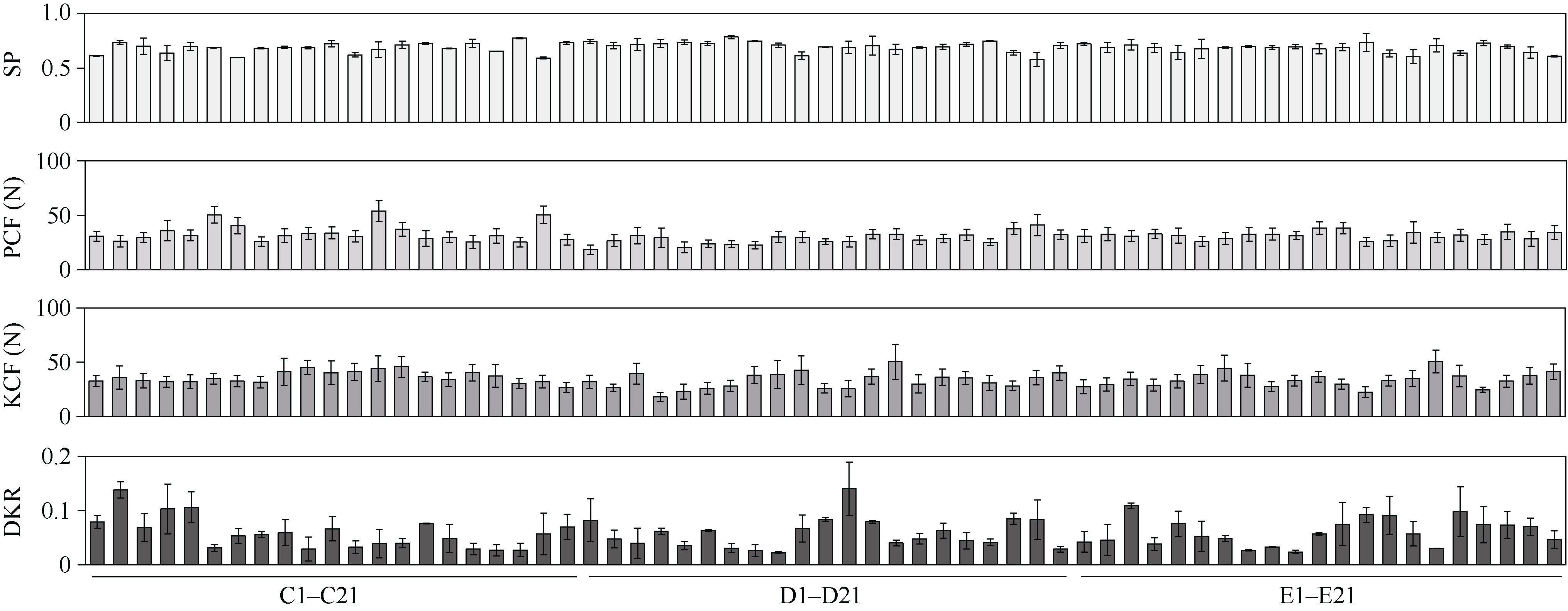
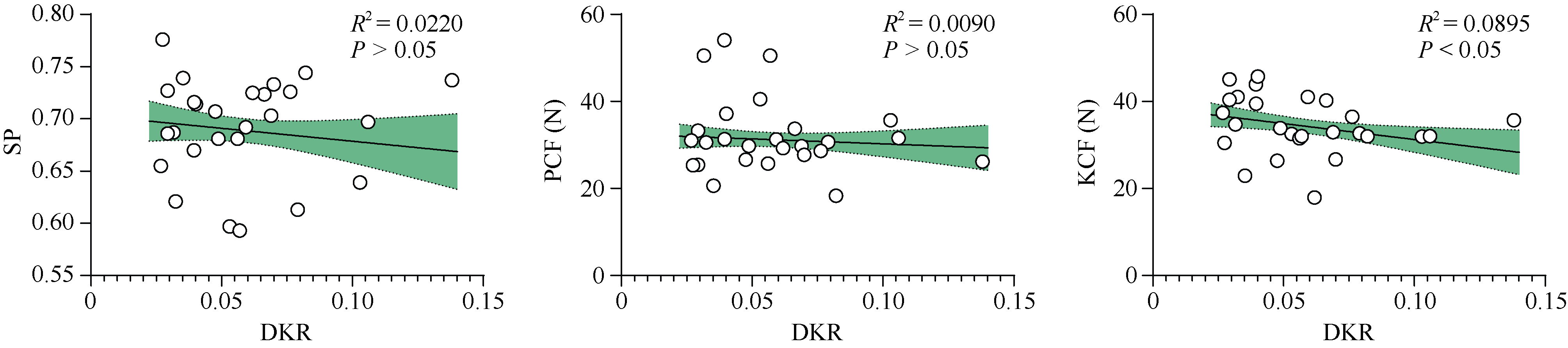
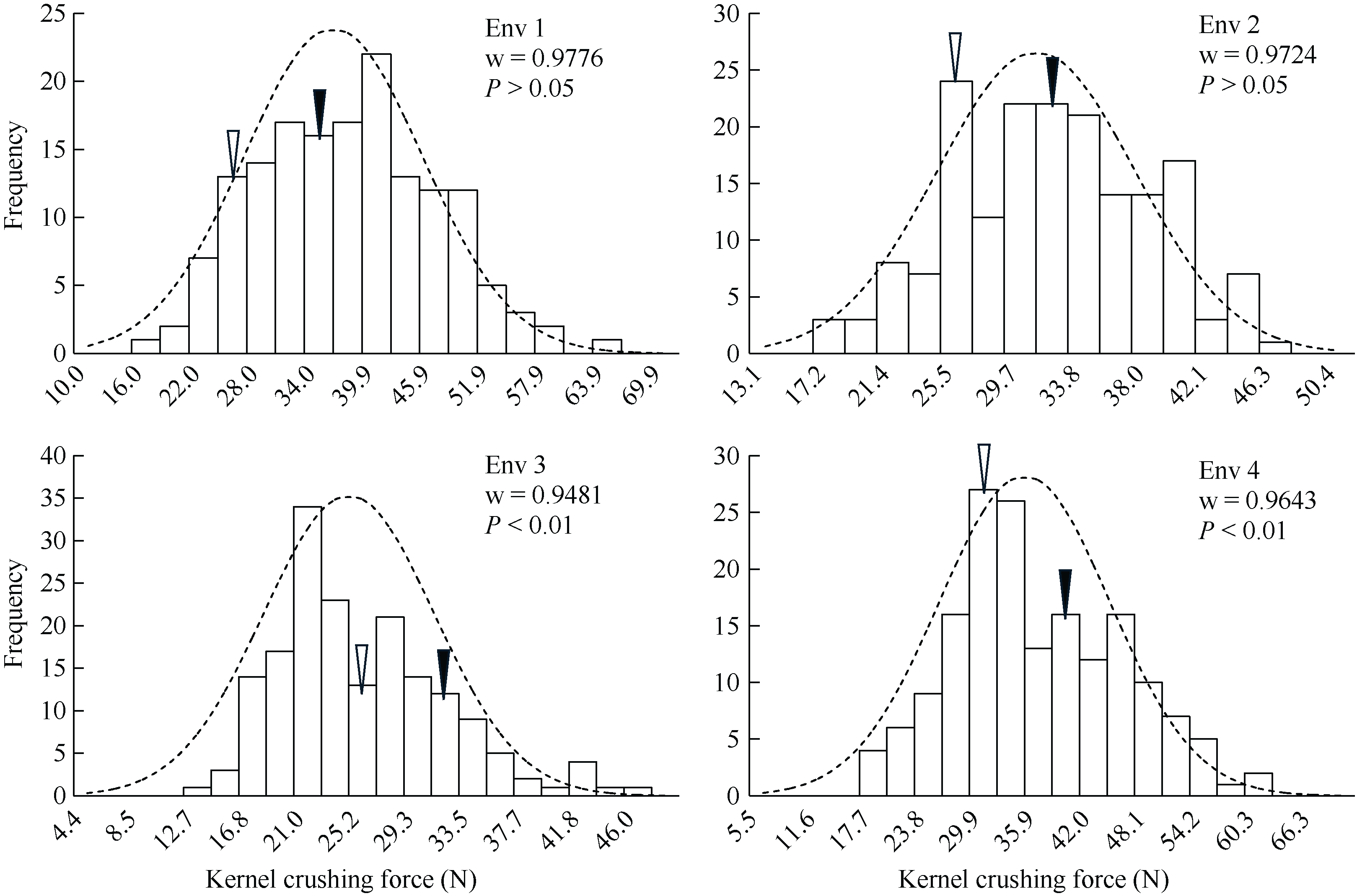
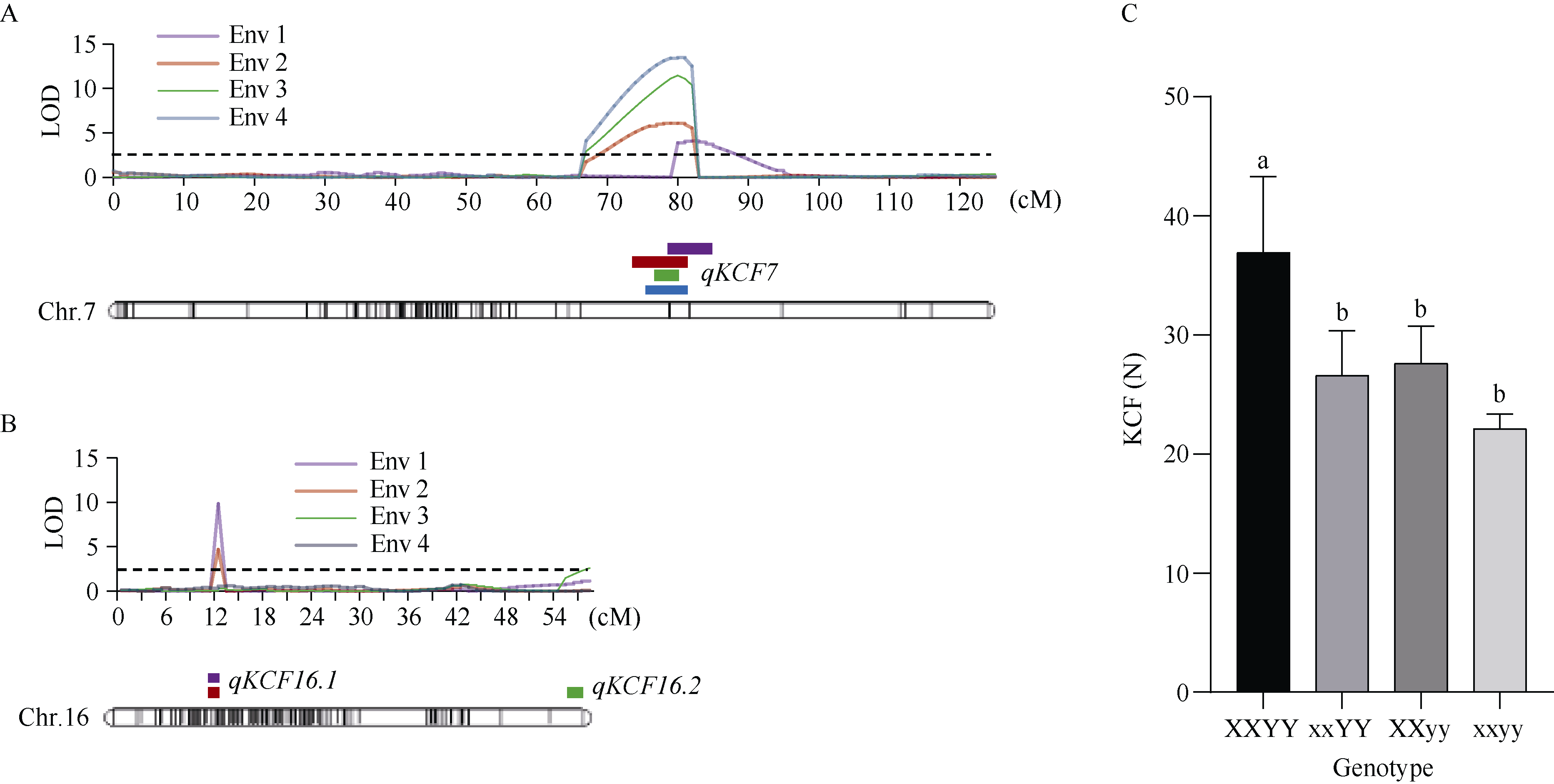
为筛选影响花生机械脱壳质量的农艺性状和探索其遗传基础, 本研究利用63个高世代品系, 选取3个荚果或籽仁相关性状(出仁率、荚果破损压力和籽仁破损压力), 分别与籽仁损伤率性状进行相关性分析。结果表明, 仅籽仁破损压力与籽仁损伤率呈显著相关。此外, 从上述高世代品系中筛选到2个籽仁损伤率低于2.50%的品系材料D9和E10。进一步针对籽仁破损压力性状, 以品种花育36号和6-13配组衍生的包含181个家系的重组自交系(recombinant inbred line, RIL)群体为材料, 采集了该RIL群体2020—2023年在山东烟台、威海、东营和青岛4个环境下的表型数据。结果表明, 籽仁破损压力在RIL群体中均表现为连续分布和超亲遗传, 广义遗传率为0.88。利用前期构建的高密度遗传图谱, 共定位到8个与籽仁破损压力相关加性QTL, 表型贡献率范围为6.04%~28.30%, 其中2个主效位点qKCF7和qKCF16.1可在不同环境下表达, 其增效等位基因均来自花育36号。共定位到12对相关上位性QTL, 共涉及24个SNP标记区间, 表型贡献率范围为1.55%~4.01%。本研究结果为后续花生适宜机械脱壳相关性状遗传改良提供了重要靶点及材料支持。
| [1] | FAOSTAT.Statistics Database. Rome Available at: http://www.fao.org/statistics/databases/en/. |
| [2] | 禹山林. 中国花生品种及其系谱. 上海: 上海科学技术出版社, 2008. |
| Yu S L. Peanut Varieties and Their Pedigrees in China. Shanghai: Shanghai Scientific & Technical Publishers, 2008 (in Chinese). | |
| [3] | 陈志德, 沈一, 刘永惠, 等. 不同花生品种机械脱壳特性研究. 江苏农业科学, 2023, 51(12): 91-95. |
| Chen Z D, Shen Y, Liu Y H, et al. Study on mechanical hulling characteristics of different peanut varieties. Jiangsu Agric Sci, 2023, 51(12): 91-95 (in Chinese). | |
| [4] | 丁彬, 谢吉先, 冯梦诗, 等. 不同花生荚果类型对机械剥壳效果的影响. 江苏农业科学, 2022, 50(5): 180-184. |
| Ding B, Xie J X, Feng M S, et al. Effect of different pod types on mechanical husking of peanut. Jiangsu Agric Sci, 2022, 50(5): 180-184 (in Chinese). | |
| [5] |
Chang A S, Sreedharan A, Schneider K R. Peanut and peanut products: a food safety perspective. Food Control, 2013, 32: 296-303.
doi: 10.1016/j.foodcont.2012.12.007 |
| [6] | 姜慧芳, 任小平, 王圣玉, 等. 花生黄曲霉侵染抗性持久性及种皮完整性对产毒的影响. 作物学报, 2006, 32: 851-855. |
| Jiang H F, Ren X P, Wang S Y, et al. Durability of resistance to Aspergillus flavus infection and effect of intact testa without injury on aflatoxin production in peanut. Acta Agron Sin, 2006, 32: 851-855 (in Chinese with English abstract). | |
| [7] | 王移收. 我国花生产品加工业现状、问题及发展趋势. 中国油料作物学报, 2006, 28: 498-502. |
| Wang Y S. Present situation, problem and developing trend of peanut food industry in China. Chin J Oil Crop Sci, 2006, 28: 498-502 (in Chinese). | |
| [8] | 陆荣, 高连兴, 刘志侠, 等. 中国花生脱壳机技术发展现状与展望. 沈阳农业大学学报, 2020, 51: 631-640. |
| Lu R, Gao L X, Liu Z X, et al. Development and prospect of technology on peanut sheller of China. J Shenyang Agric Univ, 2020, 51: 631-640 (in Chinese with English abstract). | |
| [9] | 郭陞垚, 陈剑洪, 陈永水, 等. 不同剥壳方式、含水率对春花生种子发芽和出苗的影响. 福建农业科技, 2015(5): 1-3. |
| Guo S Y, Chen J H, Chen Y S, et al. Effects of different hesking ways on seed germination and seedling emergence of spring peanut with different moisture content. Fujian Agric Sci Technol, 2015(5): 1-3 (in Chinese with English abstract). | |
| [10] | 王通, 禹山林, 谢宏峰, 等. 花生种皮变化对种子抗破损力的影响. 花生学报, 2020, 49(4): 69-72. |
| Wang T, Yu S L, Xie H F, et al. Influence of peanut testa variation on resistance of seed to breakage. J Peanut Sci, 2020, 49(4): 69-72 (in Chinese with English abstract). | |
| [11] | 王京, 高连兴, 刘志侠, 等. 花生荚果力学特性研究. 农机化研究, 2017, 39(1): 182-186. |
| Wang J, Gao L X, Liu Z X, et al. Experimental study on peanut pods mechanical property. J Agric Mech Res, 2017, 39(1): 182-186 (in Chinese with English abstract). | |
| [12] | 王京, 高连兴, 刘志侠, 等. 典型品种花生米静压力学特性及有限元分析. 沈阳农业大学学报, 2016, 47: 307-313. |
| Wang J, Gao L X, Liu Z X, et al. Static mechanical property and finite element analysis of typical of peanut varieties. J Shenyang Agric Univ, 2016, 47: 307-313 (in Chinese with English abstract). | |
| [13] | 蔡高委, 丛锦玲, 齐贝贝. 花生种子三轴方向起始破碎力. 江苏农业学报, 2019, 35: 716-721. |
| Cai G W, Cong J L, Qi B B. Experimental study on initial crushing force of peanut seeds in triaxial direction. Jiangsu J Agric Sci, 2019, 35: 716-721 (in Chinese with English abstract). | |
| [14] | 许静, 潘丽娟, 陈娜, 等. 不同花生荚果力学特性研究及优异品系筛选. 中国油料作物学报, 2021, 43: 803-815. |
| Xu J, Pan L J, Chen N, et al. Pods mechanical property of different peanuts and identification of elite varieties (lines). Chin J Oil Crop Sci, 2021, 43: 803-815 (in Chinese with English abstract). | |
| [15] |
Chen Y N, Ren X P, Zheng Y L, et al. Genetic mapping of yield traits using RIL population derived from Fuchuan Dahuasheng and ICG6375 of peanut (Arachis hypogaea L.). Mol Breed, 2017, 37: 17.
doi: 10.1007/s11032-016-0587-3 |
| [16] |
Wang Z H, Huai D X, Zhang Z H, et al. Development of a high-density genetic map based on specific length amplified fragment sequencing and its application in quantitative trait loci analysis for yield-related traits in cultivated peanut. Front Plant Sci, 2018, 9: 827.
doi: 10.3389/fpls.2018.00827 pmid: 29997635 |
| [17] |
Zhang S Z, Hu X H, Wang F F, et al. A stable and major QTL region on chromosome 2 conditions pod shape in cultivated peanut (Arachis hyopgaea L.). J Integr Agric, 2023, 22: 2323-2334.
doi: 10.1016/j.jia.2023.02.005 |
| [18] |
Zhang S Z, Hu X H, Miao H R, et al. QTL identification for seed weight and size based on a high-density SLAF-seq genetic map in peanut (Arachis hypogaea L.). BMC Plant Biol, 2019, 19: 537.
doi: 10.1186/s12870-019-2164-5 |
| [19] | 刘志侠, 吴国振, 于永强, 等. 花生荚果生物力学特性研究. 沈阳农业大学学报, 2023, 54: 732-740. |
| Liu Z X, Wu G Z, Yu Y Q, et al. Study on biomechanical characteristics of peanut pod. J Shenyang Agric Univ, 2023, 54: 732-740 (in Chinese with English abstract). | |
| [20] |
Meng L, Li H H, Zhang L Y, et al. QTL IciMapping: integrated software for genetic linkage map construction and quantitative trait locus mapping in biparental populations. Crop J, 2015, 3: 269-283.
doi: 10.1016/j.cj.2015.01.001 |
| [21] |
Yang J, Guo Z H, Luo L X, et al. Identification of QTL and candidate genes involved in early seedling growth in rice via high-density genetic mapping and RNA-seq. Crop J, 2021, 9: 360-371.
doi: 10.1016/j.cj.2020.08.010 |
| [22] |
Voorrips R E. MapChart: software for the graphical presentation of linkage maps and QTLs. J Hered, 2002, 93: 77-78.
doi: 10.1093/jhered/93.1.77 pmid: 12011185 |
| [23] |
迟晓元, 毕竞男, 赵健鑫, 等. 花生荚果力学特性评鉴及早熟种质筛选. 作物学报, 2025, 51: 943-957.
doi: 10.3724/SP.J.1006.2025.44167 |
|
Chi X Y, Bi J N, Zhao J X, et al. Evaluation of mechanical properties of peanut pods and screening of early maturing germplasm. Acta Agron Sin, 2025, 51: 943-957 (in Chinese with English abstract).
doi: 10.3724/SP.J.1006.2025.44167 |
|
| [24] |
Israel G B, Kunta S, Mlelwa W, et al. Genetic characterization and mapping of the shell-strength trait in peanut. BMC Plant Biol, 2024, 24: 1047.
doi: 10.1186/s12870-024-05727-9 pmid: 39501154 |
| [25] |
Balakrishnan D, Surapaneni M, Yadavalli V R, et al. Detecting CSSLs and yield QTLs with additive, epistatic and QTL × environment interaction effects from Oryza sativa × O. nivara IRGC81832 cross. Sci Rep, 2020, 10: 7766.
doi: 10.1038/s41598-020-64300-0 pmid: 32385410 |
| [26] | Li Z K, Luo L J, Mei H W, et al. Overdominant epistatic loci are the primary genetic basis of inbreeding depression and heterosis in rice: I. Biomass and grain yield. Genetics, 2001, 158: 1737-1753. |
| [27] |
Carlborg Ö, Haley C S. Epistasis: too often neglected in complex trait studies? Nat Rev Genet, 2004, 5: 618-625.
doi: 10.1038/nrg1407 pmid: 15266344 |
| [1] | 郑玉珍, 齐飞艳, 孙子淇, 刘华, 秦利, 石磊, 王娟, 汪蒙蒙, 韩锁义, 徐静, 苗利娟, 黄冰艳, 董文召, 郑峥, 张新友. 花生籽仁总超长链脂肪酸和7种脂肪酸组分的QTL定位[J]. 作物学报, 2026, 52(6): 1646-1657. |
| [2] | 陆一楚, 李振影, 买春海, 赵晓蕊, 王利祥. 夜间复合体关键基因AhLUX1正向调控花生结瘤的功能研究[J]. 作物学报, 2026, 52(6): 1658-1668. |
| [3] | 谷春苗, 王润风, 黄璐, 刘浩, 鲁清, 李海芬, 李少雄, 何双呈, 洪彦彬, 陈小平, 谭斌, 余倩霞. 花生WOX基因家族的全基因组分析及不定芽再生候选基因的鉴定[J]. 作物学报, 2026, 52(5): 1326-1340. |
| [4] | 覃奕琰, 付瑶, 苏畅, 李娜, 徐静茹, 程笑然, 张琪, 赵明辉. OsST41调控水稻苗期耐盐性的功能分析[J]. 作物学报, 2026, 52(3): 802-812. |
| [5] | 刘长友, 王珅, 时会影, 沈颖超, 孙蕾, 王彦, 张志肖, 苏秋竹, 田静, 范保杰. 基于饭豆基因资源的小豆远缘杂交群体抗豆象QTL定位[J]. 作物学报, 2026, 52(3): 936-944. |
| [6] | 于天一, 王春晓, 肖丽, 钟召迪, 王宣仓, 赵勇, 路亚, 吴月, 吴正锋. 不同结瘤特性花生品种氮素累积、产量及品质特性对氮肥用量的响应[J]. 作物学报, 2026, 52(3): 881-894. |
| [7] | 张晴, 杨昱, 郭茜, 岳霈尧, 殷丛丛, 牛景萍, 赵晋忠, 杜维俊, 岳爱琴. 大豆GmARA6a的克隆及响应盐胁迫的功能分析[J]. 作物学报, 2026, 52(2): 480-493. |
| [8] | 余开航, 周洪斌, 罗亮扎, 王玫郦, 姜瑞梅, 董陈文华, 李仕金, 毛孝强, 陈升位. 大麦亮氨酸富集重复型类受体激酶基因HvLRR-RLK-510的克隆和表达分析[J]. 作物学报, 2026, 52(2): 421-432. |
| [9] | 王菲菲, 张胜忠, 杨贵华, 苗华荣, 胡晓辉, 张则林, 刘莎莎, 乔利仙, 单世华, 陈静. 331份花生种质苗期耐盐性综合评价和强耐盐种质鉴选[J]. 作物学报, 2026, 52(1): 279-294. |
| [10] | 孙辰硕, 张月, 田泽锴, 晏立英, 康彦平, 陈玉宁, 王欣, 淮东欣, 王前前, 姜慧芳, 罗怀勇, 黄莉, 廖伯寿, 王志慧, 雷永. 花生种质果柄强度的遗传分化与主要影响因子分析[J]. 作物学报, 2026, 52(1): 118-130. |
| [11] | 金欣欣, 宋亚辉, 苏俏, 杨永庆, 王瑾. 高产高油高油酸花生品种的生长发育及干物质生产特征[J]. 作物学报, 2026, 52(1): 191-201. |
| [12] | 迟晓元, 刘庆, 张君, 赵旭红, 李美, 于天一, 潘丽娟, 许静, 姜骁, 殷祥贞, 马俊卿, 陈娜. 不同花生品种(系)耐盐碱性田间鉴定及各性状指标相关性研究[J]. 作物学报, 2026, 52(1): 85-98. |
| [13] | 杨海洋, 吴林宣, 李博纹, 石翰峰, 袁禧龙, 刘金朝, 蔡海荣, 陈诗怡, 郭涛, 王慧. 基于QTL定位发现的OsWRI3调控水稻种子的落粒性[J]. 作物学报, 2025, 51(7): 1712-1724. |
| [14] | 万书波, 张佳蕾, 高华鑫, 王才斌. 中国花生高产栽培研究进展与展望[J]. 作物学报, 2025, 51(7): 1703-1711. |
| [15] | 胡蒙, 沙丹, 张晟瑞, 谷勇哲, 张世碧, 李静, 孙君明, 邱丽娟, 李斌. 大豆分枝数QTL定位及候选基因筛选[J]. 作物学报, 2025, 51(7): 1747-1756. |
|
||