欢迎访问作物学报,今天是
作物学报 ›› 2026, Vol. 52 ›› Issue (3): 895-907.doi: 10.3724/SP.J.1006.2026.52029
叶凡1( ), 李帅1, 李思宇1, 陈云2, 窦超银3, 刘立军1,*()
Ye Fan1(), Li Shuai1, Li Si-Yu1, Chen Yun2, Dou Chao-Yin3, Liu Li-Jun1,*()
摘要:
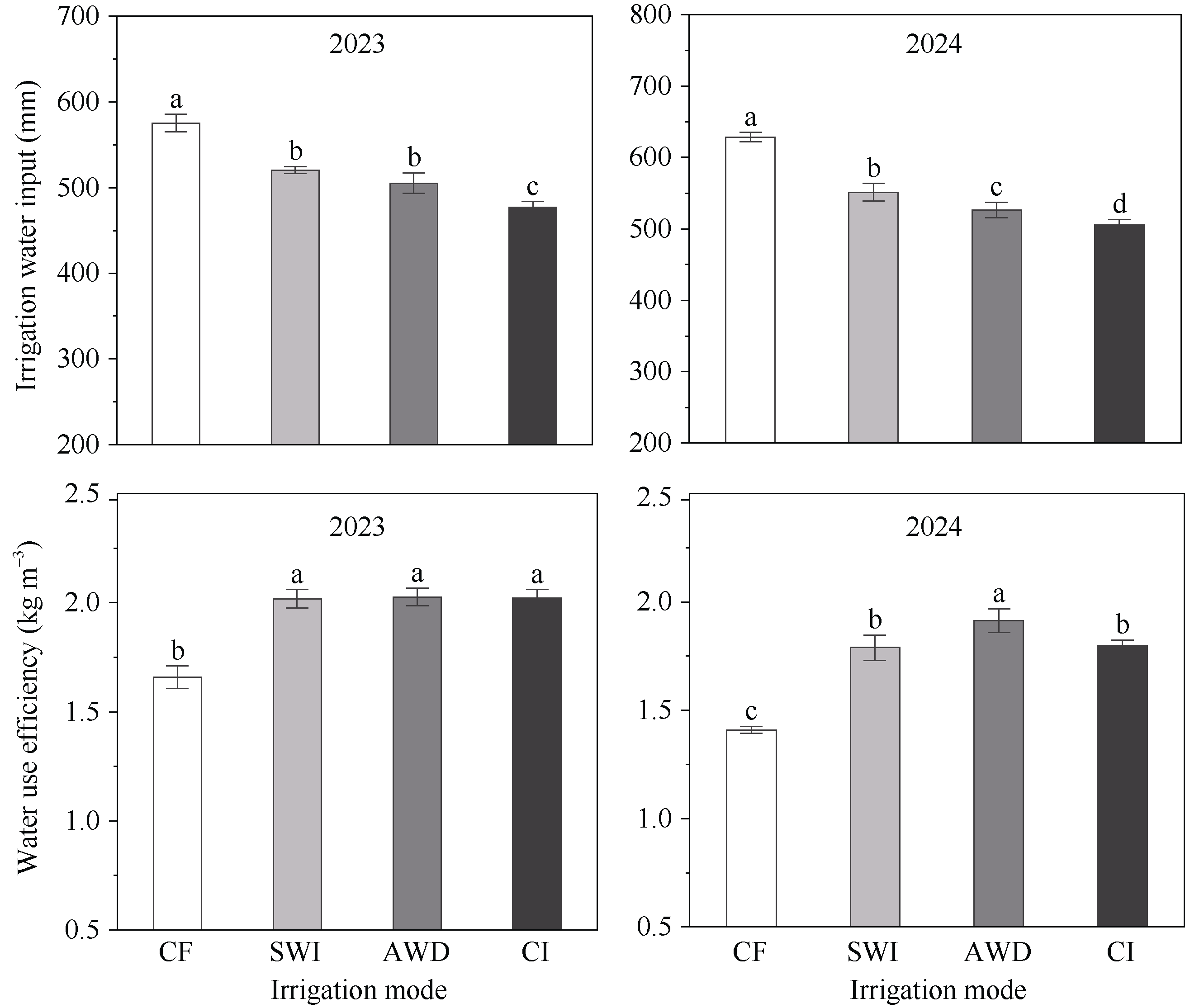
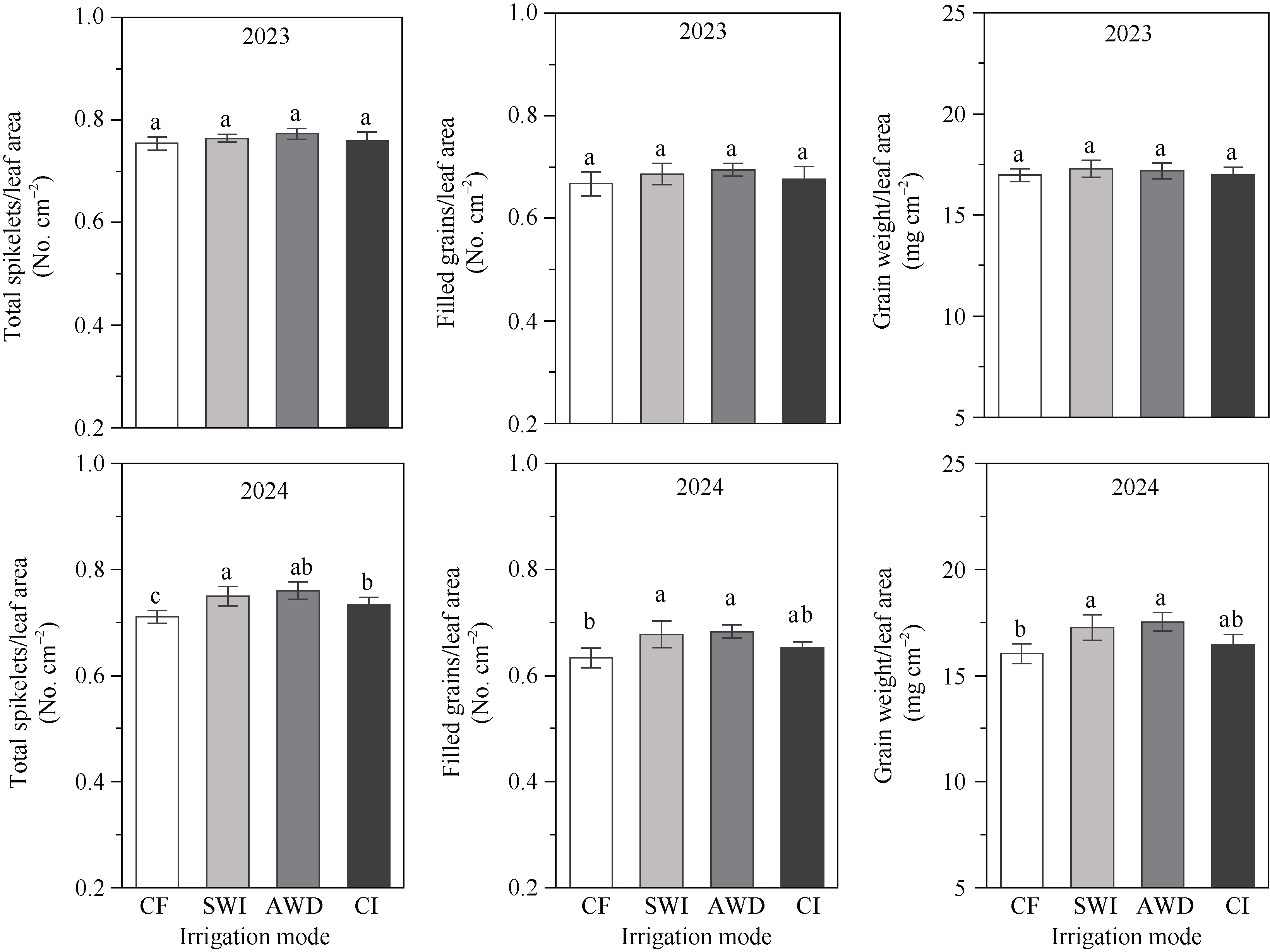
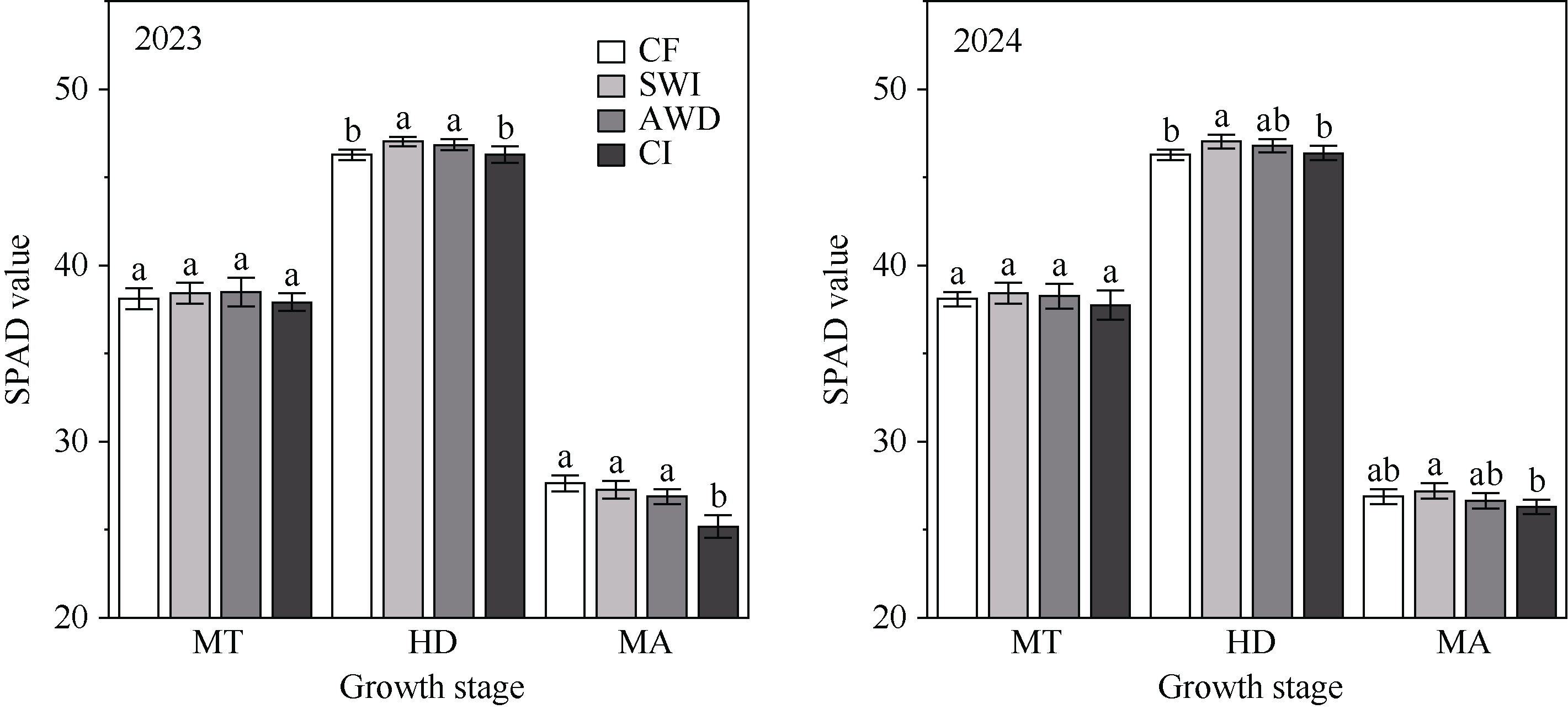
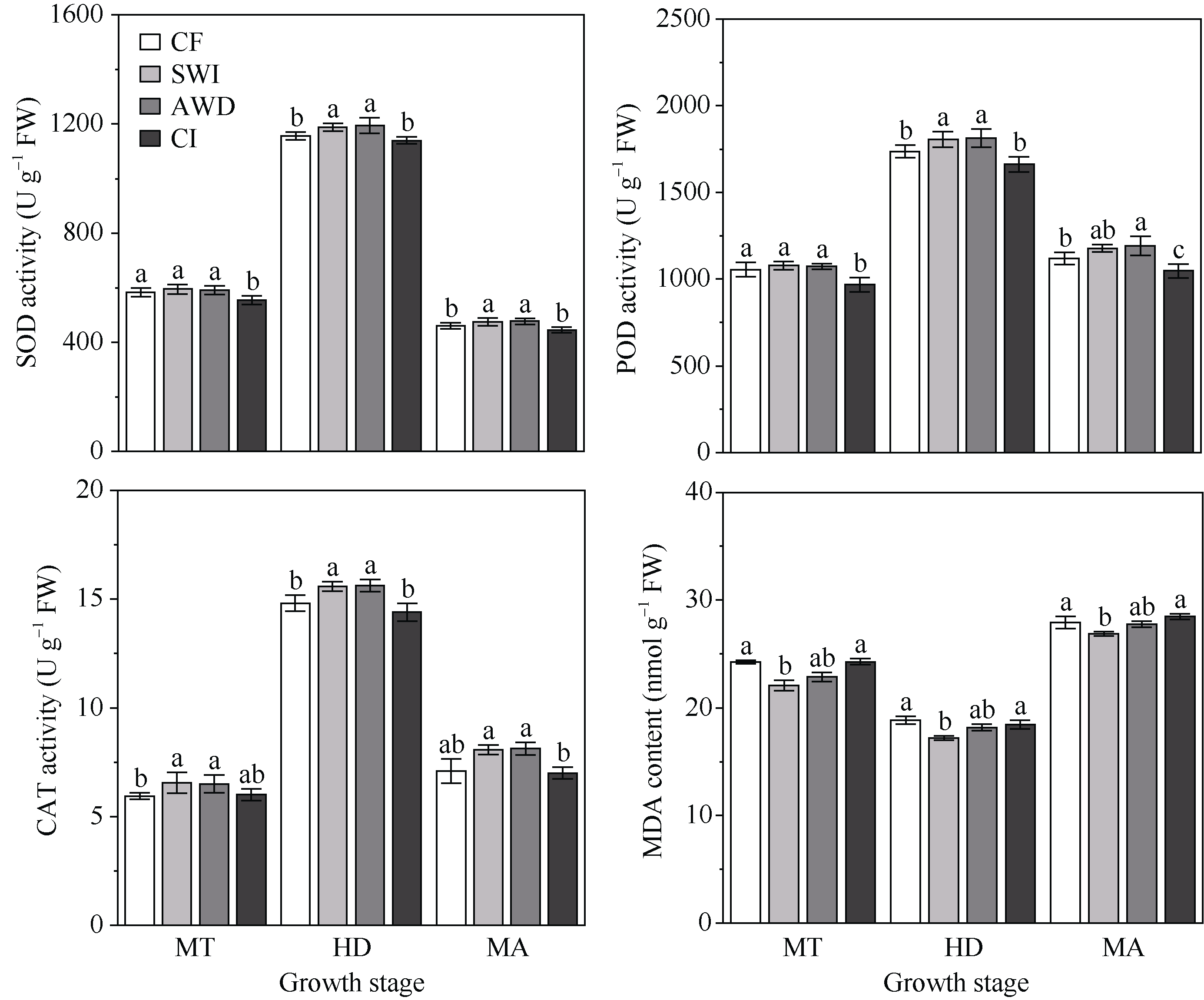
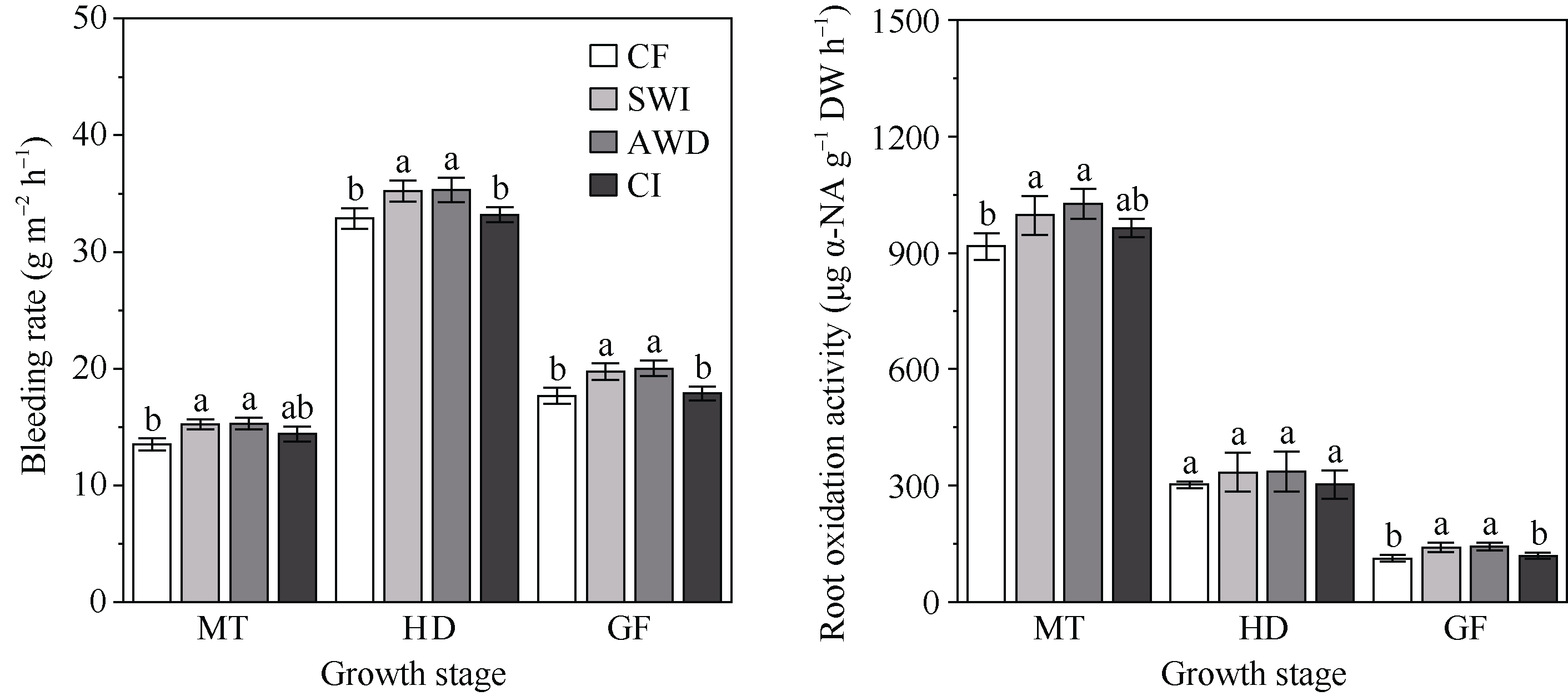
水资源短缺是东北黑土区水稻生产的重要限制因子, 推广应用节水灌溉技术对缓解当地用水紧张与水稻可持续发展有重要意义。本试验以常规粳稻龙粳31为材料, 于2023—2024年在黑龙江省佳木斯市建三江七星农场田间栽培条件下, 系统比较分析浅湿灌溉(SWI)、干湿交替灌溉(AWD)和控制灌溉(CI) 3种典型节水灌溉方式对水稻产量和群体质量的影响。结果表明: (1) 与常规水层灌溉(CF)相比, SWI、AWD和CI显著降低灌溉水用量, 节水率分别为9.5%~18.9%、12.2%~23.4%和17.0%~26.8%; 产量分别提高10.5%~11.2%、7.4%~13.5%和2.11%~2.25%; 灌溉水利用效率分别提高21.7%~29.9%、22.3%~39.8%和22.0%~29.2%。SWI与AWD增产显著主要得益于总颖花量显著增加。与SWI相比, AWD节水效果更加明显。(2) SWI和AWD处理的茎蘖成穗率、高效叶面积指数、粒叶比、茎鞘非结构性碳水化合物(NSCs)的累积与转运效率、花后干物质积累、根系伤流量与根系活力等群体质量指标均不同程度优于CF。此外, 上述两处理还提高了叶片SPAD值和抗氧化酶活性并降低了丙二醛(MDA)含量。综上, SWI和AWD可在大幅度节约灌溉用水的前提下, 优化水稻群体质量指标, 显著提高水稻产量, 研究结果为推进我国东北黑土稻区的节水灌溉策略提供了理论依据。
| [1] | 黑龙江省统计局. 黑龙江统计年鉴2024. 黑龙江: 中国统计出版社, 2024. |
| Heilongjiang Bureau of Statistics. Heilongjiang Statistical Yearbook 2024. Heilongjiang: China Statistics Press, 2024 (in Chinese). | |
| [2] |
刘立超, 谢树鹏, 门龙楠, 等. 黑龙江粳稻品质育种现状及对策. 中国稻米, 2022, 28(4): 19-22.
doi: 10.3969/j.issn.1006-8082.2022.04.004 |
| Liu L C, Xie S P, Men L N, et al. Current situation and countermeasures of quality breeding of japonica rice in Heilongjiang province. China Rice, 2022, 28(4): 19-22 (in Chinese with English abstract). | |
| [3] | 王思宇, 谷英楠, 王敬元, 等. 黑龙江省水稻产业发展形势与战略对策. 农业展望, 2024, 20(7): 98-104. |
| Wang S Y, Gu Y N, Wang J Y, et al. Development situation and strategic countermeasures of rice industry in Heilongjiang province. Agric Outlook, 2024, 20(7): 98-104 (in Chinese with English abstract). | |
| [4] | 范从龙, 戴长雷, 周广平. 水足迹视角下黑龙江省水资源利用评价. 黑龙江水利科技, 2024, 52(10): 68-70. |
| Fan C L, Dai C L, Zhou G P. Evaluation of water resources utilization in Heilongjiang province from perspective of water footprint. Heilongjiang Hydraul Sci Technol, 2024, 52(10): 68-70 (in Chinese with English abstract). | |
| [5] | 王秋菊, 来永才. 试论黑龙江省水稻生产与水资源持续利用的对策与建议. 中国稻米, 2010, 16(4): 25-28. |
| Wang Q J, Lai Y C. Countermeasures and suggestions for rice production and sustainable water resources utilization in Heilongjiang province. China Rice, 2010, 16(4): 25-28 (in Chinese). | |
| [6] |
Zhuang Y H, Zhang L, Li S S, et al. Effects and potential of water-saving irrigation for rice production in China. Agric Water Manag, 2019, 217: 374-382.
doi: 10.1016/j.agwat.2019.03.010 |
| [7] | 吴良泉, 武良, 崔振岭, 等. 中国水稻区域氮磷钾肥推荐用量及肥料配方研究. 中国农业大学学报, 2016, 21(9): 1-13. |
| Wu L Q, Wu L, Cui Z L, et al. Studies on recommended nitrogen, phosphorus and potassium application rates and special fertilizer formulae for different rice production regions in China. J China Agric Univ, 2016, 21(9): 1-13 (in Chinese with English abstract). | |
| [8] |
王光耀, 刘巍, 雷波, 等. 不同节水灌溉方式下的黑龙江省水稻节水减排潜力评估. 节水灌溉, 2023(11): 34-38.
doi: 10.12396/jsgg.2023227 |
| Wang G Y, Liu W, Lei B, et al. Water-saving and emission reduction potential of rice in Heilongjiang province under different water-saving irrigation methods. Water Sav Irrig, 2023(11): 34-38 (in Chinese with English abstract). | |
| [9] |
Wang Z, Zhang X Y, Liu L, et al. Estimates of methane emissions from Chinese rice fields using the DNDC model. Agric For Meteor, 2021, 303: 108368.
doi: 10.1016/j.agrformet.2021.108368 |
| [10] | 梁燕菲, 张潇潇, 李伏生. “薄浅湿晒”灌溉稻田土壤微生物量碳、氮和酶活性研究. 植物营养与肥料学报, 2013, 19: 1403-1410. |
| Liang Y F, Zhang X X, Li F S. Soil microbial biomass carbon and nitrogen and enzyme activities in paddy soil under “thin-shallow- wet-dry” irrigation method. J Plant Nutr Fert, 2013, 19: 1403-1410 (in Chinese with English abstract). | |
| [11] | 秦子元.不同水氮管理模式黑土稻田氮磷迁移转化利用及化学计量研究. 东北农业大学博士学位论文, 黑龙江哈尔滨, 2022. |
| Qin Z Y. Nitrogen and Phosphorus Transfer, Utilization and Stoichiometry in Black Soil Paddy Fields under Different Water and Nitrogen Management Modes. PhD Dissertation of Northeast Agricultural University, Harbin, Heilongjiang, China, 2022 (in Chinese with English abstract). | |
| [12] | 刘立军, 薛亚光, 孙小淋, 等. 水分管理方式对水稻产量和氮肥利用率的影响. 中国水稻科学, 2009, 23: 282-288. |
| Liu L J, Xue Y G, Sun X L, et al. Effects of water management methods on grain yield and fertilizer-nitrogen use efficiency in rice. Chin J Rice Sci, 2009, 23: 282-288 (in Chinese with English abstract). | |
| [13] |
褚光, 展明飞, 朱宽宇, 等. 干湿交替灌溉对水稻产量与水分利用效率的影响. 作物学报, 2016, 42: 1026-1036.
doi: 10.3724/SP.J.1006.2016.01026 |
|
Chu G, Zhan M F, Zhu K Y, et al. Effects of alternate wetting and drying irrigation on yield and water use efficiency of rice. Acta Agron Sin, 2016, 42: 1026-1036 (in Chinese with English abstract).
doi: 10.3724/SP.J.1006.2016.01026 |
|
| [14] |
张自常, 徐云姬, 褚光, 等. 不同灌溉方式下的水稻群体质量. 作物学报, 2011, 37: 2011-2019.
doi: 10.3724/SP.J.1006.2011.02011 |
|
Zhang Z C, Xu Y J, Chu G, et al. Population quality of rice under different irrigation regimes. Acta Agron Sin, 2011, 37: 2011-2019 (in Chinese with English abstract).
doi: 10.3724/SP.J.1006.2011.02011 |
|
| [15] |
丁国华, 曹良子, 周劲松, 等. 控制灌溉对寒地水稻产量及品质的影响. 中国稻米, 2021, 27(5): 93-96.
doi: 10.3969/j.issn.1006-8082.2021.05.020 |
|
Ding G H, Cao L Z, Zhou J S, et al. Effects of controlled irrigation on yield and quality of water-saving and drought-resistance rice in cold region. China Rice, 2021, 27(5): 93-96 (in Chinese with English abstract).
doi: 10.3969/j.issn.1006-8082.2021.05.020 |
|
| [16] |
Dong B, Mao Z, Cui Y L, et al. Controlled irrigation for paddy rice in China. Irrig Drain, 2020, 69: 61-74.
doi: 10.1002/ird.2519 |
| [17] |
李婷婷, 冯钰枫, 朱安, 等. 主要节水灌溉方式对水稻根系形态生理的影响. 中国水稻科学, 2019, 33: 293-302.
doi: 10.16819/j.1001-7216.2019.8116 |
|
Li T T, Feng Y F, Zhu A, et al. Effects of main water-saving irrigation methods on morphological and physiological traits of rice roots. Chin J Rice Sci, 2019, 33: 293-302 (in Chinese with English abstract).
doi: 10.16819/j.1001-7216.2019.8116 |
|
| [18] |
Yu Q, Dai Y L, Wei J, et al. Rice yield and water productivity in response to water-saving irrigation practices in China: a meta- analysis. Agric Water Manag, 2024, 302: 109006.
doi: 10.1016/j.agwat.2024.109006 |
| [19] |
Zhang S X, Rasool G, Guo X P, et al. Effects of different irrigation methods on environmental factors, rice production, and water use efficiency. Water, 2020, 12: 2239.
doi: 10.3390/w12082239 |
| [20] |
Li S Y, Wu F, Zhou Q, et al. Adopting agronomic strategies to enhance the adaptation of global rice production to future climate change: a meta-analysis. Agron Sustain Dev, 2024, 44: 23.
doi: 10.1007/s13593-024-00963-7 |
| [21] | 张伟杨, 任维晨, 于吉祥, 等. 轻干湿交替灌溉促进水稻茎中碳同化物积累与转运的机制. 扬州大学学报(农业与生命科学版), 2021, 42(6): 9-16. |
| Zhang W Y, Ren W C, Yu J X, et al. The mechanism underlying alternate wetting and moderate soil drying irrigation enhancing carbon assimilates accumulation and remobilization in rice stems. J Yangzhou Univ (Agric Life Sci Edn), 2021, 42(6): 9-16 (in Chinese with English abstract). | |
| [22] | 张洪程, 王夫玉. 中国水稻群体研究进展. 中国水稻科学, 2001, 15: 51-56. |
| Zhang H C, Wang F Y. Recent progress on research of rice population in China. Chin J Rice Sci, 2001, 15: 51-56 (in Chinese with English abstract). | |
| [23] |
Zhu G L, Chen Y T, Ella E S, et al. Mechanisms associated with tiller suppression under stagnant flooding in rice. J Agron Crop Sci, 2019, 205: 235-247.
doi: 10.1111/jac.2019.205.issue-2 |
| [24] |
Feng Z J, Qi Z J, Zhang Z X, et al. Effective tiller numbers, photosynthetic and yield response of rice (Oryza sativa) to shallow wet-dry irrigation water controlled at tillering stage in black soil area. Agric Res, 2021, 10: 97-104.
doi: 10.1007/s40003-020-00485-0 |
| [25] |
Okami M, Kato Y, Kobayashi N, et al. Morphological traits associated with vegetative growth of rice (Oryza sativa L.) during the recovery phase after early-season drought. Eur J Agron, 2015, 64: 58-66.
doi: 10.1016/j.eja.2014.12.006 |
| [26] |
张彬, 黄庆, 刘怀珍, 等. 不同水分管理模式下华南双季超级稻群体生长及物质生产特征. 中国稻米, 2013, 19(4): 30-34.
doi: 10.3969/j.issn.1006-8082.2013.04.009 |
| Zhang B, Huang Q, Liu H Z, et al. Characteristics of population growth and dry matter production in double-cropping super rice under different water management patterns in south China. China Rice, 2013, 19(4): 30-34 (in Chinese with English abstract). | |
| [27] | 杨建昌, 杜永, 吴长付, 等. 超高产粳型水稻生长发育特性的研究. 中国农业科学, 2006, 39: 1336-1345. |
| Yang J C, Du Y, Wu C F, et al. Growth and development characteristics of super-high-yielding mid-season japonica rice. Sci Agric Sin, 2006, 39: 1336-1345 (in Chinese with English abstract). | |
| [28] |
Wang C, Fa X T, Meng Q H, et al. Comparison of agronomic and physiological characteristics for rice varieties differing in water use efficiency under alternate wetting and drying irrigation. Agronomy, 2024, 14: 1986.
doi: 10.3390/agronomy14091986 |
| [29] | 曹小闯, 刘晓霞, 马超, 等. 干湿交替灌溉改善稻田根际氧环境进而促进氮素转化和水稻氮素吸收. 植物营养与肥料学报, 2022, 28: 1-14. |
| Cao X C, Liu X X, Ma C, et al. Alternative dry-wet irrigation improves the rhizospheric oxygen environment and nitrogen transformation, and increases nitrogen absorption by rice plants. J Plant Nutr Fert, 2022, 28: 1-14 (in Chinese with English abstract). | |
| [30] |
Hua K J, Yang P, Zhou J Y, et al. Enhancing rice yield, quality, and resource utilisation with slow-release fertiliser in alternate wetting and drying irrigation. Plant Soil Environ, 2024, 70: 253-262.
doi: 10.17221/450/2023-PSE |
| [31] |
Xue Y G, Duan H, Liu L J, et al. An improved crop management increases grain yield and nitrogen and water use efficiency in rice. Crop Sci, 2013, 53: 271-284.
doi: 10.2135/cropsci2012.06.0360 |
| [32] |
Zang Y G, Wu G Z, Li Q Q, et al. Irrigation regimes modulate non-structural carbohydrate remobilization and improve grain filling in rice (Oryza sativa L.) by regulating starch metabolism. J Integr Agric, 2024, 23: 1507-1522.
doi: 10.1016/j.jia.2023.05.012 |
| [33] | Chu G, Chen T T, Chen S, et al. The effect of alternate wetting and severe drying irrigation on grain yield and water use efficiency of indica-japonica hybrid rice (Oryza sativa L.). Food Energy Secur, 2018, 7: e00133. |
| [34] |
Thakur A K, Mandal K G, Mohanty R K, et al. Rice root growth, photosynthesis, yield and water productivity improvements through modifying cultivation practices and water management. Agric Water Manag, 2018, 206: 67-77.
doi: 10.1016/j.agwat.2018.04.027 |
| [35] |
付景, 马梦娟, 张骐飞, 等. 干湿交替灌溉和施氮量对粳稻光合特性和氮素吸收利用的影响. 作物学报, 2024, 50: 1787-1804.
doi: 10.3724/SP.J.1006.2024.32056 |
|
Fu J, Ma M J, Zhang Q F, et al. Effects of alternate wetting and drying irrigation and different nitrogen application levels on photosynthetic characteristics and nitrogen absorption and utilization of japonica rice. Acta Agron Sin, 2024, 50: 1787-1804.
doi: 10.3724/SP.J.1006.2024.32056 |
|
| [36] |
Chu G, Wang Z Q, Zhang H, et al. Alternate wetting and moderate drying increases rice yield and reduces methane emission in paddy field with wheat straw residue incorporation. Food Energy Secur, 2015, 4: 238-254.
doi: 10.1002/fes3.2015.4.issue-3 |
| [37] |
Gao C, Lin M W, He L, et al. The impact of water-saving irrigation on rice growth and comprehensive evaluation of irrigation strategies. Agronomy, 2024, 14: 1363.
doi: 10.3390/agronomy14071363 |
| [38] | Zhang Y, Meng Q H, Zhang N, et al. Yield and water use efficiency were enhanced under alternate wetting and drying irrigation in rice through improving leaf morphology and physiology. J Agron Crop Sci, 2025, 211: e70068. |
| [39] | 武志垒, 司振江, 黄彦, 等. 节水灌溉条件下寒区水稻光合产物形成的影响. 水利科学与寒区工程, 2024, 7(9): 10-14. |
| Wu Z L, Si Z J, Huang Y, et al. Effect of water-saving irrigation on the formation of photosynthetic products in rice of cold regions. Hydro Sci Cold Zone Eng, 2024, 7(9): 10-14 (in Chinese). | |
| [40] | 孙仕宽.西南稻区水稻粳籼亚种对水氮调控的响应特征研究. 西华大学硕士学位论文, 四川成都, 2024. |
| Sun S K. Response Characteristics of Japonica and Indica Rice Subspecies to Water and Nitrogen Regulation in Southwest China. MS Thesis of Xihua University, Chengdu, Sichuan, China, 2024 (in Chinese with English abstract). |
| [1] | 胡川, 赵凯男, 黄修利, 吴金芝, 任开明, 王贺正, 付国占, 黄明, 李友军. 一次灌溉下耕作方式和氮肥用量对旱地小麦产量和品质的影响[J]. 作物学报, 2026, 52(6): 1830-1846. |
| [2] | 马胜乾, 王志平, 陈浩天, 窦淑贤, 张燕, 邓艾兴, 张卫建, 原向阳, 宋振伟. 秸秆还田下耕作方式与氮肥施用量对东北玉米产量及土壤团聚体的影响[J]. 作物学报, 2026, 52(6): 1802-1816. |
| [3] | 胡赵, 钱润, 谢丰璞, 应素平. 水稻SPX基因家族鉴定及响应磷处理的表达分析[J]. 作物学报, 2026, 52(6): 1902-1912. |
| [4] | 邹仪妹, 徐敏, 汪海洋, 姚辉, 王加峰, 刘浩, 任代胜. 两系不育系水稻幼苗根系响应盐胁迫的转录因子调控网络鉴定[J]. 作物学报, 2026, 52(6): 1728-1742. |
| [5] | 张思思, 赵向辉, 周洋, 姚云凤, 朱荣昱, 董元杰, 胡国庆, 徐通, 刘兆新. 冬闲期翻耕和绿肥还田对连作花生田土壤理化性质和产量的影响[J]. 作物学报, 2026, 52(5): 1472-1486. |
| [6] | 张宁宁, 滕雨菲, 任娜娜, 魏兴卓, 闫书豪, 樊可心, 王永宏, 陈文康, 张兴华, 朱万超, 徐淑兔, 薛吉全. 201份玉米自交系抗旱表型评价及可塑性分析[J]. 作物学报, 2026, 52(5): 1309-1325. |
| [7] | 张鸿蓉, 王菲儿, 李盼, 仇海龙, 朱静, 赵连豪, 南运有, 何蔚, 樊志龙, 胡发龙, 柴强, 殷文. 减量20%灌水与25%有机肥替代化肥提高青贮玉米产量的光合特性[J]. 作物学报, 2026, 52(5): 1487-1500. |
| [8] | 张振, 冯连杰, 石玉, 于振文, 张永丽. 节水补灌下不同穗型小麦产量形成差异研究[J]. 作物学报, 2026, 52(5): 1522-1535. |
| [9] | 闫安, 蒋昆炜, 王蓉圆, 田林, 张璐, 王韵, 徐建龙. 水稻剑叶小维管束数基因SVN7的鉴定与克隆[J]. 作物学报, 2026, 52(5): 1364-1372. |
| [10] | 刘昕萌, 任昊, 张继波, 张吉旺, 赵斌, 任佰朝, 刘鹏, 王洪章. 茉莉酸甲酯(MeJA)缓解高温影响玉米雌穗分化的生理机制[J]. 作物学报, 2026, 52(5): 1561-1572. |
| [11] | 王壮壮, 武紫君, 张永新, 张芯源, 袁丽雪, 陈如雪, 刘世举, 段剑钊, 冯伟, 王同朝, 王永华. 豫东南黏壤潮土区水氮优化协同提高冬小麦产量和氮素利用效率[J]. 作物学报, 2026, 52(5): 1501-1521. |
| [12] | 王宇诚, 张露, 刘阿康, 黄见良, 彭少兵, 袁珅. 基于产量差的作物大面积单产提升策略与展望[J]. 作物学报, 2026, 52(5): 1279-1290. |
| [13] | 赵佳雪, 周龙昊, 郭岂源, 尚伦霄, 王涵, 刘志涛, 陈曦, 张晓佩, 宋宪亮, 毛丽丽. 长期秸秆还田与深松通过改善土壤环境与棉花光合特性提高滨海盐碱地棉花产量[J]. 作物学报, 2026, 52(5): 1548-1560. |
| [14] | 郭星宇, 胡丹, 林苏期, 王梦凯, 谭文峰, 黄传琴. 生物炭配施化肥提高玉米‖大豆下玉米产量和土壤生态系统多功能性[J]. 作物学报, 2026, 52(5): 1536-1547. |
| [15] | 陈伟, 卫万娟, 赵其兵, 常东伟, 余凌波, 翟鹏飞, 冯志明, 陈宗祥, 任仰涛, 杨鹏, 刘海浪, 李珍富, 杨永乐, 金彦刚, 左示敏. 利用CRISPR/Cas9编辑Hd6基因创制优质早熟水稻新种质[J]. 作物学报, 2026, 52(4): 1046-1056. |
|
||