欢迎访问作物学报,今天是
作物学报 ›› 2026, Vol. 52 ›› Issue (4): 1181-1192.doi: 10.3724/SP.J.1006.2026.51067
乔宇馨1( ), 李程越2, 康晓玉3, 张鑫琪1, 贾绍辉4, 刘倩4, 曹亚丽4, 史鑫蕊1, 郝兴宇1,*(), 李萍1,*()
Qiao Yu-Xin1(), Li Cheng-Yue2, Kang Xiao-Yu3, Zhang Xin-Qi1, Jia Shao-Hui4, Liu Qian4, Cao Ya-Li4, Shi Xin-Rui1, Hao Xing-Yu1,*(), Li Ping1,*()
摘要:
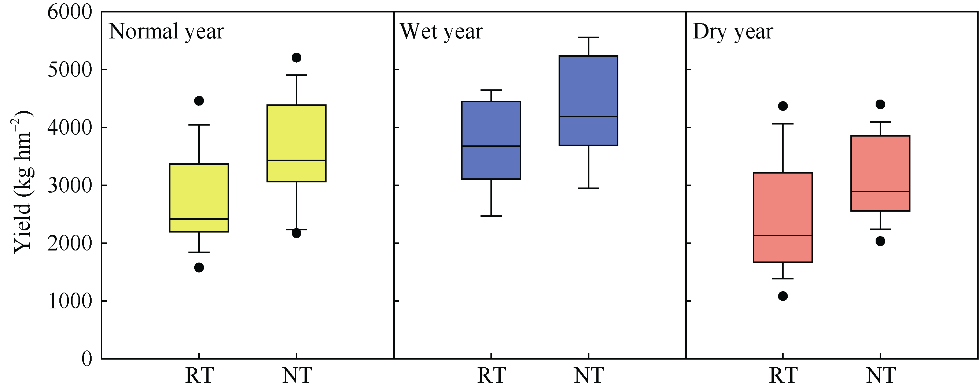
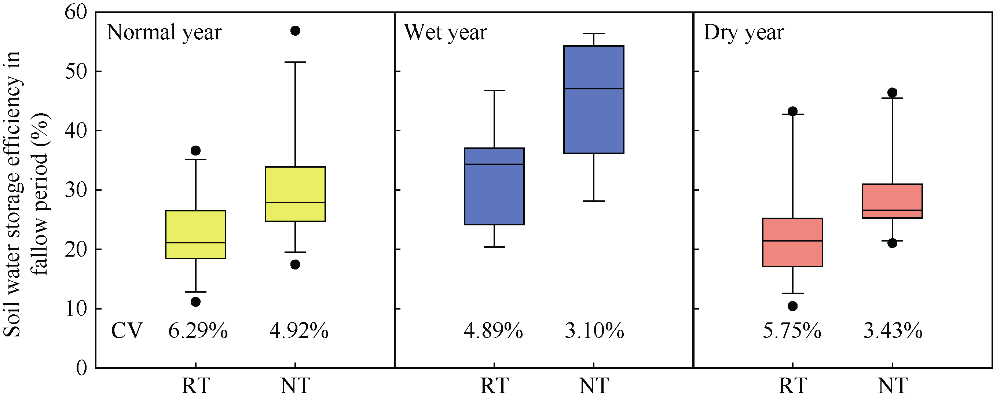
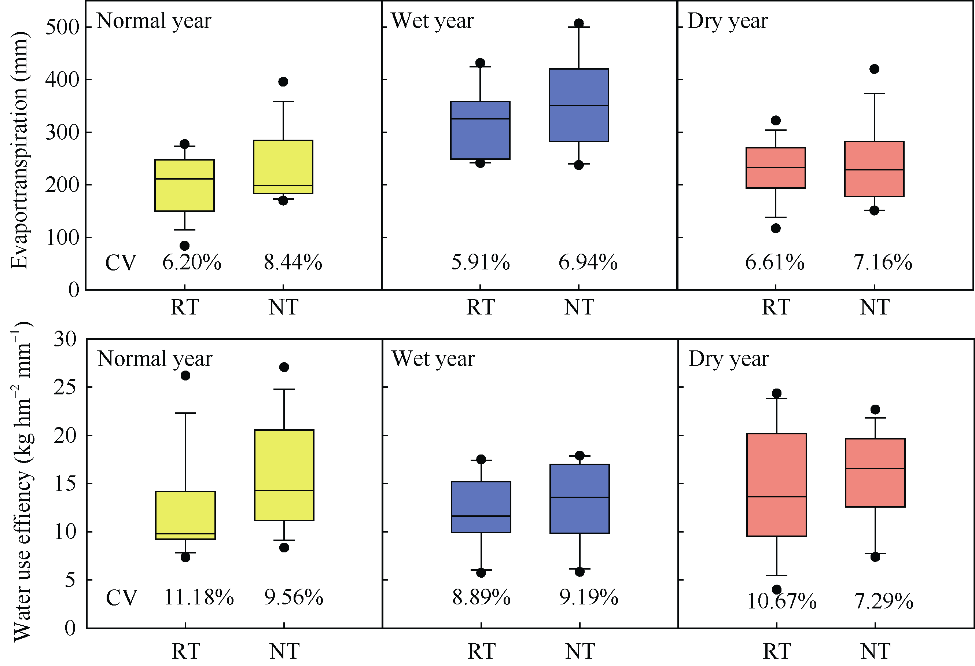
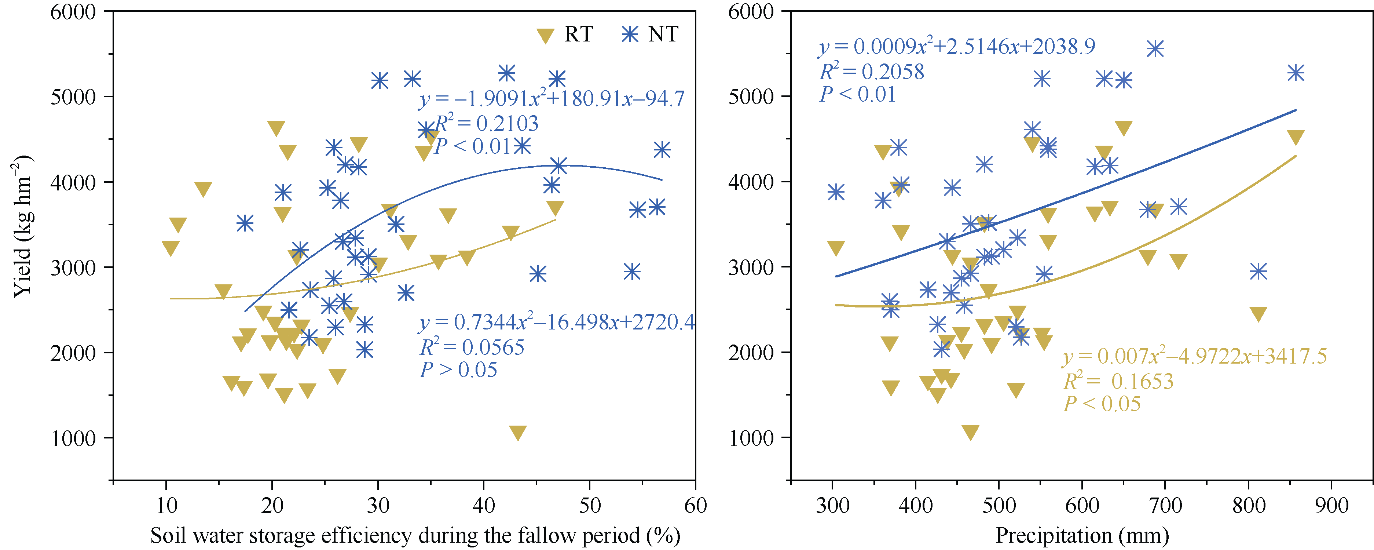
传统旋耕、翻耕模式会造成旱作区水肥流失。开展少、免耕措施影响旱地小麦土壤水分及产量的研究对旱地小麦节水稳产意义重大。本研究在山西省临汾市尧都区开展2个生长季的旱作小麦试验, 试验处理为2种耕作方式: 免耕秸秆覆盖方式(no-tillage, NT)和旋耕秸秆还田方式(rotary tillage, RT), 小麦品种为“晋麦102”, 利用冬小麦田的土壤蓄水量、各生育时期生物量和产量等数据对APSIM-Wheat模型进行校准和验证, 用校验后的APSIM-Wheat模型模拟临汾市尧都区39年历史气象条件下冬小麦生长发育、土壤水分和产量的变化, 分析不同降水年型和不同耕作方式对小麦产量、麦田土壤蓄水量和水分利用效率的影响。平水年、丰水年和欠水年免耕秸秆覆盖处理较旋耕秸秆还田处理使小麦产量分别增加31.1%、21.0%和28.5%, 而休闲期土壤蓄水效率分别增加26.6%、35.9%和37.5%, 水分利用效率分别增加29.0%、10.0%和9.9%。但小麦生育期蒸散量在2种耕作方式下无明显差异。2个处理下的小麦产量均与休闲期降水量及年降水量呈显著正相关。免耕秸秆覆盖方式下小麦产量与休闲期蓄水效率呈显著正相关, 而旋耕秸秆还田方式下相关性不显著。免耕秸秆覆盖还田主要通过提高休闲期土壤蓄水效率提高黄土高原区旱作小麦产量, 是黄土高原旱作小麦稳产的有效耕作措施。
| [1] |
齐月, 王鹤龄, 张凯, 等. 气候变化对黄土高原半干旱区春小麦生长和产量的影响: 以定西市为例. 生态环境学报, 2019, 28: 1313-1321.
doi: 10.16258/j.cnki.1674-5906.2019.07.004 |
| Qi Y, Wang H L, Zhang K, et al. Effects of climate change on growth and yield of spring wheat in semi-arid region of the Loess Plateau: a case study of Dingxi city. Ecol Environ Sci, 2019, 28: 1313-1321 (in Chinese with English abstract). | |
| [2] |
Lal R, Negassa W, Lorenz K. Carbon sequestration in soil. Curr Opin Environ Sustain, 2015, 15: 79-86.
doi: 10.1016/j.cosust.2015.09.002 |
| [3] |
Shi X R, Liu X W, Jing J Y, et al. Long-term no tillage straw mulching increased soil water and nitrogen storage in dryland wheat on the Loess Plateau, but may increase dissolved organic nitrogen leaching. Field Crops Res, 2025, 322: 109705.
doi: 10.1016/j.fcr.2024.109705 |
| [4] |
张玉娇, 李军, 郭正, 等. 渭北旱塬免耕/深松轮耕麦田产量和土壤水分对施肥的响应模拟. 作物学报, 2015, 41: 1726-1739.
doi: 10.3724/SP.J.1006.2015.01726 |
|
Zhang Y J, Li J, Guo Z, et al. Simulation of responses of yield and soil moisture to fertilization in wheat fields under no-tillage rotation on the Weibei dry plateau. Acta Agron Sin, 2015, 41: 1726-1739 (in Chinese with English abstract).
doi: 10.3724/SP.J.1006.2015.01726 |
|
| [5] |
张统帅, 闫丽娟, 李广, 等. 免耕和秸秆覆盖对旱作区土壤氮素、水分和春小麦产量的影响. 浙江农业学报, 2020, 32: 1329-1341.
doi: 10.3969/j.issn.1004-1524.2020.08.01 |
|
Zhang T S, Yan L J, Li G, et al. Effects of no tillage and straw mulching on soil nitrogen, water content and yield of spring wheat in dryland farming area. Acta Agric Zhejiangensis, 2020, 32: 1329-1341 (in Chinese with English abstract).
doi: 10.3969/j.issn.1004-1524.2020.08.01 |
|
| [6] | 卢彩云, 罗锡文, 李洪文, 等. 我国保护性耕作的发展与政策建议. 中国工程科学, 2024, 26(2): 103-112. |
| Lu C Y, Luo X W, Li H W, et al. Progress and suggestions of conservation tillage in China. Strateg. Study CAE, 2024, 26(2): 103-112 (in Chinese with English abstract) | |
| [7] |
谢炜, 贺鹏, 马宏亮, 等. 秋闲期秸秆覆盖与施磷对冬小麦氮素吸收利用的影响. 作物学报, 2024, 50: 440-450.
doi: 10.3724/SP.J.1006.2024.31019 |
|
Xie W, He P, Ma H L, et al. Effects of straw mulching from autumn fallow and phosphorus application on nitrogen uptake and utilization of winter wheat. Acta Agron Sin, 2024, 50: 440-450 (in Chinese with English abstract).
doi: 10.3724/SP.J.1006.2024.31019 |
|
| [8] | Adil M, Lu S Q, Yao Z J, et al. No-tillage enhances soil water storage, grain yield and water use efficiency in dryland wheat (Triticum aestivum) and maize (Zea mays) cropping systems: a global meta-analysis. Funct Plant Biol, 2024, 51: FP23267. |
| [9] | 刘家魁, 吴保瑞, 焦艳艳, 等. 我国土地耕作现状及未来发展趋势. 现代农业科技, 2016(1): 246-247. |
| Liu J K, Wu B R, Jiao Y Y, et al. Current status and future development trend of land tillage in China. Mod Agric Sci Technol, 2016(1): 246-247 (in Chinese). | |
| [10] |
Zheng C Y, Yu Z W, Shi Y, et al. Effects of tillage practices on water consumption, water use efficiency and grain yield in wheat field. J Integr Agric, 2014, 13: 2378-2388.
doi: 10.1016/S2095-3119(13)60733-9 |
| [11] | 白重九, 王健波, 董雯怡, 等. 长期免耕旱作对冬小麦生长季土壤剖面有机碳含量的影响. 中国农业气象, 2021, 42: 169-180. |
|
Bai C J, Wang J B, Dong W Y, et al. Effects of long-term no-tillage on soil organic carbon contents of winter wheat in different soil layers and growth period. Chin J Agrometeorol, 2021, 42: 169-180 (in Chinese with English abstract).
doi: 10.3969/j.issn.1000-6362.2021.03.001 |
|
| [12] |
Mitchell J P, Singh P N, Wallender W W, et al. No-tillage and high-residue practices reduce soil water evaporation. Cal Ag, 2012, 66: 55-61.
doi: 10.3733/ca.v066n02p55 |
| [13] | 陈梦楠. 旱作麦田休闲期轮耕对土壤水分积耗与产量形成的影响. 山西农业大学硕士学位论文, 山西太谷, 2017. |
| Chen M N. Effects of Rotational Tillage in Fallow Period on Soil Water Storage and Consumption and Yield Components of Dryland Wheat. MS Thesis of Shanxi Agricultural University, Taigu, Shanxi, China, 2017 (in Chinese with English abstract). | |
| [14] | 曹碧芸, 赵剑敏, 余少波, 等. 休闲期轮耕对旱地小麦群体质量与产量的影响. 山西农业科学, 2020, 48: 560-565. |
| Cao B Y, Zhao J M, Yu S B, et al. Effects of rotation tillage on wheat population quality and yield in dryland. J Shanxi Agric Sci, 2020, 48: 560-565 (in Chinese with English abstract). | |
| [15] | 杨娜, 王珂, 席吉龙, 等. 长期定位免耕和施有机肥对旱地冬小麦土壤水分和产量的影响. 节水灌溉, 2020(10): 61-65. |
| Yang N, Wang K, Xi J L, et al. Effects of long-term no-tillage and manure on soil water and winter wheat yield in dryland. Water Sav Irrig, 2020(10): 61-65 (in Chinese with English abstract). | |
| [16] | 邓超超, 李玲玲, 谢军红, 等. 长期不同耕作措施对黄绵土体积质量和作物水分利用效率的影响. 西北农业学报, 2018, 27: 1023-1031. |
| Deng C C, Li L L, Xie J H, et al. Effects of long-term different tillage practices on soil volumic mass and crop water use efficiency of loessal soil. Acta Agric Boreali Occid Sin, 2018, 27: 1023-1031 (in Chinese with English abstract). | |
| [17] | 邵运辉, 吕军杰, 李俊红, 等. 长期免耕覆盖对旱地小麦-玉米周年产量及水分利用的影响. 河南农业科学, 2020, 49(12): 17-23. |
| Shao Y H, Lyu J J, Li J H, et al. Effects of long-term no-tillage with straw mulching on annual yield and water use of wheat and maize. J Henan Agric Sci, 2020, 49(12): 17-23 (in Chinese with English abstract). | |
| [18] | 冯仰强, 聂志刚, 王钧, 等. 基于APSIM模型研究不同降水年型下降水变化对旱地小麦产量的影响. 作物研究, 2021, 35(2): 108-111. |
| Feng Y Q, Nie Z G, Wang J, et al. Based on APSIM model to study the influence of different precipitation years on the yield of dryland wheat. Crop Res, 2021, 35(2): 108-111 (in Chinese with English abstract). | |
| [19] |
郭晓霞, 刘景辉, 田露, 等. 免耕轮作对内蒙古地区农田贮水特性和作物产量的影响. 作物学报, 2012, 38: 1504-1512.
doi: 10.3724/SP.J.1006.2012.01504 |
|
Guo X X, Liu J H, Tian L, et al. Effects of no-tillage with rotation on soil water retaining properties and crop yield in Inner Mongolia. Acta Agron Sin, 2012, 38: 1504-1512 (in Chinese with English abstract).
doi: 10.3724/SP.J.1006.2012.01504 |
|
| [20] |
Liu S, Gao Y R, Lang H L, et al. Effects of conventional tillage and no-tillage systems on maize (Zea mays L.) growth and yield, soil structure, and water in loess plateau of China: field experiment and modeling studies. Land, 2022, 11: 1881.
doi: 10.3390/land11111881 |
| [21] |
Yadav B, Sharma D, Yadav R, et al. Simulation of soil water-heat dynamics and crop growth in wheat conservation agriculture systems based on the APSIM model. Sci Rep, 2021, 11: 18923-18934.
doi: 10.1038/s41598-021-97309-0 |
| [22] |
Chaki A K, Gaydon D S, Dalal R C, et al. How we used APSIM to simulate conservation agriculture practices in the rice-wheat system of the Eastern Gangetic Plains. Field Crops Res, 2022, 275: 108344.
doi: 10.1016/j.fcr.2021.108344 |
| [23] |
Shi X R, Li C, Li P, et al. Deep plowing increases soil water storage and wheat yield in a semiarid region of Loess Plateau in China: a simulation study. Field Crops Res, 2024, 308: 109299.
doi: 10.1016/j.fcr.2024.109299 |
| [24] | 张鑫琪. 基于APSIM模型的长期免耕秸秆覆盖对旱地小麦增产机制研究. 山西农业大学硕士学位论文, 山西太谷, 2023. |
| Zhang X Q. Research on the Mechanisms of Yield Enhancement in Dryland Wheat under Long-term No-till with Straw Mulching Based on the APSIM Model. MS Thesis of Shanxi Agricultural University, Taigu, Shanxi, China, 2023 (in Chinese with English abstract). | |
| [25] |
Asseng S, van Keulen H, Stol W, et al. Performance and application of the APSIM nwheat model in the Netherlands. Eur J Agron, 2000, 12: 37-54.
doi: 10.1016/S1161-0301(99)00044-1 |
| [26] |
Guo S L, Zhu H H, Dang T H, et al. Winter wheat grain yield associated with precipitation distribution under long-term nitrogen fertilization in the semiarid Loess Plateau in China. Geoderma, 2012, 189/190: 442-450.
doi: 10.1016/j.geoderma.2012.06.012 |
| [27] |
Maharjan G R, Prescher A K, Nendel C, et al. Approaches to model the impact of tillage implements on soil physical and nutrient properties in different agro-ecosystem models. Soil Tillage Res, 2018, 180: 210-221.
doi: 10.1016/j.still.2018.03.009 |
| [28] |
Tang J Z, Wang J, Fang Q X, et al. Optimizing planting date and supplemental irrigation for potato across the agro-pastoral ecotone in North China. Eur J Agron, 2018, 98: 82-94.
doi: 10.1016/j.eja.2018.05.008 |
| [29] |
黄明霞, 王靖, 唐建昭, 等. 气孔导度模型在北方农牧交错带的适用性评价: 以马铃薯和油葵为例. 应用生态学报, 2016, 27: 3585-3592.
doi: 10.13287/j.1001-9332.201611.033 |
|
Huang M X, Wang J, Tang J Z, et al. Suitability of four stomatal conductance models in agro-pastoral ecotone in North China: a case study for potato and oil sunflower. Chin J Appl Ecol, 2016, 27: 3585-3592 (in Chinese with English abstract).
doi: 10.13287/j.1001-9332.201611.033 |
|
| [30] | 张盼峰, 汪江涛, 焦念元, 等. 轮耕与隔畦灌溉对麦玉两熟作物生长和水分利用效率的影响. 作物杂志, 2013(6): 118-122. |
| Zhang P F, Wang J T, Jiao N Y, et al. Effects of rotational tillage and alternate border irrigation on crops growth and water use efficiency of wheat-maize double crops. Crops, 2013(6): 118-122 (in Chinese with English abstract). | |
| [31] | Glab T, Kopec S. Effect of soil compaction on root system morphology and yields of meadow fescue (Festuca pratensis). Pol J Environ Stud, 2009, 18: 219-225. |
| [32] |
Hewins D B, Sinsabaugh R L, Archer S R, et al. Soil-litter mixing and microbial activity mediate decomposition and soil aggregate formation in a sandy shrub-invaded Chihuahuan Desert grassland. Plant Ecol, 2017, 218: 459-474.
doi: 10.1007/s11258-017-0703-4 |
| [33] |
Huang G B, Chai Q, Feng F X, et al. Effects of different tillage systems on soil properties, root growth, grain yield, and water use efficiency of winter wheat (Triticum aestivum L.) in arid northwest China. J Integr Agric, 2012, 11: 1286-1296.
doi: 10.1016/S2095-3119(12)60125-7 |
| [34] | 李荣, 侯贤清, 吴鹏年, 等. 秸秆还田配施氮肥对土壤性状与水分利用效率的影响. 农业机械学报, 2019, 50(8): 289-298. |
| Li R, Hou X Q, Wu P N, et al. Effect of straw returning with nitrogen application on soil properties and water use efficiency. Trans CSAM, 2019, 50(8): 289-298 (in Chinese with English abstract). | |
| [35] | 韩宾, 李增嘉, 王芸, 等. 土壤耕作及秸秆还田对冬小麦生长状况及产量的影响. 农业工程学报, 2007, 23(2): 48-53. |
| Han B, Li Z J, Wang Y, et al. Effects of soil tillage and returning straw to soil on wheat growth status and yield. Trans CSAE, 2007, 23(2): 48-53 (in Chinese with English abstract). | |
| [36] | 侯贤清, 李荣, 韩清芳, 等. 夏闲期不同耕作模式对土壤蓄水保墒效果及作物水分利用效率的影响. 农业工程学报, 2012, 28(3): 94-100. |
| Hou X Q, Li R, Han Q F, et al. Effects of different tillage patterns during summer fallow on soil water conservation and crop water use efficiency. Trans CSAE, 2012, 28(3): 94-100 (in Chinese with English abstract). | |
| [37] |
Du Preez C C, Steyn J T, Kotze E. Long-term effects of wheat residue management on some fertility indicators of a semi-arid Plinthosol. Soil Tillage Res, 2001, 63: 25-33.
doi: 10.1016/S0167-1987(01)00227-6 |
| [38] |
Tao Z Q, Li C F, Li J J, et al. Tillage and straw mulching impacts on grain yield and water use efficiency of spring maize in northern Huang-Huai-Hai valley. Crop J, 2015, 3: 445-450.
doi: 10.1016/j.cj.2015.08.001 |
| [39] |
Xue L Z, Khan S, Sun M, et al. Effects of tillage practices on water consumption and grain yield of dryland winter wheat under different precipitation distribution in the Loess Plateau of China. Soil Tillage Res, 2019, 191: 66-74.
doi: 10.1016/j.still.2019.03.014 |
| [40] | Feng Y, Lin W, Yu S B, et al. Effects of fallow tillage on winter wheat yield and predictions under different precipitation types. PeerJ, 2021, 9: e12602. |
| [41] |
Bai H Q, Wang J, Fang Q X, et al. Does a trade-off between yield and efficiency reduce water and nitrogen inputs of winter wheat in the North China Plain? Agric Water Manag, 2020, 233: 106095.
doi: 10.1016/j.agwat.2020.106095 |
| [1] | 胡川, 赵凯男, 黄修利, 吴金芝, 任开明, 王贺正, 付国占, 黄明, 李友军. 一次灌溉下耕作方式和氮肥用量对旱地小麦产量和品质的影响[J]. 作物学报, 2026, 52(6): 1830-1846. |
| [2] | 马胜乾, 王志平, 陈浩天, 窦淑贤, 张燕, 邓艾兴, 张卫建, 原向阳, 宋振伟. 秸秆还田下耕作方式与氮肥施用量对东北玉米产量及土壤团聚体的影响[J]. 作物学报, 2026, 52(6): 1802-1816. |
| [3] | 张思思, 赵向辉, 周洋, 姚云凤, 朱荣昱, 董元杰, 胡国庆, 徐通, 刘兆新. 冬闲期翻耕和绿肥还田对连作花生田土壤理化性质和产量的影响[J]. 作物学报, 2026, 52(5): 1472-1486. |
| [4] | 张宁宁, 滕雨菲, 任娜娜, 魏兴卓, 闫书豪, 樊可心, 王永宏, 陈文康, 张兴华, 朱万超, 徐淑兔, 薛吉全. 201份玉米自交系抗旱表型评价及可塑性分析[J]. 作物学报, 2026, 52(5): 1309-1325. |
| [5] | 张振, 冯连杰, 石玉, 于振文, 张永丽. 节水补灌下不同穗型小麦产量形成差异研究[J]. 作物学报, 2026, 52(5): 1522-1535. |
| [6] | 闫安, 蒋昆炜, 王蓉圆, 田林, 张璐, 王韵, 徐建龙. 水稻剑叶小维管束数基因SVN7的鉴定与克隆[J]. 作物学报, 2026, 52(5): 1364-1372. |
| [7] | 刘昕萌, 任昊, 张继波, 张吉旺, 赵斌, 任佰朝, 刘鹏, 王洪章. 茉莉酸甲酯(MeJA)缓解高温影响玉米雌穗分化的生理机制[J]. 作物学报, 2026, 52(5): 1561-1572. |
| [8] | 王壮壮, 武紫君, 张永新, 张芯源, 袁丽雪, 陈如雪, 刘世举, 段剑钊, 冯伟, 王同朝, 王永华. 豫东南黏壤潮土区水氮优化协同提高冬小麦产量和氮素利用效率[J]. 作物学报, 2026, 52(5): 1501-1521. |
| [9] | 张鸿蓉, 王菲儿, 李盼, 仇海龙, 朱静, 赵连豪, 南运有, 何蔚, 樊志龙, 胡发龙, 柴强, 殷文. 减量20%灌水与25%有机肥替代化肥提高青贮玉米产量的光合特性[J]. 作物学报, 2026, 52(5): 1487-1500. |
| [10] | 王宇诚, 张露, 刘阿康, 黄见良, 彭少兵, 袁珅. 基于产量差的作物大面积单产提升策略与展望[J]. 作物学报, 2026, 52(5): 1279-1290. |
| [11] | 赵佳雪, 周龙昊, 郭岂源, 尚伦霄, 王涵, 刘志涛, 陈曦, 张晓佩, 宋宪亮, 毛丽丽. 长期秸秆还田与深松通过改善土壤环境与棉花光合特性提高滨海盐碱地棉花产量[J]. 作物学报, 2026, 52(5): 1548-1560. |
| [12] | 郭星宇, 胡丹, 林苏期, 王梦凯, 谭文峰, 黄传琴. 生物炭配施化肥提高玉米‖大豆下玉米产量和土壤生态系统多功能性[J]. 作物学报, 2026, 52(5): 1536-1547. |
| [13] | 蔡宏玮, 于爱忠, 姜科强, 王鹏飞, 王玉珑, 霍建喆, 庞小能, 尹波, 尚永盼. 干旱灌区有机肥替代部分化肥促进甜玉米产量提升的关键机制[J]. 作物学报, 2026, 52(4): 1166-1180. |
| [14] | 崔雪梅, 柳妍娣, 刘景辉, 米俊珍, 武俊英, 赵宝平. 不同基因型燕麦强弱势粒生理特性与产量关系研究[J]. 作物学报, 2026, 52(4): 1220-1235. |
| [15] | 杨锐, 陈敬东, 黄郢, 张学昆, 周登文, 刘清云, 徐劲松, 谢伶俐, 许本波. 长江下游冬油菜区应对气候变化的育种和栽培策略研究[J]. 作物学报, 2026, 52(4): 1153-1165. |
|
||