欢迎访问作物学报,今天是
作物学报 ›› 2023, Vol. 49 ›› Issue (5): 1372-1385.doi: 10.3724/SP.J.1006.2023.24133
李邦( ), 刘春娟(), 郭俊杰, 武宇昕, 邓志成, 张敏, 崔彤, 刘畅, 周宇飞()
LI Bang(), LIU Chun-Juan(), GUO Jun-Jie, WU Yu-Xin, DENG Zhi-Cheng, ZHANG Min, CUI Tong, LIU Chang, ZHOU Yu-Fei()
摘要:
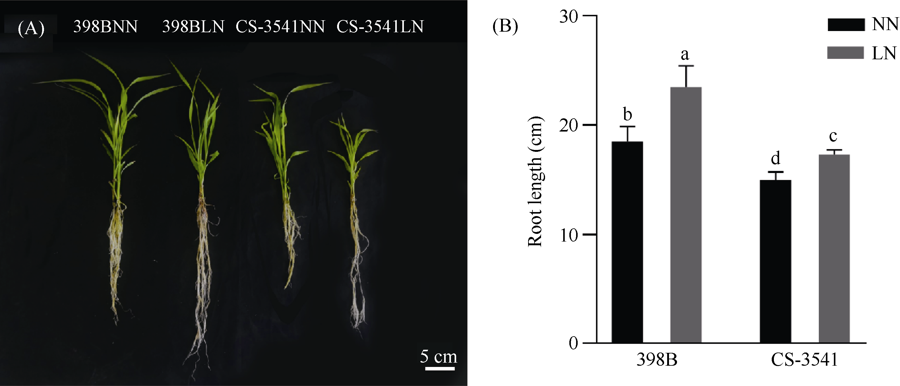
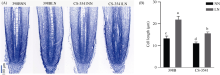
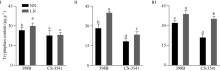
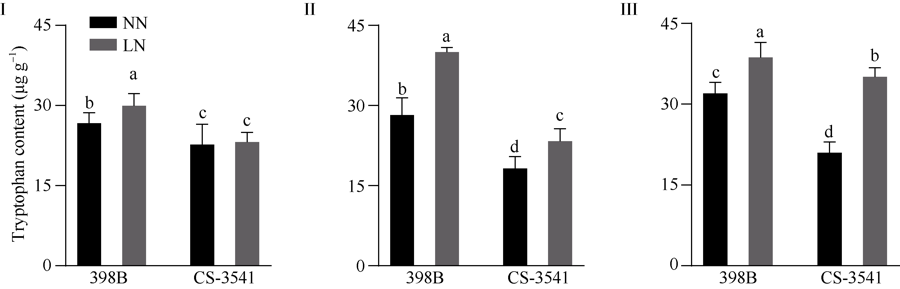
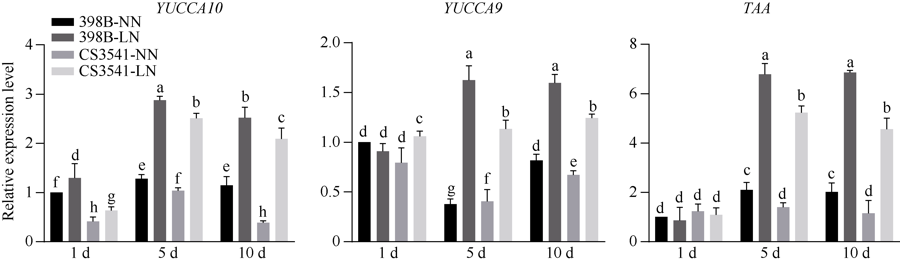
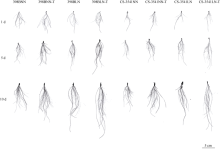
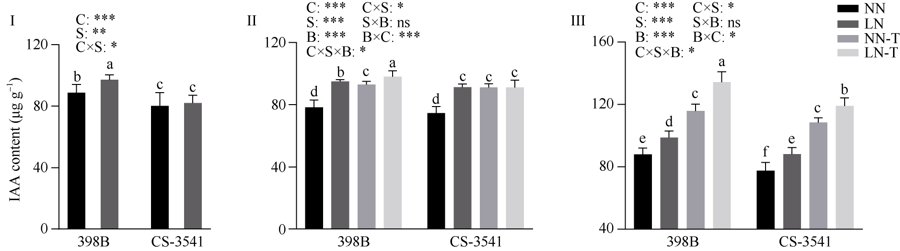
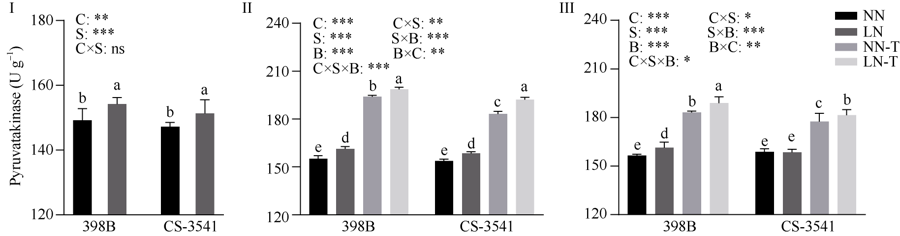
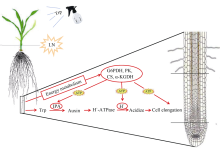
低氮胁迫促进高粱根系伸长, 但其具体的生理机制仍不清晰。为解析高粱根系在低氮胁迫下伸长的生理机制, 本试验选用高粱耐低氮自交系(398B)和氮敏感自交系(CS-3541)为材料, 研究低氮胁迫下高粱根系伸长的物质和能量代谢基础。结果表明, 与正常氮相比, 低氮胁迫显著促进了398B和CS-3541根长及根尖细胞长度, 398B表现出更长的根长; 低氮胁迫后1、5和10 d, 398B和CS-3541根系中内源色氨酸含量显著增加; 应用RNA-seq技术对2个高粱自交系低氮胁迫后根系样品进行差异表达基因鉴定, 结果发现色氨酸代谢途径的有关基因参与了低氮下高粱根系的伸长。进一步利用外源色氨酸处理发现, 外源色氨酸通过增加生长素含量, 激活了质膜H+-ATPase的活性, 促进质膜酸化, 提高了能量代谢相关酶活性及ATP含量, 从而诱导了根系的能量代谢, 促进了低氮胁迫下高粱根系的伸长。而且, 外源色氨酸对低氮胁迫下398B的作用效果更好。综上所述, 低氮胁迫处理激活了内源色氨酸在高粱根系伸长中的关键作用, 依赖色氨酸途径合成的生长素及协同提高的能量代谢是促进低氮下高粱根系伸长的生理机制。
| [1] |
刘晨阳, 张蕙杰, 辛翔飞. 中国高粱产业发展特征及趋势分析. 中国农业科技导报, 2020, 22(10): 1-9.
doi: 10.13304/j.nykjdb.2019.0706 |
| Liu C Y, Zhang H J, Xin X F. Analysis of the development characteristics and trends of sorghum industry in China. J Agric Sci Technol, 2020, 22(10): 1-9. (in Chinese with English abstract) | |
| [2] |
邹剑秋. 高粱育种与栽培技术研究新进展. 中国农业科学, 2020, 53: 2769-2773.
doi: 10.3864/j.issn.0578-1752.2020.14.001 |
|
Zou J Q. New research progress on sorghum breeding and cultivation techniques. Sci Agric Sin, 2020, 53: 2769-2773. (in Chinese with English abstract)
doi: 10.3864/j.issn.0578-1752.2020.14.001 |
|
| [3] |
张彦, 王劲松, 董二伟, 武爱莲, 王媛, 焦晓燕. 中晚熟区主要高粱品种耐瘠性综合评价. 中国农业科学, 2021, 54: 4954-4968.
doi: 10.3864/j.issn.0578-1752.2021.23.003 |
|
Zhang Y, Wang J S, Dong E W, Wu A L, Wang Y, Jiao X Y. Comprehensive evaluation of low-fertility tolerance of different sorghum cultivars in middle-late-maturing area. Sci Agric Sin, 2021, 54: 4954-4968. (in Chinese with English abstract)
doi: 10.3864/j.issn.0578-1752.2021.23.003 |
|
| [4] |
刘鹏, 武爱莲, 王劲松, 南江宽, 董二伟, 焦晓燕, 平俊爱, 白文斌. 不同基因型高粱的氮效率及对低氮胁迫的生理响应. 中国农业科学, 2018, 51: 3074-3083.
doi: 10.3864/j.issn.0578-1752.2018.16.004 |
|
Liu P, Wu A L, Wang J S, Nan J K, Dong E W, Jiao X Y, Ping J A, Bai W B. Nitrogen use efficiency and physiological responses of different sorghum genotypes influenced by nitrogen deficiency. Sci Agric Sin, 2018, 51: 3074-3083 (in Chinese with English abstract).
doi: 10.3864/j.issn.0578-1752.2018.16.004 |
|
| [5] | 李邦, 姜冰, 邢艺凡, 陈小飞, 周宇飞. 高粱幼苗根系对低氮胁迫的响应. 见: 中国作物学会主编. 第十九届中国作物学会学术年会论文摘要集. 武汉: 中国作物学会, 2020. p 315. |
| Li B, Jiang B, Xing Y F, Chen X F, Zhou Y F. Response of sorghum seedling root to low nitrogen stress. In: Crop Science Society of China, eds. Abstracts of the 19th Annual Conference of Crop Science Society of China. Wuhan: Crop Science Society of China, 2020. p 315. (in Chinese with English abstract) | |
| [6] |
Rasmussen A, Hosseini S A, Hajirezaei M R, Druege U, Geelen D. Adventitious rooting declines with the vegetative to reproductive switch and involves a changed auxin homeostasis. J Exp Bot, 2015, 66: 1437-1452.
doi: 10.1093/jxb/eru499 pmid: 25540438 |
| [7] |
Gaudin A C M, McClymont S A, Holmes B M, Lyons E, Raizada M N. Novel temporal, fine-scale and growth variation phenotypes in roots of adult-stage maize (Zea mays L.) in response to low nitrogen stress. Plant Cell Environ, 2011, 34: 2122-2137.
doi: 10.1111/pce.2011.34.issue-12 |
| [8] | Lynch J P. Steep, cheap and deep: an ideotype to optimize water and N acquisition by maize root systems. Ann Bot, 2013, 112: 356-366. |
| [9] |
谢呈辉, 马海曌, 许宏伟, 徐郗阳, 阮国兵, 郭峥岩, 宁永培, 冯永忠, 杨改河, 任广鑫. 施氮量对宁夏引黄灌区麦后复种糜子生长、产量及氮素利用的影响. 作物学报, 2022, 48: 463-477.
doi: 10.3724/SP.J.1006.2022.14010 |
|
Xie C H, Ma H Z, Xu H W, Xu X Y, Ruan G B, Guo Z Y, Ning Y P, Feng Y Z, Yang G H, Ren G X. Effects of nitrogen rate on growth, grain yield, and nitrogen utilization of multiple cropping proso millet after spring-wheat in Irrigation Area of Ningxia. Acta Agron Sin, 2022, 48: 463-477. (in Chinese with English abstract)
doi: 10.3724/SP.J.1006.2022.14010 |
|
| [10] | Mi G, Chen Y L. Ideotype root system architecture for maize to achieve high yield and resource use efficiency in intensive cropping systems. Adv Agron, 2016, 139: 73-97. |
| [11] |
Postma J A, Dathe A, Lynch J P. The optimal lateral root branching density for maize depends on nitrogen and phosphorus availability. Plant Physiol, 2014, 166: 590-602.
doi: 10.1104/pp.113.233916 pmid: 24850860 |
| [12] | Linkohr B I, Williamson L C, Fitter A H, Leyser H M. Nitrate and phosphate availability and distribution have different effects on root system architecture of Arabidopsis. Plant J, 2002, 29: 5684-5701. |
| [13] |
Gruber B D, Giehl R F, Friedel S, Wirén N. Plasticity of the Arabidopsis root system under nutrient deficiencies. Plant Physiol, 2013, 163: 452-463.
doi: 10.1016/j.jplph.2005.04.032 |
| [14] | El-Bassiouny H M S. Physiological responses of wheat to salinity alleviation by nicotinamide and tryptophan. Int J Agric Biol, 2005, 7: 653-659. |
| [15] | Abbas S H, Sohail M, Saleem M. Effect of L-tryptophan on plant weight and pod weight in chickpea under rainfed conditions. Sci Technol Dev, 2013, 163: 161-179. |
| [16] | Hassan T U, Bano A. The stimulatory effects of L-tryptophan and plant growth promoting rhizobacteria (PGPR) on soil health and physiology of wheat. J Soil Sci Plant Nutr, 2015, 15: 190-201. |
| [17] |
Pollmann S, Düchting P, Weiler E W. Tryptophan-dependent indole-3-acetic acid biosynthesis by ‘IAA-synthase’ proceeds via indole-3-acetamide. Phytochemistry, 2009, 70: 523-531.
doi: 10.1016/j.phytochem.2009.01.021 pmid: 19268331 |
| [18] |
Mano Y H, Nemoto K C. The pathway of auxin biosynthesis in plants. J Exp Bot, 2012, 63: 2853-2872.
doi: 10.1093/jxb/ers091 pmid: 22447967 |
| [19] |
Zhou Z Y, Zhang C G, Wu L, Zhang C G, Chai J, Wang M, Jha A, Jia P F, Cui S J, Yang M, Chen R J, Guo G Q. Functional characterization of the CKRC1/TAA1 gene and dissection of hormonal actions in the Arabidopsis root. Plant J, 2011, 66: 516-527.
doi: 10.1111/j.1365-313X.2011.04509.x |
| [20] |
Won C, Shen X, Mashiguchi K, Zheng Z, Dai X, Cheng Y, Kasahara H, Kamiya Y, Chory J, Zhao Y. Conversion of tryptophan to indole-3-acetic acid by tryptophsn sminotrnsferases of Arabidopsis and YUCCAs in Arabidopsis. Proc Natl Acad Sci USA, 2011, 108: 18518-18523.
doi: 10.1073/pnas.1108436108 |
| [21] |
Mashiguchi K S, Tanaka K, Sakai T Y, Sugawara S K, Kawaide H, Natsume M, Hanada A, Yaeno T, Shirasu K, Yao H, McSteen P, Zhao Y, Hayashi K, Kamiya Y J, Kasahara H K. The main auxin biosynthesis pathway in Arabidopsis. Proc Natl Acad Sci USA, 2011, 108: 234-241.
doi: 10.1073/pnas.1102710108 pmid: 21670293 |
| [22] |
Ma W Y, Li J J, Qu B Y, He X, Zhao X Q, Li B, Fu X D, Tong Y P. Auxin biosynthetic gene TAR2 is involved in low nitrogen-mediated reprogramming of root architecture in Arabidopsis . Plant J, 2014, 78: 70-79.
doi: 10.1111/tpj.2014.78.issue-1 |
| [23] |
Yamamoto Y, Kamiya N, Morinaka Y, Matsuoka M, Sazuka T. Auxin biosynthesis by the YUCCA genes in rice. Plant Physiol, 2007, 143: 1362-1371.
doi: 10.1104/pp.106.091561 pmid: 17220367 |
| [24] |
Zhang T T, Kang H, Fu L L, Sun W J, Gao W S, You C X, Wang X F, Hao Y J. NIN-like protein 7 promotes nitrate-mediated lateral root development by activating transcription of TRYPTOPHAN AMINOTRANSFERASE RELATED 2. Plant Sci, 2021, 303: 110771.
doi: 10.1016/j.plantsci.2020.110771 |
| [25] | Bakry B A, Ibrahim F M, Maha M S. Effect of banana peel extract or tryptophan on growth, yield and some biochemical aspects of quinoa plants under water deficit. Int J Pharmtech Res, 2016, 9: 276-287. |
| [26] |
Janus F, Jesper T P, Anja T F, Michael P. Plasma membrane H+-ATPase regulation in the center of plant physiology. Mol Plant, 2016, 9: 323-337.
doi: 10.1016/j.molp.2015.11.002 |
| [27] |
Jing Y, Cui D, Bao F, Hu Z, Qin Z, Hu Y. Tryptophan deficiency affects organ growth by retarding cell expansion in Arabidopsis. Plant J, 2008, 57: 511-521.
doi: 10.1111/tpj.2009.57.issue-3 |
| [28] |
Yu P H, Jiang N, Fu W M, Zheng G G, Li G Y, Feng B H, Chen T T, Ma J Y, Li H B, Tao L X, Fu G F. ATP hydrolysis determines cold tolerance by regulating available energy for glutathione synthesis in rice seedling plants. Rice, 2020, 13: 23-39.
doi: 10.1186/s12284-020-00383-7 pmid: 32274603 |
| [29] | 赵欣, 白伟. 杜仲叶片干旱胁迫响应相关差异蛋白的筛选与鉴定. 植物研究, 2018, 38: 1422-1432. |
| Zhao X, Bai W. Screening and identification of the proteins related to drought response in leaves of Eucommia ulmoides. Bull Bot Res, 2018, 38: 1422-1432. (in Chinese with English abstract) | |
| [30] |
Zhang Y, Han Q, Guo Q, Zhang S. Physiological and proteomic analysis reveals the different responses of Cunninghamia lanceolata seedlings to nitrogen and phosphorus additions. J Proteomics, 2016, 146: 109-121.
doi: 10.1016/j.jprot.2016.07.001 |
| [31] | 刘国英. 供氮水平调控番茄低温耐性的机理研究. 西北农林科技大学博士学位论文, 陕西杨凌, 2018. |
| Liu G Y. Study on the Mechanism of Nitrogen Levels Regulate Tomato Tolerance to Low Temperature. PhD Dissertation of Northwest A&F University, Yangling, Shaanxi, China, 2018. (in Chinese with English abstract) | |
| [32] | 江立庚, 曹卫星. 水稻高效利用氮素的生理机制及有效途径. 中国水稻科学, 2002, 16(3): 64-67. |
| Jiang L G, Cao W X. Physiological mechanism and approach for efficient nitrogen utilization in rice. Chin J Rice Sci, 2002, 16(3): 64-67. (in Chinese with English abstract) | |
| [33] |
Konishi N, Ishiyama K, Matsuoka K, Maru I, Hayakawa T, Yamaya T, Kojima S. NADH-dependent glutamate synthase plays a crucial role in assimilating ammonium in the Arabidopsis root. Physiol Planta, 2014, 152: 138-151.
doi: 10.1111/ppl.12177 |
| [34] | 黎旺姐. 不同生长温度和施氮量对烟草叶片中游离氨基酸含量及其代谢的效应. 云南师范大学博士学位论文, 云南昆明, 2016. |
| Li W J. Effects of Different Growth Temperature and Nitrogen Fertilization on Amino Acid Content and Its Metabolism in Tobacco Leaves. PhD Dissertation of Yunnan Normal University, Kunming, Yunnan, China, 2016. (in Chinese with English abstract) | |
| [35] |
Subudhi P K, Garcia R S, Coronejo S, Tapia R. Comparative transcriptomics of rice genotypes with contrasting responses to nitrogen stress reveals genes influencing nitrogen uptake through the regulation of root architecture. Int J Mol Sci, 2020, 21: 5795-5818.
doi: 10.3390/ijms21165795 |
| [36] |
张楚, 张永清, 路之娟, 刘丽琴. 苗期耐低氮基因型苦荞的筛选及其评价指标. 作物学报, 2017, 43: 1205-1215.
doi: 10.3724/SP.J.1006.2017.01205 |
|
Zhang C, Zhang Y Q, Lu Z J, Liu L Q. Screening Fagopyrum tararicum genotypes tolerant to low nitrogen stress at seedling stage and its evaluating indices. Acta Agron Sin, 2017, 43: 1205-1215. (in Chinese with English abstract)
doi: 10.3724/SP.J.1006.2017.01205 |
|
| [37] |
秦璐, 韩配配, 常海滨, 顾炽明, 黄威, 李银水, 廖祥生, 谢立华, 廖星. 甘蓝型油菜耐低氮种质筛选及绿肥应用潜力评价. 作物学报, 2022, 48: 1488-1501.
doi: 10.3724/SP.J.1006.2022.14087 |
|
Qin L, Han P P, Chang H B, Gu C M, Huang W, Li Y S, Liao X S, Xie L H, Liao X. Screening of rapeseed germplasms with low nitrogen tolerance and the evaluation of its potential application as green manure. Acta Agron Sin, 2022, 48: 1488-1501. (in Chinese with English abstract)
doi: 10.3724/SP.J.1006.2022.14087 |
|
| [38] |
Tian Q, Chen F, Liu J, Zhang F, Mi G. Inhibition of maize root growth by high nitrate supply is correlated with reduced IAA levels in roots. J Plant Physiol, 2008, 165: 942-951.
doi: 10.1016/j.jplph.2007.02.011 |
| [39] |
Gao K, Chen F J, Yuan L X, Mi G H. Cell production and expansion in the primary root of maize in response to low-nitrogen stress. J Integr Agric, 2014, 13: 2508-2517.
doi: 10.1016/S2095-3119(13)60523-7 |
| [40] | Zahir Z A, Yasin H M, Naveed M, Anjum M A, Khalid M. L-tryptophan application enhances the effectiveness of Rhizobium inoculation for improving growth and yield of mungbean (Vigna radiata (L.) Wilczek). Pak J Bot, 2010, 42: 1771-1780. |
| [41] | 蒋佳, 朱星宇, 李晶. 外源色氨酸对油菜幼苗色氨酸下游代谢网络及生长发育的影响. 西北植物学报, 2020, 40: 1549-1557. |
| Jiang J, Zhu X Y, Li J. Effect of exogenous tryptophan on the downstream metabolic network of tryptophan and growth in rapa seedlings. Acta Bot Boreali-Occident Sin, 2020, 40: 1549-1557. (in Chinese with English abstract) | |
| [42] |
Nathan D T, John J R, Jerry D C. The shifting paradigms of auxin biosynthesis. Trends Plant Sci, 2014, 19: 44-51.
doi: 10.1016/j.tplants.2013.09.012 |
| [43] |
Cosgrove D J. Loosening of plant cell walls by expansions. Nature, 2000, 407: 321-326.
doi: 10.1038/35030000 |
| [44] |
Tivendale N D, Millar A H. How is auxin linked with cellular energy pathways to promote growth. New Phytol, 2022, 233: 2397-2404.
doi: 10.1111/nph.17946 pmid: 34984715 |
| [45] |
Liu C K, Tu B J, Wang X, Li Y S, Zhang Q Y, Liu X B. Transcript profile in vegetable soybean roots reveals potential gene patterns regulating K uptake efficiency. Agronomy (Basel), 2020, 10: 1796-1818.
doi: 10.3390/agronomy10111796 |
| [46] | 洪丽芳, 苏帆, 付利波, 梁颖, 瞿兴, 田育天, 刘武定. 生长素在烤烟钾素库源关系改变时对根系呼吸作用生理指标的影响. 中国农业科学, 2003, 36: 1604-1608. |
| Hong L F, Su F, Fu L B, Liang Y, Qu X, Tian Y T, Liu W D. Effects of auxin on the indexes to root respiratory metabolism when the relationship of sink and source was changed. Sci Agric Sin, 2003, 36: 1604-1608. (in Chinese with English abstract) | |
| [47] |
Mustafa A, Imran M, Ashraf M, Mahmood K. Perspectives of using L-tryptophan for improving productivity of agricultural crops: a review. Pedosphere, 2018, 28: 16-34.
doi: 10.1016/S1002-0160(18)60002-5 |
| [48] |
Tretter L, Adam V V. Alpha-ketoglutarate dehydrogenase: a target and generator of oxidative stress. Philos Trans R Soc Lond B Biol Sci, 2005, 360: 2335-2345.
doi: 10.1098/rstb.2005.1764 |
| [49] |
Woo J E, Seong H J, Lee S Y, Jang Y S. Metabolic engineering of Escherichia coli for the production of hyaluronic acid from glucose and galactose. Front Bioeng Biotechnol, 2019, 7: 351.
doi: 10.3389/fbioe.2019.00351 |
| [1] | 张曦, 王广恩, 李邵琦, 刘祎, 李俊兰, 钱玉源. 基于转录组测序解析陆海杂交姊妹系马克隆值差异的形成机制[J]. 作物学报, 2026, 52(5): 1442-1458. |
| [2] | 石少阶, 刘凯, 陈姿夷, 王卉颖, 李三和, 周雷, 游艾青. 水稻矮化多分蘖基因DMT1的克隆与功能分析[J]. 作物学报, 2026, 52(4): 1022-1034. |
| [3] | 徐建霞, 丁延庆, 曹宁, 程斌, 高旭, 李文贞, 王若若, 王磊, 张立异. 397份高粱种质资源在贵州表型多样性分析及综合评价[J]. 作物学报, 2026, 52(4): 1073-1087. |
| [4] | 付江鹏, 柳发财, 闫宝琴, 王永栋, 李利利, 魏玮, 周英霞. 控释肥替代普通尿素对旱作高粱干物质积累分配、产量和品质的影响[J]. 作物学报, 2025, 51(9): 2501-2513. |
| [5] | 文璇, 钟秀丽, 王尚文, 金涛, 彭君, 刘恩科. 基于耐性指数的青稞苗期耐低氮种质筛选及不同氮效率类型综合评价[J]. 作物学报, 2025, 51(7): 1949-1958. |
| [6] | 雷松翰, 范骏扬, 车艳奕, 代永东, 郑雨萌, 田维江, 桑贤春, 王晓雯. 水稻内卷叶突变体acl3的鉴定及调控基因的功能分析[J]. 作物学报, 2025, 51(6): 1467-1479. |
| [7] | 张琴, 戴成, 马朝芝. 生长素响应报告基因转化甘蓝型油菜及各组织GUS动态信号分析[J]. 作物学报, 2025, 51(3): 667-675. |
| [8] | 徐建霞, 丁延庆, 曹宁, 程斌, 高旭, 李文贞, 张立异. 中国高粱株高和节间数全基因组关联分析及候选基因预测[J]. 作物学报, 2025, 51(3): 568-585. |
| [9] | 陈昊翔, 万鑫杰, 陈青, 王劲松, 董二伟, 王媛, 黄晓磊, 刘秋霞, 焦晓燕. 石灰性褐土条件下高粱与玉米耐瘠薄特性及对土壤肥力响应的比较[J]. 作物学报, 2025, 51(10): 2775-2787. |
| [10] | 邵美红, 赵玲玲, 程楚, 程思明, 朱双兵, 翟来圆, 陈凯, 徐建龙. 水稻黄华占背景选择导入系的耐低氮筛选评价与利用[J]. 作物学报, 2024, 50(8): 1907-1919. |
| [11] | 孙美红, 王彩琴, 王蓉, 白文斌, 高振峰. Bacillus velezensis G-1·脂肽悬浮种衣剂的制备及其对高粱丝黑穗病菌的防侵染效果[J]. 作物学报, 2024, 50(6): 1467-1485. |
| [12] | 陈玉章, 吴松果, 卢成霖, 李瑞, 龚利娟, 文悦, 宁佳欣, 吴宇涵. 条带垄覆对西南黄壤坡耕地径流和高粱水分利用的影响[J]. 作物学报, 2024, 50(5): 1325-1340. |
| [13] | 王瑞, 张福耀, 詹鹏杰, 楚建强, 晋敏姗, 赵威军, 程庆军. 基于RNA-Seq筛选高粱低氮胁迫相关候选基因[J]. 作物学报, 2024, 50(3): 669-685. |
| [14] | 张宝华, 刘佳静, 田晓, 田旭钊, 董阔, 武郁洁, 肖凯, 李小娟. 小麦TaSPX1基因的克隆、表达及耐低氮逆境的功能研究[J]. 作物学报, 2024, 50(3): 576-589. |
| [15] | 谭丹, 陈家婷, 郜钰, 张晓军, 李欣, 闫贵云, 李锐, 陈芳, 常利芳, 张树伟, 郭慧娟, 畅志坚, 乔麟轶. 小麦穗型相关生长素通路基因发掘及TaARF23-A与小穗数关联分析[J]. 作物学报, 2024, 50(2): 506-513. |
|
||