欢迎访问作物学报,今天是
作物学报 ›› 2021, Vol. 47 ›› Issue (2): 342-350.doi: 10.3724/SP.J.1006.2021.04091
王媛1,2( ), 王劲松1, 董二伟1, 武爱莲1, 焦晓燕1,*()
WANG Yuan1,2(), WANG Jin-Song1, DONG Er-Wei1, WU Ai-Lian1, JIAO Xiao-Yan1,*()
摘要:
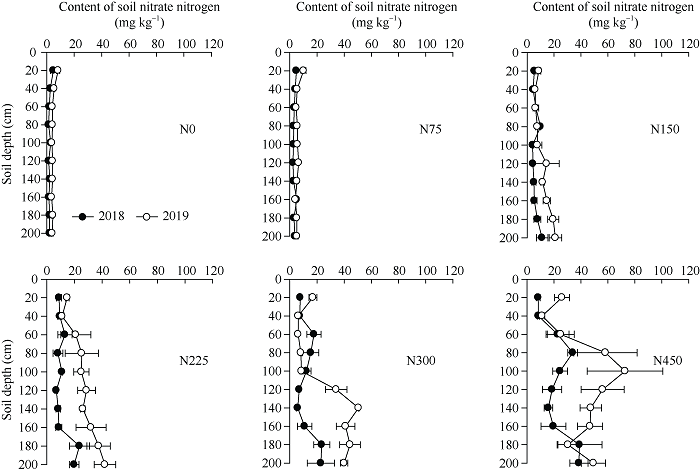
本研究于2015—2019年以晋杂34、辽杂27、晋饲2号、晋糯3号和汾酒粱1号为研究对象, 设0 (N0)、75 (N75)、150 (N150)、225 (N225)、300 (N300)、450 kg hm-2 (N450) 6个氮素水平, 调查其对产量性状、淀粉含量和土壤硝态氮以及氮素利用特性指标的影响, 以探讨高粱合理的氮素施用方案。结果表明, 高粱的产量、穗粒数及植株地上部氮素累积量, 随施氮水平的增加呈先增加后趋于稳定的趋势, 其中以N75处理增幅最大, 较N0处理最大增幅分别可达23.68%、48.05%和51.86%; 籽粒淀粉含量、5年叠加氮肥利用率、5年叠加氮肥农学效率和氮素5年叠加表观回收率随施氮水平的增加都存在不同程度的降低, 其中N75处理下5年叠加氮肥利用率为63.01%, 较N150处理提高了76.91%; 籽粒淀粉产量则随施氮水平的增加呈先增加后降低的趋势。连续施氮4~5年后, 施氮量≥225 kg hm-2, 残留的硝态氮在60~200 cm土层逐年累积, 且在0~200 cm土层存在明显的累积峰, 硝态氮淋失风险加剧。施氮量75~150 kg hm-2之间, 在满足高粱植株基本生长需求的同时, 可以弥补了土壤氮库的消耗, 有效降低了土壤硝态氮的淋失, 亦有利于高粱产量和籽粒淀粉产量的形成。
| [1] | 朱兆良, 文启孝. 中国土壤氮素. 南京: 江苏科学技术出版社, 1992. pp 228-245. |
| Zhu Z L, Wen Q X. Nitrogen in Soil of China. Nanjing: Jiangau Science and Technology Press, 1992. pp 228-245(in Chinese). | |
| [2] | 张福锁, 王激清, 张卫峰, 崔振岭, 马文奇, 陆新平, 江荣凤. 中国主要粮食作物肥料利用率现状与提高途径. 土壤学报, 2008,45:915-924. |
| Zhang F S, Wang J Q, Zhang W F, Cui Z L, Ma W Q, Lu X P, Jiang R F. Nutrient use efficiencies of major cereal crops in China and measures for improvement. Acta Pedol Sin, 2008,45:915-924 (in Chinese with English abstract). | |
| [3] |
王夏雯, 王绍华, 李刚华, 王强盛, 刘正辉, 余翔, 丁艳锋. 氮素穗肥对水稻幼穗细胞分裂素和生长素浓度的影响及其与颖花发育的关系. 作物学报, 2008,34:2184-2189.
doi: 10.3724/SP.J.1006.2008.02184 |
| Wang X W, Wang S H, Li G H, Wang Q S, Liu Z H, Yu X, Ding Y F. Effect of panicle nitrogen fertilizer on concentrations of cytokinin and auxin in young panicles of japonica rice and its relation with spikelet development. Acta Agron Sin, 2008,34:2184-2189 (in Chinese with English abstract). | |
| [4] | 依兵. 高粱子粒淀粉积累与合成相关酶活性研究. 沈阳农业大学博士学位论文, 辽宁沈阳, 2014. |
| Yi B. Starch Accumulation and Enzymes Activities for Starch Synthesis in Sorghum Grains PhD Dissertation of Shenyang Agricultural University, Shenyang, Liaoning, China, 2014 (in Chinese with English abstract). | |
| [5] |
Osaki M, Iyoda M, Tadano T. Ontogenetic changes in the contents of ribulose-1,5-bisphosphate carboxylase/oxygenase, phosphoenol pyruvate carboxylase, and chlorophyll in individual leaves of maize. Soil Sci Plant Nutr, 1995,41:285-293.
doi: 10.1080/00380768.1995.10419585 |
| [6] |
Stitt M, Müller C, Matt P, Gibon Y, Carillo P, Morcuende R, Scheible W, Krapp A. Steps towards an integrated view of nitrogen metabolism. J Exp Bot, 2002,53:959-970.
doi: 10.1093/jexbot/53.370.959 pmid: 11912238 |
| [7] | Wang H, McCaig T N, DePauw R M, Clarke F R, Clarck J M. Physiological characteristics of recent Canada western red spring wheat cultivars: components of grain nitrogen yield. Can J Plant Sci, 2003,83:699-707. |
| [8] | Wang G L, Chen X P, Cui Z L, Yue S C, Zhang F S. Estimated reactive nitrogen losses for intensive maize production in China. Agric Ecosyst Environ, 2014,197:293-300. |
| [9] |
Rimski-Korsakov H, Rubio G, Lavador R S. Fate of the nitrogen from fertilizers in field-grown maize. Nutr Cycl Agroecosys, 2012,93:253-263.
doi: 10.1007/s10705-012-9513-1 |
| [10] | Liang B, Zhao W, Yang X Y, Zhou J B. Fate of nitrogen-15 as influenced by soil and nutrient management history in a 19-year wheat-maize experiment. Field Crops Res, 2013,144:126-134. |
| [11] | 戴健, 王朝辉, 李强, 李孟华, 李富翠. 氮肥用量对旱地冬小麦产量及夏闲期土壤硝态氮变化的影响. 土壤学报, 2013,50:956-965. |
| Dai J, Wang Z H, Li Q, Li M H, Li F C. Effects of nitrogen application rate on winter wheat yield and soil nitrate nitrogen during summer fallow season on dryland. Acta Pedol Sin, 2013,50:956-965 (in Chinese with English abstract). | |
| [12] | Assefa Y, Roozeboom K, Thompson C, Schlegel A, Stone L, Lingenfelser J. Corn and Sorghum Comparison: All Things Considered. Waltham: Academic Press, 2013. pp 71-86. |
| [13] | Muchow R C. Nitrogen utilization efficiency in maize and grain sorghum. Field Crops Res, 1998,56:209-216. |
| [14] | 崔佩佩, 武爱莲, 王劲松, 董二伟, 南江宽, 白文斌, 焦晓燕. 不同施肥处理对高粱根际土壤微生物功能多样性的影响. 华北农学报, 2018,33(5):195-202. |
| Cui P P, Wu A L, Wang J S, Dong E W, Nan J K, Bai W B, Jiao X Y. Effect of different fertilization fertilization treatments on soil microbial function diversity in rhizosphere of sorghum. Acta Agric Boreali-Sin, 2018,33(5):195-202 (in Chinese with English abstract). | |
| [15] |
Hossain A K M, Zakir G V, Subbarao S J, Pearse S G, Osamu I, Takayuki S, Naoyushi K, Nakahara K, Yoshihashi T, Ono H, Yoshida M. Detection isolation and characterization of a root-exuded compound, methyl 3-(4-hydroxyphenyl) propionate, responsible for biological nitrification inhibition by sorghum (Sorghum bicolor). New Phytol, 2008,180:442-451.
pmid: 18657214 |
| [16] | Subbarao G V, Nakahara K, Ishikawa T, Ono H, Yoshida M, Zhu Y Y. Biological nitrification inhibition (BNI) activity in sorghum and its characterization. Plant Soil, 2012,366:243-259. |
| [17] | 王劲松, 董二伟, 武爱莲, 白文斌, 王媛, 焦晓燕. 不同肥力条件下施肥对粒用高粱产量、品质及养分吸收利用的影响. 中国农业科学, 2019,52:4166-4176. |
| Wang J S, Dong E W, Wu A L, Bai W B, Wang Y, Jiao X Y. Responses of fertilization on sorghum grain yield, quality and nutrient utilization to soil fertility. Sci Agric Sin, 2019,52:4166-4176 (in Chinese with English abstract). | |
| [18] | Gardner J C, Maranville J W, Paparozzi E T. Nitrogen use efficiency among diverse sorghum cultivars. Crop Sci, 1994,34:728-733. |
| [19] |
Marsalis M A, Angadi S V, Contrerasgovea F E. Dry matter yield and nutritive value of corn, forage sorghum, and BMR forage sorghum at different plant populations and nitrogen rates. Field Crops Res, 2010,116:52-57.
doi: 10.1016/j.fcr.2009.11.009 |
| [20] | Almodares A, Taheri R, Hadi M R, Fathi M. The effect of nitrogen and potassium fertilizers on the growth parameters and the yield components of two sweet sorghum cultivars. Pak J Biol Sci, 2006,9:2350-2353. |
| [21] | Tang C C, Yang X L, Chen X, Ameen A, Xie G H. Sorghum biomass and quality and soil nitrogen balance response to nitrogen rate on semiarid marginal land. Field Crops Res, 2018,2:12-22. |
| [22] | 张北赢, 徐学选, 刘文兆, 陈天林. 黄土丘陵沟壑区不同降水年型下土壤水分动态. 应用生态学报, 2008,19:1234-1240. |
| Zhang B Y, Xu X X, Liu W Z, Chen T L. Dynamic changes of soil moisture in loess hilly and gully region under effects of different yearly precipitation patterns. Chin J Appl Ecol, 2008,19:1234-1240 (in Chinese with English abstract). | |
| [23] | 鲁如坤. 土壤农业化学分析方法. 北京: 中国农业科技出版社, 1999. pp 264-268. |
| Lu R K. Analytical Methods for Soil and Agro-Chemistry. Beijing: China Agricultural Science and Technology Press, 1999. pp 264-268(in Chinese). | |
| [24] | 谷物籽粒粗淀粉测定方法(GB 5006-1985), 中华人民共和国国家标准. |
| Determination of Crude Starch in Cereals Seeds (GB 5006-1985), State Standard of the People’s Republic of China (in Chinese). | |
| [25] | 刘巽浩, 陈阜. 对氮肥利用率若干传统观念的质疑. 农业现代化研究, 1990,11(4):28-34. |
| Liu X H, Chen F. Queries on the traditional concepts of nitrogen use efficiency. Res Agric Modern, 1990,11(4):28-34 (in Chinese). | |
| [26] | 宇万太, 周桦, 马强, 沈善敏. 氮肥施用对作物吸收土壤氮的影响-兼论作物氮肥利用率. 土壤学报, 2010,47:90-96. |
| Yu W T, Zhou H, Ma Q, Shen S M. Effect of N fertilizer on uptake of soil N by crops with special discussion on fertilizer nitrogen recovery rate. Acta Pedol Sin, 2010,47:90-96 (in Chinese with English abstract). | |
| [27] | 张桂香, 史红梅, 李爱军. 高粱高淀粉基础材料的筛选及评价. 作物杂志, 2009, (1):97-98. |
| Zhang G X, Shi H M, Li A J. Screening and evaluation of sorghum varieties with high starch content. Crops, 2009, (1):97-98 (in Chinese with English abstract). | |
| [28] |
Ebadi M R, Sedghi M, Kakahkai R M. Accurate prediction of nutritional value of sorghum grain using image analysis. Brit Poultry Sci, 2019,60:154-160.
doi: 10.1080/00071668.2018.1562157 |
| [29] | Jemison J M, Fox R H. Nitrate leaching from nitrogen-fertilized and manured corn measured with zero-tension pan lysimeters. J Environ Qual, 1994,23:337-343. |
| [30] |
Takei K. Nitrogen-dependent accumulation of cytokininsin root and the translocation to leaf: Implication of cytokinin species that induces gene expression of maize response regulator. Plant Cell Physiol, 2001,42:85-93.
pmid: 11158447 |
| [31] | Samuelson M E, Larsson C M. Nitrate regulation of zeatin riboside levels in barley roots: effects of inhibitors of N assimilation and comparison with ammonium. Plant Sci, 1993,93:77-84. |
| [32] | 高杰, 李青风, 汪灿, 张国斌, 彭秋. 不同氮素水平对糯高粱物质生产及氮素利用特性的影响. 作物杂志, 2017, (6):126-130. |
| Gao J, Li Q F, Wang C, Zhang G B, Peng Q. Effects of different nitrogen level on material production and nitrogen use characteristics in glutinous sorghum. Crops, 2017, (6):126-130 (in Chinese with English abstract). | |
| [33] | Scheible W R, Gonzalez-Fontes A, Lauerer M, Müller-Röber B, Caboche M, Stitt M. Nitrate acts as a signal to induce organic acid metabolism and repress starch metabolism in tobacco. Plant Cell, 1997,5:783-798. |
| [34] | 王劲松, 董二伟, 武爱莲, 南江宽, 韩雄, 王立革, 丁玉川, 焦晓燕. 灌溉时期与施氮量对矮杆高粱产量和品质的影响. 灌溉排水学报, 2017,36(增刊2):1-8. |
| Wang J S, Dong E W, Wu A L, Nan J K, Han X, Wang L G, Ding Y C, Jiao X Y. Effects of irrigation period and nitrogen application rate on dwarf sorghum yield and quality. J Irrig Drain, 2017,36(S2):1-8 (in Chinese with English abstract). | |
| [35] | 刘璐, 王朝辉, 刁超朋, 王森, 李莎莎. 旱地不同小麦品种产量与干物质及氮磷钾养分需求的关系. 植物营养与肥料学报, 2018,24:599-608. |
| Liu L, Wang Z H, Diao C P, Wang S, Li S S. Grain yield of different wheat cultivars and their relations to dry matter and NPK requirement in dryland. Plant Nutr Fert Sci, 2018,24:599-608 (in Chinese with English abstract). | |
| [36] | 杨文治, 余存祖. 黄土高原区域治理与评价. 北京: 科学出版社, 1992. pp 125-135. |
| Yang W Z, Yu C Z. The Management and Evaluation on the Loess Plateau Area. Beijing: Science Press, 1992. pp 125-135(in Chinese). | |
| [37] | 巨晓棠, 张福锁. 中国北方土壤硝态氮的累积及其对环境的影响. 生态环境, 2003,12(1):24-28. |
| Ju X T, Zhang F S. Nitrate accumulation and its implication to environment in north China. Ecol Environ, 2003,12(1):24-28 (in Chinese with English abstract). | |
| [38] | 刘平, 刘学军, 骆晓声. 山西北部农村区域大气活性氮沉降特征. 生态学报, 2016,36:5353-5359. |
| Liu P, Liu X J, Luo X S. The atmospheric deposition characteristics of reactive nitrogen (Nr) species in Shuozhou area. Acta Ecol Sin, 2016,36:5353-5359 (in Chinese with English abstract). | |
| [39] | Chan C K, Yao X H. Air pollution in mega cities in China. Atmos Environ, 2008,42:1-42. |
| [40] | 巨晓棠. 氮肥有效率的概念及意义——兼论对传统氮肥利用率的理解误区. 土壤学报, 2014,51:921-933. |
| Ju X T. The concept and meanings of nitrogen fertilizer availability ratio discussing misunderstanding of traditional nitrogen use efficiency. Acta Pedol Sin, 2014,51:921-933 (in Chinese with English abstract). |
| [1] | 徐建霞, 丁延庆, 曹宁, 程斌, 高旭, 李文贞, 王若若, 王磊, 张立异. 397份高粱种质资源在贵州表型多样性分析及综合评价[J]. 作物学报, 2026, 52(4): 1073-1087. |
| [2] | 付江鹏, 柳发财, 闫宝琴, 王永栋, 李利利, 魏玮, 周英霞. 控释肥替代普通尿素对旱作高粱干物质积累分配、产量和品质的影响[J]. 作物学报, 2025, 51(9): 2501-2513. |
| [3] | 徐建霞, 丁延庆, 曹宁, 程斌, 高旭, 李文贞, 张立异. 中国高粱株高和节间数全基因组关联分析及候选基因预测[J]. 作物学报, 2025, 51(3): 568-585. |
| [4] | 陈昊翔, 万鑫杰, 陈青, 王劲松, 董二伟, 王媛, 黄晓磊, 刘秋霞, 焦晓燕. 石灰性褐土条件下高粱与玉米耐瘠薄特性及对土壤肥力响应的比较[J]. 作物学报, 2025, 51(10): 2775-2787. |
| [5] | 孙美红, 王彩琴, 王蓉, 白文斌, 高振峰. Bacillus velezensis G-1·脂肽悬浮种衣剂的制备及其对高粱丝黑穗病菌的防侵染效果[J]. 作物学报, 2024, 50(6): 1467-1485. |
| [6] | 陈玉章, 吴松果, 卢成霖, 李瑞, 龚利娟, 文悦, 宁佳欣, 吴宇涵. 条带垄覆对西南黄壤坡耕地径流和高粱水分利用的影响[J]. 作物学报, 2024, 50(5): 1325-1340. |
| [7] | 王瑞, 张福耀, 詹鹏杰, 楚建强, 晋敏姗, 赵威军, 程庆军. 基于RNA-Seq筛选高粱低氮胁迫相关候选基因[J]. 作物学报, 2024, 50(3): 669-685. |
| [8] | 房孟颖, 任粱, 卢霖, 董学瑞, 武志海, 闫鹏, 董志强. 乙矮合剂对粒用高粱根系建构和产量的影响[J]. 作物学报, 2023, 49(9): 2528-2538. |
| [9] | 王媛, 王劲松, 董二伟, 刘秋霞, 武爱莲, 焦晓燕. 施氮量对高粱籽粒灌浆及淀粉累积的影响[J]. 作物学报, 2023, 49(7): 1968-1978. |
| [10] | 陆梦琪, 谢若涵, 李想, 杨明冲, 何紫薇, 高杰, 赵晓燕, 沈祥陵, 陈燕, 王继斌, 胡利华, 段明政, 王令强. 基于“LabelmeP1.0”提取的高粱维管束参数与农艺性状关联研究[J]. 作物学报, 2023, 49(7): 1954-1967. |
| [11] | 李邦, 刘春娟, 郭俊杰, 武宇昕, 邓志成, 张敏, 崔彤, 刘畅, 周宇飞. 低氮胁迫下外源色氨酸对高粱幼苗根系伸长的调控作用[J]. 作物学报, 2023, 49(5): 1372-1385. |
| [12] | 王劲松, 白歌, 张艳慧, 申甜雨, 董二伟, 焦晓燕. 长期不同施肥处理对高粱花后叶片衰老、抗氧化酶活性及产量的影响[J]. 作物学报, 2023, 49(3): 845-855. |
| [13] | 陈冰嬬, 于淼, 葛占宇, 李洪奎, 黄炎, 李海青, 石贵山, 谢利, 徐宁, 闫峰, 高士杰, 周紫阳, 王鼐. 春播早熟区高粱杂种优势群及杂种优势模式分析[J]. 作物学报, 2023, 49(2): 343-353. |
| [14] | 刘秋霞, 董二伟, 黄晓磊, 王劲松, 王媛, 焦晓燕. 不同生态区高粱籽粒产量和品质对氮肥施用的响应[J]. 作物学报, 2023, 49(10): 2766-2776. |
| [15] | 王倩, 刘少雄, 柴晓娇, 李海, 张芬, 陆平, 王瑞云, 刘敏轩. 中国不同省(市、自治区)糯高粱籽粒酚类物质含量差异分析[J]. 作物学报, 2022, 48(10): 2505-2516. |
|
||