欢迎访问作物学报,今天是
作物学报 ›› 2019, Vol. 45 ›› Issue (2): 276-288.doi: 10.3724/SP.J.1006.2019.84050
陈四龙,程增书,宋亚辉,王瑾,刘义杰,张朋娟,李玉荣( )
)
Si-Long CHEN,Zeng-Shu CHENG,Ya-Hui SONG,Jin WANG,Yi-Jie LIU,Peng-Juan ZHANG,Yu-Rong LI()
摘要:
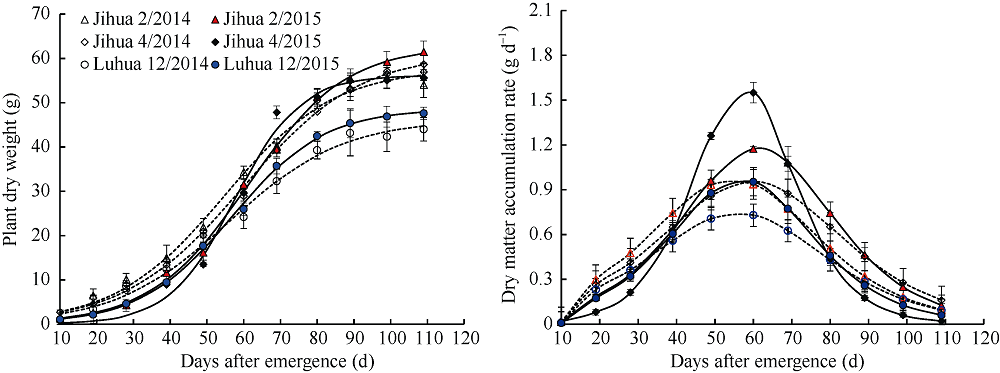
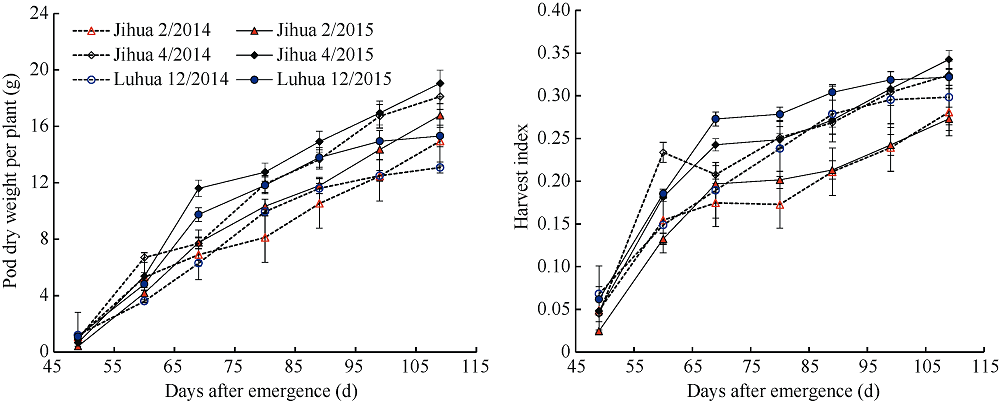
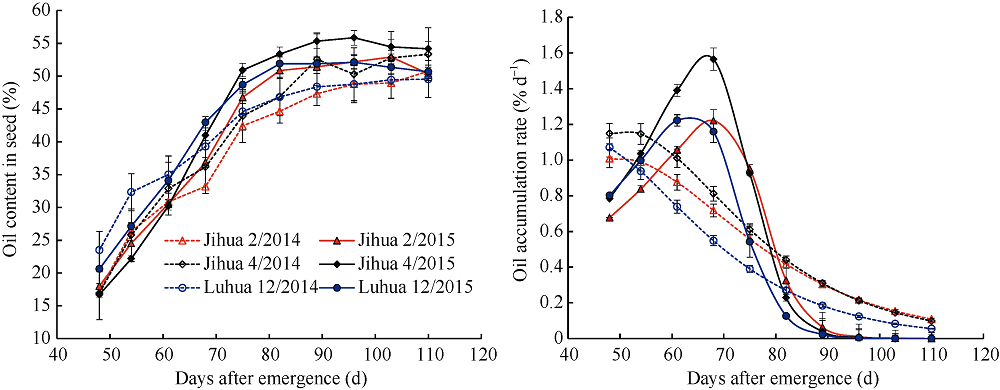
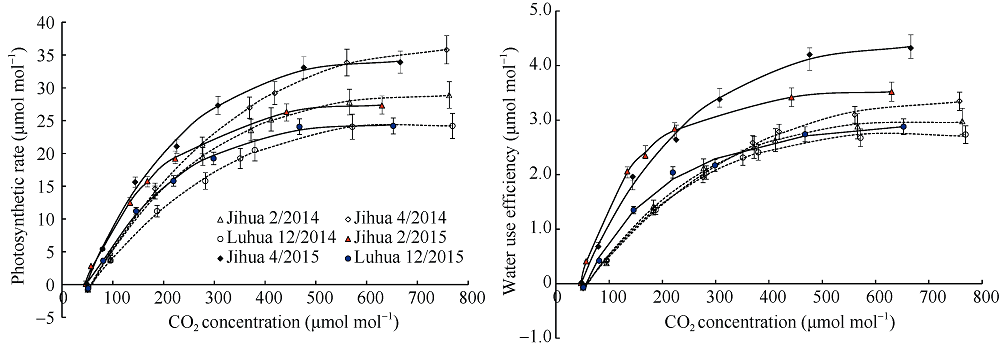
以冀花2号、冀花4号和鲁花12号为材料, 连续测定干物质、荚果产量、含油量及叶片光合指标, 定量分析高产高油花生品种冀花4号物质生产指标的动态特征和叶片光合性能, 为解析花生高产高油形成机制和优质高效栽培提供依据。结果表明, 荚果产量和籽仁含油量均以冀花4号最高。干物质平均积累速率和最大积累速率均以冀花4号>冀花2号>鲁花12号, 且冀花4号干物质积累潜力适中; 籽仁油分最大积累速率和平均积累速率均以冀花4号>鲁花12号>冀花2号, 籽仁油分积累活跃期以冀花4号最短。冀花4号全生育期的光合势显著高于冀花2号和鲁花12号, 分别高20%以上, 产量形成期的光合势占全生育期的80%, 冀花4号结荚期光合速率比冀花2号和鲁花12号均高24%以上; 光饱和点和CO2饱和点均为冀花4号最高。荚果产量与干物质平均积累速率、叶片光合速率和总光合势呈极显著正相关; 籽仁含油量与单株干物质积累速率、籽仁油分平均积累速率、光饱和点、CO2饱和点、经济系数、出仁率等显著或极显著相关; 荚果产量与含油量极显著正相关。冀花4号具有较高的经济系数、总光合势及结荚期后分配比例、光合速率、光饱和点和CO2饱和点, 以及相对较高的干物质和油分积累平均速率, 是其较冀花2号和鲁花12号高产高油的重要原因。
| [1] | Sharma M, Gupta S K, Mondal A K. Production and trade of major world oil crops. In: Gupta S eds. Technological Innovations in Major World Oil Crops, Volume 1: Breeding. New York: Springer New York, 2012. pp 1-15. |
| [2] | 禹山林 . 中国花生产业现状与发展思路探讨. 见: 中国作物学会油料作物专业委员会汇编. 中国作物学会油料作物专业委员会第七次会员代表大会暨学术年会论文集. 2013. pp 24-28. |
| Yu S L. Study on current situation and development of peanut industry in China. In: China Crop Society Oil Crop Specialized Committee, eds. Seventh Member Congress and Academic Annual Meeting of China Crop Society Oil Crop Specialized Committee. 2013. pp 24-28(in Chinese). | |
| [3] | 陈四龙, 李玉荣, 程增书, 廖伯寿, 雷永, 刘吉生 . 花生含油量杂种优势表现及主基因+多基因遗传效应分析. 中国农业科学, 2009,42:3048-3057. |
| Chen S L, Li Y R, Cheng Z S, Liao B S, Lei Y, Liu J S . Heterosis and genetic analysis of oil content in peanut using mixed model of major gene and polygene. Sci Agric Sin, 2009,42:3048-3057 (in Chinese with English abstract). | |
| [4] |
陈四龙, 李玉荣, 徐桂真, 程增书 . 不同高油花生品种(系)油分积累特性的模拟研究. 作物学报, 2008,34:142-149.
doi: 10.3724/SP.J.1006.2008.00142 |
|
Chen S L, Li Y R, Xu G Z, Cheng Z S . Simulation on oil accumulation characteristics in different high oil peanut varieties. Acta Agron Sin, 2008,34:142-149 (in Chinese with English abstract).
doi: 10.3724/SP.J.1006.2008.00142 |
|
| [5] |
张佳蕾, 顾学花, 杨传婷, 郭峰, 李向东, 万书波 . 不同品质类型花生籽仁脂肪酸积累规律研究. 花生学报, 2016,45(2):33-37.
doi: 10.14001/j.issn.1002-4093.2016.02.006 |
|
Zhang J L, Gu X H, Yang C T, Guo F, Li X D, Wan S B . Regularity of fatty acids accumulation in different quality types of peanut seed kernel. J Peanut Sci, 2016,45(2):33-37 (in Chinese with English abstract).
doi: 10.14001/j.issn.1002-4093.2016.02.006 |
|
| [6] | 凌启鸿 . 作物群体质量. 上海: 上海科学技术出版社, 2000. pp 458-516. |
| Ling Q H . Crop Population Quality. Shanghai: Shanghai Scientific and Technical Publishers, 2000. pp 458-516(in Chinese). | |
| [7] | Sarker Z I, Barma N, Zahid R A, Rahman M M, Samad M A, Pandit D B . Harvest index and biomass as the selection criteria for grain yield in spring wheat. J Sci Technol, 2003,1:37-41. |
| [8] | Ghosh M K, Chowdhuri S R, Nath S, Ghosh P K, Debnath S, Roy I, Ghosh P L . Harvest index and biological yield as selection criteria for mulberry (Moru5 spp.). Indian J Genet Plant Breed, 2007,67:196-197. |
| [9] |
Borghi B, Accerbi M, Corbellini M . Response to early generation selection for grain yield and harvest index in bread wheat (T. aestivum L.). Plant Breed, 2010,117:13-18.
doi: 10.1111/j.1439-0523.1998.tb01440.x |
| [10] |
王永宏, 王克如, 赵如浪, 王楷, 赵健, 王喜梅, 李健, 梁明晰, 李少昆 . 高产春玉米源库特征及其关系. 中国农业科学, 2013,46:257-269.
doi: 10.3864/j.issn.0578-1752.2013.02.005 |
|
Wang Y H, Wang K R, Zhang R L, Wang K, Zhao J, Wang X M, Li J, Liang M X, Li S K . Relationship between the source and sink of spring maize with high yield. Sci Agric Sin, 2013,46:257-269 (in Chinese with English abstract).
doi: 10.3864/j.issn.0578-1752.2013.02.005 |
|
| [11] |
Li J, Xie R Z, Wang K R, Ming B, Guo Y Q, Zhang G Q, Li S K . Variations in maize dry matter, harvest index, and grain yield with plant density. Agron J, 2015,107:829.
doi: 10.2134/agronj14.0522 |
| [12] |
吴桂成, 张洪程, 戴其根, 霍中洋, 许柯, 高辉, 魏海燕, 沙安勤, 徐宗进, 钱宗华, 孙菊英 . 南方粳型超级稻物质生产积累及超高产特征的研究. 作物学报, 2010,36:1921-1930.
doi: 10.3724/SP.J.1006.2010.01921 |
|
Wu G C, Zhang H C, Dai Q G, Huo Z Y, Xu K, Gao H, Wei H Y, Sha A Q, Xu Z J, Qian Z H, Sun J Y . Characteristics of dry matter production and accumulation and super-high yield of japonica super rice in South China. Acta Agron Sin, 2010,36:1921-1930 (in Chinese with English abstract).
doi: 10.3724/SP.J.1006.2010.01921 |
|
| [13] |
Liu T, Wang Z, Cai T . Canopy apparent photosynthetic characteristics and yield of two spike-type wheat cultivars in response to row spacing under high plant density. PLoS One, 2016,11:e0148582.
doi: 10.1371/journal.pone.0148582 pmid: 4741391 |
| [14] |
王才斌, 郑亚萍, 成波, 沙继锋, 姜振祥 . 花生超高产群体特征与光能利用研究. 华北农学报, 2004,19(2):40-43.
doi: 10.3321/j.issn:1000-7091.2004.02.011 |
|
Wang C B, Zheng Y P, Cheng B, Sha J F, Jiang Z X . The canopy characters and efficiency for solar energy utilization of supper high-yielding peanut. Acta Agric Boreali-Sin, 2004,19(2):40-43 (in Chinese with English abstract).
doi: 10.3321/j.issn:1000-7091.2004.02.011 |
|
| [15] |
张佳蕾, 郭峰, 杨佃卿, 孟静静, 杨莎, 王兴语, 陶寿祥, 李新国, 万书波 . 单粒精播对超高产花生群体结构和产量的影响. 中国农业科学, 2015,48:3757-3766.
doi: 10.3864/j.issn.0578-1752.2015.18.019 |
|
Zhang J L, Guo F, Yang D Q, Meng J J, Yang S, Wang X Y, Tao S X, Li X G, Wan S B . Effects of single-seed precision sowing on population structure and yield of peanuts with super-high yield cultivation. Sci Agric Sin, 2015,48:3757-3766 (in Chinese with English abstract).
doi: 10.3864/j.issn.0578-1752.2015.18.019 |
|
| [16] | Marschner H. Mineral Nutrition of Higher Plants, 2nd edn. London: Academic Press, 1995. pp 131-183. |
| [17] |
Li D Y, Zhang Z A, Zheng D J, Jiang L Y, Wang Y L . Comparison of net photosynthetic rate in leaves of soybean with different yield levels. J Northeast Agric Univ, 2012,19(3):14-19.
doi: 10.3969/j.issn.1006-8104.2012.03.002 |
| [18] | Li Y, Hu T, Duan X, Zeng F . Effects of decomposing leaf litter of Eucalyptus grandis on the growth and photosynthetic characteristics of Lolium perenne. J Agric Sci, 2013,5:123-131. |
| [19] |
Takai T, Adachi S, Taguchi-Shiobara F, Sanoh-Arai Y, Iwasawa N, Yoshinaga S, Hirose S, Taniguchi Y, Yamanouchi U, Wu J . A natural variant of NAL1, selected in high-yield rice breeding programs, pleiotropically increases photosynthesis rate. Sci Rep, 2013,3:2149.
doi: 10.1038/srep02149 pmid: 23985993 |
| [20] |
Thomasl S, Davidm B . Current perspectives on the regulation of whole-plant carbohydrate partitioning. Plant Sci, 2010,178:341-349.
doi: 10.1016/j.plantsci.2010.01.010 |
| [21] |
Lobo A K, De O M M, Lima Neto M C, Machado E C, Ribeiro R V, Silveira J A . Exogenous sucrose supply changes sugar metabolism and reduces photosynthesis of sugarcane through the down-regulation of Rubisco abundance and activity. J Plant Physiol, 2015,179:113-121.
doi: 10.1016/j.jplph.2015.03.007 pmid: 25863283 |
| [22] | Shiratake K . Genetics of sucrose transporter in plants. G3 (Bethesda), 2007,1:73-80. |
| [23] |
Zhang Y, Mulpuri S, Liu A . High light exposure on seed coat increases lipid accumulation in seeds of castor bean (Ricinus communis L.), a nongreen oilseed crop. Photosynth Res, 2016,128:125-140.
doi: 10.1007/s11120-015-0206-x pmid: 26589321 |
| [24] |
张洋, 刘爱忠 . 蓖麻种子油脂累积与可溶性糖变化的关系. 生物技术通报, 2016,32(6):120-129.
doi: 10.13560/j.cnki.biotech.bull.1985.2016.06.017 |
|
Zhang Y, Liu A Z . The correlation between soluble carbohydrate metabolism and lipid accumulation in castor seeds. Biotech Bull, 2016,32(6):120-129 (in Chinese with English abstract).
doi: 10.13560/j.cnki.biotech.bull.1985.2016.06.017 |
|
| [25] | 张凌云, 王小艺, 曹一博 . 油茶果实糖含量及代谢相关酶活性与油脂积累关系分析. 北京林业大学学报, 2013,35(4):55-60. |
| Zhang L Y, Wang X Y, Cao Y B . Soluble sugar content and key enzyme activity and the relationship between sugar metabolism and lipid accumulation in developing fruit ofCamellia oleifera. J Beijing For Univ, 2013,35(4):55-60 (in Chinese with English abstract). | |
| [26] | 姜慧芳, 任小平, 王圣玉, 黄家权, 雷永, 廖伯寿 . 野生花生高油基因资源的发掘与鉴定. 中国油料作物学报, 2010,32:30-34. |
| Jiang H F, Ren X P, Wang S Y, Huang J Q, Lei Y, Liao B S . Identification and evaluation of high oil content in wild Arachis species. Chin J Oil Crop Sci, 2010,32:30-34 (in Chinese with English abstract). | |
| [27] |
姜慧芳, 任小平 . 我国栽培种花生资源农艺和品质性状的遗传多样性. 中国油料作物学报, 2006,28:421-426.
doi: 10.3321/j.issn:1007-9084.2006.04.009 |
|
Jiang H F, Ren X P . Genetic diversity of peanut resource on morphological characters and seed chemical components in China. Chin J Oil Crop Sci, 2006,28:421-426 (in Chinese with English abstract).
doi: 10.3321/j.issn:1007-9084.2006.04.009 |
|
| [28] |
Jongrungklang N, Toomsan B, Vorasoot N, Jogloy S, Boote K J, Hoogenboom G, Patanothai A . Classification of root distribution patterns and their contributions to yield in peanut genotypes under mid-season drought stress. Field Crops Res, 2012,127:181-190.
doi: 10.1016/j.fcr.2011.11.023 |
| [29] | Boote K J . Growth stages of peanut (Arachis hypogaea L.). Peanut Sci, 1982,9:35-40. |
| [30] | Mason T G, Maskell E J . Studies on the transport of carbohydrates in the cotton plant. I. A study of diurnal variation in the carbohydrates of leaf, bark, and wood, and of the effects of ringing. Ann Bot-London, 1928,42:189-253. |
| [31] |
Ottaviano E, Camussi A . Phenotypic and genetic relationships between yield components in maize. Euphytica, 1981,30:601-609.
doi: 10.1007/BF00038787 |
| [32] |
吴桂成, 张洪程, 钱银飞, 李德剑, 周有炎, 徐军, 吴文革, 戴其根, 霍中洋, 许轲, 高辉, 徐宗进, 钱宗华, 孙菊英, 赵品恒 . 粳型超级稻产量构成因素协同规律及超高产特征的研究. 中国农业科学, 2010,43:266-276.
doi: 10.3864/j.issn.0578-1752.2010.02.006 |
|
Wu G C, Zhang H C, Qian Y F, Li D J, Zhou Y Y, Xu J, Wu W G, Dai Q G, Huo Z Y, Xu K, Gao H, Xu Z J, Qian Z H, Sun J Y, Zhao P H . Rule of grain yield components from high yield to super high yield and the characters of super-high yielding japonica super rice. Sci Agric Sin, 2010,43:266-276 (in Chinese with English abstract).
doi: 10.3864/j.issn.0578-1752.2010.02.006 |
|
| [33] |
Yan D, Zhu Y, Wang S, Cao W . A quantitative knowledge-based model for designing suitable growth dynamics in rice. Plant Prod Sci, 2006,9:93-105.
doi: 10.1626/pps.9.93 |
| [34] |
Severini A D, Borrás L, Westgate M E, Cirilo A G . Kernel number and kernel weight determination in dent and popcorn maize. Field Crops Res, 2011,120:360-369.
doi: 10.1016/j.fcr.2010.11.013 |
| [35] |
纪洪亭, 冯跃华, 何腾兵, 李云, 武彪, 王小艳 . 两个超级杂交水稻品种物质生产的特性. 作物学报, 2013,29:2238-2246.
doi: 10.3724/SP.J.1006.2013.02238 |
|
Ji H T, Feng Y H, He T B, Li Y, Wu B, Wang X Y . Dynamic characteristics of matter population in two super hybrid rice cultivars. Acta Agron Sin, 2013,39:2238-2246 (in Chinese with English abstract).
doi: 10.3724/SP.J.1006.2013.02238 |
|
| [36] |
赵姣, 郑志芳, 方艳茹, 周顺利, 廖树华, 王璞 . 基于动态模拟模型分析冬小麦干物质积累特征对产量的影响. 作物学报, 2013,39:300-308.
doi: 10.3724/SP.J.1006.2013.00300 |
|
Zhao J, Zheng Z F, Fang Y R, Zhou S L, Liao S H, Wang P . Effect of dry matter accumulation characteristics on yield of winter wheat analyzed by dynamic simulation model. Acta Agron Sin, 2013,39:300-308 (in Chinese with English abstract).
doi: 10.3724/SP.J.1006.2013.00300 |
|
| [37] |
杨惠杰, 李义珍, 杨仁崔, 姜照伟, 郑景生 . 超高产水稻的干物质生产特性研究. 中国水稻科学, 2001,15:265-270.
doi: 10.3321/j.issn:1001-7216.2001.04.006 |
|
Yang H J, Li Y Z, Yang R C, Jiang Z W, Zheng J S . Dry matter production characteristics of super high yielding rice. Chin J Rice Sci, 2001,15:265-270 (in Chinese with English abstract).
doi: 10.3321/j.issn:1001-7216.2001.04.006 |
|
| [38] |
梁晓艳, 李安东, 万书波, 王才斌, 孙奎香, 陈效东, 吴正锋 . 超高产夏直播花生生育动态及生理特性研究. 作物杂志, 2011, ( 3):46-50.
doi: 10.3969/j.issn.1001-7283.2011.03.011 |
|
Liang X Y, Li A D, Wan S B, Wang C B, Sun K X, Chen X D, Wu Z F . Developmental dynamics and physiological characteristics of super high-yielding summer-planting peanut. Crops, 2011, ( 3):46-50 (in Chinese with English abstract).
doi: 10.3969/j.issn.1001-7283.2011.03.011 |
|
| [39] |
李晓丹, 曹应龙, 胡亚平, 肖玲, 武玉花, 吴刚, 卢长明 . 花生种子发育过程中脂肪酸累积模式研究. 中国油料作物学报, 2009,31:157-162.
doi: 10.3321/j.issn:1007-9084.2009.02.009 |
|
Li X D, Cao Y L, Hu Y P, Xiao L, Wu Y H, Wu G, Lu C M . Fatty acid accumulation pattern in developing seeds of peanut. Chin J Oil Crop Sci, 2009,31:157-162 (in Chinese with English abstract).
doi: 10.3321/j.issn:1007-9084.2009.02.009 |
|
| [40] |
Hu Y, Zhang Y, Yu W, Hänninen H, Song L, Du X, Zhang R, Wu J . Novel insights into the influence of seed sarcotesta photosynthesis on accumulation of seed dry matter and oil content in Torreya grandis cv. “Merrillii”. Front Plant Sci, 2018,8:2179.
doi: 10.3389/fpls.2017.02179 pmid: 29375592 |
| [41] |
Janila P, Manohar S S, Patne N, Variath M T, Nigam S N . Genotype × environment interactions for oil content in peanut and stable high-oil-yielding sources. Crop Sci, 2016,56:2506-2515.
doi: 10.2135/cropsci2016.01.0005 |
| [42] | Meta H R, Monpara B A . Genetic variation and trait relationships in summer groundnut, Arachis hypogaea L. J Oilseeds Res, 2010,26:186-187. |
| [1] | 王丹, 周宝元, 马玮, 葛均筑, 丁在松, 李从锋, 赵明. 长江中游双季玉米种植模式周年气候资源分配与利用特征[J]. 作物学报, 2022, 48(6): 1437-1450. |
| [2] | 王旺年, 葛均筑, 杨海昌, 阴法庭, 黄太利, 蒯婕, 王晶, 汪波, 周广生, 傅廷栋. 大田作物在不同盐碱地的饲料价值评价[J]. 作物学报, 2022, 48(6): 1451-1462. |
| [3] | 颜佳倩, 顾逸彪, 薛张逸, 周天阳, 葛芊芊, 张耗, 刘立军, 王志琴, 顾骏飞, 杨建昌, 周振玲, 徐大勇. 耐盐性不同水稻品种对盐胁迫的响应差异及其机制[J]. 作物学报, 2022, 48(6): 1463-1475. |
| [4] | 杨欢, 周颖, 陈平, 杜青, 郑本川, 蒲甜, 温晶, 杨文钰, 雍太文. 玉米-豆科作物带状间套作对养分吸收利用及产量优势的影响[J]. 作物学报, 2022, 48(6): 1476-1487. |
| [5] | 陈静, 任佰朝, 赵斌, 刘鹏, 张吉旺. 叶面喷施甜菜碱对不同播期夏玉米产量形成及抗氧化能力的调控[J]. 作物学报, 2022, 48(6): 1502-1515. |
| [6] | 李祎君, 吕厚荃. 气候变化背景下农业气象灾害对东北地区春玉米产量影响[J]. 作物学报, 2022, 48(6): 1537-1545. |
| [7] | 李海芬, 魏浩, 温世杰, 鲁清, 刘浩, 李少雄, 洪彦彬, 陈小平, 梁炫强. 花生电压依赖性阴离子通道基因(AhVDAC)的克隆及在果针向地性反应中表达分析[J]. 作物学报, 2022, 48(6): 1558-1565. |
| [8] | 石艳艳, 马志花, 吴春花, 周永瑾, 李荣. 垄作沟覆地膜对旱地马铃薯光合特性及产量形成的影响[J]. 作物学报, 2022, 48(5): 1288-1297. |
| [9] | 闫晓宇, 郭文君, 秦都林, 王双磊, 聂军军, 赵娜, 祁杰, 宋宪亮, 毛丽丽, 孙学振. 滨海盐碱地棉花秸秆还田和深松对棉花干物质积累、养分吸收及产量的影响[J]. 作物学报, 2022, 48(5): 1235-1247. |
| [10] | 柯健, 陈婷婷, 吴周, 朱铁忠, 孙杰, 何海兵, 尤翠翠, 朱德泉, 武立权. 沿江双季稻北缘区晚稻适宜品种类型及高产群体特征[J]. 作物学报, 2022, 48(4): 1005-1016. |
| [11] | 刘嘉欣, 兰玉, 徐倩玉, 李红叶, 周新宇, 赵璇, 甘毅, 刘宏波, 郑月萍, 詹仪花, 张刚, 郑志富. 耐三唑并嘧啶类除草剂花生种质创制与鉴定[J]. 作物学报, 2022, 48(4): 1027-1034. |
| [12] | 李瑞东, 尹阳阳, 宋雯雯, 武婷婷, 孙石, 韩天富, 徐彩龙, 吴存祥, 胡水秀. 增密对不同分枝类型大豆品种同化物积累和产量的影响[J]. 作物学报, 2022, 48(4): 942-951. |
| [13] | 王吕, 崔月贞, 吴玉红, 郝兴顺, 张春辉, 王俊义, 刘怡欣, 李小刚, 秦宇航. 绿肥稻秆协同还田下氮肥减量的增产和培肥短期效应[J]. 作物学报, 2022, 48(4): 952-961. |
| [14] | 杜浩, 程玉汉, 李泰, 侯智红, 黎永力, 南海洋, 董利东, 刘宝辉, 程群. 利用Ln位点进行分子设计提高大豆单荚粒数[J]. 作物学报, 2022, 48(3): 565-571. |
| [15] | 陈云, 李思宇, 朱安, 刘昆, 张亚军, 张耗, 顾骏飞, 张伟杨, 刘立军, 杨建昌. 播种量和穗肥施氮量对优质食味直播水稻产量和品质的影响[J]. 作物学报, 2022, 48(3): 656-666. |
|
||