欢迎访问作物学报,今天是
作物学报 ›› 2019, Vol. 45 ›› Issue (11): 1638-1648.doi: 10.3724/SP.J.1006.2019.94003
刘浩,鲁清,李海芬,李少雄,陈小平,梁炫强( ),洪彦彬()
LIU Hao,LU Qing,LI Hai-Fen,LI Shao-Xiong,CHEN Xiao-Ping,LIANG Xuan-Qiang(),HONG Yan-Bin()
摘要:
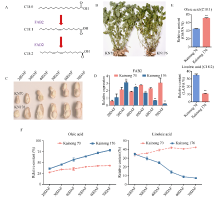
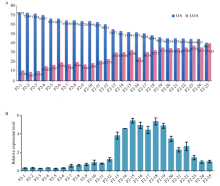
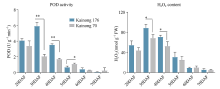
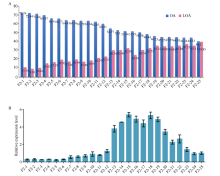
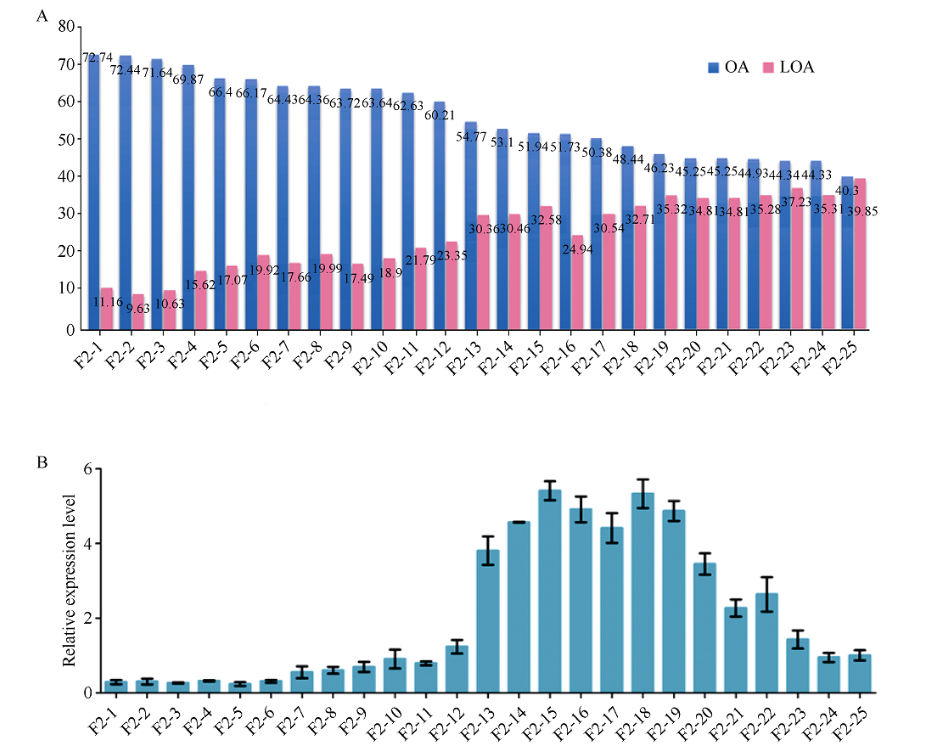
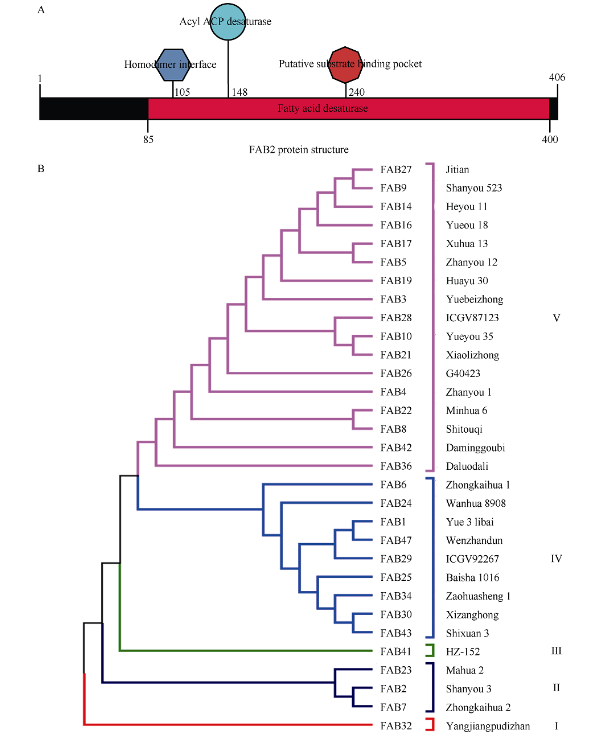
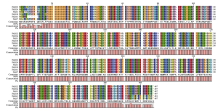
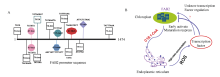
FAB2位于油酸合成通路的上游, 编码硬脂酰-ACP脱饱和酶, 调控硬脂酸(C18:0)向油酸(C18:1)转化。本研究发现高油酸品种开农176种子发育前期FAB2的表达量升高, 而成熟期油酸过量积累会抑制FAB2的表达。利用开农176与开农70构建F2杂交群体, 发现当植株油酸含量超过60%时会从整体水平上抑制FAB2的表达。种子发育前期, 油酸不断积累会导致过氧化物酶活性升高, 并且活性氧含量随之增加; 但是在种子发育后期均降低, 该结果与FAB2的表达量变化趋势相同。亚细胞定位结果表明, FAB2与FAD2分别定位于叶绿体与内质网。FAB2编码区序列多态性分析显示, 该蛋白序列氮端的氨基酸结构缺失可能会导致硬脂酸含量升高。FAB2启动子序列存在大量AT碱基的富集区域, 并且含有光响应、激素调控、转录因子结合的保守顺式元件。本研究发现过量积累的油酸会激活过氧化物酶介导的活性氧信号途径, 进而通过细胞核内的未知转录因子调节上游基因FAB2的表达量, 该结果不仅拓展了对FAB2的功能认知, 也为培育高油酸花生品种提供了相关的理论指导。
| [1] | 鲁清, 李少雄, 陈小平, 周桂元, 洪彦彬, 李海芬, 梁炫强 . 我国南方产区花生育种现状、存在问题及育种建议. 中国油料作物学报, 2017,39:556-566. |
| Lu Q, Li S X, Chen X P, Zhou G Y, Hong Y B, Li H F, Liang X Q . Current situation, problems and suggestions of peanut breeding in southern china. Chin J Oil Crop Sci, 2017,39:556-566 (in Chinese with English abstract). | |
| [2] | Gupta K, Kayam G, Faigenboim-Doron A, Clevenger J, Ozias-Akins P, Hovav R . Gene expression profiling during seed-filling process in peanut with emphasis on oil biosynthesis networks. Plant Sci, 2016,248:116-127. |
| [3] | Akhtar S, Khalid N, Ahmed I, Shahzad A, Suleria H A . Physicochemical characteristics, functional properties, and nutritional benefits of peanut oil: a review. Crit Rev Food Sci Nutr, 2014,54:1562-1575. |
| [4] | Isleib T G, Pattee H E, Sanders T H, Hendrix K W, Dean L O . Compositional and sensory comparisons between normal- and high-oleic peanuts. J Agric Food Chem, 2006,54:1759-1763. |
| [5] | Dar A A, Choudhury A R, Kancharla P K, Arumugam N . The FAD2 gene in plants: occurrence, regulation, and role. Front Plant Sci, 2017,8:1789. doi: 10.3389/fpls.2017.01789. |
| [6] | Patel M, Jung S, Moore K, Powell G, Ainsworth C, Abbott A . High-oleate peanut mutants result from a MITE insertion into the FAD2 gene. Theor Appl Genet, 2004,108:1492-1502. |
| [7] | 刘芳, 王积军, 汤松 . 我国高油酸花生品种选育与推广应用. 中国农技推广, 2017,33(1):14-15. |
| Liu F, Wang J J, Tang S . High-oleic peanut variety cultivation and popularized application in china. China Agric Technol Extension, 2017,33(1):14-15 (in Chinese with English abstract). | |
| [8] | Chi X, Yang Q, Pan L, Chen M, He Y, Yang Z, Yu S . Isolation and characterization of fatty acid desaturase genes from peanut (Arachis hypogaea L.). Plant Cell Rep, 2011,30:1393-1404. |
| [9] | Kachroo A, Shanklin J, Whittle E, Lapchyk L, Hildebrand D, Kachroo P . The Arabidopsis stearoyl-acyl carrier protein-desaturase family and the contribution of leaf isoforms to oleic acid synthesis. Plant Mol Biol, 2007,63:257-271. |
| [10] | Mandal M K, Chandra-Shekara A C, Jeong R D, Yu K, Zhu S, Chanda B, Navarre D, Kachroo A, Kachroo P . Oleic acid- dependent modulation of NITRIC OXIDE ASSOCIATED1 protein levels regulates nitric oxide-mediated defense signaling in Arabidopsis. Plant Cell, 2012,24:1654-1674. |
| [11] | Shi J, Cao Y, Fan X R, Li M, Wang Y, Ming F . A rice microsomal delta-12 fatty acid desaturase can enhance resistance to cold stress in yeast and Oryza sativa. Mol Breed, 2012,29:743-757. |
| [12] | Jiang C J, Shimono M, Maeda S, Inoue H, Mori M, Hasegawa M, Sugano S, Takatsuji H . Suppression of the rice fatty-acid desaturase gene OsSSI2 enhances resistance to blast and leaf blight diseases in rice. Mol Plant Microbe Interact, 2009,22:820-829. |
| [13] | Song N, Hu Z, Li Y, Li C, Peng F, Yao Y, Peng H, Ni Z, Xie C, Sun Q . Overexpression of a wheat stearoyl-ACP desaturase (SACPD) gene TaSSI2 in Arabidopsis ssi2 mutant compromise its resistance to powdery mildew. Gene, 2013,524:220-227. |
| [14] | Chi X, Zhang Z, Chen N, Zhang X, Wang M, Chen M, Wang T, Pan L, Chen J, Yang Z, Guan X, Yu S . Isolation and functional analysis of fatty acid desaturase genes from peanut (Arachis hypogaea L.). PLoS One, 2017,12:e189759. |
| [15] | Liu H, Li H, Gu J, Deng L, Ren L, Hong Y, Lu Q, Chen X, Liang X . Identification of the candidate proteins related to oleic acid accumulation during peanut (Arachis hypogaea L.) seed development through comparative proteome analysis. Int J Mol Sci, 2018, 19 (4). pii: E1235. doi: 10.3390/ijms19041235. |
| [16] | Wen S, Liu H, Li X, Chen X, Hong Y, Li H, Lu Q, Liang X . TALEN-mediated targeted mutagenesis of fatty acid desaturase 2 (FAD2) in peanut(Arachis hypogaea L.) promotes the accumulation of oleic acid. Plant Mol Biol, 2018,97:177-185. |
| [17] | Sui N, Wang Y, Liu S, Yang Z, Wang F, Wan S . Transcriptomic and physiological evidence for the relationship between unsaturated fatty acid and salt stress in peanut. Front Plant Sci, 2018,9:7. doi: 10.3389/fpls.2018.00007. |
| [18] | Zhao J, Favero D S, Qiu J, Roalson E H, Neff M M . Insights into the evolution and diversification of the AT-hook motif nuclear localized gene family in land plants. BMC Plant Biol, 2014,14:266. doi: 10.1186/s12870-014-0266-7. |
| [19] | Chen X, Zhu W, Azam S, Li H, Zhu F, Li H, Hong Y, Liu H, Zhang E, Wu H, Yu S, Zhou G, Li S, Zhong N, Wen S, Li X, Knapp S J, Ozias-Akins P, Varshney R K, Liang X . Deep sequencing analysis of the transcriptomes of peanut aerial and subterranean young pods identifies candidate genes related to early embryo abortion. Plant Biotechnol J, 2013,11:115-127. |
| [20] | Grevengoed T J, Klett E L, Coleman R A . Acyl-CoA metabolism and partitioning. Annu Rev Nutr, 2014,34:1-30. |
| [21] | Yang W, Dong R, Liu L, Hu Z, Li J, Wang Y, Ding X, Chu Z . A novel mutant allele of SSI2 confers a better balance between disease resistance and plant growth inhibition on Arabidopsis thaliana. BMC Plant Biol, 2016,16:208. doi: 10.1186/s12870-016-0898-x. |
| [22] | Theodoulou F L, Eastmond P J . Seed storage oil catabolism: a story of give and take. Curr Opin Plant Biol, 2012,15:322-328. |
| [23] | Kao Y T, Gonzalez K L, Bartel B . Peroxisome function, biogenesis, and dynamics in plants. Plant Physiol, 2018,176:162-177. |
| [24] | Wasternack C, Song S . Jasmonates: biosynthesis, metabolism, and signaling by proteins activating and repressing transcription. J Exp Bot, 2017,68:1303-1321. |
| [1] | 郑玉珍, 齐飞艳, 孙子淇, 刘华, 秦利, 石磊, 王娟, 汪蒙蒙, 韩锁义, 徐静, 苗利娟, 黄冰艳, 董文召, 郑峥, 张新友. 花生籽仁总超长链脂肪酸和7种脂肪酸组分的QTL定位[J]. 作物学报, 2026, 52(6): 1646-1657. |
| [2] | 陆一楚, 李振影, 买春海, 赵晓蕊, 王利祥. 夜间复合体关键基因AhLUX1正向调控花生结瘤的功能研究[J]. 作物学报, 2026, 52(6): 1658-1668. |
| [3] | 谷春苗, 王润风, 黄璐, 刘浩, 鲁清, 李海芬, 李少雄, 何双呈, 洪彦彬, 陈小平, 谭斌, 余倩霞. 花生WOX基因家族的全基因组分析及不定芽再生候选基因的鉴定[J]. 作物学报, 2026, 52(5): 1326-1340. |
| [4] | 于天一, 王春晓, 肖丽, 钟召迪, 王宣仓, 赵勇, 路亚, 吴月, 吴正锋. 不同结瘤特性花生品种氮素累积、产量及品质特性对氮肥用量的响应[J]. 作物学报, 2026, 52(3): 881-894. |
| [5] | 张胜忠, 李国卫, 戈立江, 王菲菲, 胡晓辉, 苗华荣, 李燕, 钟文, 陈静. 花生机械脱壳损伤相关农艺指标筛选与QTL定位[J]. 作物学报, 2026, 52(2): 644-652. |
| [6] | 王菲菲, 张胜忠, 杨贵华, 苗华荣, 胡晓辉, 张则林, 刘莎莎, 乔利仙, 单世华, 陈静. 331份花生种质苗期耐盐性综合评价和强耐盐种质鉴选[J]. 作物学报, 2026, 52(1): 279-294. |
| [7] | 金欣欣, 宋亚辉, 苏俏, 杨永庆, 王瑾. 高产高油高油酸花生品种的生长发育及干物质生产特征[J]. 作物学报, 2026, 52(1): 191-201. |
| [8] | 迟晓元, 刘庆, 张君, 赵旭红, 李美, 于天一, 潘丽娟, 许静, 姜骁, 殷祥贞, 马俊卿, 陈娜. 不同花生品种(系)耐盐碱性田间鉴定及各性状指标相关性研究[J]. 作物学报, 2026, 52(1): 85-98. |
| [9] | 孙辰硕, 张月, 田泽锴, 晏立英, 康彦平, 陈玉宁, 王欣, 淮东欣, 王前前, 姜慧芳, 罗怀勇, 黄莉, 廖伯寿, 王志慧, 雷永. 花生种质果柄强度的遗传分化与主要影响因子分析[J]. 作物学报, 2026, 52(1): 118-130. |
| [10] | 万书波, 张佳蕾, 高华鑫, 王才斌. 中国花生高产栽培研究进展与展望[J]. 作物学报, 2025, 51(7): 1703-1711. |
| [11] | 郭腾达, 崔梦杰, 陈琳杰, 韩锁义, 郭敬坤, 吴晨迪, 付留洋, 黄冰艳, 董文召, 张新友. 花生磷脂酰肌醇转运蛋白基因AhSFH的克隆及其响应黄曲霉菌侵染的表达特征分析[J]. 作物学报, 2025, 51(6): 1489-1500. |
| [12] | 李文佳, 廖泳俊, 黄璐, 鲁清, 李少雄, 陈小平, 金晶炜, 王润风. 花生开花时间的全基因组关联分析及候选基因筛选[J]. 作物学报, 2025, 51(5): 1400-1408. |
| [13] | 林伟津, 郭泽佳, 刘浩, 李海芬, 王润风, 黄璐, 余倩霞, 陈小平, 洪彦彬, 李少雄, 鲁清. 花生荚果产量相关性状QTL定位与候选基因分析[J]. 作物学报, 2025, 51(4): 969-981. |
| [14] | 迟晓元, 毕竞男, 赵健鑫, 陈娜, 潘丽娟, 姜骁, 殷祥贞, 赵旭红, 马俊卿, 许静. 花生荚果力学特性评鉴及早熟种质筛选[J]. 作物学报, 2025, 51(4): 943-957. |
| [15] | 晋高锐, 吴小丽, 邓丽, 陈玉宁, 喻博伦, 郭建斌, 丁膺宾, 刘念, 罗怀勇, 陈伟刚, 黄莉, 周小静, 淮东欣, 谭家壮, 姜慧芳, 任丽, 雷永, 廖伯寿. 兼抗黄曲霉侵染和产毒高油酸花生新种质的创制与评价[J]. 作物学报, 2025, 51(3): 687-895. |
|
||