欢迎访问作物学报,今天是
作物学报 ›› 2020, Vol. 46 ›› Issue (6): 937-949.doi: 10.3724/SP.J.1006.2020.93049
周宝元1,葛均筑2,侯海鹏3,孙雪芳4,丁在松1,李从锋1,马玮1,*( ),赵明1,*()
ZHOU Bao-Yuan1,GE Jun-Zhu2,HOU Hai-Peng3,SUN Xue-Fang4,DING Zai-Song1,LI Cong-Feng1,MA Wei1,*(),ZHAO Ming1,*()
摘要:
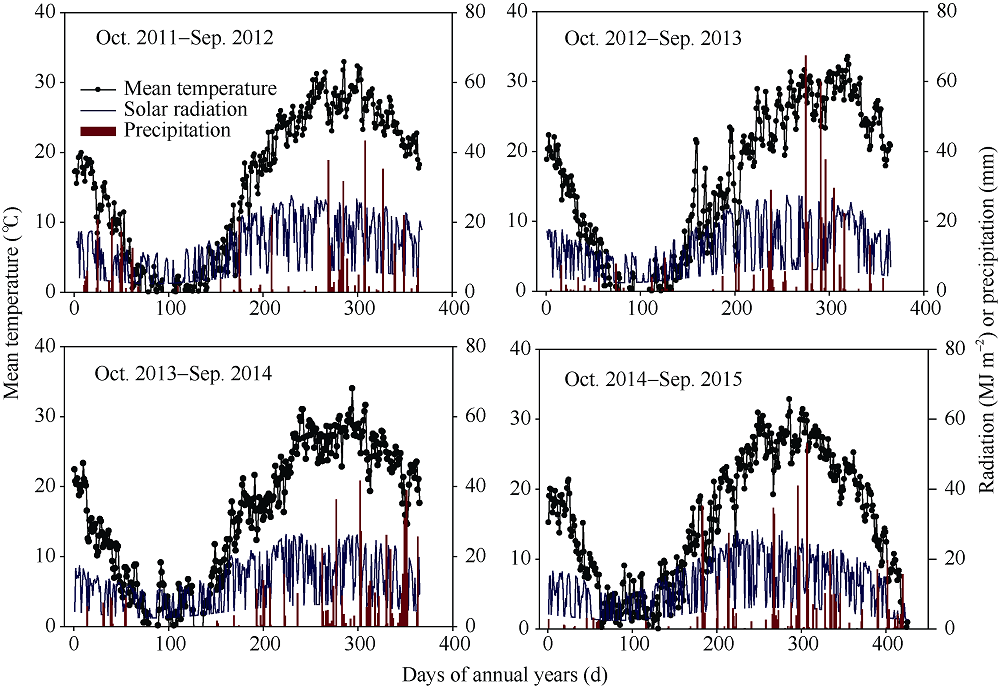
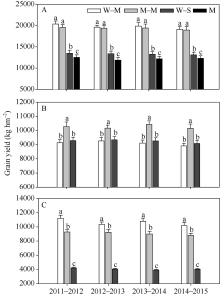
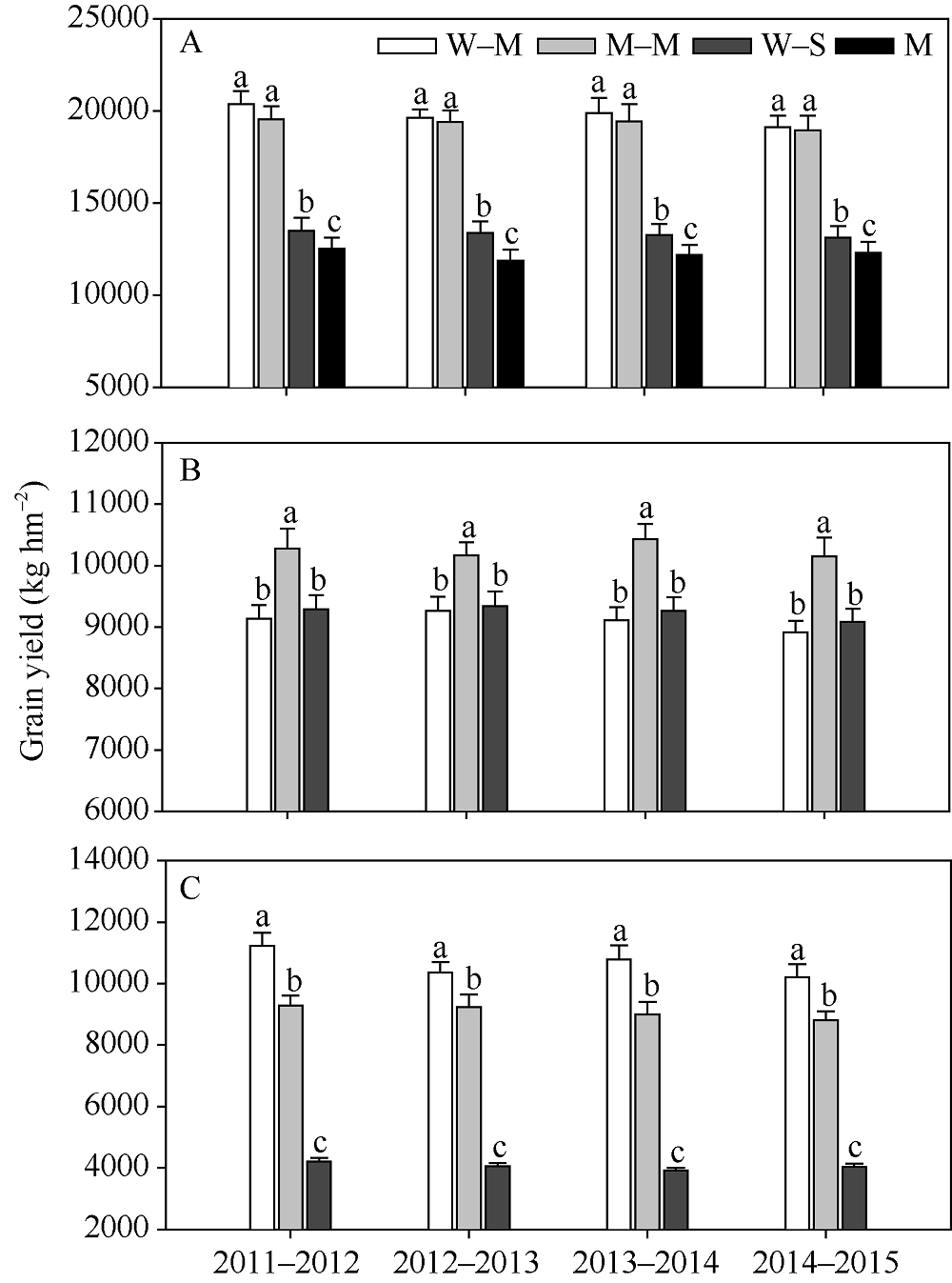
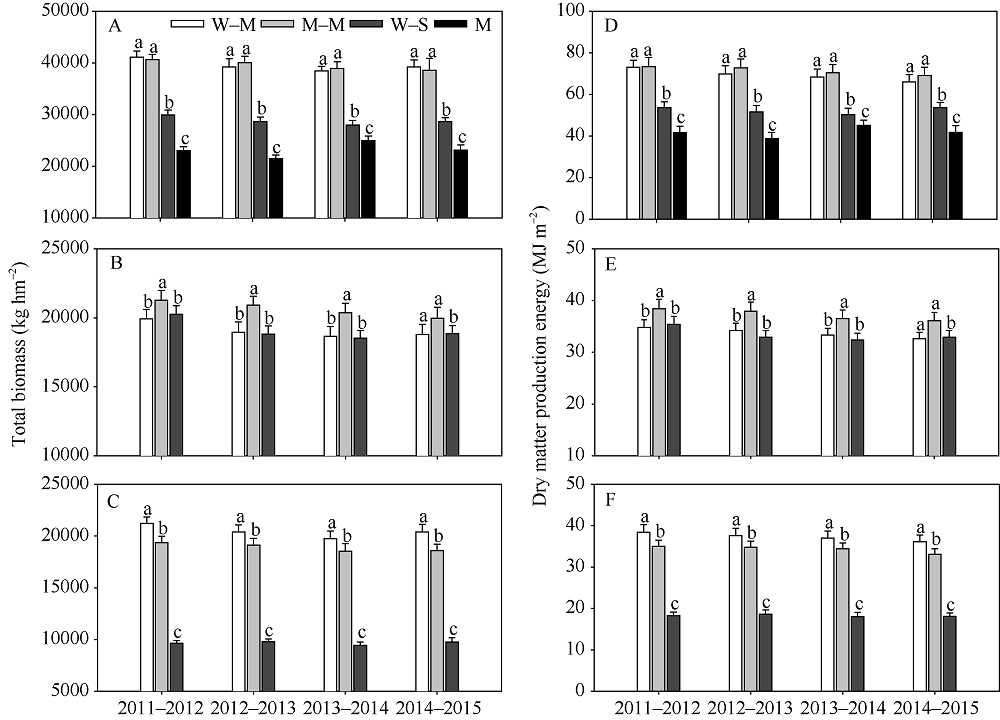
探明不同种植体系周年产量、气候资源分配及其利用效率特征, 建立周年气候资源优化配置的定量指标, 为进一步提升黄淮海区域周年产量潜力和资源利用效率提供理论依据。本研究利用2011—2015年河南新乡定位试验数据, 定量分析了冬小麦-夏玉米、冬小麦-夏大豆、双季玉米和一季春玉米4个种植体系产量、生物量、干物质产能、光温资源分配及其利用效率。结果表明, 冬小麦-夏玉米和双季玉米体系4年产量、生物量和干物质产能差异均不显著, 但显著高于冬小麦-夏大豆和一季春玉米体系, 平均增幅分别为45.4%~61.5%、37.3%~71.3%和35.7%~70.7%; 双季玉米和一季春玉米体系周年辐射生产效率、籽粒及总生物量光能利用效率均显著高于冬小麦-夏玉米和冬小麦-夏大豆体系, 其中周年辐射生产效率平均增幅为11.8%~66.7%, 籽粒及总生物量光能利用效率分别提高0.13~0.42和0.18~0.69百分点。进一步分析周年气候资源分配特征, 冬小麦-夏玉米体系两季积温分配率分别为45.6%和54.4%, 积温比值为0.8, 双季玉米两季积温分配率为51.4%和48.6%, 积温比值为1.1。综合分析产量和资源利用效率, 冬小麦-夏玉米和双季玉米种植体系可作为黄淮海区种植模式优化布局和农业生产可持续发展的重要支撑, 而明确主要种植体系积温分配率和积温比值等定量指标可为进一步优化周年气候资源配置, 挖掘黄淮海两熟区周年产量潜力和资源利用效率提供重要参考。
| [1] | 中华人民共和国农业部. 中国农业统计资料. 北京: 中国农业出版社, 2015. |
| Ministry of Agriculture of the Peoples’ Republic of China. China Agriculture Statistical Report. Beijing: China Agriculture Press, 2015 (in Chinese). | |
| [2] | 蔡剑, 姜东 . 气候变化对中国冬小麦生产的影响. 农业环境科学学报, 2011,30:1726-1733. |
| Cai J, Jiang D . The effect of climate change on winter wheat production in China. J Agro-Env Sci, 2011,30:1726-1733 (in Chinese with English abstract). | |
| [3] | 杨晓光, 刘志娟, 陈阜 . 全球气候变暖对中国种植制度可能影响: I. 气候变暖对中国种植制度北界和粮食产量可能影响的分析. 中国农业科学, 2010,43:329-336. |
| Yang X G, Liu Z J, Chen F . The possible effects of global warming on cropping systems in China: I. The possible effects of climate warming on northern limits of cropping systems and crop yields in China. Sci Environ Sin, 2010,43:329-336 (in Chinese with English abstract). | |
| [4] | Borrás L, Gambín B L . Trait dissection of maize kernel weight: towards integrating hierarchical scales using a plant growth approach. Field Crops Res, 2010,118:1-12. |
| [5] | Cairns J E, Sonder K, Zaidi P H, Verhulst N, Mahuku G, Babu R, Nair S K, Das B, Govaerts B, Vinayan M T, Rashid Z, Noor J J, Devi P, San Vicente F, Prasanna B M . Maize production in a changing climate: impacts, adaptation, and mitigation strategies. Adv Agron, 2012,114:1-58. |
| [6] | Tao F, Yokozawa M, Xu Y L, Hayashi Y, Zhang Z . Climate changes and trends in phenology and yields of field crops in China, 1981-2000. Agric For Meteorol, 2006,138:82-92. |
| [7] | Wang J, Wang E L, Yang X G, Zhang F S, Yin H . Increased yield potential of wheat-maize cropping system in the North China Plain by climate change adaptation. Climatic Change, 2012,113:825-840. |
| [8] | Warrington I J, Kanemasu E T . Corn growth response to temperature and photoperiod: I. Seedling emergence, tassel initiation and anthesis. Agron J, 1983,75:749-754. |
| [9] | Tollenaar M . Duration of the grain-filling period in maize is not affected by photoperiod and incident PPFD during the vegetative phase. Field Crops Res, 1999,62:15-21. |
| [10] | Chen C Q, Lei C X, Deng A X, Qian C R, Hoogmoed W, Zhang W J . Will higher minimum temperatures increase corn production in Northeast China? An analysis of historical data over 1965-2008. Agric For Meterol, 2011,151:1580-1588. |
| [11] | Liu Y E, Xie R Z, Hou P, Li S K, Zhang H B, Ming B, Long H L, Liang S M . Phenological responses of maize to changes in environment when grown at different latitudes in China. Field Crops Res, 2013,144:192-199. |
| [12] | Loomis R S, Williams W A . Maximum crop productivity: an estimate. Crop Sci, 1963,3:67-72. |
| [13] | 李三爱, 巨辉, 池宝亮 . 作物生产潜力研究进展. 中国农业气象, 2005,26:106-111. |
| Li S A, Ju H, Chi B L . Reviews on crop potential productivity researches. Chin J Agrometeor, 2005,26:106-111 (in Chinese with English abstract). | |
| [14] | 黄川荣, 刘洪 . 气候变化对黄淮海平原冬小麦与夏玉米生产潜力的影响. 中国农业气象, 2011,32:118-123. |
| Huang C R, Liu H . The effect of the climate change on potential productivity of winter wheat and summer maize in the Huang-Huai-Hai Plain. Chin J Agroneteor, 2011,32:118-123 (in Chinese with English abstract). | |
| [15] | 成雪峰, 张凤云 . 黄淮海夏大豆生产现状及发展对策. 大豆科学, 2010,29:157-160. |
| Cheng X F, Zhang F Y . Present conditions and countermeasures of soybean production in Huang-Huai-Hai regions. Soybean Sci, 2010,29:157-160 (in Chinese with English abstract). | |
| [16] | 王树安 . 中国吨粮田建设. 北京: 北京农业大学出版社, 1994. |
| Wang S A. Construction of the Grain Field with a Yield of 15 tons per Hectare in China. Beijing: Beijing Agricultural University Press, 1994 (in Chinese). | |
| [17] | 陈阜, 逄焕成 . 冬小麦/春玉米/夏玉米间套作复合群体的高产机理探讨. 中国农业大学学报, 2000,5(5):12-16. |
| Chen F, Pang H C . Research on mechanism for maximum yield of intercropping pattern wheat/corn/corn. J China Agric Univ, 2000,5(5):12-16 (in Chinese with English abstract). | |
| [18] | 赵秉强, 张福锁, 李增嘉, 李凤超, 劳秀荣, 史春余, 董庆裕, 张骏, 刘嘉军, 杨恩学 . 黄淮海农区集约种植制度的超高产特性研究. 中国农业科学, 2001,34:649-655. |
| Zhao B Q, Zhang F S, Li Z J, Li F C, Lao X R, Shi C Y, Dong Q Y, Zhang J, Liu J J, Yang E X . Studies on the super-high yield characteristics of three intensive multiple cropping systems in Huanghuaihai area. Sci Agric Sin, 2001,34:649-655 (in Chinese with English abstract). | |
| [19] | Meng Q F, Sun Q P, Chen X P, Cui Z L, Yue S C, Zhang F S, Römheld V . Alternative cropping systems for sustainable water and nitrogen use in the North China Plain. Agric Ecosyst Environ, 2012,146:93-102. |
| [20] | 李立娟, 王美云, 赵明 . 品种对双季玉米早春季和晚夏季的适应性研究. 作物学报, 2011,37:1660-1665 |
| Li L J, Wang M Y, Zhao M . Adaptability of varieties to double-cropping in early spring and late summer. Acta Agron Sin, 2011,37:1660-1665 (in Chinese with English abstract). | |
| [21] | 李立娟, 王美云, 薛庆林, 崔彦宏, 侯海鹏, 葛均筑, 赵明 . 黄淮海双季玉米产量性能与资源效率的研究. 作物学报, 2011,37:1229-1234. |
| Li L J, Wang M Y, Xue Q L, Cui Y H, Hou H P, Ge J Z, Zhao M . Yield performance and resource efficiency of double-cropping maize in the Yellow, Huai and Hai river valleys region. Acta Agron Sin, 2011,37:1229-1234 (in Chinese with English abstract). | |
| [22] | 王美云, 任天志, 赵明, 李少昆, 王晓波, 李立娟, 陈长利 . 双季青贮玉米模式物质生产及资源利用效率研究. 作物学报, 2007,33:1316-1323. |
| Wang M Y, Ren T Z, Zhao M, Li S K, Wang X B, Li L J, Chen C L . Matter production and resources use efficiency of double cropping silage maize system. Acta Agron Sin, 2007,33:1316-1323 (in Chinese with English abstract). | |
| [23] | 徐勇, 齐文虎, 谢高地, 章予舒 . 农业自然资源利用效率的因子-能量评价模型及其应用. 资源科学, 2002,24(3):86-91. |
| Xu Y, Qi W H, Xie G D, Zhang Y S . The factor-energy evaluation model of agricultural natural resources utilization efficiency and its application. Resour Sci, 2002,24(3):86-91 (in Chinese with English abstract). | |
| [24] | 周宝元, 马玮, 孙雪芳, 丁在松, 李从锋, 赵明 . 冬小麦-夏玉米高产模式周年气候资源分配与利用特征研究. 作物学报, 2019,45:589-600. |
| Zhou B Y, Ma W, Sun X F, Ding Z S, Li C F, Zhao M . Characteristics of annual climate resource distribution and utilization in high-yielding winter wheat-summer maize double cropping system. Acta Agron Sin, 2019,45:589-600 (in Chinese with English abstract). | |
| [25] | 杨羡敏, 曾燕, 邱新法, 姜爱军 . 1960-2000年黄河流域太阳总辐射气候变化规律研究. 应用气象学报, 2005,16:243-247. |
| Yang X M, Zeng Y, Qiu X F, Jiang A J . The climatic change of solar radiation over the yellow river basin during 1961-2000. J Appl Meteorol Sci, 2005,16:243-247 (in Chinese). | |
| [26] | 郑海霞, 封志明, 游松财 . 基于GIS 的甘肃省农业生产潜力研究. 地理科学进展, 2003,22:400-408. |
| Zheng H X, Feng Z M, You S C . A study on potential land productivity based on GIS technology in Gansu province. Prog Geogr, 2003,22:400-408 (in Chinese with English abstract). | |
| [27] | 李卫东, 张孟臣 . 黄淮海夏大豆及品种参数. 北京: 中国农业科学技术出版社, 2006. p 7. |
| Li W D, Zhang M C. Summer Soybean Varieties and Their Parameters at Huang-Huai-Hai Region. Beijing: Chinese Agricultural Science and Technology Press, 2006. p 7 (in Chinese). | |
| [28] | Zhang X Y, Chen S Y, Sun H Y, Wang Y M, Shao L W . Water use efficiency and associated traits in winter wheat cultivars in the North China Plain. Agric Water Manage, 2010,97:1117-1125. |
| [29] | Hu Y K, Moiwo J P, Yang Y H, Han S M, Yang Y M . Agricultural water-saving and sustainable groundwater management in Shijiazhuang irrigation district North China Plain. J Hydrol, 2010,393:219-232. |
| [30] | 吴丹 . 双季玉米在河北平原适应性的系统研究.河北农业大学硕士学位论文, 河北保定, 2014. |
| Wu D . A Systematic Study on Adaptability of Maize-maize Double Cropping in the Hebei Plain. MS Thesis of Agricultural University of Hebei, Baoing, Hebei, China, 2014 (in Chinese with English abstract). | |
| [31] | Xu C L, Zhao H X, Zhang P, Wang Y Y, Huang S B, Meng Q F, Wang P . Delaying wheat seeding time and maize harvest improved water use efficiency in a warm temperature continental monsoon climate. Agron J, 2018,110:1420-1429. |
| [32] | Xiong W, Matthews R, Holman I, Lin E, Xu Y L . Modelling China’s potential maize production at regional scale under climate change. Clim Change, 2007,85:433-451. |
| [33] | Zhou B Y, Yue Y, Sun X F, Wang X B, Wang Z M, Ma W, Zhao M . Maize grain yield and dry matter production responses to variations in weather conditions. Agron J, 2016,108:196-204. |
| [34] | He L, Asseng S, Zhao G, Wu D R, Yang X Y, Zhuang W, Jin N, Yu Q . Impacts of recent climate warming, cultivar changes, and crop management on winter wheat phenology across the Loess Plateau of China. Agric For Meteorol, 2015,200:135-143. |
| [35] | Liu Y E, Hou P, Xie R Z, Li S K, Zhang H B, Ming B, Ma D L, Liang S M . Spatial adaptabilities of spring maize to variation of climatic conditions. Crop Sci, 2013,53:1693-1703. |
| [36] | Sun H Y, Zhang X Y, Chen S Y, Pei D, Liu C M . Effects of harvest and sowing time on the performance of the rotation of winter wheat-summer maize in the North China Plain. Ind Crops Prod, 2007,25:239-247. |
| [37] | 周宝元, 马玮, 孙雪芳, 高卓晗, 丁在松, 李从锋, 赵明 . 播/收期对冬小麦-夏玉米一年两熟模式周年气候资源分配与利用特征的影响. 中国农业科学, 2019,52:1501-1517. |
| Zhou B Y, Ma W, Sun X F, Gao Z H, Ding Z S, Li C F, Zhao M . Effects of different sowing and harvest dates of winter wheat-summer maize under double cropping system on the annual climate resource distribution and utilization. Sci Agric Sin, 2019,52:1501-1517 (in Chinese with English abstract). | |
| [38] | Liu Y E, Xie R Z, Hou P, Li S K, Zhang H B, Ming B, Long H L, Liang S M . Phenological responses of maize to changes in environment when grown at different latitudes in China. Field Crops Res, 2013,144:192-199. |
| [39] | Dong J, Liu J, Tao F, Xu X L, Wang J B . Spatio-temporal changes in annual accumulated temperature in China and the effects on cropping systems, 1980s to 2000. Climate Res, 2009,40:37-48. |
| [1] | 王丹, 周宝元, 马玮, 葛均筑, 丁在松, 李从锋, 赵明. 长江中游双季玉米种植模式周年气候资源分配与利用特征[J]. 作物学报, 2022, 48(6): 1437-1450. |
| [2] | 王旺年, 葛均筑, 杨海昌, 阴法庭, 黄太利, 蒯婕, 王晶, 汪波, 周广生, 傅廷栋. 大田作物在不同盐碱地的饲料价值评价[J]. 作物学报, 2022, 48(6): 1451-1462. |
| [3] | 颜佳倩, 顾逸彪, 薛张逸, 周天阳, 葛芊芊, 张耗, 刘立军, 王志琴, 顾骏飞, 杨建昌, 周振玲, 徐大勇. 耐盐性不同水稻品种对盐胁迫的响应差异及其机制[J]. 作物学报, 2022, 48(6): 1463-1475. |
| [4] | 杨欢, 周颖, 陈平, 杜青, 郑本川, 蒲甜, 温晶, 杨文钰, 雍太文. 玉米-豆科作物带状间套作对养分吸收利用及产量优势的影响[J]. 作物学报, 2022, 48(6): 1476-1487. |
| [5] | 陈静, 任佰朝, 赵斌, 刘鹏, 张吉旺. 叶面喷施甜菜碱对不同播期夏玉米产量形成及抗氧化能力的调控[J]. 作物学报, 2022, 48(6): 1502-1515. |
| [6] | 李祎君, 吕厚荃. 气候变化背景下农业气象灾害对东北地区春玉米产量影响[J]. 作物学报, 2022, 48(6): 1537-1545. |
| [7] | 石艳艳, 马志花, 吴春花, 周永瑾, 李荣. 垄作沟覆地膜对旱地马铃薯光合特性及产量形成的影响[J]. 作物学报, 2022, 48(5): 1288-1297. |
| [8] | 闫晓宇, 郭文君, 秦都林, 王双磊, 聂军军, 赵娜, 祁杰, 宋宪亮, 毛丽丽, 孙学振. 滨海盐碱地棉花秸秆还田和深松对棉花干物质积累、养分吸收及产量的影响[J]. 作物学报, 2022, 48(5): 1235-1247. |
| [9] | 柯健, 陈婷婷, 吴周, 朱铁忠, 孙杰, 何海兵, 尤翠翠, 朱德泉, 武立权. 沿江双季稻北缘区晚稻适宜品种类型及高产群体特征[J]. 作物学报, 2022, 48(4): 1005-1016. |
| [10] | 李瑞东, 尹阳阳, 宋雯雯, 武婷婷, 孙石, 韩天富, 徐彩龙, 吴存祥, 胡水秀. 增密对不同分枝类型大豆品种同化物积累和产量的影响[J]. 作物学报, 2022, 48(4): 942-951. |
| [11] | 王吕, 崔月贞, 吴玉红, 郝兴顺, 张春辉, 王俊义, 刘怡欣, 李小刚, 秦宇航. 绿肥稻秆协同还田下氮肥减量的增产和培肥短期效应[J]. 作物学报, 2022, 48(4): 952-961. |
| [12] | 杜浩, 程玉汉, 李泰, 侯智红, 黎永力, 南海洋, 董利东, 刘宝辉, 程群. 利用Ln位点进行分子设计提高大豆单荚粒数[J]. 作物学报, 2022, 48(3): 565-571. |
| [13] | 陈云, 李思宇, 朱安, 刘昆, 张亚军, 张耗, 顾骏飞, 张伟杨, 刘立军, 杨建昌. 播种量和穗肥施氮量对优质食味直播水稻产量和品质的影响[J]. 作物学报, 2022, 48(3): 656-666. |
| [14] | 袁嘉琦, 刘艳阳, 许轲, 李国辉, 陈天晔, 周虎毅, 郭保卫, 霍中洋, 戴其根, 张洪程. 氮密处理提高迟播栽粳稻资源利用和产量[J]. 作物学报, 2022, 48(3): 667-681. |
| [15] | 丁红, 徐扬, 张冠初, 秦斐斐, 戴良香, 张智猛. 不同生育期干旱与氮肥施用对花生氮素吸收利用的影响[J]. 作物学报, 2022, 48(3): 695-703. |
|
||