欢迎访问作物学报,今天是
作物学报 ›› 2020, Vol. 46 ›› Issue (5): 700-711.doi: 10.3724/SP.J.1006.2020.94107
赵晋锋,杜艳伟,王高鸿,李颜方,赵根有,王振华,王玉文,余爱丽( )
)
Jin-Feng ZHAO,Yan-Wei DU,Gao-Hong WANG,Yan-Fang LI,Gen-You ZHAO,Zhen-Hua WANG,Yu-Wen WANG,Ai-Li YU()
摘要:
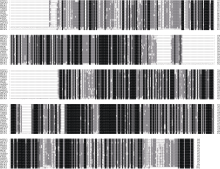
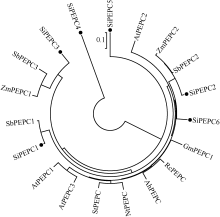
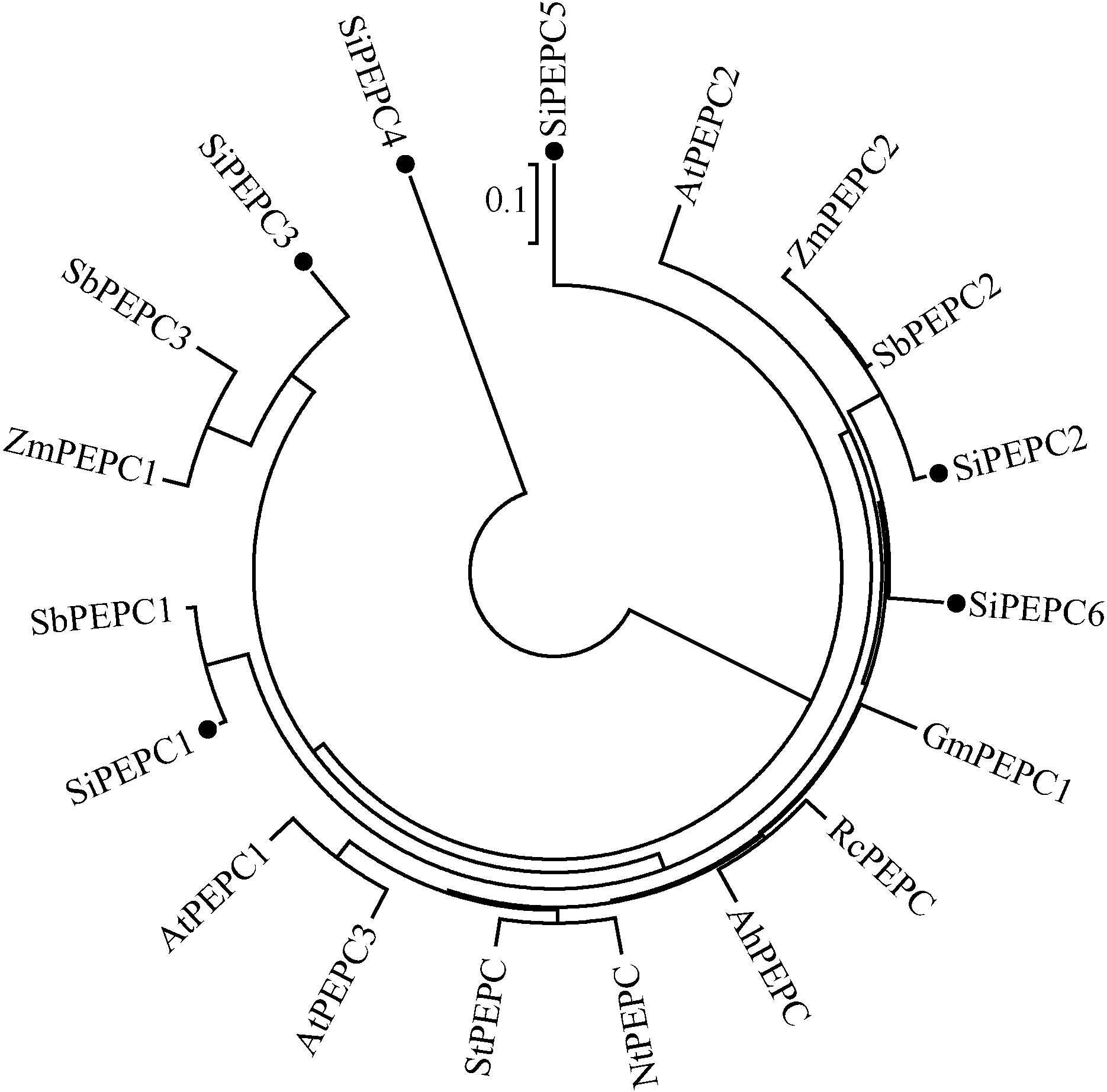
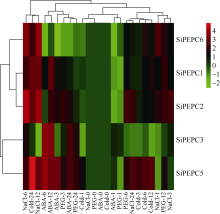
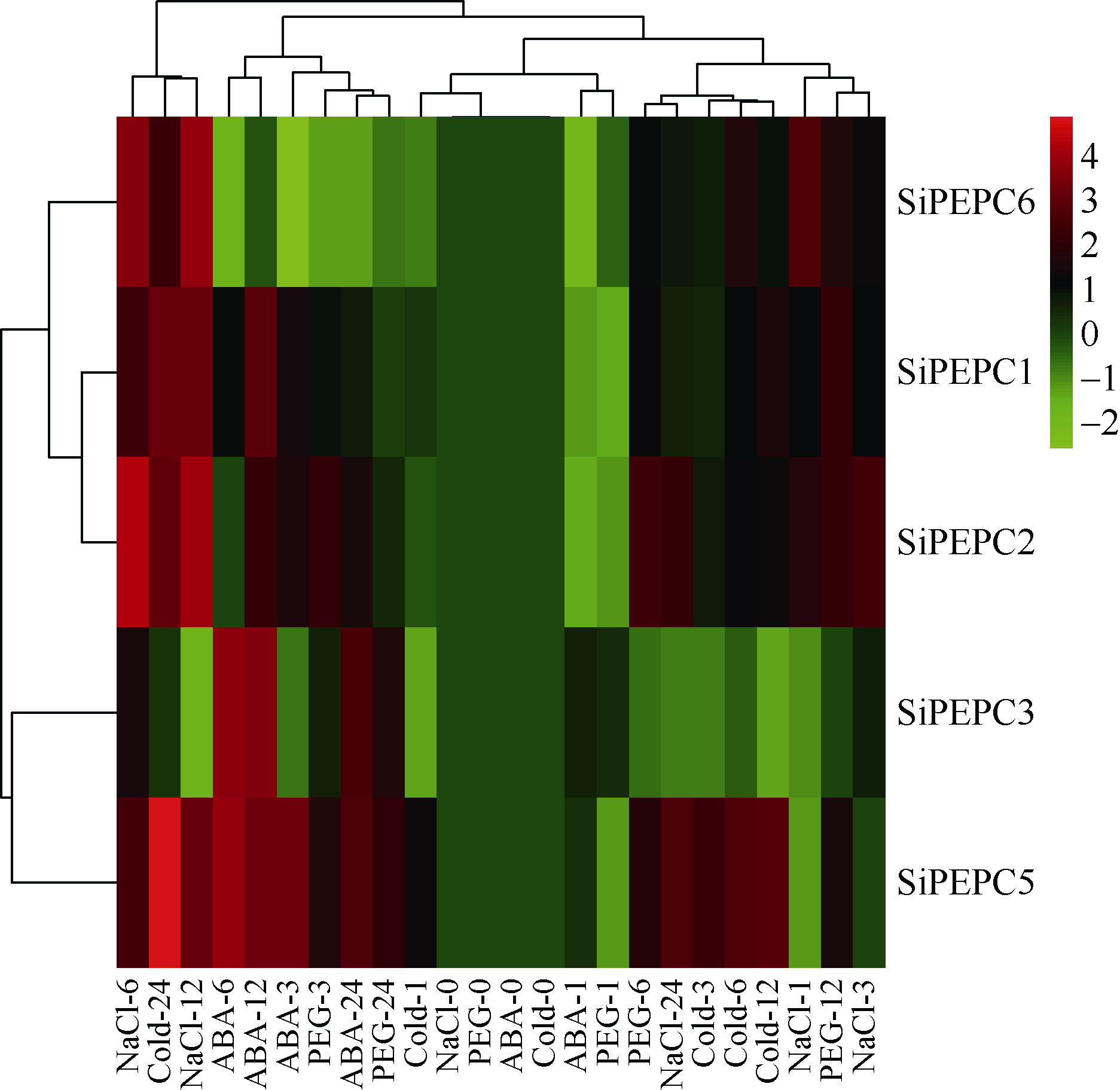
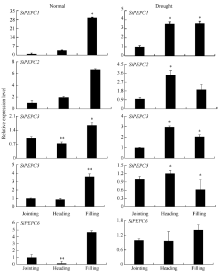
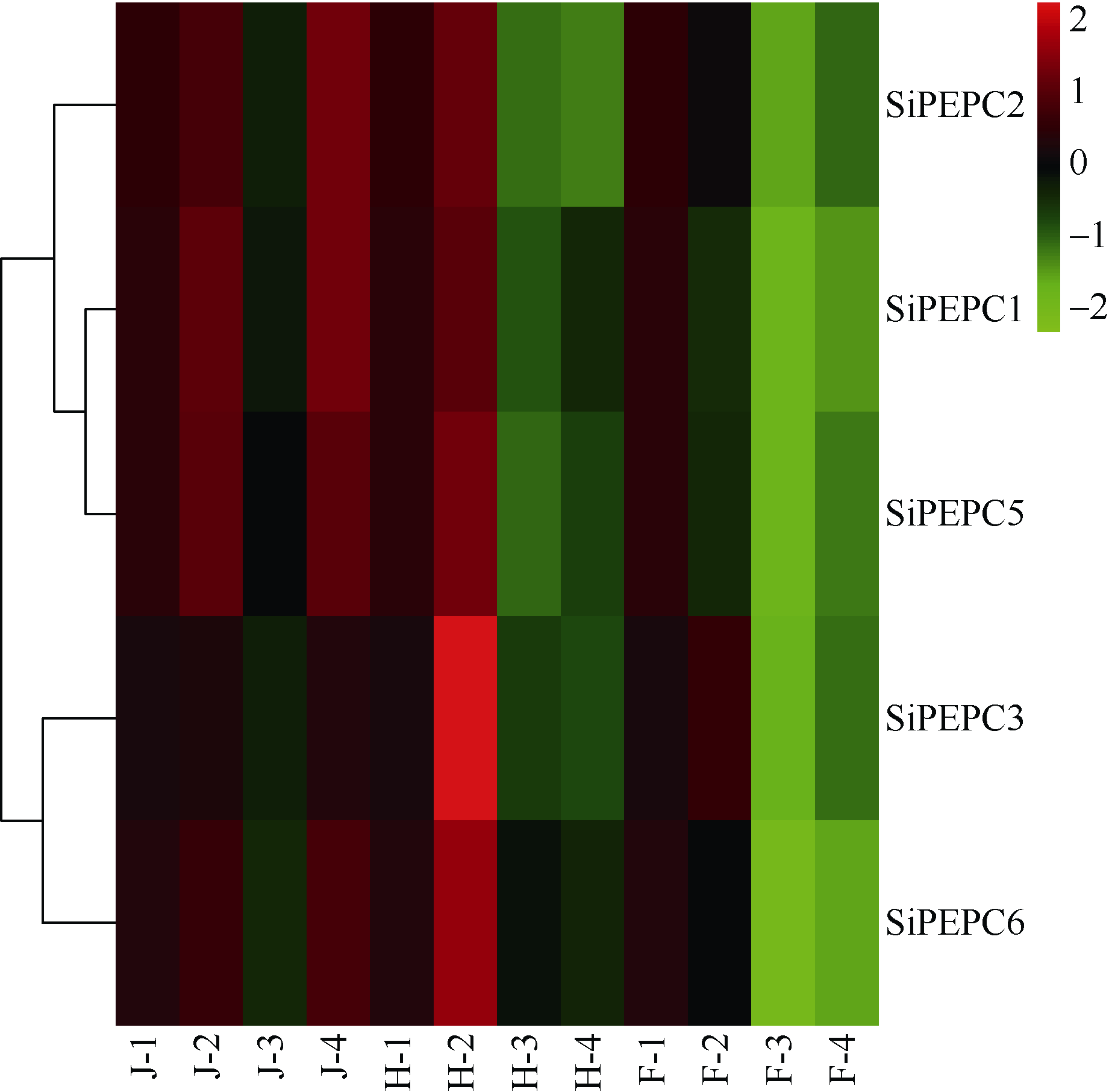
磷酸烯醇式丙酮酸羧化酶(phosphoenolpyruvate carboxylase, PEPC)是C4植物光合作用关键酶, 并在植物多种代谢途径及逆境信号应答过程中起重要作用。本研究通过序列比对, 从谷子基因组中筛选出6个SiPEPC候选基因。SiPEPC蛋白特征参数相似度很高, 序列非常保守, 都含有PEPC基因特征功能域PEPcase Motif。SiPEPC成员主要被定位在细胞质、细胞核和线粒体。在SiPEPC成员启动子序列中含大量有光、激素、逆境以及其他生长调控相关的顺式应答元件。苗期逆境qRT-PCR表达谱分析表明, 5个SiPEPC基因(SiPEPC1、SiPEPC2、SiPEPC3、SiPEPC5、SiPEPC6)不同程度受ABA、PEG、高盐和低温诱导表达, 表明其参与了苗期对非生物逆境的响应。5个SiPEPC基因表达量在正常生长条件下随着谷子的生长呈增强趋势, 且在不同生育时期干旱胁迫下明显增加, 表明其参与了拔节、抽穗、灌浆期的干旱胁迫应答。拔节期弱光可诱导5个SiPEPC基因的表达, 而在拔节期中等强度光照以及抽穗期和灌浆期的中等光照和弱光照下表达量均急剧降低, 揭示光照强度严重影响SiPEPC基因的表达。
| [1] |
Hibberd J M, Quick W P . Characteristics of C4 photosynthesis in stems and petioles of C3 flowering plants. Nature (London), 2002,415:451-454.
doi: 10.1038/415451a pmid: 11807559 |
| [2] |
Lara M V, Chuong S D X, Akhani H, Andreo S C, Edwards G E . Species Having C4 single-cell-type photosynthesis in the chenopodiaceae family evolved a photosynthetic phosphoenolpyruvate carboxylase like that of kranz-type C4 species. Plant Physiol, 2006,142:673-684.
doi: 10.1104/pp.106.085829 pmid: 16920871 |
| [3] |
Merkelbach S, Gehlen J, Denecke M, Hirschet H J, Kreuzaler F . Cloning, sequence analysis and expression of a cDNA encoding active phosphoenolpyruvate carboxylase of the C3 plant Solanum tuberosum. Plant Mol Biol, 1993,23:881-888.
doi: 10.1007/bf00021542 pmid: 8251640 |
| [4] |
Hart Y, Mayo A E, Milo R, Alon U . Robust control of PEP formation rate in the carbon fixation pathway of C4 plants by a bi-functional enzyme. BMC Systems Biol, 2011,5:171.
doi: 10.1186/1752-0509-5-171 pmid: 22024416 |
| [5] | 魏绍巍, 黎茵 . 植物磷酸烯醇式丙酮酸羧化酶的功能及其在基因工程中的应用. 生物工程学报, 2011,27:1702-1710. |
| Wei S W, Li Y . Functions of plant phosphoenolpyruvate carboxylase and its applications for genetic engineering. Chin J Biotechnol, 2011,27:1702-1710 (in Chinese with English abstract). | |
| [6] |
Lebouteiller B, Gousset-Dupont A, Pierre J N, Bleton J, Tchapla A, Maucourt M, Moing A, Rolin D, Vidal J . Physiological impacts of modulating phosphoenolpyruvate carboxylase levels in leaves and seeds of Arabidopsis thaliana. Plant Sci, 2007,172:265-272.
doi: 10.1016/j.plantsci.2006.09.008 |
| [7] |
Muramatsu M, Suzuki R, Yamazaki T, Miyao M . Comparison of plant-type phosphoenolpyruvate carboxylases from rice: identification of two plant-specific regulatory regions of the allosteric enzyme. Plant Cell Physiol, 2015,56:468-480.
doi: 10.1093/pcp/pcu189 pmid: 25505033 |
| [8] |
Sanchez R, Cejudo F J . Identification and expression analysis of a gene encoding a bacterial-type phosphoenolpyruvate carboxylase from Arabidopsis and rice. Plant Physiol, 2003,132:949-957.
doi: 10.1104/pp.102.019653 pmid: 12805623 |
| [9] |
Dong L Y, Masuda T, Kawamura T, Hata S, Izui K . Cloning, expression, and characterization of a root-form phosphoenolpyruvate carboxylase from Zea mays: comparison with the C4-form enzyme. Plant Cell Physiol, 1998,39:865-873.
doi: 10.1093/oxfordjournals.pcp.a029446 pmid: 9787461 |
| [10] |
Besnard G, Pincon G, Dhonta A, D'Hont A, Hoarau J Y, Cadet F, Offmann B . Characterisation of the phosphoenolpyruvate carboxylase gene family in sugarcane ( Saccharum spp.). Theor Appl Genet, 2003,107:470-478.
doi: 10.1007/s00122-003-1268-2 pmid: 12759729 |
| [11] |
Sullivan S, Jenkins G I, Nimmo H G . Roots, cycles and leaves: Expression of the phosphoenolpyruvate carboxylase kinase gene family in soybean. Plant Physiol, 2004,135:2078-2087.
doi: 10.1104/pp.104.042762 pmid: 15299132 |
| [12] | 蔡小宁, 陈茜, 杨平, 任源浩 . 磷酸烯醇式丙酮酸羧化酶的生物信息学分析. 安徽农业科学, 2008,36:914-916. |
| Cai X N, Chen X, Yang P, Ren Y H . Bioinformatics analysis of phosphoenolpyruvate carboxylase. J Anhui Agric Sci, 2008,36:914-916 (in Chinese with English abstract). | |
| [13] | 焦进安 . 植物磷酸烯醇式丙酮酸羧化酶的多生理功能. 植物生理学通讯, 1987, ( 1):40-43. |
| Jiao J A . Multiple function of phosphoenolpyruvate carboxylase in plants. Plant Physiol Commun, 1987, ( 1):40-43 (in Chinese). | |
| [14] |
Bandyopadhyay A, Datta K, Zhang J, Yang W, Raychaudhur S, Miyao M . Enhanced photosynthesis rate in genetically engineered indica rice expressing pepc gene cloned from maize. Plant Sci (Oxford), 2007,172:1204-1209.
doi: 10.1016/j.plantsci.2007.02.016 |
| [15] |
丁在松, 周宝元, 孙雪芳, 赵明 . 干旱胁迫下 PEPC 过表达增强水稻的耐强光能力. 作物学报, 2012,38:285-292.
doi: 10.3724/SP.J.1006.2012.00285 |
|
Ding Z S, Zhou B Y, Sun X F, Zhao M . High light tolerance is enhanced by overexpressed PEPC in rice under drought stress. Acta Agron Sin, 2012,38:285-292 (in Chinese with English abstract).
doi: 10.3724/SP.J.1006.2012.00285 |
|
| [16] | 焦德茂, 李霞, 黄雪清, 迟伟, 匡廷云, 古森本 . 转PEPC基因水稻的光合CO2同化和叶绿素荧光特性. 科学通报, 2001,46:414-418. |
| Jiao D M, Li X, Huang X Q, Chi W, Kuang T Y, Gu S B . Photosynthetic CO2 assimilation and chlorophyll fluorescence characteristics of transgenic PEPC rice. Chin Sci Bull, 2001,46:414-418 (in Chinese). | |
| [17] | 方立锋, 丁在松, 赵明 . 转ppc基因水稻苗期抗旱特性研究. 作物学报, 2008,34:1220-1226. |
| Fang L F, Ding Z S, Zhao M . Characteristics of drought tolerance in ppc overexpressed rice seedlings. Acta Agron Sin, 2008,34:1220-1226 (in Chinese with English abstract). | |
| [18] |
Jeanneau M, Gerentes D, Foueillassar X, Zivy M, Vidal J, Toppan A, Perez P . Improvement of drought tolerance in maize: towards the functional validation of the Zm-Asr1 gene and increase of water use efficiency by over-expressing C4-PEPC. Biochimie, 2002,84:1127-1135.
doi: 10.1016/S0300-9084(02)00024-X |
| [19] |
Gonzalez M C, Sanchez R, Cejudo F J . Abiotic stresses affecting water balance induce phosphoenolpyruvate carboxylase expression in roots of wheat seedlings. Planta, 2003,216:985-992.
doi: 10.1007/s00425-002-0951-x pmid: 12687366 |
| [20] |
Sanchez R, Flores A, Cejudo F J . Arabidopsis phosphoenolpyruvate carboxylase genes encode immunologically unrelated polypeptides and are differentially expressed in response to drought and salt stress. Planta, 2006,223:901-909.
doi: 10.1007/s00425-005-0144-5 |
| [21] |
Garciá-Maurino S, Monreal J, Alvarez R, Vidal J, Echevarría C . Characterization of salt stress-enhanced phosphoenolpyruvate carboxylase kinase activity in leaves of sorghum vulgare: independence of osmotic stress, involvement of iontoxicity and significance of dark phosphorylation. Planta, 2003,216:648-655.
doi: 10.1007/s00425-002-0893-3 pmid: 12569407 |
| [22] |
智慧, 牛振刚, 贾冠清, 柴杨, 李伟, 王永芳, 李海权, 陆平, 白素兰, 刁现民 . 谷子干草饲用品质性状变异及相关性分析. 作物学报, 2012,38:800-807.
doi: 10.3724/SP.J.1006.2012.00800 |
|
Zhi H, Niu Z G, Jia G Q, Chai Y, Li W, Wang Y F, Li H Q, Lu P, Bai S L, Diao X M . Variation and correlation analysis of hay forage quality traits of foxtail millet [ Setaria italica (L.) Beauv.]. Acta Agron Sin, 2012,38:800-807 (in Chinese with English abstract).
doi: 10.3724/SP.J.1006.2012.00800 |
|
| [23] |
Devos K M, Wang Z M, Beales J, Sasaki T, Gale M D . Comparative genetic maps of foxtail millet ( Setaria italica) and rice (Oryza sativa). Theor Appl Genet, 1998,96:63-68.
doi: 10.1007/s001220050709 |
| [24] |
Jayaraman A, Puranik S, Rai N K, Vidapu S, Sahu P P, Lata C , Prasad M. cDNA-AFLP analysis reveals differential gene expression in response to salt stress in foxtail millet (Setaria italica L.). Mol Biotechnol, 2008,40:241-251.
doi: 10.1007/s12033-008-9081-4 |
| [25] |
赵晋锋, 余爱丽, 田岗, 杜艳伟, 郭二虎, 刁现民 . 谷子CBL基因鉴定及其在干旱, 高盐胁迫下的表达分析. 作物学报, 2013,39:360-367.
doi: 10.3724/SP.J.1006.2013.00360 |
|
Zhao J F, Yu A L, Tian G, Du Y W, Guo E H, Diao X M . Identification of CBL genes from foxtail millet ( Setaria italica [L.] Beauv.) and its expression under drought and salt stresses. Acta Agron Sin, 2013,39:360-367 (in Chinese with English abstract).
doi: 10.3724/SP.J.1006.2013.00360 |
|
| [26] |
Zhang G Y, Liu X, Quan Z W, Cheng S F, Xu X, Pan S K, Xie M, Zeng P, Yue Z, Wang W L, Tao Y, Bian C, Han C L, Xia Q J, Peng X H, Cao R, Yang X H, Zhan D L, Hu J C, Zhang Y X, Li H N, Li H, Li N, Wang J Y, Wang C C, Wang R Y, Guo T, Cai Y J, Liu C Z, Xiang H T, Shi Q X, Huang P, Chen Q C, Li Y R, Wang J, Zhao Z H, Wang J . Genome sequence of foxtail millet ( Setaria italica) provides insights into grass evolution and biofuel potential. Nat Biotechnol, 2012,30:549-554.
doi: 10.1038/nbt.2195 pmid: 22580950 |
| [27] |
Bennetzen J L, Schmutz J, Wang H, Percifield R, Hawkins J, Pontaroli A C, Estep M, Feng L, Vaughn J N, Grimwood J, Jen-kins J, Barry K, Lindquist E, Hellsten U, Deshpande S, Wang X W, Wu X M, Mitros T, Triplett J, Yang X H, Ye C Y, Mauro-herrera M, Wang L, Li P H, Sharma M, Sharma R, Ronald P C, Panaud O, Kellogg E A, Brutnell T P, Doust A N, Tuskan G A, Rokhsar D, Devos K M . Reference genome sequence of the model plant setaria. Nat Biotechnol, 2012,30:555-561.
doi: 10.1038/nbt.2196 pmid: 22580951 |
| [28] |
Shinozaki K, Yamaguchi-Shinozaki K . A novel cis-acting element in an Arabidopsis gene is involved in responsiveness to drought, low-temperature, or high-salt stress. Plant Cell, 1994,6:251-264.
doi: 10.1105/tpc.6.2.251 pmid: 8148648 |
| [29] |
Yu C S, Chen Y C, Lu C H, Hwang J K . Prediction of protein subcellular localization. Proteins, 2006,64:643-651.
doi: 10.1002/prot.21018 pmid: 16752418 |
| [30] |
Larkin M A, Blackshields G, Brown N P, Chenna R, Mcgettigan P A, McWilliam H, Valentin F, Wallace I M, Wilm A, Lopez R . Clustal W and Clustal X version 2.0. Bioinformatics, 2007,23:2947-2948.
doi: 10.1093/bioinformatics/btm404 pmid: 17846036 |
| [31] |
Tamura K, Stecher G, Peterson D, Filipski A, Kumar S . MEGA6: molecular evolutionary genetics analysis version 6.0. Mol Biol Evol, 2013,30:2725-2729.
doi: 10.1093/molbev/mst197 |
| [32] |
Livak K J, Schmittgen T D . Analysis of relative gene expression data using real-time quantitative PCR and the 2 -ΔΔCt . Methods, 2001,25:402-408.
doi: 10.1006/meth.2001.1262 pmid: 11846609 |
| [33] |
Narusaka Y, Nakashima K, Shinwari Z K, Sakuma Y, Furihata T, Abe H, Narusaka M, Shinozaki K , Yamaguchi-shinozaki K. Interaction between two cis-acting elements, ABRE and DRE, in ABA-dependent expression of Arabidopsis rd29A gene in response to dehydration and high-salinity stresses. Plant J, 2003,621:137-148.
doi: 10.3897/zookeys.621.10115 pmid: 27833421 |
| [34] |
Nakashima K, Yamaguchi-shinozaki K . ABA signaling in stress-response and seed development. Plant Cell Rep, 2013,32:959-970.
doi: 10.1007/s00299-013-1418-1 |
| [35] |
Verma V, Ravindran P, Kumar P P . Plant hormone-mediated regulation of stress responses. BMC Plant Biol, 2016,16:86.
doi: 10.1186/s12870-016-0771-y pmid: 27079791 |
| [36] |
Zhang J, Jia W, Yang J, Ismail A M . Role of ABA in integrating plant responses to drought and salt stresses. Field Crops Res, 2006,97:111-119.
doi: 10.1016/j.fcr.2005.08.018 |
| [37] | 张吉旺, 董树亭, 王空军, 胡昌浩, 刘鹏 . 大田遮荫对夏玉米光合特性的影响. 作物学报, 2007,33:216-222. |
| Zhang J W, Dong S T, Wang K J, Hu C H, Liu P . Effects of shading in field on photosynthetic characteristics in summer corn. Acta Agron Sin, 2007,33:216-222 (in Chinese with English abstract). | |
| [38] |
Bari R, Jones J D . Role of plant hormones in plant defence responses. Plant Mol Biol, 2009,69:473-488.
doi: 10.1007/s11103-008-9435-0 |
| [1] | 马小倩, 秦娜, 代书桃, 秦家范, 李小艳, 王淑婷, 刘忠玲, 李君霞. 175份谷子种质在2种环境下的表型变异分析[J]. 作物学报, 2026, 52(6): 1757-1773. |
| [2] | 左同鸿, 张贺翠, 曾静, 朱利泉. 甘蓝自交不亲和相关基因BoPUB3L的克隆与表达分析[J]. 作物学报, 2026, 52(6): 1698-1710. |
| [3] | 胡赵, 钱润, 谢丰璞, 应素平. 水稻SPX基因家族鉴定及响应磷处理的表达分析[J]. 作物学报, 2026, 52(6): 1902-1912. |
| [4] | 田立涛, 丁宁, 王树林, 齐恩芳, 张荣, 王蕊蕊, 马利雯, 李建武, 杨江伟. 马铃薯Argonaute基因家族鉴定及晚疫病诱导表达分析[J]. 作物学报, 2026, 52(4): 1116-1126. |
| [5] | 杨宗桃, 杨婷, 王禹童, 艾静, 李燕烨, 刘家勇, 邓军, 赵勇, 张跃彬. 甘蔗CLC基因家族鉴定与表达分析[J]. 作物学报, 2026, 52(3): 722-734. |
| [6] | 孟成, 王哲. 玉米ZmPFK基因家族全基因组鉴定及响应胁迫表达分析[J]. 作物学报, 2026, 52(3): 764-779. |
| [7] | 张力岚, 杨军, 王让剑. 基于WGCNA发掘茶树糖苷类香气前体含量性状相关的候选基因[J]. 作物学报, 2026, 52(2): 494-513. |
| [8] | 王彬, 蒙姜宇, 邱浩良, 贺亚军, 钱伟. 甘蓝型油菜BnaDUF579基因家族的鉴定与表达模式分析[J]. 作物学报, 2025, 51(8): 2100-2110. |
| [9] | 沈傲, 刘敏, 倪迪安, 刘炜. 谷子m6A甲基转移酶基因SiMTA1的启动子序列特征和基因表达模式分析[J]. 作物学报, 2025, 51(7): 1969-1978. |
| [10] | 王若楠, 张颖星, 于筱菡, 刘少雄, 王跃, 薛亚鹏, 辛旭霞, 张莉, 刘敏轩. 基于近红外快速检测技术的谷子淀粉多样性分析及模型构建[J]. 作物学报, 2025, 51(7): 1757-1768. |
| [11] | 郭腾达, 崔梦杰, 陈琳杰, 韩锁义, 郭敬坤, 吴晨迪, 付留洋, 黄冰艳, 董文召, 张新友. 花生磷脂酰肌醇转运蛋白基因AhSFH的克隆及其响应黄曲霉菌侵染的表达特征分析[J]. 作物学报, 2025, 51(6): 1489-1500. |
| [12] | 梁红凯, 赵苏蒙, 陆琼, 周鹏, 智慧, 刁现民, 贺强. 谷子微核心种质的构建[J]. 作物学报, 2025, 51(6): 1435-1444. |
| [13] | 潘炬忠, 韦萍, 朱德平, 邵胜雪, 陈珊珊, 韦雅倩, 高维维. 水稻转录因子OsERF104的克隆和功能研究[J]. 作物学报, 2025, 51(4): 900-913. |
| [14] | 郭冰, 秦家范, 李娜, 宋梦瑶, 王黎明, 李君霞, 马小倩. 谷子SHMT基因家族全基因组鉴定与表达分析[J]. 作物学报, 2025, 51(3): 586-5897. |
| [15] | 朱灿灿, 李君霞, 景雅, 付森杰, 秦娜, 王春义, 代书桃, 魏昕, 张程炀. 不同耐荫性谷子对遮阴的生理响应及转录组分析[J]. 作物学报, 2025, 51(12): 3211-3223. |
|
||