欢迎访问作物学报,今天是
作物学报 ›› 2020, Vol. 46 ›› Issue (6): 902-913.doi: 10.3724/SP.J.1006.2020.93053
张玉芹1,杨恒山1,*( ),李从锋2,赵明2,罗方1,张瑞富1
ZHANG Yu-Qin1,YANG Heng-Shan1,*(),LI Cong-Feng2,ZHAO Ming2,LUO Fang1,ZHANG Rui-Fu1
摘要:
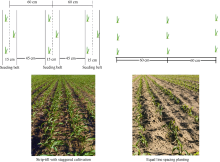
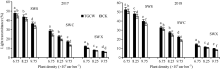
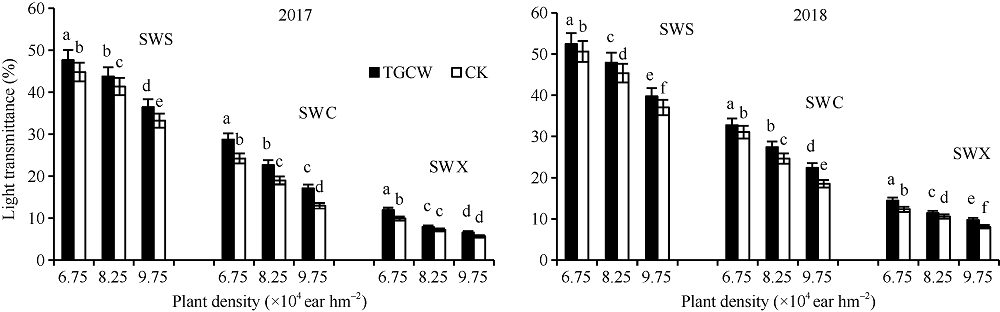
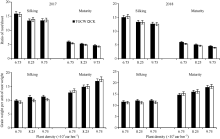
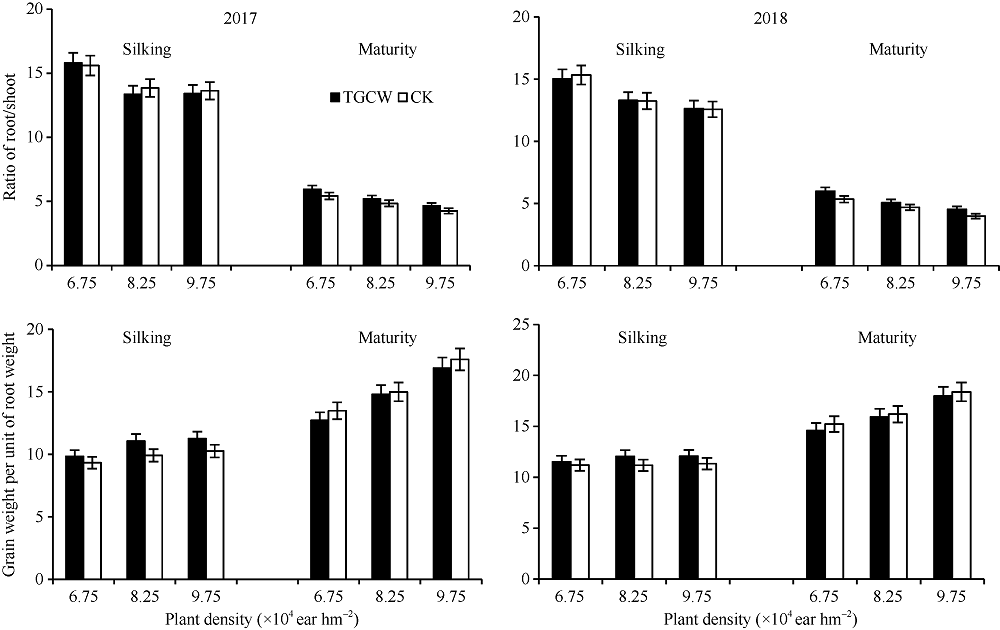
2017年和2018年在内蒙古通辽市科尔沁区农业高新科技示范园区, 以农华101为供试材料, 采用条带耕作错位种植(苗带耕作, 15 cm+45 cm小双行错位播种, TGCW)和等行常规种植(旋耕, 60 cm等行距, CK)两种模式, 6.75万株 hm -2、8.25万株 hm -2、9.75万株 hm -23个种植密度, 研究条带耕作错位种植模式对西辽河平原灌区春玉米冠根协调特征及产量形成的调控效应。结果表明, 相比于等行距常规种植, 条带耕作错位种植的产量显著提高, 其中8.25万株 hm -2增幅最明显, 2017年和2018年分别提高13.1%和13.8%, 该模式吐丝后干物质积累量及积累率具有明显优势, 较强的物质积累明显延缓了生育后期叶片衰老, 同时穗位上和穗位层透光率显著提高, 生育后期叶面积指数、净光合速率和群体光合势均显著高于CK。该模式生育后期各土层植株根干重显著高于CK, 高密度下更为明显, 且20~60 cm根系占比高, 吐丝期单位根重获得的籽粒产量和成熟期根冠比均具有明显优势。该模式的这些优点是促成西辽河平原灌区春玉米增产的主要原因之一。
| [1] | 王崇桃, 李少昆, 韩伯棠 . 玉米高产之路与产量潜力挖掘. 科技导报, 2006,24(4):8-11. |
| Wang C T, Li S K, Han B T . Approaches to high-yielding and yield potential exploration in corn. Sci Technol Rev, 2006,24(4):8-11 (in Chinese with English abstract). | |
| [2] | 靳立斌, 张吉旺, 李波, 崔海岩, 董树亭, 刘鹏, 赵斌 . 高产高效夏玉米的冠层结构及其光合特性. 中国农业科学, 2013,46:2430-2439. |
| Jin L B, Zhang J W, Li B, Cui H Y, Dong S T, Liu P, Zhao B . Canopy structure and photosynthetic characteristics of high yield and high nitrogen efficiency summer maize. Sci Agric Sin, 2013,46:2430-2439 (in Chinese with English abstract). | |
| [3] | 杨丽雯, 张永清 . 4种旱作谷类作物根系发育规律的研究. 中国农业科学, 2011,44:2244-2251. |
| Yang L W, Zhang Y Q . Developing patterns of root systems of four cereal crops planted in dryland areas. Sci Agric Sin, 2011,44:2244-2251 (in Chinese with English abstract). | |
| [4] | 陈晓远, 高志红, 罗远培 . 植物根冠关系. 植物生理学通讯, 2005,41:555-562. |
| Chen X Y, Gao Z H, Luo Y P . Relationship between root and shoot of plants. Plant Physiol Commun, 2005,41:555-562 (in Chinese with English abstract). | |
| [5] | 张玉芹, 杨恒山, 高聚林, 张瑞富, 王志刚, 徐寿军, 范秀艳, 杨升辉 . 超高产春玉米冠层结构及其生理特性. 中国农业科学, 2011,44:4367-4376. |
| Zhang Y Q, Yang H S, Gao J L, Zhang R F, Wang Z G, Xu S J, Fan X Y, Yang S H . Study on canopy structure and physiological characteristics of super-high yield spring maize. Sci Agric Sin, 2011,44:4367-4376 (in Chinese with English abstract). | |
| [6] | 郭家萌, 刘振朝, 高强, 薛吉全, 高聚林, 翟广谦, 柳家友, 孙海昆, 郭新平, 边少锋, 王俊河, 王延波, 张东兴, 陈新平 . 深松对玉米产量和养分吸收的影响. 水土保持学报, 2016,30(2):249-254. |
| Guo J M, Liu Z C, Gao Q, Xue J Q, Gao J L, Zhai G Q, Liu J Y, Sun H K, Guo X P, Bian S F, Wang J H, Wang Y B, Zhang D X, Chen X P . Effects of subsoiling on yield and nutrient uptake of maize. J Soil & Water Conserv, 2016,30(2):249-254 (in Chinese with English abstract). | |
| [7] | 王新兵, 侯海鹏, 周宝元, 孙雪芳, 马玮, 赵明 . 条带深松对不同密度玉米群体根系空间分布的调节效应. 作物学报, 2014,40:2136-2148. |
| Wang X B, Hou H P, Zhou B Y, Sun X F, Ma W, Zhao M . Effect of strip subsoiling on population root spatial distribution of maize under different planting densities. Acta Agron Sin, 2014,40:2136-2148 (in Chinese with English abstract). | |
| [8] | 王洪君, 王楠, 胡宇, 栾天宇, 孙孟琪, 梁烜赫, 赵鑫, 栾天浩, 代永刚, 陈宝玉 . 半干旱区玉米行距调整增密对群体冠层结构及产量的影响. 玉米科学, 2018,26(6):75-78. |
| Wang H J, Wang N, Hu Y, Luan T Y, Sun M Q, Liang X H, Zhao X, Luan T H, Dai Y G, Chen B Y . Effects of row spacing on canopy structure and yield of maize in semi-arid area. J Maize Sci, 2018,26(6):75-78 (in Chinese with English abstract). | |
| [9] | 何冬冬, 杨恒山, 张玉芹 . 扩行距、缩株距对春玉米冠层结构及产量的影响. 中国生态农业学报, 2018,26:397-408. |
| He D D, Yang H S, Zhang Y Q . Effects of line-spacing expansion and row-spacing shrinkage on canopy structure and yield of spring corn. Chin J Eco-Agric, 2018,26:397-408 (in Chinese with English abstract). | |
| [10] | Liu T D, Song F B . Maize photosynthesis and microclimate within the canopies at grain-filling stage in response to narrow-wide row planting patterns. Photosynthetica, 2012,50:215-222. |
| [11] | 魏珊珊, 王祥宇, 董树亭 . 株行距配置对高产夏玉米冠层结构及籽粒灌浆特性的影响. 应用生态学报, 2014,25:441-450. |
| Wei S S, Wang X Y, Dong S T . Effects of row spacing on canopy structure and grain-filling characteristics of high-yield summer maize. Chin J Appl Ecol, 2014,25:441-450 (in Chinese with English abstract). | |
| [12] | Ren B Z, Li X, Dong S T, Liu P, Zhao B, Zhang J W . Soil physical properties and maize root growth under different tillage systems in the North China Plain. Crop J, 2018,6:669-676. |
| [13] | Shao H, Shi D F, Shi W J, Ban X B, Chen Y C, Ren W, Chen F J, Mi G H . Genotypic difference in the plasticity of root system architecture of field-grown maize in response to plant density. Plant Soil, 2019,439:201-217. |
| [14] | 宋日, 刘利, 吴春胜, 马丽艳 . 根系生长空间对玉米生长和养分吸收的影响. 西北农林科技大学学报, 2009,37(6):58-64. |
| Song R, Liu L, Wu C S, Ma L Y . The effect of root growth space on maize growth and nutrient absorption. J Northwest A&F Univ, 2009,37(6):58-64 (in Chinese with English abstract). | |
| [15] | 张玉芹, 杨恒山, 高聚林, 张瑞富, 王志刚, 徐寿军, 范秀艳, 毕文波 . 超高产春玉米的根系特征. 作物学报, 2011,37:735-743. |
| Zhang Y Q, Yang H S, Gao J L, Zhang R F, Wang Z G, Xu S J, Fan X Y, Bi W B . Root characteristics of super high-yield spring maize. Acta Agron Sin, 2011,37:735-743 (in Chinese with English abstract). | |
| [16] | Duvick D N . The contribution of breeding to yield advances in maize ( Zea mays L.). Adv Agron, 2005,86:83-145. |
| [17] | 杨哲 . 栽培措施对春玉米产量差和效率差的贡献及其调控机制. 内蒙古农业大学硕士学位论文, 内蒙古通辽, 2018. |
| Yang Z . Contribution of Management Factors to the Gaps of Yield and Resource Use Efficiency of Spring Maize and Regulating Pathway. MS Thesis of Inner Mongolia Agricultural University, Tongliao, Inner Mongolia, China, 2018 (in Chinese with English abstract). | |
| [18] | 赵明, 马玮, 周宝元, 孙雪芳 . 实施玉米推茬清垄精播技术实现高产高效与环境友好生产. 作物杂志, 2016, ( 3):1-5. |
| Zhao M, Ma W, Zhou B Y, Sun X F . Using integrated technology of stubble-shoving, ridge-cleaning and precise sowing to achieve the high yield, high efficiency and environment-friendly in maize production. Crops, 2016, ( 3):1-5 (in Chinese with English abstract). | |
| [19] | 魏建军, 罗赓彤, 张力, 潘文远 . 超高产大豆主要群体生理参数与经济产量关系的研究. 中国油料作物学报, 2007,29:272-276. |
| Wei J J, Luo G T, Zhang L, Pan W Y . A study of relation between canopy physiological parameter and seed yield in super high-yield soybean. Chin J Oil Crop Sci, 2007,29:272-276 (in Chinese with English abstract). | |
| [20] | 李潮海, 刘奎 . 不同产量水平玉米杂交种生育后期光合效率比较分析. 作物学报, 2002,28:379-383. |
| Li C H, Liu K . Analysis of photosynthesis efficiency of maize hybrids with different yield in the later growth stage. Acta Agron Sin, 2002,28:379-383 (in Chinese with English abstract). | |
| [21] | Maddonni G A, Otegui M E, Cirilo A G . Plant population density, rows pacing and hybrid effects on maize canopy architecture and light attenuation. Field Crops Res, 2001,71:183-193. |
| [22] | 苌建峰, 张海红, 李鸿萍, 董朋飞, 李潮海 . 不同行距配置方式对夏玉米冠层结构和群体抗性的影响. 作物学报, 2016,42:104-112. |
| Chang J F, Zhang H H, Li H P, Dong P F, Li C H . Effects of different row spaces on canopy structure and resistance of summer maize. Acta Agron Sin, 2016,42:104-112 (in Chinese with English abstract). | |
| [23] | 李少昆, 王崇桃 . 中国玉米生产技术的演变与发展. 中国农业科学, 2009,42:1941-1951. |
| Li S K, Wang C T . Evolution and development of maize production techniques in China. Sci Agric Sin, 2009,42:1941-1951 (in Chinese with English abstract). | |
| [24] | 杨罗锦, 陶洪斌, 王璞 . 种植密度对不同株型玉米生长及根系形态特征的影响. 应用与环境生物学报, 2012,18:1009-1013. |
| Yang L J, Tao H B, Wang P . Effect of planting density on plant growth and root morphology of maize. Chin J Appl Environ Biol, 2012,18:1009-1013 (in Chinese with English abstract). | |
| [25] | 李宗新, 陈源泉, 王庆成, 刘开昌, 高旺盛, 隋鹏 . 高产栽培条件下种植密度对不同类型玉米品种根系时空分布动态的影响. 作物学报, 2012,38:1286-1294. |
| Li Z X, Chen Y Q, Wang Q C, Liu K C, Gao W S, Sui P . Influence of planting density on root spatio-temporal distribution of different types of maize under high-yielding cultivation conditions. Acta Agron Sin, 2012,38:1286-1294 (in Chinese with English abstract). | |
| [26] | 张瑞富, 杨恒山, 高聚林, 张玉芹, 王志刚, 范秀艳, 毕文波 . 深松对春玉米根系形态特征和生理特性的影响. 农业工程学报, 2015,31(5):78-84. |
| Zhang R F, Yang H S, Gao J L, Zhang Y Q, Wang Z G, Fan X Y, Bi W B . Effect of subsoiling on root morphological and physiological characteristics of spring maize. Trans CSAE, 2015,31(5):78-84 (in Chinese with English abstract). | |
| [27] | 刘朝巍, 张恩和, 谢瑞芝, 刘武仁, 李少昆 . 玉米宽窄行交替休闲保护性耕作的根系和光分布特征研究. 中国生态农业学报, 2012,20:203-209. |
| Liu C W, Zang E H, Xie R Z, Liu W R, Li S K . Effect of conservation tillage of wide/narrow row planting on maize root and transmittance distribution. Chin J Eco-Agric, 2012,20:203-209 (in Chinese with English abstract). | |
| [28] | 梁熠, 何文寿, 代晓华, 马琨, 侯贤清 . 株行配置对春玉米根冠空间分布及产量的影响. 玉米科学, 2016,24(6):97-102. |
| Liang Y, He W S, Dai X H, Ma K, Hou X Q . Effects of planting density and row spacing on root-shoot spatial distribution and grain yield of spring maize. J Maize Sci, 2016,24(6):97-102 (in Chinese with English abstract). | |
| [29] | Brouwer R . Functional equilibrium: sense or nonsense. Neth J Agric Sci, 1983,31:335-348. |
| [30] | 肖继兵, 孙占祥, 杨久廷, 张玉龙, 郑家明, 刘洋 . 半干旱区中耕深松对土壤水分和作物产量的影响. 土壤通报, 2011,42:709-714. |
| Xiao J B, Sun Z X, Yang J T, Zhang Y L, Zheng J M, Liu Y . Effect of subsoiling on soil water and crop yield in semi-arid area. Chin J Soil Sci, 2011,42:709-714 (in Chinese with English abstract). | |
| [31] | 王新兵, 侯海鹏, 周宝元, 孙雪芳, 马玮, 赵明 . 条带深松对不同密度玉米群体根系空间分布的调节效应. 作物学报, 2014,40:2136-2148. |
| Wang X B, Hou H P, Zhou B Y, Sun X F, Ma W, Zhao M . Effect of strip subsoiling on population root spatial distribution of maize under different planting densities. Acta Agron Sin, 2014,40:2136-2148 (in Chinese with English abstract). |
| [1] | 胡川, 赵凯男, 黄修利, 吴金芝, 任开明, 王贺正, 付国占, 黄明, 李友军. 一次灌溉下耕作方式和氮肥用量对旱地小麦产量和品质的影响[J]. 作物学报, 2026, 52(6): 1830-1846. |
| [2] | 马胜乾, 王志平, 陈浩天, 窦淑贤, 张燕, 邓艾兴, 张卫建, 原向阳, 宋振伟. 秸秆还田下耕作方式与氮肥施用量对东北玉米产量及土壤团聚体的影响[J]. 作物学报, 2026, 52(6): 1802-1816. |
| [3] | 张思思, 赵向辉, 周洋, 姚云凤, 朱荣昱, 董元杰, 胡国庆, 徐通, 刘兆新. 冬闲期翻耕和绿肥还田对连作花生田土壤理化性质和产量的影响[J]. 作物学报, 2026, 52(5): 1472-1486. |
| [4] | 张宁宁, 滕雨菲, 任娜娜, 魏兴卓, 闫书豪, 樊可心, 王永宏, 陈文康, 张兴华, 朱万超, 徐淑兔, 薛吉全. 201份玉米自交系抗旱表型评价及可塑性分析[J]. 作物学报, 2026, 52(5): 1309-1325. |
| [5] | 张振, 冯连杰, 石玉, 于振文, 张永丽. 节水补灌下不同穗型小麦产量形成差异研究[J]. 作物学报, 2026, 52(5): 1522-1535. |
| [6] | 闫安, 蒋昆炜, 王蓉圆, 田林, 张璐, 王韵, 徐建龙. 水稻剑叶小维管束数基因SVN7的鉴定与克隆[J]. 作物学报, 2026, 52(5): 1364-1372. |
| [7] | 刘昕萌, 任昊, 张继波, 张吉旺, 赵斌, 任佰朝, 刘鹏, 王洪章. 茉莉酸甲酯(MeJA)缓解高温影响玉米雌穗分化的生理机制[J]. 作物学报, 2026, 52(5): 1561-1572. |
| [8] | 王壮壮, 武紫君, 张永新, 张芯源, 袁丽雪, 陈如雪, 刘世举, 段剑钊, 冯伟, 王同朝, 王永华. 豫东南黏壤潮土区水氮优化协同提高冬小麦产量和氮素利用效率[J]. 作物学报, 2026, 52(5): 1501-1521. |
| [9] | 张鸿蓉, 王菲儿, 李盼, 仇海龙, 朱静, 赵连豪, 南运有, 何蔚, 樊志龙, 胡发龙, 柴强, 殷文. 减量20%灌水与25%有机肥替代化肥提高青贮玉米产量的光合特性[J]. 作物学报, 2026, 52(5): 1487-1500. |
| [10] | 王宇诚, 张露, 刘阿康, 黄见良, 彭少兵, 袁珅. 基于产量差的作物大面积单产提升策略与展望[J]. 作物学报, 2026, 52(5): 1279-1290. |
| [11] | 赵佳雪, 周龙昊, 郭岂源, 尚伦霄, 王涵, 刘志涛, 陈曦, 张晓佩, 宋宪亮, 毛丽丽. 长期秸秆还田与深松通过改善土壤环境与棉花光合特性提高滨海盐碱地棉花产量[J]. 作物学报, 2026, 52(5): 1548-1560. |
| [12] | 郭星宇, 胡丹, 林苏期, 王梦凯, 谭文峰, 黄传琴. 生物炭配施化肥提高玉米‖大豆下玉米产量和土壤生态系统多功能性[J]. 作物学报, 2026, 52(5): 1536-1547. |
| [13] | 蔡宏玮, 于爱忠, 姜科强, 王鹏飞, 王玉珑, 霍建喆, 庞小能, 尹波, 尚永盼. 干旱灌区有机肥替代部分化肥促进甜玉米产量提升的关键机制[J]. 作物学报, 2026, 52(4): 1166-1180. |
| [14] | 崔雪梅, 柳妍娣, 刘景辉, 米俊珍, 武俊英, 赵宝平. 不同基因型燕麦强弱势粒生理特性与产量关系研究[J]. 作物学报, 2026, 52(4): 1220-1235. |
| [15] | 杨锐, 陈敬东, 黄郢, 张学昆, 周登文, 刘清云, 徐劲松, 谢伶俐, 许本波. 长江下游冬油菜区应对气候变化的育种和栽培策略研究[J]. 作物学报, 2026, 52(4): 1153-1165. |
|
||