欢迎访问作物学报,今天是
作物学报 ›› 2024, Vol. 50 ›› Issue (2): 493-505.doi: 10.3724/SP.J.1006.2024.24273
聂晓玉1( ), 李真1, 王天尧2, 周元委3, 徐正华1, 王晶1, 汪波1, 蒯婕1,*(), 周广生1
NIE Xiao-Yu1(), LI Zhen1, WANG Tian-Yao2, ZHOU Yuan-Wei3, XU Zheng-Hua1, WANG Jing1, WANG Bo1, KUAI Jie1,*(), ZHOU Guang-Sheng1
摘要:
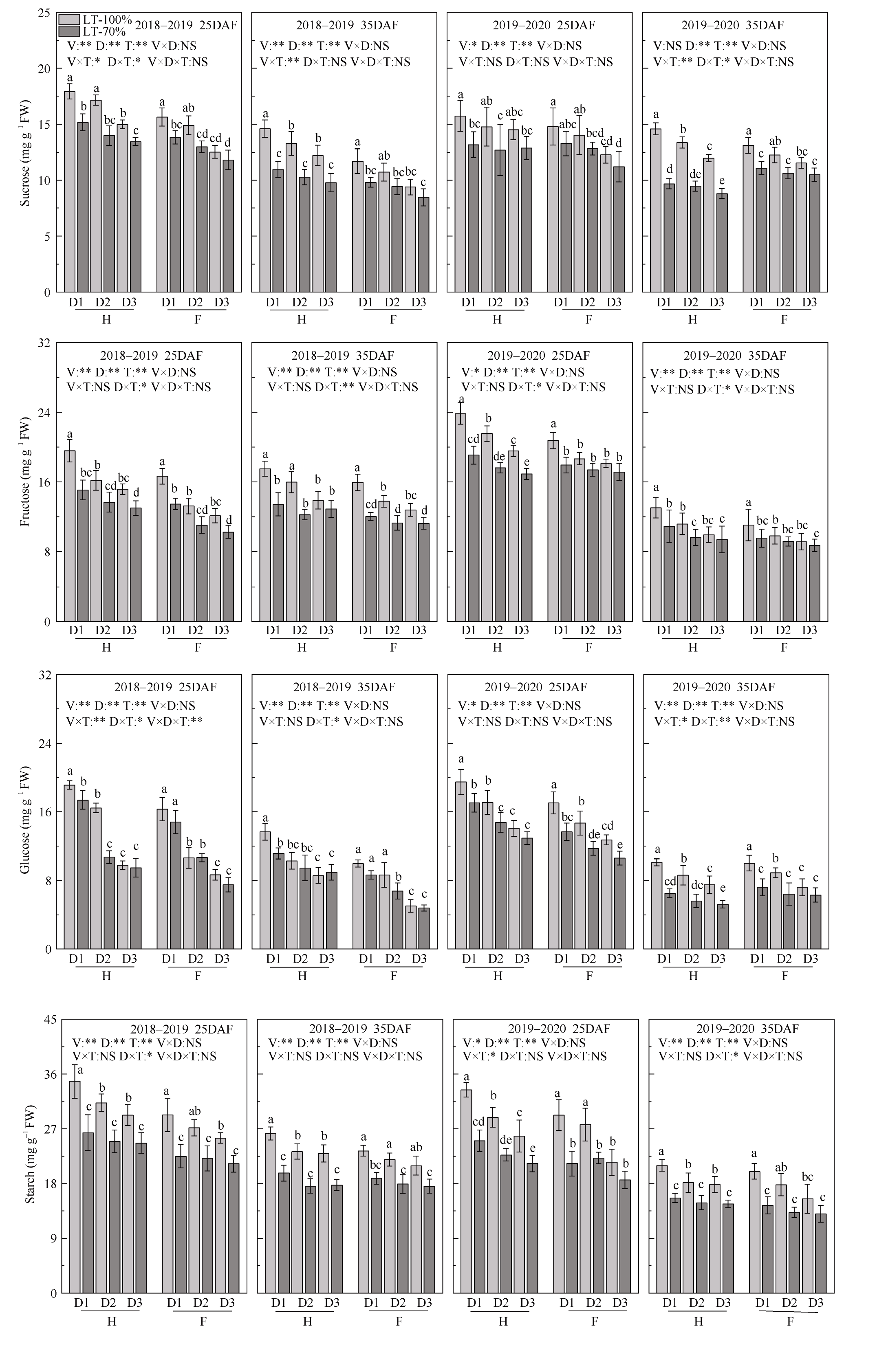
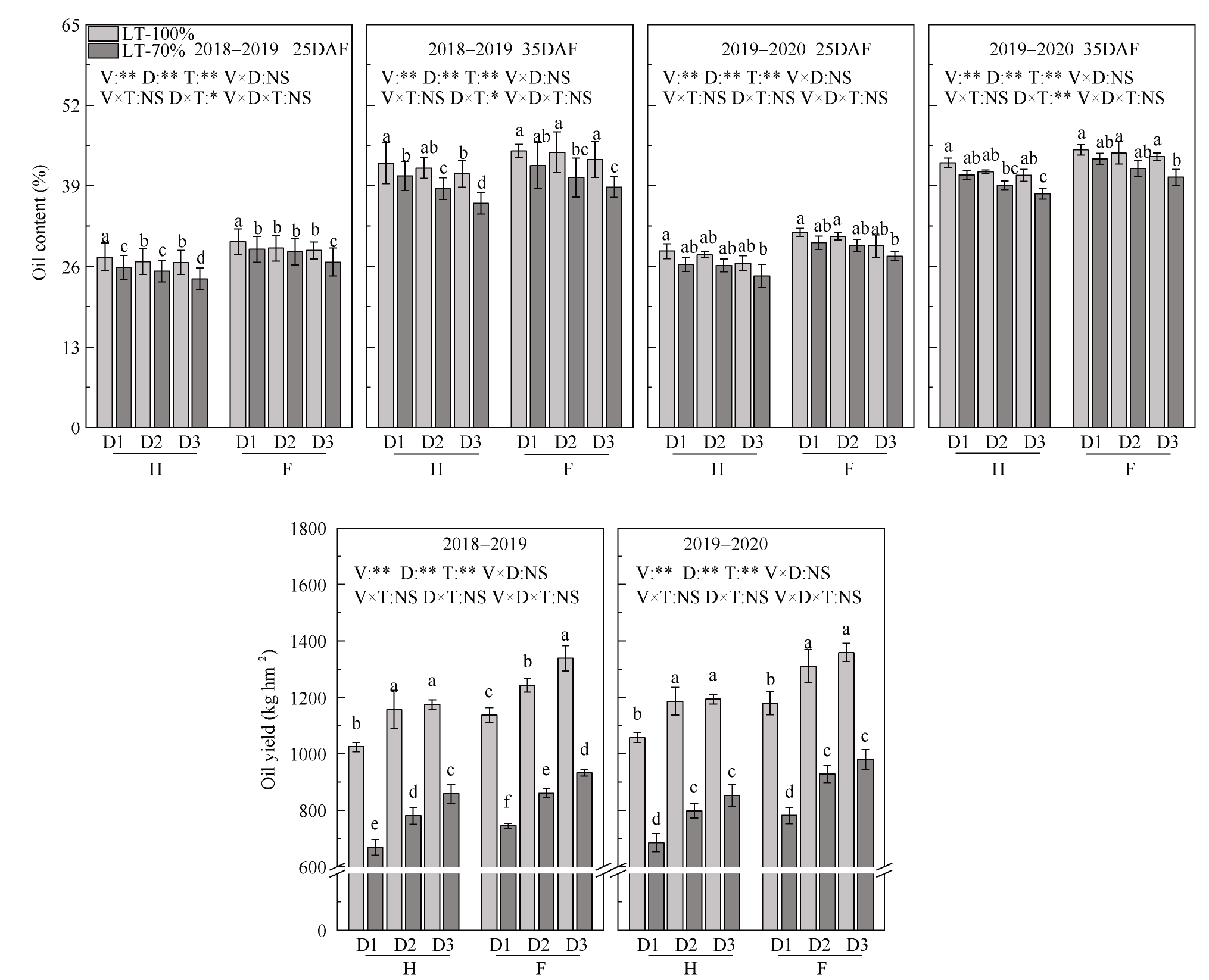
角果期光照不足显著影响油菜籽粒含油量, 而增加种植密度具有明显的增产效果, 但其对角果期弱光胁迫下籽粒含油量的影响未见报道。本试验选用华油杂62和沣油520两个品种进行大田试验, 设置3个种植密度(15×104、30×104、45×104株 hm-2)和2个光照强度(透光率为100%, LT100%和花后10~35 d透光率为70%, LT70%), 从籽粒碳代谢和油脂代谢角度, 研究种植密度对角果期弱光胁迫下油菜籽粒含油量的影响机制。结果表明: 与LT100%相比, LT70%处理下2个品种花后25 d、35 d时籽粒叶绿素含量、核酮糖-1,5-二磷酸核酮糖羧化酶(Ribulose 1,5-bisphosphate carboxylase, Rubisco)活性降低, 光合速率下降, 光合产物葡萄糖含量降低0.4%~27.9%; 蔗糖合成酶(Sucrose synthase, SuSy)分解活性降低, 导致果糖含量降低了4.8%~24.5%, 减少了籽粒碳水化合物积累与转运, 同时磷脂酸磷酸酯酶(Phosphatidate phosphatase, PPase)、6-磷酸葡萄糖脱氢酶(Glucose-6-phosphate dehydrogenase, G6PDH)活性降低, 导致含油量降低2.1%~11.8%, 油脂产量降低27.0%~35.3%。与低密度遮阴相比, 高密度LT70%处理下籽粒的Rubisco、SuSy活性降幅变小, 但籽粒G6PDH和PPase活性降幅变大。这些结果表明, 在本试验条件下, 通过增加密度可以缓解弱光对籽粒光合碳代谢的抑制, 通过增加群体产量缓解弱光胁迫下产油量的损失。
| [1] | Amiri-Oghan H, Fotokian M H, Javidfar F, Alizadeh B. Genetic analysis of grain yield, days to flowering and maturity in oilseed rape (Brassica napus L.) using diallel crosses. Int J Plant Prod, 2009, 3: 19-26. |
| [2] | Friedt W, Tu J X, Fu T D. The Brassica napus Genome. Switzerland: Springer Cham, 2018. pp 1-20. |
| [3] |
Li X Y, Zuo Q S, Chang H B, Bai G P, Kuai J, Zhou G S. Higher density planting benefits mechanical harvesting of rapeseed in the Yangtze River Basin of China. Field Crops Res, 2018, 218: 97-105.
doi: 10.1016/j.fcr.2018.01.013 |
| [4] |
Liu J D, Linderholm H, Chen D L, Zhou X J, Flerchinger G N, Yu Q, Du J, Wu D R, Shen Y B, Yang Z B. Changes in the relationship between solar radiation and sunshine duration in large cities of China. Energy, 2015, 82: 589-600.
doi: 10.1016/j.energy.2015.01.068 |
| [5] | Procko C, Crenshaw C M, Ljung K, Noel J P, Chory J. Cotyledon-generated auxin is required for shade-induced hypocotyl growth in Brassica rapa. Plant Physiol, 2014, 165: 1285-1301. |
| [6] |
Fortescue J A, Turner D W. Changes in seed size and oil accumulation in Brassica napus L. by manipulating the source-sink ratio and excluding light from the developing siliques. Aust J Agric Res, 2007, 58: 413-424.
doi: 10.1071/AR06249 |
| [7] |
Verdejo J, Calderini D F. Plasticity of seed weight in winter and spring rapeseed is higher in a narrow but different window after flowering. Field Crops Res, 2020, 250: 107777.
doi: 10.1016/j.fcr.2020.107777 |
| [8] |
Labra M H, Struik P C, Evers J B, Calderini D F. Plasticity of seed weight compensates reductions in seed number of oilseed rape in response to shading at flowering. Eur J Agron, 2017, 84: 113-124.
doi: 10.1016/j.eja.2016.12.011 |
| [9] |
Tanaka W, Maddonni G. Maize kernel oil and episodes of shading during the grain-filling period. Crop Sci, 2009, 49: 2187-2197.
doi: 10.2135/cropsci2009.05.0238 |
| [10] |
Artru S, Garré S, Dupraz C, Hiel M P, Blitz-Frayret C, Lassois L. Impact of spatio-temporal shade dynamics on wheat growth and yield, perspectives for temperate agroforestry. Eur J Agron, 2017, 82: 60-70.
doi: 10.1016/j.eja.2016.10.004 |
| [11] |
Wei H Y, Zhu Y, Qiu S, Han C, Hu L, Xu D, Zhou N B, Xing Z P, Hu Y J, Cui P Y, Dai Q G, Zhang H C. Combined effect of shading time and nitrogen level on grain filling and grain quality in japonica super rice. J Integr Agric, 2018, 17: 2405-2417.
doi: 10.1016/S2095-3119(18)62025-8 |
| [12] |
Proulx R A, Naeve S L. Pod removal, shade, and defoliation effects on soybean yield, protein, and oil. Agron J, 2009, 101: 971-978.
doi: 10.2134/agronj2008.0222x |
| [13] |
Zhang Y, Liu A Z. The correlation between soluble carbohydrate metabolism and lipid accumulation in castor seeds. Biotechnol Bull, 2016, 32: 120-129.
doi: 10.13560/j.cnki.biotech.bull.1985.2016.06.017 |
| [14] |
Han C J, Wang Q, Zhang H B, Wang S H, Song H D, Hao J M, Dong H Z. Light shading improves the yield and quality of seed in oil-seed peony (Paeonia ostii Feng Dan). J Integr Agric, 2018, 17: 1631-1640.
doi: 10.1016/S2095-3119(18)61979-3 |
| [15] |
Lyu F J, Liu J R, Ma Y N, Chen J, Abudou K, Wang Y H, Chen B L, Meng Y L, Zhou Z G. Effect of shading on cotton yield and quality on different fruiting branches. Crop Sci, 2013, 53: 2670-2678.
doi: 10.2135/cropsci2013.03.0170 |
| [16] |
Andrade F H, Ferreiro M A. Reproductive growth of maize, sunflower and soybean at different source levels during grain filling. Field Crops Res, 1996, 48: 155-165.
doi: 10.1016/S0378-4290(96)01017-9 |
| [17] |
Gindaba J, Midgley S. Comparative effects of evaporative cooling, kaolin particle film, and shade net on sunburn and fruit quality in apples. HortScience, 2005, 40: 592-596.
doi: 10.21273/HORTSCI.40.3.592 |
| [18] |
Slewinski T L, Braun D M. Current perspectives on the regulation of whole-plant carbohydrate partitioning. Plant Sci, 2010, 178: 341-349.
doi: 10.1016/j.plantsci.2010.01.010 |
| [19] |
Han C J, Wang Q, Zhang H B, Dong H Z. Seed development and nutrient accumulation as affected by light shading in oilseed peony (Paeonia ostii Feng Dan). Sci Hortic, 2019, 251: 25-31.
doi: 10.1016/j.scienta.2019.02.084 |
| [20] |
Ishibashi Y, Okamura K, Miyazaki M, Phan T, Yuasa T, Iwaya-Inouea M. Expression of rice sucrose transporter gene OsSUT1 in sink and source organs shaded during grain filling may affect grain yield and quality. Environ Exp Bot, 2014, 97: 49-54.
doi: 10.1016/j.envexpbot.2013.08.005 |
| [21] |
Zhao D, Oosterhuis D. Cotton responses to shade at different growth stages: nonstructural carbohydrate composition. Crop Sci, 1998, 38: 1196-1203.
doi: 10.2135/cropsci1998.0011183X003800050014x |
| [22] |
Pettigrew W T. Environmental effects on cotton fiber carbohydrate concentration and quality. Crop Sci, 2001, 41: 1108-1108.
doi: 10.2135/cropsci2001.4141108x |
| [23] |
Samarajeewa D, Kojima N, Sakagami J, Chandanie W. The effect of different timing of top dressing of nitrogen application under low light intensity on the yield of rice (Oryza sativa L.). J Agron Crop Sci, 2005, 191: 99-105.
doi: 10.1111/jac.2005.191.issue-2 |
| [24] |
Sims L, Pastor J, Lee T, Dewey B. Nitrogen, phosphorus and light effects on growth and allocation of biomass and nutrients in wild rice. Oecologia, 2012, 170: 65-76.
doi: 10.1007/s00442-012-2296-x pmid: 22407062 |
| [25] |
Pan S G, Liu H D, Mo Z W, Patterson B, Duan M Y, Tian H, Hu S J, Tang X R. Effects of nitrogen and shading on root morphologies, nutrient accumulation, and photosynthetic parameters in different rice genotypes. Sci Rep, 2016, 6: 32148.
doi: 10.1038/srep32148 pmid: 27557779 |
| [26] | 姜丹, 陈雅君, 刘丹, 胡海辉. 光氮互作对草地早熟禾碳氮代谢的影响. 中国草地, 2005, 27(6): 49-53. |
| Jiang D, Chen Y J, Liu D, Hu H H. Effects of light condition and nitrogen supply on carbon-nitrogen metabolism of Poa pratensis L. Grassland China, 2005, 27(6): 49-53 (in Chinese with English abstract). | |
| [27] | 郭振清, 付陈陈, 李婧实, 张敏, 张玉春, 李清瑶, 郭双双, 蔡瑞国. 施氮对花后遮光条件下小麦产量与蛋白质含量的影响. 麦类作物学报, 2021, 7: 883-890. |
| Guo Z Q, Fu C C, Li J S, Zhang M, Zhang Y C, Li Q Y, Guo S S, Cai R G. Effect of different nitrogen rate on wheat yield and protein content under shading conditions after anthesis. J Triticeae Crop, 2021, 7: 883-890 (in Chinese with English abstract). | |
| [28] | 张永强, 方辉, 陈传信, 陈兴武, 赛力汗·赛, 薛丽华, 雷钧杰. 遮阴和种植密度对冬小麦灌浆特性及籽粒品质的影响. 中国农业大学学报, 2019, 24(5): 10-19. |
| Zhang Y Q, Fang H, Chen C X, Chen X W, Sailihan S, Xue L H, Lei J J. Effects of shading and planting population on grain-filling properties and grain quality of winter wheat. J China Agric Univ, 2019, 24(5): 10-19 (in Chinese with English abstract). | |
| [29] | 周培禄. 玉米不同杂交种密植群体冠层结构及其光、氮利用特征研究. 中国农业科学院硕士学位论文, 北京, 2016. |
| Zhou P L. Study on Canopy Structure Characteristics and Light, Nitrogen Utilization Traits of Maize under high Plant Density. MS Thesis of Chinese Academy of Agricultural Sciences, Beijing, China, 2015 (in Chinese with English abstract). | |
| [30] |
蒯婕, 王积军, 左青松, 陈红琳, 高建芹, 汪波, 周广生, 傅廷栋. 长江流域直播油菜密植效应及其机理研究进展. 中国农业科学, 2018, 51: 4625-4632.
doi: 10.3864/j.issn.0578-1752.2018.24.004 |
|
Kuai J, Wang J J, Zuo Q S, Chen H L, Gao J Q, Wang B, Zhou G S, Fu T D. Effects and mechanism of higher plant density on directly-sown rapeseed in the Yangtze River Basin of China. Sci Agric Sin, 2018, 51: 4625-4632 (in Chinese with English abstract).
doi: 10.3864/j.issn.0578-1752.2018.24.004 |
|
| [31] |
Fritschi F B, Ray J D. Soybean leaf nitrogen, chlorophyll content, and chlorophyll a/b ratio. Photosynthetica, 2007, 45: 92-98.
doi: 10.1007/s11099-007-0014-4 |
| [32] |
Hendrix D L. Rapid extraction and analysis of nonstructural carbohydrates in plant tissues. Crop Sci, 1993, 33: 1306-1311.
doi: 10.2135/cropsci1993.0011183X003300060037x |
| [33] |
Wang B, Ma M, Lu H, Meng Q, Li G, Yang X. Photosynthesis, sucrose metabolism, and starch accumulation in two NILs of winter wheat. Photosynth Res, 2015, 126: 363-373.
doi: 10.1007/s11120-015-0126-9 |
| [34] |
Hussain S, Mumtaz M, Manzoor S, Li S X, Ahmed I, Skalicky M, Brestic M, Rastogi A, Ulhassan Z, Shafiq I, Allakhverdiev S I, Khurshid H, Yang W, Liu W. Foliar application of silicon improves growth of soybean by enhancing carbon metabolism under shading conditions. Plant Physiol Biochem, 2021, 159: 43-52.
doi: 10.1016/j.plaphy.2020.11.053 |
| [35] |
Diepenbrock W. Yield analysis of winter oilseed rape (Brassica napus L.): a review. Field Crops Res, 2000, 67: 35-49.
doi: 10.1016/S0378-4290(00)00082-4 |
| [36] |
Wagstaff C, Yang T J, Stead A D, Buchanan-Wollaston V, Roberts J A. A molecular and structural characterization of senescing Arabidopsis siliques and comparison of transcriptional profiles with senescing petals and leaves. Plant J, 2009, 57: 690-705.
doi: 10.1111/tpj.2009.57.issue-4 |
| [37] |
Eastmond P, Koláčá L, Rawsthorne S. Photosynthesis by developing embryos of oilseed rape (Brassica napus L.). J Exp Bot, 1996, 47: 1763-1769.
doi: 10.1093/jxb/47.11.1763 |
| [38] | King S P, Badger M R, Furbank R T. CO2 refixation characteristics of developing canola seeds and silique wall. Aust J Plant Physiol, 1998, 25: 377-386. |
| [39] | Li M, Naeem M S, Ali S, Zhang L, Liu L, Ma N, Zhang C. Root morphology, and seed yield of winter oilseed rape (Brassica napus L.) at varying plant densities. Biomed Res Int, 2017, 2017: 8581072. |
| [40] | 邵玉娇. 不同光强下油菜品质形成的生理基础研究. 华中农业大学硕士学位论文, 湖北武汉, 2005. |
| Shao Y J. Studies on the Physiological Basis of Quality Formation of Rapeseed under Different Light Intensity. MS Thesis of Huazhong Agricultural University, Wuhan, Hubei, China, 2005 (in Chinese with English abstract). | |
| [41] |
Yu N N, Ren B Z, Zhao B, Liu P, Zhang J W. Optimized agronomic management practices narrow the yield gap of summer maize through regulating canopy light interception and nitrogen distribution. Eur J Agron, 2022, 137: 126520.
doi: 10.1016/j.eja.2022.126520 |
| [42] | Tan H, Yang X, Zhang F, Zheng X, Qu C, Mu J, Li J, Guan R, Zhang H, Wang G, Zuo J. Enhanced seed oil production in canola by conditional expression of Brassica napus LEAFY COTYLEDON1 and LEC1-LIKE in developing seeds. Plant Physiol, 2011, 56: 1577-1588. |
| [43] | Ni F, Liu J H, Zhang J, Khan M N, Luo T, Xu Z H, Hu L Y. Effect of soluble sugar content in silique wall on seed oil accumulation during the seed-filling stage in Brassica napus. Crop Past Sci, 2019, 69: 1251-1263. |
| [44] |
Ekman A, Hayden D M, Dehesh K, Bülow L, Stymne S. Carbon partitioning between oil and carbohydrates in developing oat (Avena sativa L.) seeds. J Exp Bot, 2008. 59: 4247-4257.
doi: 10.1093/jxb/ern266 pmid: 19036843 |
| [45] |
Chen M, Mooney B P, Hajduch M, Joshi T, Zhou M, Xu D, Thelen J J. System analysis of an Arabidopsis mutant altered in de novo fatty acid synthesis reveals diverse changes in seed composition and metabolism. Plant Physiol, 2009, 150: 27-41.
doi: 10.1104/pp.108.134882 |
| [46] | Fan J, Yan C, Andre C, Shanklin J, Schwender J, Xu C. Oil accumulation is controlled by carbon precursor supply for fatty acid synthesis in Chlamydomonas reinhardtii. Plant Cell Physiol, 2012, 53: 1380-1390. |
| [47] |
Bennett E J, Roberts J A, Wagstaff C. The role of the pod in seed development: strategies for manipulating yield. New Phytol, 2011, 190: 838-853.
doi: 10.1111/j.1469-8137.2011.03714.x pmid: 21507003 |
| [48] |
Wardlaw I F. Tansley Review No. 27: the control of carbon partitioning in plants. New Phytol, 1990, 116: 341-381.
doi: 10.1111/j.1469-8137.1990.tb00524.x pmid: 33874094 |
| [49] |
Fallahi H, Scofield G N, Badger M R, Chow W S, Furbank R T, Ruan Y L. Localization of sucrose synthase in developing seed and siliques of Arabidopsis thaliana reveals diverse roles for SUS during development. J Exp Bot, 2008, 59: 3283-3295.
doi: 10.1093/jxb/ern180 |
| [50] |
Sturm A, Tang G Q. The sucrose-cleaving enzymes of plants are crucial for development, growth and carbon partitioning. Trends Plant Sci, 1999, 4: 401-407.
doi: 10.1016/s1360-1385(99)01470-3 pmid: 10498964 |
| [51] |
Bao X, Ohlrogge J. Supply of fatty acid is one limiting factor in the accumulation of triacylglycerol in developing embryos. Plant Physiol, 1999, 120: 1057-1062.
pmid: 10444089 |
| [52] |
Zhang S J, Liao X, Zhang C L, Xu H J. Influences of plant density on the seed yield and oil content of winter oilseed rape (Brassica napus L.). Ind Crops Prod, 2012, 40: 27-32.
doi: 10.1016/j.indcrop.2012.02.016 |
| [53] | 唐湘如, 官春云. 油菜栽培密度与几种酶活性及产量和品质的关系. 湖南农业大学学报(自然科学版), 2001, 27(4): 264-267. |
| Tang X R, Guan C Y. Effects of culture density on activities of several enzymes in rapeseed and its relationships with yield and quality. J Hunan Agric Univ, 2001, 27(4): 264-267 (in Chinese with English abstract). | |
| [54] | 黄秀芳, 孙敬东, 杨阿林, 范正辉, 孙旭明, 吴茂平, 陈俊才, 袁志章, 展旭东, 王书勤. 优质油菜史力丰生育特性及配套栽培技术研究. 中国油料作物学报, 2003, 25(1): 28-33. |
| Huang X F, Sun J D, Yang A L, Fan Z H, Sun X P, Wu M P, Chen J C, Yuan Z Z, Zhan X D, Wang S Q. Studies on growth and cultivated techniques of high-quality rapeseed Shilifeng. Chin J Oil Crop Sci, 2003, 25(1): 28-33 (in Chinese with English abstract). |
| [1] | 刘恩波, 陈静, 李红星, 于宁宁, 任佰朝, 赵斌, 刘鹏, 张吉旺. 遮阴改变源-库平衡和调节碳水化合物代谢进而抑制夏玉米幼穗发育[J]. 作物学报, 2026, 52(6): 1891-1901. |
| [2] | 杨锐, 陈敬东, 黄郢, 张学昆, 周登文, 刘清云, 徐劲松, 谢伶俐, 许本波. 长江下游冬油菜区应对气候变化的育种和栽培策略研究[J]. 作物学报, 2026, 52(4): 1153-1165. |
| [3] | 娄洪祥, 幸仁鹏, 汪波, 王晶, 徐正华, 赵杰, 蒯婕, 周广生. 播种期对长江中游甘蓝型油菜光温资源利用效率和产量的影响[J]. 作物学报, 2026, 52(2): 539-551. |
| [4] | 胡朋举, 郭颂, 宋亚辉, 金欣欣, 苏俏, 杨永庆, 王瑾. 多环境下花生含油量遗传及QTL定位分析[J]. 作物学报, 2025, 51(2): 324-333. |
| [5] | 朱灿灿, 李君霞, 景雅, 付森杰, 秦娜, 王春义, 代书桃, 魏昕, 张程炀. 不同耐荫性谷子对遮阴的生理响应及转录组分析[J]. 作物学报, 2025, 51(12): 3211-3223. |
| [6] | 郭建斌, 原小燕, 符明联, 陈伟刚, 罗怀勇, 刘念, 黄莉, 周小静, 姜慧芳, 廖伯寿, 雷永. 不同海拔生态区花生含油量和蔗糖含量的差异及蔗糖含量关联分析[J]. 作物学报, 2025, 51(11): 3005-3012. |
| [7] | 崔栋, 王同超, 杨松林, 任佰朝, 高英波, 于宁宁, 张吉旺. 灌溉方式和种植密度优化协同提高夏玉米产量和水分利用效率[J]. 作物学报, 2025, 51(11): 3026-3037. |
| [8] | 张琪祺, 陈杰昌, 蒯婕, 汪波, 王晶, 徐正华, 赵杰, 赵思明, 贾才华, 周广生. 高密度直播对油菜冷榨菜籽油品质的影响[J]. 作物学报, 2024, 50(9): 2358-2370. |
| [9] | 彭杰, 谢晓麒, 张钊, 姚晓芬, 邱深, 陈丹丹, 顾晓娜, 王玉洁, 王晨晨, 杨国正. 夏直播棉花产量与冠层微环境的关系[J]. 作物学报, 2024, 50(9): 2371-2382. |
| [10] | 曹松, 姚敏, 任睿, 贾元, 向星汝, 李文, 何昕, 刘忠松, 官春云, 钱论文, 熊兴华. 转录组结合区域关联分析挖掘油菜含油量积累的候选基因[J]. 作物学报, 2024, 50(5): 1136-1146. |
| [11] | 鲁清, 刘浩, 李海芬, 王润风, 黄璐, 梁炫强, 陈小平, 洪彦彬, 刘海燕, 李少雄. 花生含油量全基因组选择及近红外光谱筛选的育种技术探究[J]. 作物学报, 2024, 50(4): 969-980. |
| [12] | 张月, 王志慧, 淮东欣, 刘念, 姜慧芳, 廖伯寿, 雷永. 花生含油量的遗传基础与QTL定位研究进展[J]. 作物学报, 2024, 50(3): 529-542. |
| [13] | 刘雨杭, 赵书宏, 祝婷婷, 梁振宇, 贺大海, 陈佳博, 任勇, 黄林, 樊高琼, 伍碧华. 二氢赤霉素对不同增密条件下蜀麦133冠层光能截获和产量的影响[J]. 作物学报, 2024, 50(11): 2787-2800. |
| [14] | 郅晨阳, 薛晓梦, 吴洁, 李雄才, 王瑾, 晏立英, 王欣, 陈玉宁, 康彦平, 王志慧, 淮东欣, 洪彦彬, 姜慧芳, 雷永, 廖伯寿. 花生籽仁蔗糖含量遗传模型分析[J]. 作物学报, 2024, 50(1): 32-41. |
| [15] | 邓艾兴, 李歌星, 吕玉平, 刘猷红, 孟英, 张俊, 张卫建. 齐穗后遮阴时长对西北稻区粳稻产量和品质的影响[J]. 作物学报, 2023, 49(7): 1930-1941. |
|
||