欢迎访问作物学报,今天是
作物学报 ›› 2025, Vol. 51 ›› Issue (5): 1215-1229.doi: 10.3724/SP.J.1006.2025.44129
所属专题: 小麦:遗传育种·种质资源·分子遗传学
王佳婕1,5( ), 王正楠1, BATOOL Maria1, 王旺年1,4, 文静1, 任长忠1,3, 何峰1,3, 武优悠1, 徐正华1, 王晶1, 蒯婕1, 汪波1,*(), 周广生1,2, 傅廷栋1,2
WANG Jia-Jie1,5(), WANG Zheng-Nan1, BATOOL Maria1, WANG Wang-Nian1,4, WEN Jing1, REN Chang-Zhong1,3, HE Feng1,3, WU You-You1, XU Zheng-Hua1, WANG Jing1, KUAI Jie1, WANG Bo1,*(), ZHOU Guang-Sheng1,2, FU Ting-Dong1,2
摘要:
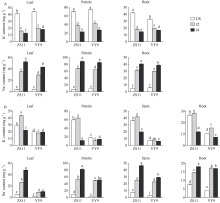
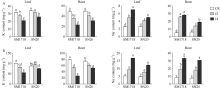
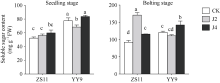
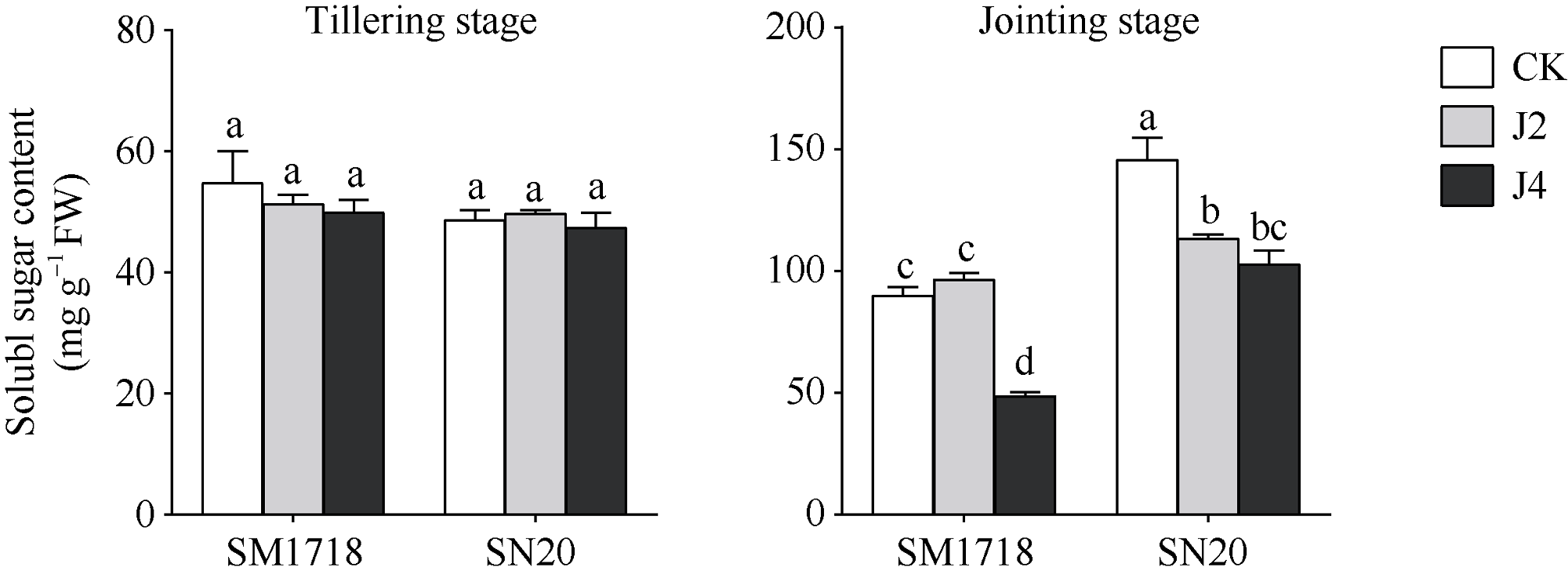
利用能产生经济效益的作物改良盐碱地是扩充我国后备耕地资源的重要手段。明确油菜和小麦响应盐碱胁迫的生理机制, 将为挖掘油菜、小麦在盐碱地种植以用作饲料及改良利用盐碱地中的潜力提供依据。本研究将取自吉林白城的盐碱土与武汉常规土壤配制为盐浓度分别为0.2%、0.4%的盐碱土, 以武汉常规土壤作对照(CK)进行盆栽试验, 分别以耐盐碱能力不同的甘蓝型油菜和小麦为材料, 测定生物量、渗透调节、离子平衡、抗氧化酶及H2O2、$\mathrm{O}^{\bar{.}}_{2}$等指标。研究结果表明, (1) 盐碱胁迫下, 油菜叶柄中的Na+含量最高, 达88.40 mg g-1; 小麦则是根系中的Na+含量最高, 为33.45 mg g-1; 且油菜各部位中的Na+积累量均显著高于小麦, 尤其是叶片中的Na+积累量, 高出2~8倍。(2) 油菜和小麦在盐碱胁迫下, 耐盐碱品种各部位中的K+降幅和K+/Na+比值均高于盐敏感品种, Na+增幅均低于盐敏感品种; 油菜苗期根系、蕾薹期叶片中的Na+对K+吸收的抑制效应最大, 而小麦各个时期均为根系中的Na+对K+吸收的抑制效应最大。(3) 油菜和小麦在盐碱胁迫下, 耐盐碱品种植株体内的可溶性糖含量、抗氧化酶活性以及$\mathrm{O}^{\bar{.}}_{2}$清除能力均高于盐敏感品种, H2O2、$\mathrm{O}^{\bar{.}}_{2}$均随盐碱胁迫浓度升高而增加, 但耐盐碱品种叶片增幅较小; 不同的是, 耐盐碱油菜品种在苗期抗盐碱生理机制中响应更快, 随着生育期的推进, 叶片中的可溶性糖含量以及$\mathrm{O}^{\bar{.}}_{2}$清除能力也会逐渐增加; 而耐盐碱小麦品种叶片中的可溶性糖含量和$\mathrm{O}^{\bar{.}}_{2}$的清除能力均随生育期推进而显著降低。油菜主要通过“储钠”作用将Na+区隔化进叶柄和茎秆中, 而小麦主要通过“拒钠”作用减少Na+的吸收, 并将Na+更多地积累在根系中; 耐盐碱能力强的品种维持钠钾离子平衡能力更强; 油菜耐盐碱能力随着生育期的推进逐渐增强, 而小麦的耐盐碱能力则随着生育期推进逐渐减弱。
| [1] | Pérez-Alfocea F, Balibrea M E, Cruz A S, Estañ M T. Agronomical and physiological characterization of salinity tolerance in a commercial tomato hybrid. Plant Soil, 1996, 180: 251-257. |
| [2] | Zhu J K. Abiotic stress signaling and responses in plants. Cell, 2016, 167: 313-324. |
| [3] | Ci L J, Yang X H. Desertification and Its Control in China. Berlin, Heidelberg: Springer Berlin Heidelberg, 2010. |
| [4] |
于宝勒. 盐碱地修复利用措施研究进展. 中国农学通报, 2021, 37(7): 81-87.
doi: 10.11924/j.issn.1000-6850.casb20200300211 |
|
Yu B L. Remediation measures of saline-alkali land: a review. Chin Agric Sci Bull, 2021, 37(7): 81-87 (in Chinese with English abstract).
doi: 10.11924/j.issn.1000-6850.casb20200300211 |
|
| [5] | Gul H, Ahmad R. Effect of different irrigation intervals on growth of canola (Brassica napus L.) under different salinity levels. Pak J Bot, 2004, 36: 359-372. |
| [6] |
汪波, 文静, 张凤华, 李立军, 来永才, 任长忠, 鲁剑巍, 沈金雄, 郭亮, 周广生, 等. 耐盐碱油菜品种选育及修复利用盐碱地研究进展. 科技导报, 2021, 39(23): 59-64.
doi: 10.3981/j.issn.1000-7857.2021.23.009 |
|
Wang B, Wen J, Zhang F H, Li L J, Lai Y C, Ren C Z, Lu J W, Shen J X, Guo L, Zhou G S, et al. Research progress in breeding of saline-alkaline tolerant rapeseed and restoring the salinate land. Sci Technol Rev, 2021, 39(23): 59-64 (in Chinese with English abstract).
doi: 10.3981/j.issn.1000-7857.2021.23.009 |
|
| [7] | 何中虎, 夏先春, 罗晶, 辛志勇, 孔秀英, 景蕊莲, 吴振录, 李杏普. 国际小麦育种研究趋势分析. 麦类作物学报, 2006, 26: 154-156. |
| He Z H, Xia X C, Luo J, Xin Z Y, Kong X Y, Jing R L, Wu Z L, Li X P. Trend analysis of international wheat breeding. J Triticeae Crops, 2006, 26: 154-156 (in Chinese with English abstract). | |
| [8] | 葛均筑, 张垚, 梁茜, 马志琪, 杨永安, 高玉平. 耐盐碱多用途油菜综合利用技术的研究进展. 土壤科学, 2019, 7(4): 312-316. |
| Ge J Z, Zhang Y, Liang Q, Ma Z Q, Yang Y A, Gao Y P. Advances in comprehensive utilization and multi-use technology of saline-alkali resistant rapeseed (Brassica napus L.). Hans J Soil Sci, 2019, 7(4): 312-316 (in Chinese with English abstract). | |
| [9] |
蔡阿敏, 范逸婷, 李鹏涛, 高腾云. 小麦青贮的营养价值及其在奶牛生产中的应用. 动物营养学报, 2021, 33: 2452-2460.
doi: 10.3969/j.issn.1006-267x.2021.05.006 |
| Cai A M, Fan Y T, Li P T, Gao T Y. Nutritional value of wheat silage and its application in dairy cow production. Chin J Anim Nutr, 2021, 33: 2452-2460 (in Chinese with English abstract). | |
| [10] |
王旺年, 葛均筑, 杨海昌, 阴法庭, 黄太利, 蒯婕, 王晶, 汪波, 周广生, 傅廷栋. 大田作物在不同盐碱地的饲料价值评价. 作物学报, 2022, 48: 1451-1462.
doi: 10.3724/SP.J.1006.2022.14051 |
|
Wang W N, Ge J Z, Yang H C, Yin F T, Huang T L, Kuai J, Wang J, Wang B, Zhou G S, Fu T D. Adaptation of feed crops to saline-alkali soil stress and effect of improving saline-alkali soil. Acta Agron Sin, 2022, 48: 1451-1462 (in Chinese with English abstract).
doi: 10.3724/SP.J.1006.2022.14051 |
|
| [11] | Yang C W, Jianaer A, Li C Y, Shi D C, Wang D L. Comparison of the effects of salt-stress and alkali-stress on photosynthesis and energy storage of an alkali-resistant halophyte Chloris virgata. Photosynthetica, 2008, 46: 273-278. |
| [12] | Kaleem M, Hameed M, Ahmad F, Ashraf M, Ahmad M S A. Anatomical and physiological features modulate ion homeostasis and osmoregulation in aquatic halophyte Fimbristylis complanata (Retz.) link. Acta Physiol Plant, 2022, 44: 59. |
| [13] | Greenway H, Munns R A. Mechanisms of salt tolerance in nonhalophytes. Annu Rev Plant Physiol, 1980, 31: 149-190. |
| [14] |
Gueta-Dahan Y, Yaniv Z, Zilinskas B A, Ben-Hayyim G. Salt and oxidative stress: similar and specific responses and their relation to salt tolerance in Citrus. Planta, 1997, 203: 460-469.
doi: 10.1007/s004250050215 pmid: 9421931 |
| [15] | Tester M. Na+tolerance and Na+transport in higher plants. Ann Bot, 2003, 91: 503-527. |
| [16] | Ahmed K, Saqib M, Akhtar J, Ahmad R. Evaluation and characterization of genetic variation in maize (Zea mays L.) for salinity tolerance. Pak J Agric Sci, 2004, 49: 521-526. |
| [17] | Anwar-ul-Haq M, Akram S, Akhtar J, Saqib M, Abbasi G H, Jan M. Morpho-physiological characterization of sunflower genotypes (Helianthus annuus L.) under saline condition. Pak J Agric Sci, 2017, 50: 49-54. |
| [18] | Mohamed I A A, Shalby N, Bai C Y, Qin M, Agami R A, Jie K, Wang B, Zhou G S. Stomatal and photosynthetic traits are associated with investigating sodium chloride tolerance of Brassica napus L. cultivars. Plants, 2020, 9: 62. |
| [19] | 李凤勤. 小麦萌发期耐盐碱相关性状关联分析及种质资源的筛选. 山东农业大学硕士学位论文, 山东泰安, 2019. |
| Li F Q. Association Study of Aline-alkali Resistance Related Traits at Wheat Germination Stage and Selection of Germplasm Resources. MS Thesis of Shandong Agricultural University, Tai’an, Shandong, China, 2019 (in Chinese with English abstract). | |
| [20] | 宋楠. 小麦种质苗期耐盐鉴定与分子标记评价. 山西大学硕士学位论文, 山西太原, 2023. |
| Song N. Salt Tolerance Identification at Seedling Stage and Molecular Marker Evaluation of Wheat Germplasms. MS Thesis of Shanxi University, Taiyuan, Shanxi, China, 2023 (in Chinese with English abstract). | |
| [21] | 鲍士旦. 土壤农化分析(第3版). 北京: 中国农业出版社, 2000. pp 30-271. |
| Bao S D. Soil and Agricultural Chemistry Analysis, 3rd edn. Beijing: China Agriculture Press, 2000. pp 30-271 (in Chinese). | |
| [22] | 王学奎. 植物生理生化实验原理和技术(第2版). 北京: 高等教育出版社, 2006. pp 202-204. |
| Wang X K. Principles and Techniques of Plant Physiological Biochemical Experiment, 2nd edn. Beijing: Higher Education Press, 2006. pp 202-204 (in Chinese). | |
| [23] |
Spitz D R, Oberley L W. An assay for superoxide dismutase activity in mammalian tissue homogenates. Anal Biochem, 1989, 179: 8-18.
pmid: 2547324 |
| [24] | Reuveni R, Shimoni M, Karchi Z, Kuc J. Peroxidase activity as a biochemical marker for resistance of muskmelon (Cucumis melo) to Pseudoperonospora cubensis. Phytopathology, 1992, 82: 749. |
| [25] |
Johansson L H, Borg L A. A spectrophotometric method for determination of catalase activity in small tissue samples. Anal Biochem, 1988, 174: 331-336.
doi: 10.1016/0003-2697(88)90554-4 pmid: 3064653 |
| [26] |
Tiryaki D, Aydın İ, Atıcı Ö. Psychrotolerant bacteria isolated from the leaf apoplast of cold-adapted wild plants improve the cold resistance of bean (Phaseolus vulgaris L.) under low temperature. Cryobiology, 2019, 86: 111-119.
doi: S0011-2240(18)30192-5 pmid: 30419217 |
| [27] | 王爱国, 罗广华. 植物的超氧物自由基与羟胺反应的定量关系. 植物生理学通讯, 1990, 26(6): 55-57. |
| Wang A G, Luo G H. Quantitative relation between the reaction of hydroxylamine and superoxide anion radicals in plants. Plant Physiol Commun, 1990, 26(6): 55-57 (in Chinese with English abstract). | |
| [28] |
郭瑞, 李峰, 周际, 李昊儒, 夏旭, 刘琪. 亚麻响应盐、碱胁迫的生理特征. 植物生态学报, 2016, 40: 69-79.
doi: 10.17521/cjpe.2015.0240 |
| Guo R, Li F, Zhou J, Li H R, Xia X, Liu Q. Eco-physiological responses of linseed (Linum usitatissimum) to salt and alkali stresses. Chin J Plant Ecol, 2016, 40: 69-79 (in Chinese with English abstract). | |
| [29] | Alemán F, Nieves-Cordones M, Martínez V, Rubio F. Root K+ acquisition in plants: the Arabidopsis thaliana model. Plant Cell Physiol, 2011, 52: 1603-1612. |
| [30] | Leidi E O, Barragán V, Rubio L, El-Hamdaoui A, Teresa Ruiz M T, Cubero B, Fernández J A, Bressan R A, Hasegawa P M, Quintero F J, et al. The AtNHX1 exchanger mediates potassium compartmentation in vacuoles of transgenic tomato. Plant J, 2010, 61: 495-506. |
| [31] | 徐鲜钧, 沈宝川, 祁建民. 植物耐盐性及其生理生化指标的研究进展. 亚热带农业研究, 2007, 3(4): 275-280. |
| Xu X J, Shen B C, Qi J M. Advances in study of salt-stress tolerance and its physiological and biochemical indices in plants. Subtrop Agric Res, 2007, 3(4): 275-280 (in Chinese with English abstract). | |
| [32] |
Cheeseman J M. Mechanisms of salinity tolerance in plants. Plant Physiol, 1988, 87: 547-550.
doi: 10.1104/pp.87.3.547 pmid: 16666181 |
| [33] | Munns R. Utilizing genetic resources to enhance productivity of salt-prone land. CABI Rev, 2010, 2: 8-18. |
| [34] |
陈惠哲, Natalia Ladatko, 朱德峰, 林贤青, 张玉屏, 孙宗修. 盐胁迫下水稻苗期Na+和K+吸收与分配规律的初步研究. 植物生态学报, 2007, 31: 937-945.
doi: 10.17521/cjpe.2007.0119 |
| Chen H Z, Ladatko N, Zhu D F, Lin X Q, Zhang Y P, Sun Z X. Absorption and distribution of Na+ and K+in rice seedling under salt stress. J Plant Ecol, 2007, 31: 937-945 (in Chinese with English abstract). | |
| [35] | 马德源, 李发良, 朱剑锋, 战伟龑, 杨洪兵. 盐胁迫下荞麦体内Na+分配与品种耐盐性的关系. 安徽农业科学, 2009, 37: 5908-5909. |
| Ma D Y, Li F L, Zhu J F, Zhan W Y, Yang H B. Correlation between sodium ion distribution in buckwheat and salt tolerance of varieties under salt stress. J Anhui Agric Sci, 2009, 37: 5908-5909 (in Chinese with English abstract) | |
| [36] | Shahzad M, Witzel K, Zörb C, Mühling K. Growth-related changes in subcellular ion patterns in maize leaves (Zea mays L.) under salt stress. J Agron Crop Sci, 2012, 198: 46-56. |
| [37] |
Munns R, Tester M. Mechanisms of salinity tolerance. Annu Rev Plant Biol, 2008, 59: 651-681.
doi: 10.1146/annurev.arplant.59.032607.092911 pmid: 18444910 |
| [38] | Harborne J B. Salinity tolerance in plants: Strategies for crop improvement. Phytochemistry, 1985, 24: 887. |
| [39] |
Pailles Y, Awlia M, Julkowska M, Passone L, Zemmouri K, Negrão S, Schmöckel S M, Tester M. Diverse traits contribute to salinity tolerance of wild tomato seedlings from the Galapagos Islands. Plant Physiol, 2020, 182: 534-546.
doi: 10.1104/pp.19.00700 pmid: 31653717 |
| [40] | 马德源, 战伟龑, 杨洪兵, 衣艳君. 荞麦主要拒Na+部位及其Na+/H+逆向转运活性的研究. 中国农业科学, 2011, 44: 185-191. |
| Ma D Y, Zhan W Y, Yang H B, Yi Y J. Study on main Na+ exclusion localization and Na+/H+ antiport activity of buckwheat. Sci Agric Sin, 2011, 44: 185-191 (in Chinese with English abstract). | |
| [41] | Macrobbie E A. Signalling in guard cells and regulation of ion channel activity. J Exp Bot, 1997, 48: 515-528. |
| [42] | Munns R. Comparative physiology of salt and water stress. Plant Cell Environ, 2002, 25: 239-250. |
| [43] | 尚玥, 刘韬, 吴丽军, 张波, 刘宝龙, 陈文杰, 张连全, 张怀刚, 刘登才. 不同倍性小麦对盐胁迫的适应性差异. 广西植物, 2017, 37: 1560-1571. |
| Shang Y, Liu T, Wu L J, Zhang B, Liu B L, Chen W J, Zhang L Q, Zhang H G, Liu D C. Different adaptations to salt stress in different ploidies of wheat. Guihaia, 2017, 37: 1560-1571 (in Chinese with English abstract). | |
| [44] |
颜佳倩, 顾逸彪, 薛张逸, 周天阳, 葛芊芊, 张耗, 刘立军, 王志琴, 顾骏飞, 杨建昌, 等. 耐盐性不同水稻品种对盐胁迫的响应差异及其机制. 作物学报, 2022, 48: 1463-1475.
doi: 10.3724/SP.J.1006.2022.12027 |
| Yan J Q, Gu Y B, Xue Z Y, Zhou T Y, Ge Q Q, Zhang H, Liu L J, Wang Z Q, Gu J F, Yang J C, et al. Different responses of rice cultivars to salt stress and the underlying mechanisms. Acta Agron Sin, 2022, 48: 1463-1475 (in Chinese with English abstract). | |
| [45] |
范惠玲, 刘秦, 白生文, 李华青, 李振洲, 甘满勤. 不同生态型芸芥中有机物质对盐胁迫的响应. 中国农学通报, 2017, 33(3): 52-56.
doi: 10.11924/j.issn.1000-6850.casb16030179 |
| Fan H L, Liu Q, Bai S W, Li H Q, Li Z Z, Gan M Q. Response of organic substance to salt stress in different Eruca sativa Mill. ecotypes. Chin Agric Sci Bull, 2017, 33(3): 52-56 (in Chinese with English abstract). | |
| [46] |
De Costa W, Zörb C, Hartung W, Schubert S. Salt resistance is determined by osmotic adjustment and abscisic acid in newly developed maize hybrids in the first phase of salt stress. Physiol Plant, 2007, 131: 311-321.
doi: 10.1111/j.1399-3054.2007.00962.x pmid: 18251902 |
| [47] | 王伟, 邓倩, 计巧灵. NaCl胁迫对6种纤维亚麻幼苗生化特性的影响. 中国农学通报, 2013, 29(18): 84-88. |
| Wang W, Deng Q, Ji Q L. Effects of NaCl stress on the biochemical characteristics in six species fiber flax seeding. Chin Agric Sci Bull, 2013, 29(18): 84-88 (in Chinese with English abstract). | |
| [48] |
Sacher R F, Staples R C. Inositol and sugars in adaptation of tomato to salt. Plant Physiol, 1985, 77: 206-210.
doi: 10.1104/pp.77.1.206 pmid: 16664009 |
| [49] | 李玉梅. 牛叠肚幼苗对盐碱胁迫的生理响应机制研究. 沈阳农业大学博士学位论文, 辽宁沈阳, 2016. |
| Li Y M. Study on the Physiological Response Mechanism of Rubus crataegifolius Bge. Seedlings under Saline Stress. PhD Dissertation of Shenyang Agricultural University, Shenyang, Liaoning, China, 2016 (in Chinese with English abstract). | |
| [50] | Adolf V I, Jacobsen S E, Shabala S. Salt tolerance mechanisms in quinoa (Chenopodium quinoa Willd.). Environ Exp Bot, 2013, 92: 43-54. |
| [51] | Shabala S N, Shabala S I, Martynenko A I, Babourina O, Newman I A. Salinity effect on bioelectric activity, growth, Na+ accumulation and chlorophyll fluorescence of maize leaves: a comparative survey and prospects for screening. Funct Plant Biol, 1998, 25: 609-616. |
| [52] | Sudhir P, Murthy S D S. Effects of salt stress on basic processes of photosynthesis. Photosynthetica, 2004, 42: 481-486. |
| [53] |
Apel K, Hirt H. Reactive oxygen species: metabolism, oxidative stress, and signal transduction. Annu Rev Plant Biol, 2004, 55: 373-399.
pmid: 15377225 |
| [54] |
Mittler R, Vanderauwera S, Gollery M, Van Breusegem F. Reactive oxygen gene network of plants. Trends Plant Sci, 2004, 9: 490-498.
doi: 10.1016/j.tplants.2004.08.009 pmid: 15465684 |
| [55] | 李忠光, 龚明. 植物中超氧阴离子自由基测定方法的改进. 云南植物研究, 2005, 27(2): 211-216. |
| Li Z G, Gong M. Improvement of measurement method for superoxide anion radical in plant. Plant Divers, 2005, 27(2): 211-216 (in Chinese). | |
| [56] | Li Q, Lyu L R, Teng Y J, Si L B, Ma T, Yang Y L. Apoplastic hydrogen peroxide and superoxide anion exhibited different regulatory functions in salt-induced oxidative stress in wheat leaves. Biol Plant, 2018, 62: 750-762. |
| [57] | Miller G, Suzuki N, Ciftci-Yilmaz S, Mittler R. Reactive oxygen species homeostasis and signalling during drought and salinity stresses. Plant Cell Environ, 2010, 33: 453-467. |
| [1] | 翟胜男, 曹新有, 李豪圣, 李吉虎, 李法计, 刘金栋, 夏先春, 吕莹莹, 马瑞峰, 王颖, 耿洪伟, 刘建军. 小麦Pod-A1、Pod-D1和Pod-2D位点等位变异对籽粒过氧化物酶活性的遗传效应分析[J]. 作物学报, 2026, 52(6): 1593-1603. |
| [2] | 习千辉, 徐梓瑗, 刘梦梦, 王宏艺, 郎凯琳, 井震海, 陈锋, 赵磊. 小麦籽粒铜含量的全基因组关联分析及候选基因预测[J]. 作物学报, 2026, 52(6): 1604-1617. |
| [3] | 毛嘉琦, 黄朋雨, 赵佳佳, 郑兴卫, 武棒棒, 郝宇琼, 屈非, 刘成, 马朋涛, 郑军. 山西小麦品种白粉病抗性评价及抗病基因分子检测[J]. 作物学报, 2026, 52(6): 1669-1681. |
| [4] | 胡川, 赵凯男, 黄修利, 吴金芝, 任开明, 王贺正, 付国占, 黄明, 李友军. 一次灌溉下耕作方式和氮肥用量对旱地小麦产量和品质的影响[J]. 作物学报, 2026, 52(6): 1830-1846. |
| [5] | 陈雪燕, 何华川, 李政嘉, 董新盼, 李藕琪, 刘小云, 李丹萍, 陈志伟, 刘国霞, 吕胜源, 吴印莹, 赵振东, 曹新有, 万何平. 水培盐碱复合胁迫下‘济麦60’苗期根系有机酸分泌动态变化及其转录调控机制[J]. 作物学报, 2026, 52(6): 1859-1875. |
| [6] | 高沛阳, 李瑾璇, 董宇奎, 石玉, 张振, 张永丽. 测墒补灌下小麦分蘖发生和成穗对施氮量的响应[J]. 作物学报, 2026, 52(6): 1847-1858. |
| [7] | 张献丰, 郭利建, 李康春, 孔斌雪, 刘玉芳, 车卓, 杨德龙. 小麦ABHD6基因家族鉴定与粒重功能标记开发[J]. 作物学报, 2026, 52(6): 1711-1727. |
| [8] | 任依涵, 赵曼利, 代晶, 李银水, 顾炽明, 杨璐, 杜雪竹, 胡文诗, 秦璐. 油菜叶片功能氮动态变化对光合速率及光合氮利用效率的影响[J]. 作物学报, 2026, 52(5): 1459-1471. |
| [9] | 王壮壮, 武紫君, 张永新, 张芯源, 袁丽雪, 陈如雪, 刘世举, 段剑钊, 冯伟, 王同朝, 王永华. 豫东南黏壤潮土区水氮优化协同提高冬小麦产量和氮素利用效率[J]. 作物学报, 2026, 52(5): 1501-1521. |
| [10] | 张振, 冯连杰, 石玉, 于振文, 张永丽. 节水补灌下不同穗型小麦产量形成差异研究[J]. 作物学报, 2026, 52(5): 1522-1535. |
| [11] | 何万龙, 耿洪伟, 张飞飞, 米克热阿依·阿巴白克热, 罗紫洋, 李鹏程, 周钊宇, 程宇坤. 基于深度学习的小麦重要病害图像识别系统的研究[J]. 作物学报, 2026, 52(5): 1401-1417. |
| [12] | 谭文清, 惠荣奎, 张凡丽, 覃磊, 毛舒香, 邓力超, 郭一鸣, 曲亮, 严明理. 油菜耐渍性快速鉴定及耐渍种质筛选[J]. 作物学报, 2026, 52(4): 1035-1045. |
| [13] | 侯思宇, 王国璀, 韦金贵, 谢玮欣, 殷文, 樊志龙, 柴强, 胡发龙. 绿肥配施化学氮肥对西北干旱灌区小麦干物质积累及产量形成的影响[J]. 作物学报, 2026, 52(4): 1208-1219. |
| [14] | 尚云秋, 赵竹, 陈欢, 丁永刚, 乔玉强, 李玮, 张向前, 曹承富, 杜世州. 长期定位耕作方式对雨养小麦籽粒灌浆和产量形成的影响[J]. 作物学报, 2026, 52(4): 1236-1250. |
| [15] | 蒯婕, 娄洪祥, 谭晓强, 郜耿东, 邵东李, 肖胜男, 赵杰, 徐正华, 王晶, 汪波, 周广生. 直播油菜单产提升的生理基础及实践途径[J]. 作物学报, 2026, 52(4): 982-992. |
|
||