欢迎访问作物学报,今天是
作物学报 ›› 2026, Vol. 52 ›› Issue (1): 202-220.doi: 10.3724/SP.J.1006.2026.51059
石吕1( ), 石晓旭1, 韩笑1, 单海勇1, 刘旭杰1, 张晋1, 严旖旎1, 李赢1, 刘海翠1, 魏亚凤1, 杨美英1, 薛亚光1,*(), 刘建1, 张祖建2,*()
Shi Lyu1(), Shi Xiao-Xu1, Han Xiao1, Shan Hai-Yong1, Liu Xu-Jie1, Zhang Jin1, Yan Yi-Ni1, Li Ying1, Liu Hai-Cui1, Wei Ya-Feng1, Yang Mei-Ying1, Xue Ya-Guang1,*(), Liu Jian1, Zhang Zu-Jian2,*()
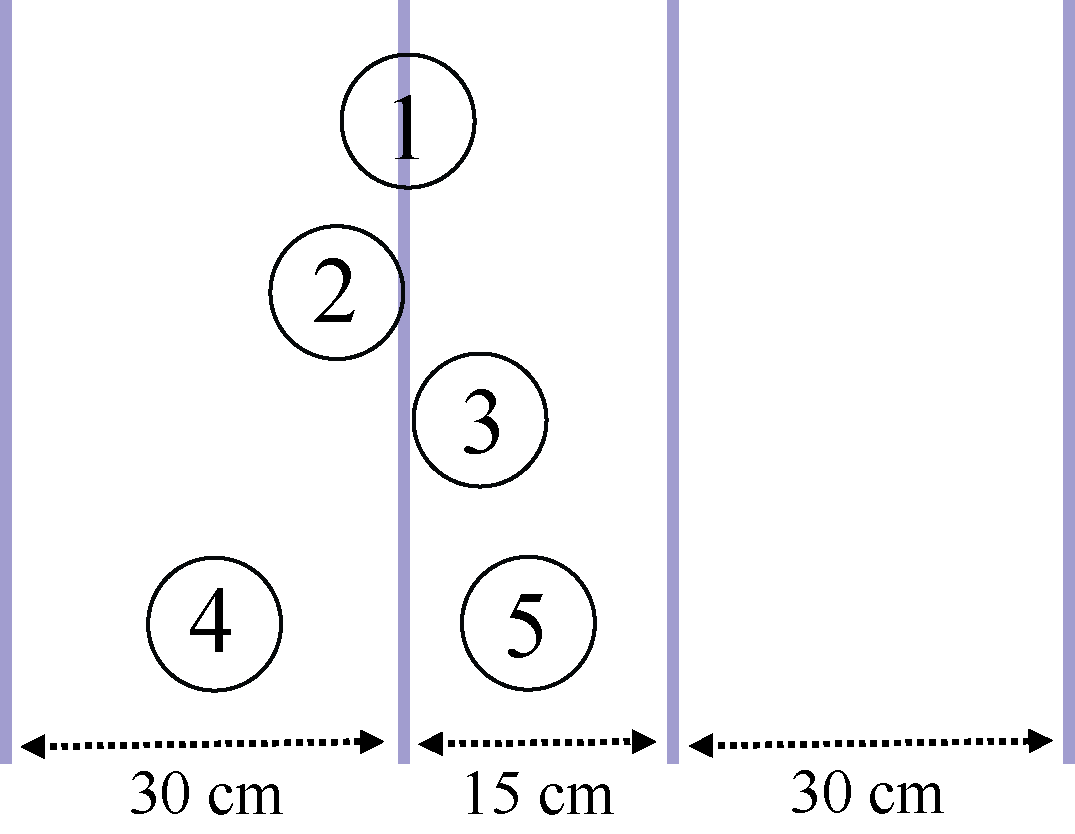
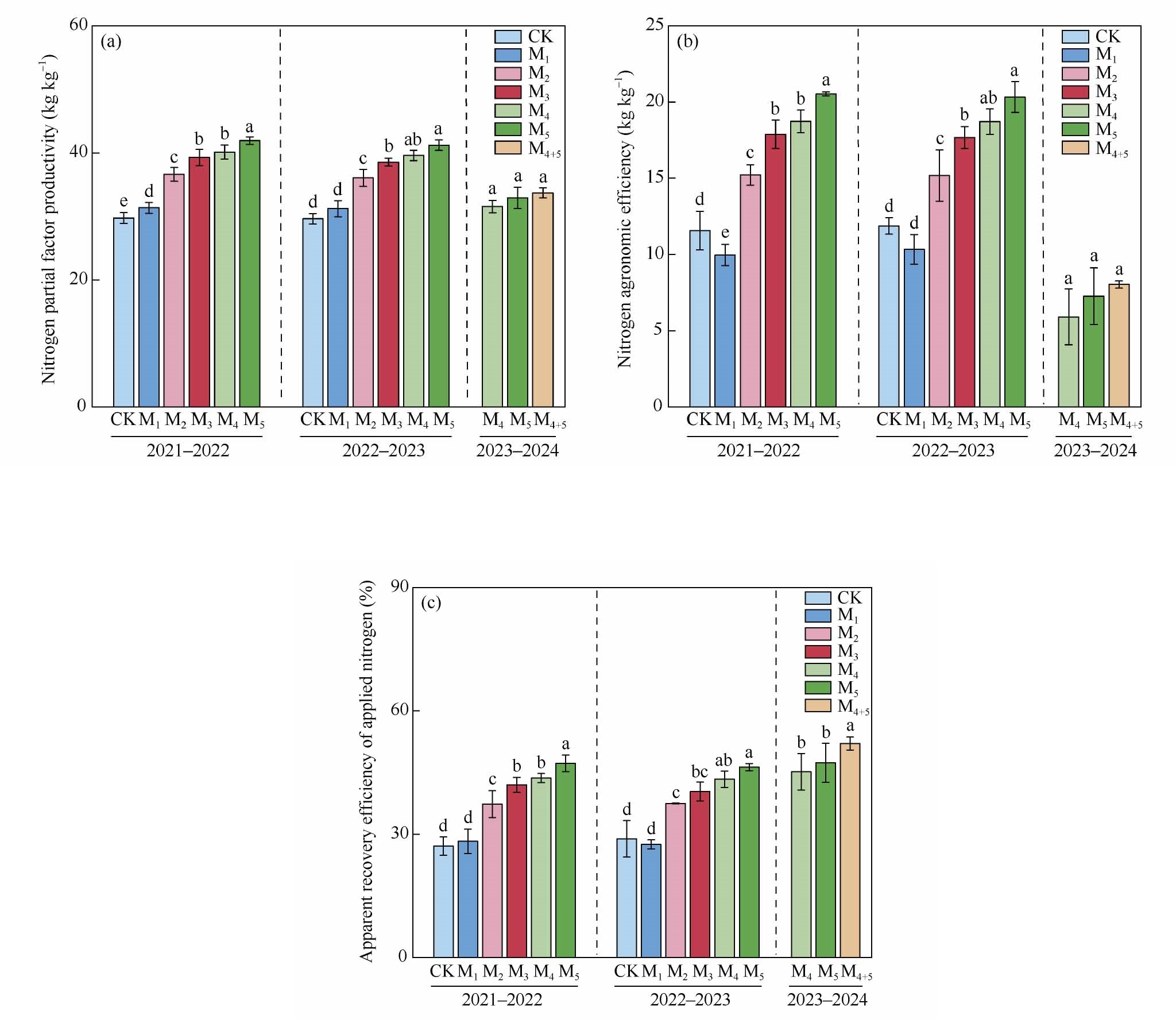
摘要: 为探究稻茬小麦深施肥“一基一追”机艺融合技术的增产增效减排机制, 2021—2024年在长江下游南通稻茬麦区开展大田试验。试验采用缓释掺混肥料(SRF, N∶P2O5∶K2O=26∶12∶12)和普通尿素(U, 46%N), 结合自主研发的2BFGK-12(6)260全秸秆茬地洁区旋耕智能施肥播种机和3ZF-4(200)中耕追肥机, 设置7种施肥模式(30 cm+15 cm宽窄行种植): 以尿素4次分施(N 240 kg hm-2, 基肥∶分蘖肥∶拔节肥∶孕穗肥=5∶1∶2∶2, 窄行基施, 追肥全田撒施)为对照(CK); 减氮15% (N 204 kg hm-2)条件下设置6种处理: M1 (100%SRF窄行基施); M2 (60% SRF窄行基施+40% U拔节期窄行撒施); M3 (60% SRF窄行基施+40%U返青期宽行条施); M4 (60% SRF窄行基施+40% SRF返青期窄行撒施); M5 (60% SRF窄行基施+40% SRF返青期宽行条施); M4+5 (60% SRF窄行基施+20% SRF返青期宽行条施+20% SRF返青期窄行撒施)。研究比较不同施肥模式对小麦产量效益、根系形态生理、氮素利用效率及N2O排放的影响。结果表明, 与CK相比, M2~M5处理提高了小麦产量(4.0%~19.0%)和经济效益(13.7%~35.7%), 其中M4和M5处理表现最优, 分别增产14.1%和19.0%, 经济效益提升34.5%和35.7%。这些处理明显改善了根系特性(根干重密度增加9.7%~111.8%, 根系活力和氧化力分别提高6.8%~52.0%和4.2%~44.2%), 降低N2O累积排放量22.6%~34.5%, 提高0~20 cm土层硝态氮含量11.2%~40.0%。在氮素利用方面, M2~M5处理均提高了籽粒氮素积累量、花后氮素积累量及其对籽粒氮素的贡献率, 氮肥利用效率指标(包括偏生产力、农学效率和表观利用率)分别显著提升了22.4%~40.0%、29.7%~74.3%和9.41~18.77个百分点。值得注意的是, M4和M5处理表现出最优的综合效益: N2O累积排放量降幅最大(分别达27.0%和34.5%), 氮肥表观利用率2季均维持在43.0%以上(均值分别为43.5%和46.8%), 同时在生育后期保持较高的根系活性和耕层无机氮含量。相比之下, M1处理虽然实现了最大的N2O减排效果(降幅35.9%), 但导致减产10.4%和经济效益下降10.8%, 且氮肥利用效率呈现不稳定的年际变化特征。而优化处理M4+5进一步改善了根系形态生理特性, 并提高氮肥表观利用率和籽粒氮素积累量。综上, 减氮15%条件下(N 204 kg hm-2), 缓混肥2次施用处理(M4和M5)能实现产量、经济效益、氮肥利用效率和N2O减排的协同提高, 并以追肥深施处理(M5)效应更强。本研究为稻茬小麦缓释肥减氮优化高效应用提供重要理论依据。
| [1] |
Ma Q, Qian Y S, Yu Q Q, et al. Controlled-release nitrogen fertilizer application mitigated N losses and modified microbial community while improving wheat yield and N use efficiency. Agric Ecosyst Environ, 2023, 349: 108445.
doi: 10.1016/j.agee.2023.108445 |
| [2] |
Duan J Z, Shao Y H, He L, et al. Optimizing nitrogen management to achieve high yield, high nitrogen efficiency and low nitrogen emission in winter wheat. Sci Total Environ, 2019, 697: 134088.
doi: 10.1016/j.scitotenv.2019.134088 |
| [3] |
Hodge A, Robinson D, Fitter A. Are microorganisms more effective than plants at competing for nitrogen? Trends Plant Sci, 2000, 5: 304-308.
doi: 10.1016/s1360-1385(00)01656-3 pmid: 10871903 |
| [4] | Selbie D R, Buckthought L E, Shepherd M A. Chapter four: the challenge of the urine patch for managing nitrogen in grazed pasture systems. Adv Agron, 2015, 129: 229-292. |
| [5] | 宁运旺, 张辉, 戴娟, 等. 江苏省小麦化肥投入现状与影响因素分析——以苏州市和盐城市为例. 江苏农业科学, 2019, 47(15): 269-273. |
| Ning Y W, Zhang H, Dai J, et al. Present situation and influencing factors of wheat fertilizer input in Jiangsu province: taking Suzhou city and Yancheng city as examples. Jiangsu Agric Sci, 2019, 47(15): 269-273 (in Chinese with English abstract). | |
| [6] |
Liu C R, Ren D Y, Liu H R, et al. Optimizing nitrogen management diminished reactive nitrogen loss and acquired optimal net ecosystem economic benefit in a wheat-maize rotation system. J Clean Prod, 2022, 331: 129964.
doi: 10.1016/j.jclepro.2021.129964 |
| [7] |
Ma Q, Wang M Y, Zheng G L, et al. Twice-split application of controlled-release nitrogen fertilizer met the nitrogen demand of winter wheat. Field Crops Res, 2021, 267: 108163.
doi: 10.1016/j.fcr.2021.108163 |
| [8] |
Ma Q, Tao R R, Jia W X, et al. Split application of polymer-coated urea combined with common urea improved nitrogen efficiency without sacrificing wheat yield and benefits while saving 20% nitrogen input. Front Plant Sci, 2024, 15: 1321900.
doi: 10.3389/fpls.2024.1321900 |
| [9] | 马泉. 稻茬小麦缓释氮肥两次分施调控产量形成和氮效率的形态生理机制. 扬州大学博士学位论文, 江苏扬州, 2023. |
| Ma Q. Morphological and Physiological Mechanism of Slow-Release Nitrogen Fertilizer Twice-split Application Regulating Yield Formation and Nitrogen Efficiency in Rice Stubble Wheat. PhD Dissertation of Yangzhou University, Yangzhou, Jiangsu, China, 2023 (in Chinese with English abstract). | |
| [10] |
Ma Q, Tao R R, Ding Y G, et al. Can split application of slow-release fertilizer improve wheat yield, nitrogen efficiency and their stability in different ecological regions? Agronomy, 2022, 12: 407.
doi: 10.3390/agronomy12020407 |
| [11] | 杜同庆, 徐鹏, 李振宏. 不同时期追施缓混肥料对稻茬麦生长特征及产量的影响. 耕作与栽培, 2023, 43(1): 60-63. |
| Du T Q, Xu P, Li Z H. Effects of topdressing slow-mixing fertilizer at different stages on growth characteristics and yield of wheat following rice. Tillage Cult, 2023, 43(1): 60-63 (in Chinese with English abstract). | |
| [12] | 盛海君, 马泉, 蒋昕, 等. 硫包衣缓释掺混肥料施用模式对江苏不同生态区稻茬小麦产量、氮效率与经济效益的影响. 中国土壤与肥料, 2022(10): 118-127. |
| Sheng H J, Ma Q, Jiang X, et al. Effects of sulfur coated blended fertilizer application patterns on yield, nitrogen efficiency and economic benefits of winter wheat following rice in different ecological regions of Jiangsu province. Soil Fert Sci China, 2022(10): 118-127 (in Chinese with English abstract). | |
| [13] | 马泉, 蒋文月, 张新钵, 等. 硫包膜缓释肥运筹方式对强筋小麦氮素积累转运、产量和品质的影响. 中国土壤与肥料, 2022(8): 148-157. |
| Ma Q, Jiang W Y, Zhang X B, et al. Effect of sulfur coated slow-released fertilizer managements on nitrogen accumulation and translocation, yield and quality of strong gluten wheat. Soil Fert Sci China, 2022(8): 148-157 (in Chinese with English abstract). | |
| [14] |
Li G H, Gu R, Xu K, et al. Split application of a mixture of controlled-release and common urea for improving quality and agronomic and economic performance in wheat production. Crop Sci, 2021, 61: 4402-4415.
doi: 10.1002/csc2.v61.6 |
| [15] | 马元喜. 小麦的根. 北京: 中国农业出版社, 1999. |
| Ma Y X. The Root System of Wheat. Beijing: China Agriculture Press, 1999 (in Chinese). | |
| [16] | 郝伯为, 赵玉娟. 返青期断根对冬小麦光合特性与产量的影响. 湖北农业科学, 2015, 54: 795-797. |
| Hao B W, Zhao Y J. Effects of reviving root-cutting on photosynthetic characteristics and yield of winter wheat. Hubei Agric Sci, 2015, 54: 795-797 (in Chinese with English abstract). | |
| [17] | 封涌涛, 路国艳, 胡昌录, 等. 返青期断根对秸秆覆盖冬小麦产量及叶片光合特性的影响. 麦类作物学报, 2021, 41: 738-744. |
| Feng Y T, Lu G Y, Hu C L, et al. Effect of spring root pruning on yield and flag leaf photosynthetic characteristics of winter wheat under straw mulching. J Triticeae Crops, 2021, 41: 738-744 (in Chinese with English abstract). | |
| [18] | 冯慧敏, 高娜娜, 孟志军, 等. 基于自动导航的小麦精准对行深施追肥机设计与试验. 农业机械学报, 2018, 49(4): 60-67. |
| Feng H M, Gao N N, Meng Z J, et al. Design and experiment of deep fertilizer applicator based on autonomous navigation for precise row-following. Trans CSAM, 2018, 49(4): 60-67 (in Chinese with English abstract). | |
| [19] | 孙晓然, 孙绿, 赵长星, 等. 追肥深度对旱地小麦花后旗叶衰老特性及产量的影响. 华北农学报, 2015, 30(增刊1): 420-424. |
|
Sun X R, Sun L, Zhao C X, et al. Effects of fertilization application depth on senescence characteristics of flag leaf after anthesis and yield of dry-land wheat. Acta Agric Boreali-Sin, 2015, 30(S1): 420-424 (in Chinese with English abstract).
doi: 10.7668/hbnxb.2015.S1.076 |
|
| [20] | 韩笑, 张晋, 石吕, 等. 稻秸行间集覆宽窄行播种技术下小麦经济效益和碳效率分析. 大麦与谷类科学, 2023, 40(2): 62-67. |
| Han X, Zhang J, Shi L, et al. Analysis of the economic benefits and carbon efficiency of wheat production using the technology of centralizing rice straw to cover wide rows and sowing in narrow rows. Barley Cereal Sci, 2023, 40(2): 62-67 (in Chinese with English abstract). | |
| [21] | 吕金岭, 高燕哺, 李太魁, 等. 施氮量对砂姜黑土小麦-玉米轮作体系N2O排放的影响. 中国生态农业学报(中英文), 2021, 29: 1846-1856. |
| Lyu J L, Gao Y B, Li T K, et al. Effect of nitrogen fertilizer amount on N2O emission from wheat-maize rotation system in lime concretion black soil. Chin J Eco-Agric, 2021, 29: 1846-1856 (in Chinese with English abstract). | |
| [22] |
Chen H, Zhou J, Li B, et al. Yield-scaled N2O emissions as affected by nitrification inhibitor and overdose fertilization under an intensively managed vegetable field: a three-year field study. Atmos Environ, 2019, 206: 247-257.
doi: 10.1016/j.atmosenv.2019.02.036 |
| [23] |
杜嘉琪, 张紫薇, 王若飞, 等. 有机肥替代化肥与丛枝菌根真菌互作对砂姜黑土和潮土N2O排放的影响. 中国农业科学, 2025, 58: 101-116.
doi: 10.3864/j.issn.0578-1752.2025.01.008 |
|
Du J Q, Zhang Z W, Wang R F, et al. The interactive effects of organic fertilizer substituting chemical fertilizers and arbuscular mycorrhizal fungi on soil nitrous oxide emission in Shajiang black soil and fluvo-aquic soil. Sci Agric Sin, 2025, 58: 101-116 (in Chinese with English abstract).
doi: 10.3864/j.issn.0578-1752.2025.01.008 |
|
| [24] | 李小方, 张志良. 植物生理学实验指导(第5版). 北京: 高等教育出版社, 2016. |
| Li X F, Zhang Z L. Experimental Guidance of Plant Physiology, 5th edn. Beijing: Higher Education Press, 2016 (in Chinese). | |
| [25] |
段文学, 于振文, 张永丽, 等. 施氮量对旱地小麦氮素吸收转运和土壤硝态氮含量的影响. 中国农业科学, 2012, 45: 3040-3048.
doi: 10.3864/j.issn.0578-1752.2012.15.004 |
| Duan W X, Yu Z W, Zhang Y L, et al. Effects of nitrogen fertilizer application rate on nitrogen absorption, translocation and nitrate nitrogen content in soil of dryland wheat. Sci Agric Sin, 2012, 45: 3040-3048 (in Chinese with English abstract). | |
| [26] |
丁锦峰, 徐东忆, 丁永刚, 等. 栽培模式对稻茬小麦籽粒产量、氮素吸收利用和群体质量的影响. 中国农业科学, 2023, 56: 619-634.
doi: 10.3864/j.issn.0578-1752.2023.04.003 |
|
Ding J F, Xu D Y, Ding Y G, et al. Effects of cultivation patterns on grain yield, nitrogen uptake and utilization, and population quality of wheat under rice-wheat rotation. Sci Agric Sin, 2023, 56: 619-634 (in Chinese with English abstract).
doi: 10.3864/j.issn.0578-1752.2023.04.003 |
|
| [27] |
谭德水, 刘兆辉. 一次性施肥技术实现三大粮食作物轻简化绿色生产. 中国农业科学, 2018, 51: 3823-3826.
doi: 10.3864/j.issn.0578-1752.2018.20.001 |
|
Tan D S, Liu Z H. One-off fertilization technology realized light-simplified and green production for the three major grain crops. Sci Agric Sin, 2018, 51: 3823-3826 (in Chinese with English abstract).
doi: 10.3864/j.issn.0578-1752.2018.20.001 |
|
| [28] | 王火焰, 周健民. 根区施肥——提高肥料养分利用率和减少面源污染的关键和必需措施. 土壤, 2013, 45: 785-790. |
| Wang H Y, Zhou J M. Root-zone Fertilization: a key and necessary approach to improve fertilizer use efficiency and reduce non-point source pollution from the cropland. Soils, 2013, 45: 785-790 (in Chinese with English abstract). | |
| [29] |
马泉, 王梦尧, 孙全, 等. 硫包膜尿素施用模式对稻茬冬小麦产量、氮肥利用率和效益的影响. 核农学报, 2021, 35: 942-952.
doi: 10.11869/j.issn.100-8551.2021.04.0942 |
|
Ma Q, Wang M Y, Sun Q, et al. Effects of application modes of sulfur coated urea on yield, nitrogen use efficiency and benefit of winter wheat following rice. J Nucl Agric Sci, 2021, 35: 942-952 (in Chinese with English abstract).
doi: 10.11869/j.issn.100-8551.2021.04.0942 |
|
| [30] | 董庆玲, 娄焕昌, 张慧, 等. 普通和控释尿素配合深施提高冬小麦花期旗叶光合性能与氮素利用效率. 植物营养与肥料学报, 2019, 25: 1134-1145. |
| Dong Q L, Lou H C, Zhang H, et al. Improving photosynthetic efficiency of flag leaves at anthesis stage and nitrogen utilization of winter wheat by deep placement of common and control- released urea mixture. J Plant Nutr Fert, 2019, 25: 1134-1145 (in Chinese with English abstract). | |
| [31] | 肖治林, 王琛, 张瑛, 等. 控释氮肥施用策略对稻茬小麦产量和氮肥吸收利用的影响. 麦类作物学报, 2024, 44: 472-484. |
| Xiao Z L, Wang C, Zhang Y, et al. Effect of controlled-released nitrogen fertilizer application strategy on yield and nitrogen uptake and utilization of wheat following rice stubble. J Triticeae Crops, 2024, 44: 472-484 (in Chinese with English abstract). | |
| [32] | 王应君, 王淑珍, 郑义. 肥料深施对小麦生育性状、养分吸收及产量的影响. 中国农学通报, 2006, 22(9): 276-280. |
| Wang Y J, Wang S Z, Zheng Y. Effects of deep application of fertilizer on growth character, absorption of nutrition and yield in wheat. Chin Agric Sci Bull, 2006, 22(9): 276-280 (in Chinese with English abstract). | |
| [33] | 高凤菊, 吕金岭. 尿素追肥深施对小麦产量及氮肥利用率的影响. 耕作与栽培, 2006(1): 28. |
| Gao F J, Lyu J L. Effects of deep application of urea as topdressing on wheat yield and nitrogen use efficiency. Tillage Cult, 2006(1): 28 (in Chinese with English abstract). | |
| [34] |
田中伟, 樊永惠, 殷美, 等. 长江中下游小麦品种根系改良特征及其与产量的关系. 作物学报, 2015, 41: 613-622.
doi: 10.3724/SP.J.1006.2015.00613 |
|
Tian Z W, Fan Y H, Yin M, et al. Genetic improvement of root growth and its relationship with grain yield of wheat cultivars in the middle-lower Yangtze River. Acta Agron Sin, 2015, 41: 613-622 (in Chinese with English abstract).
doi: 10.3724/SP.J.1006.2015.00613 |
|
| [35] | 杨兰芳, 蔡祖聪. 施氮和玉米生长对土壤氧化亚氮排放的影响. 应用生态学报, 2005, 16: 100-104. |
| Yang L F, Cai Z C. Effects of N application and maize growth on N2O emission from soil. Chin J Appl Ecol, 2005, 16: 100-104 (in Chinese with English abstract). | |
| [36] | 马二登, 马静, 徐华, 等. 稻秆还田方式对麦田N2O排放的影响. 土壤, 2007, 39: 870-873. |
| Ma E D, Ma J, Xu H, et al. Effects of rice straw returning methods on N2O emissions from wheat-growing season. Soils, 2007, 39: 870-873 (in Chinese with English abstract). | |
| [37] |
Wu P, Wu Q, Huang H, et al. Global meta-analysis and three-year field experiment shows that deep placement of fertilizer can enhance crop productivity and decrease gaseous nitrogen losses. Field Crops Res, 2024, 307: 109263.
doi: 10.1016/j.fcr.2024.109263 |
| [38] | 徐钰, 刘兆辉, 朱国梁, 等. 不同农业管理措施对华北地区麦田温室气体排放的影响. 中国土壤与肥料, 2016(2): 7-13. |
| Xu Y, Liu Z H, Zhu G L, et al. Effects of greenhouse gas emission under different agricultural management practices in wheat field in the North China Plain. Soil Fert Sci China, 2016(2): 7-13 (in Chinese with English abstract). | |
| [39] | 侯朋福, 薛利祥, 袁文胜, 等. 缓控释肥深施对黏性土壤麦田氮素去向的影响. 环境科学, 2023, 44: 473-481. |
| Hou P F, Xue L X, Yuan W S, et al. Effect of deep fertilization with slow/controlled release fertilizer on N fate in clayey soil wheat field. Environ Sci, 2023, 44: 473-481 (in Chinese with English abstract). | |
| [40] | 卞文新, 马晓晓, 孙东旭, 等. 包膜氮肥一次性减量施用对冬小麦产量和氮素利用的影响. 植物营养与肥料学报, 2022, 28: 1840-1851. |
| Bian W X, Ma X X, Sun D X, et al. Effects of coated nitrogen fertilizer under one-time reduced application on yield and nitrogen use efficiency of winter wheat. J Plant Nutr Fert, 2022, 28: 1840-1851 (in Chinese with English abstract). | |
| [41] | Shakoor A, Xu Y L, Wang Q, et al. Effects of fertilizer application schemes and soil environmental factors on nitrous oxide emission fluxes in a rice-wheat cropping system, East China. PLoS One, 2018, 13: e0202016. |
| [42] |
Ju X T, Liu X J, Pan J R, et al. Fate of 15N-labeled urea under a winter wheat-summer maize rotation on the North China Plain. Pedosphere, 2007, 17: 52-61.
doi: 10.1016/S1002-0160(07)60007-1 |
| [43] |
Wu H J, Macdonald G K, Galloway J N, et al. The influence of crop and chemical fertilizer combinations on greenhouse gas emissions: a partial life-cycle assessment of fertilizer production and use in China. Resour Conserv Recycl, 2021, 168: 105303.
doi: 10.1016/j.resconrec.2020.105303 |
| [44] | 张传红, 韩露, 谢佳男, 等. 江苏省主要农作物碳足迹动态及其构成研究. 南京信息工程大学学报(自然科学版), 2022, 14: 110-119. |
| Zhang C H, Han L, Xie J N, et al. Carbon footprint dynamics and composition assessment of major crops production in Jiangsu province. J Nanjing Univ Inf Sci Technol (Nat Sci Edn), 2022, 14: 110-119 (in Chinese with English abstract). | |
| [45] | 王兴来, 赵玉蝶, 苗淑杰, 等. 基于生命周期的江苏省稻麦周年轮作碳足迹的南北差异分析. 生态与农村环境学报, 网络首发[2025-02-20], https://doi.org/10.19741/j.issn.1673-4831.2024.0908. |
| Wang X L, Zhao Y D, Miao S J, et al. Analysis of north-south differences in the carbon footprint of rice-wheat annual rotation in Jiangsu Province based on life cycle assessment. J Ecol Rural Environ, Published online [2025-02-20], https://doi.org/10.19741/j.issn.1673-4831.2024.0908 (in Chinese with English abstract). | |
| [46] |
Ma Y Z, Qiao Y F, Tang Y J, et al. Estimation of N2O and CH4 emissions in field study and DNDC model under optimal nitrogen level in rice-wheat rotation system. Sci Total Environ, 2025, 974: 179168.
doi: 10.1016/j.scitotenv.2025.179168 |
| [47] |
李欣欣, 石祖梁, 王久臣, 等. 稻茬冬小麦氮肥吸收、残留和损失特性. 应用生态学报, 2020, 31: 3691-3699.
doi: 10.13287/j.1001-9332.202011.021 |
| Li X X, Shi Z L, Wang J C, et al. Characteristics of uptake, residual and loss of nitrogen fertilizer in winter wheat after rice stubble. Chin J Appl Ecol, 2020, 31: 3691-3699 (in Chinese with English abstract). | |
| [48] |
Zhang Y J, Ren W C, Zhu K Y, et al. Substituting readily available nitrogen fertilizer with controlled-release nitrogen fertilizer improves crop yield and nitrogen uptake while mitigating environmental risks: a global meta-analysis. Field Crops Res, 2024, 306: 109221.
doi: 10.1016/j.fcr.2023.109221 |
| [49] | 冯爱青, 张民, 李成亮, 等. 控释氮肥对土壤酶活性与土壤养分利用的影响. 水土保持学报, 2014, 28(3): 177-184. |
| Feng A Q, Zhang M, Li C L, et al. Effects of controlled release nitrogen fertilizer on soil enzyme activities and soil nutrient utilization. J Soil Water Conserv, 2014, 28(3): 177-184 (in Chinese with English abstract). |
| [1] | 胡川, 赵凯男, 黄修利, 吴金芝, 任开明, 王贺正, 付国占, 黄明, 李友军. 一次灌溉下耕作方式和氮肥用量对旱地小麦产量和品质的影响[J]. 作物学报, 2026, 52(6): 1830-1846. |
| [2] | 马胜乾, 王志平, 陈浩天, 窦淑贤, 张燕, 邓艾兴, 张卫建, 原向阳, 宋振伟. 秸秆还田下耕作方式与氮肥施用量对东北玉米产量及土壤团聚体的影响[J]. 作物学报, 2026, 52(6): 1802-1816. |
| [3] | 张思思, 赵向辉, 周洋, 姚云凤, 朱荣昱, 董元杰, 胡国庆, 徐通, 刘兆新. 冬闲期翻耕和绿肥还田对连作花生田土壤理化性质和产量的影响[J]. 作物学报, 2026, 52(5): 1472-1486. |
| [4] | 张宁宁, 滕雨菲, 任娜娜, 魏兴卓, 闫书豪, 樊可心, 王永宏, 陈文康, 张兴华, 朱万超, 徐淑兔, 薛吉全. 201份玉米自交系抗旱表型评价及可塑性分析[J]. 作物学报, 2026, 52(5): 1309-1325. |
| [5] | 张振, 冯连杰, 石玉, 于振文, 张永丽. 节水补灌下不同穗型小麦产量形成差异研究[J]. 作物学报, 2026, 52(5): 1522-1535. |
| [6] | 闫安, 蒋昆炜, 王蓉圆, 田林, 张璐, 王韵, 徐建龙. 水稻剑叶小维管束数基因SVN7的鉴定与克隆[J]. 作物学报, 2026, 52(5): 1364-1372. |
| [7] | 刘昕萌, 任昊, 张继波, 张吉旺, 赵斌, 任佰朝, 刘鹏, 王洪章. 茉莉酸甲酯(MeJA)缓解高温影响玉米雌穗分化的生理机制[J]. 作物学报, 2026, 52(5): 1561-1572. |
| [8] | 王壮壮, 武紫君, 张永新, 张芯源, 袁丽雪, 陈如雪, 刘世举, 段剑钊, 冯伟, 王同朝, 王永华. 豫东南黏壤潮土区水氮优化协同提高冬小麦产量和氮素利用效率[J]. 作物学报, 2026, 52(5): 1501-1521. |
| [9] | 张鸿蓉, 王菲儿, 李盼, 仇海龙, 朱静, 赵连豪, 南运有, 何蔚, 樊志龙, 胡发龙, 柴强, 殷文. 减量20%灌水与25%有机肥替代化肥提高青贮玉米产量的光合特性[J]. 作物学报, 2026, 52(5): 1487-1500. |
| [10] | 王宇诚, 张露, 刘阿康, 黄见良, 彭少兵, 袁珅. 基于产量差的作物大面积单产提升策略与展望[J]. 作物学报, 2026, 52(5): 1279-1290. |
| [11] | 赵佳雪, 周龙昊, 郭岂源, 尚伦霄, 王涵, 刘志涛, 陈曦, 张晓佩, 宋宪亮, 毛丽丽. 长期秸秆还田与深松通过改善土壤环境与棉花光合特性提高滨海盐碱地棉花产量[J]. 作物学报, 2026, 52(5): 1548-1560. |
| [12] | 郭星宇, 胡丹, 林苏期, 王梦凯, 谭文峰, 黄传琴. 生物炭配施化肥提高玉米‖大豆下玉米产量和土壤生态系统多功能性[J]. 作物学报, 2026, 52(5): 1536-1547. |
| [13] | 蔡宏玮, 于爱忠, 姜科强, 王鹏飞, 王玉珑, 霍建喆, 庞小能, 尹波, 尚永盼. 干旱灌区有机肥替代部分化肥促进甜玉米产量提升的关键机制[J]. 作物学报, 2026, 52(4): 1166-1180. |
| [14] | 崔雪梅, 柳妍娣, 刘景辉, 米俊珍, 武俊英, 赵宝平. 不同基因型燕麦强弱势粒生理特性与产量关系研究[J]. 作物学报, 2026, 52(4): 1220-1235. |
| [15] | 杨锐, 陈敬东, 黄郢, 张学昆, 周登文, 刘清云, 徐劲松, 谢伶俐, 许本波. 长江下游冬油菜区应对气候变化的育种和栽培策略研究[J]. 作物学报, 2026, 52(4): 1153-1165. |
|
||