欢迎访问作物学报,今天是
作物学报 ›› 2019, Vol. 45 ›› Issue (10): 1586-1594.doi: 10.3724/SP.J.1006.2019.84177
薛晓梦1,李建国1,白冬梅2,晏立英1,万丽云1,康彦平1,淮东欣1,*( ),雷永1,廖伯寿1,*()
XUE Xiao-Meng1,LI Jian-Guo1,BAI Dong-Mei2,YAN Li-Ying1,WAN Li-Yun1,KANG Yan-Ping1,HUAI Dong-Xin1,*(),LEI Yong1,LIAO Bo-Shou1,*()
摘要:
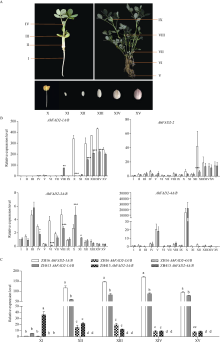
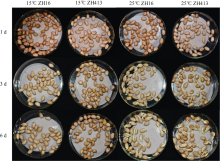
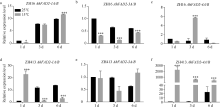
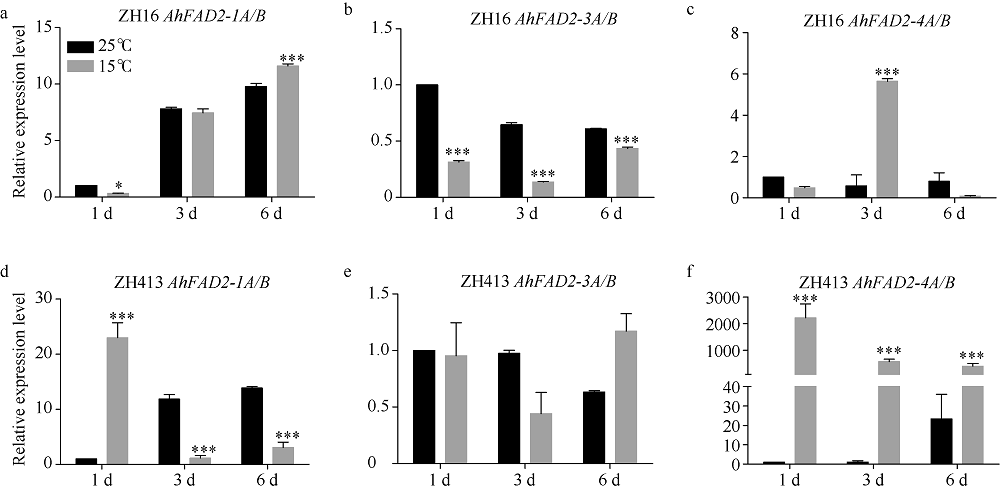
为了探究FAD2在花生低温响应中的作用, 本研究从普通油酸花生中花16 (ZH16)和高油酸花生中花413 (ZH413)中克隆得到花生AhFAD2家族的全部基因, 共7个。通过分析这些基因的表达模式发现, 在ZH16和ZH413中各FAD2基因表达模式相似, AhFAD2-1A/B主要在花和发育的种子中表达, AhFAD2-3A/B主要在营养组织中表达, AhFAD2-4A/B主要在根和花中表达, 表明AhFAD2基因在花生不同发育阶段和不同组织中发挥各自的生物学功能。在15℃下发芽6 d发现, ZH413的发芽率未显著下降, 而ZH16的发芽率显著下降。种子萌发过程中, AhFAD2-1A/B和AhFAD2-4A/B均受低温诱导表达。在ZH16中AhFAD2-1A/B在低温诱导第6天开始显著上调表达, 而在ZH413中第1天显著上调表达; 在ZH16中AhFAD2-4A/B在低温诱导第3天出现显著上调表达, 之后表达量下降, 但在ZH413中第1天就显著上调表达, 且始终维持在高水平表达。基于以上研究结果推测, 高油酸花生在受到低温胁迫时, AhFAD2-1A/B编码蛋白失活, 但AhFAD2-4A/B的高量表达在一定程度上弥补了这部分功能。同时也说明AhFAD2-1A/B功能的缺失并不是决定花生耐寒性的主要因素。本研究的开展为培育抗寒的高油酸花生品种奠定了理论基础, 为高油酸花生在高纬度、高海拔地区推广提供了理论支持。
| [1] | Chi X Y, Zhang Z M, Chen N, Zhang X W, Chen M G, Wang T, Pan L J, Chen J, Yang Z, Guan X Y, Yu S L . Isolation and characterization of fatty acid desaturase genes from peanut ( Arachis hypogaea L.). Plant Cell Rep, 2011,30:1393-1404. |
| [2] | 门爱军, 庞兴国, 胡东青, 陆福军, 李少骞 . 中国花生出口面临的困境及应对措施安徽农业科学, 2016,44:257-258. |
| Men A J, Pang X G, Hu D Q, Lu F J, Li S Q . Difficulties and countermeasures for China’s peanut export. J Anhui Agric Sci, 2016,44:257-258 (in Chinese without English abstract). | |
| [3] | 刘娟, 汤丰收, 张俊, 臧秀旺, 董文召, 易明林, 郝西 . 国内花生生产技术现状及发展趋势研究. 中国农学通报, 2017,33(22):13-18. |
| Liu J, Tang F S, Zhang J, Zang X W, Dong W Z, Yi M L, Hao X . Current status and development trends of peanut production technology in China. Chin Agric Sci Bull, 2017,33(22):13-18 (in Chinese with English abstract). | |
| [4] | Moore K M, Knauft D A . The inheritance of high oleic acid in peanut. Heredity, 1989,80:8-10. |
| [5] | 王传堂, 张建成, 唐月异, 于树涛, 王强, 刘峰, 李秋 . 中国高油酸花生育种现状与展望. 山东农业科学, 2018,50(6):171-176. |
| Wang C T, Zhang J C, Tang Y Y, Yu S T, Wang Q, Liu F, Li Q . Current situation and future directions of high oleic peanut breeding in China. Shandong Agric Sci, 2018,50(6):171-176 (in Chinese with English abstract). | |
| [6] | 迟晓元, 郝翠翠, 陈明娜, 潘丽娟, 陈娜, 王通, 王冕, 杨珍, 梁成伟, 禹山林 . 花生AhFAD2-1基因与油酸/亚油酸比值的关系. 花生学报, 2016,45(4):20-24. |
| Chi X Y, Hao C C, Chen M N, Pan L J, Chen N, Wang T, Wang M, Yang Z, Liang C W, Yu S L . Correlation between AhFAD2-1 and oleic acid/linoleic acid ratio in different peanut varieties. J Peanut Sci, 2016,45(4):20-24 (in Chinese with English abstract). | |
| [7] | Matos A R, Hourton-Cabassa C, Cicek D, Arrabaca J D, Zachowski A, Moreau F . Alternative oxidase involvement in cold stress response of Arabidopsis thaliana fad2 and fad3+ cell suspensions altered in membrane lipid composition. Plant Cell Physiol, 2007,48:856-865. |
| [8] | Miquel M, James D, Dooner H, Browse A J . Arabidopsis requires polyunsaturated lipids for low-temperature survival. Proc Natl Acad Sci USA, 1993,90:6208-6212. |
| [9] | Watanabe K, Oura T, Sakai H, Kajiwara S . Yeast Δ12 fatty acid desaturase: gene cloning, expression, and function. Biosci Biotechnol Biochem, 2004,68:721-727. |
| [10] | Kargiotidou A, Deli D, Galanopoulou D, Tsaftaris A, Farmaki T . Low temperature and light regulate delta 12 fatty acid desaturases (FAD2) at a transcriptional level in cotton ( Gossypium hirsutum). J Exp Bot, 2008,59:2043-2056. |
| [11] | 阮建, 单雷, 李新国, 郭峰, 孟静静, 万书波, 彭振英 . 花生FAD基因家族的全基因组鉴定与表达模式分析. 山东农业科学, 2018,50(6):1-9. |
| Ruan J, Shan L, Li X G, Guo F, Meng J J, Wan S B, Peng Z Y . Genome-wide identification and expression pattern analysis of peanut FAD gene family. Shandong Agric Sci, 2018,50(6):1-9 (in Chinese with English abstract). | |
| [12] | Singh S C, Sinha R P, HaÈder D P . Role of lipids and fatty acids in stress tolerance in cyanobacteria. Acta Protozoo, 2002,41:297-308. |
| [13] | 张建军, 闫世江, 王浩, 司龙亭, 马志国, 杨佳明 . 黄瓜种子脂肪酸含量与耐低温性关系的研究. 安徽农业科学, 2008,36:4859-4861. |
| Zhang J J, Yan S J, Wang H, Si L T, Ma Z G, Yang J M . Study on the relationship between the contents of fatty acids and low temperature tolerance in cucumber seeds. J Anhui Agric Sci, 2008,36:4859-4861 (in Chinese with English abstract). | |
| [14] | Ishizaki-nishizawa O, Fujii T, Ohtani T, Toguri T . Low- temperature resistance of higher plants is significantly enhanced by a nonspecific cyanobacterial desaturase. Nat Biotechnol, 1996,14:1003-1006. |
| [15] | 黄锐之, 刘智宏, 郎春秀, 胡张华, 陈锦清 . 植物中多不饱和脂肪酸生物合成的基因工程. 植物生理学通讯, 2001,37:547-550. |
| Huang R Z, Liu Z H, Lang C X, Hu Z H, Chen J Q . Genetic engineering of polyunsaturated fatty acid biosynthesis in plants. Plant Physiol Commun, 2001,37:547-550 (in Chinese with English abstract). | |
| [16] | 陈儒钢, 巩振辉, 逯明辉, 李大伟, 黄炜 . 植物抗寒基因工程研究进展. 西北植物学报, 2008,28:1274-1280. |
| Chen R G, Gong Z H, Lu M H, Li D W, Huang W . Research advance in the cold-resistance genetic engineering in plants. Acta Bot Boreali-Occident Sin, 2008,28:1274-1280 (in Chinese with English abstract). | |
| [17] | 王洪春 . 植物抗逆性与生物膜结构功能研究的进展. 植物生理学通讯, 1985, ( 1):60-66. |
| Wang H C . Advances in studies on plant stress resistance and biofilm structure. Plant Physiol Commun, 1985, ( 1):60-66 (in Chinese with English abstract). | |
| [18] | 杨玉珍, 罗青, 彭方仁 . 不同种源香椿叶片脂肪酸组分含量与抗寒性关系. 林业科技开发, 2011,25(5):21-25. |
| Yang Y Z, Luo Q, Peng F R . A relationship between cold resistance and content of fatty acid composition in leaves of Toona sinensis from different provenances. China For Sci Technol, 2011,25(5):22-25 (in Chinese with English abstract). | |
| [19] | 戴晓峰, 肖玲, 武玉花, 吴刚, 卢长明 . 植物脂肪酸去饱和酶及其编码基因研究进展. 植物学通报, 2007,24:105-113. |
| Dai X F, Xiao L, Wu Y H, Wu G, Lu C M . An overview of plant fatty acid desaturases and the coding genes. Chin Bull Bot, 2007,24:105-113 (in Chinese with English abstract). | |
| [20] | Yang Q, Fan C, Guo Z, Qin J, Wu J, Li Q, Fu T, Zhou Y . Identification of FAD2 and FAD3 genes in Brassica napus genome and development of allele-specific markers for high oleic and low linolenic acid contents. Theor Appl Genet, 2012,125:715-729. |
| [21] | Cao S J, Zhou X R, Wood C C, Green G A, Singh S P, Liu L X, Liu Q . A large and functionally diverse family of Fad2 genes in safflower( Carthamus tinctorius L.). BMC Plant Biol, 2013,13:5. doi: 10.1186/1471-2229-13-5. |
| [22] | 张照华, 王志慧, 淮东欣, 谭家壮, 陈剑洪, 晏立英, 王晓军, 万丽云, 陈傲, 康彦平, 姜慧芳, 雷永, 廖伯寿 . 利用回交和标记辅助选择快速培育高油酸花生品种及其评价. 中国农业科学, 2018,51:1641-1652. |
| Zhang Z H, Wang Z H, Huai D X, Tan J Z, Chen J H, Yan L Y, Wang X J, Wan L Y, Chen A, Kang Y P, Jiang H F, Lei Y, Liao B S . Fast development of high oleate peanut cultivars by using maker-assisted backcrossing and their evaluation. Sci Agric Sin, 2018,51:1641-1652 (in Chinese with English abstract). | |
| [23] | Jung S, Swift D, Sengoku E, Patel M, Teule F, Powell G, Moore K, Abbott A . The high oleate trait in the cultivated peanut ( Arachis hypogaea L.). Isolation and characterization of two genes encoding microsomal oleoyl-PC desaturases. Mol Gen Genet, 2000,263:796-805. |
| [24] | Wang Y, Zhang X G, Zhao Y L, Prakash C S, He G H, Yin D M. Insights into the novel members of the FAD2 gene family involved in high-oleate fluxes in peanut. NRC Res Press, 2015,58:1-9. |
| 周丽侠, 唐桂英, 陈高, 毕玉平, 单雷 . 花生AhFAD2基因的多态性及其与籽粒油酸/亚油酸比值间的相关性. 作物学报, 2011,37:415-423. | |
| Zhou L Y, Tang G Y, Chen G, Bi Y P, Shan L . Correlation between AhFAD2 polymorphism and oleic acid/linoleic acid ratio in peanut seeds. Acta Agron Sin, 2011,37:415-423 (in Chinese with English abstract). | |
| [25] | D’Angeli S, Falasca G, Matteucci M M, Altamura M M . Cold perception and gene expression differ in Olea europaea seed coat and embryo during drupe cold acclimation. New Phytol, 2013,197:123-138. |
| [26] | 唐桂英, 王芳, 徐平丽, 单雷 . 花生AhFAD2-2基因的克隆与表达分析. 山东农业科学, 2018,50(6):27-34. |
| Tang G Y, Wang F, Xu P L, Shan L . Cloning and expression analysis of AhFAD2-2 gene in peanut. Shandong Agric Sci, 2018,50(6):27-34 (in Chinese with English abstract). | |
| [27] | Heppard E P, Kinney A J, Stecca K L, Miao G H . Developmental and growth temperature regulation of two different microsomal ω-6 desaturase genes in soybeans. Plant Physiol, 1996,110:311-319. |
| [28] | Jung S, Powell G, Moore K, Abbott A . The high oleate trait in the cultivated peanut ( Arachis hypogaea L.): II. Molecular basis and genetics of the trait. Mol Gen Genet, 2000,263:806-811. |
| [29] | Okuley J, Lightner J, Feldmann K, Yadav N, Lark E, Browse J . Arabidopsis FAD2 gene encodes the enzyme that is essential for polyunsaturated lipid synthesis. Plant Cell, 1994,6:147-158. |
| [30] | 李金金, 张晶晶, 年洪娟 . Δ 12-脂肪酸去饱和酶FAD2的基本特性及其在胁迫中的功能 . 生命科学研究, 2013,17:174-178. |
| Li J J, Zhang J J, Nian H J . Characteristics of Δ 12-fatty acid desaturase FAD2 and its functions under stress. Life Sci Res, 2013,17:174-178 (in Chinese with English abstract). | |
| [31] | 年洪娟, 陈丽梅 . 不饱和脂肪酸在逆境胁迫中的作用. 中国微生态学杂志, 2012,24:760-762. |
| Nian H J, Chen L M . The role of unsaturated fatty acid in various environmental stresses. Chin J Microecol, 2012,24:760-762 (in Chinese with English abstract). | |
| [32] | Orvar B L, Sangwan V, Omann F, Dhindsa R S . Early steps in cold sensing by plant cells: the role of actin cytoskeleton and membrane fluidity. Plant J, 2000,23:785-794. |
| [1] | 左同鸿, 张贺翠, 曾静, 朱利泉. 甘蓝自交不亲和相关基因BoPUB3L的克隆与表达分析[J]. 作物学报, 2026, 52(6): 1698-1710. |
| [2] | 金昱何, 王雪菲, 徐张一娃, 缪怡宁, 蒋云杰, 伊莹, 缪德麟, 朱静仪, 钟一帆, 陈铭亨, 方芳, 刘鹏. 外源激素对低温胁迫下大豆叶片叶绿素荧光参数及抗氧化酶系统的影响[J]. 作物学报, 2026, 52(6): 1817-1829. |
| [3] | 徐苗苗, 邸太妹, 王洁, 吴叶蝶, 刘恩贝, 王玉春, 王新超, 王璐. 外源槲皮素增强茶树抗寒性的分子机制[J]. 作物学报, 2026, 52(5): 1418-1429. |
| [4] | 余开航, 周洪斌, 罗亮扎, 王玫郦, 姜瑞梅, 董陈文华, 李仕金, 毛孝强, 陈升位. 大麦亮氨酸富集重复型类受体激酶基因HvLRR-RLK-510的克隆和表达分析[J]. 作物学报, 2026, 52(2): 421-432. |
| [5] | 詹戈锐, 余文, 李锋, 武明珠, 徐馨, 罗朝鹏, 巫升鑫, 杨军, 张智强, 王中. 烟草NtWRKY6基因响应ABA表达及其调控多酚合成的功能研究[J]. 作物学报, 2026, 52(2): 446-458. |
| [6] | 景秀清, 蔡永朵, 邓宁, 赵晓东, 翟飞红, 曾群. 藜麦RopGEF家族基因的鉴定及表达模式分析[J]. 作物学报, 2026, 52(1): 28-43. |
| [7] | 马娟娥, 姚有华, 姚晓华, 吴昆仑, 崔永梅. 青稞HvERF039基因的克隆及功能研究[J]. 作物学报, 2025, 51(9): 2341-2357. |
| [8] | 薛晓菲, 戴云静, 李熙林, 丁艳艳, 王翔, 雷长英, 韩焕勇, 贺道华. 陆地棉杜松烯合酶基因GhCDN10的特征及其在棉酚合成中功能分析[J]. 作物学报, 2025, 51(8): 2060-2076. |
| [9] | 王林, 陈晓雨, 张文梦龙, 汪思琦, 程冰云, 程靖秋, 潘锐, 张文英. 大麦HvMYB2分子特性及响应干旱胁迫的功能分析[J]. 作物学报, 2025, 51(4): 873-887. |
| [10] | 侯天钰, 杜孝敬, 赵志强, 热依木·艾尼瓦尔, 伊达耶图拉·阿不拉, 布哈丽且木·阿不力孜, 袁杰, 张燕红, 王奉斌. 粳稻品种芽期耐冷性评价及耐冷种质筛选[J]. 作物学报, 2025, 51(3): 812-822. |
| [11] | 张恒, 冯雅岚, 田文仲, 郭彬彬, 张均, 马超. 小麦TaSnRK基因家族鉴定及在局部根区干旱下的表达分析[J]. 作物学报, 2025, 51(3): 632-649. |
| [12] | 张正康, 苏延红, 阮孙美, 张敏, 张攀, 张慧, 曾千春, 罗琼. 疣粒野生稻中OgXa13的克隆和功能研究[J]. 作物学报, 2025, 51(2): 334-346. |
| [13] | 王玉娇, 王永乐, 添长久, 郁春旺, 吕佳斌, 朱加保. 薏苡VQ4基因的克隆及耐盐性初步分析[J]. 作物学报, 2025, 51(12): 3198-3210. |
| [14] | 艾力, 李梦桃, 卢发宝, 刘晓晨, 麦伟涛, 周新成, 陈新. MeERF6-MePAP2模块响应低温胁迫的分子机制研究[J]. 作物学报, 2025, 51(11): 2971-2982. |
| [15] | 肖明昆, 严炜, 宋记明, 张林辉, 刘倩, 段春芳, 李月仙, 姜太玲, 沈绍斌, 周迎春, 沈正松, 熊贤坤, 罗鑫, 白丽娜, 刘光华. 卷叶木薯及其突变体叶片的比较转录组分析[J]. 作物学报, 2024, 50(8): 2143-2156. |
|
||