欢迎访问作物学报,今天是
作物学报 ›› 2020, Vol. 46 ›› Issue (12): 1945-1957.doi: 10.3724/SP.J.1006.2020.03019
刘志辉1( ), 潘高峰2, 陈文1, 秦明广1, 曹凑贵1, 常昌龙3, 展茗1,*()
Zhi-Hui LIU1(), Gao-Feng PAN2, Wen CHEN1, Ming-Guang QIN1, Cou-Gui CAO1, Chang-Long CHANG3, Ming ZHAN1,*()
摘要:
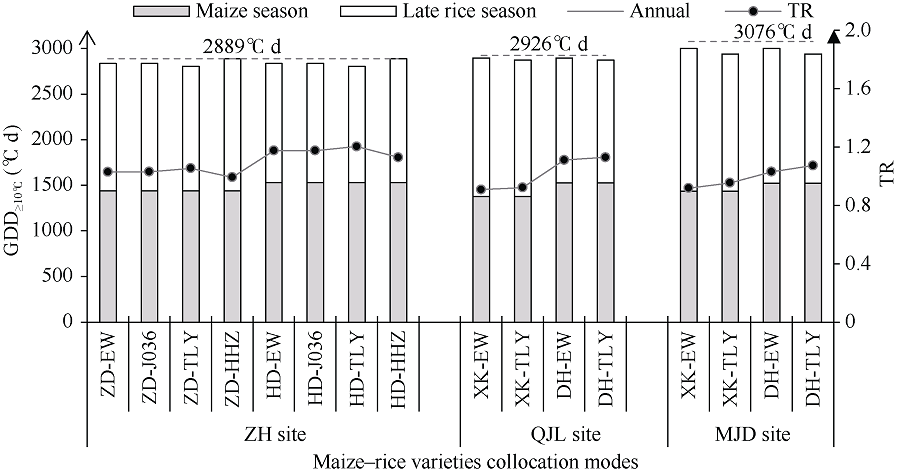
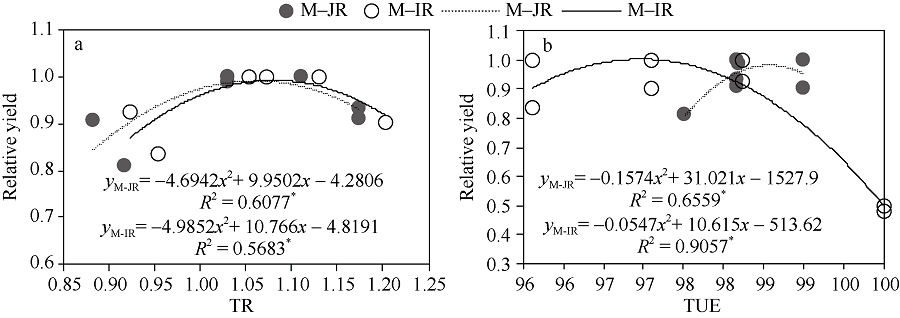
玉米-晚稻复种(M-R)能协同口粮与饲料用量生产, 近年来开始在长江中游地区发展, 其周年丰产高效技术还有待系统研究与完善, 而合理的前后季品种搭配是发挥玉-稻产量潜力的重要基础。因此, 本研究选取不同的玉米与晚稻品种, 于2015年与2017年在湖北省不同区域观测了不同品种搭配模式产量表现与资源利用效率。结果表明, 不同热量条件下品种搭配模式对M-R周年产量与资源生产效率影响显著。积温较多时以中熟玉米搭配晚籼稻品种周年产量与光、热、水资源效率具有明显优势; 反之则以早熟玉米品种搭配晚籼稻产量与资源生产效率较高。各品种搭配模式对周年有效积温(GDD≥10°C)的利用率可达95.6%~100.0%, 且前后季积温分配比值(TR)与M-R周年相对产量呈显著的非线性关系; 当GDD≥10°C利用率为97.0%~98.5%且TR为1.06~1.08时, M-R可获得较高的周年产量。因此, 可依据当地的热量资源条件及合理TR比值, 进行玉米、晚稻品种选择搭配。据此, 湖北省南部积温较高的区域宜选择生育期125 d以内的高产玉米品种与全生育期140 d以内的晚稻品种进行搭配; 而在积温相对偏少的中北部区域, 宜选择生育期120 d以内的高产玉米品种与全生育期130 d以内的晚稻品种进行搭配。
| [1] | 陈阜, 梁志杰, 陈述泉 . 多熟制的发展前景. 世界农业, 1997, ( 6):18-20. |
| Chen F, Liang Z J, Chen S Q . The development prospects of multi-mature. World Agric, 1997, ( 6):18-20 (in Chinese). | |
| [2] | 徐琪, 杨琳章, 董元华 . 中国稻田生态系统. 北京: 中国农业出版社, 1998. pp 172-190. |
| Xu Q, Yang L Z, Dong Y H. Rice Field Ecosystem in China. Beijing: China Agriculture Press, 1998. pp 172-190(in Chinese). | |
| [3] | 杨滨娟, 孙丹平, 张颖睿, 黄国勤 . 长江中游地区水旱复种轮作模式资源利用率比较研究. 中国生态农业学报, 2018,26:1197-1205. |
| Yang B J, Sun D P, Zhang Y R, Huang G Q . Comparison of resources use efficiencies among paddy-upland multi-crop rotation systems in the middle reaches of Yangtze River. Acta Eco-Agric Sin, 2018,26:1197-1205 (in Chinese with English abstract). | |
| [4] | 刘闯, 陈防, 刘毅, 李志国, 张过师, 谢娟 . 3种水旱两熟轮作制养分运筹研究进展. 中国农学通报, 2016,32(36):198-204. |
| Liu C, Chen F, Liu Y, Li Z G, Zhang G S, Xie J . Research progress of nutrient management in three paddy-upland rotating systems. Agric Sci Bull Sin, 2016,32(36):198-204 (in Chinese with English abstract). | |
| [5] | 侯方舟, 屠乃美, 何康, 王靖渊, 付小红, 杨旭初, 张清壮 . 南方双季稻区冬种绿肥对土壤质量的影响研究进展. 作物研究, 2015,29:682-686. |
| Hou F Z, Tu N M, He K, Wang J Y, Fu X H, Yang X C, Zhang Q Z . Research progress in the effect of winter planting-green manure on double cropping rice system of south. Crop Res Sin, 2015,29:682-686 (in Chinese with English abstract). | |
| [6] | 孙艳妮, 程林, 李昌新 . 我国粮食安全的区域性和结构性差异. 江苏农业科学, 2010, ( 5):524-526. |
| Sun Y N, Cheng L, Li C X . Regional and structural differences of food security in China. Jiangsu Agric Sci, 2010, ( 5):524-526 (in Chinese). | |
| [7] | 展茗, 赵明, 刘永忠, 徐尚忠 . 湖北省玉米产需矛盾及提升玉米生产科技水平对策. 湖北农业科学, 2010,49:802-806. |
| Zhan M, Zhao M, Liu Y Z, Xu S Z . Enhance maize production technology, alleviate the contradiction between production and demand of maize in Hubei province. Hubei Agric Sci, 2010,49:802-806 (in Chinese with English abstract). | |
| [8] | 袁建华, 颜伟, 陈艳萍, 张跃中 . 南方丘陵生态区玉米生产现状及发展对策. 玉米科学, 2003, ( 专刊):29-31. |
| Yuan J H, Yan W, Chen Y P, Zhang Y Z . Production situation and development strategies of maize in southern hill ecological region. J Maize Sci, 2003, ( special):29-31 (in Chinese with English abstract) | |
| [9] |
李淑娅, 田少阳, 袁国印, 葛均筑, 徐莹, 王梦影, 曹凑贵, 翟中兵, 凌霄霞, 展茗, 赵明 . 长江中游不同玉稻种植模式产量及资源利用效率的比较研究. 作物学报, 2015,41:1537-1547.
doi: 10.3724/SP.J.1006.2015.01537 |
| Li S Y, Tian S Y, Yuan G Y, Ge J Z, Xu Y, Wang M Y, Cao C G, Zhai Z B, Ling X X, Zhan M, Zhao M . Comparison of yield and resource utilization efficiency among different maize and rice cropping systems in middle reaches of Yangtze River. Acta Agron Sin, 2015,41:1537-1547 (in Chinese with English abstract). | |
| [10] |
李小勇, 唐启源, 李迪秦, 李维科, 李海林, 蔡庆红 . 不同种植密度对超高产稻田春玉米产量性状及光合生理特性的影响. 华北农学报, 2011,26(5):174-180.
doi: 10.7668/hbnxb.2011.05.035 |
| Li X Y, Tang Q Y, Li D Q, Li W K, Li H L, Cai Q H . Effects of different plant densities on the photosynthetic-physiological characters and yield traits in spring maize grown on super-high yielding paddy field. Acta Agric Boreali-Sin, 2011,26(5):174-180 (in Chinese with English abstract). | |
| [11] | Ali M Y, Waddington S R, Timsina J, Hodson D, Dixon J . Maize-rice cropping systems in Bangladesh: status and research needs. J Agric Sci Technol, 2009,3:35-53. |
| [12] | 赵强基, 郑建初, 袁从, 卞新民, 李萍萍, 章熙谷 . 中国南方稻区玉米-稻种植模式的建立和实践. 江苏农业学报, 1997,13:215-219. |
| Zhao Q J, Zheng J C, Yuan C, Bian X M, Li P P, Zhang X G . Establishment and practice on maize-rice cropping model in Paddy Area of southern China. Jiangsu J Agric Sci, 1997,13:215-219 (in Chinese with English abstract). | |
| [13] |
Timsina J, Jat M L, Majumdar K . Rice-maize systems of South Asia: current status, future prospects and research priorities for nutrient management. Plant Soil, 2010,335:65-82.
doi: 10.1007/s11104-010-0418-y |
| [14] |
Kadiyala M D M, Mylavarapu R S, Li Y C, Reddy G B, Reddy M D . Impact of aerobic rice cultivation on growth, yield, and water productivity of rice-maize rotation in semiarid tropics. Agron J, 2012,104:1757-1765.
doi: 10.2134/agronj2012.0148 |
| [15] | 李小勇 . 南方稻田春玉米-晚稻种植模式资源利用效率及生产力优势研究. 湖南农业大学博士学位论文, 湖南长沙, 2011. |
| Li X Y . Study on Resource Use Efficiency and Relative Advantage of Productivity in Spring Maize-Later Rice Planting Model on South China Paddy Field. PhD Dissertation of Hunan Agricultural University, Changsha, Hunan, China, 2011 (in Chinese with English abstract). | |
| [16] |
Sun M, Zhan M, Zhao M, Tang L L, Qin M G, Cao C G, Cai M L, Jiang Y, Liu Z H . Maize and rice double cropping benefits carbon footprint and soil carbon budget in paddy field. Field Crops Res, 2019, 243: 107620. https://doi.org/10.1016/j.fcr.2019.107620.
doi: 10.1016/j.fcr.2019.107620 |
| [17] | 姜振辉, 杨旭, 刘益珍, 林景东, 吴杨潇影, 杨京平 . 春玉米-晚稻与早稻-晚稻种植模式碳足迹比较. 生态学报, 2019,39:8091-8099. |
| Jiang Z H, Yang X, Liu Y Z, Lin J D, Wu Y X Y, Yang J P . Comparison of carbon footprint between spring maize-late rice and early rice-late rice cropping system. Acta Ecol Sin, 2019,39:8091-8099 (in Chinese with English abstract). | |
| [18] | Food and Agriculture Organization of the United Nations. Save and Grow in Practice: Maize, Rice, Wheat: a Guide to Sustainable Cereal Production.[ 2016-01-18]. http://www.fao.org/publi-cations/save-and-grow/maize-rice-wheat/en/. |
| [19] | 杨羡敏, 曾燕, 邱新法, 姜爱军 . 1960-2000年黄河流域太阳总辐射气候变化规律研究. 应用气象学报, 2005,16:243-247. |
| Yang X M, Zeng Y, Qiu X F, Jiang A J . The climatic change of solar radiation over the yellow river basin during 1961-2000. J Appl Meteorol, 2005,16:243-247 (in Chinese). | |
| [20] | 曲曼丽 . 农业气候实习指导. 北京: 北京农业大学出版社, 1990. pp 1-8. |
| Qu M L . Agro-climate Practice Instruction. Beijing: Beijing Agricultural University Publishers, 1990. pp 1-8(in Chinese with English abstract). | |
| [21] |
艾治勇, 郭夏宇, 刘文祥, 马国辉, 青先国 . 长江中游地区双季稻安全生产日期的变化. 作物学报, 2014,40:1320-1329.
doi: 10.3724/SP.J.1006.2014.01320 |
| Ai Z Y, Guo X Y, Liu W X, Ma G H, Qing X G . Changes of safe production dates of double-season rice in the middle reaches of the Yangtze River. Acta Agron Sin, 2014,40:1320-1329 (in Chinese with English abstract). | |
| [22] | 梁红梅 . 中国种植业优势区域及其耕地保护策略. 浙江大学博士学位论文, 浙江杭州, 2011. |
| Liang H M . Study on the Advantage Regions of Crop Farming in China and Their Arable Land Protection Tactics. PhD Dissertation of Zhejiang University, Hangzhou, Zhejiang, China, 2011 (in Chinese with English abstract). | |
| [23] | 武兰芳, 陈阜, 欧阳竹 . 种植制度演变与研究进展. 耕作与栽培, 2002, ( 3):1-5. |
| Wu L F, Chen F, Ou-Yang Z . Evolution and study progress of cropping system. Cult Plant, 2002, ( 3):1-5 (in Chinese). | |
| [24] | 刘建, 徐少安, 周根友, 沈锦根, 陆虎华 . 沿江稻区多熟制春玉米两段覆膜种植技术. 江苏农业学报, 2001,17:13-18. |
| Liu J, Xu S A, Zhou G Y, Shen J G, Lu H H . Cultivation techniques for multi-cropping spring maize with plastic film covered at two stages in paddy region along Yangtze River. Jiangsu J Agric Sci, 2001,17:13-18 (in Chinese with English abstract). | |
| [25] | 高亮之, 郭鹏, 张立中, 林武 . 中国水稻的光温资源与生产力. 中国农业科学, 1984,17:17-23. |
| Gao L Z, Guo P, Zhang L Z, Lin W . Light and resources and potential productive of rice in China. Sci Agric Sin, 1984,17:17-23 (in Chinese with English abstract). | |
| [26] |
吕伟生, 曾勇军, 石庆华, 潘晓华, 黄山, 商庆银, 谭雪明, 李木英, 胡水秀, 曾研华 . 近30年江西双季稻安全生产期及温光资源变化. 中国水稻科学, 2016,30:323-334.
doi: 10.16819/j.1001-7216.2016.5157 |
| Lyu W S, Zeng Y J, Shi Q H, Pan X H, Huang S, Shang Q Y, Tan X M, Li M Y, Hu S X, Zeng Y H . Changes in safe production dates and heat-light of resources of double cropping rice in Jiangxi province in recent 30 years. Chin J Rice Sci, 2016,30:323-334 (in Chinese with English abstract). | |
| [27] | 高亮之, 李林, 金之庆 . 中国水稻的气候资源与气候生态研究. 农业科技通讯, 1986, ( 4):5-8. |
| Gao L Z, Li L, Jin Z Q . Climatic resources and climatic ecology research of Chinese rice. Bull Agric Sci Technol, 1986, ( 4):5-8 (in Chinese with English abstract). | |
| [28] | 邱霞, 冯新 . 双季杂交晚稻直播栽培的不利气候分析. 湖北农业科学, 2013,52:4594-4596. |
| Qiu X, Feng X . Analysis of unfavorable climate condition to direct-seeding culture of double-cropping hybrid late rice. Hubei Agric Sci, 2013,52:4594-4596 (in Chinese with English abstract). | |
| [29] |
Xu C L, Zhao H X, Zhang P, Wang Y Y, Huang S B, Meng Q F, Wang P . Delaying wheat seeding time and maize harvest improved water use efficiency in a warm temperature continental monsoon climate. Agron J, 2018,110:1420-1429.
doi: 10.2134/agronj2017.10.0613 |
| [30] |
周宝元, 马玮, 孙雪芳, 高卓晗, 丁在松, 李从锋, 赵明 . 播/收期对冬小麦-夏玉米一年两熟模式周年气候资源分配与利用特征的影响. 中国农业科学, 2019,52:1501-1517.
doi: 10.3864/j.issn.0578-1752.2019.09.003 |
| Zhou B Y, Ma W, Sun X F, Gao Z H, Ding Z S, Li C F, Zhao M . Effects of different sowing and harvest dates of winter wheat-summer maize under double cropping system on the annual climate resource distribution and utilization. Sci Agric Sin, 2019,52:1501-1517 (in Chinese with English abstract). | |
| [31] |
周宝元, 马玮, 孙雪芳, 丁在松, 李从锋, 赵明 . 冬小麦-夏玉米高产模式周年气候资源分配与利用特征研究. 作物学报, 2019,45:589-600.
doi: 10.3724/SP.J.1006.2019.81067 |
| Zhou B Y, Ma W, Sun X F, Ding Z S, Li C F, Zhao M . Characteristics of annual climate resource distribution and utilization in high-yielding winter wheat-summer maize double cropping system. Acta Agron Sin, 2019,45:589-600 (in Chinese with English abstract). | |
| [32] |
Liu Y E, Xie R Z, Hou P, Li S K, Zhang H B, Ming B, Long H L, Liang S M . Phenological responses of maize to changes in environment when grown at different latitudes in China. Field Crops Res, 2013,144:192-199.
doi: 10.1016/j.fcr.2013.01.003 |
| [33] | 周宝元, 葛均筑, 侯海鹏, 孙雪芳, 丁在松, 李从锋, 马玮, 赵明 . 黄淮海平原南部不同种植体系周年气候资源分配与利用特征研究. 作物学报, 2020,46:937-949. |
| Zhou B Y, Ge J Z, Hou H P, Sun X F, Ding Z S, Li C F, Ma W, Zhao M . Characteristics of annual climate resource distribution and utilization for different cropping systems in the south of Yellow-Huaihe-Haihe Rivers plain. Acta Agron Sin, 2020,46:937-949 (in Chinese with English abstract). | |
| [34] | 杨晓光, 刘志娟, 陈阜 . 全球气候变暖对中国种植制度可能影响: VI. 未来气候变化对中国种植制度北界的可能影响. 中国农业科学, 2011,44:1562-1570. |
| Yang X G, Liu Z J, Chen F . The possible effects of global warming on cropping systems in China: VI. Possible effects of future climate change on northern limits of cropping system in China. Sci Agric Sin, 2011,44:1562-1570 (in Chinese with English abstract). |
| [1] | 胡川, 赵凯男, 黄修利, 吴金芝, 任开明, 王贺正, 付国占, 黄明, 李友军. 一次灌溉下耕作方式和氮肥用量对旱地小麦产量和品质的影响[J]. 作物学报, 2026, 52(6): 1830-1846. |
| [2] | 马胜乾, 王志平, 陈浩天, 窦淑贤, 张燕, 邓艾兴, 张卫建, 原向阳, 宋振伟. 秸秆还田下耕作方式与氮肥施用量对东北玉米产量及土壤团聚体的影响[J]. 作物学报, 2026, 52(6): 1802-1816. |
| [3] | 张思思, 赵向辉, 周洋, 姚云凤, 朱荣昱, 董元杰, 胡国庆, 徐通, 刘兆新. 冬闲期翻耕和绿肥还田对连作花生田土壤理化性质和产量的影响[J]. 作物学报, 2026, 52(5): 1472-1486. |
| [4] | 张宁宁, 滕雨菲, 任娜娜, 魏兴卓, 闫书豪, 樊可心, 王永宏, 陈文康, 张兴华, 朱万超, 徐淑兔, 薛吉全. 201份玉米自交系抗旱表型评价及可塑性分析[J]. 作物学报, 2026, 52(5): 1309-1325. |
| [5] | 王宇诚, 张露, 刘阿康, 黄见良, 彭少兵, 袁珅. 基于产量差的作物大面积单产提升策略与展望[J]. 作物学报, 2026, 52(5): 1279-1290. |
| [6] | 赵佳雪, 周龙昊, 郭岂源, 尚伦霄, 王涵, 刘志涛, 陈曦, 张晓佩, 宋宪亮, 毛丽丽. 长期秸秆还田与深松通过改善土壤环境与棉花光合特性提高滨海盐碱地棉花产量[J]. 作物学报, 2026, 52(5): 1548-1560. |
| [7] | 郭星宇, 胡丹, 林苏期, 王梦凯, 谭文峰, 黄传琴. 生物炭配施化肥提高玉米‖大豆下玉米产量和土壤生态系统多功能性[J]. 作物学报, 2026, 52(5): 1536-1547. |
| [8] | 张振, 冯连杰, 石玉, 于振文, 张永丽. 节水补灌下不同穗型小麦产量形成差异研究[J]. 作物学报, 2026, 52(5): 1522-1535. |
| [9] | 闫安, 蒋昆炜, 王蓉圆, 田林, 张璐, 王韵, 徐建龙. 水稻剑叶小维管束数基因SVN7的鉴定与克隆[J]. 作物学报, 2026, 52(5): 1364-1372. |
| [10] | 刘昕萌, 任昊, 张继波, 张吉旺, 赵斌, 任佰朝, 刘鹏, 王洪章. 茉莉酸甲酯(MeJA)缓解高温影响玉米雌穗分化的生理机制[J]. 作物学报, 2026, 52(5): 1561-1572. |
| [11] | 王壮壮, 武紫君, 张永新, 张芯源, 袁丽雪, 陈如雪, 刘世举, 段剑钊, 冯伟, 王同朝, 王永华. 豫东南黏壤潮土区水氮优化协同提高冬小麦产量和氮素利用效率[J]. 作物学报, 2026, 52(5): 1501-1521. |
| [12] | 张鸿蓉, 王菲儿, 李盼, 仇海龙, 朱静, 赵连豪, 南运有, 何蔚, 樊志龙, 胡发龙, 柴强, 殷文. 减量20%灌水与25%有机肥替代化肥提高青贮玉米产量的光合特性[J]. 作物学报, 2026, 52(5): 1487-1500. |
| [13] | 蔡宏玮, 于爱忠, 姜科强, 王鹏飞, 王玉珑, 霍建喆, 庞小能, 尹波, 尚永盼. 干旱灌区有机肥替代部分化肥促进甜玉米产量提升的关键机制[J]. 作物学报, 2026, 52(4): 1166-1180. |
| [14] | 崔雪梅, 柳妍娣, 刘景辉, 米俊珍, 武俊英, 赵宝平. 不同基因型燕麦强弱势粒生理特性与产量关系研究[J]. 作物学报, 2026, 52(4): 1220-1235. |
| [15] | 杨锐, 陈敬东, 黄郢, 张学昆, 周登文, 刘清云, 徐劲松, 谢伶俐, 许本波. 长江下游冬油菜区应对气候变化的育种和栽培策略研究[J]. 作物学报, 2026, 52(4): 1153-1165. |
|
||