欢迎访问作物学报,今天是
作物学报 ›› 2018, Vol. 44 ›› Issue (6): 844-851.doi: 10.3724/SP.J.1006.2018.00844
黄忠明1,周延彪2,3,*( ),唐晓丹3,赵新辉3,周在为3,符星学3,王凯4,史江伟3,李艳锋4,符辰建2,3,杨远柱1,2,3,4,*()
Zhong-Ming HUANG1,Yan-Biao ZHOU2,3,*(),Xiao-Dan TANG3,Xin-Hui ZHAO3,Zai-Wei ZHOU3,Xing-Xue FU3,Kai WANG4,Jiang-Wei SHI3,Yan-Feng LI4,Chen-Jian FU2,3,Yuan-Zhu YANG1,2,3,4,*()
摘要:
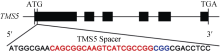
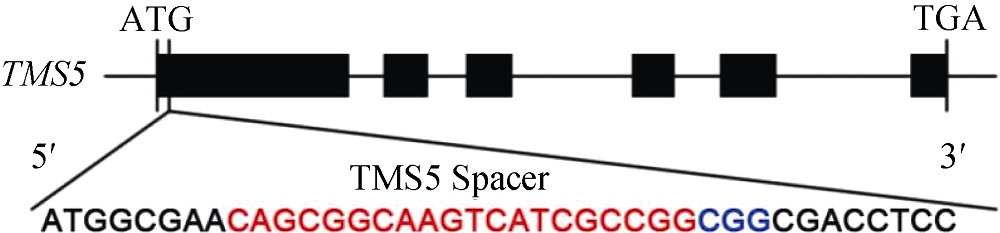
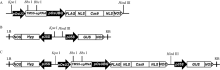
为创新优良温敏不育系, 促进两系杂交稻育种的发展, 我们以水稻温敏不育基因TMS5为编辑对象, 设计了由水稻U3启动子驱动、长20 bp的guide RNA (gRNA)靶点以靶向编辑 TMS5 基因的第1个外显子, 将靶点与表达载体pCAMBIA1301连接, 再用农杆菌介导法获得水稻转基因株系。提取T0代转基因株系的基因组DNA, 并对TMS5编辑位点附近的DNA片段进行PCR检测及测序分析。结果表明, T0代植株的突变率为63.89%, 其中纯合缺失突变率为34.78%。对T1代纯合缺失突变体的不育起点温度和农艺性状调查分析结果表明, 28℃是tms5突变体花粉育性的转换温度。大田试验结果表明, 与野生型相比, tms5突变体的结实率和单株重均显著降低。粳稻tms5突变体的获得为培育粳稻不育系奠定了材料基础。
| [1] | 周海, 周明, 杨远柱, 曹晓风, 庄楚雄 . RNase ZS1加工UbL40 mRNA控制水稻温敏雄性核不育. 遗传, 2014,36:1274 |
| Zhou H, Zhou M, Yang Y Z, Cao X F, Zhuang C X . RNase Z S1 processes UbL40 mRNAs and controls thermosensitive genic male sterility in rice . Hereditas( Beijing), 2014,36:1274 (in Chinese) | |
| [2] | 袁隆平 . 我国两系法杂交水稻研究的形势、任务和发展前景. 农业现代化研究, 1997,18(1):1-3 |
| Yuan L P . Current status and developing prospects in two-line hybrid rice research in China. Res Agric Modernization, 1997,18(1):1-3 (in Chinese with English abstract) | |
| [3] |
Zhou H, Zhou M, Yang Y Z, Li J, Zhu L Y, Jiang D G, Dong J F, Liu Q J, Gu L F, Zhou L Y, Feng M J, Qin P, Hu X C, Song C L, Shi J F, Song X W, Ni E D, Wu X J, Deng Q Y, Liu Z L, Chen M S, Liu Y G, Cao X F, Zhuang C X . RNase Z S1 processes UbL40 mRNAs and controls thermosensitive genic male sterility in rice. Nat Commun, 2014,5:4884
doi: 10.1038/ncomms5884 pmid: 25208476 |
| [4] |
Belhaj K, Chaparro-Garcia A, Kamoun S, Patron N J, Nekrasov V . Editing plant genomes with CRISPR/Cas9. Curr Opin Biotech, 2015,32:76-84
doi: 10.1016/j.copbio.2014.11.007 |
| [5] |
Baltes N J, Voytas D F . Enabling plant synthetic biology through genome engineering. Trends Biotechnol, 2015,33:120-131
doi: 10.1016/j.tibtech.2014.11.008 |
| [6] | 瞿礼嘉, 郭冬姝, 张金喆, 秦跟基 . CRISPR/Cas系统在植物基因组编辑中的应用. 生命科学, 2015, ( 1):64-70 |
| Qu L J, Guo D S, Zhang J Z, Qin G J . The application of CRISPR/Cas system in plant genome editing. Chin Bull Life Sci, 2015, ( 1):64-70 (in Chinese with English abstract) | |
| [7] |
Wiedenheft B, Sternberg S H, Doudna J A . RNA-guided genetic silencing systems in bacteria and archaea. Nature, 2012,482:331-338
doi: 10.1038/nature10886 |
| [8] |
Symington L S, Gautier J . Double-strand break end resection and repair pathway choice. Annu Rev Genet, 2011,45:247-271
doi: 10.1146/annurev-genet-110410-132435 |
| [9] |
Shan Q W, Wang Y P, Li J, Zhang Y, Chen K L, Liang Z, Zhang K, Liu J X , X J J, Qiu J L, Gao C X. Targeted genome modification of crop plants using a CRISPR-Cas system. Nat Biotechnol, 2013,31:686-688
doi: 10.1038/nbt.2650 pmid: 23929338 |
| [10] |
Feng Z Y, Zhang B T, Ding W N, Liu X D, Yang D L, Wei P L, Cao F Q, Zhu S H, Zhang F, Mao Y F, Zhu J K . Efficient genome editing in plants using a CRISPR/Cas system. Cell Res, 2013,23:1229-1232
doi: 10.1038/nbt.2501 pmid: 23360964 |
| [11] |
Li J, Meng X B, Zong Y, Chen K L, Zhang H W, Liu J X, Li J Y, Gao C X . Gene replacements and insertions in rice by intron targeting using CRISPR-Cas9. Nat Plants, 2016,2:16139
doi: 10.1038/nplants.2016.139 pmid: 27618611 |
| [12] |
Li J Y, Sun Y W, Du J L, Zhao Y D, Xia L Q . Generation of targeted point mutations in rice by a modified CRISPR/CAS9 system. Mol Plant, 2017,10:526-529
doi: 10.1016/j.molp.2016.12.001 pmid: 27940306 |
| [13] |
Lu Y, Zhu J K . Precise editing of a target base in the rice genome using a modified CRISPR/Cas9 system. Mol Plant, 2017,10:523-525
doi: 10.1016/j.molp.2016.11.013 pmid: 27932049 |
| [14] |
Xie K, Zhang J, Yang Y . Genome-wide prediction of highly specific guide RNA spacers for CRISPR-Cas9-mediated genome editing in model plants and major crops. Mol Plant, 2014,7:923-926
doi: 10.1093/mp/ssu009 pmid: 24482433 |
| [15] |
Lin J Z, Zhou B, Yang Y Z, Mei J, Zhao X Y, Guo X H, Huang X Q, Tang D Y, Liu X M . Piercing and vacuum infiltration of the mature embryo: a simplified method for Agrobacterium-mediated transformation of indica rice. Plant Cell Rep, 2009,28:1065-1074
doi: 10.1007/s00299-009-0706-2 pmid: 19455339 |
| [16] |
Zhang H, Xu C X, He Y, Zong J, Yang X J, Si H M, Sun Z X, Hu J P, Liang W Q, Zhang D B . Mutation in CSA creates a new photoperiod-sensitive genic male sterile line applicable for hybrid rice seed production. Proc Natl Acad Sci USA, 2013,110:76-81
doi: 10.1073/pnas.1213041110 |
| [17] | Zhou Y B, Liu H, Zhou X C, Yan Y Z, Du C Q, Li Y X, Liu D R, Zhang C S, Deng X L, Tang D Y, Zhao X Y, Zhu Y H, Lin J Z, Liu X M . Over-expression of a fungal NADP(H)-dependent glutamate dehydrogenase PcGDH improves nitrogen assimilation and growth quality in rice. Mol Breed, 2014,34:335-349 |
| [18] |
Liu W, Xie X, Ma X, Li J, Chen J, Liu Y G . DSDecode: a web-based tool for decoding of sequencing chromatograms for genotyping of targeted mutations. Mol Plant, 2015,8:1431-1433
doi: 10.1016/j.molp.2015.05.009 |
| [19] |
Zhou H, He M, Li J, Chen L, Huang Z F, Zheng S Y, Zhu L Y, Ni E D, Jiang D G, Zhao B R, Zhuang C X . Development of commercial thermo-sensitive genic male sterile rice accelerates hybrid rice breeding using the CRISPR/Cas9-mediated TMS5 editing system. Sci Rep, 2016,6:37395
doi: 10.1038/srep37395 |
| [20] |
Li M R, Li X X, Zhou Z J, Wu P Z, Fang M C, Pan X P, Lin Q P, Luo W B, Wu G J, Li H Q . Reassessment of the four yield-related genes Gn1a, DEP1, GS3, and IPA1 in rice using a CRISPR/Cas9 system. Front Plant Sci, 2016,7:377
doi: 10.3389/fpls.2016.00377 pmid: 27066031 |
| [21] |
Svitashev S, Schwartz C, Lenderts B, Young J K, Ciqan A M . Genome editing in maize directed by CRISPR-Cas9 ribonucleoprotein complexes. Nat Commun, 2016,7:13274
doi: 10.1038/ncomms13274 pmid: 27848933 |
| [22] |
Feng C, Yuan J, Wang R, Liu Y, Birchler J A, Han F P . Efficient targeted genome modification in maize using CRISPR/Cas9 system. J Genet Genomics, 2016,43:37-43
doi: 10.1016/j.jgg.2015.10.002 |
| [23] |
Shan Q W, Wang Y P, Li J, Gao C X . Genome editing in rice and wheat using the CRISPR/Cas system. Nat Protoc, 2014,9:2395-2410
doi: 10.1038/nprot.2014.157 |
| [24] |
Wang Y P, Cheng X, Shan Q W, Zhang Y, Liu J X, Gao C X, Qiu J L . Simultaneous editing of three homoeoalleles in hexaploid bread wheat confers heritable resistance to powdery mildew. Nat Biotechnol, 2014,32:947-951
doi: 10.1038/nbt.2969 |
| [25] |
Cai Y P, Chen L, Liu X J, Sun S, Wu C X, Jiang B J, Han T F, Hou W S . CRISPR/Cas9-mediated genome editing in soybean hairy roots. PLoS One, 2015,10:e0136064
doi: 10.1371/journal.pone.0136064 |
| [26] |
Jacobs T B , LaFayette P R, Schmitz R J, Parrott W A. Targeted genome modifications in soybean with CRISPR/Cas9. BMC Biotechnol, 2015,15:16
doi: 10.1186/s12896-015-0131-2 |
| [27] |
Jinek M, Chylinski K, Fonfara I, Hauer M, Doudna J A, Charpentier E . A programmable dual-RNA-guided DNA endonuclease in adaptive bacterial immunity. Science, 2012,337:816-821
doi: 10.1126/science.1225829 |
| [28] |
Ma X L, Zhang Q Y, Zhu Q L, Liu W, Chen Y, Qiu R, Wang B, Yang Z F, Li H Y, Lin Y R, Xie Y Y, Shen R X, Chen S F, Wang Z, Chen Y L, Guo J X, Chen L T, Zhao X C, Dong Z C, Liu Y G . A robust CRISPR/Cas9 system for convenient, high-efficiency multiplex genome editing in monocot and dicot plants. Mol Plant, 2015,8:1274-1284
doi: 10.1016/j.molp.2015.04.007 |
| [29] |
Zhang H, Zhang J S, Wei P L, Zhang B T, Gou F, Feng Z Y, Mao Y F, Yang L, Zhang H, Xu N F, Zhu J K . The CRISPR/Cas9 system produces specific and homozygous targeted gene editing in rice in one generation. Plant Biotechnol J, 2014,12:797-807
doi: 10.1111/pbi.2014.12.issue-6 |
| [30] |
杨远柱, 符辰建, 胡小淳, 张章, 周永祥, 宋永帮 . 株1S温敏核不育基因的发现及超级杂交早稻育种研究. 中国稻米, 2007, ( 6):17-22
doi: 10.3969/j.issn.1006-8082.2007.06.005 |
|
Yang Y Z, Fu C J, Hu X C, Zhang Z, Zhou Y X, Song Y B . Discovery of thermo-sensitive genic male sterile genes of Zhu1S and study on super hybrid early rice breeding. China Rice, 2007, ( 6):17-22 (in Chinese)
doi: 10.3969/j.issn.1006-8082.2007.06.005 |
|
| [31] |
李必湖, 吴厚雄, 徐孟亮, 梁满中, 张振华, 陈良碧 . 温敏核不育水稻育性对低温持续时间的敏感性差异比较研究. 作物学报, 2003,29:930-936
doi: 10.3321/j.issn:0496-3490.2003.06.023 |
|
Li B H, Wu H X, Xu M L, Liang M Z, Zhang Z H, Chen L B . Comparative studies on the sensitivity of fertility of TGMS rice lines to low temperature of consecutive time. Acta Agron Sin, 2003,29:930-936 (in Chinese with English abstract)
doi: 10.3321/j.issn:0496-3490.2003.06.023 |
|
| [32] |
Xing Y Z, Zhang Q F . Genetic and molecular bases of rice yield. Annu Rev Plant Biol, 2010,61:421-442
doi: 10.1146/annurev-arplant-042809-112209 pmid: 20192739 |
| [1] | 胡赵, 钱润, 谢丰璞, 应素平. 水稻SPX基因家族鉴定及响应磷处理的表达分析[J]. 作物学报, 2026, 52(6): 1902-1912. |
| [2] | 邹仪妹, 徐敏, 汪海洋, 姚辉, 王加峰, 刘浩, 任代胜. 两系不育系水稻幼苗根系响应盐胁迫的转录因子调控网络鉴定[J]. 作物学报, 2026, 52(6): 1728-1742. |
| [3] | 闫安, 蒋昆炜, 王蓉圆, 田林, 张璐, 王韵, 徐建龙. 水稻剑叶小维管束数基因SVN7的鉴定与克隆[J]. 作物学报, 2026, 52(5): 1364-1372. |
| [4] | 陈伟, 卫万娟, 赵其兵, 常东伟, 余凌波, 翟鹏飞, 冯志明, 陈宗祥, 任仰涛, 杨鹏, 刘海浪, 李珍富, 杨永乐, 金彦刚, 左示敏. 利用CRISPR/Cas9编辑Hd6基因创制优质早熟水稻新种质[J]. 作物学报, 2026, 52(4): 1046-1056. |
| [5] | 石少阶, 刘凯, 陈姿夷, 王卉颖, 李三和, 周雷, 游艾青. 水稻矮化多分蘖基因DMT1的克隆与功能分析[J]. 作物学报, 2026, 52(4): 1022-1034. |
| [6] | 覃奕琰, 付瑶, 苏畅, 李娜, 徐静茹, 程笑然, 张琪, 赵明辉. OsST41调控水稻苗期耐盐性的功能分析[J]. 作物学报, 2026, 52(3): 802-812. |
| [7] | 叶凡, 李帅, 李思宇, 陈云, 窦超银, 刘立军. 不同节水灌溉方式对东北稻区水稻产量和群体质量的影响[J]. 作物学报, 2026, 52(3): 895-907. |
| [8] | 高源, 王宇琦, 姜佳宁, 赵健雄, 王雪贺缘, 王浩宇, 张芮嘉, 徐晶宇, 贺琳. 玉米低温响应基因ZmNTL1和ZmNTL5的鉴定及功能分析[J]. 作物学报, 2025, 51(9): 2318-2329. |
| [9] | 王婵, 吴莹莹, 李文奇, 李霞, 王芳权, 周彤, 杨杰. 基于HRM技术开发水稻抗条纹叶枯病基因STV11功能标记[J]. 作物学报, 2025, 51(9): 2547-2556. |
| [10] | 贺红利, 张雨涵, 杨静, 程云清, 赵杨, 李星诺, 司洪亮, 张兴政, 杨向东. 大豆e1-as基因突变体的创制及生理分析[J]. 作物学报, 2025, 51(8): 2228-2239. |
| [11] | 陈惠莹, 何嘉欣, 朱斌, 黄士轩, 周星佑, 伍君权, 杨美艳. 水稻黄单胞菌噬菌体vB_XaS_HDB2的全基因组分析和生物学特性研究[J]. 作物学报, 2025, 51(8): 2087-2099. |
| [12] | 杨海洋, 吴林宣, 李博纹, 石翰峰, 袁禧龙, 刘金朝, 蔡海荣, 陈诗怡, 郭涛, 王慧. 基于QTL定位发现的OsWRI3调控水稻种子的落粒性[J]. 作物学报, 2025, 51(7): 1712-1724. |
| [13] | 雷松翰, 范骏扬, 车艳奕, 代永东, 郑雨萌, 田维江, 桑贤春, 王晓雯. 水稻内卷叶突变体acl3的鉴定及调控基因的功能分析[J]. 作物学报, 2025, 51(6): 1467-1479. |
| [14] | 李福媛, 杨奕, 马继琼, 许明辉, 林良斌, 孙一丁. 水稻OsPUB4基因克隆、激素诱导表达分析与互作蛋白筛选[J]. 作物学报, 2025, 51(6): 1690-1700. |
| [15] | 黄梦欣, 庄灵玲, 程佩佩, 李秦, 徐建堂, 陶爱芬, 方平平, 祁建民, 张立武. 黄麻U6启动子克隆及其转录活性分析[J]. 作物学报, 2025, 51(5): 1156-1165. |
|
||