欢迎访问作物学报,今天是
作物学报 ›› 2024, Vol. 50 ›› Issue (10): 2447-2457.doi: 10.3724/SP.J.1006.2024.44009
肖胜华1,2,**,*( ), 董贤镘1,**(), 彭鑫1, 李安子1, 闭兆福1, 廖铭静1, 黄礼豪1, 管倩倩2, 胡琴1,2,*(), 朱龙付2,3,*()
XIAO Sheng-Hua1,2,**,*(), DONG Xian-Man1,**(), PENG Xin1, LI An-Zi1, BI Zhao-Fu1, LIAO Ming-Jing1, HUANG Li-Hao1, GUAN Qian-Qian2, HU Qin1,2,*(), ZHU Long-Fu2,3,*()
摘要:
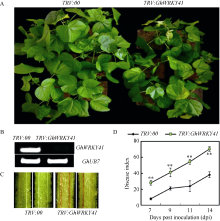
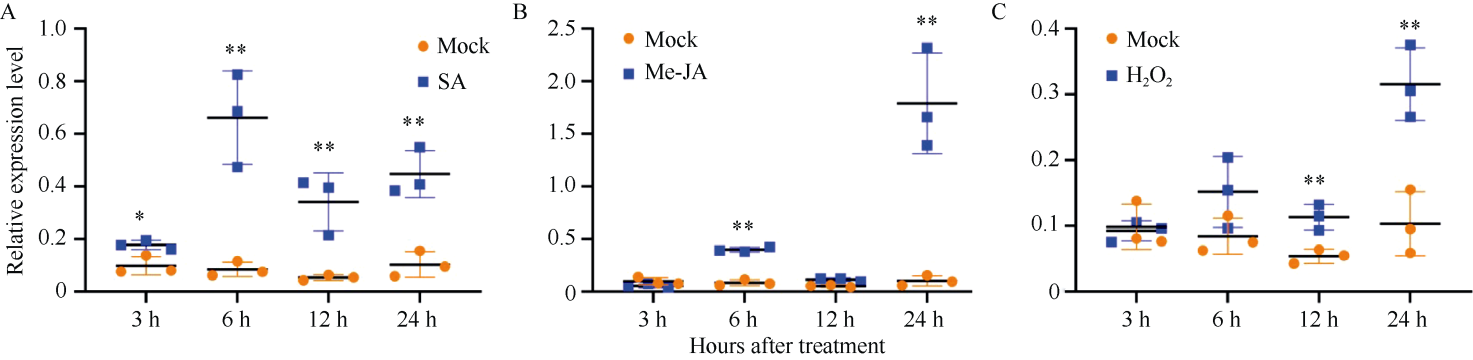
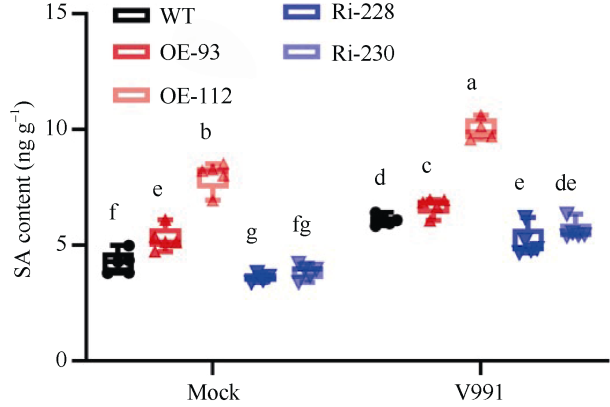
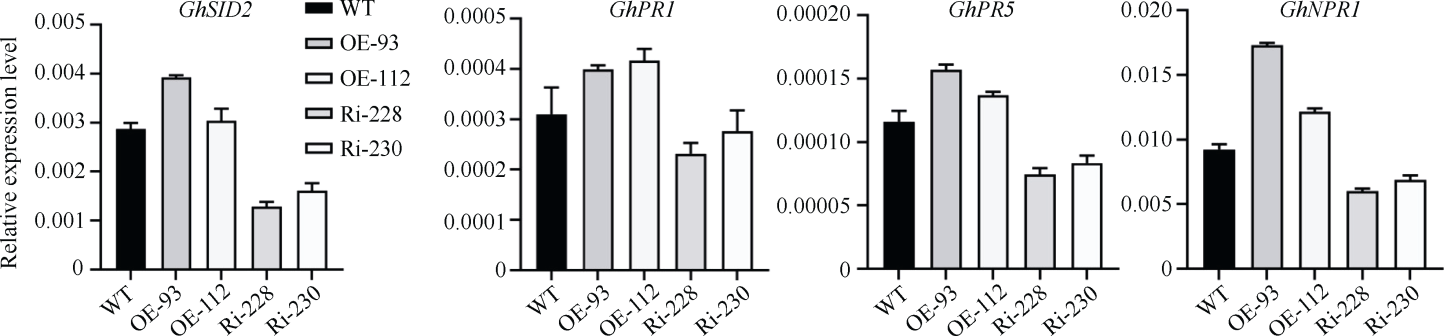
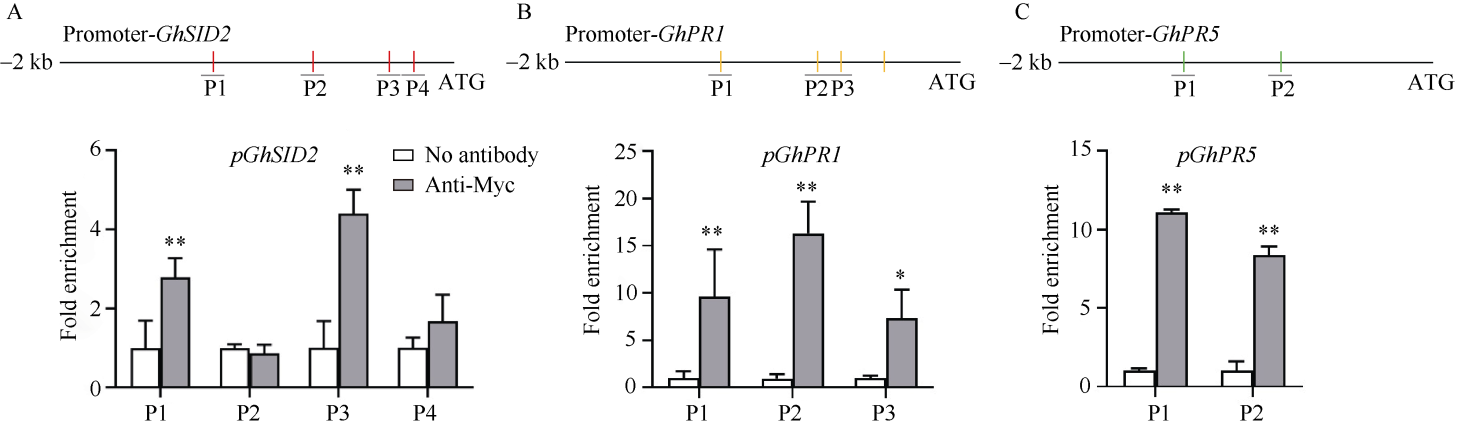
棉花是我国最重要的经济作物之一, 但其产量和品质受黄萎病菌危害而大幅度下降。挖掘棉花黄萎病抗性相关基因并解析其分子机制, 对加快棉花抗黄萎病育种进程具有重要意义。前期研究鉴定到一个在多个抗病棉花品种中均受黄萎病菌诱导显著上调表达的WRKY基因GhWRKY41, 该基因通过激活苯丙烷代谢增强棉花对黄萎病菌的抗性。本研究进一步分析了GhWRKY41在不同激素处理下的诱导表达模式, 利用病毒介导的基因沉默(VIGS)技术验证了GhWRKY41的抗病功能, 并利用前期已创制的GhWRKY41转基因棉花株系‘Jin668’测定了其内源植物抗病激素含量。 结果显示, GhWRKY41受水杨酸(SA)、Me-JA和H2O2诱导均显著上调表达; GhWRKY41被沉默后可削弱棉花对黄萎病菌的抗性; SA含量在GhWRKY41超表达棉花中显著增加, 而在GhWRKY41干涉棉花中则明显减少。RT-qPCR分析显示, SA合成基因GhSID2及SA信号转导基因GhNPR1、GhPR1、GhPR5的表达水平在超表达植株中明显上调, 而在干涉植株中则显著下降。ChIP-qPCR和双荧光素酶报告基因试验结果表明, GhWRKY41可结合并激活GhSID2、GhPR1和GhPR5的表达。此外, 外施SA可明显提高棉花的黄萎病抗性。综上表明, GhWRKY41可通过促进棉花中内源植物激素SA的合成来增强植株的黄萎病抗性, 这一结果完善了GhWRKY41在棉花抵御黄萎病菌过程中的生物学功能, 为未来利用黄萎病抗性基因创制棉花抗病材料提供了理论基础。
| [1] |
Chen J, Clinton M, Qi G, Wang D W, Liu F Q, Fu Z Q. Reprogramming and remodeling: transcriptional and epigenetic regulation of salicylic acid-mediated plant defense. J Exp Bot, 2020, 71: 5256-5268.
doi: 10.1093/jxb/eraa072 pmid: 32060527 |
| [2] |
Zhang Y X, Xu S H, Ding P T, Wang D M, Cheng Y T, He J, Gao M H, Xu F, Li Y, Zhu Z H, Li X, Zhang Y L. Control of salicylic acid synthesis and systemic acquired resistance by two members of a plant-specific family of transcription factors. Proc Natl Acad Sci USA, 2010, 107: 18220-18225.
doi: 10.1073/pnas.1005225107 pmid: 20921422 |
| [3] | Wang L, Tsuda K, Truman W, Sato M, Nguyen le V, Katagiri F, Glazebrook J. CBP60g and SARD1 play partially redundant critical roles in salicylic acid signaling. Plant J, 2011, 67: 1029-1041. |
| [4] | Gao Q M, Venugopal S, Navarre D, Kachroo A. Low oleic acid-derived repression of jasmonic acid-inducible defense responses requires the WRKY50 and WRKY51 proteins. Plant Physiol, 2011, 155: 464-476. |
| [5] |
van Verk M C, Bol J F, Linthorst H J. WRKY transcription factors involved in activation of SA biosynthesis genes. BMC Plant Biol, 2011, 11: 89-100.
doi: 10.1186/1471-2229-11-89 pmid: 21595875 |
| [6] | Guo P R, Li Z H, Huang P X, Li B S, Fang S, Chu J F, Guo H W. A tripartite amplification loop involving the transcription factor WRKY75, salicylic acid, and reactive oxygen species accelerates leaf senescence. Plant Cell, 2017, 29: 2854-2870. |
| [7] | Zhang S H, Li C, Wang R, Chen Y X, Shu S, Huang R H, Zhang D W, Li J, Xiao S, Yao N, Yang C W. The Arabidopsis mitochondrial rrotease FtSH4 is involved in leaf senescence via regulation of WRKY-dependent salicylic acid accumulation and signaling. Plant Physiol, 2017, 173: 2294-2307. |
| [8] |
Jiang J J, Ma S H, Ye N H, Jiang M, Cao J S, Zhang J H. WRKY transcription factors in plant responses to stresses. J Integr Plant Biol, 2017, 59: 86-101.
doi: 10.1111/jipb.12513 |
| [9] | Yamasaki K, Kigawa T, Inoue M, Tateno M, Yamasaki T, Yabuki T, Aoki M, Seki E, Matsuda T, Tomo Y, Hayami N, Terada T, Shirouzu M, Tanaka A, Seki M, Shinozaki K, Yokoyama S. Solution structure of an Arabidopsis WRKY DNA binding domain. Plant Cell, 2005, 17: 86-101. |
| [10] |
Rushton P J, Somssich I E, Ringler P, Shen Q J. WRKY transcription factors. Trends Plant Sci, 2010, 15: 247-258.
doi: 10.1016/j.tplants.2010.02.006 pmid: 20304701 |
| [11] | Xie W Y, Ke Y G, Cao J B, Wang S P, Yuan M. Knock out of transcription factor WRKY53 thickens sclerenchyma cell walls, confers bacterial blight resistance. Plant Physiol, 2021, 187: 1746-1761. |
| [12] | Li C, He X, Luo X Y, Xu L, Liu L L, Min L, Jin L, Zhu L F, Zhang X L. Cotton WRKY1 mediates the plant defense-todevelopment transition during infection of cotton by Verticillium dahliae by activating JASMONATE ZIM-DOMAIN1 expression. Plant Physiol, 2014, 166: 2179-2194. |
| [13] | Yang S, Cai W W, Shen L, Cao J S, Liu C L, Hu J, Guan D Y, He S L. A CaCDPK29-CaWRKY27b module promotes CaWRKY40- mediated thermotolerance and immunity to Ralstonia solanacearum in pepper. New Phytol, 2022, 233: 1843-1863. |
| [14] | 徐爱武. 近十年我国棉花生产量与消费量分析及建议. 棉花科学, 2022, 44(4): 61-64. |
| Xu A W. Analysis and suggestion of cotton production and consumption in China in recent ten years. Cotton Sci, 2022, 44(4): 61-64 (in Chinese with English abstract). | |
| [15] |
Yang X Y, Zhang X L, Yuan D J, Jin F Y, Zhang Y C, Xu J. Transcript profiling reveals complex auxin signalling pathway and transcription regulation involved in dedifferentiation and redifferentiation during somatic embryogenesis in cotton. BMC Plant Biol, 2012, 12: 110-128.
doi: 10.1186/1471-2229-12-110 pmid: 22817809 |
| [16] | Gao W, Long L, Zhu L F, Xu L, Gao W H, Sun L Q, Liu L L, Zhang X L. Proteomic and virus-induced gene silencing (VIGS) analyses reveal that gossypol, brassinosteroids, and jasmonic acid contribute to the resistance of cotton to Verticillium dahliae. Mol Cell Proteomics, 2013, 12: 3690-3703. |
| [17] | Xu L, Zhu L F, Tu L L, Gao X P, Long L, Sun L Q, Gao W, Zhang X L. Differential gene expression in cotton defence response to Verticillium dahliae by SSH. J Phytopathol, 2011, 159: 606-615. |
| [18] | Xu F, Yang L, Zhang J, Guo X P, Zhang X L, Li G Q. Prevalence of the defoliating pathotype of Verticillium dahliae on cotton in central China and virulence on selected cotton cultivars. J Phytopath, 2012, 160: 369-376. |
| [19] |
Tan J F, Tu L L, Deng F L, Hu H Y, Nie Y C, Zhang X L. A genetic and metabolic analysis revealed that cotton fiber cell development was retarded by flavonoid naringenin. Plant Physiol, 2013, 162: 86-95.
doi: 10.1104/pp.112.212142 pmid: 23535943 |
| [20] | Hu Q, Zhu L F, Zhang X L, Guan Q Q, Xiao S H, Min L, Zhang X L. GhCPK33 negatively regulates defense against Verticillium dahliae by phosphorylating GhOPR3. Plant Physiol, 2018, 178: 876-889. |
| [21] | Xiao S H, Ming Y Q, Hu Q, Ye Z X, Si H, Liu S M, Zhang X J, Wang W R, Yu Y, Kong J, Klosterman S J, Lindsey K, Zhang X L, Aierxi A, Zhu L F. GhWRKY41 forms a positive feedback regulation loop and increases cotton defence response against Verticillium dahliae by regulating phenylpropanoid metabolism. Plant Biotechnol J, 2023, 21: 961-978. |
| [22] | Li Y, Zhou Y J, Dai P H, Ren Y P, Wang Q, Liu X D. Cotton bsr-k1 modulates lignin deposition participating in plant resistance against Verticillium dahliae and fusarium oxysporum. Plant Growth Regul, 2021, 95: 283-292. |
| [23] | Chen F, Hu Y, Vannozzi A, Wu K C, Cai H Y, Qin Y, Mullis A, Lin Z G, Zhang L S. The WRKY transcription factor family in model plants and crops. Criti Rev Plant Sci, 2017, 36: 311-335. |
| [24] | Anderssen S, Naômé A, Jadot C, Brans A, Tocquin P, Rigali S. AURTHO: autoregulation of transcription factors as facilitator of cis-acting element discovery. Biochim Biophys Acta Gene Regul Mech, 2022, 1865: 194847. |
| [25] | Ng D W, Abeysinghe J K, Kamali M. Regulating the regulators: the control of transcription factors in plant defense signaling. Int J Mol Sci, 2018, 19: 3737-3755. |
| [26] |
Wang H L, Cheng X, Yin D M, Chen D L, Luo C, Liu H, Huang C L. Advances in the research on plant WRKY transcription factors responsive to external stresses. Curr Issues Mol Biol, 2023, 45: 2861-2880.
doi: 10.3390/cimb45040187 pmid: 37185711 |
| [27] | Bakshi M, Oelmüller R. WRKY transcription factors: jack of many trades in plants. Plant Signal Behav, 2014, 9: e27700. |
| [28] | Long L X, Gu L J, Wang S J, Cai H Y, Wu J H, Wang J M, Yang M S. Progress in the understanding of WRKY transcription factors in woody plants. Int J Biol Macromol, 2023, 242: 124379. |
| [29] | Liu D L, Leib K, Zhao P Y, Kogel K H, Langen G. Phylogenetic analysis of barley WRKY proteins and characterization of HvWRKY1 and -2 as repressors of the pathogen-inducible gene HvGER4c. Mol Genet Genomics, 2014, 289: 1331-1345. |
| [30] | Lippok B, Birkenbihl R P, Rivory G, Brümmer J, Schmelzer E, Logemann E, Somssich I E. Expression of AtWRKY33 encoding a pathogen- or PAMP-responsive WRKY transcription factor is regulated by a composite DNA motif containing W box elements. Mol Plant Microbe Interact, 2007, 20: 420-429. |
| [31] | Huang S X, Gao Y F, Liu J K, Peng X L, Niu X G, Fei Z J, Cao S Q, Liu Y S. Genome-wide analysis of WRKY transcription factors in Solanum lycopersicum. Mol Genet Genomics, 2012, 287: 495-513. |
| [32] | Deng B, Wang W J, Ruan C Q, Deng L L, Yao S X, Zeng K F. Involvement of CsWRKY70 in salicylic acid-induced citrus fruit resistance against Penicillium digitatum. Hortic Res, 2020, 7: 157-169. |
| [33] | Zhou R, Dong Y H, Liu X, Feng S, Wang C X, Ma X M, Liu J N, Liang Q, Bao Y, Xu S Y, Lang X Y, Gai S S, Yang K Q, Fang H C. JrWRKY21 interacts with JrPTI5L to activate the expression of JrPR5L for resistance to Colletotrichum gloeosporioides in walnut. Plant J, 2022, 111: 1152-1166. |
| [34] | Wang W J, Li T, Chen Q, Yao S X, Zeng K F. Transcriptional regulatory mechanism of a variant transcription factor CsWRKY23 in citrus fruit resistance to Penicillium digitatum. Food Chem, 2023, 413: 135573. |
| [35] | Zhang S L, Dong L J, Zhang X, Fu X H, Zhao L, Wu L Z, Wang X F, Liu J F. The transcription factor GhWRKY70 from Gossypium hirsutum enhances resistance to verticillium wilt via the jasmonic acid pathway. BMC Plant Biol, 2023, 23: 141-156. |
| [36] | Wang Y Q, Cui X, Yang B, Xu S T, Wei X Y, Zhao P Y, Niu F F, Sun M T, Wang C, Cheng H, Jiang Y Q. WRKY55 transcription factor positively regulates leaf senescence and the defense response by modulating the transcription of genes implicated in the biosynthesis of reactive oxygen species and salicylic acid in Arabidopsis. Development, 2020, 147: 189647. |
| [37] | Ulker B, Shahid M M, Somssich I E. The WRKY70 transcription factor of Arabidopsis influences both the plant senescence and defense signaling pathways. Planta, 2007, 226: 125-137. |
| [38] |
Rekhter D, Lüdke D, Ding Y, Feussner K, Zienkiewicz K, Lipka V, Wiermer M, Zhang Y, Feussner I. Isochorismate-derived biosynthesis of the plant stress hormone salicylic acid. Science, 2019, 365: 498-502.
doi: 10.1126/science.aaw1720 pmid: 31371615 |
| [39] |
Li Z, Liu H M, Ding Z H, Yan J P, Yu H Y, Pan R H, Hu J, Guan Y J, Hua J. Low temperature enhances plant immunity via salicylic acid pathway genes that are repressed by ethylene. Plant Physiol, 2020, 182: 626-639.
doi: 10.1104/pp.19.01130 pmid: 31694900 |
| [40] | Liao R J, Wei X C, Zhao Y Y, Xie Z Q, Nath U K, Yang S J, Su H N, Wang Z Y, Li L, Tian B M, Wei F, Yuan Y X, Zhang X W. Bra-miR167a targets ARF8 and negatively regulates Arabidopsis thaliana immunity against plasmodiophora brassicae. Int J Mol Sci, 2023, 24: 11850-11866. |
| [41] | Yang J, Wang Y F, Liu L, Liu L N, Wang C M, Wang C M, Li C Y. Effects of exogenous salicylic acid and pH on pathogenicity of biotrophy-associated secreted protein 1 (BAS1)-overexpressing strain, Magnaporthe oryzae. Environ Sci Pollut Res Int, 2019, 26: 13725-13737. |
| [42] | Elsharkawy M M, Omara R I, Mostafa Y S, Alamri S A, Hashem M, Alrumman S A, Ahmad A A. Mechanism of wheat leaf rust control using chitosan nanoparticles and salicylic acid. J Fungi, 2022, 8: 304-321. |
| [1] | 赵佳雪, 周龙昊, 郭岂源, 尚伦霄, 王涵, 刘志涛, 陈曦, 张晓佩, 宋宪亮, 毛丽丽. 长期秸秆还田与深松通过改善土壤环境与棉花光合特性提高滨海盐碱地棉花产量[J]. 作物学报, 2026, 52(5): 1548-1560. |
| [2] | 张曦, 王广恩, 李邵琦, 刘祎, 李俊兰, 钱玉源. 基于转录组测序解析陆海杂交姊妹系马克隆值差异的形成机制[J]. 作物学报, 2026, 52(5): 1442-1458. |
| [3] | 周琦翔, 朱艳, 汪楚博, 朱柏林, 李俊博, 宋利兵. 基于DSSAT模型模拟气候变化对新疆棉花物候期及产量的影响[J]. 作物学报, 2026, 52(2): 590-602. |
| [4] | 郭栋财, 吕涛, 蔡永生, 买吾鲁达·艾合买提, 全家, 曲延英, 郑凯. 棉花纤维品质相关性状QTL元分析及候选基因鉴定[J]. 作物学报, 2025, 51(6): 1445-1466. |
| [5] | 夏琦, 郭滢, 王坤美, 王思忆, 巨建业, 彭雅雯, 刘忠松, 夏石头. 甘蓝型油菜种子和种皮中水杨酸含量与原花色素积累的关系研究[J]. 作物学报, 2025, 51(5): 1189-1197. |
| [6] | 王亚雯, 戚正阳, 尤佳琦, 聂新辉, 曹娟, 杨细燕, 涂礼莉, 张献龙, 王茂军. 棉花60K功能位点基因芯片的制备及应用[J]. 作物学报, 2025, 51(5): 1178-1188. |
| [7] | 孟凡琦, 房孟颖, 罗艺, 卢霖, 董学瑞, 王亚菲, 郭丽娜, 闫鹏, 董志强, 张凤路. 乙烯利-甜菜碱-水杨酸合剂对夏玉米耐热性和产量的调控效应[J]. 作物学报, 2025, 51(5): 1299-1311. |
| [8] | 丁俊沣, 许映飞, 张祥, 陈媛, 陈德华. 生长调节剂吲哚丁酸对移栽棉苗成活及生长发育的影响[J]. 作物学报, 2025, 51(12): 3331-3341. |
| [9] | 哈丽哈什·依巴提, 张炎, 李青军, 徐新朋, 何萍. 基于产量反应和农学效率的棉花智能化推荐施肥方法研究[J]. 作物学报, 2025, 51(11): 3052-3064. |
| [10] | 李亚玮, 徐盈盈, 左春阳, 刘若男, 梁亚军, 孔杰, 张献龙, 闵玲. 棉花减数分裂进程鉴定体系构建及其对高温胁迫的响应分析[J]. 作物学报, 2025, 51(10): 2570-2580. |
| [11] | 陈佳伟, 林艳, 张明星, 周诗晶, 饶力群, 周池, 李鑫. 贝莱斯芽孢杆菌YCH92对棉花根际土壤微生物群落及棉花产量的影响[J]. 作物学报, 2025, 51(10): 2821-2835. |
| [12] | 谢章书, 谢学方, 屠小菊, 刘爱玉, 董合忠, 周仲华. 植物激素对棉花蕾铃脱落的调控研究进展[J]. 作物学报, 2025, 51(1): 1-29. |
| [13] | 辛明华, 秘雅迪, 王国平, 李小飞, 李亚兵, 董合林, 韩迎春, 冯璐. 行距配置和种植密度对棉花干物质生产及产量的影响[J]. 作物学报, 2025, 51(1): 221-232. |
| [14] | 李超, 付小琼. 基于GYT双标图综合评价黄河流域中熟杂交棉花区域试验品种[J]. 作物学报, 2025, 51(1): 30-43. |
| [15] | 艾莎, 李莎, 方治伟, 李论, 李甜甜, 高利芬, 陈利红, 肖华锋, 万人静, 闫多子, 武星廷, 彭海, 韩瑞玺, 周俊飞. 棉花MNP标记位点开发及其在DNA指纹图谱构建中的应用[J]. 作物学报, 2024, 50(9): 2267-2278. |
|
||