欢迎访问作物学报,今天是
作物学报 ›› 2026, Vol. 52 ›› Issue (3): 857-865.doi: 10.3724/SP.J.1006.2026.55054
赵翔( ), 李佳宜, 李爽, 韩文辉, 黄俊霞, 姚兴东, 张惠君, 王海英, 谢甫绨()
Zhao Xiang(), Li Jia-Yi, Li Shuang, Han Wen-Hui, Huang Jun-Xia, Yao Xing-Dong, Zhang Hui-Jun, Wang Hai-Ying, Xie Fu-Ti()
摘要:
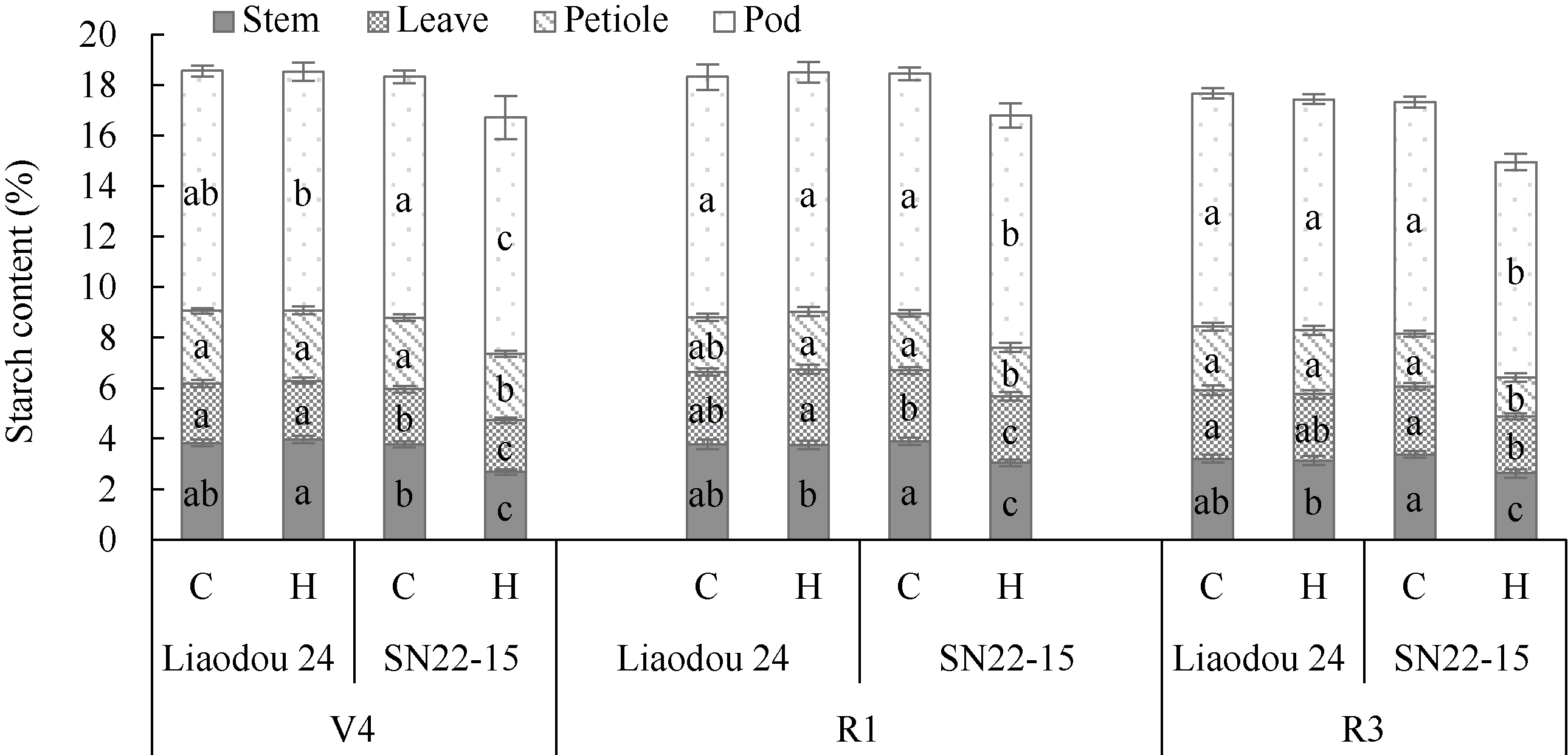
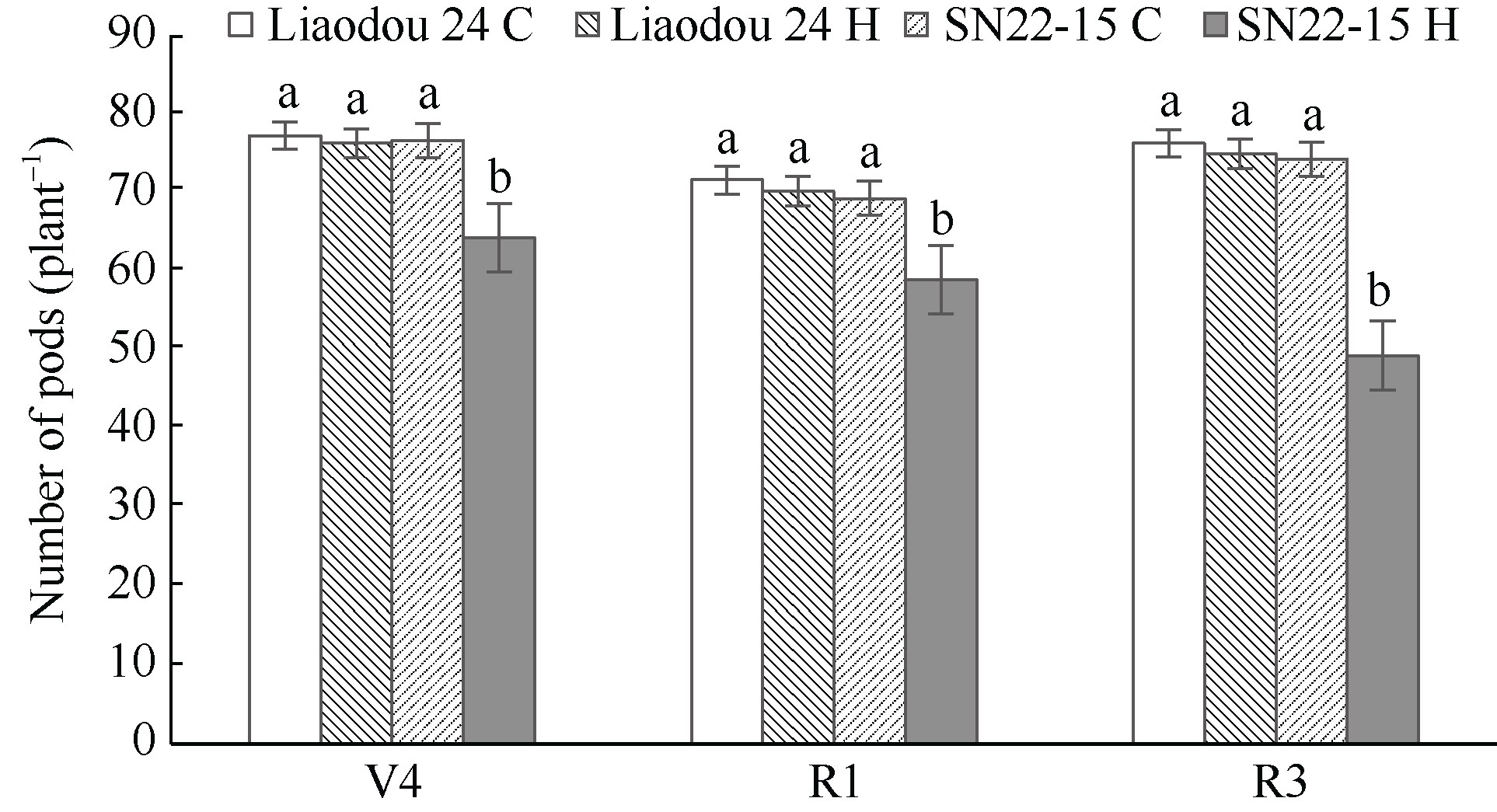
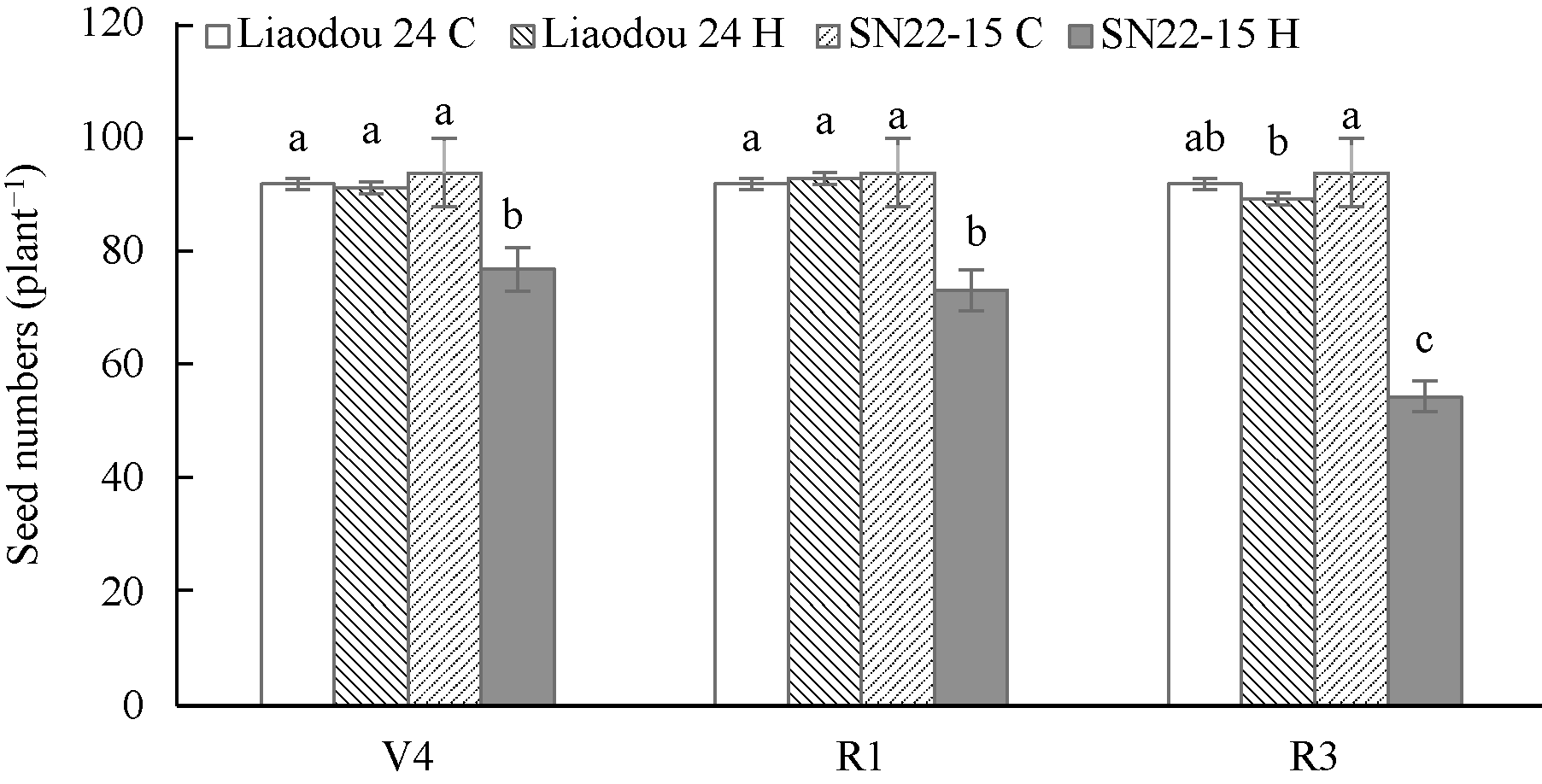
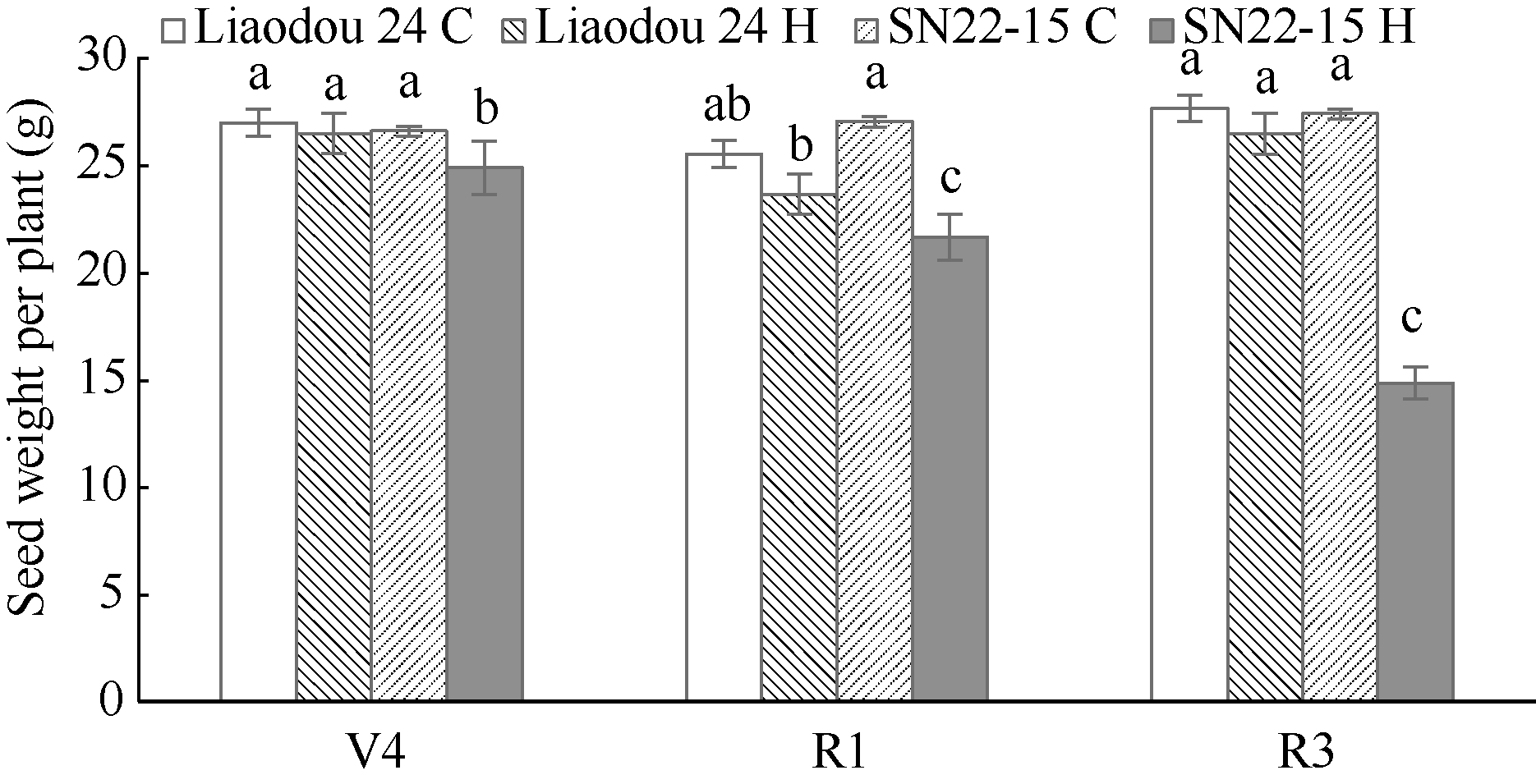
高温是限制大豆生长发育的主要因素之一, 探究不同生育时期高温对大豆干物质积累和糖代谢的影响, 有助于揭示高温对大豆产量影响的生理机制, 以期为选育耐高温大豆品种提供理论依据。本试验在盆栽条件下选用高温不滞育品种辽豆24和高温滞育品种SN22-15, 进行不同生育时期的高温处理试验, 测定了植株的干物质积累、光合指标和糖类含量等。不同生育时期高温处理下辽豆24的叶色值、净光合速率、气孔导度、胞间CO2浓度、蒸腾速率、以及茎秆、叶片、叶柄和豆荚的干物质重量均显著高于SN22-15; 在R1和R3时期进行高温处理, 辽豆24各部位的可溶性糖含量、蔗糖含量、淀粉含量均显著高于SN22-15; 在V4、R1和R3时期进行高温处理, 辽豆24的单株荚数、单株粒数和单株粒重均显著高于SN22-15, 尤其在R3时期高温处理会导致SN22-15的产量大幅度下降。过高的温度会影响大豆叶片光合作用, 抑制光合产物的形成, 造成干物质积累和糖分积累减少, 最终导致产量下降。辽豆24对高温不敏感, 只有在R3时期遇到高温时其干物质积累、糖代谢以及产量才会受到一定的影响; 而SN22-15对高温敏感, 不同生育时期遇高温时, 其干物质积累、糖代谢以及产量均会受到影响, 尤以R3时期受影响最大。试验表明, 在育种过程中应选育合适的生育期品种, 避免因始荚期遇高温而造成产量下降。
| [1] | IPCC第六次评估报告第一工作组报告发布. 中国气象报, 2021-08-10 (001). |
| The report of the first working group of the sixth assessment report of the IPCC has been released. China Meteorological News, 2021-08-10 (001) (in Chinese). | |
| [2] | 吴鹏, 谷星月, 王朋岭. 中国气候变化蓝皮书(2022)发布. 中国气象报, 2022-08-04 (001). |
| Wu P, Gu X Y, Wang P L. Blue book on climate change in China (2022) released. China Meteorological News, 2022-08-04 (001) (in Chinese). | |
| [3] | 李彪. 国家气候中心: 全球气温每十年升高0.2℃. 每日经济新闻, 2021-08-20 (002). |
| Li B. National Climate Centre: global temperature increases by 0.2℃ per decade. National Business Daily, 2021-08-20 (002) (in Chinese). | |
| [4] |
Salem M A, Kakani V G, Koti S, et al. Pollen-based screening of soybean genotypes for high temperatures. Crop Sci, 2007, 47: 219-231.
doi: 10.2135/cropsci2006.07.0443 |
| [5] | 刘秋霞, 樊永惠, 罗音, 等. 不同阶段夜间增温对小麦生长特性及产量的影响. 麦类作物学报, 2021, 41: 624-631. |
| Liu Q X, Fan Y H, Luo Y, et al. Effect of night warming at different stages on growth characteristics and yield of wheat. J Triticeae Crops, 2021, 41: 624-631 (in Chinese with English abstract). | |
| [6] | Dogan M, Bolat I, Turan M, et al. Physiological and biochemical responses of ‘Divadona’ peach on Rootpac 20 and Rootpac 40 under drought and heat stress adaptation and its recovery mechanisms. Physiol Plant, 2025, 177: e70250. |
| [7] |
Naawe E K, Köken I, Aytekin R I, et al. Effects of elevated temperature on agronomic, morphological, physiological and biochemical characteristics of potato genotypes: 1. agronomic and morphological traits. Potato Res, 2025, 68: 1115-1136.
doi: 10.1007/s11540-024-09774-5 |
| [8] | Ahmad Kalantar Ahmadi S, Daneshian J. Enhancing soybean (Glycine max L. merr) heat stress tolerance: effects of sowing date on seed yield, oil content, and fatty acid composition in hot climate conditions. Food Sci Nutr, 2024, 13: e4690. |
| [9] |
冯茜, 金丽惠, 薛海清, 等. 增温和土壤肥力对大豆光合特征和产量的影响. 中国农学通报, 2023, 39(35): 111-117.
doi: 10.11924/j.issn.1000-6850.casb2022-0979 |
| Feng Q, Jin L H, Xue H Q, et al. Effects of warming and soil fertility on photosynthetic characteristics and yield of soybean. Chin Agric Sci Bull, 2023, 39(35): 111-117 (in Chinese with English abstract). | |
| [10] | 冀宝璐.不同产量水平大豆品种花荚脱落和倒伏性对密植的响应. 沈阳农业大学硕士学位论文, 辽宁沈阳, 2024. |
| Ji B L. Responses of Flowering Pod Shedding and Lodging Ability of Soybean Varieties with Different Yield Levels to Dense Planting. MS Thesis of Shenyang Agricultural University, Shenyang, Liaoning, China, 2024 (in Chinese with English abstract). | |
| [11] |
Parasuraman B, Rajamanickam V, Rathinavelu S, et al. Interactive effect of drought and high temperature on physiological traits of soybean (Glycine max). Plant Physiol Rep, 2024, 29: 116-124.
doi: 10.1007/s40502-023-00767-z |
| [12] | 潘仕球.大豆光合特性及产量品质对增温的响应. 南京信息工程大学硕士学位论文, 江苏南京, 2022. |
| Pan S Q. Responses of Photosynthetic Characteristics and Yield and Quality of Soybean to Warming. MS Thesis of Nanjing University of Information Science and Technology, Nanjing, Jiangsu, China, 2022 (in Chinese with English abstract). | |
| [13] | 刘昭霖, 宗毓铮, 张东升, 等. 大气CO2浓度和气温升高对大豆叶片光合特性及氮代谢的影响. 中国农业气象, 2021, 42: 426-437. |
| Liu Z L, Zong Y Z, Zhang D S, et al. Effects of elevated atmospheric CO2 concentration and increased air temperature on photosynthetic characteristics and nitrogen metabolism of soybean leaves. Chin J Agrometeorol, 2021, 42: 426-437 (in Chinese with English abstract). | |
| [14] | 孙贺祥.遮荫对超高产大豆品种花荚脱落影响的生理与分子机制. 沈阳农业大学博士学位论文, 辽宁沈阳, 2024. |
| Sun H X.Physiological and Molecular Mechanism of Shading Effect on Flower and Pod Shedding of Super-high Yield Soybean Varieties. PhD Dissertation of Shenyang Agricultural University, Shenyang, Liaoning, China, 2024 (in Chinese with English abstract). | |
| [15] |
Yang L, Song W W, Xu C L, et al. Effects of high night temperature on soybean yield and compositions. Front Plant Sci, 2023, 14: 1065604.
doi: 10.3389/fpls.2023.1065604 |
| [16] | 杜艳丽.水分胁迫对大豆生长和籽粒性状的影响机制研究. 沈阳农业大学博士学位论文, 辽宁沈阳, 2020. |
| Du Y L.Effects of Drought Stress on Growth and Grain Traits of Soybeans. PhD Dissertation of Shenyang Agricultural University, Shenyang, Liaoning, China, 2020 (in Chinese with English abstract). | |
| [17] | 费志宏, 吴存祥, 孙洪波, 等. 以光周期处理与分期播种试验综合鉴定大豆品种的光温反应. 作物学报, 2009, 35: 1525-1531. |
|
Fei Z H, Wu C X, Sun H B, et al. Identification of photothermal responses in soybean by integrating photoperiod treatments with planting-date experiments. Acta Agron Sin, 2009, 35: 1525-1531 (in Chinese with English abstract).
doi: 10.3724/SP.J.1006.2009.01525 |
|
| [18] |
Liu Y J, Dai L. Modelling the impacts of climate change and crop management measures on soybean phenology in China. J Clean Prod, 2020, 262: 121271.
doi: 10.1016/j.jclepro.2020.121271 |
| [19] |
王丹, 乔匀周, 董宝娣, 等. 昼夜不对称性与对称性升温对大豆产量和水分利用的影响. 植物生态学报, 2016, 40: 827-833.
doi: 10.17521/cjpe.2015.0439 |
|
Wang D, Qiao Y Z, Dong B D, et al. Differential effects of diurnal asymmetric and symmetric warming on yield and water utilization of soybean. Chin J Plant Ecol, 2016, 40: 827-833 (in Chinese with English abstract).
doi: 10.17521/cjpe.2015.0439 |
|
| [20] |
Dutta S, Mohanty S, Tripathy B C. Role of temperature stress on chloroplast biogenesis and protein import in pea. Plant Physiol, 2009, 150: 1050-1061.
doi: 10.1104/pp.109.137265 pmid: 19403728 |
| [21] | 张小琴.CO2浓度和温度升高对大豆糖代谢和脂肪代谢的影响. 山西农业大学硕士学位论文, 山西太谷, 2022. |
| Zhang X Q. Effects of Elevated CO2 Concentration and Increased Temperature on the Metabolism of Sugar and Lipid in Soybean. MS Thesis of Shanxi Agricultural University, Taigu, Shanxi, China, 2022 (in Chinese with English abstract). | |
| [22] |
Giménez V D, Serrago R A, García G A, et al. How milling and breadmaking quality are modified by warmer nights in wheat? J Cereal Sci, 2021, 102: 103343.
doi: 10.1016/j.jcs.2021.103343 |
| [23] |
Escamilla D M, Xavier A, Vuong T D, et al. An assessment of the interaction between sucrose content and seed quality traits in soybeans. Crop Sci, 2023, 63: 2650-2664.
doi: 10.1002/csc2.v63.5 |
| [24] | Medina I R, da Rocha G H, Pereira E G. Photosynthetic adjustments and proline concentration are probably linked to stress memory in soybean exposed to recurrent drought. Ciênc Agrotec, 2023, 47: e015322. |
| [25] |
Nakagawa A C S, Ario N, Tomita Y, et al. High temperature during soybean seed development differentially alters lipid and protein metabolism. Plant Prod Sci, 2020, 23: 504-512.
doi: 10.1080/1343943X.2020.1742581 |
| [26] | Ting M F, Lesk C, Liu C Y, et al. Contrasting impacts of dry versus humid heat on US corn and soybean yields. Sci Rep, 2023, 13: 710. |
| [27] |
Zhang L X, Zhu L L, Yu M Y, et al. Warming decreases photosynthates and yield of soybean [Glycine max (L.) Merrill] in the North China Plain. Crop J, 2016, 4: 139-146.
doi: 10.1016/j.cj.2015.12.003 |
| [28] |
Petridis A, van der Kaay J, Sungurtas J, et al. Photosynthetic plasticity allows blueberry (Vaccinium corymbosum L.) plants to compensate for yield loss under conditions of high sink demand. Environ Exp Bot, 2020, 174: 104031.
doi: 10.1016/j.envexpbot.2020.104031 |
| [29] | Schauberger B, Archontoulis S, Arneth A, et al. Consistent negative response of US crops to high temperatures in observations and crop models. Nat Commun, 2017, 8: 13931. |
| [1] | 刘恩波, 陈静, 李红星, 于宁宁, 任佰朝, 赵斌, 刘鹏, 张吉旺. 遮阴改变源-库平衡和调节碳水化合物代谢进而抑制夏玉米幼穗发育[J]. 作物学报, 2026, 52(6): 1891-1901. |
| [2] | 任依涵, 赵曼利, 代晶, 李银水, 顾炽明, 杨璐, 杜雪竹, 胡文诗, 秦璐. 油菜叶片功能氮动态变化对光合速率及光合氮利用效率的影响[J]. 作物学报, 2026, 52(5): 1459-1471. |
| [3] | 张振, 冯连杰, 石玉, 于振文, 张永丽. 节水补灌下不同穗型小麦产量形成差异研究[J]. 作物学报, 2026, 52(5): 1522-1535. |
| [4] | 张鸿蓉, 王菲儿, 李盼, 仇海龙, 朱静, 赵连豪, 南运有, 何蔚, 樊志龙, 胡发龙, 柴强, 殷文. 减量20%灌水与25%有机肥替代化肥提高青贮玉米产量的光合特性[J]. 作物学报, 2026, 52(5): 1487-1500. |
| [5] | 赵佳雪, 周龙昊, 郭岂源, 尚伦霄, 王涵, 刘志涛, 陈曦, 张晓佩, 宋宪亮, 毛丽丽. 长期秸秆还田与深松通过改善土壤环境与棉花光合特性提高滨海盐碱地棉花产量[J]. 作物学报, 2026, 52(5): 1548-1560. |
| [6] | 李坤, 籍亚腾, 田银帅, 胡民航, 刘亮, 李菲, 李国强, 郝立华, 郑云普. CO2和NaCl对大豆气孔特征、光合性能及抗氧化系统的影响[J]. 作物学报, 2026, 52(4): 1251-1267. |
| [7] | 蔡宏玮, 于爱忠, 姜科强, 王鹏飞, 王玉珑, 霍建喆, 庞小能, 尹波, 尚永盼. 干旱灌区有机肥替代部分化肥促进甜玉米产量提升的关键机制[J]. 作物学报, 2026, 52(4): 1166-1180. |
| [8] | 侯思宇, 王国璀, 韦金贵, 谢玮欣, 殷文, 樊志龙, 柴强, 胡发龙. 绿肥配施化学氮肥对西北干旱灌区小麦干物质积累及产量形成的影响[J]. 作物学报, 2026, 52(4): 1208-1219. |
| [9] | 金欣欣, 宋亚辉, 苏俏, 杨永庆, 王瑾. 高产高油高油酸花生品种的生长发育及干物质生产特征[J]. 作物学报, 2026, 52(1): 191-201. |
| [10] | 高园, 李霞, 魏少博, 田小海, 周文彬. 植物光合午休研究进展[J]. 作物学报, 2025, 51(9): 2253-2265. |
| [11] | 付江鹏, 柳发财, 闫宝琴, 王永栋, 李利利, 魏玮, 周英霞. 控释肥替代普通尿素对旱作高粱干物质积累分配、产量和品质的影响[J]. 作物学报, 2025, 51(9): 2501-2513. |
| [12] | 樊友众, 王先领, 王宗铠, 王春云, 王天尧, 谢捷, 蒯婕, 汪波, 王晶, 徐正华, 赵杰, 周广生. 秸秆还田耦合氮肥运筹对稻茬油菜光合性能及产量的影响[J]. 作物学报, 2025, 51(8): 2139-2151. |
| [13] | 杨婷婷, 陈娟, ABDUL Rehman, 李婧, 闫素辉, 汪建来, 李文阳. 花后弱光对软质小麦干物质积累转运、籽粒产量和淀粉品质的影响[J]. 作物学报, 2025, 51(8): 2204-2219. |
| [14] | 李雪婷, 任昊, 王洪章, 张吉旺, 赵斌, 任佰朝, 刘莹, 姚海燕, 刘鹏. 盐胁迫对不同耐盐型玉米品种叶片光合性能和干物质积累与分配的影响[J]. 作物学报, 2025, 51(4): 1091-1101. |
| [15] | 李培华, 李杰, 孟祥宇, 孙玉晨, 冯永佳, 李云丽, 刁邓超, 赵雯, 吴玮, 韩德俊, 张嵩午, 郑炜君. 高温胁迫下冷型小麦的抗逆性评估及其生理响应研究[J]. 作物学报, 2025, 51(4): 1118-1130. |
|
||