欢迎访问作物学报,今天是
作物学报 ›› 2026, Vol. 52 ›› Issue (4): 1236-1250.doi: 10.3724/SP.J.1006.2026.51074
尚云秋1,2( ), 赵竹1,2,*(), 陈欢1,2, 丁永刚1,2, 乔玉强1,2, 李玮1,2, 张向前1,2,3, 曹承富1,2, 杜世州1,2,*()
Shang Yun-Qiu1,2(), Zhao Zhu1,2,*(), Chen Huan1,2, Ding Yong-Gang1,2, Qiao Yu-Qiang1,2, Li Wei1,2, Zhang Xiang-Qian1,2,3, Cao Cheng-Fu1,2, Du Shi-Zhou1,2,*()
摘要:
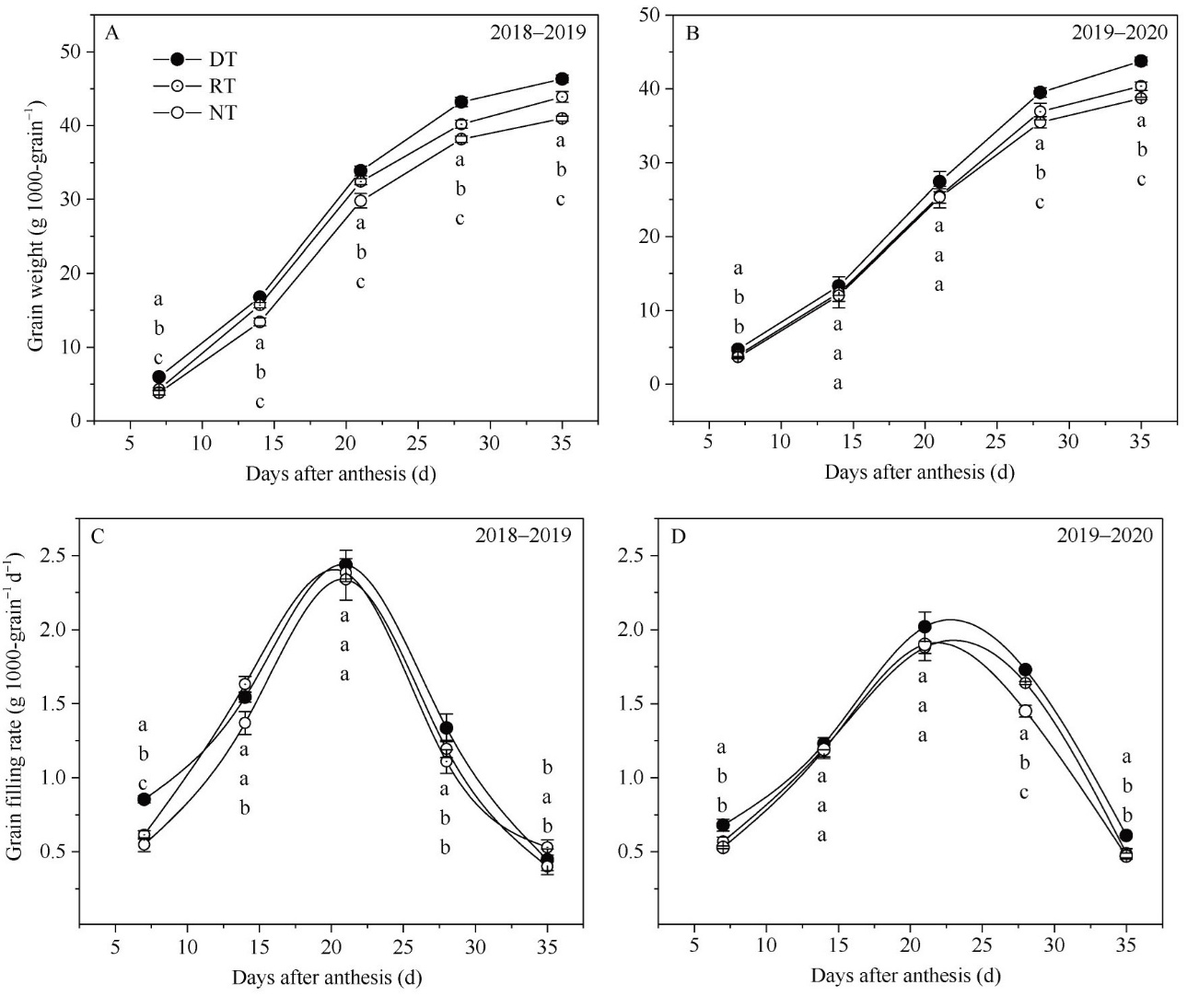
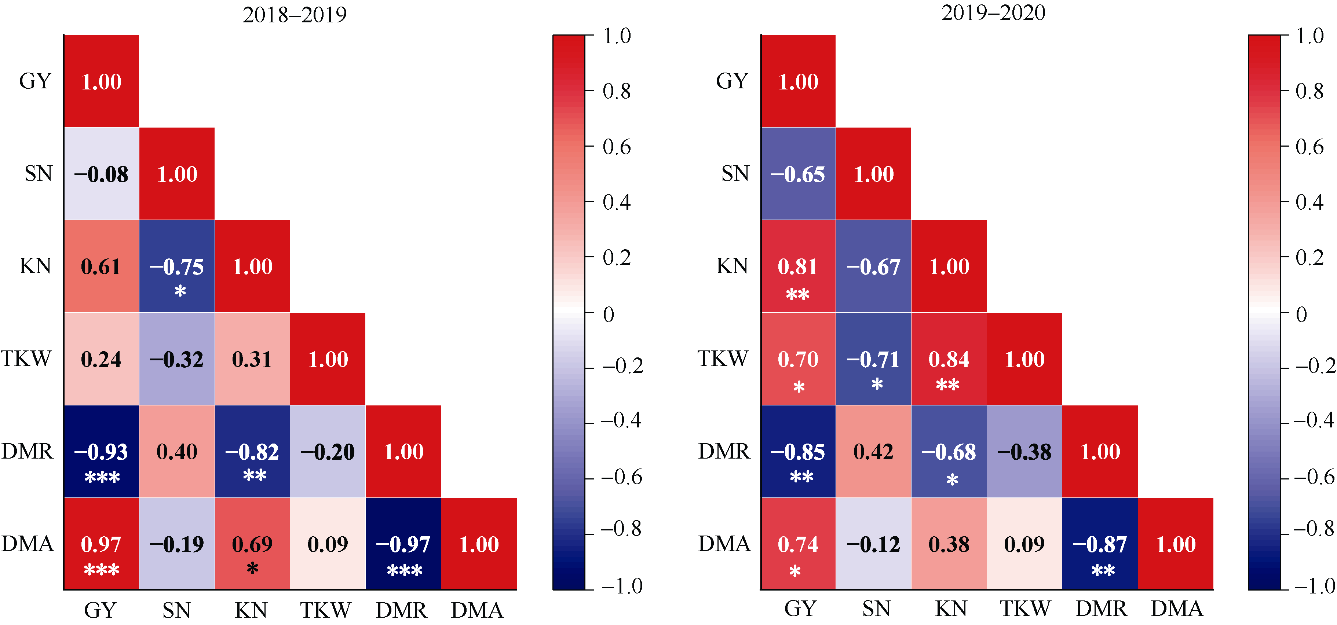
针对黄淮海雨养麦区季节性干旱制约小麦产量提升的现实问题, 开展耕作抗旱保墒技术实现小麦产量稳定的生理生态机制研究, 以期为区域抗旱耕作制度的优化提供依据。本研究基于14年的长期定位试验, 以济麦22为材料, 设置常年深耕结合秸秆还田(DT)、常年旋耕(RT)和常年少免耕(NT) 3种耕作方式, 于2018—2020年度测定农田耗水特性、同化物转运与同化特征、籽粒灌浆参数、产量及其构成要素。结果表明, 0~60 cm土层农田耗水总量在DT、RT和NT处理间无显著差异。然而, DT的播种期至拔节期农田耗水量分别较RT、NT降低19.64%~29.67% (2018—2019年)和5.12%~10.97% (2019—2020年), 拔节期至成熟期农田耗水量分别提高17.16%~45.38% (2018— 2019年)和7.20%~12.74% (2019—2020年)。2年度花后同化干物质在DT和RT处理间无显著差异, 但是均显著大于NT; 且DT的花后同化干物质对籽粒的贡献率较RT、NT分别提升0.50~20.07个百分点(2018—2019年)和4.32~16.29个百分点(2019—2020年)。Logistic方程拟合结果表明, DT在最大灌浆速率、平均灌浆速率及灌浆持续时间方面均优于RT和NT。相关性分析进一步证实, 开花期至成熟期农田耗水量的增加是促进花后同化干物质积累、优化籽粒灌浆参数和提升籽粒产量的主要驱动因素。最终DT的产量在2018—2019年度相较于NT提高了15.67%, 在2019—2020年度相较于NT和RT分别提高了5.34%和8.61%。因此, 相较于常年旋耕和少免耕, 深耕结合秸秆还田通过“前控后补”的农田耗水优势, 有效增强花后同化物积累及其向籽粒的转运效率, 显著提高灌浆速率和延长有效灌浆期, 协同优化穗数、穗粒数和千粒重, 是保障雨养小麦稳产增产的关键耕作模式。
| [1] |
Luo X M, Yang Y M, Lin X L, et al. Deciphering spike architecture formation towards yield improvement in wheat. J Genet Genom, 2023, 50: 835-845.
doi: 10.1016/j.jgg.2023.02.015 |
| [2] |
赵鸿, 蔡迪花, 王鹤龄, 等. 干旱灾害对粮食安全的影响及其应对技术研究进展与展望. 干旱气象, 2023, 41(2): 187-206.
doi: 10.11755/j.issn.1006-7639(2023)-02-0187 |
| Zhao H, Cai D H, Wang H L, et al. Progress and prospect on impact of drought disaster on food security and its countermeasures. J Arid Meteor, 2023, 41(2): 187-206 (in Chinese with English abstract). | |
| [3] |
Xue R, Jiang Y, Li H, et al. Review of advancements and challenges in delayed irrigation: enhancing crop water productivity and sustainable crop production. Agric Water Manag, 2025, 318: 109739.
doi: 10.1016/j.agwat.2025.109739 |
| [4] |
Zeng R Y, Lin X M, Welch S M, et al. Impact of water deficit and irrigation management on winter wheat yield in China. Agric Water Manag, 2023, 287: 108431.
doi: 10.1016/j.agwat.2023.108431 |
| [5] |
Si Z Y, Qin A Z, Liang Y P, et al. A review on regulation of irrigation management on wheat physiology, grain yield, and quality. Plants, 2023, 12: 692.
doi: 10.3390/plants12040692 |
| [6] | 国家统计局. 2024中国统计年鉴. https://www.stats.gov.cn/sj/ndsj/2024/indexch.htm. |
| National Bureau of Statistics of China. China statistical yearbook in 2024. https://www.stats.gov.cn/sj/ndsj/2024/indexch.htm (in Chinese). | |
| [7] | 居煇, 李三爱, 严昌荣. 我国北方旱区雨养小麦生产潜力研究. 中国生态农业学报, 2008, 16: 728-731. |
| Ju H, Li S A, Yan C R. Potential productivity of rain-fed wheat in dry farmlands of North China. Chin J Eco-Agric, 2008, 16: 728-731 (in Chinese with English abstract). | |
| [8] |
Fang Q X, Ma L, Green T R, et al. Water resources and water use efficiency in the North China Plain: current status and agronomic management options. Agric Water Manag, 2010, 97: 1102-1116.
doi: 10.1016/j.agwat.2010.01.008 |
| [9] |
胡实, 莫兴国, 林忠辉. 冬小麦种植区域的可能变化对黄淮海地区农业水资源盈亏的影响. 地理研究, 2017, 36: 861-871.
doi: 10.11821/dlyj201705005 |
|
Hu S, Mo X G, Lin Z H. Impacts of possibility planting region change for winter wheat on agricultural water surplus and deficit in Huang-Huai-Hai Region. Geogr Res, 2017, 36: 861-871 (in Chinese with English abstract).
doi: 10.11821/dlyj201705005 |
|
| [10] | 王亚飞, 李世景, 徐萍, 等. 黄淮和长江中下游冬麦区小麦品种(系)农艺性状及其聚类分析. 中国生态农业学报(中英文), 2020, 28: 395-404. |
| Wang Y F, Li S J, Xu P, et al. Agronomic traits and cluster analysis of winter wheat varieties (lines) in the Huanghuai and the middle/lower reaches of the Yangtze River wheat areas. Chin J Eco-Agric, 2020, 28: 395-404 (in Chinese with English abstract). | |
| [11] |
Qin P H, Xie Z H, Zou J, et al. Future precipitation extremes in China under climate change and their physical quantification based on a regional climate model and CMIP5 model simulations. Adv Atmos Sci, 2021, 38: 460-479.
doi: 10.1007/s00376-020-0141-4 |
| [12] | 张玉娇, 王浩, 王淑兰, 等. 小麦/玉米轮作旱地长期轮耕的保墒增产效应. 农业工程学报, 2018, 34(12): 126-136. |
| Zhang Y J, Wang H, Wang S L, et al. Soil moisture preservation and improving of crop yield in dry land under long-term wheat/maize rotation. Trans CSAE, 2018, 34(12): 126-136 (in Chinese with English abstract). | |
| [13] |
王永华, 刘焕, 辛明华, 等. 耕作方式与灌水次数对砂姜黑土冬小麦水分利用及籽粒产量的影响. 中国农业科学, 2019, 52: 801-812.
doi: 10.3864/j.issn.0578-1752.2019.05.003 |
|
Wang Y H, Liu H, Xin M H, et al. Effects of tillage practices and irrigation times on water use efficiency and grain yield of winter wheat in lime concretion black soil. Sci Agric Sin, 2019, 52: 801-812 (in Chinese with English abstract).
doi: 10.3864/j.issn.0578-1752.2019.05.003 |
|
| [14] |
赵亚丽, 薛志伟, 郭海斌, 等. 耕作方式与秸秆还田对冬小麦-夏玉米耗水特性和水分利用效率的影响. 中国农业科学, 2014, 47: 3359-3371.
doi: 10.3864/j.issn.0578-1752.2014.17.004 |
| Zhao Y L, Xue Z W, Guo H B, et al. Effects of tillage and straw returning on water consumption characteristics and water use efficiency in the winter wheat and summer maize rotation system. Sci Agric Sin, 2014, 47: 3359-3371 (in Chinese with English abstract). | |
| [15] | 张凯, 刘战东, 强小嫚, 等. 耕作方式和灌水处理对冬小麦-夏玉米水分利用及产量的影响. 农业工程学报, 2019, 35(17): 102-109. |
| Zhang K, Liu Z D, Qiang X M, et al. Effects of tillage and irrigation on water use and yield of winter wheat and summer maize. Trans CSAE, 2019, 35(17): 102-109 (in Chinese with English abstract). | |
| [16] |
祁小平, 李广, 袁建钰, 等. 保护性耕作对陇中旱作麦田蓄水保墒效果和产量的影响. 干旱区研究, 2022, 39: 312-321.
doi: 10.13866/j.azr.2022.01.30 |
|
Qi X P, Li G, Yuan J Y, et al. Effects of conservation tillage on the water storage, moisture conservation, and yield of dry-land wheat fields of central Gansu Province. Arid Zone Res, 2022, 39: 312-321 (in Chinese with English abstract).
doi: 10.13866/j.azr.2022.01.30 |
|
| [17] | 刘战东, 刘祖贵, 宁东峰, 等. 深松耕作对玉米水分利用和产量的影响. 灌溉排水学报, 2015, 34(5): 6-12. |
| Liu Z D, Liu Z G, Ning D F, et al. Effects of subsoiling tillage on water utilization and yield of maize. J Irrig Drain, 2015, 34(5): 6-12 (in Chinese with English abstract). | |
| [18] |
谢迎新, 靳海洋, 李梦达, 等. 周年耕作方式对砂姜黑土农田土壤养分及作物产量的影响. 作物学报, 2016, 42: 1560-1568.
doi: 10.3724/SP.J.1006.2016.01560 |
|
Xie Y X, Jin H Y, Li M D, et al. Effect of annual tillage practices on soil nutrient and crop yield in lime concretion black soil farmland. Acta Agron Sin, 2016, 42: 1560-1568 (in Chinese with English abstract).
doi: 10.3724/SP.J.1006.2016.01560 |
|
| [19] |
王庆源, 陈甜, 于振文, 等. 长期定位耕作模式对小麦13C同化物分配和籽粒产量形成的影响. 应用生态学报, 2024, 35: 926-932.
doi: 10.13287/j.1001-9332.202404.010 |
| Wang Q Y, Chen T, Yu Z W, et al. Effects of long-term positioning tillage on 13C assimilate distribution and grain yield formation in wheat. Chin J Appl Ecol, 2024, 35: 926-932 (in Chinese with English abstract). | |
| [20] | 陈甜, 于振文, 石玉, 等. 不同耕作模式下麦田土壤温室气体排放和小麦产量. 植物营养与肥料学报, 2023, 29: 8-17. |
| Chen T, Yu Z W, Shi Y, et al. Soil greenhouse gas emission and yield in wheat fields under different tillage patterns. J Plant Nutr Fert, 2023, 29: 8-17 (in Chinese with English abstract). | |
| [21] | 陈月明, 高磊, 张中彬, 等. 淮北平原砂姜黑土区砂姜的空间分布及其驱动因素. 土壤学报, 2022, 59: 148-160. |
| Chen Y M, Gao L, Zhang Z B, et al. Spatial distribution of Shajiang content in Shajiang black soil of Huaibei Plain and its influencing factors. Acta Pedol Sin, 2022, 59: 148-160 (in Chinese with English abstract). | |
| [22] |
Abrisqueta I, Abrisqueta J M, Tapia L M, et al. Basal crop coefficients for early-season peach trees. Agric Water Manag, 2013, 121: 158-163.
doi: 10.1016/j.agwat.2013.02.001 |
| [23] |
Ali M H, Hoque M R, Hassan A A, et al. Effects of deficit irrigation on yield, water productivity, and economic returns of wheat. Agric Water Manag, 2007, 92: 151-161.
doi: 10.1016/j.agwat.2007.05.010 |
| [24] |
Thorup-Kristensen K, Salmerón Cortasa M, Loges R. Winter wheat roots grow twice as deep as spring wheat roots, is this important for N uptake and N leaching losses? Plant Soil, 2009, 322: 101-114.
doi: 10.1007/s11104-009-9898-z |
| [25] |
Wu Q, Wang Y Z, Chen T T, et al. Soil nitrogen regulation using clinoptilolite for grain filling and grain quality improvements in rice. Soil Tillage Res, 2020, 199: 104547.
doi: 10.1016/j.still.2019.104547 |
| [26] |
Wang D. Water use efficiency and optimal supplemental irrigation in a high yield wheat field. Field Crops Res, 2017, 213: 213-220.
doi: 10.1016/j.fcr.2017.08.012 |
| [27] |
Tian S Z, Ning T Y, Wang Y, et al. Crop yield and soil carbon responses to tillage method changes in North China. Soil Tillage Res, 2016, 163: 207-213.
doi: 10.1016/j.still.2016.06.005 |
| [28] |
Li P F, Ma B L, Wei X F, et al. Deeper root distribution and optimized root anatomy help improve dryland wheat yield and water use efficiency under low water conditions. Plant Soil, 2024, 501: 437-454.
doi: 10.1007/s11104-024-06526-9 |
| [29] |
张妍妍, 李迎, 刘栩辰, 等. 深松耕作条件下滴灌对冬小麦花后干物质积累及灌浆特性的影响. 作物学报, 2025, 51: 3065-3079.
doi: 10.3724/SP.J.1006.2025.51036 |
|
Zhang Y Y, Li Y, Liu X C, et al. Effects of drip irrigation on post-anthesis dry matter accumulation and grain-filling characteristics of winter wheat under subsoiling tillage. Acta Agron Sin, 2025, 51: 3065-3079 (in Chinese with English abstract).
doi: 10.3724/SP.J.1006.2025.51036 |
|
| [30] | 鞠梦倩, 王杰, 李心月, 等. 不同耕作方式与秸秆还田对土壤全氮和小麦产量的影响. 中国土壤与肥料, 2025(4): 97-106. |
| Ju M Q, Wang J, Li X Y, et al. Effects of different tillage methods and straw returning to soil on soil total nitrogen and wheat yield. Soil Fert Sci China, 2025(4): 97-106 (in Chinese with English abstract). | |
| [31] |
Eagle A J, Bird J A, Horwath W R, et al. Rice yield and nitrogen utilization efficiency under alternative straw management practices. Agron J, 2000, 92: 1096-1103.
doi: 10.2134/agronj2000.9261096x |
| [32] |
李明, 李朝苏, 刘淼, 等. 耕作播种方式对稻茬小麦根系发育、土壤水分和硝态氮含量的影响. 应用生态学报, 2020, 31: 1425-1434.
doi: 10.13287/j.1001-9332.202005.027 |
|
Li M, Li C S, Liu M, et al. Effects of different tillage and sowing practices on root growth, soil moisture, and soil nitrate nitrogen content of wheat after rice. Chin J Appl Ecol, 2020, 31: 1425-1434 (in Chinese with English abstract).
doi: 10.13287/j.1001-9332.202005.027 |
|
| [33] | Shang Y Q, Lin X, Li P, et al. Effects of supplemental irrigation at the jointing stage on population dynamics, grain yield, and water-use efficiency of two different spike-type wheat cultivars. PLoS One, 2020, 15: e0230484. |
| [34] | 田肖肖, 吕慎强, 张亮, 等. 免耕覆盖有效提高夏玉米产量及水氮利用效率. 植物营养与肥料学报, 2017, 23: 606-614. |
| Tian X X, Lyu S Q, Zhang L, et al. No-tillage with straw mulching could increase grain yield, water and nitrogen use efficiencies of summer maize. J Plant Nutr Fert, 2017, 23: 606-614 (in Chinese with English abstract). | |
| [35] |
曹永刚, 徐龙龙, 柴强, 等. 水氮减量条件下地膜玉米免耕轮作小麦的水分利用特征. 中国农业科学, 2023, 56: 2660-2672.
doi: 10.3864/j.issn.0578-1752.2023.14.003 |
|
Cao Y G, Xu L L, Chai Q, et al. Water use characteristics of wheat rotated after No tillage plastic film mulching maize with reduced water and nitrogen. Sci Agric Sin, 2023, 56: 2660-2672 (in Chinese with English abstract).
doi: 10.3864/j.issn.0578-1752.2023.14.003 |
|
| [36] | 马尚宇, 王艳艳, 刘雅男, 等. 播期、播量和施氮量对小麦干物质积累、转运和分配及产量的影响. 中国生态农业学报(中英文), 2020, 28: 375-385. |
| Ma S Y, Wang Y Y, Liu Y N, et al. Effect of sowing date, planting density, and nitrogen application on dry matter accumulation, transfer, distribution, and yield of wheat. Chin J Eco-Agric, 2020, 28: 375-385 (in Chinese with English abstract). | |
| [37] |
马冬云, 郭天财, 王晨阳, 等. 施氮量对冬小麦灌浆期光合产物积累、转运及分配的影响. 作物学报, 2008, 34: 1027-1033.
doi: 10.3724/SP.J.1006.2008.01027 |
|
Ma D Y, Guo T C, Wang C Y, et al. Effects of nitrogen application rates on accumulation, translocation, and partitioning of photosynthate in winter wheat at grain filling stage. Acta Agron Sin, 2008, 34: 1027-1033 (in Chinese with English abstract).
doi: 10.3724/SP.J.1006.2008.01027 |
|
| [38] |
Arduini I, Masoni A, Ercoli L, et al. Grain yield, and dry matter and nitrogen accumulation and remobilization in durum wheat as affected by variety and seeding rate. Eur J Agron, 2006, 25: 309-318.
doi: 10.1016/j.eja.2006.06.009 |
| [39] |
Zhiipao R R, Pooniya V, Kumar D, et al. Above and below-ground growth, accumulated dry matter and nitrogen remobilization of wheat (Triticum aestivum) genotypes grown in PVC tubes under well- and deficit-watered conditions. Front Plant Sci, 2023, 14: 1087343.
doi: 10.3389/fpls.2023.1087343 |
| [40] |
Sang X G, Wang D, Lin X. Effects of tillage practices on water consumption characteristics and grain yield of winter wheat under different soil moisture conditions. Soil Tillage Res, 2016, 163: 185-194.
doi: 10.1016/j.still.2016.06.003 |
| [41] | 陈翔, 唐志伟, 翁颖, 等. 不同秸秆还田技术模式对冬小麦强弱势粒灌浆特性的影响. 农业工程学报, 2024, 40(12): 128-137. |
| Chen X, Tang Z W, Weng Y, et al. Effects of straw returning modes on the superior/inferior grain filling of winter wheat. Trans CSAE, 2024, 40(12): 128-137 (in Chinese with English abstract). | |
| [42] |
Liu Y, Sui Y W, Gu D D, et al. Effects of conservation tillage on grain filling and hormonal changes in wheat under simulated rainfall conditions. Field Crops Res, 2013, 144: 43-51.
doi: 10.1016/j.fcr.2013.01.009 |
| [43] | Du C L, Li L L, Effah Z, et al. Different tillage and stubble management practices affect root growth and wheat production in a semi-arid area. Plant Soil, 2024, 502: 211-225. |
| [44] |
Alsamin B, El-Hendawy S, Refay Y, et al. Integrating tillage and mulching practices as an avenue to promote soil water storage, growth, production, and water productivity of wheat under deficit irrigation in arid countries. Agronomy, 2022, 12: 2235.
doi: 10.3390/agronomy12092235 |
| [45] | 谢迎新, 靳海洋, 孟庆阳, 等. 深耕改善砂姜黑土理化性状提高小麦产量. 农业工程学报, 2015, 31(10): 167-173. |
| Xie Y X, Jin H Y, Meng Q Y, et al. Deep tillage improving physical and chemical properties of soil and increasing grain yield of winter wheat in lime concretion black soil farmland. Trans CSAE, 2015, 31(10): 167-173 (in Chinese with English abstract). | |
| [46] | Khan S, Anwar S, Yu S B, et al. Soil water consumption, water use efficiency and winter wheat production in response to nitrogen fertilizer and tillage. PeerJ, 2020, 8: e8892. |
| [47] | 韩上, 武际, 李敏, 等. 深耕结合秸秆还田提高作物产量并改善耕层薄化土壤理化性质. 植物营养与肥料学报, 2020, 26: 276-284. |
| Han S, Wu J, Li M, et al. Deep tillage with straw returning increase crop yield and improve soil physicochemical properties under topsoil thinning treatment. J Plant Nutr Fert, 2020, 26: 276-284 (in Chinese with English abstract). | |
| [48] |
赵亚丽, 刘卫玲, 程思贤, 等. 深松(耕)方式对砂姜黑土耕层特性、作物产量和水分利用效率的影响. 中国农业科学, 2018, 51: 2489-2503.
doi: 10.3864/j.issn.0578-1752.2018.13.005 |
|
Zhao Y L, Liu W L, Cheng S X, et al. Effects of pattern of deep tillage on topsoil features, yield and water use efficiency in lime concretion black soil. Sci Agric Sin, 2018, 51: 2489-2503 (in Chinese with English abstract).
doi: 10.3864/j.issn.0578-1752.2018.13.005 |
|
| [49] | 郑侃, 何进, 李洪文, 等. 中国北方地区深松对小麦玉米产量影响的Meta分析. 农业工程学报, 2015, 31(22): 7-15. |
| Zheng K, He J, Li H W, et al. Meta-analysis on maize and wheat yield under subsoiling in northern China. Trans CSAE, 2015, 31(22): 7-15 (in Chinese with English abstract). | |
| [50] | 翟振, 李玉义, 张莉, 等. 短期深旋松对黄淮海沙姜黑土耕层结构及小麦生长的影响. 应用生态学报, 2017, 28: 1211-1218. |
| Zhai Z, Li Y Y, Zhang L, et al. Effects of short-term deep vertically rotary tillage on topsoil structure of lime concretion black soil and wheat growth in Huang-Huai-Hai Plain, China. Chin J Appl Ecol, 2017, 28: 1211-1218 (in Chinese with English abstract). | |
| [51] | 王健波, 严昌荣, 刘恩科, 等. 长期免耕覆盖对旱地冬小麦旗叶光合特性及干物质积累与转运的影响. 植物营养与肥料学报, 2015, 21: 296-305. |
| Wang J B, Yan C R, Liu E K, et al. Effects of long-term no-tillage with straw mulch on photosynthetic characteristics of flag leaues and dry matter accumulation and translocation of winter wheat in dryland. J Plant Nutr Fert, 2015, 21: 296-305 (in Chinese with English abstract). |
| [1] | 翟胜男, 曹新有, 李豪圣, 李吉虎, 李法计, 刘金栋, 夏先春, 吕莹莹, 马瑞峰, 王颖, 耿洪伟, 刘建军. 小麦Pod-A1、Pod-D1和Pod-2D位点等位变异对籽粒过氧化物酶活性的遗传效应分析[J]. 作物学报, 2026, 52(6): 1593-1603. |
| [2] | 习千辉, 徐梓瑗, 刘梦梦, 王宏艺, 郎凯琳, 井震海, 陈锋, 赵磊. 小麦籽粒铜含量的全基因组关联分析及候选基因预测[J]. 作物学报, 2026, 52(6): 1604-1617. |
| [3] | 毛嘉琦, 黄朋雨, 赵佳佳, 郑兴卫, 武棒棒, 郝宇琼, 屈非, 刘成, 马朋涛, 郑军. 山西小麦品种白粉病抗性评价及抗病基因分子检测[J]. 作物学报, 2026, 52(6): 1669-1681. |
| [4] | 胡川, 赵凯男, 黄修利, 吴金芝, 任开明, 王贺正, 付国占, 黄明, 李友军. 一次灌溉下耕作方式和氮肥用量对旱地小麦产量和品质的影响[J]. 作物学报, 2026, 52(6): 1830-1846. |
| [5] | 陈雪燕, 何华川, 李政嘉, 董新盼, 李藕琪, 刘小云, 李丹萍, 陈志伟, 刘国霞, 吕胜源, 吴印莹, 赵振东, 曹新有, 万何平. 水培盐碱复合胁迫下‘济麦60’苗期根系有机酸分泌动态变化及其转录调控机制[J]. 作物学报, 2026, 52(6): 1859-1875. |
| [6] | 高沛阳, 李瑾璇, 董宇奎, 石玉, 张振, 张永丽. 测墒补灌下小麦分蘖发生和成穗对施氮量的响应[J]. 作物学报, 2026, 52(6): 1847-1858. |
| [7] | 马胜乾, 王志平, 陈浩天, 窦淑贤, 张燕, 邓艾兴, 张卫建, 原向阳, 宋振伟. 秸秆还田下耕作方式与氮肥施用量对东北玉米产量及土壤团聚体的影响[J]. 作物学报, 2026, 52(6): 1802-1816. |
| [8] | 张献丰, 郭利建, 李康春, 孔斌雪, 刘玉芳, 车卓, 杨德龙. 小麦ABHD6基因家族鉴定与粒重功能标记开发[J]. 作物学报, 2026, 52(6): 1711-1727. |
| [9] | 张宁宁, 滕雨菲, 任娜娜, 魏兴卓, 闫书豪, 樊可心, 王永宏, 陈文康, 张兴华, 朱万超, 徐淑兔, 薛吉全. 201份玉米自交系抗旱表型评价及可塑性分析[J]. 作物学报, 2026, 52(5): 1309-1325. |
| [10] | 张思思, 赵向辉, 周洋, 姚云凤, 朱荣昱, 董元杰, 胡国庆, 徐通, 刘兆新. 冬闲期翻耕和绿肥还田对连作花生田土壤理化性质和产量的影响[J]. 作物学报, 2026, 52(5): 1472-1486. |
| [11] | 王壮壮, 武紫君, 张永新, 张芯源, 袁丽雪, 陈如雪, 刘世举, 段剑钊, 冯伟, 王同朝, 王永华. 豫东南黏壤潮土区水氮优化协同提高冬小麦产量和氮素利用效率[J]. 作物学报, 2026, 52(5): 1501-1521. |
| [12] | 刘昕萌, 任昊, 张继波, 张吉旺, 赵斌, 任佰朝, 刘鹏, 王洪章. 茉莉酸甲酯(MeJA)缓解高温影响玉米雌穗分化的生理机制[J]. 作物学报, 2026, 52(5): 1561-1572. |
| [13] | 王宇诚, 张露, 刘阿康, 黄见良, 彭少兵, 袁珅. 基于产量差的作物大面积单产提升策略与展望[J]. 作物学报, 2026, 52(5): 1279-1290. |
| [14] | 赵佳雪, 周龙昊, 郭岂源, 尚伦霄, 王涵, 刘志涛, 陈曦, 张晓佩, 宋宪亮, 毛丽丽. 长期秸秆还田与深松通过改善土壤环境与棉花光合特性提高滨海盐碱地棉花产量[J]. 作物学报, 2026, 52(5): 1548-1560. |
| [15] | 郭星宇, 胡丹, 林苏期, 王梦凯, 谭文峰, 黄传琴. 生物炭配施化肥提高玉米‖大豆下玉米产量和土壤生态系统多功能性[J]. 作物学报, 2026, 52(5): 1536-1547. |
|
||