欢迎访问作物学报,今天是
作物学报 ›› 2024, Vol. 50 ›› Issue (12): 3013-3024.doi: 10.3724/SP.J.1006.2024.44060
方然1( ), 袁丽媚1, 王玉林1, 芦思佳1,2, 孔凡江1,2, 刘宝辉1,2,*(), 孔令平1,2,*()
FANG Ran1(), YUAN Li-Mei1, WANG Yu-Lin1, LU Si-Jia1,2, KONG Fan-Jiang1,2, LIU Bao-Hui1,2,*(), KONG Ling-Ping1,2,*()
摘要:
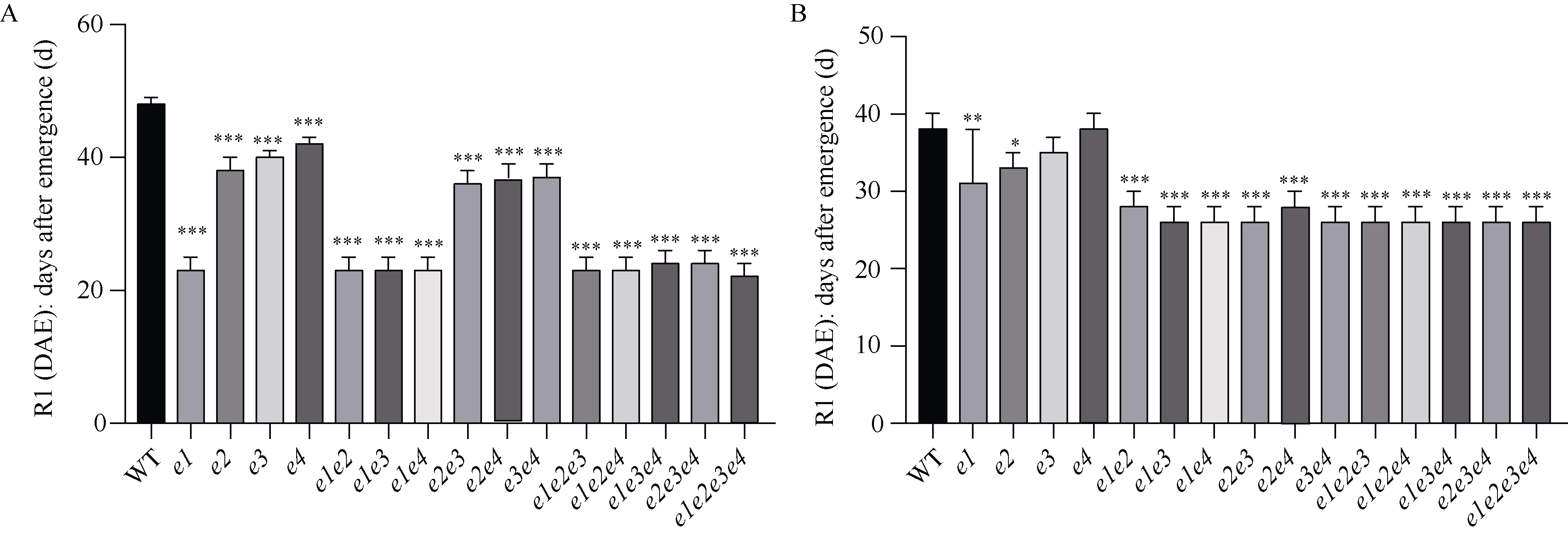
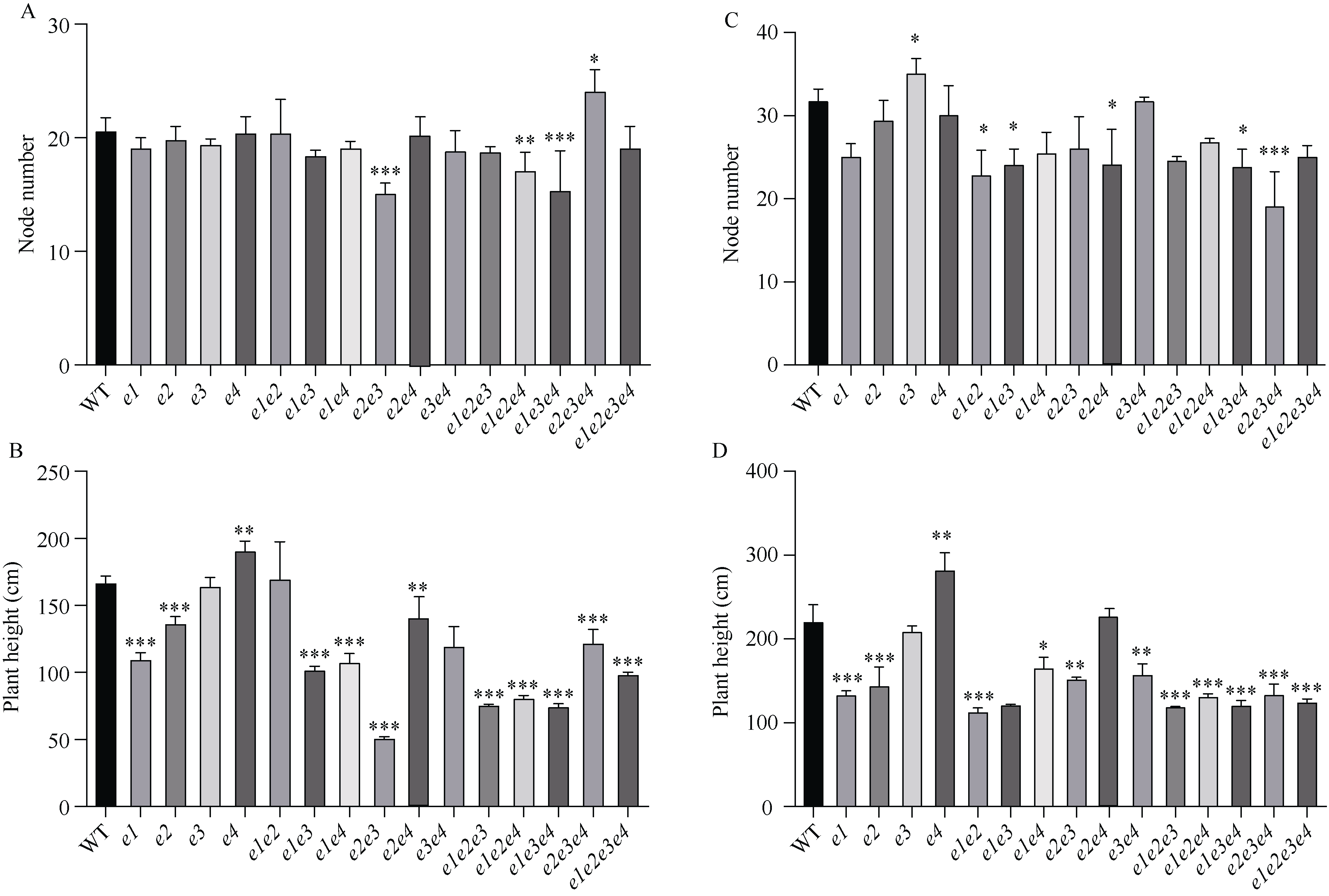
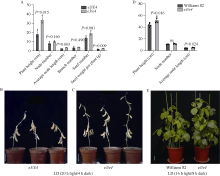
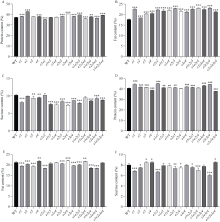
大豆作为重要的油料作物, 是人类优质蛋白和食用油的主要来源之一。大豆产量、种子品质和生育期性状密切相关, 生育期性状主要受一系列生育期相关基因的控制。本研究以Harosoy为遗传背景创制了E1~E4不同基因组合的16种近等基因系材料, 种植在河北石家庄和安徽合肥试验田, 调查了生育期、品质及产量性状, 以此来了解E1~E4不同突变组合对中纬度种植区域的适应性。研究结果表明, 16种近等基因系材料, 对光周期敏感程度不同, 开花期存在差异, WT和e4单突近等基因系由于晚花晚熟、产量低, 不适合在石家庄种植, 而所有的近等基因系在合肥种植时均能正常成熟。E1~E4不同等位基因组合还影响株高、节间距、单株产量、品质等农艺性状。本研究发现, 在长日照条件下, e3或e4单独突变可以提前开花, 同时还会使大豆产生避荫反应, 株高增高、节间距变大。测量种子的蛋白质、油分和蔗糖含量时发现, WT材料在较高纬度的石家庄地区种植时, 种子不能正常成熟, 含油量最低, 而蔗糖的含量最高。整体来看, 其余近等基因系的种子在石家庄地区种植时总油分、蔗糖含量高于合肥, 而蛋白含量总体低于合肥地区。因此, 在评估大豆品种的纬度适应性时, 需综合考察生育期基因对光周期敏感性、品质和产量的影响。
| [1] |
Cao D, Takeshima R, Zhao C, Liu B H, Jun A, Kong F J. Molecular mechanisms of flowering under long days and stem growth habit in soybean. J Exp Bot, 2017, 68: 1873-1884.
doi: 10.1093/jxb/erw394 pmid: 28338712 |
| [2] |
Lin X Y, Fang C, Liu B H, Kong F J. Natural variation and artificial selection of photoperiodic flowering genes and their applications in crop adaptation. aBIOTECH, 2021, 2: 156-169.
doi: 10.1007/s42994-021-00039-0 pmid: 36304754 |
| [3] | Destro D, Carpentieri-Pípolo V, Kiihl R A S, Almeida L A. Photoperiodism and genetic control of the long juvenile period in soybean: a review. Crop Breed Appl Biotechnol, 2001, 1: 72-92. |
| [4] | Mourtzinis S, Conley S P. Delineating soybean maturity groups across the United States. Agron J, 2017, 109: 1397-1403. |
| [5] | Jia H C, Jiang B J, Wu C X, Lu W C, Hou W S, Sun S, Yan H R, Han T F. Maturity group classification and maturity locus genotyping of early-maturing soybean varieties from high-latitude cold regions. PLoS One, 2014, 9: e94139. |
| [6] | Li J C, Wang X B, Song W W, Huang X Y, Zhou J, Zeng H Y, Sun S, Jia H C, Li W B, Zhou X N, Li S Z, Chen P Y, Wu C X, Guo Y, Han T F, Qiu L J. Genetic variation of maturity groups and four E genes in the Chinese soybean mini core collection. PLoS One, 2017, 12: e0172106. |
| [7] | Yang W Y, Wu T T, Zhang X Y, Song W W, Xu C L, Sun S, Hou W S, Jiang B J, Han T F, Wu C X. Critical photoperiod measurement of soybean genotypes in different maturity groups. Crop Sci, 2019, 59: 2055-2061. |
| [8] | Xia Z J, Watanabe S, Yamada T, Tsubokura Y, Nakashima H, Zhai H, Anai T, Sato S, Yamazaki T, Lyu S X, Wu H Y, Tabata S, Harada K. Positional cloning and characterization reveal the molecular basis for soybean maturity locus E1 that regulates photoperiodic flowering. Proc Natl Acad Sci USA, 2012, 109: E2155-E2164. |
| [9] |
Xu M L, Yamagishi N, Zhao C, Takeshima R, Kasai M, Watanabe S, Kanazawa A, Yoshikawa N, Liu B H, Yamada T, Abe J. The soybean-specific maturity gene E1 family of floral repressors controls night-break responses through down-regulation of FLOWERING LOCUS T orthologs. Plant Physiol, 2015, 168: 1735-1746.
doi: 10.1104/pp.15.00763 |
| [10] |
Watanabe S, Xia Z J, Hideshima R, Tsubokura Y, Sato S, Yamanaka N, Takahashi R, Anai T, Tabata S, Kitamura K, Harada K. A map-based cloning strategy employing a residual heterozygous line reveals that the GIGANTEA gene is involved in soybean maturity and flowering. Genetics, 2011, 188: 395-407.
doi: 10.1534/genetics.110.125062 pmid: 21406680 |
| [11] |
Watanabe S, Hideshima R, Xia Z J, Tsubokura Y, Sato S, Nakamoto Y, Yamanaka N, Takahashi R, Ishimoto M, Anai T, Tabata S, Harada K. Map-based cloning of the gene associated with the soybean maturity locus E3. Genetics, 2009, 182: 1251-1262.
doi: 10.1534/genetics.108.098772 pmid: 19474204 |
| [12] |
Liu B H, Kanazawa A, Matsumura H, Takahashi R, Harada K, Abe J. Genetic redundancy in soybean photoresponses associated with duplication of the phytochrome A gene. Genetics, 2008, 180: 995-1007.
doi: 10.1534/genetics.108.092742 pmid: 18780733 |
| [13] | Cober E R. Long juvenile soybean flowering responses under very short photoperiods. Crop Sci, 2011, 51: 140-145. |
| [14] | Cober E R, Voldeng H D. Low R: FR light quality delays flowering of E7E7 soybean lines. Crop Sci, 2001, 41: 1823-1826. |
| [15] | Cober E R, Molnar S J, Charette M, Voldeng H D. A new locus for early maturity in soybean. Crop Sci, 2010, 50: 524-527. |
| [16] | Kong F J, Nan H Y, Cao D, Li Y, Wu F F, Wang J L, Lu S J, Yuan X H, Cober E R, Abe J, Liu B H. A new dominant gene E9 conditions early flowering and maturity in soybean. Crop Sci, 2014, 54: 2529-2535. |
| [17] | Kong F J, Liu B H, Xia Z J, Sato S, Kim B M, Watanabe S, Yamada T, Tabata S, Kanazawa A, Harada K, Abe J. Two coordinately regulated homologs of FLOWERING LOCUS T are involved in the control of photoperiodic flowering in soybean. Plant Physiol, 2010, 154: 1220-1231. |
| [18] |
Samanfar B, Molnar S J, Charette M, Schoenrock A, Dehne F, Golshani A, Belzile F, Cober E R. Mapping and identification of a potential candidate gene for a novel maturity locus, E10, in soybean. Theor Appl Genet, 2017, 130: 377-390.
doi: 10.1007/s00122-016-2819-7 pmid: 27832313 |
| [19] | Lu S J, Dong L D, Fang C, Liu S L, Kong L P, Cheng Q, Chen L Y, Su T, Nan H Y, Zhang D, Zhang L, Wang Z J, Yang Y Q, Yu D Y, Liu X L, Yang Q Y, Lin X Y, Tang Y, Zhao X H, Yang X Q, Tian C G, Xie Q G, Li X, Yuan X H, Tian Z X, Liu B H, Weller J L, Kong F J. Stepwise selection on homeologous PRR genes controlling flowering and maturity during soybean domestication. Nat Genet, 2020, 52: 428-436. |
| [20] | 侯智红. 大豆高纬度适应性相关位点Tof5的克隆与功能研究. 黑龙江八一农垦大学博士学位论文,黑龙江大庆, 2022. |
| Hou Z H. Cloning and Functional Analysis of Tof5, a Locus of Soybean Adaptated to High Latitude. PhD Dissertation of Heilongjiang Bayi Agricultural University, Daqing, Heilongjiang, China, 2022 (in Chinese with English abstract). | |
| [21] |
Lu S J, Zhao X H, Hu Y L, Liu S L, Nan H Y, Li X M, Fang C, Cao D, Shi X Y, Kong L P, Su T, Zhang F G, Li S C, Wang Z, Yuan X H, Cober E R, Weller J L, Liu B H, Hou X L, Tian Z X, Kong F J. Natural variation at the soybean J locus improves adaptation to the tropics and enhances yield. Nat Genet, 2017, 49: 773-779.
doi: 10.1038/ng.3819 |
| [22] | Lu S J, Li Y, Wang J L, Srinives P, Nan H Y, Cao D, Wang Y P, Li J L, Li X M, Fang C, Shi X Y, Yuan X H, Watanabe S, Feng X Z, Liu B H, Abe J, Kong F J. QTL mapping for flowering time in different latitude in soybean. Euphytica, 2015, 206: 725-736. |
| [23] | Lin X Y, Dong L D, Tang Y, Li H Y, Cheng Q, Li H, Zhang T, Ma L X, Xiang H L, Chen L N, Nan H Y, Fang C, Lu S J, Li J G, Liu B H, Kong F J. Novel and multifaceted regulations of photoperiodic flowering by phytochrome A in soybean. Proc Natl Acad Sci USA, 2022, 119: e2208708119. |
| [24] | Li H Y, Du H P, He M L, Wang J H, Wang F, Yuan W J, Huang Z R, Cheng Q, Gou C J, Chen Z, Liu B H, Kong F J, Fang C, Zhao X H, Yu D Y. Natural variation of FKF1 controls flowering and adaptation during soybean domestication and improvement. New Phytol, 2023, 238: 1671-1684. |
| [25] | Dong L D, Cheng Q, Fang C, Kong L P, Yang H, Hou Z H, Li Y L, Nan H Y, Zhang Y H, Chen Q S, Zhang C B, Kou K, Su T, Wang L S, Li S C, Li H Y, Lin X Y, Tang Y, Zhao X H, Lu S J, Liu B H, Kong F J. Parallel selection of distinct Tof5 alleles drove the adaptation of cultivated and wild soybean to high latitudes. Mol Plant, 2022, 15: 308-321. |
| [26] | Bonato E R, Vello N A. E6, a dominant gene conditioning early flowering and maturity in soybeans. Genet Mol Biol, 1999, 22: 229-232. |
| [27] | Ray J D, Hinson K, Mankono J E B, Malo M F. Genetic control of a long-juvenile trait in soybean. Crop Sci, 1995, 35: 1001-1006. |
| [28] | Fang C, Liu J, Zhang T, Su T, Li S C, Cheng Q, Kong L P, Li X M, Bu T T, Li H Y, Dong L D, Lu S J, Kong F J, Liu B H. A recent retrotransposon insertion of J caused E6 locus facilitating soybean adaptation into low latitude. J Integr Plant Biol, 2021, 63: 995-1003. |
| [29] |
Dong L D, Fang C, Cheng Q, Su T, Kou K, Kong L P, Zhang C B, Li H Y, Hou Z H, Zhang Y H, Chen L Y, Yue L, Wang L S, Wang K, Li Y L, Gan Z R, Yuan X H, Weller J L, Lu S J, Kong F J, Liu B H. Genetic basis and adaptation trajectory of soybean from its temperate origin to tropics. Nat Commun, 2021, 12: 5445.
doi: 10.1038/s41467-021-25800-3 pmid: 34521854 |
| [30] | Fehr W R, Caviness C E, Burmood D T, Pennington J S. Stage of development descriptions for soybeans, Glycine max (L.) Merrill. Crop Sci, 1971, 11: 929-931. |
| [31] | Tsubokura Y, Watanabe S, Xia Z J, Kanamori H, Yamagata H, Kaga A, Katayose Y, Abe J, Ishimoto M, Harada K. Natural variation in the genes responsible for maturity loci E1, E2, E3 and E4 in soybean. Ann Bot, 2014, 113: 429-441. |
| [32] | Krezhova D. Soybean - Genetics and Novel Techniques for Yield Enhancement. Internet: InTechOpen, 2011. pp 51-76. |
| [33] |
Xu M L, Xu Z H, Liu B H, Kong F J, Tsubokura Y, Watanabe S, Xia Z J, Harada K, Kanazawa A, Yamada T, Abe J. Genetic variation in four maturity genes affects photoperiod insensitivity and PHYA-regulated post-flowering responses of soybean. BMC Plant Biol, 2013, 13: 91.
doi: 10.1186/1471-2229-13-91 pmid: 23799885 |
| [34] | Tsubokura Y, Matsumura H, Xu M L, Liu B H, Nakashima H, Anai T, Kong F J, Yuan X H, Kanamori H, Katayose Y, Takahashi R, Harada K, Abe J. Genetic variation in soybean at the maturity locus E4 Is involved in adaptation to long days at high latitudes. Agronomy, 2013, 3: 117-134. |
| [35] | Abe J, Xu D H, Miyano A, Komatsu K, Kanazawa A, Shimamoto Y. Photoperiod-insensitive Japanese soybean landraces differ at two maturity loci. Crop Sci, 2003, 43: 1300-1304. |
| [36] |
Liu B H, Abe J. QTL mapping for photoperiod insensitivity of a Japanese soybean landrace Sakamotowase. J Hered, 2010, 101: 251-256.
doi: 10.1093/jhered/esp113 pmid: 19959597 |
| [37] | Cober E R, Tanner J W, Voldeng H D. Genetic control of photoperiod response in early-maturing, near-isogenic soybean lines. Crop Sci, 1996, 36: 601-605. |
| [38] |
Cober E R, Morrison M J. Regulation of seed yield and agronomic characters by photoperiod sensitivity and growth habit genes in soybean. Theor Appl Genet, 2010, 120: 1005-1012.
doi: 10.1007/s00122-009-1228-6 pmid: 20012856 |
| [39] |
Fang C, Ma Y M, Wu S W, Liu Z, Wang Z, Yang R, Hu G H, Zhou Z K, Yu H, Zhang M, Pan Y, Zhou G A, Ren H X, Du W G, Yan H R, Wang Y P, Han D Z, Shen Y T, Liu S L, Liu T F, Zhang J X, Qin H, Yuan J, Yuan X H, Kong F J, Liu B H, Li J Y, Zhang Z W, Wang G D, Zhu B G, Tian Z X. Genome-wide association studies dissect the genetic networks underlying agronomical traits in soybean. Genome Biol, 2017, 18: 161.
doi: 10.1186/s13059-017-1289-9 pmid: 28838319 |
| [40] | Wan Z, Liu Y X, Guo D D, Fan R, Liu Y, Xu K, Zhu J L, Quan L, Lu W T, Bai X, Zhai H. CRISPR/Cas9-mediated targeted mutation of the E1 decreases photoperiod sensitivity, alters stem growth habits, and decreases branch number in soybean. Front Plant Sci, 2022, 13: 1066820. |
| [41] | Carrera C, Martínez M J, Dardanelli J, Balzarini M. Environmental variation and correlation of seed components in nontransgenic soybeans: protein, oil, unsaturated fatty acids, tocopherols, and isoflavones. Crop Sci, 2011, 51: 800-809. |
| [42] | Song W W, Yang R P, Wu T T, Wu C X, Sun S, Zhang S W, Jiang B J, Tian S Y, Liu X B, Han T F. Analyzing the effects of climate factors on soybean protein, oil contents, and composition by extensive and high-density sampling in China. J Agric Food Chem, 2016, 64: 4121-4130. |
| [43] |
Song W W, Yang R P, Yang X S, Sun S, Mentreddy S R, Jiang B J, Wu T T, Tian S Y, Sapey E, Wu C X, Hou W S, Ren G X, Han T F. Spatial differences in soybean bioactive components across China and their influence by weather factors. Crop J, 2018, 6: 659-668.
doi: 10.1016/j.cj.2018.05.001 |
| [1] | 翟胜男, 曹新有, 李豪圣, 李吉虎, 李法计, 刘金栋, 夏先春, 吕莹莹, 马瑞峰, 王颖, 耿洪伟, 刘建军. 小麦Pod-A1、Pod-D1和Pod-2D位点等位变异对籽粒过氧化物酶活性的遗传效应分析[J]. 作物学报, 2026, 52(6): 1593-1603. |
| [2] | 胡川, 赵凯男, 黄修利, 吴金芝, 任开明, 王贺正, 付国占, 黄明, 李友军. 一次灌溉下耕作方式和氮肥用量对旱地小麦产量和品质的影响[J]. 作物学报, 2026, 52(6): 1830-1846. |
| [3] | 习千辉, 徐梓瑗, 刘梦梦, 王宏艺, 郎凯琳, 井震海, 陈锋, 赵磊. 小麦籽粒铜含量的全基因组关联分析及候选基因预测[J]. 作物学报, 2026, 52(6): 1604-1617. |
| [4] | 金昱何, 王雪菲, 徐张一娃, 缪怡宁, 蒋云杰, 伊莹, 缪德麟, 朱静仪, 钟一帆, 陈铭亨, 方芳, 刘鹏. 外源激素对低温胁迫下大豆叶片叶绿素荧光参数及抗氧化酶系统的影响[J]. 作物学报, 2026, 52(6): 1817-1829. |
| [5] | 马胜乾, 王志平, 陈浩天, 窦淑贤, 张燕, 邓艾兴, 张卫建, 原向阳, 宋振伟. 秸秆还田下耕作方式与氮肥施用量对东北玉米产量及土壤团聚体的影响[J]. 作物学报, 2026, 52(6): 1802-1816. |
| [6] | 唐宽强, 李公允, 宋美毅, 赵雪, 常春玲. 大豆株高性状全基因组关联分析及预测模型构建[J]. 作物学报, 2026, 52(6): 1743-1756. |
| [7] | 王壮壮, 武紫君, 张永新, 张芯源, 袁丽雪, 陈如雪, 刘世举, 段剑钊, 冯伟, 王同朝, 王永华. 豫东南黏壤潮土区水氮优化协同提高冬小麦产量和氮素利用效率[J]. 作物学报, 2026, 52(5): 1501-1521. |
| [8] | 张思思, 赵向辉, 周洋, 姚云凤, 朱荣昱, 董元杰, 胡国庆, 徐通, 刘兆新. 冬闲期翻耕和绿肥还田对连作花生田土壤理化性质和产量的影响[J]. 作物学报, 2026, 52(5): 1472-1486. |
| [9] | 姚术, 郭凯悦, 翟慧慧, 姚佳慧, 邓文琪, 闫玲, 黄驰, 高阳, 俞嫣然, 赵振邦, 李英慧, 王晓波, 李佳佳. 大豆苗期耐低铁综合评价及优异种质筛选[J]. 作物学报, 2026, 52(5): 1373-1387. |
| [10] | 张宁宁, 滕雨菲, 任娜娜, 魏兴卓, 闫书豪, 樊可心, 王永宏, 陈文康, 张兴华, 朱万超, 徐淑兔, 薛吉全. 201份玉米自交系抗旱表型评价及可塑性分析[J]. 作物学报, 2026, 52(5): 1309-1325. |
| [11] | 刘昕萌, 任昊, 张继波, 张吉旺, 赵斌, 任佰朝, 刘鹏, 王洪章. 茉莉酸甲酯(MeJA)缓解高温影响玉米雌穗分化的生理机制[J]. 作物学报, 2026, 52(5): 1561-1572. |
| [12] | 张振, 冯连杰, 石玉, 于振文, 张永丽. 节水补灌下不同穗型小麦产量形成差异研究[J]. 作物学报, 2026, 52(5): 1522-1535. |
| [13] | 闫安, 蒋昆炜, 王蓉圆, 田林, 张璐, 王韵, 徐建龙. 水稻剑叶小维管束数基因SVN7的鉴定与克隆[J]. 作物学报, 2026, 52(5): 1364-1372. |
| [14] | 张鸿蓉, 王菲儿, 李盼, 仇海龙, 朱静, 赵连豪, 南运有, 何蔚, 樊志龙, 胡发龙, 柴强, 殷文. 减量20%灌水与25%有机肥替代化肥提高青贮玉米产量的光合特性[J]. 作物学报, 2026, 52(5): 1487-1500. |
| [15] | 王宇诚, 张露, 刘阿康, 黄见良, 彭少兵, 袁珅. 基于产量差的作物大面积单产提升策略与展望[J]. 作物学报, 2026, 52(5): 1279-1290. |
|
||