欢迎访问作物学报,今天是
作物学报 ›› 2025, Vol. 51 ›› Issue (10): 2750-2758.doi: 10.3724/SP.J.1006.2025.54031
丁楚蔚1( ), 吕永平1(), 汪一婷1,2, 毛玲荣3, 牟豪杰1, 李海营1, 陈剑平1,2,4, 陈志1,*()
DING Chu-Wei1(), LYU Yong-Ping1(), WANG Yi-Ting1,2, MAO Ling-Rong3, MOU Hao-Jie1, LI Hai-Ying1, CHEN Jian-Ping1,2,4, CHEN Zhi1,*()
摘要:
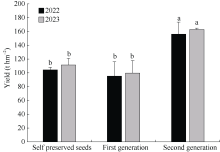
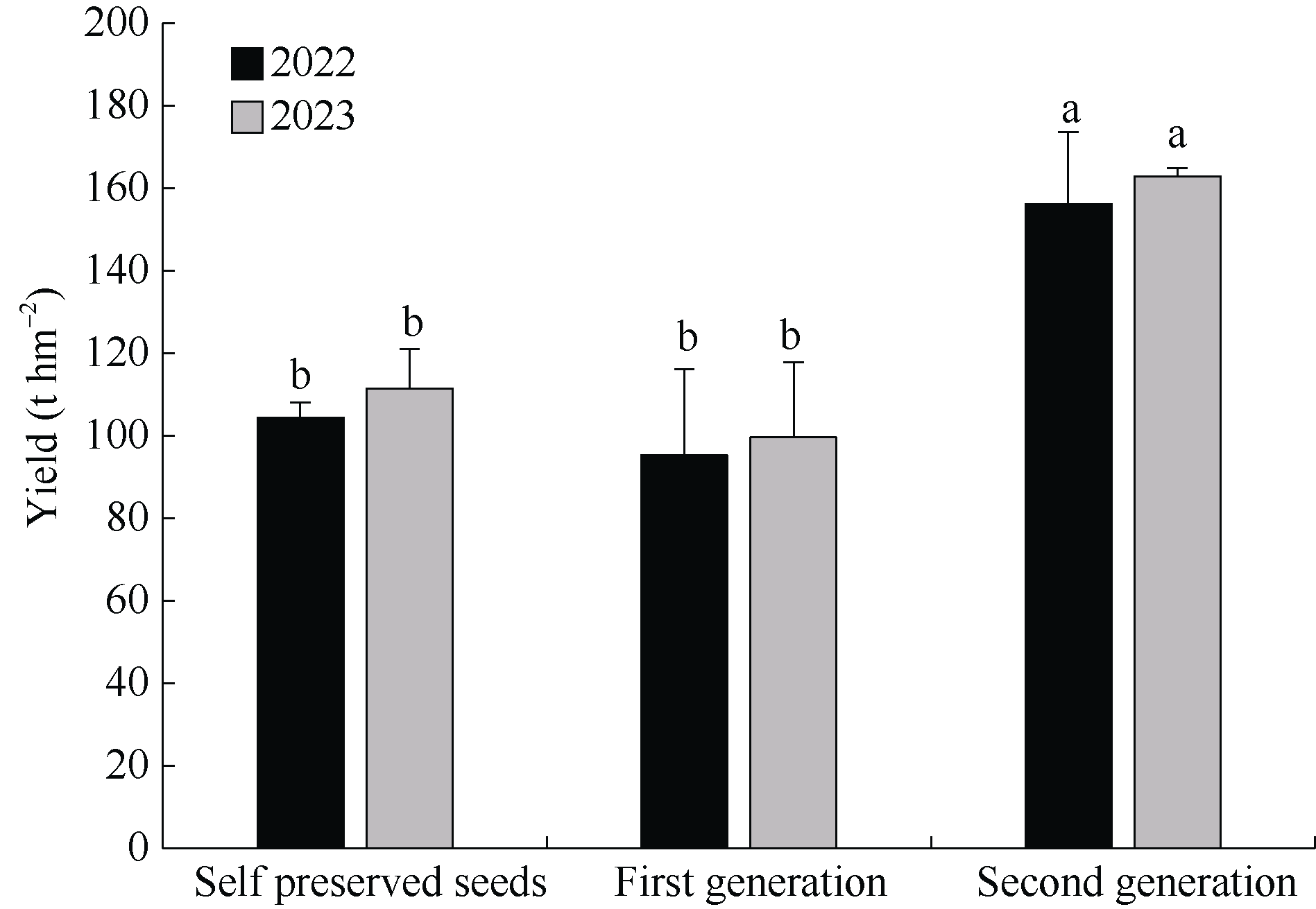
为探究脱病毒种苗对果蔗的影响, 本研究以广东黄皮果蔗为试验材料, 进行了自留种、脱毒一代、脱毒二代果蔗种苗的田间性状和果汁品质的比较研究。结果表明, 3种材料中, 脱毒二代果蔗的田间生长状态最佳, 与自留种和脱毒一代相比, 其地上株高分别提高9.08%、5.80% (其中可食部分高度分别提高13.64%、7.19%), 茎粗分别提高13.98%、9.71%, 产量分别提高47.76%、63.72% (达到159.5 t hm-2), 出汁率分别提高3.64%、9.17%, 蔗汁的总糖含量分别下降10.14%、12.73%; 脱毒对果蔗蔗汁的密度、锤度和纤维含量无显著影响; 脱毒苗第一代果蔗与自留种的产量和蔗汁品质无显著差异, 脱毒组培苗作为第一代种苗可用于繁育脱毒果蔗种茎, 3—4月份适宜移栽。因此, 相对于一代组培苗, 采用脱毒第二代种苗(脱毒第一代种苗种植收获的果蔗种茎)进行商品蔗种植效果更好, 可促进果蔗田间生长, 显著提高果蔗的产量。
| [1] | Tripathy S K, Ithape D M. High-throughput in vitro culture system targeting genetic transformation in sugarcane. J Crop Sci Biotechnol, 2020, 23: 325-335. |
| [2] | 王敬湧, 谢洒洒, 盖倞尧, 王梓廷. 花叶病胁迫下甘蔗叶片叶绿素含量的高光谱预测模型. 光谱学与光谱分析, 2023, 43: 2885-2893. |
| Wang J Y, Xie S S, Gai J Y, Wang Z T. Hyperspectral prediction model of chlorophyll content in sugarcane leaves under stress of mosaic. Spectrosc Spectr Analy, 2023, 43: 2885-2893 (in Chinese with English abstract). | |
| [3] | Kamat D N, Krushalini J S, Singh R. Assessment of regenerative response of early sugarcane varieties under in vitro condition. Int J Environ Clim Change, 2023, 13: 625-631. |
| [4] | Lin X R, Yang D, Zhu Y, Qin Y L, Liang T, Yang S D, Tan H W. Changes in root metabolites and soil microbial community structures in rhizospheres of sugarcanes under different propagation methods. Microb Biotechnol, 2024, 17: e14372. |
| [5] | 钱永兰, 匡昭敏, 赵晓凤, 张艳红, 何延波, 李祎君, 王纯枝. 世界甘蔗种植及蔗糖生产流通演变. 甘蔗糖业, 2024, 53(2): 68-81. |
| Qian Y L, Kuang Z M, Zhao X F, Zhang Y H, He Y B, Li Y J, Wang C Z. Evolution of global sugarcane planting and cane sugar production and circulation. Sugar Canesugar, 2024, 53(2): 68-81 (in Chinese with English abstract). | |
| [6] | 张跃彬, 赵培方, 胡朝晖, 阙友雄. 近年我国甘蔗品种的育种成就与发展趋势. 中国糖料, 2024, 46(1): 87-92. |
| Zhang Y B, Zhao P F, Hu Z H, Que Y X. The recent achievements and development trends of sugarcane improvement in China. Sugar Crops China, 2024, 46(1): 87-92 (in Chinese with English abstract). | |
| [7] | 肖祎, 吕达, 陈道德. 我国果蔗研究新进展. 中国糖料, 2018, 40(1): 62-67. |
| Xiao Y, Lyu D, Chen D D. The latest research progress of chewing-cane in China. Sugar Crops China, 2018, 40(1): 62-67 (in Chinese with English abstract). | |
| [8] | 李鸿博, 严卓晟, 邓权清, 颜静婷, 吴佳, 钟坚文, 沈万宽. 超声波处理对果蔗产量品质及生理特性的影响. 华中农业大学学报, 2019, 38(3): 7-12. |
| Li H B, Yan Z S, Deng Q Q, Yan J T, Wu J, Zhong J W, Shen W K. Effects of ultrasonic treatment on yield, quality and physiological characteristics of chewing cane. J Huazhong Agric Univ, 2019, 38(3): 7-12 (in Chinese with English abstract). | |
| [9] | 张莉娟, 吴凤, 李今朝, 罗义灿, 单彬, 林垠孚. 中国糖料蔗和果蔗品种发展历史. 农业研究与应用, 2023, 36(6): 79-86. |
| Zhang L J, Wu F, Li J Z, Luo Y C, Shan B, Lin Y F. Development history of industrial cane and chewing cane varieties in China. J Agric Res Appl, 2023, 36(6): 79-86 (in Chinese with English abstract). | |
| [10] | 周慧文, 范业赓, 黄杏, 陈荣发, 杨柳, 卢星高, 吴建明, 丘立杭, 李杨瑞. 甘蔗健康种苗原苗提前移栽对田间繁育的影响. 中国糖料, 2019, 41(3): 23-27. |
| Zhou H W, Fan Y G, Huang X, Chen R F, Yang L, Lu X G, Wu J M, Qiu L H, Li Y R. Effects of early transplanting on the growth and developments of virus-free sugarcane seedlings. Sugar Crops China, 2019, 41(3): 23-27 (in Chinese with English abstract). | |
| [11] | Yang D, Lin X R, Wei Y F, Li Z J, Zhang H D, Liang T, Yang S D, Tan H W. Can endophytic microbial compositions in cane roots be shaped by different propagation methods. PLoS One, 2023, 18: e0290167. |
| [12] | Tayade A S, Geetha P, Anusha S. Standardizing planting agro- techniques for sugarcane tissue culture plantlets and bud chip settlings. Sugar Tech, 2021, 23: 1097-1104. |
| [13] | Lu J J, Ali A, He E Q, Yan G Q, Arak T U, Gao S J. Establishment of an open, sugar-free tissue culture system for sugarcane micropropagation. Sugar Tech, 2020, 22: 8-14. |
| [14] | Wang K L, Deng Q Q, Chen J W, Shen W K. Physiological and molecular mechanisms governing the effect of virus-free chewing cane seedlings on yield and quality. Sci Rep, 2020, 10: 10306. |
| [15] | Saptari R T, Aksa A A, Riyadi I, Prasetyo M E R B, Lindawati S, Setiawati Y, Minarsih H, Sinta M M, Sumaryono S. Genetic stability analysis of the temporary immersion bioreactors-derived sugarcane seedlings with simple sequence repeat (SSR) markers. Plant Cell Tissue Organ Cult, 2023, 156: 22. |
| [16] | Abide M, Kidanemariam D, Yimam T, Worku Y, Kebede M, Abraham A. Protocol optimization for elimination of sugarcane bacilliform virus and rapid propagation of virus-free sugarcane using meristem tip culture. Trop Plant Pathol, 2022, 47: 693-697. |
| [17] | Salokhe S. Development of an efficient protocol for tissue culture of sugarcane. Plant Cell Biotechnol Mol Biol, 2021, 22: 9-21. |
| [18] | 林丽丽. “黄皮果蔗”脱毒苗配套栽培技术. 福建热作科技, 2024, 49(2): 34-36. |
| Lin L L. Healthy virus-free seedling and its cultivation technology of “yellow peel chewing cane”. Fujian Sci Technol Trop Crops, 2024, 49(2): 34-36 (in Chinese with English abstract). | |
| [19] | 吴转娣, 赵培方, 杨洪昌, 昝逢刚, 覃伟, 杨立凡, 郭家文. 高糖新品种云蔗1640花叶病原的检测与脱毒种苗生产. 中国糖料, 2024, 46(2): 1-8. |
| Wu Z D, Zhao P F, Yang H C, Zan F G, Qin W, Yang L F, Guo J W.Detection of mosaic disease and propagation of virus-free seedlings for high sugar new sugarcane variety Yunzhe 1640. Sugar Crops China, 2024, 46(2): 1-8 (in Chinese with English abstract). | |
| [20] | 周慧文, 覃兴云, 陈荣发, 范业赓, 韦素, 闫海锋, 丘立杭, 吴建明, 李杨瑞. 甘蔗健康种苗一代种茎生产力分析. 广西糖业, 2021, (3): 15-19. |
| Zhou H W, Qin X Y, Chen R F, Fan Y G, Wei S, Yan H F, Qiu L H, Wu J M, Li Y R. Study on production performance of first generation stem of sugarcane virus-free plantlets. Guangxi Sugar Ind, 2021, (3): 15-19 (in Chinese with English abstract). | |
| [21] | 劳方业, 何慧怡, 樊丽娜, 陈勇生, 黄俊坚, 齐永文. 果蔗脱毒种苗主要经济性状表现分析. 甘蔗糖业, 2021, 50(3): 37-42. |
| Lao F Y, He H Y, Fan L N, Chen Y S, Huang J J, Qi Y W. Analysis of the main economic characters of chewing cane virus-free seedlings. Sugar Canesugar, 2021, 50(3): 37-42 (in Chinese with English abstract). | |
| [22] | 刘红坚, 梁文燊, 何为中, 叶权, 刘丽敏, 何毅波, 卢曼曼, 刘俊仙, 李松, 林善海. 桂果蔗1号不同级数健康种苗生长特征及性状变异. 南方农业学报, 2021, 52(2): 288-296. |
| Liu H J, Liang W S, He W Z, Ye Q, Liu L M, He Y B, Lu M M, Liu J X, Li S, Lin S H. Growth characters and properties variation of different generations of chewing cane Guiguozhe 1 seedlings. J South Agric, 2021, 52(2): 288-296 (in Chinese with English abstract). | |
| [23] | Snyman S J, Shezi S N, Ramburan S. Field assessment of in vitro micropropagated NovaCane sugarcane (Saccharum spp. hybrids). Sugar Tech, 2018, 20: 609-612. |
| [24] | Shezi S N, Ramburan S. Agronomic comparisons of sugarcane varieties derived from tissue culture (NovaCane) and conventional propagation under rainfed conditions. J Crop Improv, 2018, 32: 705-716. |
| [25] | 陆耀邦. 组培蔗在无性世代中农艺性状表现. 广西农学院学报, 1989, 8(3): 8-12. |
| Lu Y B. The expression of main agronomical characters in callus derived sugarcane in agamobiums. Genom Appl Biol, 1989, 8(3): 8-12 (in Chinese with English abstract). | |
| [26] | 陈引芝. 甘蔗腋芽组培苗与原种茎性能比较试验简报. 广西农学报, 1997, 12(2): 5-8. |
| Chen Y Z. A brief report on the comparision experiment between the characteristics of the tissue culture seedling of sugarcane axillary and the original sugarcane stem. J Guanxi Agric, 1997, 12(2): 5-8 (in Chinese with English abstract). | |
| [27] | 杨华春. 甘蔗芽培苗、组培苗和种茎苗的种性比较. 甘蔗, 2001, (4): 30-31. |
| Yang C H. Comparison of seed characteristics among sugarcane sprouts, tissue culture seedlings, and stem seedlings. Sugarcane, 2001, (4): 30-31 (in Chinese). | |
| [28] | 李松, 游建华, 余坤兴, 刘丽敏, 谭芳, 刘红坚, 淡明, 戴友铭. 黑皮果蔗茎尖脱毒不同代数种茎苗商品性能研究. 热带作物学报, 2010, 31(2): 176-181. |
| Li S, You J H, Yu K X, Liu L M, Tan F, Liu H J, Dan M, Dai Y M. Commercial performances of seedcanes in different generations of virus-free chewing cane (badila) from shoot apices. Chin J Trop Crops, 2010, 31(2): 176-181 (in Chinese with English abstract). | |
| [29] | 韦海球, 唐利球, 黄珍玲, 何洪良, 秦昌鲜, 江清梅, 罗晟昇. 甘蔗组培苗田间种植效果初探. 中国热带农业, 2017, (4): 63-64. |
| Wei H Q, Tang L Q, Huang Z L, He H L, Qin C X, Jiang Q M, Luo S S. Preliminary study on field planting effect of sugarcane tissue culture seedlings. China Trop Agric, 2017, (4): 63-64 (in Chinese). | |
| [30] | 欧丽萍. 新台糖22号脱毒苗在百色蔗区快繁试验初报. 广西蔗糖, 2013, (1): 3-7. |
| Ou L P. A primary study on the rapid breeding experiment of the “new-tai sugar NO.22” virus-free seeding in baise sugarcane area. Guangxi Sugar Ind, 2013, (1): 3-7 (in Chinese with English abstract). | |
| [31] | 宿翠翠, 毋玲玲, 赵玺, 施志国, 周彦芳, 魏玉杰. 种植时间对甘肃引黄灌区红花生长发育、品质及产量的影响. 作物杂志, 2023, (1): 176-183. |
| Su C C, Wu L L, Zhao X, Shi Z G, Zhou Y F, Wei Y J. Effects of sowing date on the growth, quality and yield of safflower in Gansu yellow river irrigation area. Crops, 2023, (1): 176-183 (in Chinese with English abstract). | |
| [32] | 杨本鹏, 张树珍, 蔡文伟, 张洪溢, 龚康达, 王永壮, 冯翠莲, 王俊刚, 杨学. 甘蔗健康种苗田间栽培主要农艺性状比较. 热带作物学报, 2010, 31(2): 171-175. |
| Yang B P, Zhang S Z, Cai W W, Zhang H Y, Gong K D, Wang Y Z, Feng C L, Wang J G, Yang X. Agronomic characters of virus-free sugarcane seedlings. Chin J Trop Crops, 2010, 31(2): 171-175 (in Chinese with English abstract). | |
| [33] | 符策, 赵静. 甘蔗组培苗不同假植时期移栽效果比较. 农业研究与应用, 2014, 27(1): 21-23. |
| Fu C, Zhao J. Comparison of transplanting effects of sugarcane tissue culture seedlings in different heel in periods. Agric Res Appl, 2014, 27(1): 21-23 (in Chinese). | |
| [34] | Devarumath R M, Doule R B, Kawar P G, Naikebawane S B, Nerkar Y S. Field performance and RAPD analysis to evaluate genetic fidelity of tissue culture raised plantsvis-à-vis conventional setts derived plants of sugarcane. Sugar Tech, 2007, 9: 17-22. |
| [35] | 吴松海, 李海明, 郑家祯, 林加根, 林一心. 不同代数黑皮果蔗脱毒种茎苗生产性状比较. 福建农业学报, 2014, 29: 1088-1091. |
| Wu S H, Li H M, Zheng J Z, Lin J G, Lin Y X. Comparing growth characters of detoxified seedling in different generations of chewing-cane ‘badila'. Fujian J Agric Sci, 2014, 29: 1088-1091 (in Chinese with English abstract). | |
| [36] | 李恒锐. 甘蔗脱毒与非脱毒种苗田间比较试验. 中国糖料, 2014, 36(1): 42-43. |
| Li H R. Comparative trial between virus-free and non-virus free sugarcane seedling. Sugar Crops China, 2014, 36(1): 42-43 (in Chinese with English abstract). | |
| [37] | 叶燕平, 李杨瑞, 苏俊波, 黄诚梅, 唐军, 黄学. 果蔗脱毒健康种苗试验初报. 作物杂志, 2003, (6): 21-22. |
| Ye Y P, Li Y R, Su J B, Huang C M, Tang J, Huang X. Preliminary report on the experiment of virus-free healthy seedlings of fruit cane. Crops, 2003, (6): 21-22 (in Chinese with English abstract). | |
| [38] | 陈月桂, 谭嘉娜, 罗剑飘, 罗青文, 谢静, 杨俊贤, 李奇伟. 粤糖60号与新台糖22号健康种苗假植与田间对比试验. 广东农业科学, 2014, 41(18): 24-27. |
| Chen Y G, Tan J N, Luo J P, Luo Q W, Xie J, Yang J X, Li Q W.Temporary planting and field contrast experiments for sugarcane healthy seedings of Yuetang 60 and Roc 22. Guangdong Agric Sci, 2014, 41(18): 24-27 (in Chinese with English abstract). | |
| [39] | 邓万超, 胡朝仁, 陆丽英. 宁明县新台糖22号脱毒健康种苗田间试验初报. 广西糖业, 2015, 35(5): 11-14. |
| Deng W C, Hu C R, Lu L Y. Report on the field test of virus-free ROC22 seedlings in Ningming. Guangxi Sugar Ind, 2015, 35(5): 11-14 (in Chinese with English abstract). | |
| [40] | 谢静, 常海龙, 刘壮, 张垂明, 王勤南, 吴建涛. 果蔗脱毒种茎苗对农艺性状和品质的影响. 分子植物育种, 网络首发[2024-06-04],http://kns.cnki.net/kcms/detail/46.1068.S.20240604.1032.008.html. |
| Xie J, Chang H L, Liu Z, Zhang C M, Wang Q N, Wu J T. Effects of virus-free seedling of chewing cane on agronomic traits and quality. Mol Plant Breed, Published online [2024-06-04], http://kns.cnki.net/kcms/detail/46.1068.S.20240604.1032.008.html (in Chinese with English abstract). | |
| [41] | 邓展云, 刘海斌, 方锋学, 贤武, 唐仕云, 王伦旺, 刘晓静, 李鸣, 陆建勋, 徐林. 几个甘蔗新品种的健康种苗对比试验. 中国糖料, 2010, 32(4): 19-20. |
| Deng Z Y, Liu H B, Fang F X, Xian W, Tang S Y, Wang L W, Liu X J, Li M, Lu J X, Xu L. Comparison test of healthy seedcane on new sugarcane varieties. Sugar Crops China, 2010, 32(4): 19-20 (in Chinese with English abstract). | |
| [42] | 吴松海, 李海明, 张树河, 李瑞美, 林一心. 果蔗脱毒与常规种茎苗生产性状比较. 福建农业学报, 2012, 27: 821-825. |
| Wu S H, Li H M, Zhang S H, Li R M, Lin Y X. Growth differences between seedcanes of pathogen-free chewing and conventional sugarcanes. Fujian J Agric Sci, 2012, 27: 821-825 (in Chinese with English abstract). | |
| [43] | 李复琴, 李文风, 杨华. 关于还原糖作为甘蔗品种选育重要指标的探讨. 中国糖料, 2009, 31(2): 43-44. |
| Li F Q, Li W F, Yang H. Discussion on reducing sugar as important standard in sugarcane breeding. Sugar Crops China, 2009, 31(2): 43-44 (in Chinese with English abstract). |
| [1] | 胡川, 赵凯男, 黄修利, 吴金芝, 任开明, 王贺正, 付国占, 黄明, 李友军. 一次灌溉下耕作方式和氮肥用量对旱地小麦产量和品质的影响[J]. 作物学报, 2026, 52(6): 1830-1846. |
| [2] | 马胜乾, 王志平, 陈浩天, 窦淑贤, 张燕, 邓艾兴, 张卫建, 原向阳, 宋振伟. 秸秆还田下耕作方式与氮肥施用量对东北玉米产量及土壤团聚体的影响[J]. 作物学报, 2026, 52(6): 1802-1816. |
| [3] | 张思思, 赵向辉, 周洋, 姚云凤, 朱荣昱, 董元杰, 胡国庆, 徐通, 刘兆新. 冬闲期翻耕和绿肥还田对连作花生田土壤理化性质和产量的影响[J]. 作物学报, 2026, 52(5): 1472-1486. |
| [4] | 张宁宁, 滕雨菲, 任娜娜, 魏兴卓, 闫书豪, 樊可心, 王永宏, 陈文康, 张兴华, 朱万超, 徐淑兔, 薛吉全. 201份玉米自交系抗旱表型评价及可塑性分析[J]. 作物学报, 2026, 52(5): 1309-1325. |
| [5] | 王宇诚, 张露, 刘阿康, 黄见良, 彭少兵, 袁珅. 基于产量差的作物大面积单产提升策略与展望[J]. 作物学报, 2026, 52(5): 1279-1290. |
| [6] | 赵佳雪, 周龙昊, 郭岂源, 尚伦霄, 王涵, 刘志涛, 陈曦, 张晓佩, 宋宪亮, 毛丽丽. 长期秸秆还田与深松通过改善土壤环境与棉花光合特性提高滨海盐碱地棉花产量[J]. 作物学报, 2026, 52(5): 1548-1560. |
| [7] | 郭星宇, 胡丹, 林苏期, 王梦凯, 谭文峰, 黄传琴. 生物炭配施化肥提高玉米‖大豆下玉米产量和土壤生态系统多功能性[J]. 作物学报, 2026, 52(5): 1536-1547. |
| [8] | 张振, 冯连杰, 石玉, 于振文, 张永丽. 节水补灌下不同穗型小麦产量形成差异研究[J]. 作物学报, 2026, 52(5): 1522-1535. |
| [9] | 闫安, 蒋昆炜, 王蓉圆, 田林, 张璐, 王韵, 徐建龙. 水稻剑叶小维管束数基因SVN7的鉴定与克隆[J]. 作物学报, 2026, 52(5): 1364-1372. |
| [10] | 刘昕萌, 任昊, 张继波, 张吉旺, 赵斌, 任佰朝, 刘鹏, 王洪章. 茉莉酸甲酯(MeJA)缓解高温影响玉米雌穗分化的生理机制[J]. 作物学报, 2026, 52(5): 1561-1572. |
| [11] | 王壮壮, 武紫君, 张永新, 张芯源, 袁丽雪, 陈如雪, 刘世举, 段剑钊, 冯伟, 王同朝, 王永华. 豫东南黏壤潮土区水氮优化协同提高冬小麦产量和氮素利用效率[J]. 作物学报, 2026, 52(5): 1501-1521. |
| [12] | 张鸿蓉, 王菲儿, 李盼, 仇海龙, 朱静, 赵连豪, 南运有, 何蔚, 樊志龙, 胡发龙, 柴强, 殷文. 减量20%灌水与25%有机肥替代化肥提高青贮玉米产量的光合特性[J]. 作物学报, 2026, 52(5): 1487-1500. |
| [13] | 蔡宏玮, 于爱忠, 姜科强, 王鹏飞, 王玉珑, 霍建喆, 庞小能, 尹波, 尚永盼. 干旱灌区有机肥替代部分化肥促进甜玉米产量提升的关键机制[J]. 作物学报, 2026, 52(4): 1166-1180. |
| [14] | 崔雪梅, 柳妍娣, 刘景辉, 米俊珍, 武俊英, 赵宝平. 不同基因型燕麦强弱势粒生理特性与产量关系研究[J]. 作物学报, 2026, 52(4): 1220-1235. |
| [15] | 杨锐, 陈敬东, 黄郢, 张学昆, 周登文, 刘清云, 徐劲松, 谢伶俐, 许本波. 长江下游冬油菜区应对气候变化的育种和栽培策略研究[J]. 作物学报, 2026, 52(4): 1153-1165. |
|
||